November 4, 2026
Updated: November 4, 2026
The 2025 list, what changed from 2021, a dated example for every category, and how to test and prevent each risk.

Mohammed Khalil
The OWASP Top 10 2025 is the current edition of OWASP's awareness list of the most critical web application security risks. In order, the ten categories are A01 Broken Access Control, A02 Security Misconfiguration, A03 Software Supply Chain Failures, A04 Cryptographic Failures, A05 Injection, A06 Insecure Design, A07 Authentication Failures, A08 Software or Data Integrity Failures, A09 Security Logging and Alerting Failures, and A10 Mishandling of Exceptional Conditions. Compared with the 2021 list, two categories are new, SSRF was merged into Broken Access Control, and Security Misconfiguration jumped from fifth to second.
Later sections cover each category in the same way: a short definition, a dated real-world CVE or incident, how a penetration tester checks for it in an authorized engagement, and the controls that prevent it.
| ID | Category | Change from 2021 | In one sentence |
|---|---|---|---|
| A01:2025 | Broken Access Control | Still #1; SSRF merged in | Users or the server reach data and functions they should not |
| A02:2025 | Security Misconfiguration | Up from #5 | Insecure defaults, settings, permissions or exposed features |
| A03:2025 | Software Supply Chain Failures | New; expands A06:2021 | Compromised or vulnerable dependencies, builds or distribution |
| A04:2025 | Cryptographic Failures | Down from #2 | Missing, weak or misused cryptography and key handling |
| A05:2025 | Injection | Down from #3 | Untrusted input is executed as code, a query or a command |
| A06:2025 | Insecure Design | Down from #4 | Flaws in architecture or business logic that code fixes cannot cure |
| A07:2025 | Authentication Failures | Still #7; renamed | Identity is not proven, or sessions are not protected |
| A08:2025 | Software or Data Integrity Failures | Still #8; renamed | Code, updates or data are trusted without integrity checks |
| A09:2025 | Security Logging and Alerting Failures | Still #9; renamed | Attacks are not logged, or nobody is alerted |
| A10:2025 | Mishandling of Exceptional Conditions | New | Errors and abnormal states leak data or fail open |
OWASP's own pages write A09 as "Security Logging & Alerting Failures"; the meaning is identical.
The OWASP Top 10 is a free awareness document published by the OWASP Foundation, a nonprofit that is not affiliated with any technology company. It represents a broad consensus about the most critical security risks to web applications and is meant to start conversations, training and testing programs, not to be a complete list of every possible weakness.
The list was first published in 2003, and the 2025 release is the eighth installment. OWASP's project page now lists 2025 as the current version, and the official repository on GitHub marks the 2025 edition as released and the 2021 edition as superseded. The release was planned for OWASP's Global AppSec USA conference in Washington, D.C., in November 2025.
Three facts about how the 2025 list was built matter when you read it:
The OWASP introduction to the 2025 edition documents the full methodology, including how CVE exploit and impact scores were weighted.
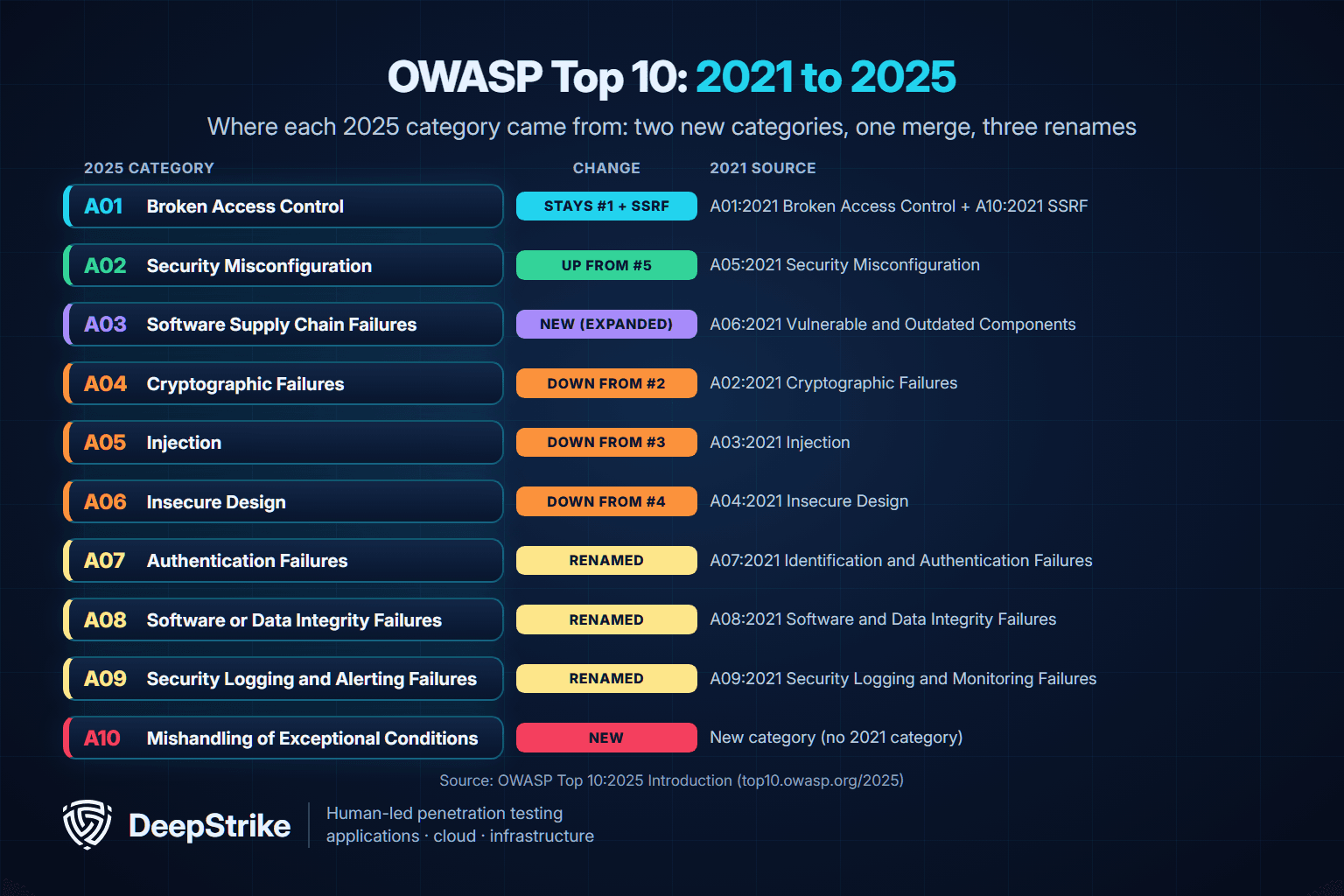
The 2025 edition has two new categories and one consolidation. Three categories were renamed, and four moved position.
| Rank | OWASP Top 10 2021 | OWASP Top 10 2025 | What changed |
|---|---|---|---|
| 1 | A01:2021 Broken Access Control | A01:2025 Broken Access Control | Stays #1; Server-Side Request Forgery (A10:2021) rolled in |
| 2 | A02:2021 Cryptographic Failures | A02:2025 Security Misconfiguration | Misconfiguration up from #5; Cryptographic Failures down to #4 |
| 3 | A03:2021 Injection | A03:2025 Software Supply Chain Failures | New category that expands A06:2021 Vulnerable and Outdated Components |
| 4 | A04:2021 Insecure Design | A04:2025 Cryptographic Failures | Down two places from #2 |
| 5 | A05:2021 Security Misconfiguration | A05:2025 Injection | Down two places from #3 |
| 6 | A06:2021 Vulnerable and Outdated Components | A06:2025 Insecure Design | Down two places from #4 |
| 7 | A07:2021 Identification and Authentication Failures | A07:2025 Authentication Failures | Same rank; shorter name |
| 8 | A08:2021 Software and Data Integrity Failures | A08:2025 Software or Data Integrity Failures | Same rank; "and" became "or" |
| 9 | A09:2021 Security Logging and Monitoring Failures | A09:2025 Security Logging and Alerting Failures | Same rank; "Monitoring" became "Alerting" |
| 10 | A10:2021 Server-Side Request Forgery (SSRF) | A10:2025 Mishandling of Exceptional Conditions | SSRF merged into A01; new category for error handling and failing open |
What the changes mean in practice:
The 2021 list is still published as a reference, but new testing scopes, policies and training should use the 2025 categories.
Real vulnerabilities rarely respect category boundaries. A single CVE can involve a missing authorization check (A01), an unrestricted file upload (A06) and a deserialization flaw (A08). The examples below are assigned to the category whose CWE mapping fits best, using the CWE published in the National Vulnerability Database (NVD) or the vendor's own description. The testing notes describe what a tester verifies in a scoped, authorized engagement; they are not instructions for testing systems you do not own.
Definition. Broken access control means the application lets a user act outside their intended permissions, such as reading another customer's records, calling an admin function or editing data they should only view. In 2025 the category also includes server-side request forgery, where the server is tricked into sending requests to destinations the attacker cannot reach directly.
Why it ranks first. OWASP found some form of broken access control in 100% of the applications tested, and on average 3.73% of applications had at least one of the category's 40 CWEs. It has the most occurrences of any category in the contributed data.
Real example. On March 2, 2021, Microsoft disclosed four Exchange Server zero-days exploited by the HAFNIUM group. The first link in the chain, CVE-2021-26855, was a server-side request forgery flaw that let an attacker send arbitrary HTTP requests and authenticate as the Exchange server. NVD maps it to CWE-918, which OWASP now places in A01.
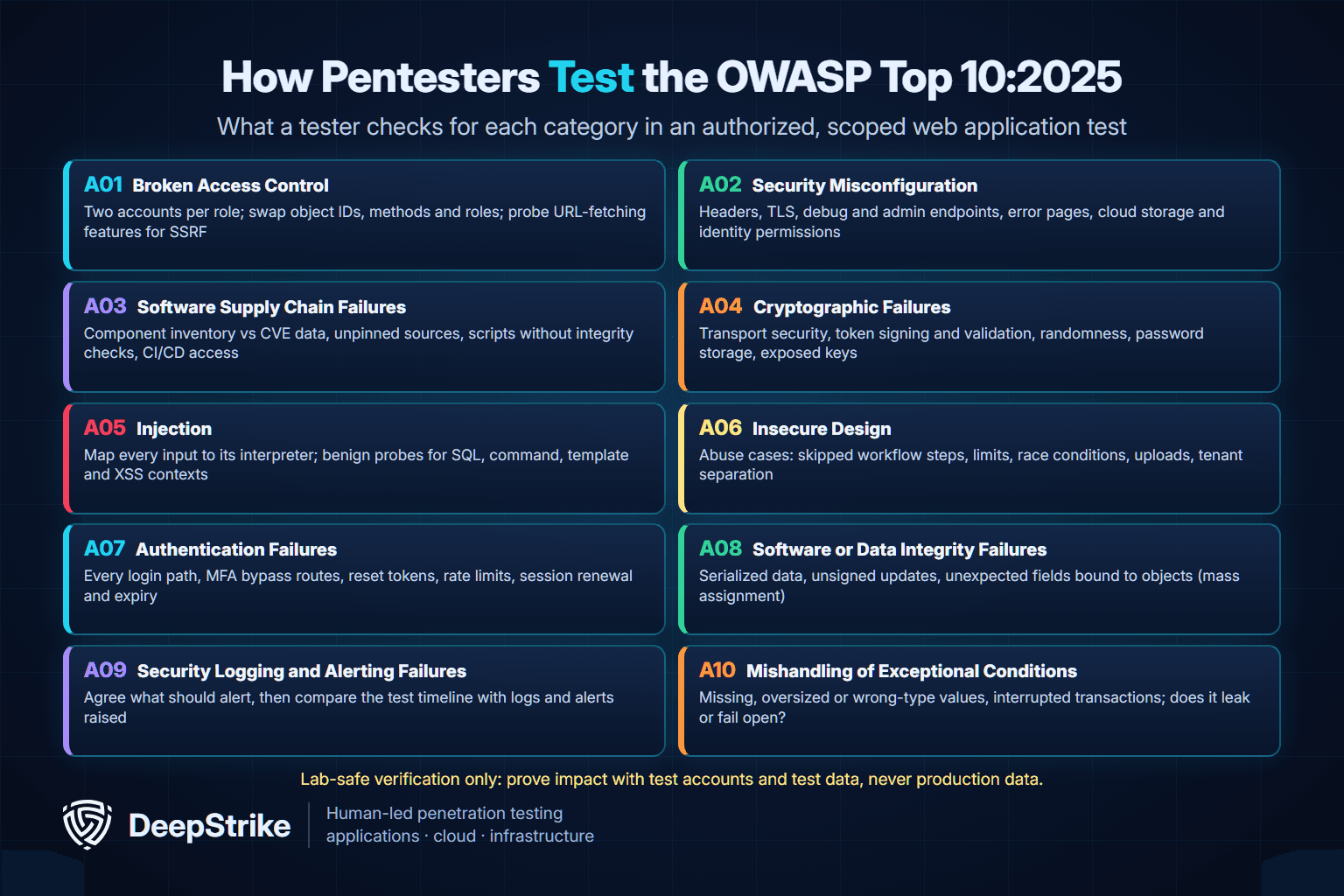
How pentesters test for it. Testers build a role and object matrix before they touch a request: every role, every object type, and who should be able to read, create, change or delete it. Using two or more test accounts per role, they replay legitimate requests while changing only the identity, the object identifier or the HTTP method, then compare what the server returns. They also check whether controls hidden in the user interface are enforced on the server, whether unauthenticated users can reach admin routes, and whether tenant boundaries hold.
For SSRF, they list every feature that fetches a URL, such as webhooks, file importers, link previews and PDF renderers, and confirm in a controlled way whether the server can be made to reach internal or cloud metadata addresses.
How to prevent it.
DeepStrike deep dives. Object-level authorization in APIs (BOLA) is covered in our guide to API penetration testing, and a real case of broken authorization on a destructive endpoint is walked through in our path traversal in DELETE requests case study. Our IDOR guide explains object-level access control flaws in depth. Our SSRF guide covers cloud metadata attacks and defenses.
Definition. Security misconfiguration happens when a system is deployed with insecure settings: default accounts left enabled, unnecessary features or sample apps installed, overly permissive cloud storage, verbose error pages, missing security headers or weak XML parser settings. The code may be sound, but the way it is configured exposes data or functionality to attackers.
Why it moved up. Misconfiguration climbed from fifth place in 2021 to second. OWASP found some form of it in every application tested, with an average incidence rate of 3.00% across its 16 CWEs, which include XML External Entity (XXE) processing.
Real example. On September 18, 2023, the Microsoft Security Response Center reported that an employee had published a storage URL in a public GitHub repository while sharing open-source AI models. The URL contained an overly permissive Shared Access Signature (SAS) token for an internal storage account. Researchers used it to reach workstation backups and internal Teams messages of two former employees. Microsoft said no customer data was exposed; it revoked the token two days after the June 22, 2023 report. Microsoft stressed there was no flaw in Azure Storage itself: the exposure came from how the token was scoped and shared.
How pentesters test for it. Testers compare what is deployed against what should be: response headers, TLS settings, enabled HTTP methods, directory listing, debug and admin endpoints, default content, and how errors are rendered. In cloud-backed applications they review storage, function and identity permissions within scope, and check whether client-side configuration exposes keys or overly broad backend rules. They also confirm that development settings, such as permissive CORS or verbose logging, did not reach production.
How to prevent it.
DeepStrike deep dives. See our research on misconfigured Supabase instances at scale and on Firebase authentication misconfigurations, both common in modern web stacks. For cloud environments, cloud penetration testing covers the platform layer behind the application.
Definition. Software supply chain failures are compromises or weaknesses anywhere in the chain that builds and delivers your software: vulnerable or unmaintained dependencies, malicious packages, hijacked maintainer accounts, tampered build systems and compromised distribution channels. The category expands the 2021 "Vulnerable and Outdated Components" risk from known flaws to the whole ecosystem.
Why it is new. This was the community survey's top concern, with exactly 50% of respondents ranking it first. OWASP notes the category has limited presence in automated testing data, which it attributes to how hard it is to test, but the highest average exploit and impact scores from related CVEs.
Real examples. On March 29, 2024, CISA warned that malicious code had been embedded in XZ Utils versions 5.6.0 and 5.6.1, a compression library present in many Linux distributions. The backdoor, tracked as CVE-2024-3094, was hidden in the release tarballs and could allow unauthorized access to affected systems. In September 2025, CISA reported that a self-replicating worm known as "Shai-Hulud" had compromised more than 500 npm packages by stealing developer tokens and publishing infected versions.
How pentesters test for it. Supply chain testing starts with inventory. Testers identify client-side and server-side components and versions, compare them with vulnerability databases, and look for libraries loaded from third-party domains without integrity checks. When the CI/CD pipeline is in scope, they review who can change build definitions, how secrets are stored, whether package sources are pinned to trusted registries, and whether internal package names could be claimed on a public registry. Much of this work is review rather than exploitation, which is one reason the category is underrepresented in scanner data.
How to prevent it.
DeepStrike deep dives. Our guide to software supply chain attacks explains attack types and detection in depth, and our secure SDLC guide shows where dependency and build controls fit in each phase of development.
Definition. Cryptographic failures cover the absence of encryption where it is needed and the misuse of cryptography where it exists: cleartext transmission, weak or outdated algorithms, poor randomness, unsalted or fast password hashes, hardcoded or leaked keys, and broken signature or certificate validation. These failures often lead directly to sensitive data exposure or system compromise.
Why it dropped. It fell from second to fourth, but it is far from rare: OWASP's data shows that on average 3.80% of applications had at least one of its 32 CWEs, slightly more than Broken Access Control's 3.73%.
Real example. Oracle's April 19, 2022 Critical Patch Update fixed CVE-2022-21449, nicknamed "Psychic Signatures." According to the Centre for Cyber Security Belgium, the ECDSA signature verification code introduced in Java 15 did not check that the signature values r and s were non-zero. A signature made of zeros could therefore validate, which let an attacker forge signatures and bypass authentication that relied on ECDSA, including JSON Web Tokens. Java 15 through 18 were affected.
How pentesters test for it. Testers check transport security (protocol versions, cipher suites, HSTS and any cleartext endpoints), how tokens and session identifiers are generated, and whether the application accepts tokens with invalid, missing or downgraded signatures in a test environment. In white-box or code-assisted tests they review password hashing, key storage, hardcoded secrets and the use of deprecated algorithms or modes. They also look for sensitive data that is cached, logged or returned when it does not need to be.
How to prevent it.
DeepStrike deep dive. Our explainer on perfect forward secrecy covers why forward-secret key exchange limits the damage of a stolen server key.
Definition. Injection occurs when untrusted input is sent to an interpreter as part of a command or query, so the interpreter executes attacker-controlled instructions. The category includes SQL, NoSQL, OS command, LDAP and expression language injection, server-side template injection and cross-site scripting, where the browser is the interpreter.
Why it is still in the top five. Injection fell from third to fifth, yet OWASP calls it one of the most tested categories, with every application tested for some form of it and the greatest number of associated CVEs. Cross-site scripting alone accounts for more than 30,000 CVEs and SQL injection for more than 14,000. For how SQL injection works and how to prevent it, see our SQL injection guide.
Real example. According to a joint CISA and FBI advisory published June 7, 2023, the CL0P ransomware gang began exploiting a previously unknown SQL injection vulnerability in Progress MOVEit Transfer on May 27, 2023. The flaw, CVE-2023-34362, let unauthenticated attackers reach the application's database. Internet-facing MOVEit Transfer servers were infected with a web shell named LEMURLOOT, which was used to steal data.
How pentesters test for it. Testers map every input the application processes, including headers, cookies, JSON and GraphQL fields, file names and values that are stored and reused later. For each one they send benign probe values and watch for changes in errors, timing or output that show the input reached a query, command or template unescaped. For cross-site scripting they identify the output context (HTML body, attribute, JavaScript, URL) where each value is reflected or stored. In code-assisted tests they trace sources to sinks and flag string-built queries and shell calls. Confirmation stays within agreed limits, such as proving read access to a test record rather than extracting data.
How to prevent it.
DeepStrike deep dives. See our guides to server-side template injection and GraphQL API attacks, plus two disclosed case studies: SQL injection in SVX Portal and reflected XSS through an unescaped attribute. For XSS types and output encoding, see our cross-site scripting (XSS) guide.
Definition. Insecure design is a missing or ineffective security control that should have been decided before any code was written. Examples include business logic that allows abusing discounts or limits, workflows that trust the client, weak tenant separation, unrestricted file uploads and race conditions. A perfect implementation of an insecure design is still insecure, so these flaws need design changes.
Why it moved down. Insecure Design slid from fourth to sixth as Security Misconfiguration and Software Supply Chain Failures overtook it. OWASP credits noticeable improvements in threat modeling since the category was introduced in 2021, and warns that insecure design is beyond the scope of most forms of testing.
Real example. CVE-2025-31324 was published on April 24, 2025. The Metadata Uploader in SAP NetWeaver Visual Composer was not protected with a proper authorization check, allowing an unauthenticated user to upload potentially malicious executable files to the host. NVD classifies it as CWE-434, unrestricted upload of a file with a dangerous type, which OWASP maps to A06. CISA added it to its Known Exploited Vulnerabilities (KEV) catalog on April 29, 2025. The case shows how a design decision (an upload feature reachable without authentication) overlaps with access control.
How pentesters test for it. Because design flaws do not show up as malformed input, testers start from the application's purpose. They review the threat model if one exists, then write abuse cases against key flows: skipping steps in a checkout or approval workflow, repeating an action faster than the business allows, changing quantities or prices the server should own, and sending parallel requests to expose race conditions. They also check whether file uploads restrict type, size, storage location and execution, and whether one tenant's actions can affect another's.
How to prevent it.
DeepStrike deep dives. Start with our threat modeling guide. For two design-level weaknesses OWASP maps to A06, see our explainers on HTTP request smuggling and time-of-check to time-of-use race conditions.
Definition. Authentication failures occur when an application cannot reliably confirm who a user is or protect the session afterward. Typical causes include allowing credential stuffing and brute force, weak or default passwords, missing or bypassable multifactor authentication, flawed password reset flows, hardcoded credentials, and session identifiers that are exposed, reused or never invalidated.
What changed. The category kept seventh place and dropped "Identification" from its name to match its 36 CWEs more accurately. OWASP notes that standardized authentication frameworks appear to be reducing occurrences, but the risk remains common.
Real examples. CVE-2024-1709, published February 21, 2024, was an authentication bypass in ConnectWise ScreenConnect 23.9.7 and earlier that used an alternate path (CWE-288). CISA's KEV entry describes it as letting an attacker with network access to the management interface create a new administrator-level account; CISA added it to the catalog the next day. In January 2024, CVE-2023-7028 showed the password reset variant: GitLab could send reset emails to an unverified address, enabling account takeover. NVD maps it to CWE-640, a weak password recovery mechanism, which sits in A07.
How pentesters test for it. Testers exercise every way into an account, not just the main login form: registration, login, MFA enrollment and challenge, password reset, "remember me," single sign-on and API tokens. Using test accounts, they check whether MFA can be skipped on an alternate endpoint, whether reset tokens are single-use, bound to the account and short-lived, whether rate limits and lockouts slow automated guessing, and whether session identifiers change after login and die after logout or timeout. For token-based sign-in they verify issuer, audience, expiry and signature validation.
How to prevent it.
DeepStrike deep dives. See 2FA bypass techniques, our JWT account takeover case study and OAuth from a security perspective.
Definition. Software or data integrity failures happen when an application trusts code, updates, serialized objects or critical data without verifying that they come from the expected source and have not been altered. Examples include insecure deserialization, unsigned updates, scripts loaded from untrusted origins, and frameworks that let users set object properties they should not control.
What changed. The category stayed eighth, with a small clarifying rename from "Software and Data" to "Software or Data." OWASP positions it at a lower level than A03: A03 is about the ecosystem, while A08 is about the trust boundaries inside your own application and pipeline. Its notable CWEs include CWE-502 (deserialization of untrusted data) and CWE-915, better known as mass assignment.
Real example. In July 2025, attackers exploited on-premises Microsoft SharePoint Server through an exploit chain publicly called "ToolShell." CVE-2025-53770, a deserialization of untrusted data flaw that let an unauthorized attacker execute code over the network and was a patch bypass for an earlier SharePoint CVE, was added to CISA's KEV catalog on July 20, 2025. CISA's alert on the SharePoint exploitation tracked the campaign as it expanded to web shells and ransomware.
How pentesters test for it. Testers look for serialized data that crosses a trust boundary, such as cookies, hidden fields, view state, message queues and API parameters, and check whether the application verifies a signature or integrity value before using it. In APIs they add properties that are not in the documented request, such as role or ownership fields, to see whether the server binds them. They also review update and plugin mechanisms, third-party scripts loaded without Subresource Integrity, and, where in scope, who can alter pipeline definitions and artifacts.
How to prevent it.
DeepStrike deep dives. Read our mass assignment guide and penetration testing for DevOps, which covers pipeline trust.
Definition. Security logging and alerting failures mean attacks go unrecorded or unnoticed. Logins, access control failures and high-value transactions are not logged, logs lack the context needed for investigation, logs leak sensitive data or can be tampered with, or nobody is alerted when suspicious activity occurs. Without detection, every other control failure lasts longer.
What changed. The category kept ninth place and was renamed from "Monitoring" to "Alerting" because, in OWASP's words, great logging with no alerting is of minimal value in identifying security incidents. It was voted onto the list by survey participants for the third time; it has only five CWEs and minimal representation in CVE data because it is so hard to test.
Real example. In mid-June 2023, a US federal civilian agency noticed MailItemsAccessed events with an unexpected application ID in its Microsoft 365 audit logs and reported them to Microsoft and CISA. The joint CISA and FBI advisory of July 12, 2023 explains that advanced persistent threat (APT) actors had used forged authentication tokens to read Exchange Online mail from a small number of accounts. The agency caught it because it had enhanced logging and a baseline of normal activity; CISA and the FBI said they were not aware of other audit logs or events that would have detected it.
How pentesters test for it. OWASP itself notes that testers can often only confirm whether they triggered incident response in a test environment, which is rarely monitored like production. The most useful approach is to coordinate with the defenders: agree on which test actions should be detected, then compare the attack timeline with what was logged and alerted. Testers also check whether security events carry enough context (user, source, object, outcome), whether logs record secrets or personal data, and whether user input written to logs is encoded to prevent log injection.
How to prevent it.
DeepStrike deep dives. Our guides to mean time to detect (MTTD), purple teaming and incident response planning cover how to measure and improve detection.
Definition. Mishandling of exceptional conditions covers how software behaves when something unexpected happens: a missing parameter, a malformed value, an exhausted resource, a failed dependency or an interrupted transaction. Weaknesses include detailed error messages that leak information, unchecked return values, NULL pointer dereferences, partial transactions that are not rolled back, and security checks that fail open.
Why it is new. OWASP created this category in 2025 with 24 CWEs, some of which were previously grouped under general code quality. Notable entries include CWE-209 (error message containing sensitive information) and CWE-636 (not failing securely, or "failing open").
Real example. CVE-2025-47813, published July 10, 2025, affects the web interface of Wing FTP Server before version 7.4.4. Sending an overly long value in the UID cookie to the loginok.html page caused the server to disclose the application's full local installation path. CISA's KEV entry classifies it as CWE-209 and was added on March 16, 2026, meaning there was evidence of exploitation in the wild. An installation path is exactly the kind of detail attackers use when chaining other flaws.
How pentesters test for it. Testers deliberately send the application into unusual states in a test environment: parameters that are missing, duplicated, empty, oversized or of the wrong type; requests that interrupt multistep transactions halfway; and dependency failures where they can be simulated. They then check three things. Does the response leak stack traces, file paths, queries or versions? Does the transaction roll back completely? When a security component such as an authorization service or token validator errors out, does the application deny the request or let it through?
How to prevent it.
DeepStrike deep dives. There is no dedicated DeepStrike guide to this new category yet. Our overview of the most common web application vulnerabilities covers related information disclosure issues.
No single tool or test type covers the whole list. OWASP says so directly: tools cannot comprehensively detect, test or protect against the Top 10 because some risks, such as insecure design, are not testable by tooling, and OWASP discourages any claim of full coverage. The table below shows where each technique tends to find each category. It is DeepStrike's editorial guidance for planning, not an OWASP mapping.
| Category | Design review and threat modeling | SAST and code review | SCA and SBOM | DAST and scanners | Manual penetration testing | Detection testing |
|---|---|---|---|---|---|---|
| A01 Broken Access Control | Partial | Partial | No | Limited | Strong | Partial |
| A02 Security Misconfiguration | Partial | Partial | No | Strong | Strong | No |
| A03 Software Supply Chain Failures | Partial | Partial | Strong | Limited | Partial | No |
| A04 Cryptographic Failures | Partial | Strong | Partial | Partial | Strong | No |
| A05 Injection | No | Strong | No | Strong | Strong | No |
| A06 Insecure Design | Strong | Limited | No | Limited | Partial | No |
| A07 Authentication Failures | Partial | Partial | No | Partial | Strong | Partial |
| A08 Software or Data Integrity Failures | Partial | Strong | Partial | Limited | Strong | No |
| A09 Security Logging and Alerting Failures | Partial | Partial | No | No | Partial | Strong |
| A10 Mishandling of Exceptional Conditions | Partial | Strong | No | Partial | Strong | Partial |
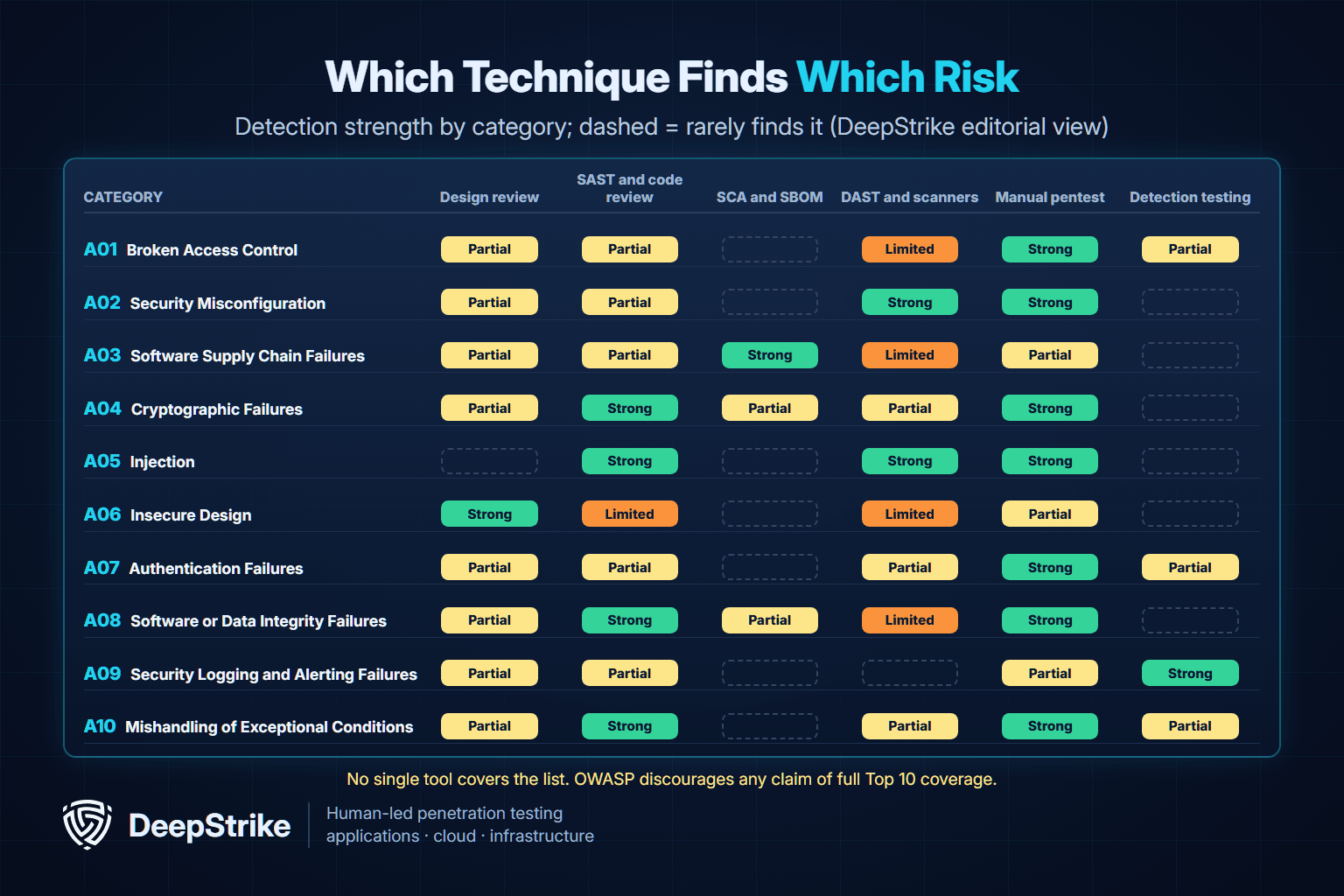
Three patterns stand out. Access control, authentication and business logic flaws (A01, A06 and A07) depend on understanding what each user should be allowed to do, which is why manual testing finds them far more reliably than scanners. Supply chain risk (A03) is mostly a dependency and pipeline review problem. Logging and alerting (A09) can only be proven by checking whether defenders actually saw the test. For a broader comparison of testing approaches, see our guide to SAST vs DAST vs IAST vs RASP and our penetration testing methodology.
OWASP describes the Top 10 as primarily an awareness document and says that if you use it as a coding or testing standard, it is "the bare minimum and just a starting point." For requirements and test cases, use the OWASP projects designed for that job:
| Need | OWASP resource | Why |
|---|---|---|
| Awareness, training, executive risk discussion | OWASP Top 10 2025 | Short, ranked, widely recognized |
| Security requirements and verifiable controls | Application Security Verification Standard (ASVS) | Designed to be verified and tested at three levels |
| Test procedures for a web application pentest | Web Security Testing Guide (WSTG) | Step-by-step test cases by area |
| API-specific risks | OWASP API Security Top 10 (2023) | Covers object and function level authorization, resource consumption and more |
| LLM and generative AI applications | OWASP Top 10 for LLM Applications | Prompt injection, data leakage, excessive agency |
| Secure coding guidance | OWASP Cheat Sheet Series | Concise defenses per topic |
The resources are at asvs.owasp.org, the Web Security Testing Guide, the OWASP API Security Top 10 2023 and the OWASP Cheat Sheet Series. DeepStrike covers the AI list in our OWASP LLM Top 10 guide, API risk data in our API security statistics, and API tooling in our review of API security testing tools.
A practical way to combine them: use the Top 10 to explain risk and set priorities, ASVS to define what "secure enough" means for each application, and WSTG to drive the test plan. For the controls behind each category and how ASVS levels work, see our web application security guide.
OWASP also published three "next steps" risks that were considered but did not make the final ten. They are worth adding to threat models and test scopes now:
The full descriptions are on OWASP's Next Steps page.
For a wider list that goes beyond the Top 10 categories, see our guide to the 20 most common web application vulnerabilities.
The OWASP Top 10 is a free awareness document from the OWASP Foundation that ranks the ten most critical security risk categories for web applications. It is built from vulnerability data contributed by organizations plus a practitioner survey, and it is widely used for developer training, testing scopes and security policies.
The ten categories are A01 Broken Access Control, A02 Security Misconfiguration, A03 Software Supply Chain Failures, A04 Cryptographic Failures, A05 Injection, A06 Insecure Design, A07 Authentication Failures, A08 Software or Data Integrity Failures, A09 Security Logging and Alerting Failures, and A10 Mishandling of Exceptional Conditions.
OWASP released the 2025 edition in November 2025, planned around its Global AppSec USA conference in Washington, D.C. It was the first update since 2021, and OWASP now lists 2025 as the current version and 2021 as superseded.
No. As of November 2026, the 2025 edition is the current web application list. Recent editions appeared in 2017, 2021 and 2025, so a new web list in 2026 would be unusual. OWASP's separate Top 10 for LLM Applications follows its own release schedule.
Two categories are new: A03 Software Supply Chain Failures, which expands the 2021 Vulnerable and Outdated Components category, and A10 Mishandling of Exceptional Conditions. Server-Side Request Forgery was merged into A01 Broken Access Control, Security Misconfiguration rose from fifth to second, and three categories were renamed.
The 2021 list remains published for reference, but OWASP marks it as superseded. Use the 2025 categories for new policies, training, scanner rules and penetration test scopes, and map older findings to their 2025 equivalents.
The web Top 10 applies to APIs that sit behind web applications, but API-specific risks are better covered by the OWASP API Security Top 10 (2023 edition). Large language model applications have their own OWASP Top 10 for LLM Applications.
The Top 10 is an awareness document, not a regulation or certification. Many organizations, customers and auditors still use it as a baseline for secure development and testing scopes. OWASP recommends ASVS when you need a verifiable standard.
The fastest way to learn where your application stands is to test it the way an attacker would, with every role, every tenant and every business flow in scope. DeepStrike's web application penetration testing combines automated coverage with manual testing that covers the OWASP Top 10, checks access from multiple users' perspectives and reports only vulnerabilities validated through exploitation. Each engagement includes fix recommendations, re-testing to confirm remediation and an attestation letter. To scope a test, contact DeepStrike.
Mohammed Khalil is a Cybersecurity Architect at DeepStrike, specializing in advanced penetration testing and offensive security operations. With certifications including CISSP, OSCP, and OSWE, he has led numerous red team engagements for Fortune 500 companies, focusing on cloud security, application vulnerabilities, and adversary emulation. His work involves dissecting complex attack chains and developing resilient defense strategies for clients in the finance, healthcare, and technology sectors.

Stay secure with DeepStrike penetration testing services. Reach out for a quote or customized technical proposal today
Contact Us
