July 16, 2026
Updated: July 28, 2026
A practical guide to the definition, trust-path attack model, verified cases, detection evidence, prevention controls, and response decisions organizations need before and after a supplier or dependency compromise.

Mohammed Khalil
A practical guide to the definition, trust-path attack model, verified cases, detection evidence, prevention controls, and response decisions organizations need before and after a supplier or dependency compromise.
A supply chain attack is a cyberattack that abuses a product, dependency, supplier, service, delivery mechanism, or trusted relationship to reach downstream targets. The attacker intentionally weaponizes an upstream position or accepted trust path such as a signed update, software package, vendor account, API integration, managed service, or hardware component to gain access, execute code, steal data, disrupt operations, or pivot further.
The cyber supply chain includes the people, organizations, software, services, identities, processes, infrastructure, and physical components used to create, deliver, or operate technology. It reaches beyond a vendor list to source repositories, registries, build workers, cloud services, APIs, open-source projects, support teams, hardware, and their own upstream dependencies.
Definition: A supply chain attack occurs when an adversary compromises or maliciously substitutes an upstream product, component, supplier, service, or trusted delivery/access path and intentionally uses that position to expose or compromise downstream targets.
MITRE ATT&CK T1195 classifies supply-chain compromise across development tools and dependencies, software delivery, and hardware. The classification focuses on manipulation before the final consumer receives the product or service. Enterprise practice also has to account for trusted service and identity paths: an attacker may not alter a binary if a privileged vendor account, support tool, OAuth grant, API token, or remote-management channel already reaches customers.
Upstream is the producer, supplier, component, service, or process earlier in the trust chain; downstream is the customer, deployment, user, or connected organization reached through it. The attacker’s leverage is expected trust in a signer, source, integration, service account, or route.
“Third party” is broader than “supplier.” It can include partners, advisers, customers, processors, affiliates, support providers, marketplaces, and integration operators. Third-party risk evidence therefore covers a wider universe than confirmed supply-chain attacks. Vendor risk management evaluates particular provider relationships; cybersecurity supply chain risk management (C-SCRM) coordinates risk across products, services, suppliers, and dependencies; software supply chain security focuses on how software is sourced, built, verified, released, and consumed. A supply-chain compromise is the upstream condition. A supply-chain attack is the adversary’s intentional use of that condition or trust path.
Classify an incident as a confirmed or well-supported supply chain attack only when all four questions are supported by evidence:
If any answer is unknown, use a narrower label third-party breach, vulnerable component, product exploitation, operational incident, or suspected compromise until the evidence improves.
| Event type | What happened | Was trust weaponized? | Supply chain attack? | Primary response owner | Example or caveat |
|---|---|---|---|---|---|
| Supply chain attack | An upstream product, service, component, supplier, or delivery/access path was compromised and used downstream. | Yes, intentionally. | Yes, when supported by evidence. | Incident command plus the owner of the affected trust path. | A trojanized signed update or abused managed-service channel. |
| Third-party breach | A provider’s own environment or data was compromised. | Not necessarily. | Only if the breach was used to reach or compromise downstream parties. | TPRM, legal/privacy, and the business/service owner. | A supplier loses its own records but no customer path is weaponized. |
| Vulnerable dependency | A component contains a security flaw. | No, unless an attacker tampered with the component or delivery chain. | Not by itself. | Product security, AppSec, and vulnerability management. | Log4Shell was a critical vulnerability in Log4j, not proof that the project was maliciously compromised. |
| Product zero-day or mass exploitation | Attackers exploit a flaw in customer-deployed copies of a product. | The product is targeted, but the producer or delivery chain may be intact. | Not automatically. | Product owner, vulnerability management, SOC, and IR. | MOVEit exploitation does not by itself prove upstream build or update compromise. |
| Vendor outage or defective update | A non-malicious defect or operational failure causes loss of service or availability. | No malicious weaponization. | No. | Service owner, IT operations, resilience, and vendor management. | CrowdStrike’s July 2024 defective content update was a resilience lesson, not a cyberattack. |
| Physical logistics disruption | Shipping, manufacturing, inventory, or transport is disrupted without a cyber trust-path compromise. | Usually no. | No, unless cyber manipulation of a technology supply chain is separately evidenced. | Operations, logistics, safety, and continuity. | Port closure or component shortage is not a cybersecurity supply chain attack. |
Classification should follow the trust path and evidence not the mere presence of a vendor.
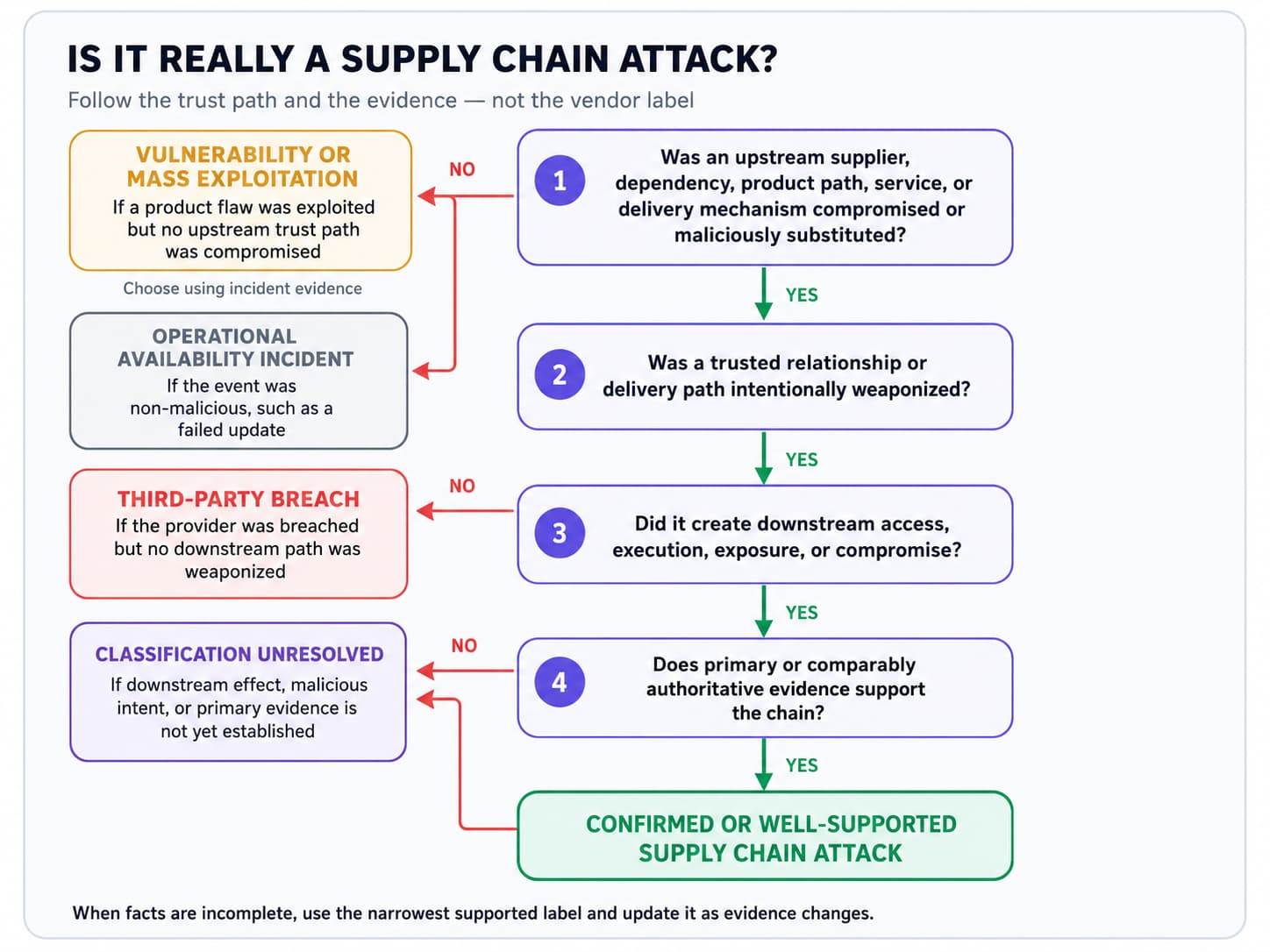
Figure 1. Is it really a supply chain attack? Classify the incident by the trust path and evidence, not by the fact that a vendor was involved. Source: Original DeepStrike classification framework informed by MITRE ATT&CK T1195.
The sequence varies, but defenders can usually trace seven linked decisions:
This is a defensive abstraction, not a claim that every campaign follows the same order.
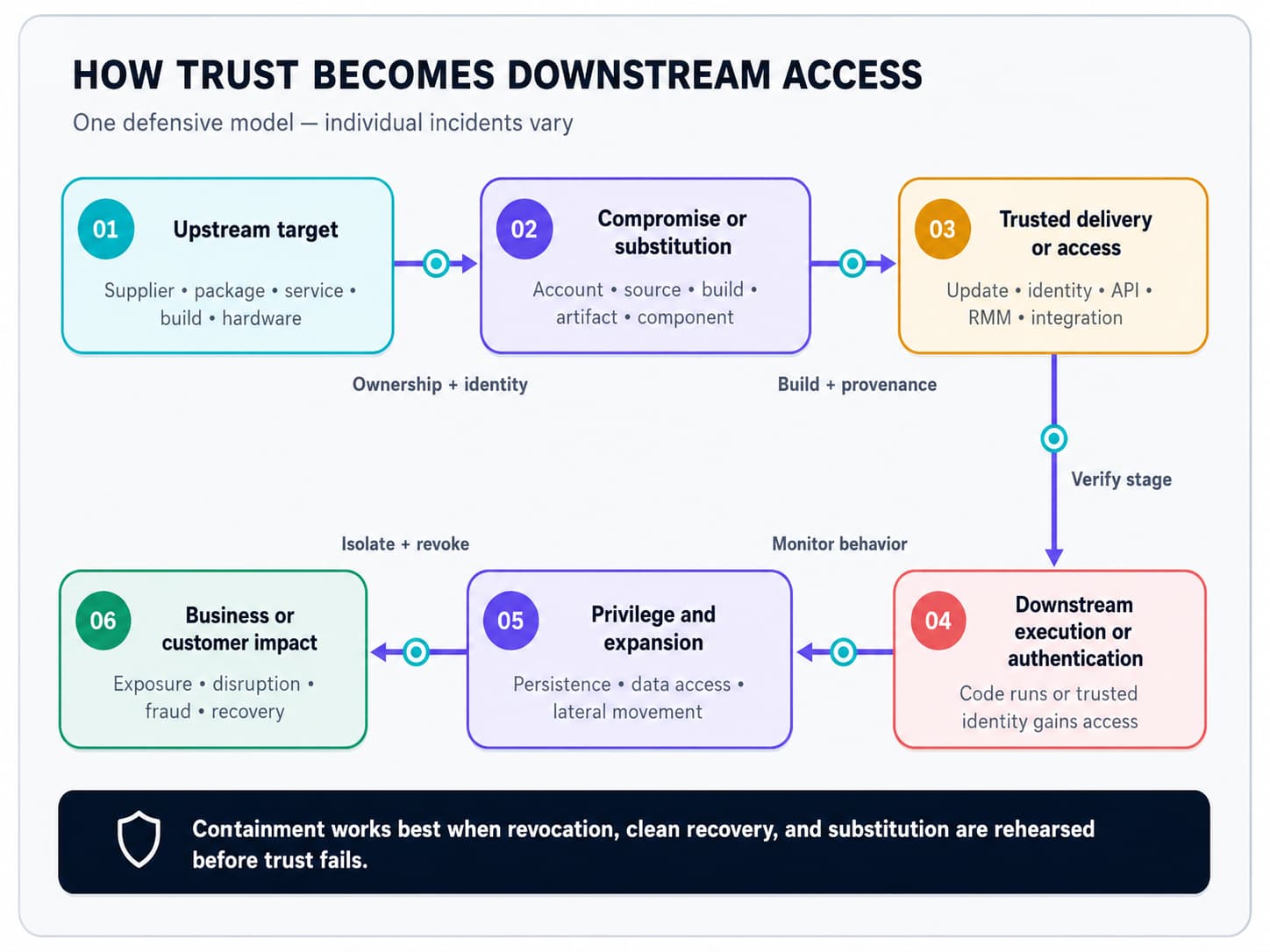
Figure 2. How a supply chain attack reaches downstream targets. A supply chain attack converts an upstream compromise into downstream access through a trusted product, service, artifact, identity, or integration. Source: Original DeepStrike synthesis informed by MITRE ATT&CK T1195 and NIST C-SCRM guidance.
These categories overlap. One campaign may begin with a package, reach a build environment, and end in signed artifacts delivered through a trusted update channel.
| Attack type | Trust path | Typical target | Defensive signal | Primary preventive control | Important limitation |
|---|---|---|---|---|---|
| Compromised dependency or development tool | Imported library, compiler, action, plugin, or SDK | Producer source and build process | Unexpected version, hash, source, or behavior change | Pinned, reviewed dependencies and controlled build inputs | A clean vulnerability scan cannot prove logic is benign. |
| Malicious or hijacked open-source package | Registry name, maintainer account, or release ownership | Developers and automated builds | New owner, unusual release cadence, install-time behavior, provenance gap | Protected maintainer accounts, allowlists, review, and provenance | Open source is not inherently unsafe; governance and evidence vary by project. |
| Dependency confusion or typosquatting | Resolver precedence or look-alike package name | Internal builds and developers | Public package unexpectedly satisfies an internal name; near-match name | Private namespace controls, repository policy, and exact identifiers | Naming controls do not detect a compromised legitimate package. |
| Source-repository compromise | Commit, branch, tag, pull request, or maintainer identity | Source code and release metadata | Bypassed review, force push, new token, unusual branch event | Strong authentication, protected branches, review, and signed changes | Authorized changes can still contain malicious logic. |
| CI/CD or build-system compromise | Build worker, pipeline definition, runner, cache, or build secret | Release artifacts and deployment | Unapproved pipeline change, ephemeral-worker drift, secret use, source/artifact mismatch | Isolated hardened builds, least privilege, reproducibility, and attestations | Reproducibility may be impractical for every build and does not secure all inputs. |
| Artifact, image, or release-pipeline compromise | Registry, repository, promotion gate, or deployment system | Packages, containers, firmware, and production workloads | Digest mismatch, tag movement, missing attestation, abnormal promotion | Immutable digests, signed provenance, controlled promotion, and separation of duties | A signature can authenticate an artifact produced by a compromised pipeline. |
| Signing-key or certificate abuse | Publisher identity and cryptographic trust | Software, scripts, packages, and updates | Key use outside expected build, time, device, or release | Hardware-backed keys, quorum approval, short-lived credentials, rotation, and audit | Signing proves a relationship to a key; it does not prove safe behavior. |
| Update or distribution compromise | Vendor update service, CDN, mirror, installer, or auto-update | Customer endpoints and workloads | Unexpected update source, certificate/path change, post-update behavior | Secure release, staged rollout, independent verification, rollback, and egress monitoring | Even legitimate delivery can distribute a compromised build. |
| Attack type | Trust path | Typical target | Defensive signal | Primary preventive control | Important limitation |
|---|---|---|---|---|---|
| SaaS, cloud, identity, API, or integration compromise | OAuth grant, service account, federation, API token, webhook, or tenant integration | Customer data, workflows, and connected tenants | New scopes, consent, token use, tenant changes, or cross-environment access | Least privilege, separate identities, scope review, token lifecycle controls, and telemetry | Strong authentication does not fix excessive authorized scope. |
| MSP, support, RMM, or service-provider compromise | Privileged remote tool, support session, administrator, or shared platform | Customer networks and endpoints | Vendor login anomaly, mass action, new script, unusual support session | Dedicated vendor paths, just-in-time access, segmentation, and rapid revocation | The customer may have limited visibility into provider-side activity. |
| Hardware, firmware, or counterfeit component compromise | Manufacturing, logistics, firmware update, or component substitution | Devices, appliances, and embedded systems | Provenance gap, unexpected firmware, tamper evidence, or component variance | Approved sources, chain of custody, secure boot, attestation, sampling, and inspection | Inspection cannot establish absence of every hidden modification. |
| Second-order or cascading compromise | A supplier’s own supplier or dependency | Producers and their customers | First supplier incident followed by unexplained producer access or build change | Fourth-party mapping, critical-dependency review, segmentation, and producer monitoring | Customers often cannot see transitive relationships directly. |
| AI/ML model, dataset, plugin, or serving-chain compromise | Third-party model, data source, extension, repository, or model service | ML development and deployed AI systems | Model/data provenance drift, unexpected plugin permissions, endpoint or behavior change | Provenance, access control, evaluation, isolation, and monitored promotion | Ordinary model error, prompt injection, or poor output is not automatically a supply-chain attack. |
AI and machine-learning supply chains deserve the same classification discipline. MITRE ATLAS and MITRE’s secure-AI work emphasize the provenance and chain-of-custody problem around models, data, frameworks, and external services. An incident belongs in the supply-chain category only when an upstream trust or delivery path was intentionally compromised or substituted and used downstream.
Supply-chain defenses must challenge activity that appears legitimate. Valid signatures, approved vendor routes, service accounts, and standard deployment tools can also reduce friction for an attacker controlling the trusted path.
Exposure is correlated: one package, identity provider, build service, managed platform, or remote tool can connect many systems. Hidden transitive dependencies also make concentration and blast radius difficult to inventory from either the producer or customer side.
Containment crosses organizational boundaries. Procurement owns evidence and contract terms; engineering owns builds; identity teams own tokens; the SOC owns detection; legal and privacy assess duties; business owners decide whether to stop a critical service. Supplier telemetry or notice may arrive late.
Recovery is more than patching. Teams may need to revoke access, rotate credentials and keys, replace artifacts, rebuild from trusted inputs, scope local execution, and use a substitute service. A supplier statement helps, but it does not replace customer-side investigation.
The Verizon 2026 Data Breach Investigations Report examined more than 31,000 incidents and more than 22,000 confirmed breaches involving organizations in 145 countries. Its in-scope events occurred from November 1, 2024 through October 31, 2025. The report says 48% of total breaches had third-party involvement, a 60% increase from its prior dataset.
That figure measures broad third-party involvement in a global breach dataset; it does not mean 48% of breaches were confirmed supply-chain attacks. Surveys, package telemetry, vulnerability counts, and breach datasets have different denominators. For maintained figures and methodology notes, see DeepStrike’s supply chain cybersecurity statistics.
| Incident and date | Upstream element | Trust mechanism abused | Confirmed downstream result | Classification |
|---|---|---|---|---|
| SolarWinds / SUNBURST, 2020 | Orion software build and release process | Signed vendor updates | Trojanized Orion updates reached customers; selected victims experienced follow-on intrusion activity | Confirmed software supply-chain attack |
| 3CX, 2023 | Employee endpoint, then 3CX build environments | A trojanized upstream application and signed 3CX desktop installers | Compromised Windows and macOS 3CX applications were distributed to customers | Confirmed cascading software supply-chain attack |
| Codecov Bash Uploader, 2021 | Container build credential and uploader script | Trusted uploader and integrations used in CI | The modified uploader could export CI environment information from users | Confirmed development-tool supply-chain attack |
| Kaseya VSA, 2021 | VSA product and trusted remote-management channel | Privileged MSP/RMM deployment path | Ransomware was delivered through VSA-managed customer environments | Confirmed service-provider/RMM supply-chain attack |
| XZ Utils, 2024 | Release tarballs for xz 5.6.0 and 5.6.1 | Maintainer/release trust and downstream distribution | Malicious code entered releases, but broad downstream compromise was not confirmed before intervention | Attempted compromise / near miss |
Attackers inserted SUNBURST into SolarWinds Orion builds that were signed and distributed as legitimate updates in 2020. MITRE’s SolarWinds campaign record and CISA’s advisory support the classification: the upstream build and release path was manipulated, and downstream organizations installed the result through an accepted channel.
The signature correctly associated the artifact with SolarWinds; it could not make a compromised build benign. Producers need isolated builds, controlled inputs, separated duties, and provenance. Consumers need staged deployment, behavioral monitoring, egress controls, and rapid isolation. Exposure must remain distinct from confirmed follow-on compromise.
The 3CX-commissioned Mandiant investigation found that a trojanized, end-of-life X_TRADER application compromised a 3CX employee environment. Attackers then reached 3CX’s Windows and macOS build environments and distributed compromised desktop applications. MITRE C0057 describes it as a cascading two-stage supply-chain compromise.
The unexpected dependency was on an employee endpoint and became a route to production. Endpoint controls, user/build separation, scoped credentials, and independent release verification reduce that risk. Public reporting established the path, not a universal customer-impact count.
Codecov reported that an error in its Docker image creation process exposed a credential. An attacker used it to modify the Bash Uploader, and the altered script could export information from customer continuous-integration environments. The official security update and postmortem identify the trusted uploader and related integrations as the downstream path.
Consumers needed to identify where the uploader ran and which secrets it could read. CI jobs should use minimal, preferably short-lived credentials; third-party scripts should be pinned and verified; and build-worker egress should be monitored. Each customer still had to scope its own variables, tokens, repositories, and executions.
In July 2021, CISA described the event as a Kaseya VSA supply-chain ransomware attack. Attackers exploited the VSA product and used its trusted remote-management capabilities to deliver ransomware through managed-service-provider and customer environments. Kaseya shut down its SaaS service and advised customers to shut down on-premises VSA servers during containment.
Unlike SolarWinds, public evidence did not establish a compromised Kaseya build. The weaponized trust path was the privileged RMM/service-provider channel. Dedicated vendor access, time-bound privilege, segmentation, mass-action detection, offline recovery, and a tested kill switch reduce its blast radius.
In March 2024, investigators found malicious code in the xz 5.6.0 and 5.6.1 release packages. Red Hat’s alert explained that the build path included material present in release packages but not in the public source repository; Red Hat’s response review describes discovery and containment.
This is best labeled an attempted supply-chain compromise or near miss, not a confirmed mass breach. It supports comparing source, release tarballs, and artifacts; protecting maintainer identities; and sustaining review of critical projects. The lesson is evidence for ownership, inputs, builds, and provenance not that open source is inherently unsafe.
Commonly confused incidents: MOVEit was mass exploitation of a product vulnerability, not proof of a compromised build. Log4Shell was a severe dependency vulnerability, not proof of malicious insertion into Log4j. CrowdStrike’s July 2024 event was a defective update, not a cyberattack. A vendor breach remains a third-party breach unless evidence shows downstream weaponization.
No single telemetry source can establish the whole path. Detection works by correlating upstream changes, trust-path activity, and downstream behavior.
For critical suppliers, define notification timeframes, affected-product detail, lawful tenant indicators, relevant administrative logs, retention, evidence preservation, incident contacts, subcontractor dependencies, and independent-assurance procedures. Requirements should match the service architecture, privacy duties, and negotiating leverage.
Known-vulnerability scanning finds disclosed flaws in recognized components; it cannot reliably detect a malicious new package, a hijacked maintainer, hostile logic, stolen signing credentials, an abused OAuth grant, or an unknown producer-side build change.
The goal is not to certify trust once. It is to make trust visible, verify it repeatedly, limit its reach, and prepare for failure.
Maintain linked inventories of suppliers, services, software, dependencies, integrations, access paths, critical data, and business processes. Tier them by criticality, privilege, sensitivity, substitutability, concentration, and operational dependency not spend alone.
Define security evidence, incident-notification, vulnerability-disclosure, log-access, subcontractor, change-management, secure-development, recovery, data-return, and exit requirements proportionate to the tier. Use certifications and questionnaires as inputs, then test whether the described controls apply to the service and trust path you actually use. Dedicated vendor risk evidence belongs in the vendor-risk program rather than being repeated as a supply-chain attack statistic.
Identify fourth parties and transitive dependencies whose compromise or failure could affect a critical service. For concentrated services, document alternatives, export formats, recovery dependencies, and shutdown or substitution authority.
Give suppliers, integrations, build systems, and service accounts minimum privilege and reach. Prefer phishing-resistant authentication where feasible, dedicated identities, time-bound privilege, sensitive-action approval, and session logging. Separate vendor paths from workforce and production administration.
Map data flows and trust boundaries. Segment management planes, builds, and critical workloads; constrain egress; and stop one support tool or token from reaching unrelated environments. Inventory keys, webhooks, tokens, federation trusts, and OAuth grants with owners, expiry, rotation, and emergency revocation.
Protect source control with strong authentication, reviewed changes, branch protection, separate release authority, and audit logs. Isolate build workers, control inputs, minimize persistent state, keep secrets out of source and artifacts, and separate development, signing, and release roles.
Generate signed provenance and verify it at promotion points. Use reproducible or independently verifiable builds where the product and ecosystem make that practical. Pin dependencies and digests, control update sources, review high-risk dependency changes, and monitor package ownership. Apply NIST SSDF practices and use SLSA as a source/build integrity model not as a security certificate.
Secure releases with staged rollout, canaries, health criteria, rollback, immutable artifacts, and protection for signing keys. A CI/CD security testing program can validate configuration and trust boundaries within an authorized scope, but it does not replace secure engineering and operational monitoring.
Connect packages and artifacts to applications, environments, owners, and versions. Ingest supplier SBOMs where available, generate internal inventories where needed, and verify that each inventory maps to the deployed artifact.
Use controlled dependency sources, exact identifiers, immutable digests, malicious-package intelligence, vulnerability monitoring, and provenance checks. Test and stage changes, observe behavior, retain rollback, and assign explicit pause or exception authority for high-impact updates.
Continue monitoring integrations after approval. Review API scopes, cloud roles, OAuth grants, webhooks, data access, and service accounts; remove unused permissions and rotate credentials when ownership or risk changes. Design applications to fail safely if a supplier becomes unavailable or untrusted.
Create playbooks for supplier, package, signing-key, CI/CD, SaaS, identity, and defective-update events. Maintain escalation paths, offline contacts, decision owners, backups, clean-artifact sources, credential-rotation sequences, notification assessment, and replacement steps.
Exercise revocation, isolation, alternative workflows, artifact replacement, and communications. Retest remediated trust paths and feed lessons into architecture, contracts, supplier tiers, and development controls.
| Framework or resource | Problem addressed | Primary users | What it does not guarantee |
|---|---|---|---|
| MITRE ATT&CK T1195 | Adversary classification for dependency/development-tool, software, and hardware supply-chain compromise | Threat modeling, detection, IR, and red teams | Complete coverage of enterprise C-SCRM or proof that an incident fits without evidence |
| NIST SP 800-161 Rev. 1 Update 1 | Organization-wide cybersecurity supply chain risk management | Executives, enterprise risk, procurement, security, engineering, and suppliers | Compliance, supplier safety, or elimination of systemic risk |
| NIST CSF 2.0 GV.SC and SP 1305 | Governance outcomes and communication of supplier requirements | Governance, TPRM, procurement, and program leaders | A prescriptive control set or universal legal requirement |
| NIST SSDF 1.1, SP 800-218 | Common secure-software-development practices and purchaser/supplier vocabulary | Software producers and acquiring organizations | Safe code, absence of malicious logic, or a certification |
| SLSA v1.2 | Source and build integrity, provenance, and verification | Platform, build, release, and software-consumer teams | Security of every dependency, runtime behavior, or organization process |
| CISA SBOM resources | Component transparency and operational use of SBOMs | Producers, consumers, vulnerability management, procurement, and IR | That an inventory is complete, current, exploitable, or benign |
| OWASP SCVS and OpenSSF guidance | Community control catalogs and open-source ecosystem practices | AppSec, DevSecOps, maintainers, and consumers | Universal adoption, assurance, certification, or prevention |
Frameworks are maps, not outcomes. Organizations should select and tailor practices according to technology, risk, contractual obligations, and applicable law. NIST guidance is voluntary unless a contract, regulator, or other authority makes a specific requirement applicable.
Actions depend on the technology, business criticality, legal duties, and evidence. Use the sequence below as a decision framework alongside the organization’s incident-response plan.
Restore in stages, monitor for retained access, and verify remediation before removing heightened controls. Update inventories, tiers, contract language, notification paths, token design, build controls, and deployment procedures; document decisions and rehearse supplier replacement while lessons are fresh.
The five stages turn an abstract supplier list into testable trust decisions.
| Stage | Key question | Owner | Evidence | Authorized validation method | Failure signal |
|---|---|---|---|---|---|
| Map | Which suppliers, dependencies, identities, integrations, and data flows affect a critical outcome? | Architecture, TPRM, service owners, AppSec | Inventories, diagrams, SBOMs, contracts, IAM/API records | Architecture review, discovery, trust-path mapping | Critical path lacks an owner, record, or boundary |
| Verify | Is the asserted identity, artifact, configuration, ownership, and evidence current and relevant? | IAM, platform, product security, procurement | Provenance, signatures, logs, attestations, configuration, supplier evidence | Configuration, provenance, access, and safe control review | Evidence is stale, unverifiable, out of scope, or mismatched |
| Constrain | If this trust fails, how far can it reach? | Security architecture, IAM, cloud, network/app owners | Roles, scopes, segments, tokens, data flows, allowlists | Authorized access, API, cloud, and segmentation testing | Vendor or integration reaches unrelated systems, data, or admin planes |
| Detect | Would unexpected change or behavior create timely evidence? | SOC, detection engineering, platform/producer teams | Source, build, artifact, identity, vendor, endpoint, network, SaaS logs | Log-path validation, safe simulation, alert and telemetry review | No event links upstream change to downstream behavior |
| Rehearse | Can the organization revoke, contain, recover, communicate, and substitute? | IR, continuity, legal, communications, service owners | Playbooks, contacts, backups, recovery tests, decision logs | Tabletop, resilience exercise, revocation drill, retest | Access cannot be disabled; clean source or alternative is unclear |
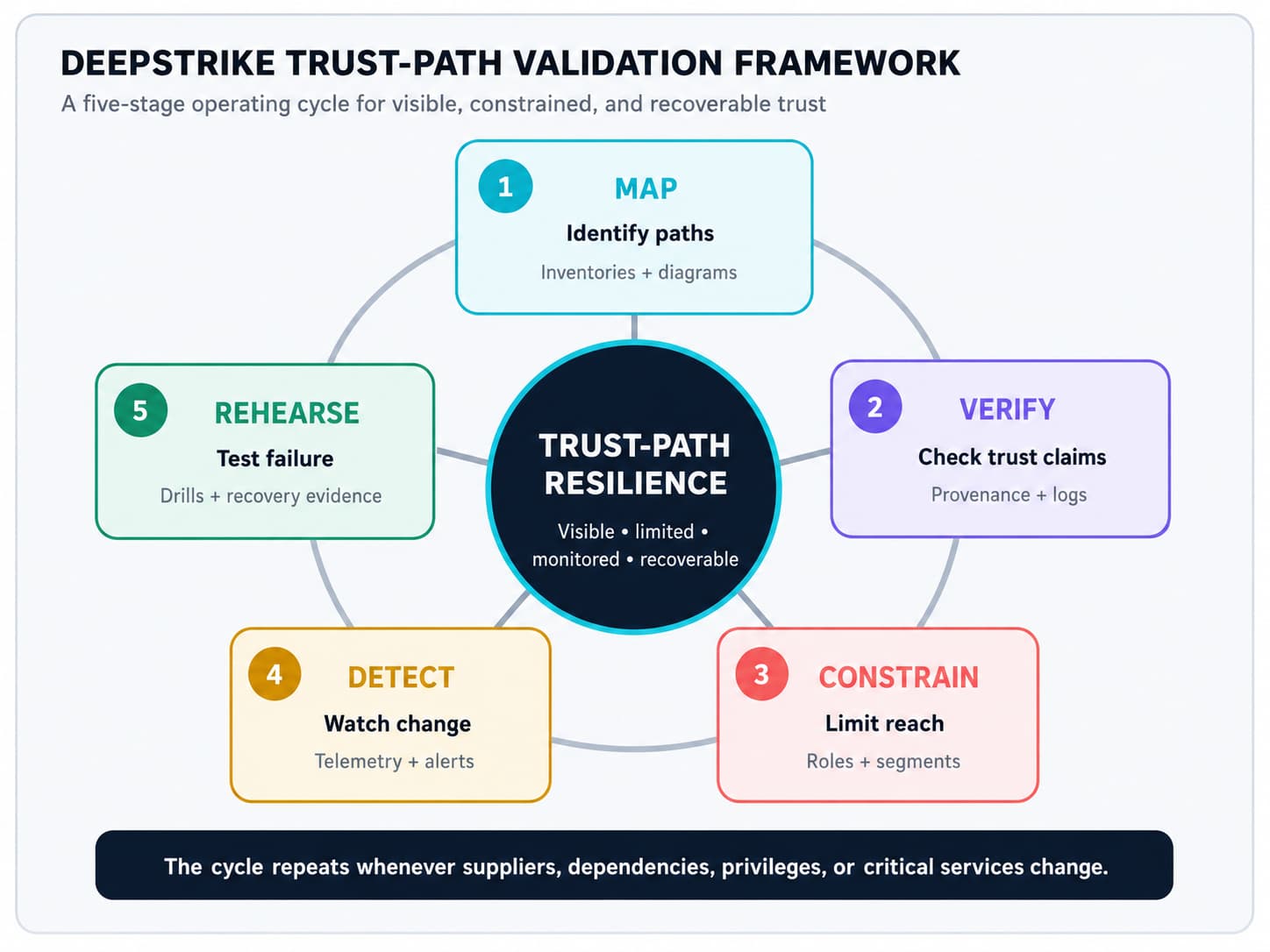
Figure 3. DeepStrike Trust-Path Validation Framework. Supply chain resilience depends on making trust visible, limiting it, monitoring it, and rehearsing what happens when it fails. Source: Original DeepStrike framework.
Within written authorization, asset-owner permission, approved rules of engagement, safety controls, and explicit boundaries, technical assessment can answer focused questions that questionnaires and scanners cannot.
Testing may validate:
Partner and third-party interfaces can be assessed through properly scoped API penetration testing. The distinction between automated vulnerability identification and human attack-path validation is also important; this vulnerability assessment versus penetration testing comparison explains their different evidence.
Testing cannot prove every supplier is secure, inspect an unapproved environment, guarantee artifact safety, compliance, certification, an audit result, or breach prevention, or replace C-SCRM, procurement, secure development, monitoring, incident response, and continuity. It demonstrates only what was assessed, when, and under the agreed scope and assumptions.
Metrics should expose risk and response capability, not reward paperwork. Define the denominator, owner, data source, target, exception process, and review cadence for each measure.
| Metric | What it tests | Suggested owner | Interpretation guardrail |
|---|---|---|---|
| Critical suppliers inventoried and tiered | Visibility and prioritization | TPRM / procurement | Tier quality matters more than a high raw percentage. |
| Privileged vendor access reviewed | Excess privilege and stale access | IAM / service owners | Include non-human and emergency accounts. |
| Critical software with current SBOM or component inventory | Deployment-level component visibility | AppSec / product owners | “Current” must map to the deployed version or artifact. |
| Production artifacts with verifiable provenance | Source/build evidence | Platform / release engineering | Verification must occur at a decision point, not only be generated. |
| Median time to identify affected dependencies | Exposure triage speed | Vulnerability management | Measure from authoritative notice to a validated inventory result. |
| Time to disable a vendor path | Containment capability | IAM / operations | Test safely; distinguish identity revocation from network isolation. |
| Time to rotate critical credentials and tokens | Recovery from trust loss | IAM / platform teams | Track dependency order and business disruption. |
| Supplier notification time against contract | Evidence and escalation performance | TPRM / legal | Separate initial notice from complete scoping. |
| Critical suppliers covered by an incident playbook | Prepared ownership | IR / service owners | A document that has not been exercised is weak evidence. |
| Recovery or substitution exercise completion | Operational resilience | Business continuity | Record whether the alternative actually met minimum service needs. |
| Retest closure rate for demonstrated trust-path findings | Remediation validation | Security assurance | Do not close on ticket status alone; confirm the path is blocked. |
Tailor targets to architecture and risk. A metric becomes compliance theater when it is easy to improve without reducing uncertainty, privilege, blast radius, or recovery time.
A supply chain attack compromises or maliciously substitutes an upstream product, dependency, supplier, service, delivery path, or trusted relationship and uses it to reach downstream targets. The defining feature is intentional weaponization of trust.
An attacker controls or substitutes an upstream product, service, identity, component, or distribution path, then abuses something customers accept such as an update, package, account, token, or managed tool. Local privilege, segmentation, monitoring, and deployment determine the impact.
SolarWinds is a well-supported example: attackers altered the Orion build and release path, and signed vendor updates delivered the compromised code. The case shows why signing must be paired with protected builds, provenance, staged rollout, behavior monitoring, and rapid isolation.
Major types include package or dependency compromise, repository and build attacks, artifact or update manipulation, signing-key abuse, SaaS/API/identity compromise, MSP or RMM abuse, hardware or firmware tampering, and cascading second-order compromise. Defenses should follow the actual trust path.
A third-party breach means an external organization was compromised. It becomes a supply chain attack only when the attacker intentionally uses that supplier, product, service, artifact, identity, or relationship against downstream targets.
Not automatically. An ordinary defect is a component vulnerability. It becomes a supply-chain compromise when an attacker inserts, substitutes, hijacks, or distributes the component through a trusted upstream path. Evaluate maintenance, ownership, provenance, review, response, and deployment rather than assuming open source is unsafe.
Inventory and tier critical suppliers and dependencies; constrain vendor and integration privileges; protect source and builds; verify provenance; control dependency sources; stage updates; and monitor downstream behavior. Rehearse revocation, clean rebuild, recovery, and substitution because prevention cannot remove all upstream risk.
Detection correlates source, build, artifact, registry, identity, vendor, SaaS, API, endpoint, workload, and network evidence. Signals include ownership or pipeline changes, missing provenance, unusual signing or vendor sessions, new OAuth scopes, token anomalies, and abnormal post-update behavior.
No. An SBOM helps identify declared components and affected software; it does not prove completeness, component safety, build integrity, or final behavior. It is most useful when current, mapped to deployed artifacts, and connected to vulnerability, VEX, provenance, and response workflows.
No organization can remove every upstream risk. Map trust, constrain its reach, monitor misuse, and rehearse revocation.
See data breach prevention guidance, or ask DeepStrike to validate authorized supply-chain trust paths.
Mohammed Khalil is a Cybersecurity Architect at DeepStrike and holds CISSP, OSCP, and OSWE certifications. His work focuses on application and cloud security, penetration testing, control validation, and communicating technical risk to security and executive stakeholders.

Stay secure with DeepStrike penetration testing services. Reach out for a quote or customized technical proposal today
Contact Us
