July 15, 2026
Updated: July 28, 2026
This guide maps common breach paths to prioritized controls, accountable owners, operating evidence, and appropriate validation methods helping organizations reduce the likelihood and impact of data breaches without implying that any control or assessment can eliminate risk.

Mohammed Khalil
By Mohammed Khalil • Researched and verified July 15, 2026
Direct answer. No organization can guarantee that it will prevent every data breach. It can materially reduce breach likelihood and impact through layered governance, identity, software, cloud, data, vendor, monitoring, response, recovery, and validation controls. Effective data breach prevention is a continuous risk-management process: reduce exposure, restrict reach, detect misuse, contain quickly, recover safely, and test whether controls work not a product or annual test.
How this guide was built. DeepStrike reviewed current US search intent, live ranking pages, official guidance, and original breach research. Source facts are cited near the claim; recommendations are editorial synthesis. Dataset totals are not combined where their populations, geography, time periods, or definitions differ.
Data breach prevention is the coordinated work of reducing opportunities for unauthorized access, limiting what a compromised identity or system can reach, detecting suspicious access and data movement, containing compromise quickly, preserving recoverability, and testing whether those protections operate as intended.
That definition is broader than blocking an attacker at the perimeter. It includes decisions about what data the organization collects, where it flows, who owns it, how software and cloud services handle it, which vendors can reach it, and what happens after an alert. This lifecycle view is consistent with NIST Cybersecurity Framework 2.0, which organizes cyber risk work across Govern, Identify, Protect, Detect, Respond, and Recover.
| Term | Meaning | Example | Key distinction |
|---|---|---|---|
| Security event | Observable occurrence requiring analysis | Unusual login | Not automatically an incident or breach |
| Security incident | Event that threatens confidentiality, integrity, or availability | Compromised endpoint | May not involve exposed data |
| Data exposure or leak | Data becomes accessible or leaves its intended boundary | Public cloud storage | May be accidental or malicious |
| Data breach | Unauthorized access, acquisition, use, or disclosure of protected data | Customer records accessed by an attacker | Definitions vary by law and context |
| Reportable breach | Legal or regulatory classification | Determined under an applicable law | Requires legal and jurisdictional analysis |
Editorial comparison for operational clarity; not legal advice. Legal definitions and notification duties depend on the applicable jurisdiction, sector, data type, contracts, and incident facts.
No. Unknown vulnerabilities, trusted-party compromise, control drift, human decisions, and determined adversaries make absolute prevention an unsafe claim. A defensible program instead creates several independent opportunities to reduce risk.
The goal is therefore to reduce likelihood, limit impact, and validate controls not to declare the organization breach-proof.
The strongest current cybersecurity statistics do not justify a single-cause story. It points to a portfolio problem: exploitable software, extortion, identity abuse, and third parties can converge on the same data. The figures below come from different datasets and should be interpreted separately.
| Finding | What it measures | Scope and period | Practical meaning | Method limit |
|---|---|---|---|---|
| 31% | Breaches beginning with exploitation of software vulnerabilities | Verizon 2026 DBIR; global contributors; Nov. 1, 2024–Oct. 31, 2025; n=19,905 non-error, non-misuse breaches | Internet-facing exposure and exploit evidence should influence patch order, not severity score alone. | VERIS-normalized contributed cases; not a census of all breaches. |
| 48% | Confirmed breaches involving ransomware | Verizon 2026 DBIR; 145 countries; more than 22,000 confirmed breaches in the corpus | Segmentation, detection, containment, and recovery must accompany entry controls. | The executive summary states a lower-bound corpus size, not an exact denominator. |
| USD 4.44M | Average studied breach cost | IBM 2025 report; 600 breached organizations in 16 countries/regions; incidents Mar. 2024–Feb. 2025 | Business impact supports risk-based investment, but an average cannot predict one company’s loss. | Interview-based cost study; studied breaches involved 2,960–113,620 records. |
| 3,322 | US publicly reported data compromises in 2025 | ITRC 2025 Annual Data Breach Report; United States; calendar 2025 | Public-notice volume remains high, but it is not a global incident total. | Built from public, legal, and voluntary notices; reporting practices affect completeness. |
| 70% (2,324/3,322) | ITRC notices that did not disclose attack information | Same ITRC 2025 US notice dataset | Organizations need their own evidence and timelines; public notices often cannot explain the control failure. | Measures notice content, not absence of an identified cause internally. |
Sources: Verizon 2026 Data Breach Investigations Report; IBM Cost of a Data Breach Report 2025; ITRC 2025 Annual Data Breach Report and ITRC findings summary. Retrieved July 15, 2026. The datasets differ in population, method, geography, and purpose and are not combined.
For a wider trends view, see DeepStrike’s data breach statistics research. Detailed financial context belongs in the separate cost of a data breach guide. Here, the decision is narrower: prioritize controls against the attack paths that can reach the organization’s most consequential data, and require proof that those controls operate.
Organizations commonly lose control of data through stolen or abused credentials; exploitation of an exposed vulnerability; broken web or API authorization; cloud IAM, storage, or secrets mistakes; malicious or negligent insiders; third-party access; and ransomware paired with exfiltration or operational disruption. These paths can overlap for example, an exposed application may yield a workload identity that can read a misconfigured data store.
The useful question is not only “How did someone get in?” It is also “Which control allowed the identity or system to expand its reach, discover sensitive data, move it, and remain undetected?” DeepStrike’s guide to the common causes of data breaches covers the causes cluster in more depth; the rest of this article maps those paths to prevention and proof.
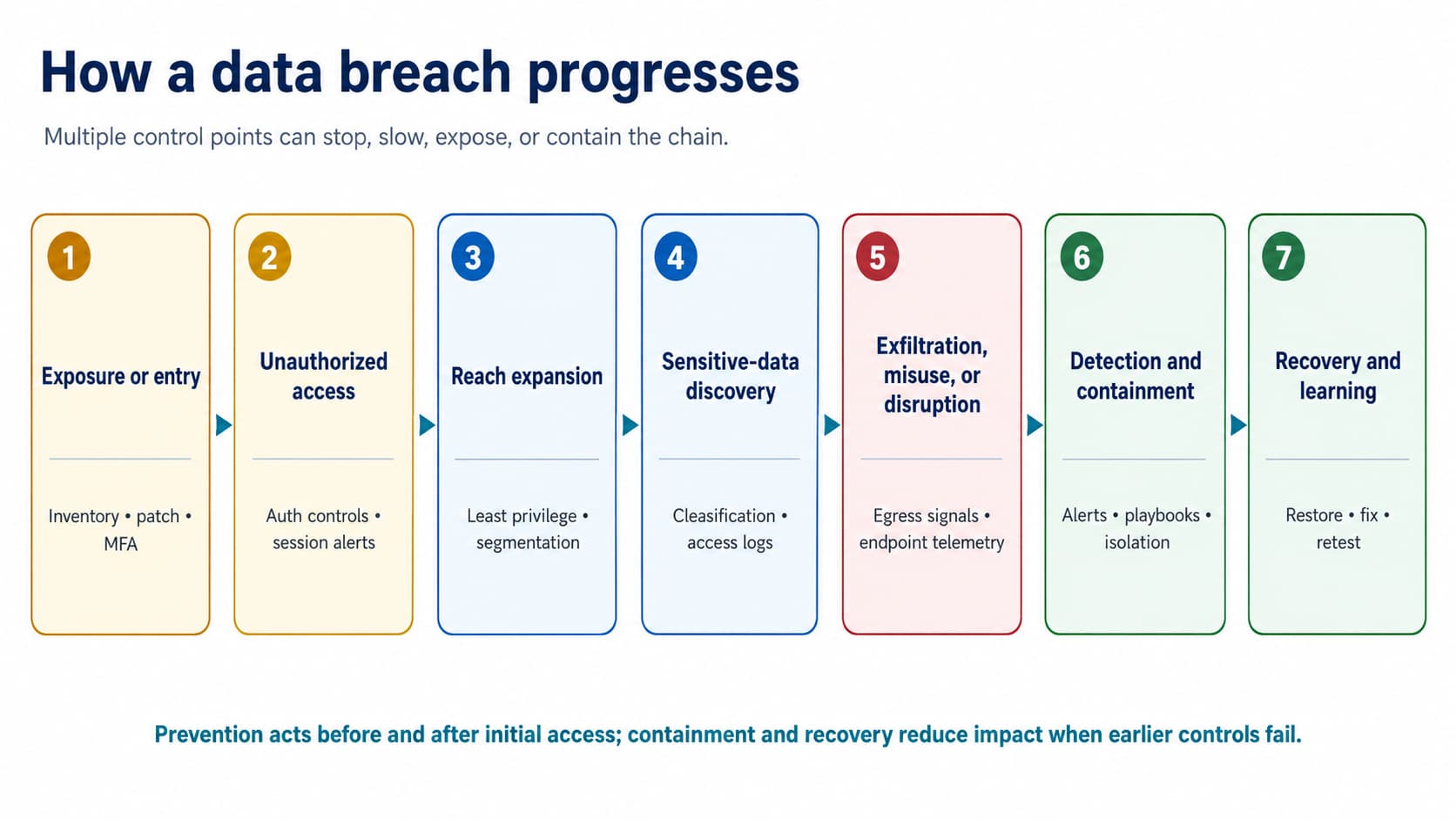
Figure 1. A data breach usually develops through multiple stages, creating several opportunities to prevent, detect, or contain the incident.
Source note: Original DeepStrike editorial synthesis informed by NIST CSF 2.0, NIST SP 800-61 Rev. 3, and the Verizon 2026 DBIR.
Framework status. The DeepStrike Breach Prevention Validation Map is an original DeepStrike editorial framework informed by NIST CSF 2.0, NIST SP 800-61 Rev. 3, CISA Cybersecurity Performance Goals, current breach research, and security-testing practice. It is not an official NIST, CISA, regulatory, certification, or compliance framework.
The map separates documented intent from demonstrable operation. A policy can state that privileged access is reviewed; operating evidence shows who reviewed which accounts, exceptions, removals, and timestamps; validation tests whether the resulting boundaries resist selected, authorized paths.
| Breach path | Asset/data at risk | Preventive controls | Detection/containment | Required evidence | Validation method | Primary owner | Limitation |
|---|---|---|---|---|---|---|---|
| Credential compromise and social engineering | Email, SaaS, admin consoles, customer data | Phishing-resistant MFA; secure recovery; conditional access; least privilege | Risky-login and session alerts; revoke tokens; isolate accounts | MFA enrollment; recovery changes; access reviews; exception log | Identity configuration review; controlled detection or purple-team exercise | IAM lead | MFA cannot fix excessive access, session theft, or unsafe recovery by itself. |
| Internet-facing vulnerability exploitation | Public services, edge devices, internal footholds | Exposure inventory; KEV-aware patching; hardening; compensating controls | Exploit telemetry; endpoint/network isolation; emergency change path | Asset owner; version/config state; SLA exceptions; remediation ticket | Authenticated scan; config review; scoped penetration test; retest | Infrastructure / product owner | A clean scan is time-bound and cannot cover unknown or out-of-scope weaknesses. |
| Web application or API authorization failure | Accounts, transactions, tenant and personal data | Server-side authorization; secure design; abuse controls; secret handling | App/API logs; unusual object access; rate and export controls | Threat model; tests in CI; route inventory; authz decisions; findings closure | Code review; API/web penetration test; negative authorization tests | AppSec + engineering | Testing selected roles and routes cannot prove every business rule or future release. |
| Cloud IAM, storage, secrets, or configuration exposure | Cloud data stores, workloads, keys, backups | Guardrails; least privilege; secret manager; private defaults; key separation | Cloud audit logs; posture alerts; key/session revocation; quarantine | Account inventory; policies; exposure findings; log coverage; exception owner | Cloud configuration review; attack-path analysis; authorized cloud test | Cloud platform owner | Provider boundaries, ephemeral assets, and SaaS controls may limit visibility. |
| Insider misuse or excessive privileges | Source code, finance, HR, customer and research data | Role design; separation of duties; just-in-time access; export restrictions | User/entity signals; database and admin audit; rapid access suspension | Joiner/mover/leaver records; access approvals; recertification; exception history | Privilege review; scenario exercise; selected control and alert tests | Data owner + IAM / HR | Monitoring must respect law and privacy; authorized users may still misuse legitimate access. |
| Third-party or software supply-chain compromise | Shared data, integrations, build pipelines, customer environments | Due diligence; scoped access; signed artifacts; dependency and pipeline controls | Vendor identity/app telemetry; kill switch; artifact monitoring; segmentation | Data-flow register; contract evidence; access list; attestations; offboarding proof | Access recertification; configuration review; tabletop; scoped integration test | Procurement + service owner | Questionnaires and attestations are point-in-time and cannot reveal every vendor weakness. |
| Ransomware with exfiltration or disruption | Endpoints, servers, backups, regulated and operational data | Hardening; segmentation; privilege control; protected backups; patching | Endpoint/network detection; egress monitoring; isolation; crisis coordination | Coverage maps; alert results; backup immutability/access; restore records; actions log | Purple-team test; tabletop; segmentation validation; restoration test | SOC / IR + IT resilience | Restoration reduces disruption but does not prove that data was not accessed or exfiltrated. |
Original DeepStrike editorial synthesis. Control selection and testing scope must be based on the organization’s assets, threats, business context, legal constraints, and approved risk decisions.
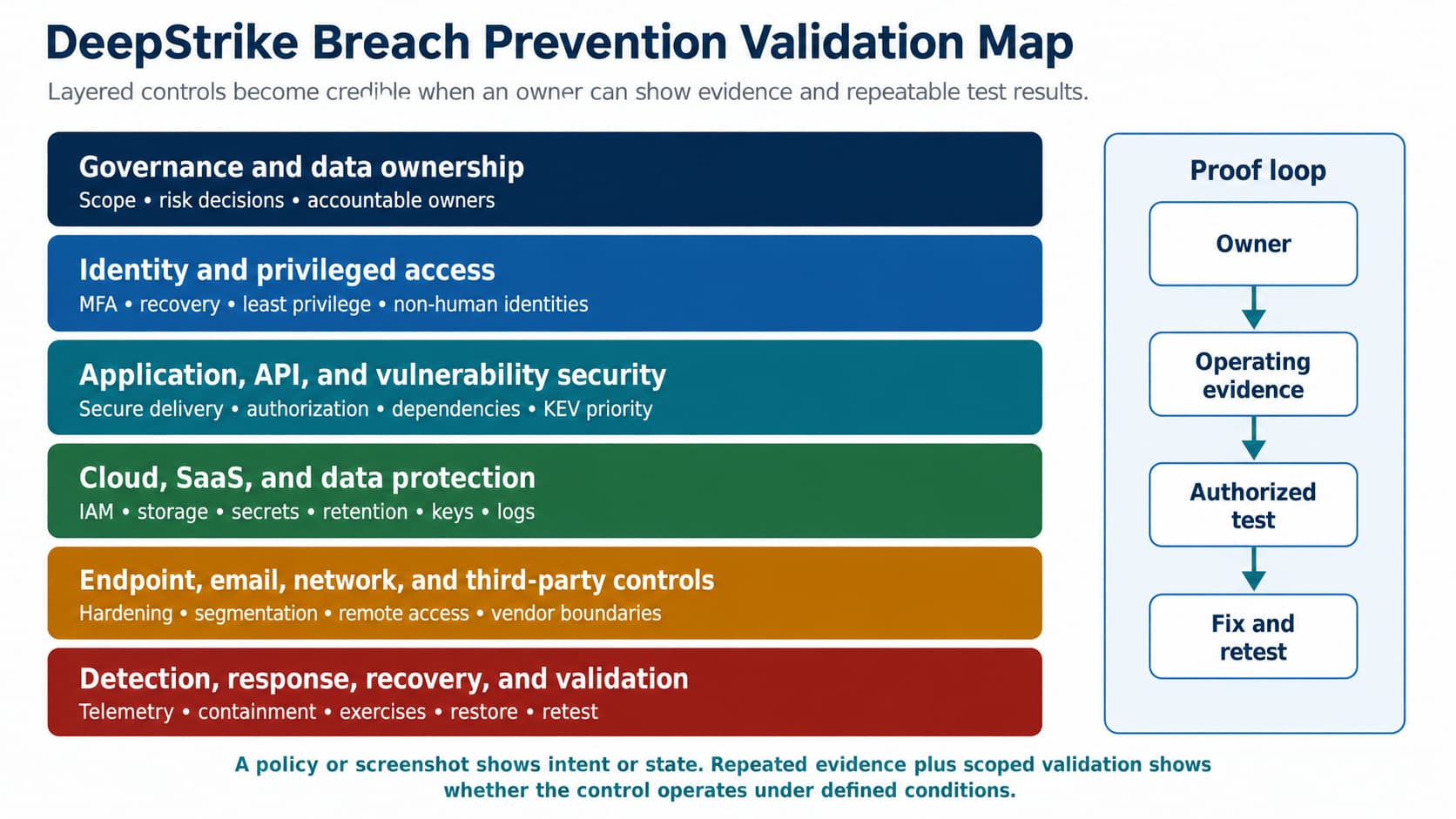
Figure 2. The DeepStrike Breach Prevention Validation Map connects breach paths to layered controls, evidence, ownership, and testing.
Source note: Original DeepStrike editorial framework informed by NIST CSF 2.0 and CISA Cybersecurity Performance Goals. It is not an official NIST or CISA framework.
These actions are ordered from visibility and exposure reduction through validation. Actual sequencing must follow risk: a known exposed administrative service or leaked secret may require immediate action before inventory work is complete.
This addresses unknown exposure and unowned data. Security or enterprise architecture usually maintains the inventory, but business and data owners must validate it. Evidence includes reconciled cloud, endpoint, domain, SaaS, repository, and data-store records with owners and last-seen dates. Test by sampling discovery sources against deployed assets and tracing a sensitive-data flow end to end. An inventory is a decision input; it does not prove that each asset is secure or that shadow technology is absent.
This limits the volume and sensitivity of data available to steal. Privacy, legal, records, and data owners set rules; system owners enforce them. Evidence includes approved classifications, collection purposes, retention jobs, deletion exceptions, and sampled outcomes. Test whether expired records are actually removed from production, replicas, exports, and relevant backups under the approved policy. Classification labels alone do not prevent access, and deletion can be constrained by legal holds, recovery design, or business obligations. The FTC’s data-protection guidance similarly emphasizes taking stock and keeping only what is needed.
This reduces credential-replay and account-takeover risk, especially for privileged and remote access. IAM owns enrollment, policy, recovery, and exceptions. Evidence includes coverage by user class, factor strength, fallback methods, recovery events, bypasses, and dormant accounts. Test policy paths including recovery and device replacement without harvesting real credentials. MFA does not correct excessive authorization, compromised endpoints, stolen sessions, or weak help-desk recovery; those paths need separate controls.
This limits reach after an identity is abused. IAM, platform teams, and data owners share ownership. Evidence includes role definitions, time-bound elevation, access approvals, privileged-session records, service-account owners, secret rotation, and recertification results. Test whether representative users and workloads can access only approved systems and actions, then confirm removals. Least privilege cannot eliminate misuse of correctly granted access and deteriorates when exceptions, inherited roles, or machine identities are not reviewed.
This addresses exploitation of public applications, edge devices, remote-access systems, and management planes. Vulnerability management coordinates; asset owners remediate. Evidence should join asset criticality, exposure, exploit evidence, CISA’s Known Exploited Vulnerabilities Catalog, version/configuration, owner, due date, exception, and retest. Validate with authenticated scanning, configuration review, and an authorized penetration test where impact warrants it. A CVSS score or scanner result alone does not establish business exposure or complete exploitability, and a patch cannot fix unsafe architecture.
This addresses broken authorization, injection, unsafe business logic, exposed secrets, vulnerable components, and build compromise. Engineering owns the code; AppSec supplies standards and assurance. Evidence includes threat models, endpoint and role inventories, server-side authorization tests, dependency decisions, secret scans, protected branches, build provenance, findings, and retests. Use code review, negative authorization tests, and authorized web application penetration testing. OWASP ASVS, the OWASP API Security Top 10, and the NIST Secure Software Development Framework are useful references. No test covers every business rule or future change.
This addresses public data, overbroad roles, leaked keys, cross-account trust, and missing audit trails. Cloud platform owners, SaaS administrators, and data owners share accountability. Evidence includes account and tenant inventories, policies, public-access findings, secret age and use, logging destinations, exception owners, and remediation retests. Validate through configuration review, attack-path analysis, and appropriately scoped cloud penetration testing. A posture tool sees only connected services and encoded rules; provider limits, ephemeral resources, and business-context errors can remain.
This reduces credential theft, malware execution, vulnerable client software, and unmanaged entry paths. Endpoint, messaging, and IT operations own baselines and coverage. Evidence includes device enrollment, supported versions, hardening conformance, email controls, endpoint telemetry health, remote-access configuration, exceptions, and removal times. Test representative platforms, control health, alert flow, and isolation procedures. Hardening cannot make a trusted device or message harmless, and coverage gaps may persist across contractors, unmanaged assets, or legacy systems.
This limits lateral movement and creates signals around access to critical data. Network, cloud, application, data, and SOC teams must agree on allowed flows. Evidence includes current diagrams, policy-as-code or firewall rules, flow logs, approved exceptions, alert logic, and test results. Validate representative allowed and denied paths plus alert escalation under written authorization. Segmentation can fail through identity-based access, shared services, hidden routes, or permissive exceptions; egress monitoring also needs context to distinguish legitimate bulk processing from misuse.
Encryption reduces exposure when storage media, databases, backups, or network traffic are accessed outside the intended trust boundary. Data, platform, and cryptographic-key owners define coverage and separation. Evidence includes data-to-key mapping, key policies, rotation, access logs, backup encryption, recovery-account controls, and restore records. Test key access, revocation, recovery, and representative decryption paths. Encryption does not prevent a legitimately authorized application or compromised identity from reading plaintext, and inaccessible keys can damage recovery.
This addresses supplier identities, integrations, support channels, processors, and software dependencies. Procurement and third-party risk coordinate, but the internal service and data owners accept the exposure. Evidence includes data flows, approved purpose, scoped accounts, contract terms, security evidence, subprocessor information, review dates, monitoring, and offboarding records. Test access recertification, disablement, segmentation, and incident-notification paths. Questionnaires, certifications, and contract clauses are evidence not guarantees and may not describe the exact service configuration used.
This reduces dwell time and impact when prevention fails. The SOC and incident-response lead coordinate with service owners, legal, privacy, communications, and resilience teams. Evidence includes telemetry coverage, tested alerts, escalation records, exercise actions, restore results, remediation tickets, and independent retests. Use detection validation, a tabletop, restoration testing, and targeted retesting. Passing one exercise proves performance only for the defined scenario, people, scope, and time; it does not guarantee future detection or recovery.
Choose the method that answers the decision at hand. Scope, authorization, safety controls, data handling, and success criteria should be agreed before testing; findings should be assigned and retested.
| Validation method | What it can test | Best use | Typical limitation | Evidence produced |
|---|---|---|---|---|
| Vulnerability scanning | Potential known weaknesses and missing patches across discoverable assets | Broad, repeatable exposure triage | Does not prove full exploitability, business impact, unknown flaws, or complete asset coverage | Timestamped findings, asset scope, scan configuration, exceptions, remediation status |
| Configuration and cloud-security review | Settings, IAM policies, logging, storage exposure, guardrails, and trust paths | Finding unsafe states and control drift | Depends on connected scope, rule quality, provider visibility, and business context | Configuration snapshots, policy analysis, exposure paths, prioritized fixes |
| Web, API, network, and cloud penetration testing | Selected exploitable paths, authentication, authorization, trust boundaries, and impact | Validating high-risk systems within an approved scope and time window | Not a complete vulnerability inventory; results age as systems change | Rules of engagement, evidence, affected assets, risk narrative, remediation and retest results |
| Red-team exercise | Agreed adversarial objectives plus prevention, detection, decision, and response performance | Testing realistic cross-control assumptions | Objective-led, time-bound, and deliberately incomplete as an inventory | Objective results, control observations, detection timeline, response lessons |
| Detection validation / purple-team exercise | Whether selected behaviors generate usable telemetry, alerts, triage, and containment | Improving control-to-alert coverage collaboratively | Tests defined behaviors; cannot establish detection of every technique or variation | Test cases, signal path, alert fidelity, response timing, tuning and retest |
| Incident-response tabletop | Roles, decisions, escalation, communications, dependencies, and legal questions | Rehearsing coordinated judgment before a crisis | Does not test the technical effectiveness of every preventive or detective control | Scenario record, decisions, timing, gaps, owners, due dates |
| Backup restoration test | Ability to retrieve and restore defined systems/data with protected recovery access | Validating recoverability and recovery assumptions | Validates recovery not breach prevention or absence of exfiltration | Restore logs, integrity checks, elapsed time, dependencies, exceptions |
| Third-party access review | Continued need, scope, owner, authentication, monitoring, and offboarding for supplier access | Reducing inherited and forgotten access | Evidence may be self-reported and cannot reveal every supplier compromise | Recertification, removals, exceptions, test disablement, contract or assurance records |
Testing methods are complementary. No single assessment proves compliance, guarantees security, or covers every asset and attack path. DeepStrike’s vulnerability assessment vs penetration testing guide explains the core distinction in more detail.
Use the calendar as a coordination device, not a universal maturity model. Accelerate issues with active exploitation, exposed administrative access, unsafe secrets, uncontrolled data access, or legal and operational urgency.
| Days | Action | Owner | Evidence | Dependency | Completion criterion |
|---|---|---|---|---|---|
| 0–30 | Identify crown-jewel data and owners | CISO / data owners | Data register, business impact, accountable owner | Leadership and business input | Priority data stores and decisions have named owners |
| 0–30 | Confirm asset and internet-exposure inventory | Security architecture / IT | Reconciled domains, IPs, cloud, SaaS, apps, edge assets | Discovery sources and ownership data | High-confidence external inventory with gaps assigned |
| 0–30 | Review privileged and remote-access accounts | IAM / IT | Account list, factors, owners, last use, exceptions | Authoritative identity and HR records | Orphans disabled; urgent factors and privilege corrected |
| 0–30 | Triage KEV and critical internet-facing weaknesses | Vulnerability lead / owners | Exposure, exploit evidence, fix/mitigation, due date | Accurate versions and change path | Each priority weakness fixed, mitigated, or risk-accepted by an owner |
| 0–30 | Confirm incident contacts and escalation | IR lead / legal / leadership | Current roster, secure channels, decision authority | Executive and counsel availability | Contact and escalation test completed |
| 0–30 | Identify critical third parties and processors | TPRM / procurement / service owners | Data flows, access, owner, contract, dependency | Vendor and architecture records | Critical suppliers ranked; unknown access assigned |
| 31–60 | Expand phishing-resistant MFA | IAM | Coverage by privileged/remote group; recovery and exceptions | Supported identity and device paths | Priority users enrolled; exceptions time-bound and approved |
| 31–60 | Reduce excessive privilege | IAM / platform / data owners | Role changes, removals, JIT/PAM use, recertification | Owner decisions and application roles | Priority excess access removed and sampled |
| 31–60 | Fix high-risk application, API, and cloud findings | Engineering / AppSec / cloud | Tickets, code/config changes, test evidence | Release windows and asset ownership | Risk-ranked findings fixed or formally treated |
| 31–60 | Improve logging around critical data stores | SOC / data platform | Events, destinations, retention, alerts, owner | Telemetry and privacy decisions | Representative access and export events reach tested alerts |
| 31–60 | Review vendor access and contractual evidence | TPRM / legal / service owner | Access recertification, terms, assurance, exceptions | Vendor cooperation and contract rights | Unneeded access removed; evidence gaps assigned |
| 31–60 | Test backup isolation and restoration | IT resilience / service owner | Restore record, integrity result, protected admin path | Known recovery objective and clean environment | Representative critical service restored and exceptions logged |
| 61–90 | Conduct appropriate authorized penetration testing | Security testing / asset owner | Scope, authorization, findings, business impact | Stable target, rules, safety controls | Agreed paths tested; findings owned and prioritized |
| 61–90 | Run an IR or ransomware tabletop | IR lead | Decisions, timings, communications, action register | Current playbooks and participants | Actions have owners and dates; material gaps escalated |
| 61–90 | Test alerting and escalation | SOC / service owners | Test cases, signals, alerts, triage, containment | Safe test methods and telemetry | Priority cases produce a usable, acknowledged path |
| 61–90 | Retest remediated findings | Independent tester / owners | Retest evidence and residual risk | Fix deployed in the tested environment | Fix verified or finding reopened with owner |
| 61–90 | Close evidence gaps | Control owners / assurance | Missing artifacts, exceptions, review trail | Defined evidence standard | Priority controls have current, reviewable evidence |
| 61–90 | Establish recurring reviews and metrics | CISO / risk / control owners | Metric definitions, denominator, cadence, forum | Reliable source systems | Owners review trends and trigger corrective action |
Original DeepStrike implementation model. Sequencing must be adjusted for active threats, asset criticality, regulatory and contractual context, organizational dependencies, and approved risk decisions.
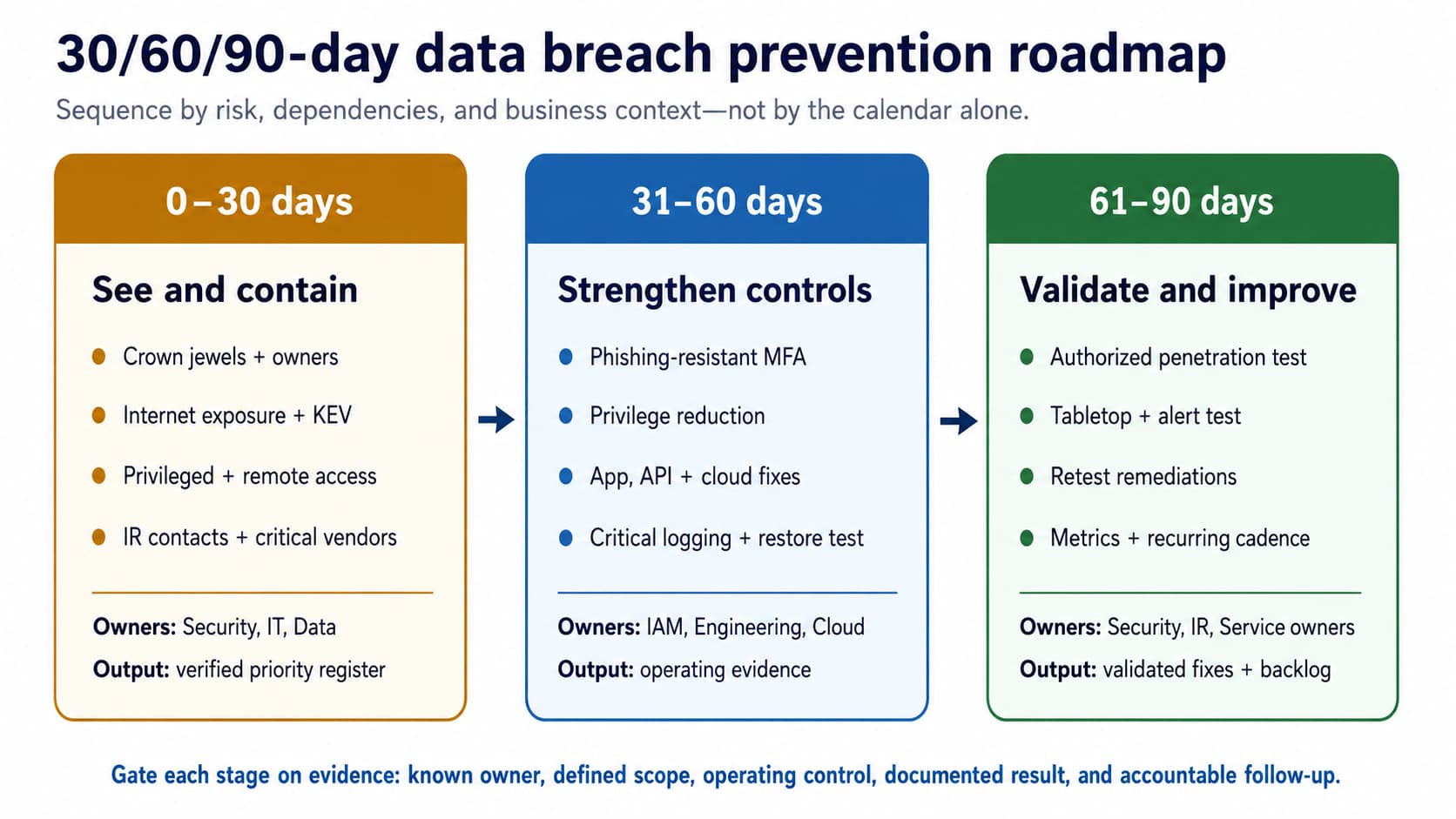
Figure 3. A risk-based 30/60/90-day roadmap for moving from exposure visibility to control validation and resilience.
Source note: Original DeepStrike implementation model based on the controls discussed in this article.
A useful metric has an owner, a stable definition, a denominator, a source system, a review cadence, and a decision it can trigger. Do not import universal “good” thresholds without considering business exposure and measurement quality.
Treat the situation as a suspected incident until investigation and legal analysis establish what occurred. Activate the approved response process; involve security, IT, leadership, legal counsel, privacy, communications, and other necessary stakeholders; preserve evidence; and contain further loss with qualified responder guidance. Identify affected systems, data, accounts, and third parties, and document decisions and timestamps.
NIST SP 800-61 Rev. 3 integrates incident response across cybersecurity risk management, while the FTC’s Data Breach Response guide recommends securing operations, assembling the right team, fixing vulnerabilities, and preserving evidence. Determine notification duties under the laws, sectors, contracts, data types, jurisdictions, and facts that actually apply. There is no universal deadline. Qualified legal or privacy counsel should guide that determination. After containment, remediate root causes and verify the fixes.
Authorized penetration testing can validate selected exploitable paths into agreed systems; test authentication and authorization; assess web, API, cloud, and network exposure; demonstrate potential business impact within the scope; support remediation priorities; and retest whether identified weaknesses were fixed.
It cannot guarantee that a future breach will not happen, automatically test every asset or attack path, replace vulnerability management, monitoring, incident response, backups, governance, or staff training, prove compliance by itself, or guarantee an audit result. Testing should proceed only with written authorization, approved assets, a defined scope, rules of engagement, safety controls, asset-owner permission, and controlled evidence handling.
Start with crown-jewel data and reachable attack paths. Prioritize identity, internet exposure, application/API authorization, cloud access, segmentation, monitoring, recovery, and evidence-based validation according to risk.
Identify the data and services that would cause the most harm, protect administrator and remote accounts with phishing-resistant MFA, patch exposed systems, reduce retained data, verify backups, restrict vendors, and maintain a usable response contact list. Managed services still require clear ownership and evidence.
Encryption can limit exposure when data is accessed outside the intended trust boundary. It does not stop an authorized application, user, or compromised session from reading plaintext, and it requires sound key governance.
No. Ransomware may disrupt availability without confirmed unauthorized access to protected data. Exfiltration can create a breach, but the legal classification depends on evidence and applicable law.
Set a risk-based cadence and retest after material changes, high-risk findings, control failures, or major supplier and architecture changes. Some controls need continuous monitoring; others suit periodic exercises. There is no universal interval.
Data loss prevention (DLP) focuses on how sensitive data is discovered, used, and moved. Broader data breach prevention also covers governance, identity, application and API security, cloud configuration, vendors, monitoring, incident response, recovery, and control validation. DLP can support the program, but it is not the whole program.
Data breach prevention is credible when the organization can connect a consequential data asset to its likely attack paths, accountable owners, layered controls, current evidence, and appropriate validation. The objective is not a perfect checklist; it is a repeatable ability to reduce exposure, constrain reach, detect misuse, contain harm, recover safely, and learn from evidence.
Data breach prevention depends on controls that work under realistic pressure. An authorized, carefully scoped penetration test can help validate selected web, application, cloud, and network attack paths and confirm whether identified fixes hold up during retesting. It supports a wider risk-reduction program; it cannot guarantee breach prevention or compliance.
Mohammed Khalil is a Cybersecurity Architect at DeepStrike and holds CISSP, OSCP, and OSWE certifications. His work focuses on application and cloud security, penetration testing, control validation, and communicating technical risk to security and executive stakeholders.

Stay secure with DeepStrike penetration testing services. Reach out for a quote or customized technical proposal today
Contact Us
