June 8, 2026
Updated: October 18, 2026
A practical guide to API pentesting scope, OWASP API risks, methodology, checklist items, cost drivers, timelines, reporting, and provider selection.

Mohammed Khalil
API penetration testing services are controlled security assessments that test REST, GraphQL, SOAP, gRPC, WebSocket, mobile-backend, partner, internal, and public API endpoints for exploitable weaknesses in authentication, authorization, input validation, business logic, rate limiting, data exposure, and server-side security controls.
A strong API pentest goes beyond automated scanning. It manually validates whether attackers can access unauthorized data, abuse workflows, bypass roles, manipulate object identifiers, exhaust resources, or chain API flaws into real business impact. Authenticated and role-based testing should be the baseline for business-critical APIs, because many serious API vulnerabilities only appear after a user logs in and interacts with protected endpoints. When choosing a vendor, compare the best API penetration testing companies.
This guide covers API pentest scope, OWASP API testing, practical checklist items, testing methodology, REST vs GraphQL vs SOAP vs gRPC/WebSocket differences, cost drivers, timelines, report deliverables, compliance evidence, provider selection, and red flags.
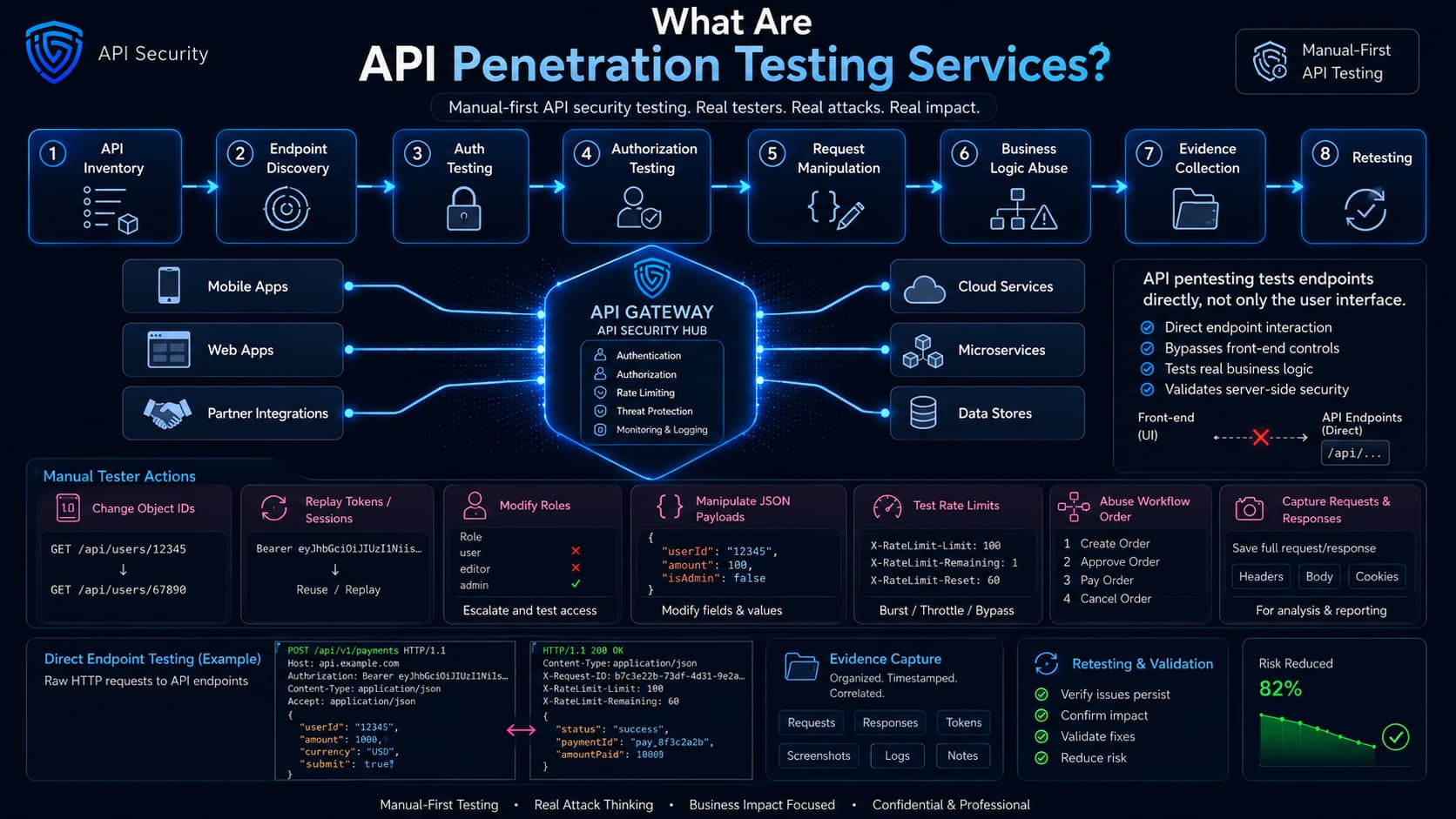
API penetration testing services are specialized security assessments that target application programming interfaces to find and validate exploitable vulnerabilities. APIs are the backend contracts used by mobile apps, single-page applications, cloud services, microservices, third-party integrations, and partner ecosystems to exchange data and execute business workflows.
Unlike browser-only testing, API pentesting involves crafting and sending requests directly to API endpoints. Testers use documentation such as OpenAPI specifications, Swagger files, Postman collections, proxy-captured traffic, application behavior, and manual discovery to enumerate endpoints, parameters, roles, objects, and operations. Clear API documentation also helps developers keep endpoint details and usage instructions in one place.
The key difference from a basic scan is exploit validation. A scanner may flag missing headers, known CVEs, or unusual responses. A manual API pentester tests whether a valid user can access another user’s object, whether an admin-only function can be called by a standard account, whether a token can be replayed, or whether a workflow can be abused in a way that affects the business.
API vulnerability assessment and API penetration testing are related, but they are not the same. Mature security programs often use both: broad automated discovery for recurring visibility and manual pentesting for deeper validation of real attack paths.
| Category | API Vulnerability Assessment | API Penetration Testing | Buyer Takeaway |
|---|---|---|---|
| Primary goal | Identify and prioritize possible API security issues. | Validate exploitability and business impact through manual testing. | Use assessment for breadth and pentesting for proof of risk. |
| Depth | Broad but usually shallow. | Narrower but deeper and attack-driven. | Scans find signals; pentests test attack paths. |
| Automation level | Mostly automated with human review where mature. | Manual-led with selective automation. | Tools help, but tester skill determines depth. |
| Authenticated testing | May be limited or omitted. | Should include authenticated and role-based testing. | APIs often fail behind login, not only at public endpoints. |
| Authorization validation | Often basic. | Tests object, property, function, role, and tenant boundaries. | Authorization is one of the highest-value API test areas. |
| Exploit validation | Usually reports possible exposure. | Attempts safe exploitation where authorized. | Validation turns alerts into business risk. |
| Business logic | Limited because scanners do not understand workflows. | Tests real workflows, abuse cases, race conditions, and edge cases. | Business logic often requires manual analysis. |
| Deliverables | List of findings and severity ratings. | Report with evidence, reproduction steps, impact, and fixes. | Demand proof, not only a scanner export. |
APIs expose business logic directly. They may process payments, orders, messages, documents, identities, tokens, health records, financial data, or enterprise workflows. If an API trusts the client too much, an attacker can bypass the UI and interact with the backend directly.
For SaaS, fintech, healthcare, marketplaces, and API-first platforms, authenticated API testing is usually more valuable than unauthenticated scanning alone. The highest-risk findings often require multiple roles, realistic test data, and an understanding of how the business workflow should behave.
API pentest scope should define exactly which APIs, environments, roles, authentication methods, endpoints, integrations, and testing boundaries are authorized. It should also state what is excluded, which test windows apply, how critical issues are escalated, and how retesting will work.
| Scope Area | What Testers Examine | Example Finding | Business Risk |
|---|---|---|---|
| REST APIs | Endpoints, methods, path/query parameters, JSON bodies, headers, and status codes. | Changing an order ID returns another user’s order. | Unauthorized data access and privacy exposure. |
| GraphQL APIs | Introspection, queries, mutations, field-level authorization, query depth, aliases, batching, and resolver behavior. | A standard user can query admin-only fields. | Sensitive data exposure or privilege escalation. |
| SOAP APIs | WSDL exposure, XML payloads, SOAPAction headers, schema validation, WS-Security patterns, and legacy auth. | An XML parser accepts unsafe entity behavior or exposes internal files. | Legacy API compromise or data leakage. |
| gRPC APIs | Proto definitions, service methods, metadata, message validation, auth context, and streaming behavior. | A low-privilege client calls an internal method exposed through gRPC. | Unauthorized internal function execution. |
| WebSocket APIs | Handshake controls, session binding, message schemas, authorization, event flows, and rate limits. | A user subscribes to another user’s event stream. | Real-time data leakage or account abuse. |
| Authentication | Login, signup, password reset, OAuth/OIDC, JWT, session cookies, API keys, and token lifecycle. | Expired JWTs remain valid or refresh tokens are not rotated. | Account takeover and persistent unauthorized access. |
| Authorization and object access | Roles, tenants, object ownership, function permissions, and property-level controls. | A user modifies another tenant’s record by changing tenant_id. | Tenant escape and cross-account data breach. |
| Rate limiting and abuse controls | Quotas, throttling, pagination, bulk exports, brute force resistance, and expensive operations. | No limit on export endpoint or password-reset attempts. | Scraping, account enumeration, service disruption. |
| Business logic | Payment, order, approval, refund, booking, transfer, and state-change workflows. | A user replays a payment adjustment request twice. | Fraud, revenue loss, or workflow manipulation. |
| Webhooks and callbacks | Signature verification, replay resistance, source validation, payload validation, and SSRF risk. | Unsigned webhook requests are accepted as trusted events. | Forged transactions or workflow abuse. |
| API gateway and infrastructure | Gateway routing, CORS, authentication forwarding, default consoles, logging, and backend exposure. | Backend API is reachable directly and bypasses gateway rules. | Control bypass and unmonitored access. |
Do not include third-party APIs, payment processors, partner systems, vendor environments, or systems outside organizational control unless explicit written authorization exists. API tests should be legally and operationally scoped before any request is sent.
The OWASP API Security Top 10 is best used as a risk taxonomy, not a complete test plan. It helps categorize common API risks, but a real pentest must still validate implementation-specific authorization, data flows, business rules, token behavior, and abuse cases.
| OWASP API Risk | What Testers Validate | Example Finding | Why It Matters |
|---|---|---|---|
| Broken Object Level Authorization | Object IDs, tenant IDs, account IDs, ownership checks, and horizontal privilege boundaries. | Changing /orders/123 to /orders/124 returns another user’s order. | Attackers may access or modify objects they do not own. |
| Broken Authentication | Login flows, API keys, OAuth/OIDC, JWT validation, token expiry, refresh behavior, and brute-force resistance. | Expired tokens remain accepted after logout. | Attackers can hijack or impersonate users. |
| Broken Object Property Level Authorization | Overexposed fields, writable protected properties, mass assignment, and role-specific fields. | A user submits isAdmin=true in JSON and changes their role. | Attackers can read or change fields they should not control. |
| Unrestricted Resource Consumption | Rate limits, pagination, response size, expensive queries, uploads, and concurrency. | An endpoint returns every record with no pagination or throttling. | Scraping, DoS, cost abuse, and service instability. |
| Broken Function Level Authorization | Admin, support, internal, or privileged functions invoked by lower-privilege users. | A standard user calls an admin delete endpoint successfully. | Privilege escalation and unauthorized actions. |
| Unrestricted Access to Sensitive Business Flows | High-value workflows such as checkout, booking, password reset, refunds, referrals, or transfers. | A user repeats discount or refund requests outside intended limits. | Fraud, stock depletion, workflow abuse, or financial loss. |
| Server-Side Request Forgery | URL-fetching features, webhook callbacks, file importers, metadata access, and outbound request validation. | Supplying an internal URL causes the API to fetch private resources. | Access to internal services or cloud metadata. |
| Security Misconfiguration | Debug mode, verbose errors, CORS, default credentials, exposed docs, weak headers, and gateway settings. | API docs expose hidden admin endpoints in production. | Attackers gain useful information or bypass controls. |
| Improper Inventory Management | Deprecated versions, undocumented APIs, shadow endpoints, forgotten environments, and inconsistent controls. | Old v1 API bypasses MFA required by v2. | Legacy endpoints remain exploitable. |
| Unsafe Consumption of APIs | Trust in third-party API responses, webhook data, partner integrations, and schema validation. | A partner webhook is trusted without signature verification. | External data can trigger internal compromise or business abuse. |
OWASP mapping is useful in a report, but the finding should still include evidence: the request, response, affected role, affected endpoint, reproduction steps, impact, and remediation guidance.
A practical API pentest checklist should cover common risk categories and custom business flows. The exact list should be adapted to the API type, roles, data sensitivity, and environment.
A professional API pentest should be repeatable, evidence-driven, and flexible enough to follow real attack paths. A practical methodology usually includes these phases:
Different API architectures require different test techniques. Buyers should confirm that the provider can test the API types actually used in the product, not only generic REST endpoints.
| API Type | Common Test Focus | Example Risk | Buyer Note |
|---|---|---|---|
| REST API | Endpoint enumeration, HTTP methods, path/query parameters, JSON payloads, object IDs, mass assignment, and rate limits. | Changing /orders/123 to /orders/124 returns another user’s order. | REST is common, but each method and object boundary must be tested. |
| GraphQL API | Introspection, query depth, resolver authorization, field-level controls, batching, aliases, fragments, and query complexity. | A standard user retrieves admin-only fields or sends an expensive nested query. | GraphQL needs field-level and resolver-level testing, not only endpoint checks. |
| SOAP API | WSDL exposure, XML payloads, SOAPAction headers, schema validation, XML parser behavior, and legacy authentication. | WSDL reveals admin operations or XML parsing exposes internal files. | SOAP often appears in legacy enterprise systems and needs XML-aware testing. |
| gRPC API | Proto definitions, service methods, metadata, authorization context, streaming behavior, and message validation. | A client calls a privileged service method by modifying metadata. | gRPC requires protocol-aware tooling and strong service-level authorization review. |
| WebSocket API | Handshake authentication, message schemas, subscriptions, room/channel authorization, event ordering, and rate limits. | A user subscribes to another user’s real-time event stream. | WebSockets need stateful testing across connection lifecycle and message flows. |
Unauthenticated API testing only scratches the surface. Most serious API findings appear after a user has a valid token and begins interacting with protected endpoints. The scope should include realistic roles and test data.
Each role should be tested for allowed and disallowed actions. A good test does not only ask “can this role do what it should?” It also asks “can this role do what it should not?” That is where BOLA, BFLA, tenant escape, mass assignment, and privilege escalation often appear.
API testing depth depends heavily on how much access and context testers receive.
| Testing Model | What Testers Receive | Best For | Limitation |
|---|---|---|---|
| Black box | Minimal information, public endpoints, and external discovery. | External exposure checks and attacker realism. | Often misses authenticated, role-based, and business-logic flaws. |
| Grey box | API docs, test accounts, roles, tokens, architecture context, and target scope. | Most business-critical API pentests. | Requires client preparation but gives much better coverage. |
| White box | Source code, architecture, configuration, logs, and deeper implementation context. | High-risk, regulated, complex, or source-assisted testing. | More coordination and review time, but stronger root-cause visibility. |
For most serious APIs, grey-box testing should be the baseline. Black-box testing can be useful, but it is usually not enough to validate role boundaries, object ownership, business logic, and multi-tenant behavior.
API penetration testing cost is usually quote-based because effort depends on scope and depth. A small, well-documented REST API is very different from a multi-tenant platform with REST, GraphQL, partner APIs, mobile-backend APIs, complex OAuth flows, and several roles.
| Cost Driver | Why It Changes Effort | Buyer Question to Ask |
|---|---|---|
| Number of endpoints | More endpoints and methods require more discovery, testing, and evidence collection. | How many endpoints, methods, and versions are included? |
| API types | REST, GraphQL, SOAP, gRPC, and WebSocket APIs require different techniques. | Does the quote cover all API technologies we use? |
| User roles and tenants | Each role and tenant scenario multiplies authorization tests. | How many roles and tenant combinations will be tested? |
| Authentication complexity | OAuth, OIDC, JWT, SSO, MFA, API keys, and service accounts increase setup and test time. | Which auth flows are included? |
| Documentation quality | Good OpenAPI, Postman, schema, or proto files speed up testing; missing docs require discovery. | What documentation do you need before testing starts? |
| Business logic complexity | Custom workflows require creative manual testing and domain understanding. | Which high-risk business flows will be tested? |
| Compliance mapping | Mapping findings to frameworks or internal controls adds reporting effort. | Will findings be mapped to compliance or risk-control categories? |
| Retesting | Fix validation requires additional effort after remediation. | Is retesting included, and what is the retest window? |
Buyers should compare what is included, not only the final number. A low quote that excludes authenticated testing, multiple roles, GraphQL, business logic, or retesting may look cheaper but fail to answer the real risk question.
Duration depends on scope, API complexity, access readiness, and reporting depth. A small API surface may take several business days. A standard REST API with authentication and several roles often takes one to two weeks. A complex API ecosystem with multiple services, GraphQL, partner integrations, and sensitive workflows may take two to four weeks. Enterprise API platforms with multiple environments, compliance mapping, and retesting may require four or more weeks.
The timeline increases when documentation is incomplete, credentials are missing, OAuth or SSO setup is complex, multiple roles must be tested, APIs are undocumented, production testing is restricted, or retesting must be scheduled after remediation.
A useful API pentest report should serve engineers, security leaders, product owners, and compliance stakeholders. It should not be a vague scanner export.
The best reports make it easy for developers to reproduce and fix the issue, while giving leadership a clear view of which API risks matter first.
API pentesting can support compliance and customer security evidence, but it does not automatically make an organization compliant. It provides documented evidence that API security testing was performed, findings were validated, and remediation was prioritized or completed.
API testing may be relevant to SOC 2, ISO 27001, PCI DSS, HIPAA, GDPR, NIST-aligned risk management, enterprise customer questionnaires, vendor due diligence, and sector-specific security reviews. The exact scope depends on the systems, data flows, control objectives, and obligations involved.
For compliance-sensitive APIs, confirm with the relevant auditor, QSA, legal counsel, or compliance advisor which APIs, environments, roles, data flows, and integrations must be included. Treat the pentest report as evidence for security testing and remediation, not as a standalone compliance certificate.
When evaluating API penetration testing providers, focus on technical depth, role-based testing, reporting quality, and scope clarity. API security is not just a web scan with a different URL list.
API penetration testing focuses on API endpoints, authentication, authorization, object access, rate limits, business logic, and backend data exposure. It often overlaps with other security services, but it is not identical to them.
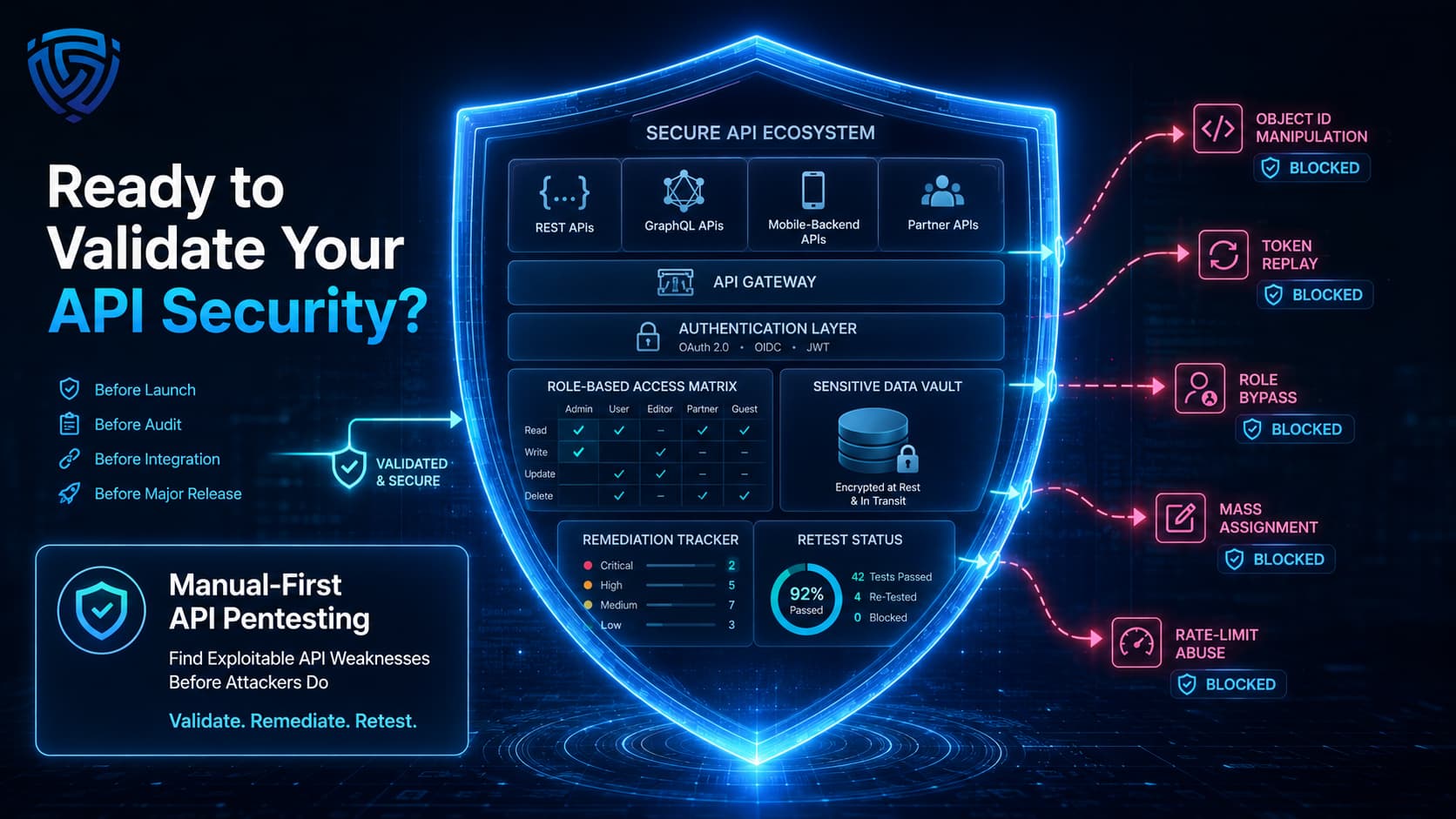
API penetration testing services help organizations validate whether APIs can be abused to access unauthorized data, bypass roles, manipulate workflows, exhaust resources, or expose sensitive business logic. The strongest API pentests combine OWASP-aligned risk coverage, authenticated role-based testing, manual exploit validation, clear reporting, remediation guidance, and retesting.
For buyers, the most important questions are not only “how many endpoints will be scanned?” but “which roles will be tested, which business flows will be abused, which findings will be manually validated, and what evidence will the report provide?” A strong API pentest should answer those questions clearly before testing starts and again in the final report.
API penetration testing services are controlled security assessments where testers attempt to identify and validate exploitable vulnerabilities in API endpoints, authentication flows, authorization logic, business workflows, rate limits, and data exposure controls.
Scope can include REST APIs, GraphQL APIs, SOAP APIs, gRPC APIs, WebSocket APIs, internal APIs, public APIs, partner APIs, mobile-backend APIs, authentication flows, API gateways, webhooks, roles, tenants, and documented or undocumented endpoints.
No. API vulnerability scanning identifies possible weaknesses. API penetration testing manually validates whether weaknesses can be exploited and what business impact they create.
OWASP API testing means using the OWASP API Security Top 10 as a risk taxonomy while validating real API implementation issues such as BOLA, broken authentication, property-level authorization, rate-limit abuse, business flow abuse, SSRF, misconfiguration, inventory gaps, and unsafe third-party API consumption.
Common findings include broken object-level authorization, broken function-level authorization, weak authentication, excessive data exposure, mass assignment, weak rate limits, injection, insecure webhooks, exposed legacy endpoints, and business logic abuse.
Cost is usually quote-based. Key drivers include endpoint count, API types, roles, authentication complexity, documentation quality, business logic complexity, compliance mapping, reporting depth, and retesting.
A small API may take several business days. A standard API with authentication and several roles may take one to two weeks. Complex or enterprise API environments may take two to four weeks or more, especially when retesting is included.
It should. For business-critical APIs, authenticated testing with multiple roles is usually essential because many serious API vulnerabilities are hidden behind valid tokens and role-based workflows.
Yes. GraphQL requires additional focus on introspection, query depth, resolver authorization, field-level access, batching, aliases, fragments, and query complexity. REST testing focuses more on endpoints, methods, object IDs, JSON payloads, and parameter tampering.
Choose a provider that performs manual role-based testing, explains OWASP API methodology, supports your API technologies, provides request/response evidence, handles credentials securely, offers retesting, and can explain business impact clearly.
Mohammed Khalil, CISSP, OSCP, OSWE, is a Cybersecurity Architect specializing in penetration testing and offensive security. He has more than 10 years of experience helping organizations validate security controls across web, mobile, cloud, API, and compliance-driven environments, including SOC 2, PCI DSS, HIPAA, and ISO 27001.

Stay secure with DeepStrike penetration testing services. Reach out for a quote or customized technical proposal today
Contact Us
