August 20, 2026
Updated: August 20, 2026
The frameworks, the six phases, the reporting clocks, and a template you can adapt to your own environment.
Abdalla Mohamed
An incident response plan is the documented, tested set of procedures your organization follows the moment a security incident is suspected, so the response is fast, coordinated, and defensible instead of improvised under pressure. A good plan names who does what, defines how incidents are classified and escalated, and specifies the legal and regulatory notifications you owe within hours, not days. This guide walks through the frameworks that shape modern plans, including the 2025 change to the NIST guidance most articles have not caught up with, the six phases, the reporting deadlines that carry real penalties, and a template you can adapt.
Updated: August 2026. Reflects NIST SP 800-61 Revision 3 (April 2025), which withdrew Revision 2 and re-framed incident response as a NIST CSF 2.0 Community Profile, alongside the SANS PICERL model still used across the industry.
An incident response plan (IRP) is a formal document that tells your people exactly how to detect, respond to, contain, and recover from a cybersecurity incident. It turns a chaotic event, a ransomware detonation, a data breach, a compromised account, into a sequence of known steps with clear owners, decision points, and communication paths.
It helps to separate three terms that get used interchangeably:
The plan matters because the expensive part of a breach is rarely the initial intrusion; it is the time between compromise and containment. Faster detection and response directly lower cost, which is why the metrics that track them, mean time to detect and mean time to respond, sit at the center of any mature program.
Three forces make an incident response plan non-negotiable in 2026.
Without a plan, teams waste the most valuable hours of an incident deciding who is in charge and what to do. With one, they execute.
Two reference models dominate. They agree on the substance and differ mostly in how they group the work.
The SANS PICERL model breaks incident response into six steps: Preparation, Identification, Containment, Eradication, Recovery, and Lessons Learned. It is the framework most practitioners learn first and the one this guide uses for its step-by-step walkthrough.
The NIST guidance, published as Special Publication 800-61, is the other anchor. For years its Revision 2 used a four-phase lifecycle: preparation; detection and analysis; containment, eradication, and recovery; and post-incident activity. In practice, SANS and NIST Rev 2 describe the same journey.
The important 2026 update is that NIST changed course. In April 2025, NIST withdrew SP 800-61 Revision 2 and published Revision 3, which drops the rigid lifecycle diagram entirely and instead frames incident response as a Community Profile of the NIST Cybersecurity Framework (CSF) 2.0. Rather than marching through fixed phases, Revision 3 maps response activities onto CSF 2.0's six functions: Govern, Identify, Protect, Detect, Respond, and Recover. The message is that incident response is not a separate silo bolted onto security; it is woven through your entire risk-management program, with governance and preparation (Govern, Identify, Protect) treated as continuous work rather than a one-time first step.
| Model | Structure | Best used for |
|---|---|---|
| SANS PICERL | 6 steps: Prepare, Identify, Contain, Eradicate, Recover, Lessons Learned | Hands-on playbooks and training |
| NIST SP 800-61 Rev 2 (withdrawn) | 4 phases: Preparation; Detection & Analysis; Containment/Eradication/Recovery; Post-Incident | Legacy plans and references |
| NIST SP 800-61 Rev 3 (2025) | CSF 2.0 profile: Govern, Identify, Protect, Detect, Respond, Recover | Integrating IR into enterprise risk management |
The practical takeaway: use the six operational steps below to run an incident, and use the CSF 2.0 framing to make sure preparation and governance are ongoing, not an afterthought.
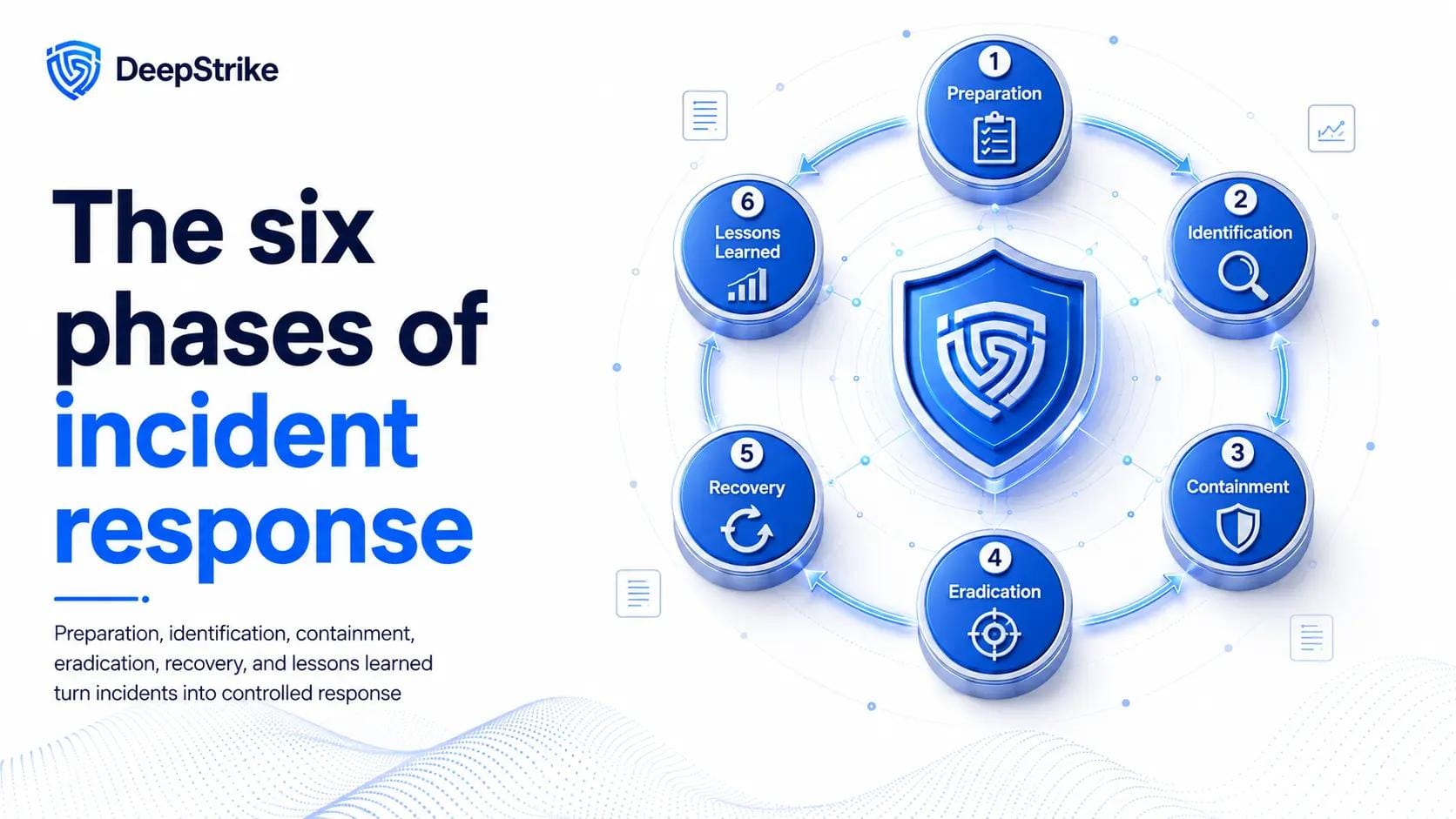
Preparation is the phase that determines whether every later phase succeeds. It covers everything you do before an incident: writing and approving the plan, building the response team, deploying detection tooling, defining severity levels, creating playbooks for common scenarios, and rehearsing. It also includes the unglamorous logistics, an up-to-date contact list, out-of-band communication channels in case email is compromised, retainers with external forensics or legal counsel, and access to the logs you will need.
A plan that lives in a shared drive nobody has opened in a year is not preparation. Preparation is the plan plus the muscle memory to execute it.
Identification is confirming that an event is actually a security incident and understanding its scope. Alerts flow in from many sources, endpoint detection, SIEM correlation, user reports, threat intelligence, and most are noise. This phase triages them: is this a real incident, how severe is it, what systems and data are involved, and is it still active?
Two decisions anchor this phase. First, classification: assign a severity so the response matches the threat. Second, declaration: formally declaring an incident triggers the plan, notifies the team, and starts the clock on regulatory timelines. Document the timeline from the first indicator, because you will need it for both the investigation and any legal notification.
Containment stops the bleeding. The goal is to prevent the incident from spreading while preserving evidence for later analysis. It usually happens in two stages: short-term containment to immediately limit damage, such as isolating an affected host from the network, and long-term containment, applying temporary fixes that let clean systems keep operating while you prepare to eradicate.
Resist the urge to wipe everything immediately. Pulling the plug can destroy the forensic evidence you need to understand how the attacker got in and whether they are still present. Isolate, capture memory and disk images where relevant, and then move to eradication deliberately.
Eradication removes the threat from the environment: deleting malware, disabling breached accounts, closing the exploited vulnerability, and eliminating any persistence the attacker established. This is where thoroughness matters most, because attackers routinely plant backdoors, additional credentials, and scheduled tasks so they can return after the obvious infection is cleaned.
Eradication depends on the root-cause understanding you built during identification and containment. If you do not know how the attacker got in, you cannot be confident you have removed them, which is why rushing this phase so often leads to reinfection.
Recovery restores affected systems to normal operation and confirms they are clean and hardened before returning them to production. That means rebuilding from known-good backups or images, applying patches and configuration fixes, monitoring closely for signs the attacker returns, and validating that business functions work as expected.
Recovery is a judgment call about timing. Restore too early and you risk bringing a still-compromised system back online; wait too long and the business impact grows. Clear criteria, defined in advance, for what "clean and ready" means make this decision defensible.
As soon as practical after closing the incident, often within days or a few weeks, the team holds a post-incident review: what happened, how the response went, what worked, and what to fix. The output is concrete, updated playbooks, new detection rules, patched gaps, and training, so the same incident cannot succeed twice.
This phase is the one teams most often skip, and skipping it is how organizations get breached the same way repeatedly. In the CSF 2.0 framing, lessons learned feed straight back into Govern and Identify, closing the loop so that every incident makes the next response faster.
The frameworks describe the flow; the plan itself needs specific, written components. A complete IRP includes:
A plan is only as good as the scenarios it anticipates. Build playbooks for the incident types most likely to hit your environment:
You do not need a bespoke playbook for every variation, but the plan should map cleanly to each of these categories and name who leads the response for each.
Notification timelines are short and enforced. Map the ones that apply to you into the plan so declaring an incident automatically starts the right clocks.
| Regulation / rule | Who it applies to | Deadline |
|---|---|---|
| SEC cybersecurity disclosure (Form 8-K Item 1.05) | US public companies | Within 4 business days after determining the incident is material; the materiality determination must be made without unreasonable delay |
| EU GDPR (Article 33) | Organizations handling EU personal data | Notify the supervisory authority within 72 hours of awareness when the breach is likely to result in a risk to individuals' rights and freedoms |
| EU NIS2 | Covered essential and important entities | Early warning within 24 hours of becoming aware of a significant incident; incident notification within 72 hours, followed by later reporting as required |
| EU DORA | In-scope financial entities | Initial notification within 4 hours after classification as a major ICT-related incident and no later than 24 hours after awareness; intermediate report within 72 hours; final report within one month |
| US HIPAA Breach Notification Rule | US covered entities and business associates | Notify affected individuals without unreasonable delay and no later than 60 days; HHS Secretary timing varies by breach size |
These are baselines, not legal advice; confirm the exact requirements for your industry and every jurisdiction you operate in, and build the tightest applicable deadline into your plan.
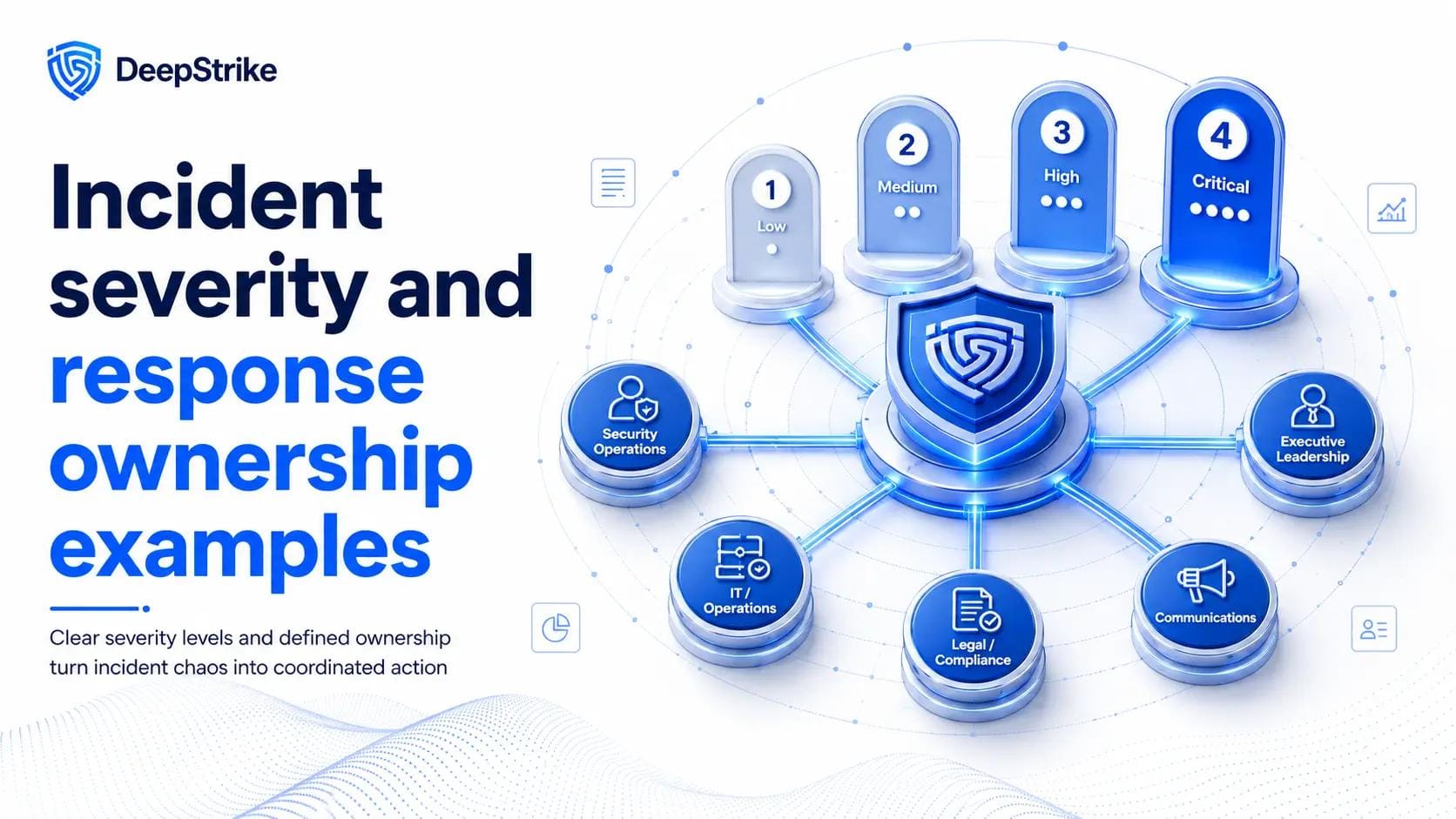
Use these examples as a starting point and adapt them to your risk profile, business impact, and regulatory obligations.
| Severity | Example | Typical escalation |
|---|---|---|
| Critical | Active ransomware, destructive malware, confirmed large-scale exfiltration, compromise of critical systems | Immediate executive, legal, communications, and incident-command activation |
| High | Confirmed privileged-account compromise, material application breach, active lateral movement | Immediate security leadership escalation and incident-response activation |
| Medium | Confirmed compromise with limited scope and no evidence of broad impact | Same-business-day triage and containment |
| Low | Suspicious event with no confirmed compromise or material impact | Standard investigation queue with defined ownership |
| Activity | Incident Commander | Security / IR | IT / Ops | Legal / Compliance | Communications | Executive |
|---|---|---|---|---|---|---|
| Declare incident | A | R | C | C | I | I |
| Preserve evidence | C | R | R | C | I | I |
| Contain affected systems | A | R | R | C | I | I |
| Determine notification duties | C | C | I | R/A | C | I |
| External communications | C | I | I | C | R | A |
| Recovery approval | A | R | R | C | I | C |
| Post-incident review | A | R | R | C | C | I |
R = Responsible, A = Accountable, C = Consulted, I = Informed.
An untested plan is a hypothesis. Validate it the way you would any critical control.
Testing is also where penetration testing feeds the plan. A penetration test shows you the attack paths an adversary would use, which tells you which playbooks and detections you actually need. Our guide to penetration testing methodology covers how those engagements are scoped and run.
Use this as a skeleton and fill each section with details specific to your environment:
Most failed responses fail for the same handful of reasons. Design your plan to prevent them:
Every item above is cheap to fix in advance and expensive to discover mid-incident.
An incident response plan earns its value in the first hours of a real incident, when a rehearsed team executes known steps instead of arguing about who is in charge. Build it on the six operational phases, keep the SANS and NIST frameworks in mind, and adopt the CSF 2.0 mindset from NIST's 2025 revision: preparation and governance are continuous, not a box you check once. Then test it, measure detection and response, and update it every time reality teaches you something new. The organizations that weather incidents well are rarely the ones that never get hit; they are the ones that practiced the response until it became routine.
An incident response plan governs how you handle a security incident, detecting, containing, eradicating, and recovering from an attack. A disaster recovery plan is broader, focused on restoring IT operations and data after any disruption, including non-security events like hardware failure or natural disaster. A cyber incident often triggers both.
They describe the same work with different groupings. SANS uses six steps (PICERL). NIST SP 800-61 Rev 2 used four phases. In April 2025, NIST Rev 3 replaced that lifecycle with a NIST CSF 2.0 profile organized around six functions (Govern, Identify, Protect, Detect, Respond, Recover). Use the six operational steps to run incidents and the CSF 2.0 framing to integrate response into overall risk management.
Run tabletop exercises at least annually and more frequently for high-risk or rapidly changing environments. Supplement them with technical exercises such as red or purple team engagements that test whether detection and response actually work. Track mean time to detect and mean time to respond so you can see improvement over time.
At minimum, an incident commander, technical responders (security and IT), a communications lead, and legal or compliance representation, with executive sponsorship. Many organizations formalize this as a CSIRT and use a RACI model. Define external contacts too, forensics, outside counsel, and law enforcement, before you need them.
It depends on the regulation. US public companies file an SEC 8-K within four business days of determining materiality; EU GDPR requires notifying authorities within 72 hours; US HIPAA allows no later than 60 days. Sector rules can be tighter. Map every deadline that applies to you into the plan so declaring an incident starts the right clocks automatically.
A CSIRT, or Computer Security Incident Response Team, is the cross-functional group responsible for executing the incident response plan. It typically combines security, IT, legal, communications, and management, and it is exactly the team your plan's roles and RACI define. Some organizations use the terms CIRT or CERT for the same function; the label matters less than having named, trained people ready to act.

Stay secure with DeepStrike penetration testing services. Reach out for a quote or customized technical proposal today
Contact Us
