November 4, 2026
Updated: November 4, 2026
Security activities per SDLC phase, NIST SSDF practice groups, CISA Secure by Design, a maturity model and a pentest timing guide.

Mohammed Khalil
A secure software development lifecycle (SSDLC, or secure SDLC) builds security work into every phase of how software is planned, designed, coded, built, released and maintained, instead of testing for it once at the end. In practice that means security requirements during planning, threat modeling during design, secure coding, code review and SAST during development, DAST and penetration testing before release, and vulnerability handling in production. NIST's Secure Software Development Framework (SSDF, SP 800-218) groups these practices into four areas you can map to any SDLC, and penetration testing fits wherever risk changes, not only once a year.
A secure SDLC is your normal software development lifecycle with defined security activities, owners and exit criteria added to each phase. It is not a separate process that runs beside development. The NIST SSDF describes its practices as a core set of high-level secure development practices that can be integrated into each SDLC implementation, which is the key idea: the SSDLC adapts to waterfall, agile, DevOps or any mix, because it defines what must happen, not how your team ships.
A working SSDLC has four properties:
| Aspect | Traditional SDLC | Secure SDLC (SSDLC) |
|---|---|---|
| When security happens | Mostly at the end, often as a single test before release or an annual audit | In every phase, with lighter checks early and deeper verification before release |
| Requirements | Functional and performance requirements | The same plus security, privacy and compliance requirements |
| Design | Architecture for features and scale | Architecture plus threat modeling and security design review |
| Development | Code review for quality | Secure coding standards, security-focused review, SAST, secret scanning and dependency checks |
| Testing | Functional, integration and performance tests | The same plus DAST, API security tests and penetration testing |
| Production | Bug fixes and feature updates | Vulnerability intake, prioritized remediation, root-cause analysis and retesting |
| Cost of a defect | Found late, when fixes touch released code | Many issues found while they are still cheap to change |
The two terms overlap but are not the same. The SSDLC is the lifecycle model: which security activities happen in which phase and who owns them. DevSecOps is the culture and automation that runs many of those activities inside fast CI/CD pipelines. A DevOps team that adds SAST to its pipeline has started DevSecOps, but without threat modeling, security requirements and a vulnerability response process it does not yet have a full secure SDLC. For the pipeline side, see our guide to penetration testing for DevOps, which covers CI/CD security gates in detail.
Three pressures make a secure SDLC a business requirement rather than a best practice.
Attackers go after software flaws. The Verizon 2026 Data Breach Investigations Report found that 31% of breaches in its dataset (incidents from November 1, 2024 to October 31, 2025) started with the exploitation of software vulnerabilities, ahead of stolen credentials as the top way in. Every flaw an SSDLC prevents before release is one less entry point.
Buyers and governments expect evidence. CISA's Secure by Design guidance asks software manufacturers to document conformance to a secure SDLC framework, and names the NIST SSDF as the option to consider in the United States. In the European Union, the Cyber Resilience Act entered into force on December 10, 2024; manufacturers must report actively exploited vulnerabilities from September 11, 2026, and its main obligations, which cover the planning, design, development and maintenance of products with digital elements, apply from December 11, 2027.
US federal policy moved to risk-based assurance. On January 23, 2026, OMB memorandum M-26-05 rescinded M-22-18 and M-23-16, the memos that had required federal agencies to collect secure software development attestations. Agencies must still maintain software and hardware inventories and set assurance requirements that match their risk. They may still use the Secure Software Development Attestation Form, may require a software bill of materials (SBOM) by contract, and can reference NIST SP 800-218. In other words, the mandatory form is gone, but the SSDF remains the reference federal buyers point to.
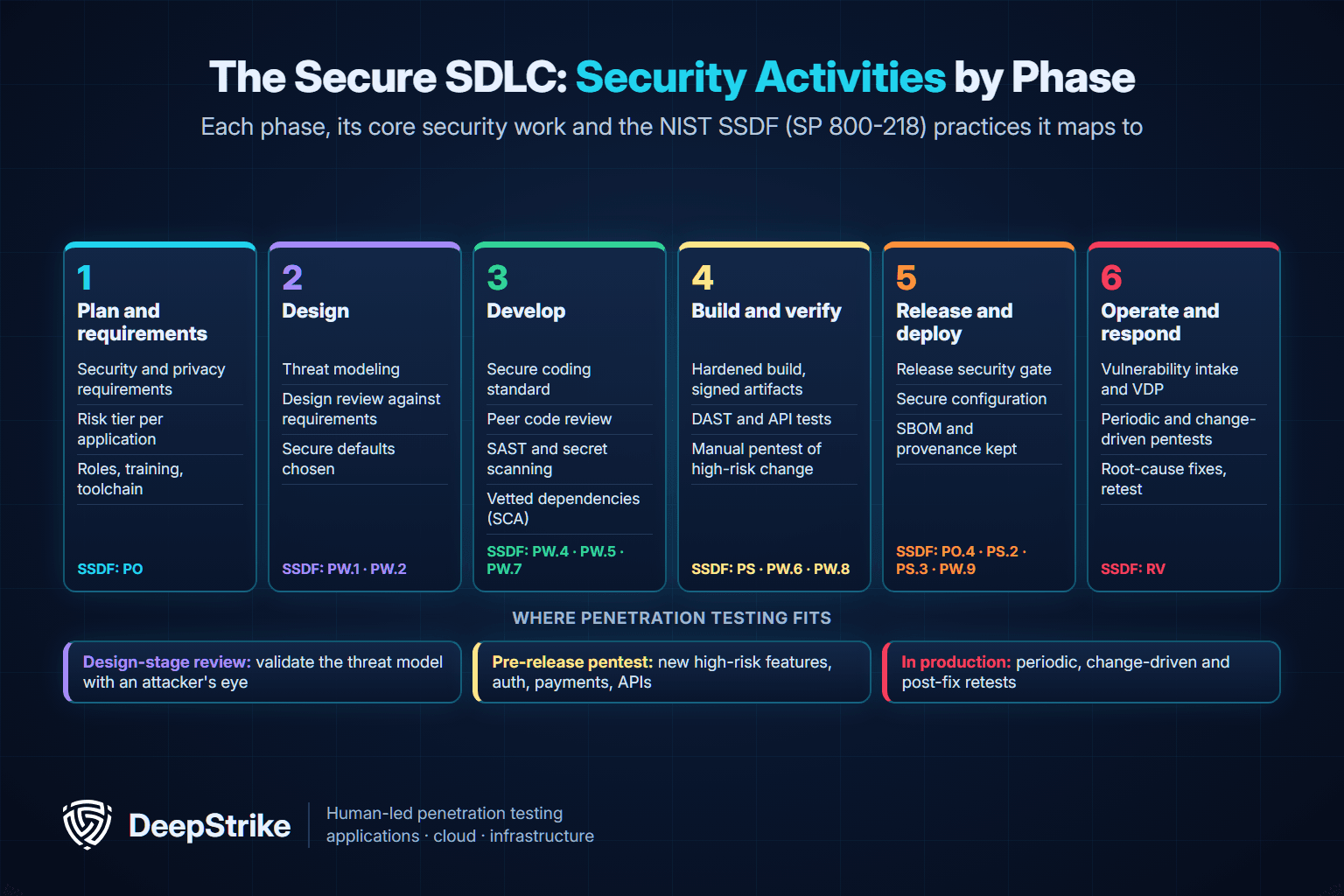
The table below is the core of an SSDLC. Phase names vary between frameworks: IBM's explainer lists nine, Cobalt and HackerOne use six. The six phases here follow common practice; what matters is that each activity has an owner and each phase has an exit gate. The SSDF column uses practice IDs from NIST SP 800-218 Version 1.1.
| Phase | Key security activities | SSDF practices | Testing and review methods | Exit gate (example) |
|---|---|---|---|---|
| 1. Plan and requirements | Security and privacy requirements, risk tier per application, roles, training, toolchain and environment security | PO.1, PO.2, PO.3, PO.5 | Requirements review against a standard such as OWASP ASVS | Requirements and risk tier approved |
| 2. Design | Threat modeling, security design review, secure defaults, choice of vetted components | PW.1, PW.2, PW.4, PW.9 | Threat model review; architecture review by a security engineer | Threat model reviewed; high risks have mitigations |
| 3. Develop | Secure coding standard, peer code review, SAST, secret scanning, software composition analysis (SCA) | PW.4, PW.5, PW.7 | Manual review of security-sensitive code; SAST and SCA on every pull request | No unresolved high-severity findings on changed code |
| 4. Build and verify | Hardened build settings, protected repositories, signed artifacts, dynamic testing | PS.1, PW.6, PW.8 | DAST, API security tests, fuzzing, manual penetration testing of high-risk changes | Security criteria from PO.4 met |
| 5. Release and deploy | Release security gate, secure configuration, release integrity, SBOM and provenance archived | PO.4, PS.2, PS.3, PW.9 | Configuration review; final retest of fixed findings | Release sign-off with known residual risk |
| 6. Operate and respond | Vulnerability intake, disclosure policy, prioritized remediation, root-cause analysis, periodic and change-driven testing | RV.1, RV.2, RV.3 | Periodic pentests, bug bounty or VDP reports, monitoring | Fixes verified; root causes fed back to phases 1 to 3 |
Security starts before any design. Define security and privacy requirements alongside functional ones: authentication strength, authorization model, data classification, logging, encryption and regulatory needs. OWASP ASVS (version 5.0.0, published May 30, 2025) is a practical source of testable requirements, because the same items later become test cases.
Assign each application a risk tier so effort is proportional. A customer-facing payment service and an internal reporting tool should not get the same depth of review. This phase also covers the organization-level SSDF practices: PO.1 (define security requirements), PO.2 (roles, responsibilities and training), PO.3 (supporting toolchains) and PO.5 (secure development environments).
Where pentesting fits: not yet as a test, but plan for it. Budget time and scope for pre-release and periodic testing now, so testing is not cut when the release date gets tight.
Design is where the most expensive flaws are prevented. SSDF practice PW.1.1 recommends forms of risk modeling, such as threat modeling, attack modeling or attack surface mapping, to assess the security risk of the software. A threat model asks what you are building, what can go wrong, what you will do about it and whether you did a good enough job. Our threat modeling guide covers STRIDE, PASTA and data flow diagrams step by step.
PW.2 then asks for a review of the design against the security requirements and risk information, by a qualified person who was not the designer. Design choices that remove whole classes of bugs belong here: parameterized queries through a vetted data layer, a central authorization service, memory-safe languages for new components and secure defaults (PW.9).
Where pentesting fits: for high-risk systems, an experienced tester can review the architecture and threat model before code exists, asking how an attacker would chain trust boundaries, roles and integrations. That is far cheaper than finding a broken authorization model after launch.
Developers write code to a secure coding standard (PW.5) and reuse well-secured components instead of writing their own crypto or parsers (PW.4). PW.7 covers reviewing and analyzing human-readable code: SSDF distinguishes code review, where a person reads the code, from code analysis, where tools do. Both have a place. Automated tools catch known patterns at scale; human reviewers catch logic and authorization flaws that tools cannot model. Our comparison of manual vs automated code review explains how to combine them.
Practical controls in this phase:
Where pentesting fits: not as a full test, but findings from earlier pentests should shape secure coding rules and review checklists here.
The build pipeline itself is an attack target. SSDF PS.1 asks you to protect all forms of code from unauthorized access and tampering, and PW.6 covers secure compiler, interpreter and build settings. Signed commits, protected branches, least-privilege CI runners and signed artifacts belong here. The SLSA framework gives graded levels for build integrity.
Verification moves from code to running software. PW.8 (test executable code) lists dynamic testing in automated suites, regression tests for previously reported vulnerabilities, fuzz testing and, in Example 6, using penetration testing "to simulate how an attacker might attempt to compromise the software in high-risk scenarios." DAST and API scanners cover known patterns quickly. For how SAST, DAST, IAST and RASP divide the work, see our SAST vs DAST vs IAST vs RASP guide.
Where pentesting fits: this is the main pre-release slot. A targeted manual pentest of new high-risk functionality, such as a new login flow, a payment feature, multi-tenant data access or a public API, finds business logic and access control flaws that scanners miss.
Release is a decision point. SSDF PO.4 asks you to define criteria for security checks and track them through the SDLC, which is what a release gate does: no open critical findings, known residual risks accepted by an owner, and fixed findings retested. PS.2 and PS.3 cover release integrity and archiving: publish hashes or signatures so customers can verify releases, and keep the SBOM and provenance data for each release.
Deploy with secure configuration by default (PW.9). Configuration deserves the same scrutiny as code; common problems include debug modes left on, overly broad cloud permissions, default credentials and exposed admin interfaces.
Where pentesting fits: retest every finding fixed before release, and test the production-like configuration rather than only a developer environment.
No SDLC prevents every flaw, so the last phase covers response. RV.1 asks you to identify and confirm vulnerabilities on an ongoing basis, including through a vulnerability disclosure program (RV.1.3) and a product security incident response team (PSIRT). RV.2 covers assessing, prioritizing and remediating, and RV.3 analyzing root causes so that whole classes of vulnerabilities are addressed rather than single instances. Our guide to vulnerability management covers prioritization and remediation timelines.
Where pentesting fits: periodic full-scope tests, tests after significant changes, and retests after fixes. Each confirmed finding should end in three outputs: a fix, a root cause recorded against the phase that should have caught it, and a regression test so it does not return.
The example below is illustrative, not a client engagement. A SaaS team adds "share a report with an external user by link."
The NIST Secure Software Development Framework, SP 800-218 Version 1.1, was published as final in February 2022. It is not a checklist or a mandated process; it is a set of outcome-based practices, each with tasks, notional implementation examples and references to other standards such as BSIMM, OWASP SAMM, Microsoft SDL and IEC 62443. Version 1.1 has 19 practices in four groups:
| Group | Purpose | Practices (Version 1.1) | Main SSDLC phases |
|---|---|---|---|
| Prepare the Organization (PO) | Get people, processes and technology ready for secure development | PO.1 Define security requirements; PO.2 Implement roles and responsibilities; PO.3 Implement supporting toolchains; PO.4 Define and use criteria for software security checks; PO.5 Implement and maintain secure development environments | Plan, plus gates in every phase |
| Protect the Software (PS) | Protect code and releases from tampering and unauthorized access | PS.1 Protect all forms of code; PS.2 Provide a mechanism for verifying release integrity; PS.3 Archive and protect each release | Build, release |
| Produce Well-Secured Software (PW) | Produce releases with minimal security vulnerabilities | PW.1 Design to meet security requirements and mitigate risks; PW.2 Review the design; PW.4 Reuse well-secured software; PW.5 Secure coding practices; PW.6 Secure build configuration; PW.7 Review and analyze code; PW.8 Test executable code; PW.9 Secure settings by default | Design, develop, build and verify |
| Respond to Vulnerabilities (RV) | Find residual vulnerabilities, fix them and prevent recurrence | RV.1 Identify and confirm vulnerabilities on an ongoing basis; RV.2 Assess, prioritize and remediate; RV.3 Analyze root causes | Operate and respond |
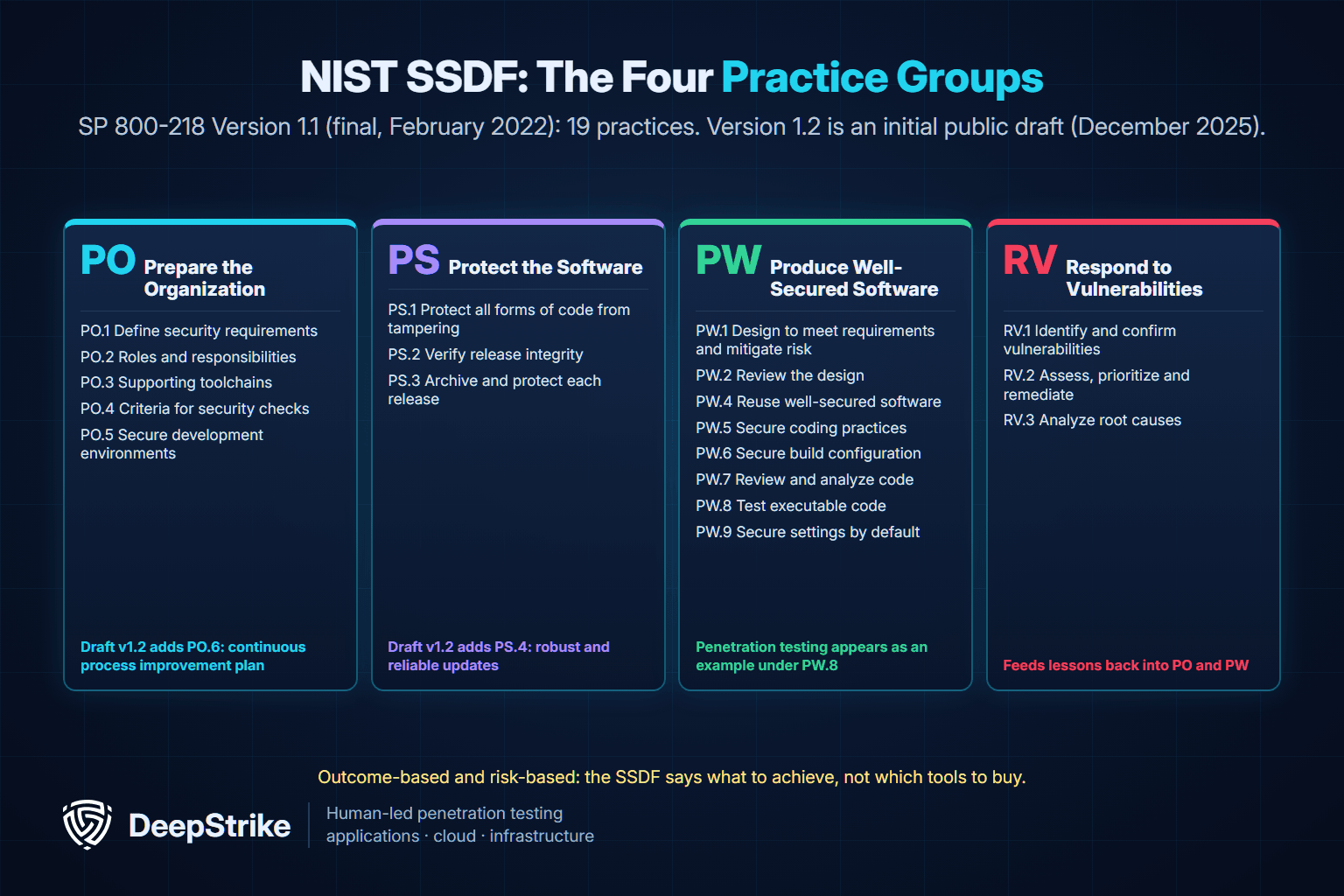
PW.3 does not appear because NIST merged it into PW.4 during the 2021 revision.
What is changing. On December 17, 2025, NIST released SP 800-218 Rev. 1, SSDF Version 1.2, as an initial public draft in response to Executive Order 14306. The comment period closed on January 30, 2026, and as of NIST's pages checked on November 4, 2026, Version 1.1 remains the final version. The draft's change log adds two practices, PO.6 (define and implement a continuous process improvement plan) and PS.4 (ensure software updates are robust and reliable, including tiered and staged roll-outs), and adds examples such as testing the functionality that uses third-party dependencies under PW.8.2.
AI development. NIST also published SP 800-218A in July 2024, an SSDF community profile that adds practices for developing generative AI and dual-use foundation models. Teams that train or fine-tune models should treat it as an extension of the same SSDLC rather than a separate program.
Is the SSDF mandatory? For most private companies, no. It is a voluntary NIST framework. US federal agencies may still reference it when they set software assurance requirements under M-26-05, and customers increasingly ask suppliers to show how they align with it.
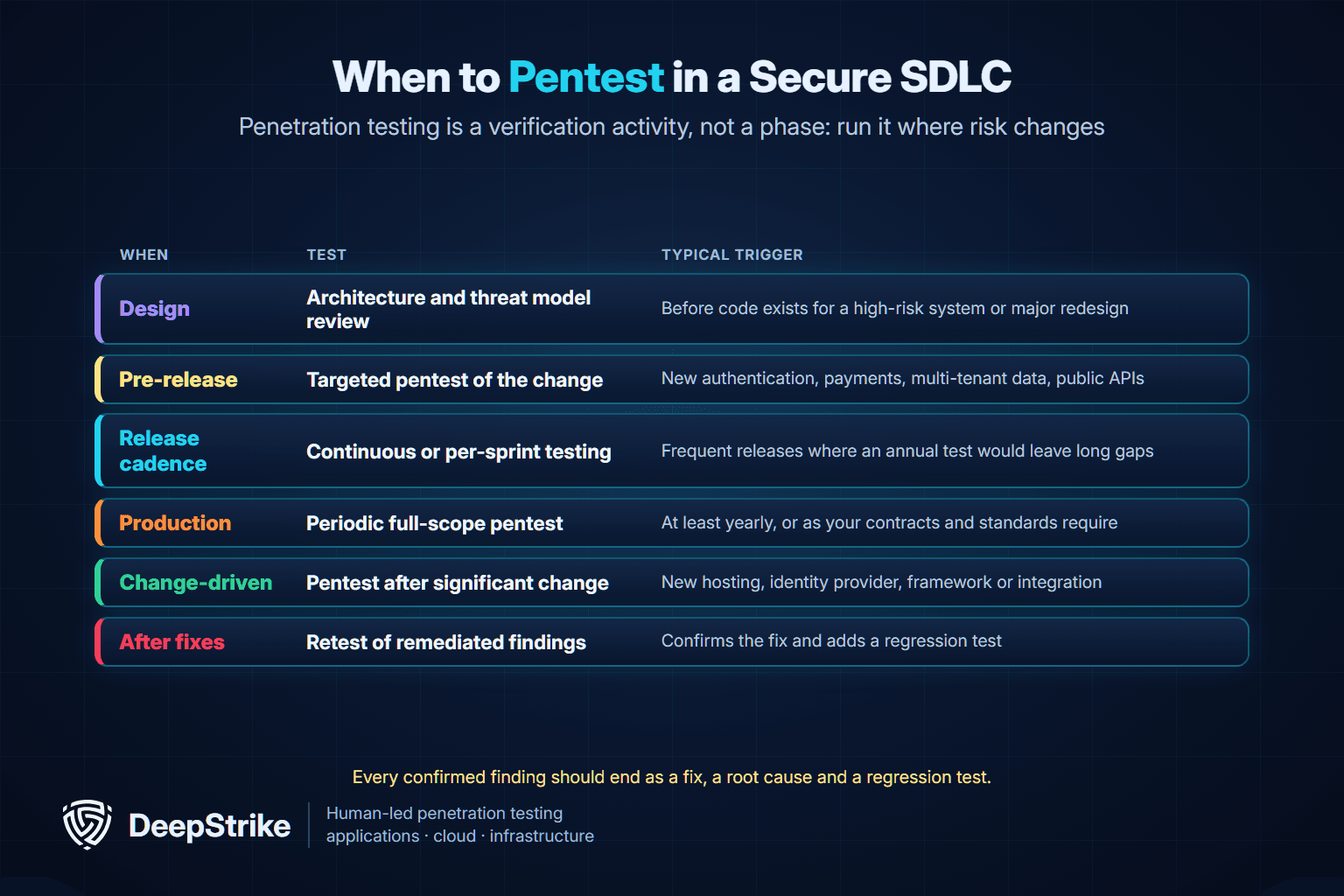
Penetration testing is not a phase. It is a verification activity that the SSDF places under PW.8 (test executable code) and RV.1 (identify and confirm vulnerabilities), and it pays off most where risk changes. A single annual test leaves every change between tests unverified by a human attacker's view.
| When | Type of test | Typical trigger | What it catches best | SSDF link |
|---|---|---|---|---|
| Design | Architecture and threat model review by an offensive tester | New high-risk system or major redesign | Broken trust boundaries and authorization models before code exists | PW.1, PW.2 |
| Pre-release | Targeted pentest of the change | New authentication, payments, multi-tenant data access, public APIs | Business logic and access control flaws in new functionality | PW.8 |
| Release cadence | Continuous or per-sprint manual testing | Frequent releases where an annual test would leave long gaps | Regressions and new endpoints soon after they ship | PW.8, RV.1 |
| Production | Periodic full-scope pentest | At least yearly, or as contracts and standards require | Chained issues across features, configuration and integrations | RV.1 |
| Change-driven | Pentest after significant change | New hosting, identity provider, framework or major integration | Issues introduced by infrastructure and platform changes | RV.1 |
| After fixes | Retest of remediated findings | Every fixed finding | Incomplete fixes and regressions | RV.2 |
Compliance regimes set their own minimum cadence; for one example, see our PCI DSS penetration testing guide.
Automated tools are good at known patterns: injection signatures, missing headers, outdated components. A manual tester works from how the application is supposed to behave and looks for ways to make it do something else. Typical examples:
These are design and logic flaws, which is why the earlier phases, especially threat modeling and security-focused code review, should feed the tester's scope.
A pentest only improves the SDLC if its results travel backward. For each confirmed finding:
A good penetration testing report makes this easier: reproducible steps, affected components and root-cause notes map directly to these four actions.
Each activity sees a different slice of risk. None replaces the others.
| Activity | SSDLC phase | Finds best | Misses or struggles with | SSDF |
|---|---|---|---|---|
| Threat modeling | Design | Design flaws, missing controls, trust boundary mistakes | Implementation bugs in code | PW.1 |
| Manual code review | Develop | Logic, authorization and crypto misuse in specific code | Issues spread across services; scale | PW.7 |
| SAST | Develop | Known insecure code patterns at scale, early | Business logic; context; produces false positives | PW.7 |
| SCA | Develop, build | Known-vulnerable and outdated dependencies | Flaws in your own code | PW.4 |
| DAST and API scanning | Build and verify, operate | Runtime and configuration issues in known patterns | Multi-step logic and authorization across roles | PW.8 |
| Penetration testing | Verify, operate | Chained, logic and access control flaws; real exploitability | Breadth across every line of code; it is a time-boxed sample | PW.8, RV.1 |
| Bug bounty or VDP | Operate | Issues outside researchers find in production | Pre-release code; coverage is not guaranteed | RV.1 |
For a deeper comparison of the last two rows, read penetration testing vs bug bounty. For how these methods fit together in a testing program, see software testing vs security testing.
The SSDF tells you which practices to run. CISA's Secure by Design initiative asks why and for whom: it argues that software manufacturers, not customers, should carry the burden of security. CISA's Secure by Design page describes it as prioritizing customer security as a core business requirement rather than a technical feature.
The joint guide Shifting the Balance of Cybersecurity Risk, first published in April 2023 and revised on October 25, 2023 with international partners, sets out three principles:
The guide defines "secure by default" as products that are resilient against prevalent exploitation techniques out of the box, without added charge. For the SSDLC it makes two concrete recommendations: document conformance to a secure SDLC framework (in the United States, consider the NIST SSDF), and move beyond patching single bugs toward data-driven analysis that eliminates entire classes of vulnerability.
On May 8, 2024, CISA announced that 68 software manufacturers had signed its voluntary Secure by Design Pledge, committing to work toward seven goals within a year:
| Pledge goal | Where it lives in the SSDLC |
|---|---|
| Increase customers' use of multi-factor authentication | Requirements and design (PO.1, PW.1) |
| Reduce default passwords | Secure defaults (PW.9) |
| Reduce entire classes of vulnerability | Design choices, coding standards and root-cause analysis (PW.1, PW.5, RV.3) |
| Increase customers' installation of security patches | Release and update strategy (PS.2; draft PS.4) |
| Publish a vulnerability disclosure policy | Response (RV.1.3) |
| Show transparency in CVE reporting, including accurate CWE and CPE fields | Response (RV.1, RV.3) |
| Increase customers' ability to gather evidence of intrusions | Requirements for logging (PO.1, PW.1) |
The pledge is not legally binding, but its goals make a useful checklist: if your SSDLC cannot show progress on them, buyers who follow CISA guidance will notice.
Most organizations do not move from "no SSDLC" to "fully measured" at once. The model below is a DeepStrike editorial model for self-assessment, not a NIST or OWASP standard. It borrows the idea of graded levels from OWASP SAMM, which defines three maturity levels for each of its 15 security practices across five business functions (governance, design, implementation, verification and operations). Score each dimension separately; it is normal to be at different levels.
| Dimension | Level 1: Ad hoc | Level 2: Defined | Level 3: Integrated | Level 4: Measured and improving |
|---|---|---|---|---|
| Governance and training | No written policy; security depends on individuals | Secure development policy, named owners, basic developer training | Security champions in each team; role-based training | Metrics reviewed by leadership; training updated from findings |
| Requirements and design | Security considered informally | Security requirements for high-risk apps; threat modeling on request | Threat modeling and design review required for every high-risk change | Threat models reused and updated from incidents and pentest results |
| Code and dependencies | Occasional review; no tooling | Secure coding standard; SAST and SCA available | SAST, SCA and secret scanning on every pull request with tuned gates | Whole vulnerability classes removed by design (safe libraries, memory-safe components) |
| Testing | Annual pentest only, if any | Pentest before major releases; DAST in staging | Pentests tied to risk and change; regression tests for every finding | Coverage and escape rate tracked; testing depth adjusted by risk tier |
| Release and supply chain | Manual releases; no integrity checks | Protected branches; documented release process | Signed artifacts, SBOM per release, hardened CI | Provenance verified at deploy; build integrity graded (for example, SLSA levels) |
| Vulnerability response | Fixes when customers complain | Intake process and severity-based remediation targets | Public disclosure policy, PSIRT, retesting of fixes | Root-cause analysis drives standards; CVE transparency |
Use the model to choose one step up per dimension for the next two quarters rather than trying to reach Level 4 everywhere.
| Framework | Owner | Best for | Form |
|---|---|---|---|
| NIST SSDF (SP 800-218) | NIST | A common vocabulary for practices, especially when US government or regulated customers ask | 19 outcome-based practices (Version 1.1) with references to other frameworks |
| OWASP SAMM | OWASP | Measuring maturity and planning improvement roadmaps | 5 business functions, 15 practices, 3 maturity levels |
| Microsoft SDL | Microsoft | Concrete engineering practices from a large software producer | 10 practices, from standards and threat modeling to monitoring and training |
| BSIMM | Black Duck | Benchmarking your program against what other organizations actually do | Observational survey of real software security initiatives |
| OWASP ASVS | OWASP | Testable application security requirements | Verification requirements (version 5.0.0, May 2025) |
| SLSA | OpenSSF | Build and supply chain integrity | Graded build levels |
Framework sites: OWASP SAMM, Microsoft SDL, OWASP ASVS and SLSA.
These frameworks map to each other; the SSDF itself references BSIMM, OWASP SAMM and Microsoft SDL for each practice. Pick one as your backbone and use the others for depth.
This plan is a practical starting sequence, not a requirement from any framework.
Days 1 to 30: baseline
Days 31 to 60: put gates on the riskiest work
Days 61 to 90: close the loop
Track a few measures that reflect outcomes, not tool activity:
Our DevSecOps statistics roundup collects industry benchmarks you can compare against, with their sources.
SSDLC stands for secure software development lifecycle. It is a software development lifecycle with defined security activities in every phase: security requirements in planning, threat modeling in design, secure coding and code analysis in development, dynamic and penetration testing before release, and vulnerability response in production.
The SDLC is the process for planning, building, releasing and maintaining software. The SSDLC is the same process with security built into each phase, with owners and exit gates, instead of one security test at the end. The secure version catches many flaws earlier, when they are cheaper to fix.
A common model has six phases: plan and requirements, design, develop, build and verify, release and deploy, and operate and respond. Frameworks name and split them differently; the NIST SSDF avoids fixed phases and groups practices into Prepare the Organization, Protect the Software, Produce Well-Secured Software and Respond to Vulnerabilities.
The Secure Software Development Framework, NIST SP 800-218, is a set of outcome-based secure development practices that can be added to any SDLC. Version 1.1 (February 2022) has 19 practices in four groups. Version 1.2 was released as an initial public draft on December 17, 2025, and adds two practices.
Not for most private companies. Federal attestation requirements tied to it were rescinded by OMB memorandum M-26-05 on January 23, 2026, but agencies may still reference SP 800-218 and use the attestation form when setting risk-based software assurance requirements, so suppliers to government and regulated buyers are often asked to show alignment.
Penetration testing belongs in verification and operations: before release for high-risk changes, periodically in production, after significant changes and as a retest after fixes. For high-risk systems, an offensive review of the architecture and threat model during design adds value before code exists.
At least once a year for important applications, plus before releasing high-risk features and after significant changes. Teams that release frequently often move to continuous or per-sprint testing so new functionality is tested soon after it ships.
Because exploitation of software vulnerabilities is a leading way attackers get in, and because customers, regulators such as the EU under the Cyber Resilience Act, and government buyers increasingly expect evidence of secure development. An SSDLC also lowers cost by catching flaws before release.
No. Agile and DevOps changed how fast teams move through the lifecycle, not the need for planning, design, development, testing, release and maintenance. A secure SDLC works with any delivery model, including DevSecOps pipelines that run many security checks automatically.
A secure SDLC works when every phase has a security activity, an owner and a gate, and when findings travel back to the phase that should have caught them. Start by scoring your six maturity dimensions, adding threat modeling and pull request checks to your riskiest work, and scheduling a pentest where risk is changing right now.
DeepStrike's web application penetration testing puts that verification step in place: manual testing that simulates real attacks based on your application's logic, checks from multiple users' perspectives, findings validated through exploitation, fix recommendations, a technical presentation for your engineers and re-testing to confirm that fixes hold. For teams that release often, continuous penetration testing integrates manual security testing into the SDLC so changes are tested before they reach production. To discuss scope, contact DeepStrike.
Mohammed Khalil is a Cybersecurity Architect at DeepStrike, specializing in advanced penetration testing and offensive security operations. With certifications including CISSP, OSCP, and OSWE, he has led numerous red team engagements for Fortune 500 companies, focusing on cloud security, application vulnerabilities, and adversary emulation. His work involves dissecting complex attack chains and developing resilient defense strategies for clients in the finance, healthcare, and technology sectors.

Stay secure with DeepStrike penetration testing services. Reach out for a quote or customized technical proposal today
Contact Us
