August 20, 2026
Updated: September 30, 2026
A continuous program, not a scan: how to find, rank, fix, and verify the exposures that actually carry risk.
Abdalla Mohamed
Vulnerability management is the continuous, cyclical process of identifying, prioritizing, remediating, and verifying security weaknesses across your systems, so the flaws most likely to be exploited get fixed before an attacker finds them. It is not a one-time scan or an annual audit; it is an ongoing program that never really ends, because new vulnerabilities appear every day. With 48,244 CVE records published in 2025, up from 40,077 in 2024, no team can fix everything, which makes the real skill knowing what to fix first. This guide covers the full lifecycle, modern risk-based prioritization, the shift toward continuous exposure management, and how to measure a program that works.
Updated: August 2026. Reflects record 2025 CVE volumes, the NVD enrichment backlog, EPSS and the CISA KEV catalog for prioritization, Gartner's CTEM model, and CISA's 2026 move (BOD 26-04) to risk-scored remediation deadlines.
Vulnerability management is a documented, repeatable program for continuously discovering weaknesses in your environment, deciding which ones matter, fixing or mitigating them, and confirming the fix worked. The weaknesses include far more than missing patches: misconfigurations, weak credentials, exposed services, insecure defaults, and outdated software all qualify.
It helps to place it next to two things people confuse it with:
The defining word for vulnerability management is continuous. A scan tells you where you stood on Tuesday; a program keeps you informed and improving week after week.
The scale of the problem has changed. 48,244 CVE records were published in 2025, up from 40,077 in 2024, an increase of about 20 percent, which works out to more than 130 new vulnerabilities disclosed every day. On top of the raw volume, the US National Vulnerability Database (NVD) developed a significant backlog of un-enriched CVEs starting in early 2024, meaning the authoritative source many teams relied on for context could no longer keep pace.
Two conclusions follow, and they shape everything below. First, you cannot patch everything, so a program that treats every vulnerability as equally urgent will drown. Second, severity alone is a poor guide to risk, because only a small fraction of vulnerabilities are ever actually exploited. The organizations that stay secure are the ones that reliably find and fix the few that matter, fast. Our vulnerability statistics roundup puts the numbers behind that reality.
A mature program extends beyond software CVEs. It can include:
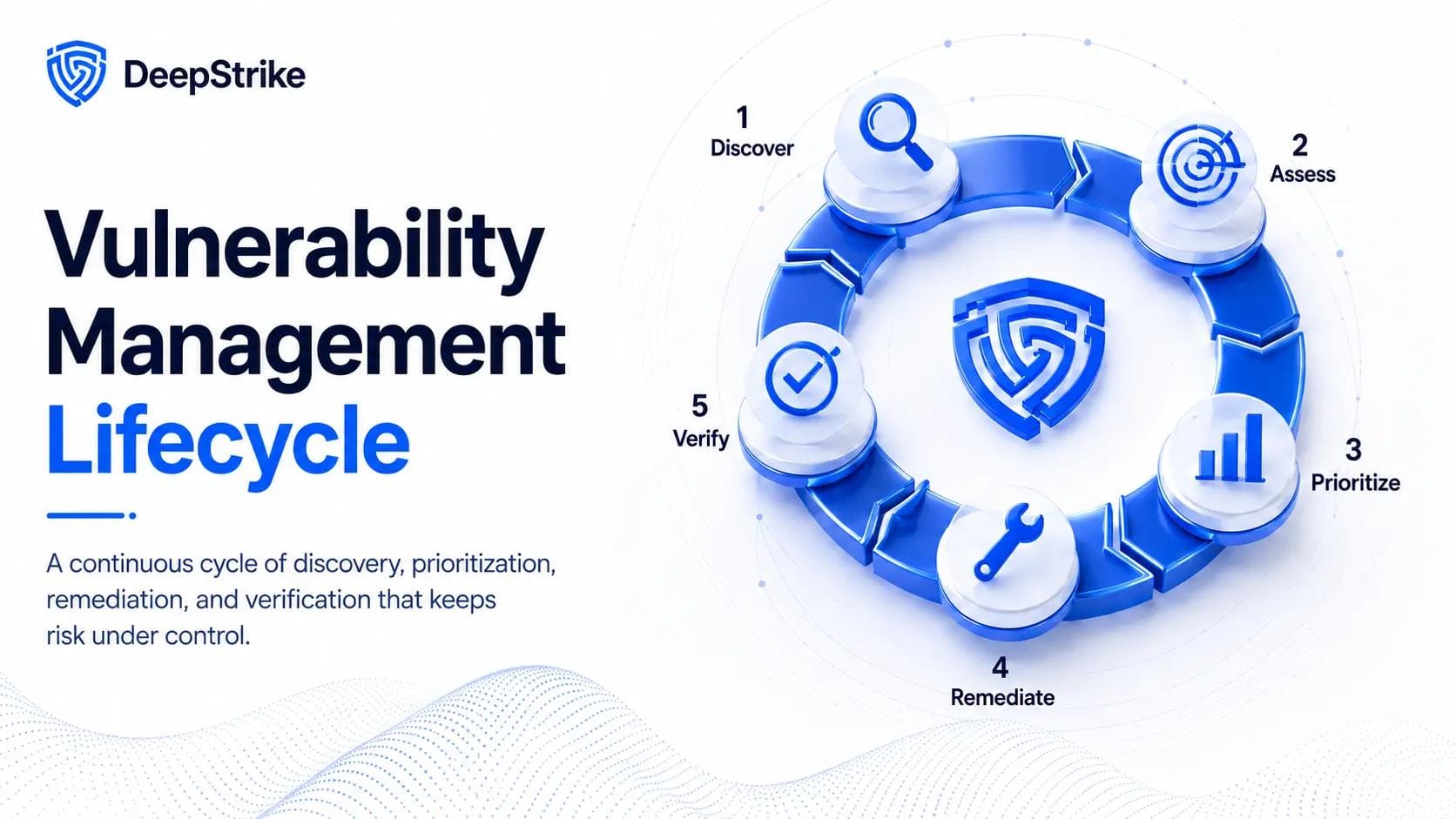
Most mature programs run some version of the same repeating cycle. The names vary; the work does not.
You cannot secure what you do not know you have. The cycle starts with a current inventory of assets, servers, endpoints, cloud workloads, applications, containers, and the growing sprawl of internet-facing services. Shadow IT and forgotten cloud instances are where breaches love to start, so discovery is continuous, not a one-time list.
Next, scan those assets for known vulnerabilities and misconfigurations using automated tools, authenticated where possible for accuracy. Scanning covers infrastructure, web applications, cloud, and containers. This is the step that produces the raw findings, and on its own it is a firehose: a mid-sized environment can surface tens of thousands of findings.
This is the stage that separates effective programs from busywork, and it gets its own section below. The goal is to rank the flood of findings so the team spends its limited time on the vulnerabilities that pose real risk to your specific environment.
Fix what matters, in priority order. Remediation usually means patching, but it can also mean reconfiguring, applying a compensating control, isolating a system, or accepting the risk with sign-off when a fix is not feasible. Clear ownership matters here: every priority finding needs a named owner and a deadline.
Prioritization should lead to an explicit treatment decision rather than a ticket that sits open indefinitely.
| Decision | Use when | Example |
|---|---|---|
| Remediate | A practical fix is available and should be applied | Patch a vulnerable library or update a misconfigured service |
| Mitigate | A full fix is unavailable or too disruptive in the short term | Segment the host, disable the feature, or add compensating controls |
| Accept | Residual risk is below tolerance and is formally approved | Keep a low-risk issue on an isolated test asset with documented sign-off |
| Remove | The asset or service no longer provides enough business value to justify the exposure | Retire a legacy internet-facing server |
Confirm the fix actually worked. Re-scan or re-test to make sure the vulnerability is genuinely closed and that the change did not introduce a new problem. A finding is not resolved because a ticket was closed; it is resolved when verification proves it.
Report on progress against goals, track trends, and feed lessons back into the program. Then the cycle repeats, because the environment and the threat landscape both keep changing. Reporting is also where you demonstrate the program's value to leadership and auditors.
For years, teams prioritized by CVSS score alone, fixing the "criticals" and "highs" first. That approach is now understood to be badly flawed, because CVSS measures a vulnerability's theoretical severity in isolation, not the likelihood that it will actually be exploited or the importance of the asset it sits on.
Modern prioritization layers several signals together:
| Signal | What it tells you | Source |
|---|---|---|
| CVSS | Theoretical technical severity of the flaw | FIRST (CVSS v4.0) |
| EPSS | Probability the flaw will be exploited in the near term | FIRST (Exploit Prediction Scoring System) |
| CISA KEV | Whether the flaw is actively being exploited right now | CISA Known Exploited Vulnerabilities catalog |
| Asset context | How critical and how exposed the affected asset is | Your asset inventory |
The combination is powerful. A high-CVSS vulnerability with a near-zero EPSS score on an isolated internal test box is rarely urgent. A medium-CVSS vulnerability that appears on the CISA KEV catalog, meaning attackers are exploiting it in the wild, on an internet-facing production system, is a drop-everything emergency. Prioritizing by exploitability and business context, not raw severity, is the single highest-leverage change most programs can make. This is exactly the discipline behind risk-based vulnerability management (RBVM), and it aligns closely with broader IT risk management practices that assess vulnerabilities in the context of business impact and acceptable exposure
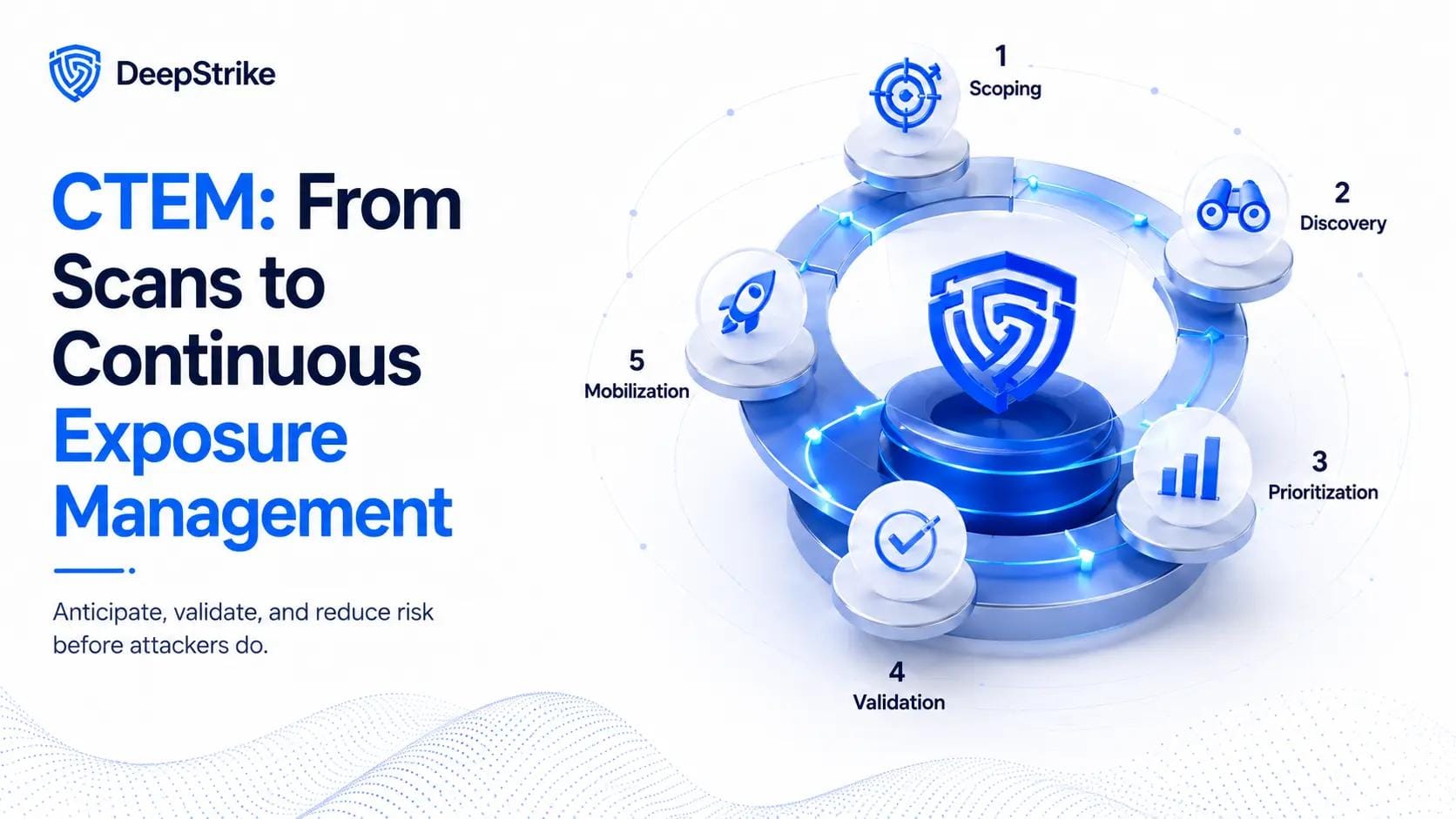
The industry's thinking has moved beyond even RBVM toward Continuous Threat Exposure Management (CTEM), a framework Gartner introduced in 2022. CTEM widens the lens from "known software vulnerabilities" to the entire attack surface, misconfigurations, identity and access risks, exposed APIs, and emerging AI exposures, and it treats security posture as something to be continuously tested, not periodically scanned.
CTEM is defined as a five-stage, repeating cycle:
The stage that most often gets skipped is validation, and it is the one that changes everything. A scanner says a vulnerability exists; validation proves whether it is actually reachable and exploitable in your environment, which is the difference between a theoretical finding and a real risk. This is where penetration testing fits directly into a vulnerability management program: it validates that the exposures you prioritized can, or cannot, be exploited, so remediation effort goes where it counts. Our penetration testing methodology guide explains how that validation is scoped and run.
Fixing fast is as important as fixing the right thing. Programs set remediation SLAs by priority, for example, critical exploited vulnerabilities within days, high within weeks, and lower-risk findings on a longer cadence tied to normal patch cycles. Tie the tightest SLAs to the KEV-and-EPSS signals above, not to CVSS alone.
The regulatory baseline is instructive. CISA's KEV catalog was long paired with fixed federal deadlines under Binding Operational Directive 22-01. In June 2026, CISA replaced that flat model with BOD 26-04, which scores each vulnerability against multiple risk criteria and can demand remediation in as little as three days when a flaw is severe, exploited, and exposed. The direction of travel is clear: deadlines are getting tighter and more risk-driven, and private-sector programs are adopting the same logic. Effective patch management is the engine that makes those SLAs achievable.
Not every vulnerability can be fixed immediately. When a team accepts risk or grants an exception, the decision should be time-bounded and auditable rather than permanent by default.
A good exception record includes:
Exceptions should expire automatically unless they are reviewed and renewed. That prevents temporary workarounds from becoming permanent blind spots.
A program needs tooling, but tools do not make a program. The core categories are:
What turns those tools into a program is the human structure around them: defined ownership, agreed SLAs, executive sponsorship, and a repeatable cycle. A pile of scan results with nobody accountable for fixing them is not vulnerability management; it is a liability with a dashboard.
Ownership is shared, but accountability should be explicit.
| Activity | Security | IT / Operations | Application Owner | Risk / Governance |
|---|---|---|---|---|
| Asset discovery | R | C | C | I |
| Prioritization | R | C | C | A |
| Remediation | C | R | R | I |
| Risk acceptance | C | C | C | A |
| Verification | R | C | C | I |
| Reporting | R | C | C | A |
R = Responsible, A = Accountable, C = Consulted, I = Informed.
Measure the program the way you would any operational capability. The metrics that matter most:
Trend these over time. A healthy program shows falling MTTR, high SLA compliance, and near-zero long-lived KEV exposure.
Scan frequency should match how fast your environment and the threat landscape change, which is to say: more often than most teams do. Continuous or near-continuous scanning is the modern standard, because a monthly scan leaves you blind to three-and-a-half weeks of newly disclosed vulnerabilities. Practical guidance:
Compliance minimums, such as quarterly scans, are floors, not targets. The gap between "we scanned last quarter" and "we know our exposure today" is exactly where attackers operate.
Vulnerability management supports security and assurance requirements across many major frameworks, while some standards such as PCI DSS contain more explicit vulnerability-scanning and remediation requirements. ISO 27001, SOC 2, NIST frameworks, HIPAA, and sector rules may also require or strongly support documented processes for identifying, evaluating, and addressing technical risk, depending on scope and implementation.
The important framing is that compliance is a byproduct of a good program, not its goal. A team that builds vulnerability management to genuinely reduce risk, continuous discovery, risk-based prioritization, tracked remediation, and verification, will satisfy the auditors almost automatically. A team that builds only to pass an audit tends to do the minimum, scan quarterly, file the report, and remains exposed the rest of the time. Build for risk reduction, and let the compliance evidence fall out of it.
Knowing the lifecycle is easy; running it well is where most programs struggle. The recurring obstacles:
Naming these openly is the first step to designing a program that survives contact with reality.
You do not stand up a mature program overnight. A realistic maturity path looks like this:
Crawl. Get an accurate asset inventory and start authenticated scanning on your most important systems. Establish basic severity-based prioritization and a simple ticketing flow so findings become tracked work. The goal here is visibility and a repeatable cycle, however basic.
Walk. Layer risk-based prioritization on top of raw severity, pulling in EPSS and the CISA KEV catalog so effort concentrates on exploitable, exploited flaws. Define remediation SLAs by risk tier, assign clear ownership, and begin reporting trends to leadership. Coverage expands to the full environment, including cloud and external-facing assets.
Run. Move toward continuous, validated exposure management: broaden scope beyond CVEs to misconfigurations, identity, and exposed services in the CTEM spirit, validate prioritized exposures with real testing such as zero-day and exploit-aware assessments, automate the routine, and drive MTTR down while keeping long-lived KEV exposure at zero. At this stage vulnerability management is woven into development and operations, not bolted on afterward.
Most organizations are somewhere between walk and run. The point is not to leap straight to the end, but to always be moving up the curve.
Vulnerability management is not about scanning more; it is about fixing the right things fast, forever. With over 40,000 new CVEs a year and a database backlog behind them, the winning move is disciplined, risk-based prioritization, combining CVSS with EPSS, the CISA KEV catalog, and your own asset context, wrapped in a continuous lifecycle and, increasingly, the broader CTEM model. Validate what you prioritize with real testing, remediate against tight SLAs, and measure relentlessly. Do that, and you fix the handful of exposures that actually drive risk instead of drowning in the thousands that do not. The goal was never a clean scan report; it was a smaller, better-understood attack surface that shrinks a little more with every turn of the cycle.
A vulnerability assessment is a point-in-time snapshot, a scan or review that lists weaknesses at one moment. Vulnerability management is the ongoing program that surrounds those assessments: continuously discovering, prioritizing, remediating, and verifying weaknesses in a repeating cycle. The assessment is one step; the management is the whole lifecycle.
Vulnerability management is a continuous program built largely on automated scanning to find and fix known weaknesses at scale. Penetration testing is a targeted, human-led engagement that actively exploits and chains weaknesses to show real-world impact. They complement each other: pentesting validates whether the exposures your program prioritized are truly exploitable.
Do not rely on CVSS alone. Layer CVSS with EPSS (probability of exploitation), the CISA KEV catalog (active exploitation in the wild), and your own asset context (how critical and exposed the system is). A flaw that is actively exploited and internet-facing outranks a higher-CVSS flaw that no one is exploiting on an isolated system.
Continuous Threat Exposure Management is a Gartner framework that broadens vulnerability management from known software flaws to the whole attack surface, misconfigurations, identity risks, exposed APIs, and more, across five repeating stages: scoping, discovery, prioritization, validation, and mobilization. Think of it as vulnerability management grown up: continuous, risk-based, and validated by real testing.
Set SLAs by risk, not by CVSS alone. Actively exploited, internet-facing vulnerabilities should be fixed in days; lower-risk findings can follow normal patch cycles. As a benchmark, CISA's 2026 BOD 26-04 can require federal agencies to remediate the most dangerous flaws in as little as three days, and private-sector programs are trending toward similarly risk-driven deadlines.
A program typically combines a vulnerability scanner (covering infrastructure, web, cloud, and containers), asset-discovery and attack-surface tooling to keep the inventory current, a risk-based prioritization or CTEM platform that ingests EPSS, the CISA KEV catalog, and asset context, and integration with ticketing so findings become owned, tracked work. But tools alone are not a program; the human structure of ownership, SLAs, and a repeating cycle is what makes them effective.
Much of it can and should be. Discovery, scanning, prioritization enrichment, and ticket creation are all automatable, which is what lets a small team keep pace with tens of thousands of findings. But remediation decisions, risk acceptance, and validating whether an exposure is genuinely exploitable still need human judgment, and hands-on testing like penetration testing remains essential. Automate the routine so people can focus on the calls that require reasoning.

Stay secure with DeepStrike penetration testing services. Reach out for a quote or customized technical proposal today
Contact Us
