November 4, 2026
Updated: November 4, 2026
Roles, rules of engagement, ATT&CK technique selection, test cards, scoring detection coverage, reporting and TIBER-EU purple teaming requirements.

Mohammed Khalil
Purple teaming is less a third team than a way of working: red team operators run real attacker techniques in the open while the blue team watches its own tools, checks what was logged, alerted and stopped, and fixes gaps on the spot. A purple team exercise repeats that test-detect-tune cycle for every technique on a planned list, usually mapped to MITRE ATT&CK, then scores detection coverage and retests. Use it to turn red team findings, threat intelligence or a new security tool into detections you have proven work.
Purple teaming is a collaborative security exercise in which offensive testers (the red team) and defenders (the blue team) work together, with full knowledge of each other's actions, to test and improve detection and response. The European Central Bank's TIBER-EU Purple Teaming Guidance describes it as a collaborative activity that involves both red team testers and the blue team and their offensive and defensive actions, and notes that it can range from tabletop discussions to specific technical testing. The open-source Purple Team Exercise Framework (PTEF), published by SCYTHE, puts it more simply: a purple team is a collaboration of various information security skill sets.
Three ideas separate purple teaming from other testing:
Usually not. In most organizations, "purple team" describes the exercise or the function, not a standing group with its own headcount. PTEF describes three engagement models: ad hoc purple team exercises, an operationalized purple team that runs as a continuing virtual team, and a dedicated purple team with its own staff. Most programs start with occasional exercises and move toward a regular cadence once the method proves its value.
The three colors answer different questions. A red team asks whether a realistic attacker can reach business objectives without being stopped. A blue team defends every day. A purple team brings the two together to make specific detections work.
| Criterion | Red team | Blue team | Purple team |
|---|---|---|---|
| Main question | Can a realistic attacker reach our objectives unnoticed? | Can we detect, investigate and contain threats every day? | Do our detections fire for these techniques, and can we fix them now? |
| Who knows about the test | Only a small control team | Not applicable: this is the standing defense | Everyone taking part |
| Mode | Covert, objective-based campaign | Continuous monitoring, hunting and response | Open, technique by technique |
| Typical length | Several weeks to months | Ongoing | Hours to a few weeks per exercise |
| Main output | Attack narrative, missed detections, control gaps | Handled alerts, contained incidents, hardened systems | Tuned detections and a coverage score per technique |
| Success measure | Objectives reached or blocked, and whether defenders noticed | Time to detect and respond, incidents contained | Techniques moved from "not visible" or "logged" to "alerted" and "contained" |
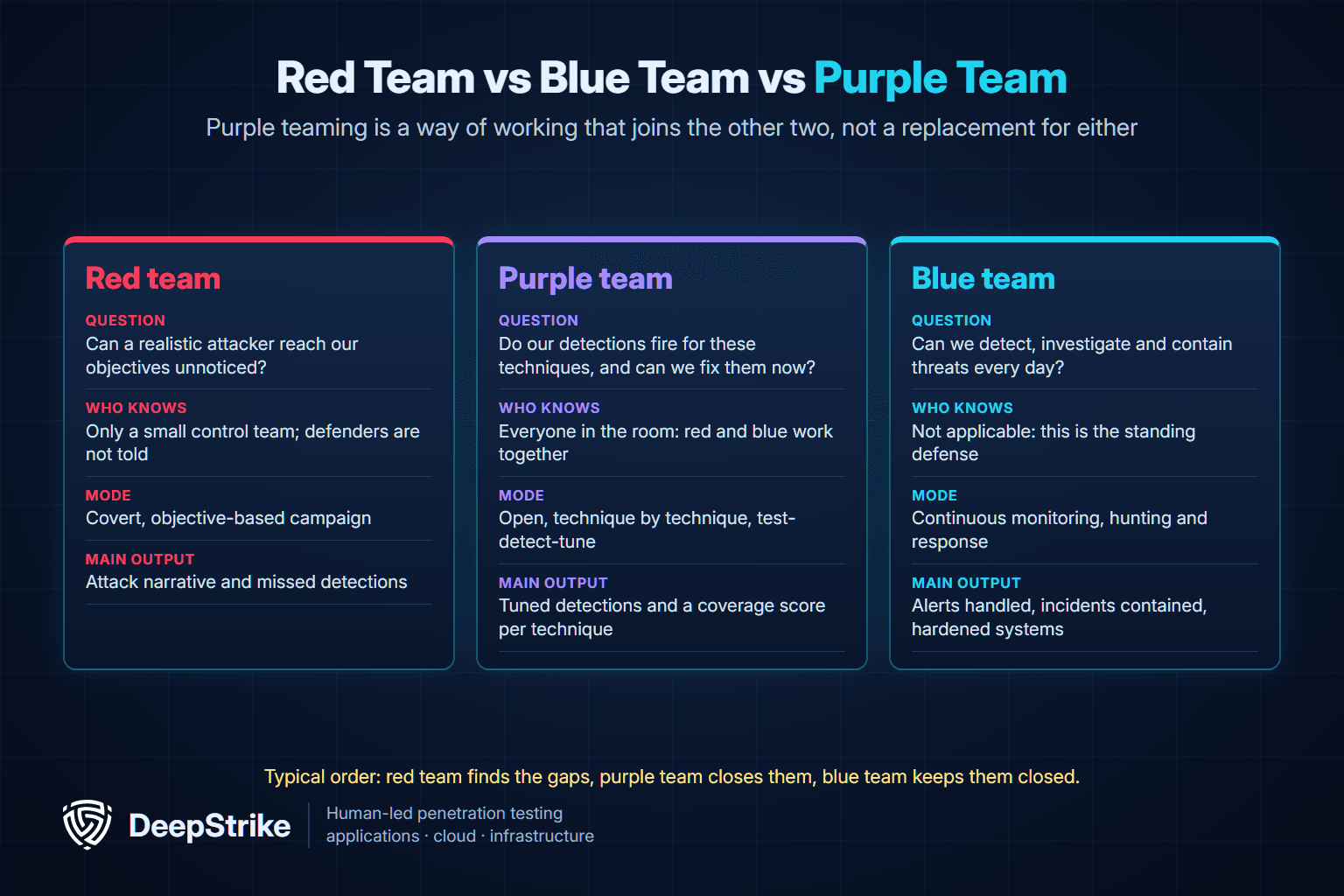
For a deeper look at each team's role and skills, see our guide to red team vs blue team in cybersecurity. For how a covert engagement runs from planning to debrief, read what red teaming is and how a red team assessment works.
The difference is secrecy and purpose. A red team stays hidden so it can measure how your organization reacts to an attack it does not expect. A purple team gives up that realism on purpose so that defenders can see every step and learn from it. The two work best in sequence: a red team shows which attack paths and techniques went unnoticed, and a purple team replays those techniques in the open until the detections work. TIBER-EU builds exactly this order into its tests, with a purple team exercise in the closure phase after the covert red team phase.
A penetration test looks for exploitable weaknesses in a defined scope and mostly measures prevention. "Purple team pen testing" usually means running a penetration test with the SOC watching, so that each exploitation step is also checked for detection. Breach and attack simulation (BAS) platforms run scripted techniques on a schedule. They are useful for regression testing once detections exist, but they do not replace the human discussion, threat intelligence and on-the-spot tuning that make a purple team exercise valuable.
Purple teaming pays off when you have detection tools and people to operate them, but you do not know which attacker techniques they actually catch. Typical triggers include:
Purple teaming is less useful if basic logging is missing across most of the estate, or if no one has time to tune detections after the session. In that case, fix log collection first, using a threat modeling exercise to decide which systems and attack paths matter most.
A purple team exercise needs clear roles even though everyone is in the same room. The roles below adapt the responsibilities described in PTEF and in the TIBER-EU guidance for a commercial setting.
| Role | Typical person | Responsibilities |
|---|---|---|
| Sponsor | CISO or head of security operations | Approves objectives, scope, risk and budget; funds remediation |
| Exercise coordinator | A neutral lead, often from the SOC or an outside facilitator | Runs the agenda, keeps time, records outcomes and action items, owns the report |
| Threat intelligence | CTI analyst | Picks the adversary and techniques, explains why each matters and what it looks like in the wild |
| Red team operators | Internal red team or external testers | Prepare safe procedures, run them openly, share commands, hosts and timestamps |
| SOC analysts and threat hunters | Blue team | Search telemetry, triage alerts and follow their normal process so the result is realistic |
| Detection engineers | Blue team | Write and tune rules during the session and document the logic |
| Incident responders | Blue team or DFIR | Test containment steps and playbooks for detected techniques |
| System owners | IT, cloud and identity administrators | Approve test hosts, fix logging configuration, restore changes |
The coordinator role matters most. The TIBER-EU guidance stresses that the red team should explain its tactics clearly, acknowledge areas of strength and keep regular checkpoints so both sides understand each other's actions. Someone has to enforce that tone, keep the session moving and make sure every result is written down.
The steps below cover a single exercise. A focused first exercise usually tests 10 to 20 techniques; PTEF notes that exercises can last a few hours, days or weeks depending on goals. The steps are deliberately non-operational: specific procedures depend on your environment and must stay inside the agreed rules of engagement.
Start with a sentence that a sponsor can approve, such as "Confirm that we detect the credential theft and lateral movement techniques used in the last red team" or "Validate detections after the EDR migration." Then agree in writing:
MITRE ATT&CK is the common language for purple teaming. As of ATT&CK v20, released October 13, 2026, the Enterprise matrix has 15 tactics, including TA0005 Stealth and TA0112 Defense Impairment, which older material groups together as Defense Evasion. Check which version your detection mappings use before you compare results across exercises.
Pick techniques with threat intelligence, not by browsing the matrix. Good sources include ATT&CK group pages, government advisories, your own incident history and the findings of your last red team engagement. Then score each candidate technique on five criteria:
The table below is an illustrative plan for a generic ransomware intrusion scenario. It is an example of the format, not a recommendation for any specific organization; build your own list from your threat intelligence.
| Order | Tactic | ATT&CK technique | What the exercise checks | Main telemetry to inspect |
|---|---|---|---|---|
| 1 | Initial Access | Spearphishing Attachment (T1566.001) | Is a test attachment flagged, reported and traced to the endpoint? | Email security logs, endpoint process events |
| 2 | Execution | PowerShell (T1059.001) | Are suspicious script executions logged with full content? | Script block logging, EDR process telemetry |
| 3 | Persistence | Scheduled Task (T1053.005) | Is creation of a new scheduled task by an unusual parent detected? | Windows task scheduler events, EDR |
| 4 | Discovery | Domain Account (T1087.002) | Is bulk directory enumeration from a workstation visible? | Domain controller and LDAP query logs |
| 5 | Credential Access | Kerberoasting (T1558.003) | Are unusual service ticket requests detected regardless of the tool used? | Domain controller Kerberos events |
| 6 | Credential Access | LSASS Memory (T1003.001) | Is access to credential memory blocked or alerted? | EDR, process access events |
| 7 | Lateral Movement | Remote Desktop Protocol (T1021.001) | Is an unusual remote logon path between workstations detected? | Authentication logs, network flow data |
| 8 | Execution | Windows Management Instrumentation (T1047) | Is remote process creation through WMI visible and attributable? | WMI activity logs, EDR |
| 9 | Exfiltration | Exfiltration to Cloud Storage (T1567.002) | Is an upload of test data to an unsanctioned cloud service detected? | Proxy, DNS and cloud access logs |
| 10 | Impact | Inhibit System Recovery (T1490) | Is an attempt to delete backups or shadow copies caught before ransomware runs? Lab host only. | EDR, backup system logs |
MITRE ATT&CK reference pages for these techniques: T1566.001, T1059.001, T1053.005, T1087.002, T1558.003, T1003.001, T1021.001, T1047, T1567.002 and T1490.
Background on several of these techniques is in our explainers on LSASS dumping and living off the land attacks, which rely on built-in tools such as PowerShell and WMI.
A test card turns a technique into something the room can run and score. Write one per procedure before the session, and share it with the blue team only when that procedure starts, so analysts still have to find the evidence themselves.
| Field | What to record |
|---|---|
| Technique and procedure | ATT&CK ID and the specific way it will be performed (tool or built-in command family), described at the level your rules of engagement allow |
| Threat context | Which adversary uses it and why it matters, in two sentences |
| Preconditions | Test host, test account, privileges needed and any lab requirement |
| Expected telemetry | Which log sources should record it, and which event types |
| Expected detection | Which rule or analytic should fire, and at what severity |
| Expected response | Which playbook step the SOC should take |
| Safety and cleanup | What the procedure changes and how to reverse it |
| Result fields | Outcome level, prevented yes/no, time to detect, time to triage, notes, action owner |
Test more than one procedure for high-priority techniques. In CISA advisory AA24-193A, published July 11, 2024, a federal agency's detection rules keyed to specific strings, such as "kerberoast" in command lines, missed kerberoasting performed in other ways. One passed procedure proves that one variation is covered, not the whole technique.
Before the session, confirm that the plumbing works so the exercise tests detections, not broken log forwarding:
This is the core of the exercise. PTEF describes a per-technique flow in which threat intelligence presents the technique, the coordinator leads a short discussion of expected controls, the red team executes while sharing its screen and indicators, the blue team follows its standard process to find evidence, and detection engineering makes short-term adjustments before the red team repeats the technique. A practical version has five beats:
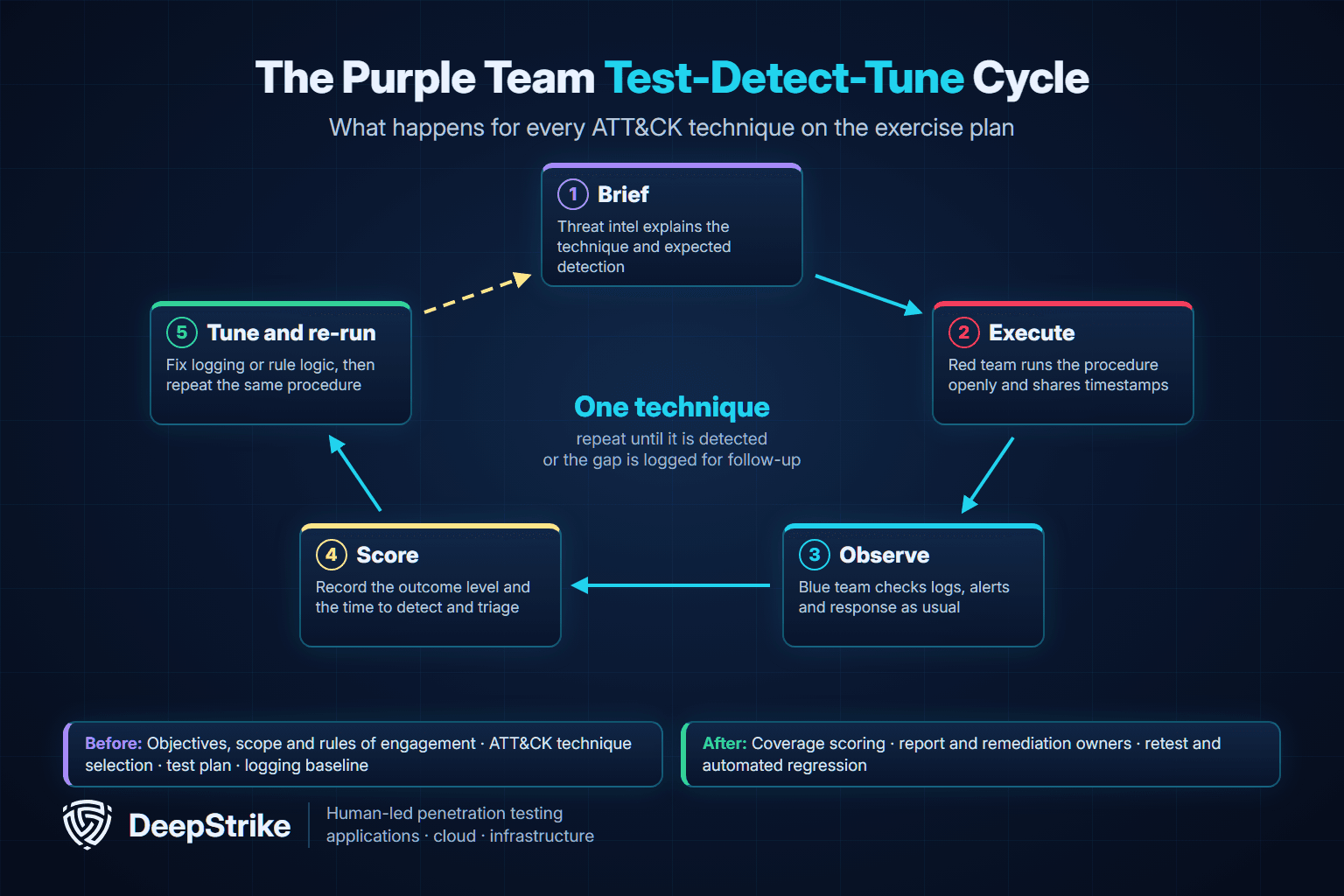
Keep a strict time box per technique, typically 20 to 45 minutes, and park deep investigations for later. A session that spends three hours on one missing log source tests nothing else.
Score each procedure with a consistent scale (see the next section) and calculate coverage for the exercise as a whole. The point is not a single impressive percentage but a clear before-and-after view of which techniques moved and which still need work.
Write the report while the session is fresh. PTEF recommends delivering lessons learned in less than two weeks. A useful purple team report includes:
The same evidence standards that make a penetration testing report useful apply here: reproducible steps, timestamps and clear priorities.
Detections decay. Log sources change, rules get tuned for noise and agents are updated. After remediation, rerun the failed and newly fixed procedures, then add the passing ones to a regression set that runs on a schedule with an open-source framework or BAS platform. Plan the next exercise around new threat intelligence rather than repeating the same list.
A scoring scale makes results comparable across techniques, teams and exercises. The six-level ladder below is a DeepStrike editorial scale built from the same idea as PTEF's graded score, which runs from "no visibility" to "full response." Record the highest level each procedure reaches.
| Level | Name | Definition |
|---|---|---|
| 0 | Not visible | No telemetry for the activity is collected anywhere |
| 1 | Local telemetry only | An event exists on the host but never reaches the SIEM or data lake |
| 2 | Centrally logged | The activity is searchable by a hunter, but no rule fires |
| 3 | Alerted | A detection fires with enough context for an analyst to act |
| 4 | Triaged correctly | An analyst confirms the alert as malicious within the agreed time |
| 5 | Contained | The response playbook runs, for example the host is isolated or the account disabled |
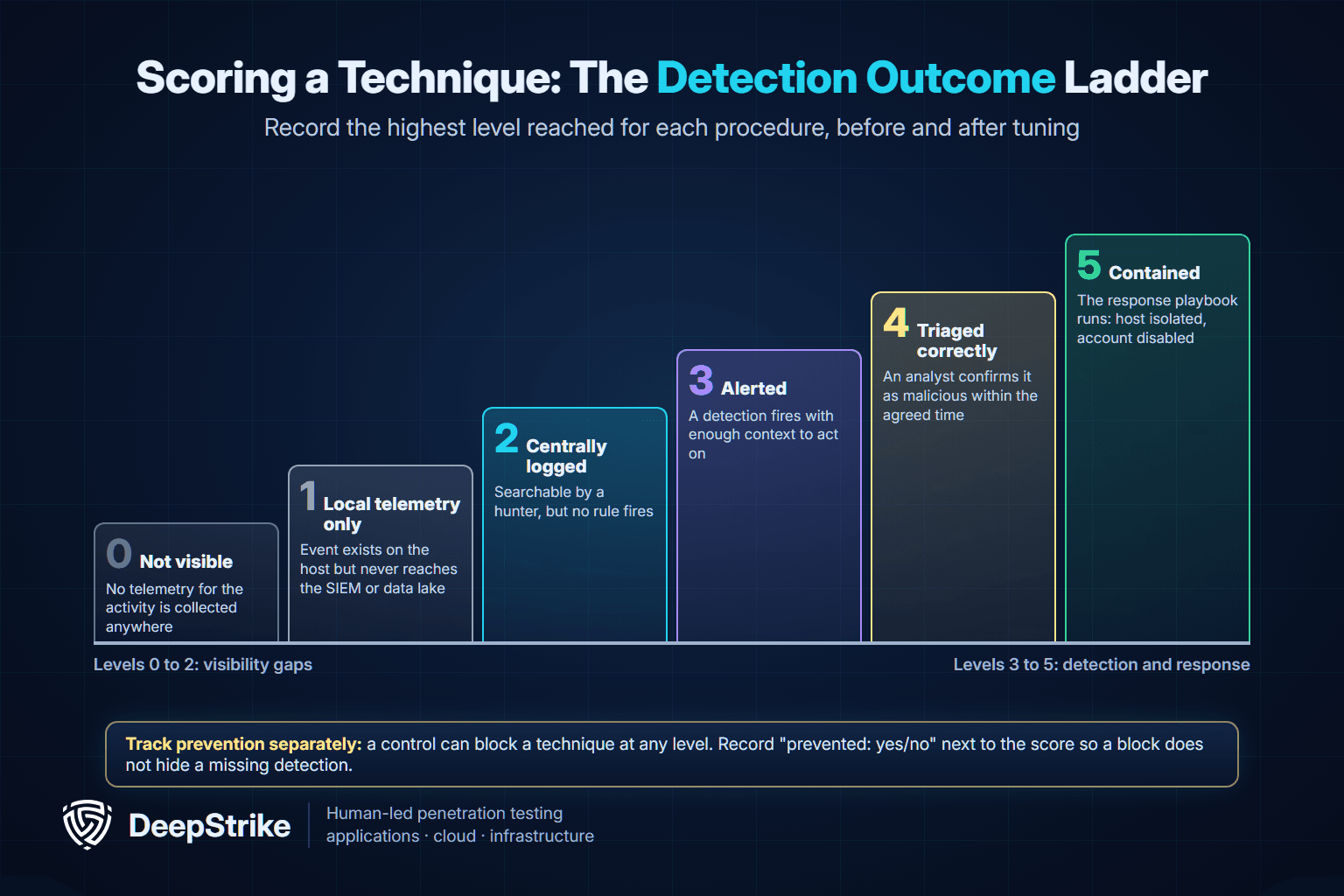
Track prevention separately. A control can block a technique at any level, and a blocked technique with no alert is still a detection gap: the attacker will simply try a variation. Recording "prevented: yes/no" next to the score keeps that visible.
From the ladder, calculate a few simple measures for the exercise:
The scorecard below is illustrative, not data from a real exercise. It applies the ladder to the ten-technique plan from Step 2.
| Technique | Before tuning | Prevented | After tuning | Main gap found |
|---|---|---|---|---|
| T1566.001 Spearphishing Attachment | 3 | Yes | 4 | Alert lacked the recipient list; enrichment added |
| T1059.001 PowerShell | 2 | No | 3 | Script content logged but no rule for encoded commands |
| T1053.005 Scheduled Task | 0 | No | 3 | Task creation events not collected from test hosts |
| T1087.002 Domain Account | 2 | No | 2 | Too noisy to alert; saved as a hunt query |
| T1558.003 Kerberoasting | 1 | No | 3 | Domain controller events not forwarded |
| T1003.001 LSASS Memory | 3 | Yes | 4 | Alert routed to the wrong queue |
| T1021.001 Remote Desktop Protocol | 2 | No | 3 | No rule for workstation-to-workstation logons |
| T1047 Windows Management Instrumentation | 2 | No | 2 | Fix needs a new data source; action item raised |
| T1567.002 Exfiltration to Cloud Storage | 0 | No | 1 | Proxy logs for the service not centralized |
| T1490 Inhibit System Recovery (lab) | 1 | No | 3 | EDR rule existed but was disabled |
In this example, visibility coverage moves from 60% (6 of 10) to 90% (9 of 10), and alerting coverage moves from 20% (2 of 10) to 70% (7 of 10). The three procedures still below level 3 become the backlog. Note that these percentages describe the procedures tested, not the whole ATT&CK matrix; a "70% covered" claim without that context is misleading.
To visualize results, export scores as a layer for ATT&CK Navigator, MITRE's web app for annotating ATT&CK matrices. DeTT&CT is an open-source framework that uses ATT&CK to score data source quality, visibility and detection coverage, and it exports Navigator layers too.
Public purple team results are rare, but CISA has published two red team advisories that show why the collaborative phase matters.
In advisory AA23-059A, published February 28, 2023, CISA described a red team assessment of a large critical infrastructure organization that did not detect the red team's activity during the assessment, even when the team tried to trigger a response. Undetected activity like that is exactly what a follow-up purple team exercise is designed to fix.
In advisory AA24-193A, the assessment of a federal civilian agency ran for about eight months in 2023, with roughly three months spent collaborating directly with the agency's defenders after the red team notified the SOC. The team held weekly sessions with technical staff, withheld its indicators so defenders had to build their own detections, proposed behavior-based, tool-agnostic detections and helped correlate data sources such as EDR alerts and memory analysis. CISA reported measurable improvements in response times for known techniques and new behavior-based detections.
The advisory also listed lessons any purple team should check: short log retention, detections written for one tool rather than the underlying technique, alerts that were not reviewed every day, and IT teams that worked in silos from the SOC. CISA recommends exercising, testing and validating your security program against the ATT&CK techniques in its advisories, which is a ready-made technique list for a first exercise.
In the European financial sector, purple teaming is now part of regulated threat-led testing. On February 11, 2025, the Eurosystem updated the TIBER-EU framework to align with the DORA regulatory technical standards on threat-led penetration testing (TLPT), specifying purple teaming as mandatory and renaming the white team the control team. The TIBER-EU Purple Teaming Guidance (January 2025) defines two variants:
| Variant | When it happens | Key requirements in the guidance |
|---|---|---|
| Limited purple teaming (LPT) | During active red team testing, as a last resort | Only under exceptional circumstances, after the control team lead has suspended the test, if the test cannot otherwise continue, with the test manager's prior approval; can help fulfil the 12-week minimum of active testing |
| Purple teaming exercise | Closure phase, after the replay | Mandatory; no later than ten weeks after active red team testing ends; covers topics jointly identified by stakeholders, such as vulnerabilities found, issues that could not be tested, alternative scenarios, proofs of concept, anticipated remediation and business continuity exercises |
The guidance also names useful exercise types that work outside regulated testing:
If the gap is decisions rather than detections, start with a tabletop exercise.
For the full framework, read our guide to the TIBER-EU framework, and for who must run TLPT and how often, see DORA penetration testing and TLPT requirements.
You can run a strong purple team exercise with open-source tools. Each one below should be run only on approved test hosts or in a lab; review every test before execution, because some change system configuration.
| Tool | What it does in a purple team exercise |
|---|---|
| MITRE ATT&CK | Shared vocabulary for technique selection, test cards and reporting |
| Atomic Red Team | A library of small tests mapped to ATT&CK, useful for single-technique procedures and regression |
| MITRE Caldera | An automated adversary emulation platform for running chains of ATT&CK techniques |
| CTID Adversary Emulation Library | Full emulation plans for specific threat groups, built from public intelligence |
| Sigma | A generic, open signature format for writing detections once and converting them to many SIEM query languages |
| ATT&CK Navigator | Heat maps of tested techniques and scores |
| DeTT&CT | Scoring of data source quality, visibility and detection coverage against ATT&CK |
| PTEF | Exercise method, roles, checklists and a purple team maturity model |
Commercial BAS platforms automate many of these steps. They are a good fit for regression once you know what you are testing, but the human brief, discussion and tuning loop is what turns a failed test into a working detection.
The agenda below is an illustrative example for a first exercise with ten techniques. Adjust it to your scope; PTEF suggests a break at least every 90 minutes for remote sessions.
| Session | Day 1 | Day 2 |
|---|---|---|
| Morning start | Kickoff: objectives, rules of engagement, roles, safety checks, logging baseline review | Recap of day 1 results and overnight rule deployments |
| Morning block | Techniques 1–3 (initial access, execution, persistence) | Techniques 6–8 (credential access, lateral movement, remote execution) |
| Afternoon block | Techniques 4–5 (discovery, kerberoasting) | Techniques 9–10 (exfiltration and impact, lab host) |
| Late afternoon | Re-run of procedures tuned during the day | Re-runs, scoring review, draft action list with owners |
| Close | Daily summary to sponsor | Debrief, next steps and retest dates |
A purple team is a collaborative way of testing defenses in which red team testers run attacker techniques openly while the blue team checks whether its tools and people detect and respond to them, then tunes detections on the spot. It is usually an exercise or function rather than a permanent separate team.
A purple team exercise is a planned session in which red and blue teams work through a list of attacker techniques, usually mapped to MITRE ATT&CK. For each technique, the red team executes, the blue team looks for evidence, the result is scored and detections are tuned and retested.
A purple team assessment usually means an outside provider or internal team runs a purple team exercise and delivers a scored report of detection coverage, gaps and remediation actions. The method is the same as an exercise; the emphasis is on the measured result.
It depends on scope. PTEF notes that exercises can last a few hours, days or weeks. A focused first exercise covering 10 to 20 techniques commonly fits into a few days of joint sessions, plus preparation before and reporting after.
No, but it helps. A red team shows which techniques went unnoticed under realistic conditions, which gives the purple team a high-value list. Without one, threat intelligence and government advisories provide a good starting list.
There is no fixed rule. Many programs run an exercise after each red team engagement, after major detection or logging changes, and on a regular cadence such as quarterly, with automated regression testing of passing techniques in between.
Red teaming is covert and measures how the organization reacts to an unexpected attack. Purple teaming is open and collaborative and focuses on making specific detections work. Red teaming finds the gaps; purple teaming closes them.
A purple team exercise works when it starts from a short list of techniques that matter, runs each one in the open with a strict time box, scores the result on a consistent scale and leaves every gap with an owner and a retest date. The easiest way to start is to take the techniques from your last red team or a recent CISA advisory, write test cards for ten of them and book two days with your SOC and detection engineers.
If you do not yet know which techniques your defenders miss, an adversary's view comes first. DeepStrike's red teaming services measure your SOC, alerting and response workflows against realistic tradecraft, and the debrief gives your security and engineering teams attacker pathways, evidence, remediation priorities and retest-ready next actions: the raw material for your first purple team exercise. To discuss scope, contact DeepStrike.
Mohammed Khalil is a Cybersecurity Architect at DeepStrike, specializing in advanced penetration testing and offensive security operations. With certifications including CISSP, OSCP, and OSWE, he has led numerous red team engagements for Fortune 500 companies, focusing on cloud security, application vulnerabilities, and adversary emulation. His work involves dissecting complex attack chains and developing resilient defense strategies for clients in the finance, healthcare, and technology sectors.

Stay secure with DeepStrike penetration testing services. Reach out for a quote or customized technical proposal today
Contact Us
