November 4, 2026
Updated: November 4, 2026
Objectives, roles, injects, ten ransomware scenarios, a facilitator checklist, after-action reporting and turning findings into red and purple team tests.

Mohammed Khalil
A tabletop exercise is a facilitated, discussion-based rehearsal in which the people named in your incident response plan talk through a realistic scenario, decide what they would do and expose gaps before a real attack does. Nothing is touched in production. A cybersecurity tabletop exercise usually runs two to eight hours, follows a short scenario fed by timed "injects" and ends with a hotwash and an after-action report. This guide gives you the planning steps, ten ransomware scenarios with injects and questions, a facilitator checklist and a way to turn findings into technical tests.
NIST defines a tabletop exercise as a discussion-based event where people with roles in a particular IT plan meet, discuss their roles during an emergency and their responses to a given situation, while a facilitator presents a scenario and asks questions. In NIST SP 800-84, the federal guide to test, training and exercise (TT&E) programs, a tabletop "is discussion-based only and does not involve deploying equipment or other resources." The same guide calls tabletops cost-effective tools to validate the content of IT plans such as incident response and contingency plans.
Three things make a session a tabletop rather than a meeting:
In security teams the abbreviation TTX is common, and NIST's glossary entry for tabletop exercise lists it as a synonym. When people say "cyber tabletop" or "incident response tabletop," they mean the same format applied to a security incident.
A tabletop tests whether people know the plan and can make decisions together. It cannot prove that a detection fires or that a backup restores. That is the job of the hands-on exercises in the table below.
| Exercise | What it tests | Systems touched | Who knows | Typical output |
|---|---|---|---|---|
| Tabletop exercise | Roles, decisions, coordination, plan content | None; discussion only | Everyone; the scenario is announced | After-action report and plan updates |
| Functional exercise | Whether people can perform their duties in a simulated environment | Simulated operational environment | Participants know it is an exercise | Observed performance against procedures |
| Red team engagement | Whether a realistic attacker can reach objectives unnoticed | Real systems, within agreed rules | A small control team only | Attack narrative, missed detections, remediation priorities |
| Purple team exercise | Whether detections fire for specific techniques, tuned on the spot | Real or lab systems, in the open | Red and blue work together | Tuned detections and a coverage score |
NIST SP 800-84 describes functional exercises as letting personnel validate their operational readiness by performing their duties in a simulated operational environment. For the other two, see our guides to what red teaming is and how an engagement runs and to running a purple team exercise. The most useful programs run all of them in a loop: the tabletop surfaces assumptions, and the technical exercises test them.
Ransomware touches every part of a response plan at once: detection, containment, backups, legal, insurance, law enforcement, customers, regulators and the board. That makes it the most efficient scenario for a first exercise, and it is common enough to justify the time. Verizon's 2026 Data Breach Investigations Report, which covers incidents from November 1, 2024 to October 31, 2025, says 48% of all breaches now involve ransomware and that 31% of breaches start with the exploitation of software vulnerabilities. For broader context, see our ransomware statistics roundup.
Government guidance points the same way. The CISA #StopRansomware Guide (September 2023) tells organizations to "regularly exercise a basic cyber incident response plan," keep offline, encrypted backups of critical data and use out-of-band communication methods during response. It also points readers to CISA's tabletop packages for ransomware scenarios. A tabletop is the cheapest way to find out whether your plan matches those recommendations before an attacker tests it for you.
NIST SP 800-84 breaks a tabletop into four phases: design, development, conduct and evaluation. In practice, two extra steps matter just as much: the hotwash immediately after the session and the work of proving or fixing what the group assumed. The design phase is usually the longest. NIST notes that planning typically starts at least one month ahead for a simple exercise and at least three months ahead for a large, complex one.
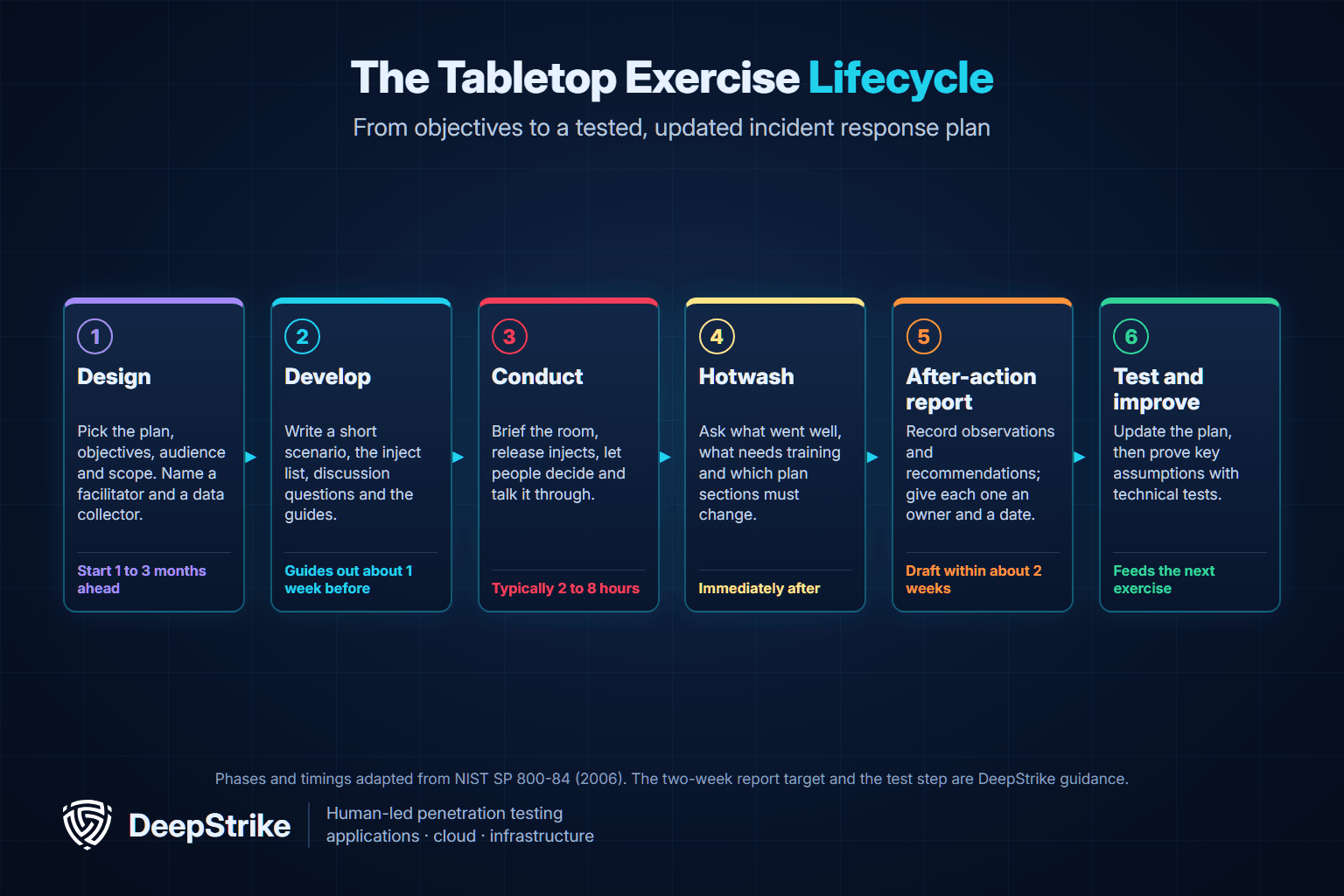
Start with the document you are testing, which is usually your incident response plan plus any ransomware playbook, business continuity plan and crisis communications plan. NIST SP 800-84 says tabletop objectives should validate three things: the content of the plan and related procedures, participants' roles and responsibilities as written, and the interdependencies the plan documents.
Turn those into three to five specific objectives that an observer can mark as met or not met. Good examples:
Avoid objectives such as "improve ransomware readiness." Nobody can score that.
NIST recommends running senior-level and operational-level teams in separate tabletops at first, because their responsibilities differ, and then combining them to test coordination. It gives typical lengths of two to four hours for senior-level exercises and two to eight hours for operational ones.
| Track | Typical participants | Focus | Typical length |
|---|---|---|---|
| Executive | CEO or COO, CFO, general counsel, CISO, communications lead | Business impact, payment and disclosure decisions, external messaging | 2 to 4 hours |
| Operational | Incident response lead, SOC, IT operations, identity, backup, cloud and network owners | Detection, triage, containment, eradication, recovery steps | 2 to 8 hours |
| Combined | Both groups | Handoffs, escalation, decision timing | Half day |
Keep the room to people who own a decision or a task in the plan. Observers who will not speak make participants cautious. If a key role (for example, your managed service provider or cyber insurer's breach coach) cannot attend, assign someone to play it from a short brief.
NIST SP 800-84 names two core staff roles: a facilitator who leads the discussion and a data collector who records what happens. CISA's tabletop packages add planners, evaluators and participants. A practical cast looks like this:
| Role | Responsibility | Tip |
|---|---|---|
| Executive sponsor | Approves the exercise, protects the calendar time and receives the after-action report | NIST stresses that management approval is an essential early step |
| Lead planner | Owns objectives, scenario, logistics and the report | Usually the incident response lead or GRC owner |
| Facilitator | Presents the scenario, releases injects, asks questions and keeps time | Should not be the most senior person in the room; an outside facilitator helps when the security team is being evaluated |
| Data collector (scribe) | Records decisions, times, gaps and quotes against each objective | Use a template organized by objective |
| Trusted agent | Subject matter expert who checks that the scenario is technically plausible | NIST suggests one when a detailed scenario is needed |
| Participants | Play their real roles and make decisions | Seat people away from their own teams, as NIST suggests, to encourage independent thinking |
| Role players | Simulate outside parties: attacker, reporter, regulator, insurer, MSP | Script their lines in the inject list |
NIST calls a common misconception the belief that scenarios must be very detailed. Long scenarios make participants debate the story instead of the objectives. Write a one-paragraph opening situation, then let injects carry the detail.
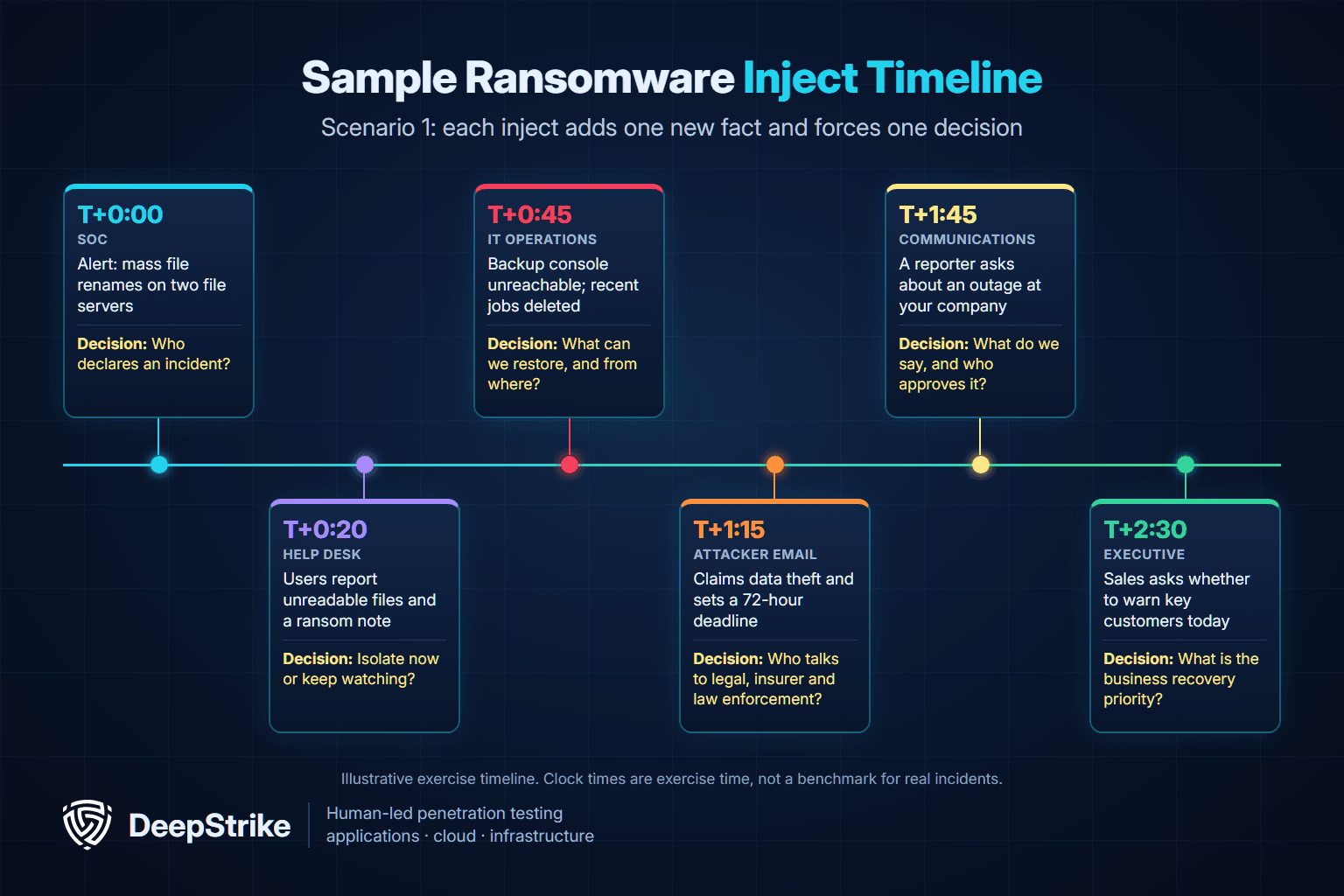
An inject is a timed piece of new information. Each one should push the group toward a decision tied to an objective:
| Field | What to write | Example |
|---|---|---|
| Time | Exercise clock time | T+0:45 |
| Source | Who delivers it | IT operations |
| Content | The new fact, in one or two sentences | The backup console is unreachable and last night's jobs show as deleted |
| Expected decision | What the plan says should happen | Incident commander confirms backup isolation status and activates recovery lead |
| Objective | Which objective it tests | Objective 3: restore priorities and backup source |
| Follow-up questions | Two or three prompts if the room stalls | Where is the last offline copy? Who can confirm it is clean? |
Write six to ten injects for a three-hour session. Escalate pressure, but keep each inject plausible for your environment. If you use technical details, take them from public sources such as MITRE ATT&CK techniques T1486 Data Encrypted for Impact and T1490 Inhibit System Recovery, not from guesses.
NIST SP 800-84 lists four documents for a typical tabletop:
Book the room or video bridge, confirm attendance in writing and decide whether the session is in person, remote or hybrid. In-person sessions produce better cross-team discussion; remote sessions should use a separate chat channel for the data collector and strict speaking order.
The scenarios below are written for a mid-sized organization with a SOC (in-house or outsourced), a Windows and cloud estate and a cyber insurance policy. Adjust names, systems and times to your environment. Each scenario lists injects, discussion questions and the technical test that would confirm what the room concluded. All scenarios are illustrative and contain no attack instructions.
| # | Scenario | Best audience | Plan sections tested | Follow-up technical test |
|---|---|---|---|---|
| 1 | Encryption starts on file servers | Operational, then combined | Declaration, isolation, recovery priorities | Purple team detection timing |
| 2 | Data theft with no encryption | Executive | Legal, notification, extortion response | Data exfiltration detection test |
| 3 | Backups deleted before encryption | Operational | Backup isolation and restore | Timed restore test |
| 4 | Compromise through a managed service provider | Combined | Third-party access, vendor coordination | Third-party access review and assumed-breach test |
| 5 | Help desk MFA reset leads to ransomware | Operational | Identity verification, account recovery | Social engineering test of reset process |
| 6 | Hypervisors encrypted, mass outage | Operational | Infrastructure recovery, out-of-band comms | Rebuild and restore drill |
| 7 | Cloud and SaaS data extortion | Combined | Cloud logging, token revocation, SaaS contracts | Cloud configuration and logging review |
| 8 | Attack during a holiday weekend | Combined | On-call, delegation, contact lists | Out-of-hours call-tree test |
| 9 | The ransom payment decision | Executive | Payment policy, sanctions, insurer, law enforcement | Policy review; no technical test |
| 10 | Reinfection after recovery | Operational | Eradication, credential reset, monitoring | Red team or compromise assessment after recovery |
Setup: At 2:10 a.m. on a Tuesday, your SOC sees mass file renames on two file servers. Users in one office cannot open shared documents when they log in.
Injects:
Discussion questions:
What to test afterward: the time from first encryption activity to a confirmed alert, using a purple team exercise in a lab or approved scope.
Setup: No systems are encrypted. A ransomware group posts your company name and a sample of internal files on its data leak site and emails your CEO.
Injects:
Discussion questions:
What to test afterward: whether data staging and bulk transfer out of the environment would be detected, through a purple team or red team objective focused on exfiltration.
Setup: Encryption begins on Saturday morning. Investigation shows the attacker used an administrator account to delete snapshots and backup catalogs two days earlier.
Injects:
Discussion questions:
What to test afterward: a timed restore of one critical system from the offline copy into an isolated environment. The CISA guide's emphasis on offline, encrypted backups is only useful if the restore works.
Setup: Your managed service provider (MSP) tells you that one of its remote monitoring and management (RMM) consoles was compromised. Several of its clients report ransomware.
Injects:
Discussion questions:
What to test afterward: a third-party access review plus an assumed-breach test that starts from the vendor's access path. Our guide to third-party risk management covers the contract side.
Setup: A caller claiming to be a traveling executive persuades the help desk to reset multifactor authentication. Within hours, the account is used to reach admin tools and ransomware is staged.
Injects:
Discussion questions:
What to test afterward: an authorized social engineering penetration test of the reset process.
Setup: The attacker encrypts virtual machine files at the hypervisor layer. Hundreds of servers go down at once, including domain controllers and the ticketing system.
Injects:
Discussion questions:
What to test afterward: a rebuild and restore drill for core identity services, plus a check that break-glass credentials are stored outside the infrastructure they recover.
Setup: An attacker uses stolen session tokens to download data from your cloud storage and a SaaS platform, then demands payment. On-premises systems are untouched.
Injects:
Discussion questions:
What to test afterward: a cloud logging and configuration review, and a purple team check of whether token misuse would be detected.
Setup: Ransomware is detected on the Friday evening before a holiday weekend. The CISO is on leave abroad and the incident response lead is unreachable.
Injects:
Discussion questions:
What to test afterward: an unannounced out-of-hours call-tree test that measures how long it takes to reach each decision maker.
Setup: Recovery from backups will take two weeks. The attacker offers a decryptor and promises to delete stolen data in exchange for payment.
Injects:
Discussion questions:
What to test afterward: no technical test; a policy review with legal, finance and the board, and a check of insurance terms. For context on how often victims pay, see our ransomware payout statistics.
Setup: Two weeks after restoring operations, the SOC sees the same remote access tool beaconing from a restored server, and a new ransom note appears.
Injects:
Discussion questions:
What to test afterward: a compromise assessment or red team engagement after recovery, focused on persistence and credential reuse. The CISA guide warns responders to take care not to re-infect clean systems during recovery.
Use this checklist to run any of the scenarios above. It combines the logistics and documentation steps in NIST SP 800-84 with practices that keep a cyber tabletop on track.
Before the exercise
During the exercise
After the exercise
| Time | Block | Notes |
|---|---|---|
| 0:00 to 0:15 | Welcome, objectives, ground rules | Introductions by role |
| 0:15 to 0:25 | Opening situation | Scenario paragraph only |
| 0:25 to 1:25 | Injects 1 to 3 | Detection, declaration, containment |
| 1:25 to 1:35 | Break | Facilitator and scribe check progress against objectives |
| 1:35 to 2:30 | Injects 4 to 6 | External parties, communications, business decisions |
| 2:30 to 3:00 | Hotwash | Strengths, gaps, plan changes, parking lot |
The after-action report (AAR) is where a tabletop turns into change. NIST SP 800-84 says the report should describe the exercise background (purpose, objectives, participants and scenario), the observations made by the facilitator and data collector, and recommendations for improving the plan. It also says evaluation criteria should be written before the exercise so data collectors know what to capture. The U.S. Homeland Security Exercise and Evaluation Program (HSEEP), whose latest revision was released in February 2020, pairs the report with an improvement plan in a single After-Action Report/Improvement Plan (AAR/IP).
A practical AAR for a cyber tabletop has six parts:
| Observation | Objective | Recommendation | Owner | Due date | How we will verify |
|---|---|---|---|---|---|
| No one could confirm which backups were offline | 3 | Document backup isolation and test a restore of the ERP database | Infrastructure lead | Within 60 days | Timed restore test with evidence |
| Night-time escalation took longer than the plan assumes | 1 | Add delegated authority and offline contact list | IR lead | Within 30 days | Out-of-hours call-tree test |
| Disagreement on who approves customer notices | 4 | Name approvers in the communications plan | General counsel | Within 30 days | Plan review sign-off |
Illustrative example rows.
Keep the AAR factual and no-fault. Participants who expect to be blamed will stop speaking openly in the next exercise.
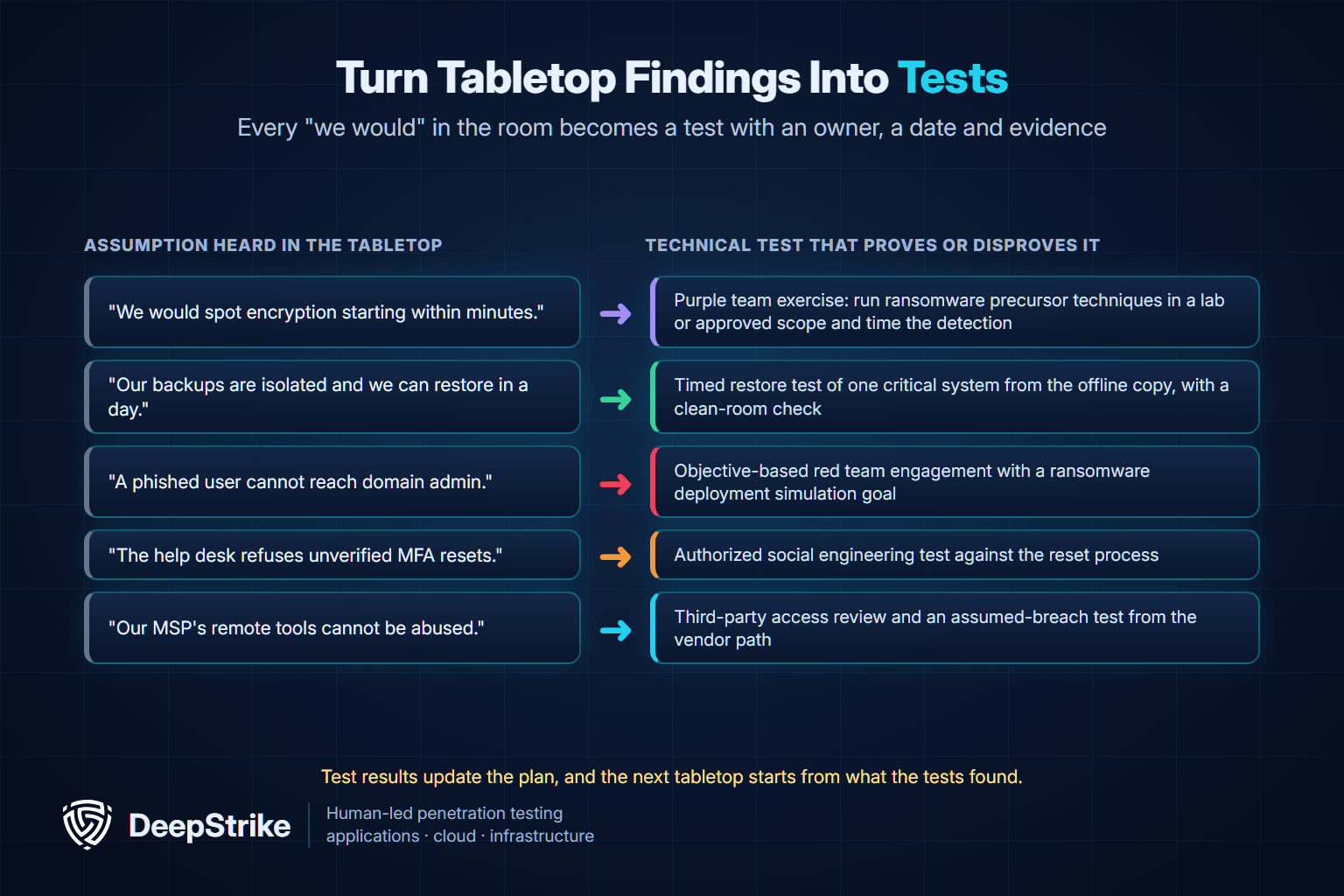
A tabletop produces statements, not proof. Phrases such as "we would see that," "our backups are isolated" or "the help desk would never reset that" are assumptions until someone tests them. The highest-value output of a cybersecurity tabletop exercise is a short list of those assumptions, each converted into a technical test with an owner and a date.
| Assumption heard in the tabletop | Technical test that proves or disproves it | Typical owner |
|---|---|---|
| "We would spot encryption starting within minutes." | Purple team exercise: run ransomware precursor techniques in a lab or approved scope and time the detection | Detection engineering |
| "Our backups are isolated and we can restore in a day." | Timed restore test of one critical system from the offline copy, with a clean-room check | Infrastructure |
| "A phished user cannot reach domain admin." | Objective-based red team engagement with a ransomware deployment simulation goal | Security leadership |
| "The help desk refuses unverified MFA resets." | Authorized social engineering test against the reset process | IT service management |
| "Our MSP's remote tools cannot be abused." | Third-party access review and an assumed-breach test from the vendor path | Vendor risk and security |
Three practices make the bridge work:
The loop also works in reverse. A red team report shows what an attacker did; a tabletop built on that attack path shows whether the organization would have made the right decisions once it noticed. Running the tabletop on a real attack narrative is often more persuasive for executives than a hypothetical one.
You do not need to write everything from scratch. Three free, government-backed resources cover most needs:
| Resource | Publisher | What you get | Best for |
|---|---|---|---|
| CISA Tabletop Exercise Packages (CTEPs) | U.S. Cybersecurity and Infrastructure Security Agency | Over 100 customizable packages with template objectives, scenarios, discussion questions, role templates, slide decks, feedback forms and an after-action report template; cyber scenarios include ransomware, insider threats, phishing and industrial control system compromise | U.S. organizations wanting a full kit, including sector-specific versions |
| Exercise in a Box | UK National Cyber Security Centre | A free online tool with micro exercises and tabletop exercises (20 exercises across 12 topics, including ransomware, phishing and supply chain) that helps identify post-exercise actions | Small and mid-sized organizations without exercise experience |
| NIST SP 800-84 | U.S. National Institute of Standards and Technology | The method: design, development, conduct and evaluation, plus sample facilitator guide, participant guide and after-action report in Appendix A | Program owners building a repeatable exercise process |
Open the resources: CISA Tabletop Exercise Packages (CTEPs), Exercise in a Box and NIST SP 800-84.
NIST SP 800-84 dates from September 2006, so treat its logistics checklist (which mentions CD-ROMs) as dated, but its exercise method still holds. For incident response planning itself, NIST replaced SP 800-61 Rev. 2 with SP 800-61 Rev. 3 in April 2025, which ties incident response to the Cybersecurity Framework (CSF) 2.0. Make sure your tabletop tests the plan you actually have, aligned to current guidance.
NIST SP 800-84 says organizations should run tabletop exercises periodically and also after organizational changes, plan updates or new exercise guidance. It notes that federal agencies must exercise or test system contingency plans at least annually under NIST SP 800-53. A practical cadence for most organizations is at least one full ransomware tabletop a year for executives, more frequent short operational exercises for the response team, and an extra session after any major change such as a merger, a new MSP, a cloud migration or a significant incident. Our incident response plan guide recommends supplementing annual tabletops with red or purple team engagements, which is the loop this guide describes.
A cybersecurity tabletop exercise is a facilitated discussion in which the people responsible for incident response walk through a realistic attack scenario, such as ransomware, and talk through their decisions and actions. NIST describes tabletops as discussion-based only; no systems are touched. The goal is to validate the incident response plan, roles and handoffs, and to find gaps before a real incident.
A common example is a ransomware scenario: the SOC sees mass file encryption overnight, backups turn out to be deleted, the attacker claims to have stolen data and a reporter calls. Participants decide who declares the incident, what to isolate, what to restore first and who to notify. The ten scenarios in this guide are ready-to-adapt examples.
NIST SP 800-84 says tabletops typically last two to eight hours. Senior-level sessions usually run two to four hours and operational sessions two to eight. A three-hour session with six injects and a 30-minute hotwash works well for a first ransomware exercise.
Everyone with a role in the incident response plan: the incident response lead, SOC, IT operations, identity and backup owners, legal, communications, finance and an executive decision maker. NIST recommends separate sessions for senior and operational teams at first, then a combined one.
An inject is a timed piece of new information released by the facilitator during the exercise, such as "the backup console is unreachable." Each inject should force a decision tied to an exercise objective.
Background (purpose, objectives, participants, scenario), observations recorded by the facilitator and data collector, and recommendations for improving the plan, according to NIST SP 800-84. Add an improvement plan with an owner, a due date and a verification method for each recommendation.
No. A tabletop tests people, decisions and the plan through discussion. A penetration test or red team engagement tests real systems and controls. They complement each other: the tabletop shows what the organization assumes, and technical testing shows whether those assumptions hold.
A good cybersecurity tabletop exercise leaves you with a better plan and a short list of things the room believed but could not prove. Pick one scenario from this guide, run it with the facilitator checklist, write the after-action report within two weeks and turn the top three assumptions into tests.
When the open question is whether a real attacker could get from a phished user to a ransomware-ready position without being noticed, you need an adversary's view. DeepStrike's red teaming services include ransomware deployment simulation as a campaign objective and measure your SOC, alerting and response workflows against realistic tradecraft. The debrief gives your teams attacker pathways, evidence, remediation priorities and retest-ready next actions, which you can feed straight into your next tabletop. To discuss scope, contact DeepStrike.
Mohammed Khalil is a Cybersecurity Architect at DeepStrike, specializing in advanced penetration testing and offensive security operations. With certifications including CISSP, OSCP, and OSWE, he has led numerous red team engagements for Fortune 500 companies, focusing on cloud security, application vulnerabilities, and adversary emulation. His work involves dissecting complex attack chains and developing resilient defense strategies for clients in the finance, healthcare, and technology sectors.

Stay secure with DeepStrike penetration testing services. Reach out for a quote or customized technical proposal today
Contact Us
