November 4, 2026
Updated: November 4, 2026
How BAS validates your security controls against known attack techniques, what it can't find, and how to pair it with penetration testing in a CTEM program.

Mohammed Khalil
Breach and attack simulation (BAS) is automated software that safely runs known attacker techniques inside your environment to check whether your security controls prevent, detect or log them. It answers one question very well: do the defenses we paid for actually work against attacks we already know about? Penetration testing answers a different one: what can a skilled attacker find and exploit that nobody has thought of yet? BAS is strong at control validation and catching regressions. It cannot find business logic flaws, broken authorization in your own applications or novel chains of weaknesses. Most mature programs need both.
The short version, before the detail:
| Dimension | Breach and attack simulation (BAS) | Penetration testing |
|---|---|---|
| Main question | Do our controls stop or detect known techniques? | What can an attacker exploit here, and how far can they get? |
| Who runs it | Software, configured by the security team | Skilled human testers, often supported by tools |
| Cadence | Continuous or scheduled, daily to weekly | Point in time, or continuous when tied to changes |
| What it tests | Preventive and detective controls: EDR, email security, network controls, WAF, SIEM rules | Applications, APIs, cloud, networks and identities, including custom logic |
| Attack source | A library of predefined scenarios, usually mapped to MITRE ATT&CK | Tester reasoning, reconnaissance and the target's real behavior |
| Finds unknown flaws | Rarely; it replays what is in its library | Yes; that is its main purpose |
| Business logic and authorization | Not covered | Core strength |
| Chained attack paths | Only chains someone already scripted | Discovers and proves new chains |
| Typical output | Pass/fail per technique, ATT&CK coverage, control drift over time | Exploitable findings with evidence, impact and fixes, then retest |
| Main limit | Blind to anything outside the library | Coverage depends on scope, time and skill |
The rest of this guide explains how BAS works, what it is genuinely good at, the categories of risk it cannot see, and how to combine it with penetration testing inside a continuous threat exposure management (CTEM) program.
Breach and attack simulation is a category of security validation tools that emulate real adversary behavior, in a controlled and non-destructive way, to measure how well an organization's defenses respond. Instead of looking for vulnerabilities in code or configuration, BAS tests the controls that are supposed to stop or catch an attacker: endpoint detection and response (EDR), email filtering, network segmentation, web application firewalls, data loss prevention and the detection rules in a security information and event management (SIEM) system.
The idea grew from a simple gap. Organizations buy and configure many controls, but they rarely confirm, day to day, that those controls still behave the way the design says they should. A rule gets disabled during troubleshooting, an agent stops reporting after an upgrade, an exception becomes permanent. BAS replays attacker techniques on a schedule so those failures surface quickly.
Government guidance points in the same direction. In joint advisory AA22-257A, CISA and partner agencies recommend "exercising, testing, and validating your organization's security program against the threat behaviors mapped to the MITRE ATT&CK for Enterprise framework," selecting techniques from the advisory, testing your technologies against them and tuning people, processes and technology based on the results. That workflow is exactly what BAS tools automate.
The market label is shifting. Gartner now covers these tools in its Market Guide for Adversarial Exposure Validation (AEV), which, according to Gartner's public summary, addresses validating threat exposure, security controls and defensive readiness against attack scenarios and techniques. Many vendors that called themselves BAS now also use the AEV or "exposure validation" label, and some combine BAS with automated penetration testing. When you compare products, look at what each one actually tests rather than which acronym it uses.
Most BAS platforms share the same building blocks: something that executes the attack, a library of what to execute, a mapping to a common framework, safety controls, and a way to read the results.
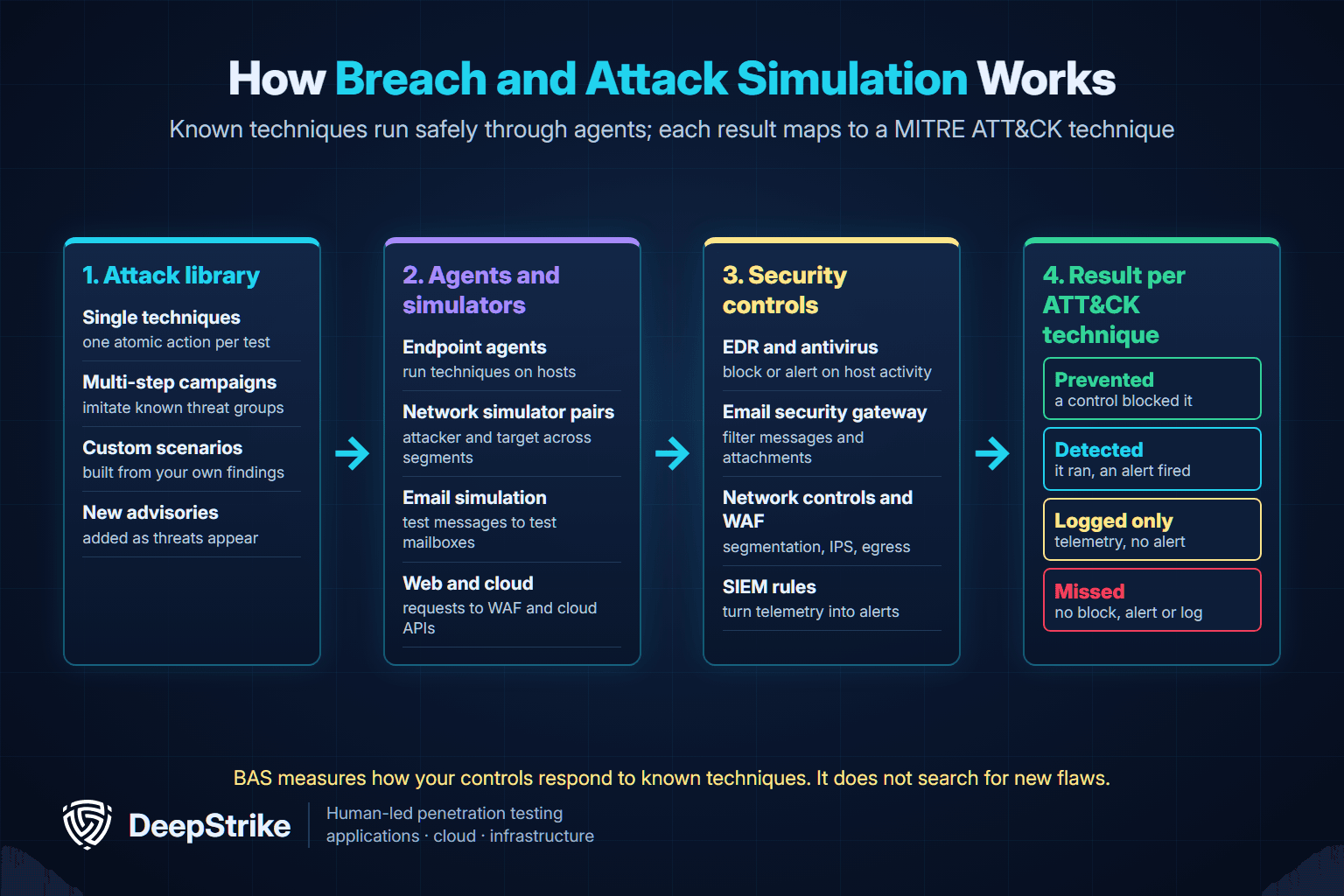
BAS needs a foothold to run tests from. Platforms typically use one or more of these:
Agent placement decides what you learn. An agent on a hardened golden image tells you little about the developer laptop with local admin rights or the legacy server nobody patched.
The library is the heart of a BAS product. It contains scenarios ranging from single techniques (one atomic action, such as dumping credentials from memory) to multi-step campaigns that imitate a known threat group or ransomware family. Vendors add scenarios when new threat intelligence or government advisories appear, and most platforms let you build custom scenarios.
Open-source projects show how these libraries are structured. MITRE Caldera is an adversary emulation platform built to automate adversary emulation and assist manual red teams, and the Atomic Red Team project publishes a library of small tests mapped to MITRE ATT&CK. Commercial examples of the BAS category include AttackIQ, SafeBreach, Picus Security and Cymulate. These names are examples of the category, not recommendations.
The library is also the main limit. A BAS platform can only run what someone has already written. That matters later in this guide.
Almost every BAS platform maps its scenarios to MITRE ATT&CK, the public knowledge base of adversary tactics and techniques. Each test carries a technique ID, such as T1059.001 for PowerShell execution or T1003.001 for LSASS memory credential dumping. That mapping lets you:
ATT&CK coverage is a useful measurement, but it is not the same as security. Blocking one implementation of a technique does not mean every variation of it is blocked.
BAS is built to run in production without causing harm. Typical safety measures include benign stand-ins for malware, simulated exfiltration of fake data to a controlled endpoint, encryption tests on dummy files only, automatic cleanup after each test, and allow-listing so the security team can tell simulations from real incidents. Even so, coordinate with IT operations and the SOC before you start, run new scenarios in a test segment first, and agree on how alerts generated by simulations will be labeled and closed.
Each simulated technique ends in one of four states:
The illustrative table below shows how one scenario might look. It is a composite example, not data from a real environment.
| Step | ATT&CK technique | Prevented | Detected | Result and action |
|---|---|---|---|---|
| Phishing attachment delivered to test mailbox | T1566.001 Spearphishing Attachment | Yes | Yes | Gateway quarantined it; no action |
| Encoded PowerShell launched on workstation agent | T1059.001 PowerShell | No | Yes | EDR alerted but did not block; review blocking policy |
| Credential dumping attempt against LSASS | T1003.001 LSASS Memory | Yes | Yes | EDR blocked; no action |
| Lateral movement over admin shares to a server | T1021.002 SMB/Windows Admin Shares | No | No | Logged only; build a SIEM detection and retest |
| Simulated exfiltration of dummy files | T1048 Exfiltration Over Alternative Protocol | No | No | Missed; review egress filtering and DLP |
| Encryption of dummy test files | T1486 Data Encrypted for Impact | No | Yes | Alert fired after encryption began; tune ransomware rules |
The value is in the last column. Each gap becomes a specific engineering task, and the same scenario reruns after the fix to prove it worked.
BAS earns its place in a security program when the question is about controls, not about finding new weaknesses.
BAS confirms that controls behave as configured. Typical findings include EDR policies set to "detect" where you expected "block," email rules that miss a particular attachment type, segmentation rules that allow traffic the architecture diagram says is blocked, and SIEM rules that never fire because the log source stopped sending data.
Controls drift. Upgrades reset policies, emergency changes outlive the emergency, and new systems join the network without the standard build. Because BAS runs the same scenarios repeatedly, a result that changes from "prevented" to "missed" is a clear signal that something changed. This regression testing is the main reason to run BAS continuously instead of once.
Detection engineers use BAS to test new and updated rules against repeatable activity, without waiting for a red team exercise or a real attack. Combined with collaborative purple team work, it shortens the loop from "we think this rule works" to "we watched it fire." Our guide to red team vs blue team explains how purple teaming joins both sides.
When a government advisory or threat report describes a campaign, many BAS platforms add matching scenarios. Running them answers "would we have caught this?" within days, which is the workflow CISA describes in AA22-257A.
ATT&CK-mapped trends turn control performance into numbers leaders can follow over time, such as the share of tested techniques prevented or detected this quarter compared with last quarter.
This is where buyers most often over-read a BAS dashboard. A BAS platform measures how your controls respond to known techniques. It does not examine how your applications, APIs and business processes behave, and it does not invent new attacks. NIST's Technical Guide to Information Security Testing and Assessment (SP 800-115) makes the general point well: "no one technique can provide a complete picture of the security of a system or network." Here are the gaps that matter most.
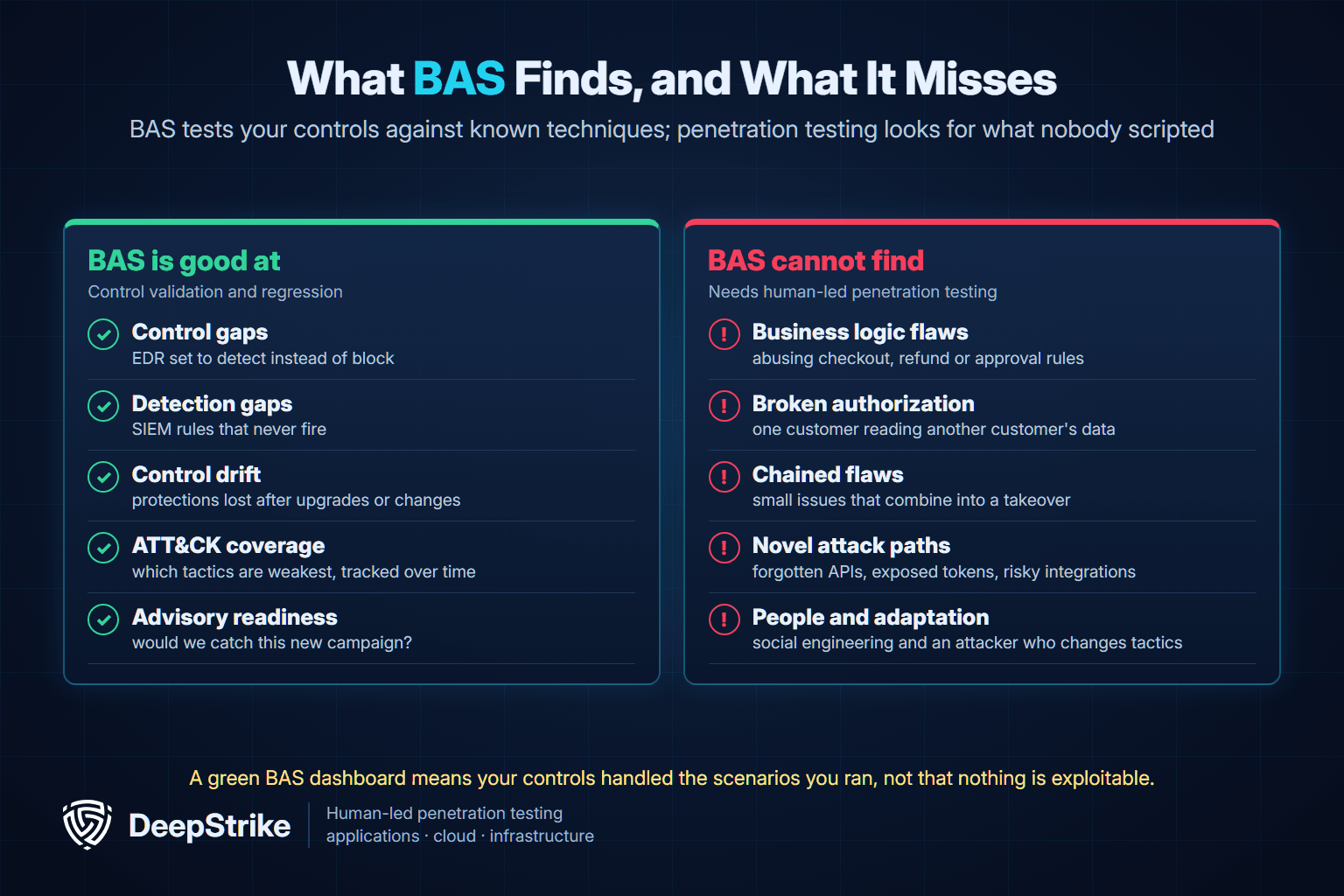
Business logic flaws are weaknesses in how an application's rules work, not in its code syntax or its infrastructure. Examples include applying a discount twice, skipping a payment step in a checkout flow, cancelling a transaction after loyalty points were credited, or approving your own request in a workflow that should need a second person.
The OWASP Web Security Testing Guide is direct about this. Its business logic testing introduction says this type of vulnerability "cannot be detected by a vulnerability scanner and relies upon the skills and creativity of the penetration tester," and that automating business logic abuse cases "is not possible." BAS libraries do not contain your checkout flow, so they cannot test it.
Broken object level authorization (BOLA), where a user can access another user's records by changing an identifier, is the first risk in the OWASP API Security Top 10 2023. Finding it requires understanding which user should see which object in your specific application. That is a property of your data model and permission design. No generic attack scenario knows it, and no EDR or WAF control is designed to stop a validly authenticated request for the wrong record.
Many serious breaches come from several modest weaknesses combined. A BAS platform can replay a chain someone already scripted, but it does not discover a new chain in your environment.
Here is an illustrative example, not drawn from a real engagement. A tester notices that a user profile API returns internal account IDs (low severity on its own). The password reset endpoint accepts an account ID and has no rate limit (medium). The reset confirmation page reveals whether a token was valid (low). Individually, a scanner might rate all three as minor. A tester who sees how they connect can show, using test accounts, that together they allow account takeover. A BAS run in the same environment would show EDR, email and network controls working perfectly, because none of those controls sit in this path.
BAS does not perform the reconnaissance a real attacker does. It will not notice the forgotten staging API on an old subdomain, the cloud storage bucket a contractor made public, the CI/CD token committed to a repository, or the SaaS integration with far broader permissions than anyone intended. Finding those requires discovery and human judgment about what the environment actually looks like, not what the asset inventory says. Our penetration testing methodology guide shows how testers build that picture during reconnaissance.
A BAS scenario runs the same way every time. Real attackers adapt: when one technique is blocked, they try another, wait, change tools or abuse a trusted process. BAS also has limited reach into social engineering, help desk procedures, physical security and the speed of a real incident response team. Those questions belong to red teaming and, for people-focused risk, social engineering assessments.
When teams are measured on BAS pass rates, there is a temptation to write detections that match the simulation's exact artifacts rather than the underlying behavior. The dashboard turns green, but a slightly different implementation of the same technique still gets through. Treat BAS results as one input, rotate and customize scenarios, and validate high-value detections with human-led testing.
The practical conclusion: a fully green BAS dashboard means your controls handled the scenarios you ran. It does not mean nothing in your environment is exploitable.
Penetration testing starts from the target instead of from a library. A tester maps the application or environment, forms hypotheses about how it could be abused, and tries them safely within agreed rules of engagement. The output is a set of exploitable findings with evidence, business impact and a fix, followed by a retest to confirm closure. That is how logic flaws, authorization errors and new attack chains are found.
Penetration testing has limits too, and they are the mirror image of BAS:
Automated penetration testing narrows part of the frequency gap for known exploitation and lateral movement steps in networks and identity systems, but it shares BAS's weakness with custom logic. Our comparison of manual vs automated penetration testing covers that trade-off in detail. For applications and APIs that change every sprint, continuous penetration testing ties human testing to each meaningful change instead of to the calendar.
BAS is easy to confuse with neighboring methods. This table separates their jobs.
| Method | Primary question | Human or automated | Finds new flaws | Best use |
|---|---|---|---|---|
| Vulnerability scanning | Which known weaknesses exist on known assets? | Automated | Known CVEs and misconfigurations only | Broad hygiene coverage |
| Breach and attack simulation | Do controls prevent or detect known techniques? | Automated | No; validates controls | Continuous control validation and regression |
| Automated penetration testing | Can common exploitation and lateral movement steps succeed? | Automated | Some known paths in networks and identity | Frequent checks of infrastructure attack paths |
| Manual penetration testing | What can a skilled attacker exploit, and how far can they go? | Human-led | Yes, including logic and chained flaws | Applications, APIs, cloud and high-value systems |
| Continuous penetration testing | Is each new change exploitable? | Human-led, change-triggered | Yes, as the attack surface changes | Fast-changing applications and APIs |
| Red teaming | Can an adversary reach a business objective before we detect and stop them? | Human-led | Yes, across people, process and technology | Periodic objective-driven tests of the whole defense |
| Purple teaming | Which detections should fire, and do they? | Human-led, collaborative | Detection gaps | Tuning detections with attackers and defenders together |
Use the question you need answered, not the tool you already own, to choose a method.
| If your question is... | Use | Why |
|---|---|---|
| Did last month's EDR upgrade weaken any protections? | BAS | Repeatable scenarios show regressions immediately |
| Would we detect the techniques in the latest government advisory? | BAS, then purple team for gaps | Mapped scenarios exist quickly; humans tune what fails |
| Can a customer see another customer's data through our API? | Penetration testing | Authorization depends on your data model, which BAS cannot know |
| Can someone abuse our checkout, refund or approval workflow? | Penetration testing | Business logic needs human reasoning (OWASP WSTG) |
| We ship features weekly. Is each release safe? | Continuous penetration testing, with BAS for controls | Human testing follows change; BAS watches the controls around it |
| Are our segmentation rules still enforced? | BAS or automated penetration testing | Network simulators test this continuously |
| Could an attacker reach our crown-jewel data before the SOC reacts? | Red teaming | Objective-driven, adaptive and tests response under pressure |
| Do several medium findings combine into something critical? | Penetration testing | Chains are discovered by testers, not replayed from libraries |
| Did a fix for a pentest finding actually work? | Targeted retest, then add a BAS regression scenario where possible | The retest proves closure; BAS keeps checking it |
| Do we need evidence for a penetration testing requirement? | Penetration testing | Standards such as PCI DSS require penetration testing; BAS results are supporting evidence at most |
If most of your questions land in the BAS rows, your gap is control assurance. If most land in the pentest rows, your gap is finding exploitable weaknesses. Most organizations have both.
Continuous threat exposure management gives both methods a clear home. In CTEM, validation is the stage that tests whether prioritized exposures are actually exploitable and whether controls respond. BAS and penetration testing are two of the main validation methods, and they answer different halves of that question.
A layered cadence works for most mid-size and enterprise teams:
| Layer | Method | Cadence | What it validates | Feeds |
|---|---|---|---|---|
| Continuous control layer | BAS | Daily to weekly, plus after control changes | EDR, email, network, WAF and SIEM behavior against known techniques | Control fixes, detection backlog, drift alerts |
| Change-driven depth layer | Continuous or scheduled penetration testing | Triggered by releases, new APIs, architecture changes; full test at least yearly | Applications, APIs, cloud and identity, including logic and chained flaws | Remediation tickets with evidence; new BAS scenarios |
| Objective layer | Red teaming and purple teaming | Periodically, often yearly | End-to-end detection and response against a business objective | Program priorities and detection engineering |
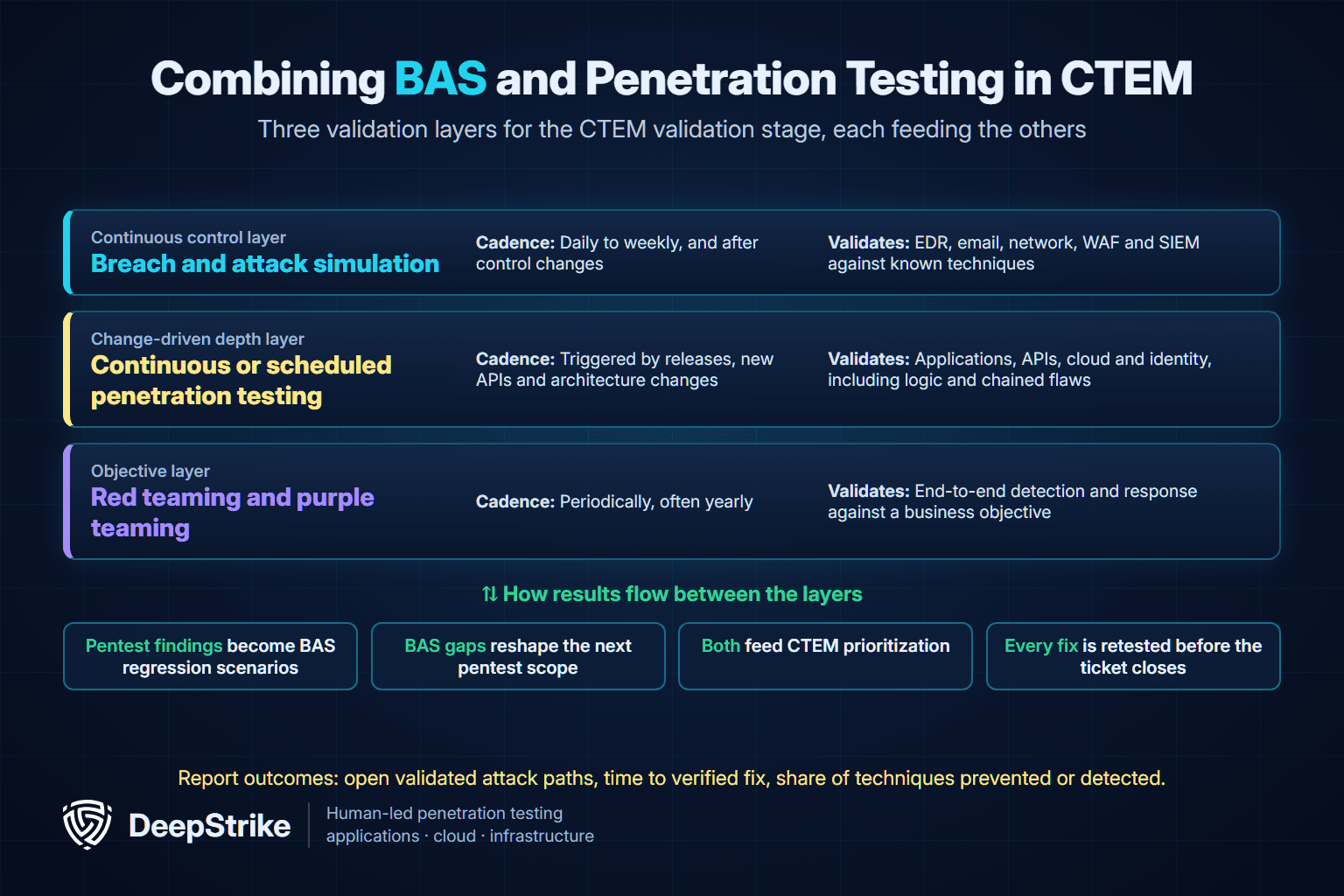
The layers work best when results flow between them:
For many organizations, BAS covers the infrastructure controls well, and the uncovered area is the custom software they build: web applications, APIs, mobile backends and the integrations between them. That is also the part of the attack surface that changes most often. The 2026 Verizon Data Breach Investigations Report found that exploitation of vulnerabilities was the most common known initial access vector in the breaches it analyzed, at 31%. Validating the controls around an application does not tell you whether the application itself can be exploited.
BAS tools fall into a few broad groups:
These are examples of the category, not recommendations. Evaluate any option against your own environment with questions like these:
Ask every vendor directly what the product does not test. A credible answer will include business logic and application authorization.
Breach and attack simulation is software that safely imitates known attacker techniques inside your environment to see whether your security controls block, detect or log them. Results are usually mapped to MITRE ATT&CK, so you can see which techniques your defenses handle and which they miss.
No. BAS checks whether controls respond to known techniques. Penetration testing finds exploitable weaknesses, including business logic flaws, broken authorization and chained attack paths, which BAS libraries cannot know about. Use BAS for continuous control assurance and penetration testing to find what an attacker could actually exploit.
BAS platforms are designed for production use, with benign payloads, dummy data, controlled exfiltration endpoints and automatic cleanup. Risk is not zero, so start in a test segment, coordinate with IT operations and the SOC, and agree how simulated alerts will be labeled and closed.
BAS runs predefined scenarios automatically and repeatedly to measure controls. Red teaming is a human-led, adaptive exercise that pursues a business objective, such as reaching sensitive data, while testing people, process and detection under realistic pressure. BAS gives frequent signal; red teaming gives depth and realism.
CTEM is a five-stage program for scoping, discovering, prioritizing, validating and fixing exposures. BAS is one tool for the validation stage, focused on security controls. A CTEM program usually combines BAS with penetration testing, red teaming and attack path analysis.
Many teams run core scenarios daily or weekly and rerun relevant scenarios after any change to security controls, after major infrastructure changes and when a new threat advisory affects their sector. Regression detection depends on frequent, consistent runs.
Generally no. Standards such as PCI DSS require penetration testing, and auditors expect human-led testing of the in-scope environment. BAS results can support evidence that controls are monitored and validated, but confirm with your assessor before relying on them for any specific requirement.
Breach and attack simulation is one of the best ways to know whether your security controls still work against the techniques attackers use today, and to catch the day they stop working. It is not designed to find the flaws in your own applications: broken authorization, abusable business logic and new chains of small weaknesses. Run BAS for continuous control assurance, use penetration testing for depth, and connect both through the validation stage of your CTEM program so each finding strengthens the other.
If your applications and APIs change faster than your testing schedule, talk to DeepStrike about continuous penetration testing services. Our team monitors signals such as front-end JavaScript changes, API documentation, release change logs and GraphQL schema changes, then starts manual testing when something new ships, with remediation retesting to confirm fixes. For objective-driven tests of detection and response, see our red teaming service.
Mohammed Khalil is a Cybersecurity Architect at DeepStrike, specializing in advanced penetration testing and offensive security operations. With certifications including CISSP, OSCP, and OSWE, he has led numerous red team engagements for Fortune 500 companies, focusing on cloud security, application vulnerabilities, and adversary emulation. His work involves dissecting complex attack chains and developing resilient defense strategies for clients in the finance, healthcare, and technology sectors.

Stay secure with DeepStrike penetration testing services. Reach out for a quote or customized technical proposal today
Contact Us
