November 3, 2026
Updated: November 4, 2026
Scope, discover, prioritize, validate and mobilize: how Gartner's CTEM cycle turns exposure lists into validated, fixed risk.
Abdalla Mohamed
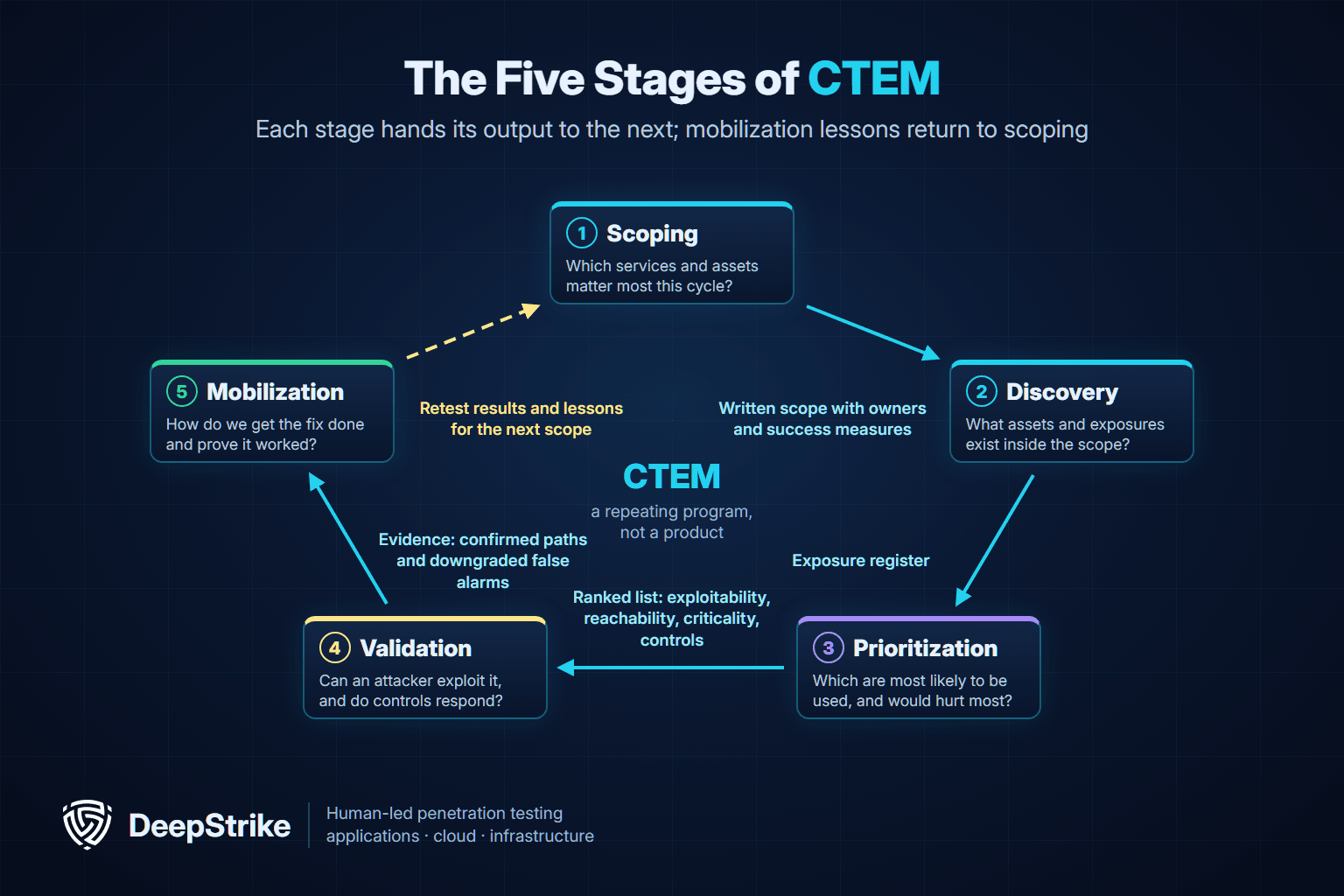
Continuous threat exposure management (CTEM) is a security program model, introduced by Gartner, that repeatedly finds, ranks, tests and fixes the exposures an attacker could actually use against the business. It runs as a five-stage cycle: scoping, discovery, prioritization, validation and mobilization. CTEM is not a product you buy. It is an operating discipline that ties existing tools such as scanners, attack surface management and penetration testing to business priorities, then proves which exposures are exploitable before asking engineering teams to fix them. Each cycle narrows the gap between what is wrong and what gets fixed.
If you only need the short version, this table summarizes the five stages of CTEM, the question each one answers and what it should hand to the next stage.
| Stage | Question it answers | Main output |
|---|---|---|
| 1. Scoping | Which business services and assets matter most this cycle? | A written scope tied to business impact, with owners and success measures |
| 2. Discovery | What assets and exposures exist inside that scope? | An exposure register: vulnerabilities, misconfigurations, identity weaknesses, exposed services and unknown assets |
| 3. Prioritization | Which exposures are most likely to be used, and which would hurt most? | A ranked list based on exploitability, reachability, asset criticality and existing controls |
| 4. Validation | Can an attacker really exploit this, and do our controls detect or stop it? | Evidence: confirmed attack paths, downgraded false alarms and tested defenses |
| 5. Mobilization | How do we get the fix done and prove it worked? | Owned remediation work, approved exceptions, retest results and lessons for the next scope |
The rest of this guide explains each stage, where penetration testing, red teaming and breach and attack simulation (BAS) fit, how CTEM differs from vulnerability management, and how to start a program without buying a new platform first.
Gartner introduced continuous threat exposure management in 2022 research for its clients and later named it one of its top cybersecurity trends. In its 2024 cybersecurity trends announcement, Gartner describes CTEM as a pragmatic, systemic approach to continually evaluate "the accessibility, exposure and exploitability of digital and physical assets." The same announcement says CTEM aligns assessment and remediation scope with threat vectors or business projects rather than with a single infrastructure component.
Three words in that definition carry most of the meaning:
Because CTEM is a program, not a tool category, you will not find a single "CTEM product" that completes it. Vendors sell platforms that support parts of the cycle, such as exposure assessment, attack path analysis or automated validation. The program itself is the set of decisions, owners and feedback loops that connect those tools to what the business needs to protect. Gartner's August 2025 Strategic Roadmap for Continuous Threat Exposure Management frames the work the same way: a roadmap for CISOs to pivot from traditional technology vulnerability management to a broader, more dynamic CTEM program.
An exposure is any condition that gives an attacker a usable path toward something you care about. In practice, CTEM programs track at least these categories:
That breadth is the main reason CTEM exists. A vulnerability scanner sees the first item well and the rest poorly.
Traditional programs produce long lists of findings. The problem is not finding issues; it is fixing the ones that matter before attackers use them. The 2026 Verizon Data Breach Investigations Report shows how wide that gap has become:
These figures describe Verizon's datasets, not every organization, but they point to the same lesson. Teams are not short of findings. They are short of a reliable way to decide which exposures to fix first, prove those exposures are real, and get the right people to act. CTEM is Gartner's answer to that operational problem.
A second reason is scope. Attack surfaces now include cloud control planes, SaaS tenants, APIs that change every sprint and identity systems that connect all of them. A quarterly scan of known IP ranges cannot keep up. Our guide to attack surface management explains why discovery has to be continuous before anything else in the cycle can work.
Gartner's framework names five stages. Practitioners often describe the first three as diagnosis and the last two as action. The stages repeat; the output of one cycle reshapes the scope of the next.
Scoping decides what this cycle will protect and how you will know whether it worked. It is the stage most programs rush, and it determines whether CTEM produces business value or simply more findings.
Good scoping starts from business impact and works backward to technology. Instead of "all servers," a useful scope reads like "the customer payments flow, including the public checkout API, the services behind it, the cloud accounts that host them and the identities that administer them." That scope has an owner, a reason and a boundary.
Practical scoping outputs include:
Many organizations begin with two scopes: the external attack surface and one high-value internal service. Both are concrete enough to finish a cycle in weeks rather than quarters.
Discovery finds the assets and exposures inside the scope. It goes beyond CVE scanning to include misconfigurations, identity weaknesses, exposed secrets, SaaS posture and unknown assets.
Typical discovery inputs include vulnerability scanners, external attack surface management, cloud security posture tools, identity and access reviews, code and dependency analysis, and threat intelligence about which techniques adversaries are using. Manual reconnaissance still matters here, because tools miss assets nobody pointed them at.
The output should be an exposure register, not a raw tool export. Each record needs a stable asset identifier, an owner, the exposure type, where it was found and when it was last confirmed. Practitioner guidance on CTEM stresses the same point: the number of discovered assets and vulnerabilities is not a success measure. Accurate discovery inside a business-relevant scope is.
Prioritization decides what to address first. CTEM replaces "fix everything rated critical" with a ranking that combines several signals:
Attack path analysis adds another useful view. It looks for "choke points," single weaknesses that sit on many paths to critical assets, so one fix removes several routes. Our comparison of EPSS vs CVSS explains how to combine those scores without over-trusting either one.
The output is a defensible priority list with target remediation times. It is still a hypothesis until validation tests it.
Validation is where CTEM most clearly departs from traditional vulnerability management. It asks three questions about the top-priority exposures:
Validation can move priorities in both directions. An exposure that looked critical may be unreachable because of segmentation or authentication, so it can be downgraded. A "medium" misconfiguration may complete a path from an internet-facing app to production data, so it moves to the top. Validation also tests the proposed fix, so remediation effort is not wasted on a change that does not close the path.
Methods range from automated checks to human-led adversary emulation. The next section compares them in detail, because choosing the right method for each exposure is the core practical decision in this stage.
Mobilization turns validated findings into completed work. Most CTEM programs stall here, because the people who must fix an exposure usually sit outside the security team.
Effective mobilization includes:
What the team learns here, such as which owners were unclear or which asset types kept reappearing, feeds the next scoping round. Our guide to patch management covers the change-control side of turning priorities into deployed fixes.
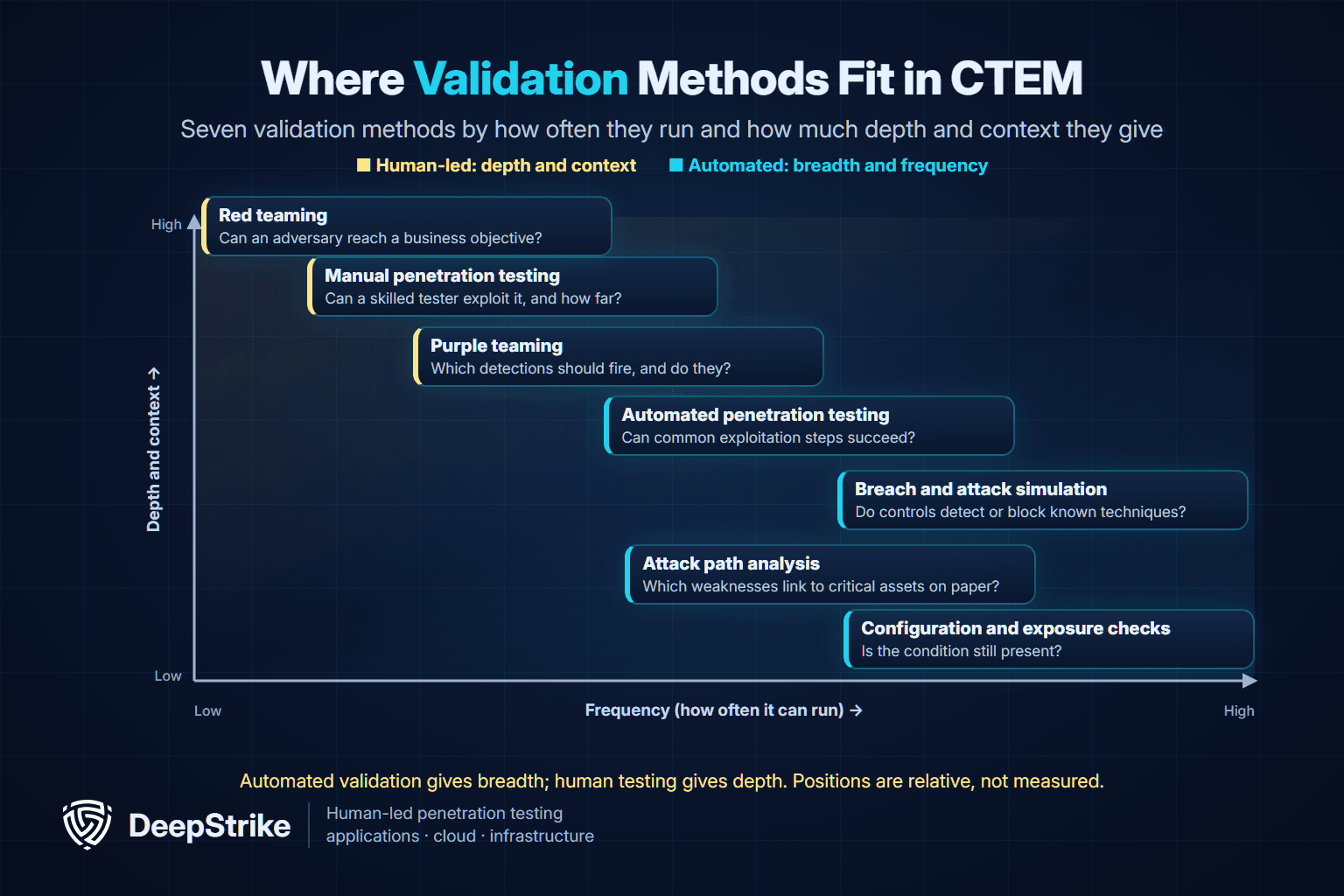
CTEM does not prescribe one validation tool. The SANS Institute's 2024 white paper on CTEM recommends a mix of red team exercises, controlled simulations, attack path analysis and breach and attack simulation, and it stresses that CTEM cannot be fully automated. Each method answers a different question, so a mature program uses several.
| Method | Question it answers best | Strengths | Limits | Typical place in a CTEM cycle |
|---|---|---|---|---|
| Configuration and exposure checks | Is the condition still present? | Fast, cheap, repeatable at scale | Confirms presence, not exploitability or impact | Every cycle, for all top-priority findings |
| Attack path analysis | Which weaknesses connect to critical assets on paper? | Shows choke points across large environments | Models paths from data; does not prove a path works | Prioritization input and validation planning |
| Breach and attack simulation (BAS) | Do our controls detect or block known techniques? | Continuous, safe-by-design tests of preventive and detective controls | Runs predefined scenarios; weak at business logic and novel chains | Ongoing control validation between human tests |
| Automated penetration testing | Can common exploitation and lateral movement steps succeed? | Broad, frequent coverage of known paths | Limited creativity and context; may avoid risky steps | Frequent checks of network and identity paths |
| Manual penetration testing | Can a skilled tester exploit this application, API, cloud or network exposure, and how far can they go? | Finds logic flaws, chained issues and context-specific risk; produces fix-ready evidence | Point-in-time unless run continuously; needs scoping and expertise | Validation of the highest-priority and most complex exposures |
| Red teaming and adversary emulation | Can a capable adversary reach a business objective before we detect and stop them? | Tests people, process, identity and detection under realistic pressure | Narrow by design; does not aim to find every flaw | Periodic, objective-driven validation of the whole defense |
| Purple teaming | Which detections should fire, and do they? | Fast detection tuning with attackers and defenders together | Depends on defender availability and logging quality | Follows red team or BAS findings |
Two technical references help structure these tests. NIST SP 800-115, the Technical Guide to Information Security Testing and Assessment, covers planning, rules of engagement and safe execution. MITRE ATT&CK gives a shared vocabulary of adversary tactics and techniques for selecting scenarios and mapping detection coverage.
Use the exposure's type and the decision you need to make, not habit, to pick the method. These rules work well as a starting point:
Automated validation gives breadth and frequency; human testing gives depth and context. A CTEM program that relies only on simulations will miss logic flaws in its own applications. One that relies only on an annual pentest will validate a snapshot that changes the day after the report.
Validation is only useful if mobilization can act on it. For each validated exposure, record:
That record lets the remediation owner act without re-investigating, and it gives leadership evidence rather than opinions.
CTEM does not replace vulnerability management. It builds on it and changes its scope, cadence and success measures. Our full guide to vulnerability management covers the lifecycle CTEM extends.
| Dimension | Traditional vulnerability management | CTEM |
|---|---|---|
| Scope | Known assets and software vulnerabilities, mostly CVEs | Business-defined scope covering vulnerabilities, misconfigurations, identity, SaaS, unknown assets and people |
| Starting point | The asset inventory and scanner coverage | The business services and threat scenarios that matter most |
| Prioritization | Often CVSS-led, sometimes risk-based | Exploit likelihood, reachability, business criticality and controls, then tested |
| Validation | Usually absent or limited to re-scanning | Built in: tests whether exposures are exploitable and whether controls respond |
| Remediation | Patch-centric tickets routed by severity | Mobilization across security, IT and engineering, with exceptions and playbooks |
| Cadence | Scheduled scans and reporting cycles | Continuous discovery with repeating, scoped cycles |
| Success measure | Findings closed, scan coverage, patch SLAs | Reduction in validated exposure to critical services and time to close validated paths |
The practical difference shows up in one question. A vulnerability management report asks, "How many critical findings do we have?" A CTEM report asks, "Which validated paths to our most important services are still open, and who is closing them?"
Risk-based vulnerability management (RBVM) sits between the two. It improves prioritization with threat and business context, but it usually stops before validation and cross-team mobilization. Many organizations reach CTEM by adding those two stages to an RBVM program they already run.
The overlap between these terms causes most of the confusion around CTEM, so it helps to separate their jobs:
Our explainer on vulnerability assessment vs penetration testing covers the difference between finding a weakness and proving its impact in more detail.
The following example is illustrative. It is a composite designed to show how the stages connect, not a description of a specific client or engagement.
A software company selects its customer-facing API platform as the first scope. The business goal is to protect customer data and keep the service available. The scope includes the public API, the web front end, the cloud account that hosts both, the CI/CD pipeline and the administrator identities.
Discovery produces about 400 findings. They include a critical CVE on an internet-facing VPN appliance that is listed in the CISA KEV catalog, an old staging API that still answers on a forgotten subdomain, a cloud role used by the build pipeline with broad write permissions, and dozens of medium-severity library vulnerabilities.
Prioritization puts the KEV-listed VPN flaw first because it is known to be exploited and is reachable from the internet. The staging API ranks second because it is unmanaged and reachable. The pipeline role ranks lower on severity alone, but attack path analysis shows it connects the build system to production storage.
Validation changes the picture. Testers confirm that the staging API accepts requests without the authorization checks the production API enforces, and that it shares a data store with production. In a controlled test using a test account, they show it can return records belonging to other tenants. Separately, they confirm the VPN flaw is exploitable but that the appliance sits in a segment with strong monitoring, and a BAS run shows the alerting fires. Several of the medium library findings turn out to be unreachable code paths and are downgraded.
Mobilization gives the staging API to the platform team with a same-week deadline and a recommendation to decommission it. The VPN patch goes through an emergency change. The pipeline role is reduced to least privilege through a pre-approved playbook. A risk acceptance with a 90-day expiry covers two library upgrades blocked by a vendor dependency. Retests confirm each closure.
The lesson for the next cycle: unmanaged environments were the biggest source of real exposure, so the next scope adds an inventory review of every subdomain and cloud account tied to the platform.
Gartner attached a strategic planning assumption to CTEM that appears in almost every article about it. In its February 2024 trends announcement, Gartner predicted that by 2026, organizations prioritizing their security investments based on a CTEM program would realize a two-thirds reduction in breaches. Earlier Gartner research expressed the same idea as being three times less likely to suffer a breach.
Read that prediction carefully:
The prediction is a reasonable argument for focusing effort on validated, business-relevant exposures. It is not a guarantee, and it should not be quoted as proof that any single product cuts breaches by a fixed amount.
Measure outcomes, not activity. Useful CTEM metrics include:
Avoid reporting total findings as a success measure. A rising count may mean better discovery, and a falling count may mean narrower scanning.
You can start CTEM with the tools you already have. This checklist assumes a small security team and one cross-functional sponsor.
Days 1 to 30: scope and baseline
Days 31 to 60: prioritize and validate
Days 61 to 90: mobilize and review
After the first cycle, shorten it. Mature programs run discovery continuously and repeat the scoping-to-mobilization loop on a cadence that matches how fast each scope changes.
The validation stage is where many programs run out of capacity. Automated tools cover known techniques well, but most organizations cannot keep human testers on every release of their applications and APIs. That is the gap continuous penetration testing is designed to close: instead of one annual snapshot, testing follows the changes that create new exposure.
DeepStrike's continuous penetration testing services apply that model to applications. The team monitors signals such as public front-end JavaScript files, API documentation, product release change logs and GraphQL schema changes, then starts manual testing when something new ships. Clients can also request a specific test through a shared Slack channel. In CTEM terms, that provides human-led validation for the parts of the attack surface that change most often, and remediation retesting helps confirm closure during mobilization.
Continuous penetration testing is one validation input, not a complete CTEM program. You still need scoping, discovery across infrastructure and identity, prioritization and cross-team mobilization. For objective-driven tests of detection and response, red teaming fills a different role.
CTEM is a program framework, not a product. Gartner describes it as an approach for continually evaluating the accessibility, exposure and exploitability of assets. Platforms can support individual stages, but the program consists of the scope, owners, decisions and feedback loops that connect those tools to business priorities.
The five stages are scoping, discovery, prioritization, validation and mobilization. Scoping defines what matters, discovery finds assets and exposures, prioritization ranks them by likelihood and impact, validation tests whether they are exploitable and whether controls respond, and mobilization gets fixes done and verified.
Vulnerability management finds and fixes known weaknesses, mostly CVEs, on known assets. CTEM widens the scope to misconfigurations, identity, SaaS and unknown assets, starts from business priorities, adds validation of real exploitability and treats remediation as a cross-team mobilization process.
Exposure management is the broader discipline of understanding and reducing the ways an attacker could compromise an organization. CTEM is Gartner's program model for running exposure management as a repeating, scoped five-stage cycle. In practice, many teams use the terms together, but CTEM refers to the specific cycle.
No. Penetration testing is one of the main validation methods inside CTEM. CTEM changes when and why you test: instead of a fixed annual scope, testing targets the highest-priority exposures in each cycle and retests fixes before closure.
Breach and attack simulation is a validation technology that runs predefined attack scenarios to test whether security controls detect or block them. CTEM is the whole program. BAS can supply part of the validation stage, alongside penetration testing, red teaming and attack path analysis.
See our breach and attack simulation guide for how BAS compares with penetration testing.
A SIEM collects and correlates logs to detect attacks as they happen. CTEM works earlier, reducing the exposures attackers could use. The two connect during validation, when tests show whether the SIEM and other detection controls actually alert on realistic techniques.
There is no fixed length. A first cycle on a narrow scope often takes 60 to 90 days because it includes building the register and processes. Later cycles are usually shorter, and discovery runs continuously between them.
A security leader usually owns the program, but it needs a business sponsor and named remediation owners in IT, cloud and engineering. Without owners outside security, mobilization stalls and validated exposures stay open.
Continuous threat exposure management is less about new technology and more about discipline: scope what matters, find what is exposed, rank it honestly, prove what is exploitable and make sure the fix lands. Start with one business-critical scope, use the tools you already have, and add human-led validation where automated checks cannot reach. If your applications and APIs change faster than your testing schedule, talk to DeepStrike about continuous penetration testing as the validation layer of your CTEM program.
Abdalla is an offensive security engineer at DeepStrike, where he runs penetration tests across web applications, cloud infrastructure, and internal networks. He breaks into systems so defenders can fix them first and writes about the attack paths he sees most often in real engagements.

Stay secure with DeepStrike penetration testing services. Reach out for a quote or customized technical proposal today
Contact Us
