August 20, 2026
Updated: September 3, 2026
Find every asset an attacker can reach, rank what matters, and shrink the surface before someone else maps it.
Abdalla Mohamed
Attack surface management is the continuous process of discovering, inventorying, classifying, prioritizing, and monitoring every asset an attacker could reach, so you can find and fix your exposures before someone else exploits them. It exists because most organizations no longer know everything they own: cloud accounts, forgotten servers, third-party integrations, and shadow IT expand the attack surface faster than security teams can track it, and attackers now scan the entire internet looking for exactly those blind spots. With exploitation of public-facing applications rising to become one of the most common ways attackers break in, knowing your own attack surface as well as they do has become foundational. This guide is a complete, practical walkthrough of what attack surface management is, its types, its lifecycle, and how to actually reduce your exposure.
Updated: August 2026. Reflects the Gartner ASM categories (EASM, CAASM, DRPS), the role of ASM within Continuous Threat Exposure Management (CTEM), and 2025-2026 breach data from IBM and industry research.
Attack surface management (ASM) is the ongoing discipline of continuously discovering, analyzing, prioritizing, remediating, and monitoring the assets and exposures that make up an organization's attack surface. It combines the outside-in perspective of an attacker with internal context where available, so teams can see not only what is exposed but also what an attacker could reach next. The emphasis is on continuous and attacker's perspective: ASM is not a one-time inventory or an annual audit, but a repeating program that keeps pace with an environment that changes every day, and it deliberately looks at your organization the way an adversary would, hunting for the assets you forgot you had.
The discipline emerged because a foundational assumption of traditional security, that you know what you are defending, stopped being true. You cannot protect, patch, or monitor an asset you do not know exists, and modern organizations are full of assets nobody is tracking. ASM's core job is to close that visibility gap.
To understand ASM, you first have to understand the thing it manages: the attack surface itself.
An attack surface is the total set of all points, the "entry points" or attack vectors, where an unauthorized user could try to enter or extract data from an environment. Every device, application, user account, API, cloud service, and network connection adds to it. The larger and less understood your attack surface, the more opportunities an attacker has, which is why reducing and managing it is such a high-leverage security activity.
Security teams generally divide the attack surface into three categories.
The digital attack surface covers everything reachable over a network: web applications, APIs, servers, cloud resources, databases, network services, code, and the configurations that tie them together. It is the largest and fastest-changing category, because cloud environments and software deployments shift constantly. Common weaknesses here include misconfigurations, weak identity and access management, exposed storage and services, unpatched software, and shadow IT. Much of ASM focuses here, and it is where our guidance on external penetration testing and network penetration testing applies directly.
The physical attack surface is the hardware an attacker could reach in person: servers, workstations, laptops, mobile devices, USB ports, and the growing population of IoT and operational-technology devices. It is exploited through stolen or lost equipment, insider access, poor disposal of decommissioned hardware, and unsecured endpoints in remote or hybrid settings. It is easy to overlook in a cloud-first world, but a single unencrypted laptop or an exposed IoT device can undo a lot of digital defense.
The social engineering attack surface is your people. Rather than exploiting a technical flaw, attackers manipulate human psychology, through phishing, pretexting, and deception, to trick employees into handing over credentials or access. This surface is uniquely hard to patch because it depends on awareness and behavior, and it remains one of the most reliable ways into an organization. It is why security awareness and human-focused testing sit alongside technical controls.
ASM is often associated with the external perimeter, but the real risk does not stop at initial access.
The external attack surface is everything an attacker can discover or reach from outside the organization: domains and subdomains, public IPs, web applications, APIs, VPNs, exposed cloud services, storage endpoints, certificates, remote-access portals, and third-party integrations.
The internal attack surface determines what happens after an attacker gets a foothold. It includes Active Directory and Entra ID relationships, IAM roles, service accounts, internal APIs, network segmentation, privileged paths, lateral-movement opportunities, and access to sensitive systems or data.
This is why modern ASM benefits from combining external visibility with internal context. Two exposed assets can look equally severe from the internet, but the one connected to privileged identities, production data, or broad lateral movement has a much larger blast radius.
Within the digital attack surface, ASM draws a critical distinction based on visibility, because the assets that hurt you most are usually the ones you did not know about.
The industry calls the worst of these "unknown-unknowns": exposures that are not just unmanaged but entirely invisible to the security team. Organizations routinely discover material numbers of internet-facing assets that were missing from internal inventories, and some of those unknown assets carry serious exposures. Surfacing them is the entire point of ASM.
These two terms are used together so often that they blur, but the distinction matters. The attack surface is the sum of all possible entry points, the breadth of what could be attacked. An attack vector is the specific method or path an attacker uses to exploit one of those entry points, such as a phishing email, a set of stolen credentials, or an unpatched vulnerability in an exposed web app. In short: the attack surface is where an attack could happen; the attack vector is how it happens. Managing the attack surface shrinks the number of vectors available to an attacker.
The terms are related but not identical. The attack surface is the full set of assets, interfaces, identities, and entry points that could potentially be attacked. The threat surface is the subset of that surface that becomes especially relevant because current adversary behavior, active exploitation, exposed paths, or business context make it more likely to be targeted. Threat modeling is the discipline that formalizes this distinction, mapping which threats and attack paths actually matter for a given system before you prioritize defenses.
| Term | Meaning |
|---|---|
| Attack surface | Every potential entry point or exposure across technology, people, and physical systems |
| Attack vector | The specific method used to exploit an entry point |
| Threat surface | The portion of the attack surface that is especially relevant to current threats and attacker behavior |
The distinction matters because not every exposed asset deserves the same priority. A large attack surface can contain many low-risk assets, while one internet-facing system tied to active exploitation and privileged access may dominate the real threat surface.
Three shifts turned ASM from a nice-to-have into a core security function.
The attack surface exploded. Cloud migration, SaaS adoption, remote and hybrid work, IoT and operational technology, mergers and acquisitions that bring in unknown inherited systems, and now AI infrastructure deployed outside IT governance have all multiplied the number of internet-facing assets, while decentralizing who controls them. Every one of those trends creates assets that appear without the security team's knowledge.
Attackers moved to the edge. Adversaries continuously scan the entire internet for exposed, vulnerable assets, and it is working: IBM X-Force has reported that exploitation of public-facing applications became the single most common way attackers gain initial access, accounting for roughly 40 percent of incidents and rising sharply year over year. That is the external attack surface, precisely what ASM is built to see. The window to act is shrinking too, with widely exploited vulnerabilities weaponized within days of disclosure.
The cost is real. IBM's Cost of a Data Breach 2026 report put the global average breach at 4.99 million dollars, a record high, and unknown or unmanaged assets remain dangerous because a system nobody is watching is a system nobody is patching. Our cost of a data breach and vulnerability statistics breakdowns put the numbers in context, and the cloud security and API security statistics show where the new exposure concentrates.
The through-line is simple: you cannot defend what you cannot see, and organizations have never been able to see less of what they actually own.
The data behind ASM explains why it has moved to the center of security strategy. A few figures worth knowing (with sources noted, because attribution matters):
Taken together, the numbers say the same thing: the assets you do not know about are the ones getting you breached, and they are more numerous than you think.
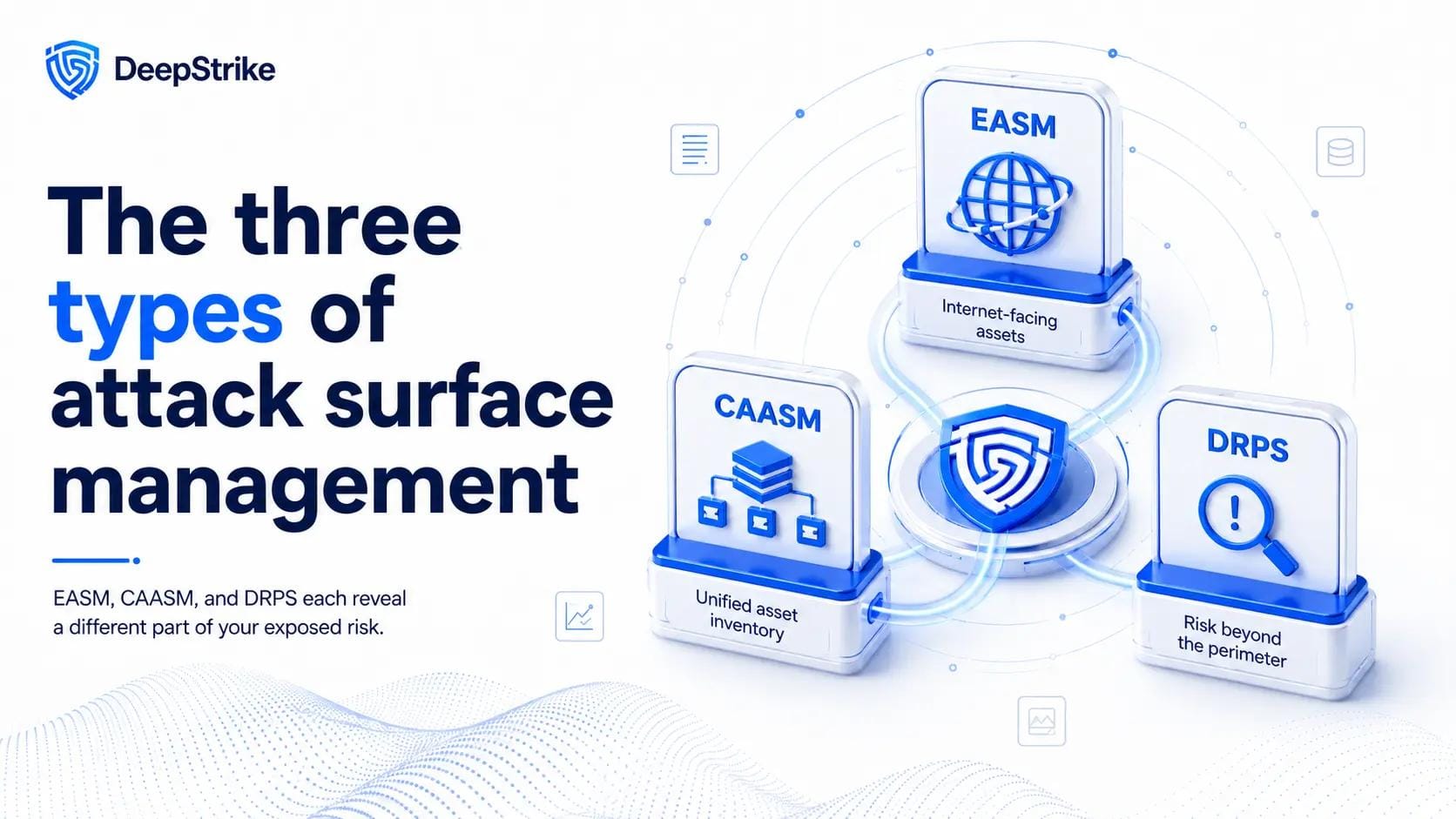
Industry frameworks commonly distinguish three complementary capabilities around attack-surface and digital-risk management: EASM, CAASM, and DRPS. Mature programs may use more than one, because each sees a different slice of the problem.
| Type | Full name | What it covers | Perspective |
|---|---|---|---|
| EASM | External Attack Surface Management | Internet-facing assets: domains, IPs, web apps, certificates, cloud services, exposed ports | Outside-in |
| CAASM | Cyber Asset Attack Surface Management | Consolidated inventory of internal and external assets, via API integrations with existing tools | Inside-out |
| DRPS | Digital Risk Protection Services | Threats beyond your perimeter: leaked data, brand impersonation, dark-web mentions, phishing domains | Outside the perimeter |
EASM takes the attacker's outside-in view, continuously discovering and monitoring everything about your organization that is reachable from the public internet, whether or not you knew it existed. It enumerates domains and subdomains, IP ranges, web applications, SSL/TLS certificates, exposed services and ports, and cloud assets, then flags the exposures among them. EASM is the discipline most people mean when they say "attack surface management," because the external surface is where attackers start.
CAASM takes the inside-out view. Rather than scanning from outside, it integrates through APIs with the tools you already run, endpoint, cloud, identity, vulnerability, and configuration systems, to build one consolidated, deduplicated inventory of every asset, internal and external. Its value is answering "what do we actually have, and which assets are missing a control?" by unifying data that normally lives in a dozen separate consoles.
DRPS looks beyond your own infrastructure to the risks that live out on the open, deep, and dark web: leaked credentials and data, brand and executive impersonation, lookalike phishing domains, and chatter about your organization in criminal forums. It extends ASM from "what of ours is exposed?" to "how is our brand and data being abused or targeted out there?"
Combining outside-in EASM with inside-out CAASM closes the gaps that either approach leaves alone, and DRPS adds the external-threat context around them.
Cloud environments make ASM harder because assets are dynamic, distributed, and often created outside traditional inventory processes. Provider-generated hostnames, ephemeral workloads, containers, serverless functions, public storage, Kubernetes services, temporary test environments, APIs, and multi-cloud accounts can appear and disappear faster than a spreadsheet or periodic scan can track them.
A cloud-aware ASM program therefore needs more than DNS and IP discovery. It should correlate outside-in visibility with cloud-account metadata, IAM, tags, configuration data, and ownership information so teams can tell whether an exposed resource is temporary, business-critical, overprivileged, or connected to sensitive systems.
Useful ownership signals include:
That context is what turns "we found an asset" into "we know who owns it, what it can reach, and how urgently it needs attention."
AI adoption adds another fast-moving layer to the attack surface. Organizations now expose model APIs, inference endpoints, vector databases, agent tools, data connectors, service accounts, plugins, and third-party AI SaaS, often before traditional asset-governance processes catch up.
The risk is not only an exposed model endpoint. AI agents can hold credentials, call external tools, reach internal data, and trigger workflows, so their blast radius depends on the permissions and integrations behind them. ASM should therefore discover unsanctioned AI services and map the identities, data stores, APIs, and external actions connected to them.
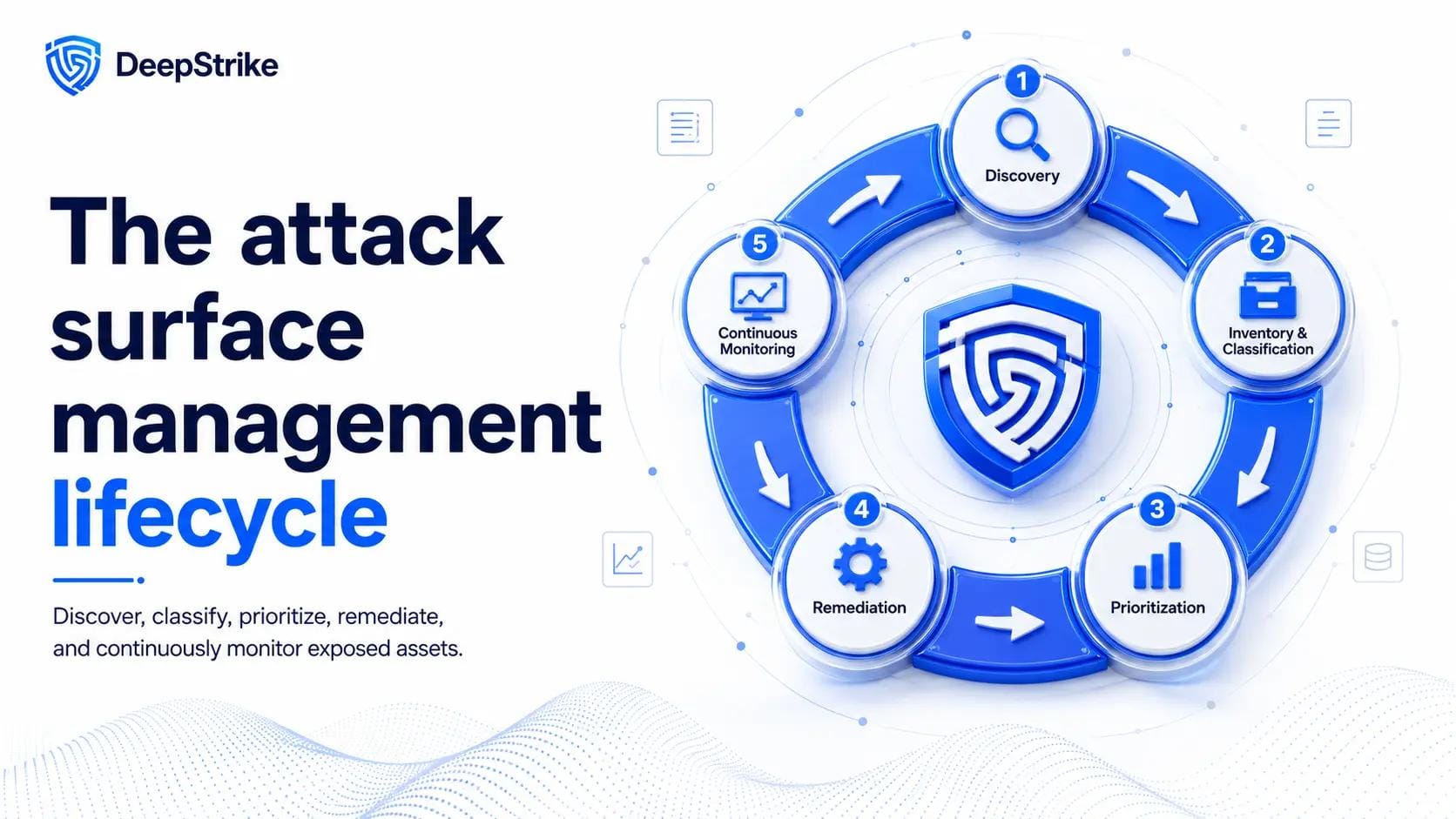
Whatever tools you use, effective ASM runs as a continuous, five-phase loop. Each cycle keeps the picture current as the environment changes.
Discovery finds every asset connected to your organization: domains and subdomains, IP addresses, web applications, APIs, cloud resources, IoT devices, SaaS and third-party integrations, and, crucially, the shadow IT and forgotten systems nobody registered. Good discovery is relentless and attacker-like, following the same trails an adversary would to find assets you do not know are yours.
Discovered assets are only useful once they are cataloged and understood. This phase builds a living inventory, classifying each asset by type, owner, business criticality, technology stack, and data sensitivity. Ownership can be inferred and validated through cloud tags, CMDB records, infrastructure-as-code provenance, source-code repository ownership, certificates, DNS, and account metadata. A real-time inventory becomes the single source of truth the rest of the program depends on, and it is where CAASM-style consolidation pays off.
You cannot fix everything at once, so exposures are scored and ranked by real risk, not raw severity. Effective prioritization weighs reachability, exploitability, privilege, data sensitivity, blast radius, active threat activity, and business impact, layering signals like CVSS, EPSS, and the CISA Known Exploited Vulnerabilities catalog rather than trusting severity scores alone. This is the same risk-based discipline that governs modern vulnerability management.
| Signal | Question to ask |
|---|---|
| Reachability | Can an attacker reach this asset or service now? |
| Exploitability | Is the weakness realistically exploitable, and is exploit code available? |
| Privilege | What identities, permissions, or credentials does the asset have? |
| Data sensitivity | What sensitive or regulated data could be reached? |
| Blast radius | What can an attacker pivot to after compromising this asset? |
| Threat activity | Is the vulnerability or technique being actively exploited? |
| Business criticality | What happens to the business if this asset is compromised or unavailable? |
A public test VM with no sensitive access and a public VM that can assume an administrative production role may look similar in a scanner, but they do not represent the same risk. Blast radius and attack-path context are what separate them.
Remediation acts on the prioritized exposures: patching, fixing misconfigurations, revoking access, decommissioning forgotten assets, adding controls, or, often the fastest win in ASM, simply taking an unnecessary internet-facing asset offline. Clear ownership and routing into existing IT and ticketing workflows are what turn findings into fixes. Reliable patch management underpins much of this phase.
Because the attack surface changes constantly, monitoring never stops. New assets appear, certificates expire, services get exposed, and new vulnerabilities land daily, so ASM continuously re-scans and re-evaluates, surfacing changes and new exposures before an attacker finds them. Then the loop begins again.
ASM does not replace your other security programs; it feeds and sharpens them. Understanding how the pieces connect is what turns a pile of tools into a coherent exposure-reduction strategy.
| Discipline | Core question | Nature |
|---|---|---|
| Attack surface management | What do we have, and what is exposed? | Continuous discovery and monitoring |
| Vulnerability management | Which known weaknesses exist on our assets? | Continuous scanning and remediation |
| Penetration testing | Can these exposures actually be exploited? | Point-in-time, human-led validation |
| CTEM | How do we run all of this against real business risk? | Continuous operating model |
These categories overlap, but they solve different parts of the problem.
| Discipline | Main job |
|---|---|
| EASM | Discover and monitor internet-facing assets from the outside in |
| CAASM | Consolidate asset and control data from internal tools |
| CSPM | Identify cloud configuration and posture risk |
| CNAPP | Unify multiple cloud-native security capabilities across workloads, posture, identity, and runtime |
| ASM | Map and manage the assets and exposures that make up the attack surface |
| Exposure management | Combine visibility with exploitability, identity, data, and attack-path context to decide what materially matters |
| CTEM | Orchestrate continuous exposure reduction across scoping, discovery, prioritization, validation, and mobilization |
A useful shorthand is that ASM is visibility-first, while exposure management is outcome-first. ASM builds and maintains the map; exposure management uses that map plus business and attack-path context to decide which exposures deserve action first.
The practical takeaway: ASM discovers and prioritizes exposure, pentesting validates it, vulnerability management remediates the known flaws, and CTEM orchestrates the whole cycle. Our guide to continuous penetration testing shows how validation becomes an ongoing input rather than an annual event.
Discovering exposure is only half the job; the goal is to shrink the surface itself. The most effective reduction practices:
ASM is delivered through a mix of tooling, and the categories map to the three types above: EASM platforms scan the external surface outside-in, CAASM platforms consolidate asset inventory inside-out through API integrations, and DRPS services watch the open and dark web for digital risk. Many broader security platforms now bundle these capabilities together, and the market is trending toward consolidation.
When evaluating tools, the qualities that matter most are discovery breadth and accuracy (does it actually find your unknown assets, with few false positives?), the ability to combine outside-in and inside-out visibility, risk-based prioritization that goes beyond raw CVSS, and integration with the ticketing and workflow systems that make remediation happen. The emerging frontier is autonomous ASM, tools that not only discover exposures but act on them, deploying mitigations or triggering governance automatically, though human oversight of consequential actions remains essential. For organizations that prefer a service-led approach, enterprise PTaaS combines continuous testing with the validation ASM needs.
A tool is not a program, though. As with vulnerability management, what turns ASM tooling into results is the human structure around it: clear ownership of the inventory, defined remediation SLAs, executive sponsorship, and a repeating cycle that never treats the surface as "done."
ASM proves its value in several recurring situations, and recognizing them helps justify and scope a program:
Across all of these, the common thread is visibility into assets that manual, inside-out inventories miss. Pair that discovery with real validation, testing the exposures ASM surfaces the way our penetration testing methodology describes, and you close the loop from "we found it" to "we know it is safe."
A useful measurement model starts with five steps:
The goal is not to drive the raw asset count to zero. It is to reduce unmanaged exposure and make the highest-impact attack paths visible early enough to act.
Measure the program so you can prove its value and find its gaps:
A healthy program shows a shrinking gap between what you own and what you know you own, and falling time-to-remediate for external exposures.
Attack surface management has become foundational because the oldest assumption in security, that defenders know what they are defending, no longer holds. Cloud, SaaS, remote work, acquisitions, and AI have scattered assets across environments faster than teams can track them, and attackers have responded by making exposed, internet-facing systems their favorite way in. ASM answers with continuous, attacker's-eye discovery: find every asset, know which exposures actually matter, fix or remove them fast, and never stop watching. Run it as a loop, feed it into CTEM, validate what it finds with real testing, and reduce the surface itself wherever you can. The organizations that stay secure are simply the ones that see their own attack surface as clearly as their adversaries do.
It is the continuous practice of finding and keeping track of everything an attacker could target, your websites, servers, cloud services, APIs, and forgotten or unknown systems, and then fixing or removing the risky exposures before an attacker exploits them. It looks at your organization from the outside, the way an adversary would, to catch the assets you did not know you had.
The attack surface is the total set of all possible entry points into your environment. An attack vector is the specific method an attacker uses to exploit one of those entry points, such as phishing, stolen credentials, or an unpatched web app. The surface is where an attack could happen; the vector is how it happens.
They are the three types of attack surface management. EASM (External Attack Surface Management) discovers internet-facing assets from the outside in. CAASM (Cyber Asset Attack Surface Management) consolidates a full internal and external asset inventory by integrating with your existing tools. DRPS (Digital Risk Protection Services) monitors external threats like leaked data, brand impersonation, and dark-web activity. Mature programs combine them.
Vulnerability management finds and fixes known weaknesses (mostly CVEs) on assets you already know about. Attack surface management makes sure you actually know about all your assets in the first place, including unknown and shadow IT systems, and monitors your exposure from an attacker's perspective. ASM answers "what do we have and what is exposed?"; vulnerability management answers "which known flaws are on it?" They work together.
Continuous Threat Exposure Management (CTEM) is Gartner's broader, five-stage operating model for managing exposure. Attack surface management is a core component of CTEM, powering its scoping and discovery stages by continuously mapping what you have and what is exposed. CTEM then adds prioritization, validation (often through penetration testing), and coordinated remediation.
Decommission unnecessary internet-facing assets, enforce least privilege and multi-factor authentication, adopt zero trust and network segmentation, patch exposed and actively exploited flaws first, govern shadow IT and cloud sprawl, train people against social engineering, and validate your external exposures with regular penetration testing. The fastest reduction is often simply removing an asset you did not need exposed.
Both, but the process matters more. Tools (EASM, CAASM, and DRPS platforms) automate discovery, inventory, and monitoring, but they only produce results inside a program with clear ownership, risk-based prioritization, remediation SLAs, and a continuous cycle. A pile of discovered assets that nobody is accountable for fixing is not attack surface management.

Stay secure with DeepStrike penetration testing services. Reach out for a quote or customized technical proposal today
Contact Us
