July 21, 2026
Updated: September 13, 2026
A practical guide to scope, safety, evidence, reporting, and retesting

Mohammed Khalil
Network penetration testing is an authorized, time-bounded assessment of whether weaknesses in network infrastructure can form meaningful attack paths. It may start from the internet, inside the network, or from a deliberately provided foothold. Unlike vulnerability scanning, it combines human judgment with controlled validation to show what is exploitable, which controls stop the path, and which business systems could be affected. Results apply only to the written scope, access, assumptions, and test window; they never prove that every vulnerability was found or that a future breach is impossible.
Safety note: Network testing requires written asset-owner authorization, explicit scope, Rules of Engagement, emergency contacts, and any necessary third-party or cloud-provider permission. This article is educational, not legal advice.
The NIST glossary describes penetration testing as active testing of how well a system, device, or process resists attempts to compromise its security. In a network context, the primary targets are infrastructure and the controls that connect, isolate, authenticate, and manage it.
That can include internet-facing hosts, internal address ranges, servers, endpoints, routers, switches, firewalls, virtual private network gateways, remote-access services, management interfaces, identity services, Active Directory, network segments, and hybrid connections. Exact coverage depends on the approved scope.
The practical distinction is identification versus validation. A scan may report an exposed service or outdated component; a penetration test asks whether the condition can be safely confirmed, whether another control stops the path, and what evidence supports the business risk. One proven path from a lower-trust zone to a critical boundary can be more useful than a long list of isolated alerts.
No finite test can identify every vulnerability. Findings reflect the assets, time window, starting position, credentials, assumptions, and safety constraints that were approved.
“Network test” is not permission to assess every technology reachable through a network. The statement of work and Rules of Engagement should separate infrastructure coverage from adjacent application, cloud, wireless, physical, social-engineering, and safety-sensitive testing.
| Area | Normally Included When Scoped | Requires Separate or Explicit Scope | Key Boundary |
|---|---|---|---|
| Public IP ranges | Exposed services and perimeter controls | Provider-owned shared infrastructure | Confirm ownership and exact ranges |
| Internal CIDR ranges | Hosts, services, and internal access paths | Unlisted subsidiaries or partner networks | Define source and destination ranges |
| Firewalls and VPN gateways | Exposed interfaces and access-control behavior | Disruptive resilience or denial-of-service tests | Use production-safe limits |
| Routers and switches | Approved management and configuration exposure | Carrier or managed-service equipment | Obtain operator permission |
| Network services | Authentication, encryption, access, and version risk | Deep application logic behind a service | Stop at the agreed proof |
| Management interfaces | Exposure and privilege boundaries | Vendor support systems | Separate owner and admin approval |
| Identity infrastructure | Authentication and excessive-access paths | Destructive identity changes | Use test accounts and safety limits |
| Active Directory | Domains, trusts, privilege tiers, and access paths | Unlisted forests or operational attack procedures | Define domains and stop points |
| Entra ID or cloud identity | Only when expressly included | SaaS tenants and cloud control planes | Treat as a distinct cloud/identity scope |
| Network segmentation | Approved source-to-destination zone tests | Unapproved sensitive environments | Define expected flows and safe proof |
| Wireless networks | Usually separate | SSIDs, radios, locations, and devices | Verify physical and radio boundaries |
| Cloud network components | Customer-owned resources in named accounts | Provider infrastructure and other tenants | Follow each provider’s current policy |
| Web applications | Surface exposure may be observed | Business logic, sessions, and authorization depth | Use a web application scope |
| APIs | Network reachability may be observed | Object authorization and workflow abuse | Use an API scope |
| SaaS platforms | Customer configuration only if authorized | Vendor platform or other tenants | Obtain tenant and provider authority |
| OT, ICS, and SCADA | Not assumed | Any safety-sensitive operational system | Use specialized planning and expertise |
| Social engineering | Not assumed | Phishing, calls, or pretexting | Separate written authorization |
| Physical access | Not assumed | Offices, data centers, and devices | Separate sites, dates, and controls |
| Denial-of-service | Normally prohibited | Controlled resilience testing | Separate approval and safeguards |
A web login page on a network host does not authorize deep testing of its business logic. Cloud identity and control-plane testing may require a separate cloud assessment. Wireless testing also needs named locations, SSIDs, devices, and radio boundaries. Our guide to wireless penetration testing explains how that radio-boundary scope is defined.
Cloud rules also differ. AWS permits testing only within its published conditions and does not permit customers to test AWS infrastructure itself; Microsoft requires compliance with its unified Rules of Engagement; Google Cloud says tests must affect only the customer’s projects and comply with its terms. Verify the current AWS policy, Microsoft cloud Rules of Engagement, and Google Cloud security-testing guidance for the actual platform before work begins.
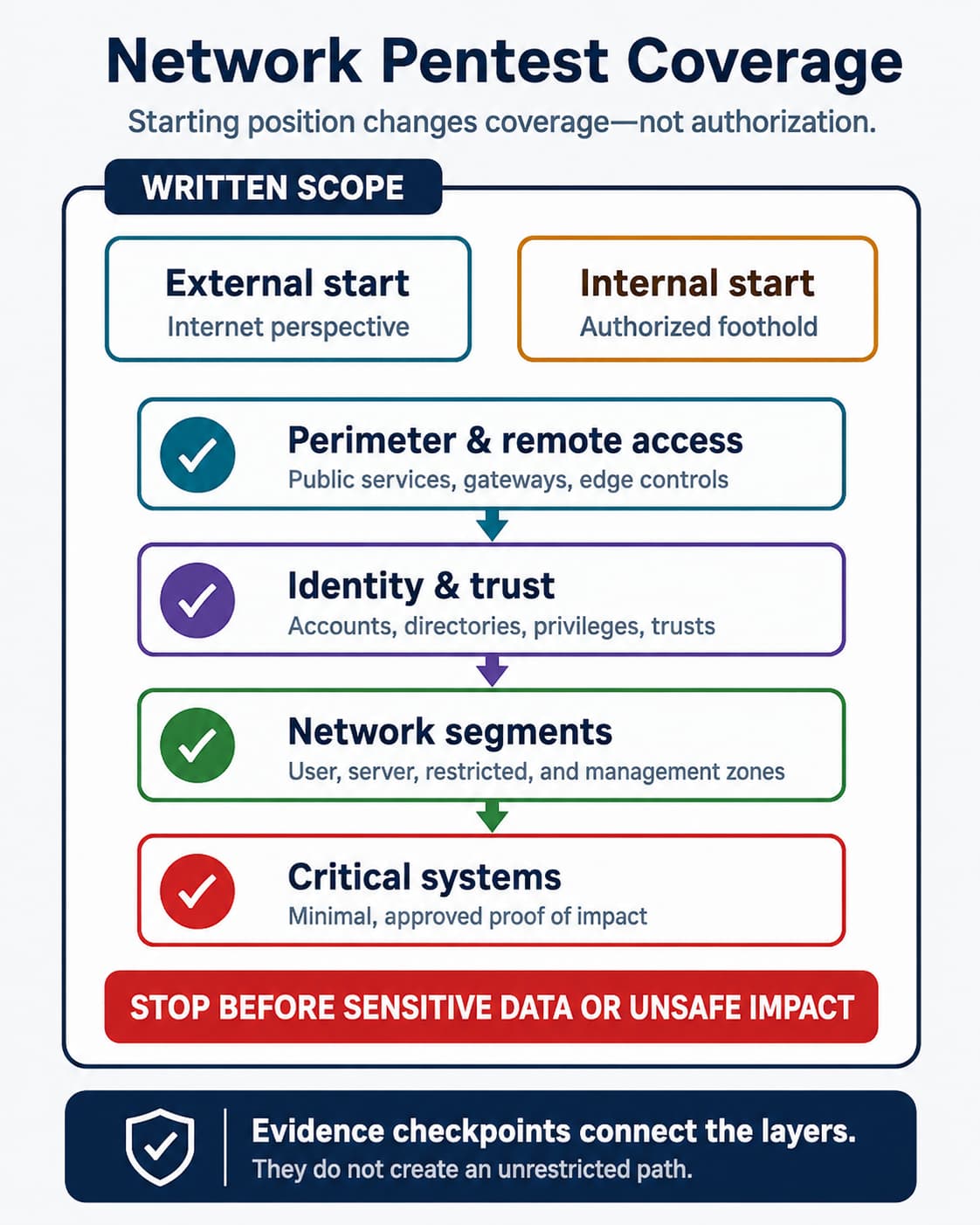
External testing begins from the internet and asks whether approved public assets expose a path inward. Internal testing starts behind the perimeter and examines what an insider or compromised device could reach through identity, privilege, and segmentation. Choose one or both according to the threat scenario not by habit.
Internal testing begins behind the perimeter from an approved connection, test workstation, or VPN. It examines segmentation, excessive access, identity exposure, privilege boundaries, and movement from the stated starting account or segment.
Assumed-breach testing starts with a defined foothold or low-privileged account so limited time can focus on post-access controls. It is not automatically a red-team exercise; it can remain transparent, tightly scoped, and evidence-led.
Identity can connect weaknesses that look isolated at the host or subnet level. Name domains, forests, trusts, privileged tiers, test accounts, synchronization paths, and safety limits; do not assume cloud or SaaS identity is included.
Segmentation testing verifies whether named zones enforce intended flows. Define each source, destination, expected permit or deny result, sensitive boundary, and minimum safe proof.
Combined testing fits business questions that cross the perimeter, but each layer still needs explicit scope, time, and authorization. For the detailed comparison, see internal vs. external penetration testing.
| Test Type | Starting Position | Primary Question | Typical Evidence | Common Boundary |
|---|---|---|---|---|
| External | Internet | Can exposed infrastructure enable initial access? | Confirmed exposure and bounded impact | Third-party and provider assets |
| Internal | Approved internal connection | What can an insider or compromised device reach? | Access paths, privilege, segmentation | Sensitive and safety-critical systems |
| Assumed breach | Defined foothold or account | How well is post-access movement contained? | Control successes and reachable paths | Not a stealth exercise by default |
| Identity / AD | Named user and directory context | Can identity paths cross privilege tiers? | Trust and privilege-boundary evidence | Cloud/SaaS identity may be separate |
| Segmentation | Named source zone | Do zones enforce intended flows? | Allowed and denied path results | Only listed source/destination pairs |
| Combined | External plus internal scenario | Can a permitted path cross multiple layers? | Joined attack-path narrative | Depth limited by time and authorization |
Tools can support a pentest, but running a scanner is not itself a complete penetration test. CREST’s buyer guidance likewise treats vulnerability assessment and penetration testing as different forms of assurance.
| Assessment | Primary Purpose | Typical Starting Point | Human Validation | Best Output | What It Does Not Prove |
|---|---|---|---|---|---|
| Vulnerability scan | Find known patterns at scale | Authenticated or unauthenticated scanner | Limited | Machine-readable exposure list | Exploitability or business impact |
| Vulnerability assessment | Analyze and prioritize weaknesses | Asset inventory plus scan/review | Moderate | Validated risk register | A joined attack path |
| Network penetration test | Validate infrastructure attack paths | External, internal, or assumed breach | Central | Evidence-backed path and fixes | Complete security or breach prevention |
| Breach and attack simulation | Repeat known techniques against controls | Deployed simulation platform | Scenario-dependent | Control telemetry and trend | Open-ended human reasoning |
| Red team exercise | Test objectives, detection, and response | Threat-led, often covert | Central | Objective and defensive-performance story | Full vulnerability coverage |
| Purple team exercise | Improve controls collaboratively | Joint attacker/defender session | Central | Tuned detections and shared evidence | Independent assessment by default |
| Web/API penetration test | Test application logic and authorization | Application identities and workflows | Central | Application-layer findings | Network-wide segmentation |
| Cloud penetration test | Test cloud resources, identity, and control plane | Named accounts/subscriptions | Central | Cloud-specific paths and configuration risk | Provider infrastructure security |
| Architecture/configuration review | Identify design and control weaknesses | Documentation and configurations | Central | Design decisions and gaps | Live exploitability unless validated |
DeepStrike’s vulnerability assessment vs. penetration testing guide provides more detail on the first two categories.
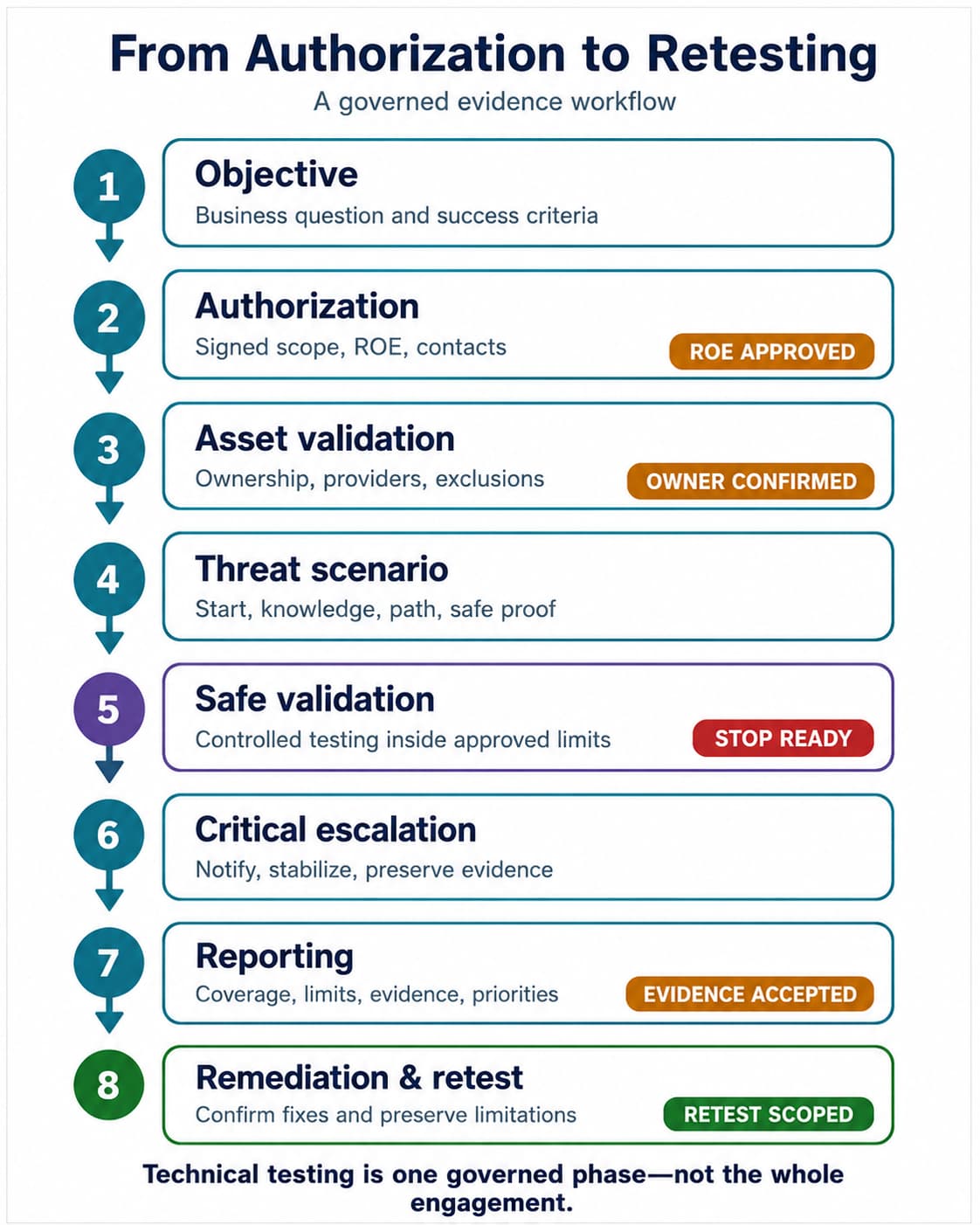
NIST SP 800-115, published in 2008 and still listed as Final, organizes security testing around planning, execution, analysis, and mitigation. The PTES pre-engagement guidance is a community resource that emphasizes scope, timeline, communications, and Rules of Engagement; it is not a law or regulatory standard. A safe buyer-facing lifecycle can be summarized as follows.
| Phase | Client Input | Assessment Output | Safety Gate |
|---|---|---|---|
| 1. Objective | Business risk, critical assets, success criteria | Testable questions | Objective accepted |
| 2. Authorization and ROE | Asset-owner approval, dates, contacts | Signed scope and permitted activities | No work before approval |
| 3. Asset validation | IPs, domains, accounts, owners, providers | Confirmed in/out lists | Ownership and third parties checked |
| 4. Threat design | Starting position, knowledge, scenario | Coverage plan and stop points | Scenario within authority |
| 5. Discovery and analysis | Access, diagrams, test accounts | Mapped exposure and hypotheses | Rate and production limits active |
| 6. Controlled validation | Approved paths and proof rules | Confirmed findings and control results | Stop before unsafe impact |
| 7. Escalation and evidence | Critical contacts and data rules | Timely alert and minimal proof | Critical issue acknowledged |
| 8. Cleanup, report, retest | Acceptance and retest terms | Report, cleanup record, closure status | Evidence and retest scope accepted |
NIST defines Rules of Engagement as detailed constraints for security testing that are established before the test and authorize defined activities. A contract or statement of work may describe the commercial relationship; the ROE should govern operational limits, communication, emergency handling, and stop authority.
For a deeper treatment of assessment phases and frameworks, use DeepStrike’s penetration testing methodology guide.
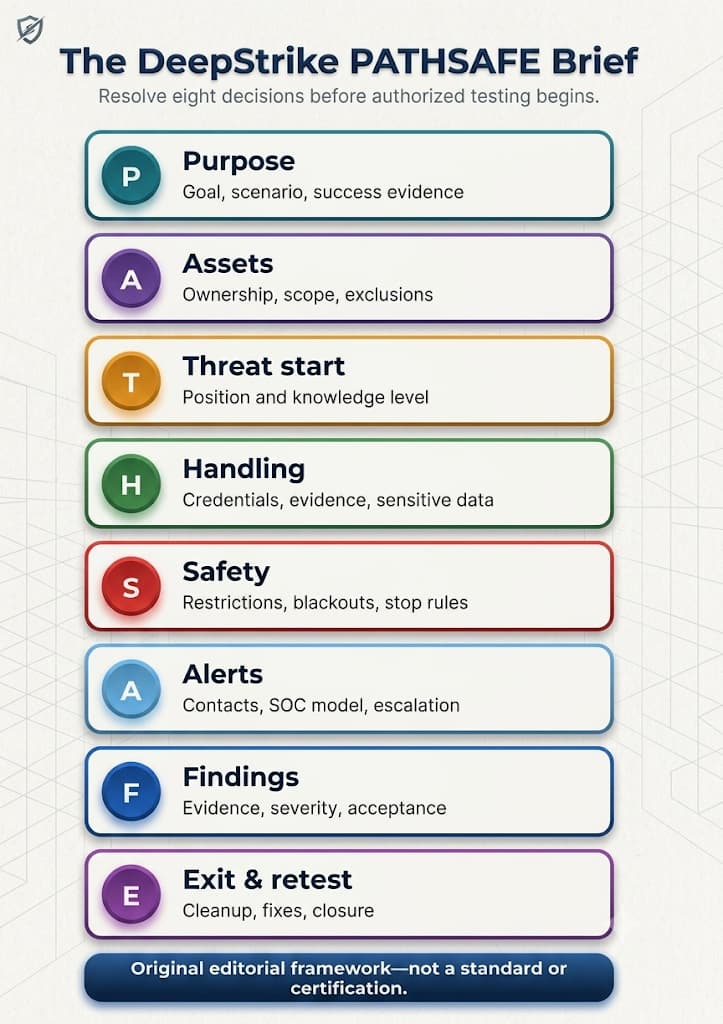
PATHSAFE is an original DeepStrike editorial framework for preparing a network test. It is a scoping aid not an official NIST, PCI, ISO, PTES, CREST, or regulatory standard.
State the business goal, threat scenario, critical assets, safe proof, and decision the test should enable; “find vulnerabilities” is not a testable success criterion.
List all ranges, domains, locations, cloud accounts, zones, directory domains, owners, third parties, and explicit exclusions. Visibility or DNS data alone never proves authority.
Record starting position and knowledge level separately. An internal test can be black box, and an external test can be white box.
Define credential issuance, transfer, storage, rotation, and deletion, plus evidence minimization, encryption, access, retention, and prohibited sensitive data.
Name production limits, legacy or safety-sensitive systems, rate constraints, blackouts, prohibited actions, and stop conditions for instability, sensitive data, scope doubt, or third-party impact.
Name primary and emergency contacts, the pause authority, escalation channel, and SOC model: informed, partially informed, or blind.
Agree on coverage, evidence, severity rationale, attack-path narratives, remediation, limitations, readout, and objective report-acceptance criteria.
Specify cleanup, credential rotation, remediation ownership, retest window, eligible findings, rounds, changed-system handling, and closure wording.
| PATHSAFE Element | Buyer Question | Required Input | Evidence of Completion |
|---|---|---|---|
| Purpose | What decision should the test enable? | Goal, scenario, critical assets | Approved success criteria |
| Assets | What is owned and authorized? | Ranges, domains, owners, exclusions | Signed in/out scope |
| Threat start | Where does testing begin, with what knowledge? | Position, accounts, black/gray/white box | Scenario and access plan |
| Handling | How are credentials and evidence protected? | Transfer, minimization, retention | Approved data-handling plan |
| Safety | What is prohibited, and when must work stop? | Limits, blackouts, legacy systems | ROE restrictions and stop rule |
| Alerts | Who communicates and escalates? | Contacts, SOC model, urgency | Escalation matrix |
| Findings | What must the report prove? | Evidence, severity, deliverables | Acceptance checklist |
| Exit | How are cleanup, fixes, and retest handled? | Cleanup and retest terms | Closure and retest record |
Testers combine discovery tools, configuration and protocol analysis, validation techniques, and human reasoning. The categories below are potential coverage areas, not a promise that every engagement includes every test.
| Test Area | Security Question | Example Evidence | Scope Caveat |
|---|---|---|---|
| External exposure | Are unnecessary services reachable? | Confirmed service and owner | Public assets only |
| Remote access | Do gateways enforce intended access? | Bounded authentication/control result | Avoid account lockout |
| Security-device configuration | Do edge controls match policy? | Observed permitted or blocked path | Review access may be separate |
| Management interfaces | Can lower-trust users reach administration? | Reachability and privilege boundary | No unsafe configuration change |
| Outdated services | Does age create a validated path? | Version plus safe validation | Legacy limits may apply |
| Protocol security | Are weak protocols or encryption accepted? | Negotiation or configuration evidence | No broad protocol flooding |
| Authentication | Do controls resist approved test cases? | Confirmed policy/control behavior | Credentials and rates defined |
| Credential reuse and access | Can one identity reach excessive resources? | Authorized access matrix | No uncontrolled credential attacks |
| Directory services | Do trusts or permissions cross tiers? | Identity-path evidence | Named domains and accounts only |
| Privilege boundaries | Can low privilege become administrative? | Bounded privilege proof | Stop before destructive action |
| Segmentation | Are zones isolated as designed? | Source/destination results | Listed pairs only |
| Sensitive services and shares | Is access limited to intended roles? | Minimal metadata or access proof | Do not open real sensitive data |
| Certificates and encryption | Are trust and transport controls sound? | Certificate or protocol evidence | Application cryptography may be separate |
| Logging and detection | Did included controls record the activity? | Agreed telemetry correlation | Only when detection validation is scoped |
| Hybrid connectivity | Do cloud/on-prem paths expand trust? | Approved cross-boundary path | Cloud policy and account scope apply |
| Critical-system paths | Can lower trust approach a critical asset? | Safe stop-point evidence | Stop before sensitive impact |
MITRE ATT&CK can help describe adversary goals such as initial access, credential access, privilege escalation, discovery, and lateral movement, but ATT&CK tactics are a behavior knowledge base not a penetration-testing methodology or compliance certification.
The following are fictional composites, not DeepStrike client case studies.
An approved public remote-access asset exposes a weakness that permits limited access to a nonproduction service. The tester proves only the minimum foothold allowed by the ROE, then checks an explicitly named trust boundary. A separate identity control blocks access to the administration zone, and the tester records that positive control along with the initial weakness. The business can now prioritize the exposed service while preserving evidence that the internal boundary contained the path. No customer data is accessed.
The tester begins with an authorized low-privileged account on a user segment. Excessive access permits visibility into a management service, and weak segmentation allows a path toward a sensitive environment. The ROE requires a stop before opening any sensitive record, so the tester records the reachable boundary and ends the path. Remediation priorities are to restrict the management interface, correct group access, and enforce zone rules. Retest criteria require the same starting account to be denied at each corrected boundary.
Automation improves coverage, repeatability, discovery, and known-pattern identification. Human judgment validates context, joins relevant weaknesses, chooses safe proof, explains business impact, and decides when to stop. Manual testing can use tools; automation can still support a deep engagement.
Buyers can assess depth without asking for arbitrary “manual testing percentages”:
Claims such as “zero false positives” or “80% manual” reveal little without a defined scope, validation method, and evidence standard.
A report should let leadership understand the risk, engineers reproduce the verified condition safely, and owners track remediation. It should distinguish confirmed findings from observations or unverified possibilities.
| Report Element | Why the Buyer Needs It | Quality Indicator | Warning Sign |
|---|---|---|---|
| Scope and assets | Proves what received coverage | Tested asset inventory | No coverage record |
| Exclusions and limitations | Prevents false assurance | Specific constraints and effects | No limitations section |
| Dates and starting position | Frames the evidence | Clear window and access level | Ambiguous test context |
| Method summary | Explains assessment depth | Scope-specific approach | Generic copied text |
| Executive narrative | Supports risk decisions | Joined business-relevant paths | Finding-count summary only |
| Technical findings | Enables correction | Affected assets and conditions | Scanner export as full report |
| Evidence | Supports validation | Minimal, clear, attributable proof | No proof or unsafe data |
| Severity rationale | Prioritizes accurately | Context, likelihood, and impact | Scanner score alone |
| Attack paths and controls | Shows how risk connects or stops | Confirmed sequence and boundaries | Isolated alerts only |
| Remediation | Guides owners | Specific control changes and dependencies | Generic “patch systems” text |
| Critical escalation | Confirms urgent handling | Time and acknowledgement record | Critical issue saved for final report |
| Retest and residual risk | Shows closure truthfully | Fixed, partial, open, or not retested | No verification status |
Positive controls that interrupted a path can be valuable when the evidence is reliable. For more detail on structure and stakeholder use, see DeepStrike’s penetration testing report guide. The table above describes buyer expectations, not a promise of DeepStrike’s current deliverables.
Report delivery is a transition, not the endpoint. Convert findings into named owners, deadlines, dependencies, and risk decisions. Attack-path findings may require several changes such as service hardening, identity restrictions, and segmentation not a single patch.
An evidence review checks documents, configurations, screenshots, or change records supplied by the client. A technical retest repeats the agreed validation against the affected asset or path. A retest is not automatically a new full-scope assessment, and unrelated changes or newly discovered weaknesses may require new authorization and scope.
| Situation | Evidence Review | Technical Retest | New Scope Needed |
|---|---|---|---|
| Patch applied to the same asset | Helpful | Usually appropriate | No, if original conditions remain |
| Firewall rule changed | Helpful | Confirm the original path is blocked | Only for added zones |
| Identity groups redesigned | Helpful | Test affected privilege path | Yes for new domains or trusts |
| Asset replaced or architecture changed | Limited | Original test may no longer apply | Often |
| Finding accepted as risk | Record decision | Optional unless treatment changes | No |
| New weakness appears during retest | Record separately | Do not expand automatically | Yes |
Keep unresolved limitations visible. “Not reproduced,” “not retested,” and “fixed” are different conclusions.
There is no single frequency for every organization. CIS Control 18 recommends a penetration-testing program appropriate to organizational size, complexity, industry, and maturity, while specific frameworks may impose schedules on systems within their scope. Risk and change triggers should shape the program.
| Trigger | Why It Changes Risk | Appropriate Testing Response |
|---|---|---|
| New public service or remote access | Expands initial-access surface | External test before or shortly after launch |
| Cloud migration or hybrid connection | Creates new trust and policy boundaries | Cloud/network scope with provider checks |
| Identity redesign or new domain trust | Changes privilege paths | Identity and internal assessment |
| Segmentation or major firewall change | Alters permitted flows | Targeted segmentation validation |
| Merger, acquisition, or new site | Adds unknown assets and trust | Inventory-led combined assessment |
| Significant security incident | Changes threat assumptions | Incident-informed scoped test after stabilization |
| New critical system | Raises potential impact | Test relevant access paths |
| Previous high-risk finding | Indicates residual path risk | Remediate, retest, then reassess broader exposure |
| Contractual or regulatory duty | Creates defined evidence needs | Test only the applicable system scope and schedule |
| Stable environment with active remediation | Risk still evolves | Periodic assessment based on risk, not habit alone |
Continuous scanning does not replace a scoped human-led test. A focused retest does not replace the next risk-based full assessment. Testing too frequently without remediation can produce repeated reports instead of reduced risk. DeepStrike’s penetration testing frequency guide discusses scheduling in more detail.
Price and duration depend on what must be tested, how safely it can be tested, and what evidence must be produced. A defensible quote needs more than a host count.
| Driver | Why It Changes Effort | What the Buyer Can Prepare |
|---|---|---|
| Public IPs and domains | Expands external discovery and validation | Current owned inventory |
| Internal subnets and locations | Adds reachability and coordination | Diagrams, ranges, access method |
| Segmentation | Adds source/destination test pairs | Zone matrix and expected flows |
| Domains and trusts | Increases identity-path complexity | Directory map and privileged tiers |
| Cloud/hybrid connectivity | Adds provider rules and trust boundaries | Accounts, subscriptions, approvals |
| Legacy or safety-sensitive systems | Requires lower rates and exclusions | System owners and restrictions |
| Starting position and knowledge | Changes discovery time and depth | Scenario and access package |
| Test accounts | Enables role and privilege coverage | Named accounts and reset process |
| Production windows and blackouts | Limits scheduling and pace | Approved dates and maintenance windows |
| Reporting and evidence depth | Adds analysis, QA, and stakeholder work | Required audiences and format |
| Compliance mapping | Requires applicable control context | Exact framework and system scope |
| Readouts and retesting | Adds delivery and verification effort | Participants, acceptance, retest terms |
| Third-party approvals | Can delay authorization | Owner contacts and written permission |
Do not compare quotes until scope, assumptions, exclusions, deliverables, and retest terms are comparable. See DeepStrike’s penetration testing cost guide for broader pricing factors; this article intentionally does not state an unverified range.
Penetration testing may produce evidence for an assurance program, but obligations depend on the applicable framework, system boundary, implementation, contract, and assessor interpretation.
| Context | How It May Affect Scope | Evidence to Preserve | Caveat |
|---|---|---|---|
| PCI DSS v4.0.1 | Requirement 11.4 addresses applicable internal/external testing and segmentation validation | Scope, methodology, results, remediation, repeat testing | Report alone does not establish compliance |
| SOC 2 | Testing may support controls relevant to the system description and risks | Scope, results, remediation, control linkage | No universal annual pentest rule |
| ISO/IEC 27001 | Risk-based assurance may justify technical testing | Risk treatment, control evidence, follow-up | No universal annual pentest rule |
| NIST SP 800-53 | CA-8 can require organization-defined testing on defined systems | Assignment, plan, results, remediation | Not a universal legal duty |
| FedRAMP | Applicable 2026 certification profile, rules, and CA-08 guidance shape scope | Profile, scope, assessment evidence, remediation | Path-specific; legacy guidance may not govern every 2026 route |
| HIPAA | Testing can support broader risk analysis and safeguards | Scope, risk analysis, treatment evidence | Annual testing remains in a proposed not final Security Rule update as checked July 21, 2026 |
| Cyber insurance / customers | A test may answer a specific questionnaire or contract | Current report, attestation if available, remediation | No guarantee of coverage, premium, or acceptance |
PCI SSC describes PCI DSS v4.0.1 as a limited revision that added or deleted no requirements. NIST SP 800-53 Rev. 5 makes CA-8 scope and frequency organization-defined. For FedRAMP, use the applicable 2026 certification profile, consolidated rules, and current Rev5 CA-08 guidance rather than assuming one legacy guide governs every pathway.
The AICPA describes SOC 2 as an examination of controls relevant to selected Trust Services Criteria, not a universal annual-testing schedule. ISO describes ISO/IEC 27001:2022 as a risk-management system standard. HHS’s current HIPAA Security Rule requires administrative, physical, and technical safeguards; the separate Security Rule NPRM proposes more specific testing requirements but remained a proposal on the research date.
Penetration testing can support a wider assurance program, but it does not by itself prove compliance, certification, or security.
Certifications can support due diligence, but relevant experience, scope clarity, safety, evidence quality, and independent review matter more than badges alone.
| Buyer Question | Strong Answer Should Clarify | Warning Sign |
|---|---|---|
| What exactly is in scope? | Assets, starting position, exclusions, assumptions | “Entire network” without inventory |
| Who performs the work? | Named roles, relevant experience, subcontractors | Unknown delivery team |
| How is quality reviewed? | Independent technical and editorial review | No reviewer or acceptance process |
| What method is used? | Scope-specific lifecycle and evidence gates | Tool list presented as methodology |
| How are findings validated? | Manual reasoning, safe proof, uncertainty labels | Scanner output accepted without review |
| How are ROE and safety handled? | Rates, blackouts, prohibited actions, stop authority | No operational ROE |
| How is data protected? | Credential handling, encryption, access, retention, deletion | Vague “industry standard” answer |
| How are critical findings escalated? | Channel, urgency, acknowledgement, pause decision | Final-report-only notification |
| Can we review a sample report? | Sanitized evidence, paths, limitations, fixes | No sample or scanner-export sample |
| What will the report contain? | Coverage, evidence, severity rationale, remediation | Generic template promises |
| What are retesting terms? | Eligibility, window, rounds, closure language | “Retest included” without limits |
| How are third parties and cloud handled? | Ownership verification and provider-policy checks | Assumes all reachable assets are allowed |
| What legal documents apply? | Authorization, SOW, ROE, privacy, insurance where relevant | Testing proposed before authority |
| How will we communicate? | Kickoff, cadence, emergency contacts, final readout | No named engagement lead |
| How are references verified? | Comparable work subject to confidentiality | Certifications treated as sole proof |
Match provider experience to the named environment external infrastructure, Active Directory, hybrid cloud, legacy systems, or regulated segments and never rank value by finding count.
Use this list before signing the scope and again before kickoff.
| Mistake | Consequence | Correction |
|---|---|---|
| No written authorization | Legal and operational exposure | Obtain owner approval and ROE |
| Incomplete IP inventory | Coverage gaps | Reconcile ranges, DNS, and cloud |
| Unverified ownership | Third-party systems may be touched | Map authority to every asset group |
| Third-party hosting ignored | Provider rules are missed | Secure approval and follow policy |
| Start confused with knowledge | Wrong test design | Record both decisions separately |
| Identity omitted | Trust and privilege paths disappear | Name systems, tiers, and accounts |
| Cloud control plane assumed | Scope expands without authority | Name accounts, services, and actions |
| No segmentation objective | Testing becomes unfocused | Define source, destination, and proof |
| No test accounts | Role coverage is reduced | Prepare controlled identities |
| No critical-asset list | Impact is poorly prioritized | Name essential systems and processes |
| No stop conditions | Unsafe decisions are delayed | Define instability and scope triggers |
| No emergency contacts | Escalation stalls | Provide reachable decision owners |
| Blackout windows omitted | Production risk rises | Document freezes and sensitive periods |
| No data-handling plan | Credentials and evidence are exposed | Set transfer, access, retention, deletion |
| No SOC communication model | False alarms or invalid detection test | Choose informed, partial, or blind |
| Scanner output called a pentest | Alerts replace validated risk | Require context, evidence, limitations |
| Value measured by finding count | Noise is rewarded | Measure coverage and decision value |
| No report acceptance criteria | Delivery disputes follow | Agree evidence, review, and readout |
| No remediation owner | Findings become backlog debt | Assign owner and deadline |
| No retest agreement | Closure remains ambiguous | Define window, rounds, and status |
| Testing repeated without fixes | Reports recur without risk reduction | Track and retest unresolved paths |
| Compliance or prevention assumed | False assurance | Treat testing as one program input |
Use this PATHSAFE-based template as a planning aid. It does not replace a contract, authorization letter, statement of work, Rules of Engagement, privacy review, third-party approval, or legal advice.
| Business objective ________________________________ | Threat scenario ________________________________ |
|---|---|
| Success criteria and safe proof ________________________________ | Critical assets / processes ________________________________ |
| Starting position ________________________________ | Knowledge level ________________________________ |
| In-scope assets and zones ________________________________ | Out-of-scope boundaries ________________________________ |
| Asset owners and confirmations ________________________________ | Third-party approvals ________________________________ |
| Cloud-provider restrictions ________________________________ | Test credentials / initial privilege ________________________________ |
| Credential lifecycle ________________________________ | Sensitive-data handling ________________________________ |
| Evidence transfer and retention ________________________________ | Dates, time zone, windows ________________________________ |
| Blackout periods ________________________________ | Allowed activities ________________________________ |
| Prohibited activities ________________________________ | Rate / safety constraints ________________________________ |
| Stop conditions and authority ________________________________ | SOC notification model ________________________________ |
| Primary and emergency contacts ________________________________ | Critical escalation channel ________________________________ |
| Deliverables and audiences ________________________________ | Evidence / severity requirements ________________________________ |
| Acceptance and final readout ________________________________ | Cleanup and artifact removal ________________________________ |
| Remediation ownership ________________________________ | Retest window, rounds, closure ________________________________ |
Network penetration testing is an authorized, scoped assessment that uses controlled validation and human judgment to determine whether infrastructure, identity, trust, or segmentation weaknesses create exploitable attack paths. It may start from the internet, inside the network, or from a defined foothold. Conclusions apply only to the approved assets, access, period, and constraints.
Depending on scope, it can include public IPs, internal ranges, servers, network devices, VPNs, management interfaces, directory services, Active Directory, segmentation, and hybrid connectivity. Web applications, APIs, wireless, cloud control planes, SaaS, social engineering, physical access, OT, and denial-of-service require separate, explicit authorization.
External testing begins from the internet and asks whether approved public assets enable initial access or expose the perimeter. Internal testing begins behind that perimeter and asks what an insider or compromised device could reach, including identity, privilege, lateral movement, and segmentation paths. Many organizations need both perspectives, but the correct choice follows the threat scenario and business risk.
No. A vulnerability scanner identifies known patterns across many assets and can support discovery. A penetration test uses human judgment to validate selected weaknesses safely, combine relevant conditions into attack paths, record controls that stop those paths, and explain business impact and limitations. A scanner export without validation, context, and evidence is not a complete penetration-test report.
Only when Active Directory is explicitly in scope. Name domains, forests, trusts, privileged tiers, test accounts, starting permissions, and safety limits. Entra ID, cloud identity, SaaS identity, and synchronized environments may require additional scope; “internal network” does not authorize every connected identity system.
Production testing can be performed with controlled risk, but it is never risk-free. The ROE should define windows, rates, legacy systems, prohibited actions, monitoring, escalation, backups where relevant, and stop conditions. Some checks may need staging validation or exclusion, with asset owners, operations, and the SOC involved as needed.
Duration depends on public IPs, subnets, locations, identity complexity, segmentation pairs, hybrid connectivity, access, production limits, reporting depth, and retesting. Reliable planning needs an asset inventory, network and identity diagrams, expected flows, test-account needs, approvals, and delivery requirements not only a host count.
Cost varies with scope, depth, access, complexity, safety constraints, evidence, readouts, and retesting terms. Compare proposals only after aligning assets, starting position, exclusions, deliverables, and assumptions. A low quote may reflect incomplete coverage; a high quote is not proof of quality without clear scope and evidence standards.
Set frequency from risk, exposure, applicable obligations, material changes, incidents, remote access, cloud migration, identity redesign, segmentation changes, acquisitions, and unresolved findings. Continuous scanning complements rather than replaces human-led testing, and a focused retest does not replace the next risk-based full assessment.
Expect tested assets, exclusions, dates, starting position, limitations, method summary, executive risk narrative, findings, attributable evidence, attack paths, severity rationale, business impact, remediation, critical escalation, and retest status. The report should distinguish confirmed findings from observations and unverified conditions.
No. A penetration test may support evidence for PCI DSS, SOC 2, ISO/IEC 27001, NIST, FedRAMP, HIPAA risk management, customer assurance, or insurance processes when those contexts apply. It does not by itself prove compliance, certification, audit success, underwriting approval, breach prevention, or overall security. Scope, remediation, governance, and the rest of the control environment still matter.
Network penetration testing turns approved infrastructure weaknesses into evidence about attack paths, control boundaries, and remediation priorities. Its value depends on written authorization, verified ownership, precise scope, safe Rules of Engagement, and the right external, internal, identity, or segmentation perspective. Results should lead to owned remediation and accurate retesting, while remaining a time-bounded assessment not a guarantee of security.
Planning an authorized network assessment? Contact DeepStrike to confirm the appropriate scope, starting position, safety constraints, deliverables, and engagement terms for your environment.
Mohammed Khalil is a Cybersecurity Architect at DeepStrike, specializing in advanced penetration testing and offensive security operations. With certifications including CISSP, OSCP, and OSWE, he has led red team and application security engagements across technology, finance, healthcare, cloud, and regulated environments. His work focuses on real-world attack path validation, application vulnerabilities, API security, cloud security, identity exposure, breach-risk reduction, and adversary emulation.
| NIST SP 800-115 | NIST SP 800-53 Rev. 5, Update 1 | HHS — HIPAA Security Rule | Microsoft — Cloud Penetration Testing ROE |
|---|---|---|---|
| NIST Glossary — Penetration Testing | PCI SSC — PCI DSS v4.0.1 | HHS — HIPAA Security Rule NPRM | Google Cloud — Penetration Testing FAQ |
| NIST Glossary — Rules of Engagement | FedRAMP 2026 Rev5 — CA-08 | AWS — Penetration Testing | CIS Control 18 — Penetration Testing |

Stay secure with DeepStrike penetration testing services. Reach out for a quote or customized technical proposal today
Contact Us
