November 1, 2026
Updated: November 4, 2026
Seven security assessment types plus IT, network, cyber, and cloud assessments compared: what each examines and delivers, when to choose it, and what drives cost.

Mohammed Khalil
Buying the wrong security assessment wastes budget and leaves the real question unanswered. Security assessment services range from risk assessments and vulnerability scans to penetration tests, red team exercises, cloud configuration reviews, and compliance readiness checks. Each one produces a different kind of evidence. For security leaders, engineering teams, and buyers, the right choice starts with the decision you need to make, not with a vendor's menu. Match the assessment to the question, scope it to the assets that matter, and judge providers on methodology, tester expertise, and report quality.
Security assessment services are engagements that evaluate how well an organization's systems, controls, and processes stand up to threats. They end with a report of findings and a prioritized remediation path. The term is deliberately broad. At one end it covers a document-driven review of policies against a framework. At the other, a qualified tester tries to exploit a live application.
NIST's Technical Guide to Information Security Testing and Assessment (SP 800-115) describes technical testing as a way to find vulnerabilities and to verify compliance with a policy or other requirements. It also stresses that every technique has benefits and limitations. That framing helps buyers most. No single assessment answers every question, so the first job is to decide which question matters now.
Whether labeled cybersecurity assessment services or an IT security assessment, the purchase serves one of three needs: visibility, validation, or assurance for an auditor, customer, or board.
A risk assessment identifies threats, vulnerabilities, likelihood, and business impact. It then ranks the resulting risks so leadership can decide what to fix, transfer, or accept. The work is analytical: interviews, asset inventories, control reviews, and threat modeling, not hands-on exploitation.
NIST SP 800-30 Rev. 1, the federal Guide for Conducting Risk Assessments, places risk assessment inside a broader risk management process. In that process, the assessment gives senior leaders what they need to choose a response to each risk.
Some regulations make risk assessment mandatory. The HIPAA Security Rule, for example, lists risk analysis as a required implementation specification under 45 CFR 164.308(a)(1)(ii)(A).
Choose it when you are building or resetting a security program, preparing a security budget, adding a new business line, or need a defensible basis for prioritization.
A vulnerability assessment lists known weaknesses across networks, hosts, and applications. It combines authenticated and unauthenticated scanning, configuration checks, and analyst review. Its strength is breadth. Its limit is depth: it rarely proves whether a finding is exploitable or how findings chain together.
Public-sector programs reflect the same role. CISA offers no-cost Cyber Hygiene services to US government and critical infrastructure organizations. The services center on recurring vulnerability scanning and web application scanning, delivered with regular reports.
For a closer look at how scanning differs from manual testing, see our guide to vulnerability assessment and penetration testing (VAPT).
Choose it when you need a recurring baseline, want to track patch hygiene over time, or want input for prioritizing a later penetration test.
A penetration test is a time-boxed, authorized attempt by skilled testers to exploit vulnerabilities within an agreed scope. Testers confirm each finding and show its realistic impact, such as data access or privilege escalation. They also document reproduction steps so engineers can fix root causes. NIST SP 800-115 treats penetration testing as one of several techniques for confirming that a vulnerability is real.
Targets include external networks, internal infrastructure, applications, APIs, and cloud environments. The output is proof of exploitability, which is why customers and auditors ask for it. If you are comparing providers, start with what a human-led penetration testing engagement should cover.
Choose it when you have shipped a major release, changed infrastructure, need third-party evidence for customers or auditors, or want to know what an attacker could actually achieve.
A red team engagement simulates a specific adversary pursuing a defined objective, such as reaching a payment system or stealing sensitive data. The campaign can move across people, identity, cloud, applications, and internal networks. A red team does not try to list every vulnerability. Instead, it measures whether your detection and response teams notice a realistic campaign and stop it in time.
Red teaming pays off most when established vulnerability management and a working security operations center (SOC) are already in place; otherwise a penetration test yields more actionable findings for the money. Our red teaming service overview explains how objective-driven campaigns are scoped.
Choose it when you need to test detection and response, check security investments against realistic attacker techniques, or answer a board-level question about resilience.
A cloud configuration review checks settings in AWS, Microsoft Azure, or Google Cloud against benchmarks and least-privilege principles. It covers identity and access management (IAM), network controls, storage permissions, logging, and encryption, where many high-impact cloud exposures originate.
Scope follows the shared responsibility model. AWS describes its own part as security "of" the cloud, meaning the infrastructure that runs its services, and the customer's part as security "in" the cloud, which depends on the services you choose. A cloud security assessment therefore concentrates on what you configure: identities and roles, network exposure, data stores, encryption keys, logging, and workload settings. Many assessments now cover software-as-a-service tenants too. CISA's Secure Cloud Business Applications (SCuBA) project publishes secure configuration baselines for Microsoft 365 and Google Workspace, along with free tools that check a tenant against them.
A configuration review tells you what is set wrong. A cloud penetration test goes a step further and tests whether those settings can be abused, for example by chaining an over-permissive role into privilege escalation. Many teams run both.
Deliverables: findings grouped by account, subscription, or project, each with severity, the affected resource, and the setting to change; a view of publicly exposed resources and risky identity paths; and a remediation plan that separates quick configuration fixes from design changes. Ask whether each finding cites the benchmark it was checked against, such as a CIS Benchmark for your provider, and whether the checks can carry over into cloud security posture management (CSPM) tools so drift is caught between assessments.
Choose it when you are migrating workloads, adopting Kubernetes or serverless, expanding into multiple accounts or clouds, or preparing for an audit that covers cloud controls.
A compliance gap assessment compares your current controls with a target framework and lists what is missing before a formal audit. The most common targets for US companies are SOC 2, ISO/IEC 27001, PCI DSS, and HIPAA.
SOC 2 is an AICPA examination of controls at a service organization. The controls examined relate to security, availability, processing integrity, confidentiality, or privacy. A readiness review maps your controls to the Trust Services Criteria before a CPA firm performs the examination.
ISO/IEC 27001:2022 defines the requirements for an information security management system (ISMS). A gap assessment checks your risk process, policies, and controls against those requirements before certification.
The PCI Data Security Standard sets a baseline of technical and operational requirements for any entity that stores, processes, or transmits payment account data. It includes requirements for vulnerability scanning and penetration testing.
A readiness assessment is not an audit, and it does not produce a certification or attestation; it produces a remediation roadmap. Penetration test results are often part of the evidence, and our guide to penetration testing for compliance maps which frameworks expect it.
Choose it when a customer contract, sales cycle, or regulator requires a framework and you need to know how far you are from audit-ready.
An application security assessment focuses on one web app, mobile app, or API. It can combine manual testing against the OWASP Top 10, authorization testing across every user role, and testing for business-logic flaws, and in a white-box engagement it can also include source code review. Scanners fall shortest on two kinds of findings. Broken access control lets one customer read another customer's data, for example by changing an object ID in a request (often called IDOR, or BOLA in APIs). Business-logic flaws abuse the intended workflow, such as reusing a single-use discount code or completing an order without the payment step.
Tester skill makes a large difference in application work, so ask how much of a web application penetration test is manual and how the provider tests multi-role authorization.
Choose it when you are launching a product, adding payment or authentication flows, handling regulated data, or answering an enterprise customer's security questionnaire.
| Assessment type | Core question it answers | Typical method | Main deliverable | Choose it when |
|---|---|---|---|---|
| Risk assessment | What could hurt us most, and how likely is it? | Interviews, asset inventory, threat modeling | Ranked risk register and treatment plan | Building a program or setting budget |
| Vulnerability assessment | What known weaknesses exist across our estate? | Automated scanning plus analyst review | Prioritized vulnerability list | You need a recurring baseline |
| Penetration test | Which weaknesses are exploitable, and what is the impact? | Manual exploitation within agreed scope | Validated findings with reproduction steps | Major change, audit, or customer request |
| Red team | Would we detect and stop a capable adversary? | Objective-driven attack simulation | Attack narrative and detection gaps | Mature SOC wants a realistic test |
| Cloud configuration review | Are our cloud settings configured securely? | Benchmark and IAM review | Misconfiguration report and fixes | Migration or cloud expansion |
| Compliance gap assessment | How far are we from passing an audit? | Control mapping against a framework | Gap list and remediation roadmap | Before SOC 2, ISO 27001, PCI DSS, or HIPAA work |
| Application security assessment | What must be fixed in this app, API, or mobile client before launch? | Manual testing, optional code review | App-specific findings and fixes | Launch, new auth or payment flows |
Buyers often search by scope rather than by method: an IT security assessment, a network security assessment, a cybersecurity assessment, or a cloud security assessment. These labels describe which part of the environment is examined, and each one usually combines several of the seven types above. Two providers can sell very different work under the same name, so confirm the methods behind the label before you compare quotes. The cloud security assessment is covered under type 5 above; the other three follow.
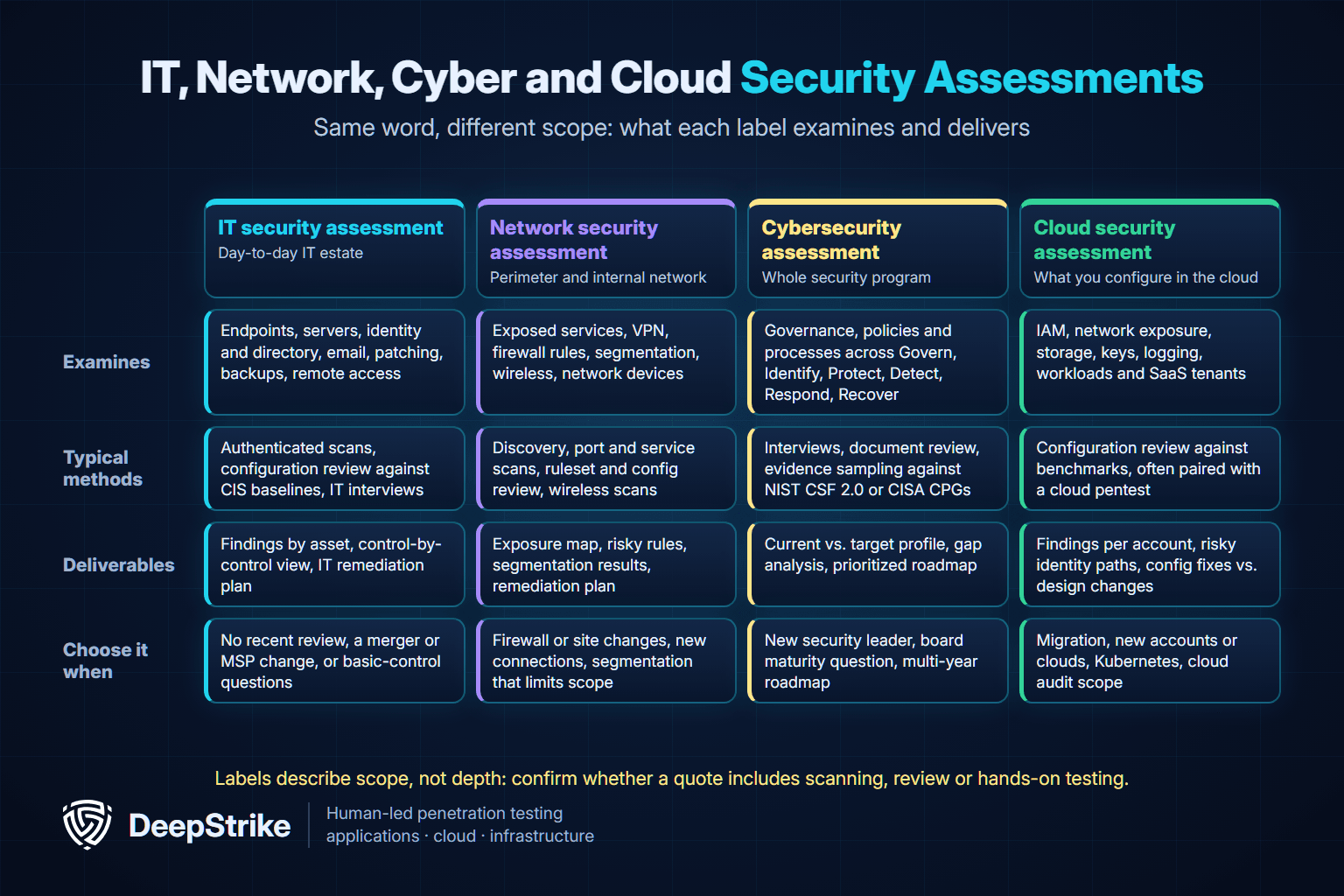
What it examines: the technology the organization runs every day. That means endpoints and servers, identity and directory services, email, patching, backups, and remote access, plus the administrative practices around them, such as who holds admin rights and how new devices are set up. Most providers combine authenticated vulnerability scanning with a configuration review and interviews with the IT team. A common yardstick is the CIS Critical Security Controls, a prioritized set of 18 controls whose Implementation Groups scale expectations to an organization's resources and risk, used together with CIS Benchmarks for individual operating systems and platforms.
Deliverables: findings by asset (missing patches, weak configurations, excessive administrative rights, and gaps in backup or multi-factor authentication coverage), a control-by-control view against the chosen baseline, and a remediation plan the IT team can schedule. An IT security assessment confirms weaknesses through analysis, not exploitation. If you also need proof of what an attacker could reach, add hands-on testing in a combined VAPT engagement. It is not an audit either: an audit checks controls against a standard and issues a formal result. For that process, see how an IT security audit works.
Choose it when your IT estate has not had an independent review in the past year, after a merger or a change of managed service provider, when a customer questionnaire or insurance application asks about basic controls such as MFA, patching, and backups, or when a small IT team needs an outside baseline before investing in deeper testing.
What it examines: how traffic enters, moves through, and leaves your environment. Typical scope covers the external perimeter (internet-facing IP ranges, open ports and exposed services, VPN and remote-access gateways), firewall and router rule sets, segmentation between user, server, and sensitive zones, wireless networks, and the configuration of network devices. NIST SP 800-115 describes the core techniques: network discovery, port and service identification, vulnerability scanning, wireless scanning, and reviews of firewall rulesets and system configurations.
Depth varies more under this label than under any other. Some providers deliver scanning plus a configuration review; others include hands-on exploitation from outside and inside the network, which makes the work a network penetration test. Ask which one the quote covers. The inside view matters most when you want to know how far an attacker could move after a phishing click or a stolen VPN account, which is what an internal penetration test measures.
Deliverables: a map of exposed services and how each one is reached, firewall rules flagged as overly permissive, unused, or redundant, segmentation results showing which zones can reach which, insecure protocols and device settings, wireless findings, and a prioritized remediation plan. If segmentation reduces your compliance scope, the report should explain how it was verified. PCI DSS, for example, requires penetration tests of segmentation controls when segmentation is used to isolate the cardholder data environment.
Choose it when you are replacing firewalls, adding sites or cloud connections, connecting a partner or an acquired company, changing your remote-access model, relying on segmentation to limit compliance scope, or have not reviewed your rule sets in a long time.
What it examines: usually the whole security program rather than one environment, meaning how the organization governs, identifies, protects, detects, responds to, and recovers from cyber risk. The work is mostly interviews, document review, and evidence sampling, scored against a framework rather than tested hands-on.
The NIST Cybersecurity Framework (CSF) 2.0, published on February 26, 2024, is a common reference. Assessors document a Current Profile of the outcomes you achieve today, compare it with a Target Profile, and turn the gaps into a prioritized action plan. Smaller organizations and critical infrastructure operators often start from CISA's Cross-Sector Cybersecurity Performance Goals (CPGs) 2.0, a baseline of high-impact practices that CISA has aligned with the CSF 2.0 functions. CISA's free Cyber Security Evaluation Tool (CSET) supports a structured self-assessment against recognized standards.
Deliverables: a current-state rating for each framework function or category, a gap analysis against the target, a prioritized roadmap with owners, and a briefing for leadership or the board. It overlaps with a risk assessment (type 1 above) but answers a different question: a risk assessment ranks specific risks by likelihood and impact, while a cybersecurity assessment measures how complete and mature the program is. Because its evidence comes mainly from documents and interviews, it does not show that a control holds up under attack. Validate the highest-risk gaps with penetration testing services or, for teams with a working SOC, a red team exercise.
Choose it when a new security leader needs a baseline, the board asks how mature the program is, you are building a multi-year security budget or roadmap, or a regulator, insurer, or major customer asks you to map your program to a framework such as NIST CSF.
The most common buying mistake is choosing an assessment by name rather than by the evidence it produces. Each type answers a different question, so start with the question you need answered now. This guide groups the options into four kinds of evidence (an original DeepStrike framework, not an industry standard). They are not maturity levels: they serve different goals, often run side by side, and none is a prerequisite for another.
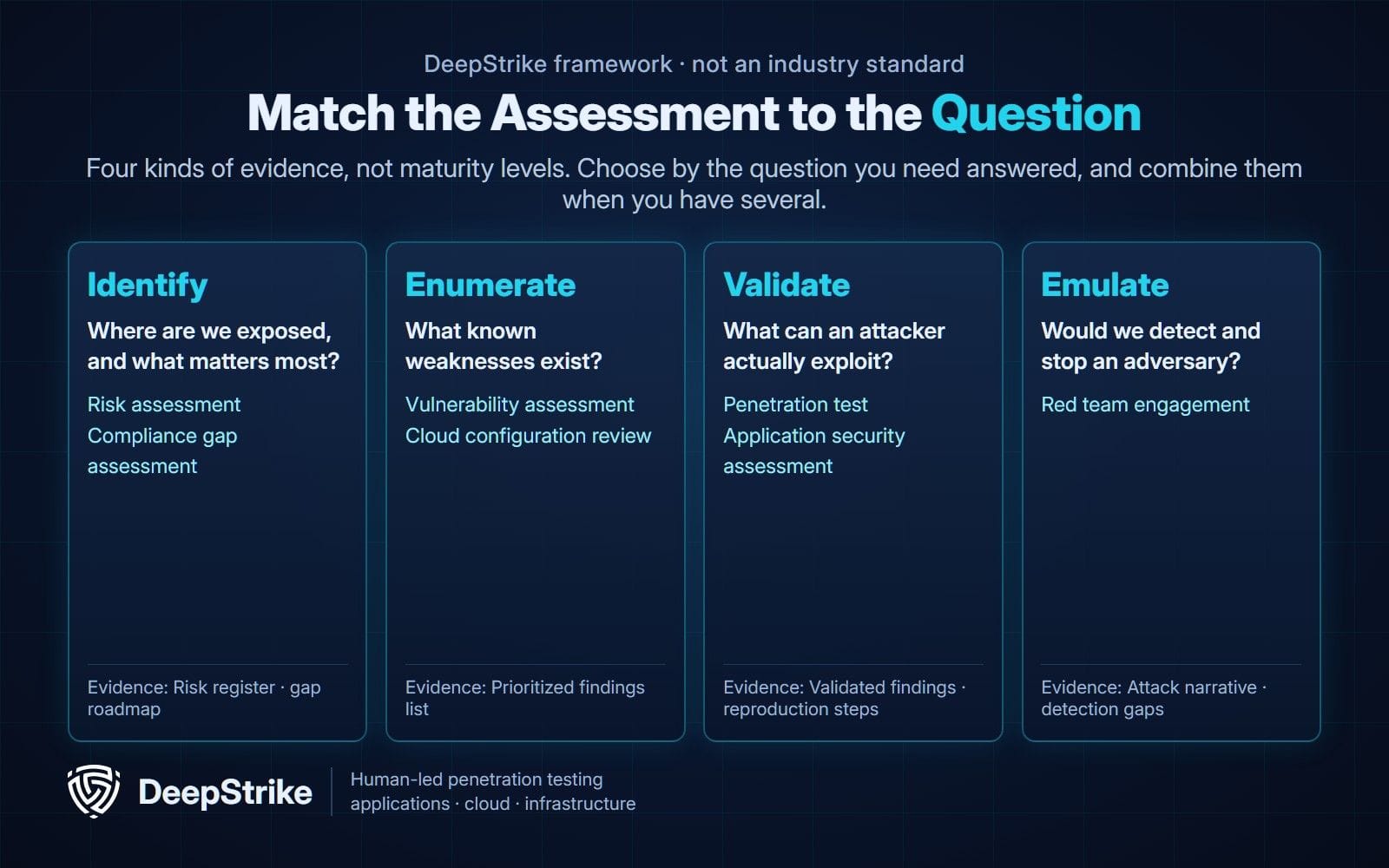
Four kinds of evidence, not maturity levels: choose by the question, and combine types when you have several.
Choose the type whose evidence answers your current question, and combine types when you have more than one. Some sequencing still helps in practice: a red team engagement tests detection and response, so it delivers the most value once basic vulnerability management is in place; before that, it tends to surface issues a scan would have found, at a higher price.
Two illustrative scenarios show how this works in practice:
Scope is where assessment value is won or lost: a vague scope produces a vague report. For risk and compliance reviews, define the business scope, the assessment criteria or framework, the documents to review, and who will be interviewed. For engagements involving technical testing, agree the elements below before work starts.
Every engagement should end with an executive summary in business terms, prioritized findings, and remediation guidance. The rest depends on the type of assessment:
Where customers or auditors need it, ask whether an attestation or completion letter is available, and request a readout session so your team can question the assessors directly.
Before signing, ask for a sanitized sample report from the same type of assessment; it is one of the most useful previews of what you will receive, alongside the proposed scope and the testers' relevant experience.
Security assessment companies range from large consultancies to boutique specialists. Evaluate the testers and methodology, not the brand.
Cybersecurity assessment cost depends on scope, depth, and expertise, so credible providers confirm scope before committing to a price, even when they offer packaged plans. Expect the following factors to move the price:
If you are budgeting specifically for scanning, our breakdown of vulnerability assessment pricing explains the main variables.
For hands-on testing, DeepStrike's penetration testing pricing page outlines what each engagement plan includes; final quotes depend on scope.
Most assessments follow a similar arc. NIST SP 800-115 groups testing into planning, execution, and post-execution stages. The workflow below illustrates a typical technical testing engagement in seven steps; risk and compliance reviews rely on document review and interviews instead and may not need test accounts or network access:
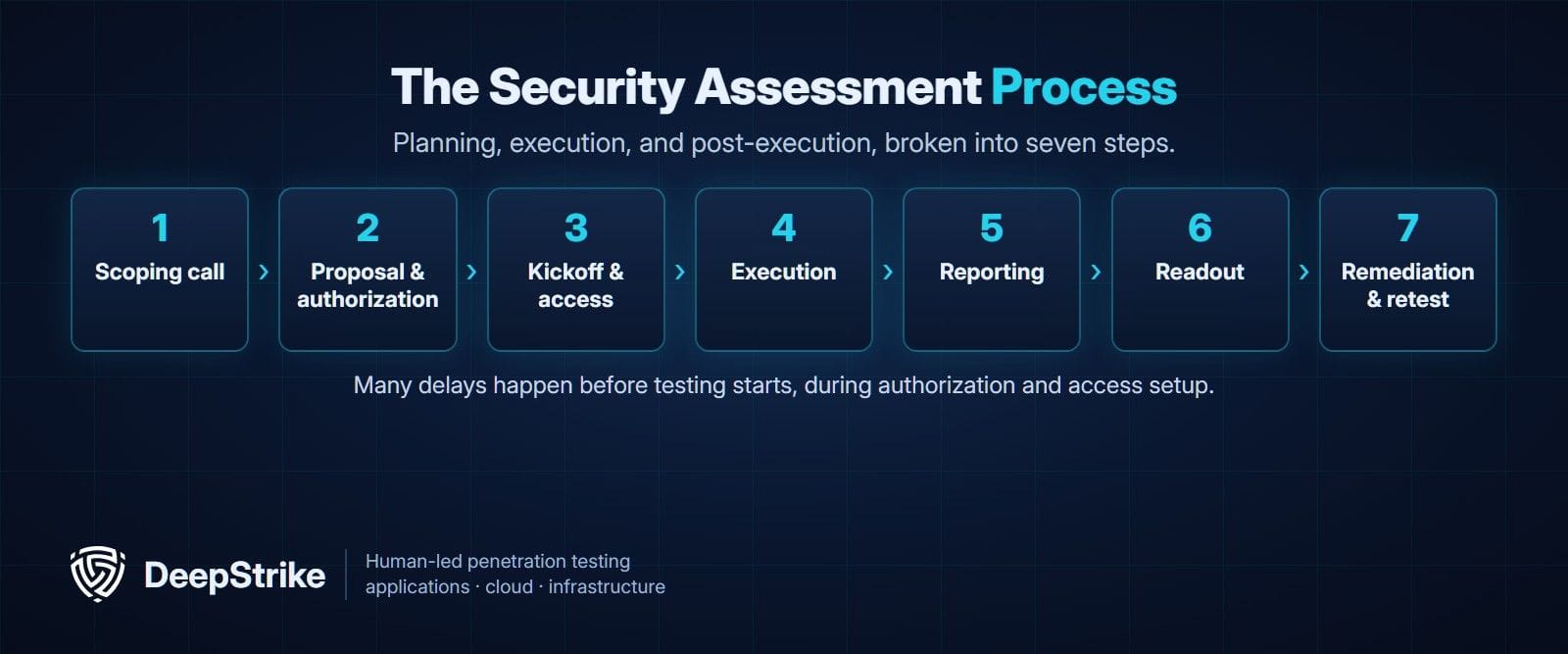
Example workflow for a technical testing engagement; access needs and any retest are set in the agreed scope.
Duration depends on scope, so ask for a written schedule. Delays can occur before testing starts, while teams wait for signatures, test accounts, or network access. Preparing those during the proposal stage keeps the engagement on track.
Risk is reduced through effective remediation or compensating controls, verified in a way that fits the change; a closed ticket alone is not evidence of reduced risk. Track each finding to a documented treatment decision, record any accepted residual risk separately, and use a simple workflow to keep remediation moving after the readout:
Track open findings by severity and age. A growing backlog of high-severity items past their target dates is an earlier warning sign than any single report.
A point-in-time assessment shows the state of your environment during the testing window. That suits audit evidence, a major release, or a pre-acquisition review. Environments that change weekly, such as SaaS products with frequent deployments or growing cloud estates, can drift between annual tests.
In that case, a recurring cadence keeps evidence current: scheduled scanning for breadth, plus periodic or continuous penetration testing for depth on new features. The right rhythm depends on how fast your environment changes, its risk, and any contract or framework requirements, not on a fixed calendar.
DeepStrike was founded in 2016 by a team that first met in the bug bounty community, and offensive security testing remains its core focus. DeepStrike LLC is based in Newark, Delaware, has a business address in Dubai, UAE, and employs a team of 11 to 50 people. Its penetration testing assessments are performed manually and cover web and mobile applications, cloud environments, infrastructure, social engineering, and red team assessments. Testers score severity with CVSS, document reproduction steps, root causes, and remediation guidance, and retest fixes; retest terms are confirmed in each proposal.
Individual DeepStrike testers hold certifications including OSCP, OSWE, OSEP, OSWP, GXPN, GWAPT, eCPPT, eMAPT, eWPT, CREST CPSA, CRTP, CRTE, and Microsoft Azure Security Engineer Associate. These are personal credentials, not a company accreditation.
Reports are prepared to support evidence needs for frameworks such as SOC 2, ISO 27001, PCI DSS, and HIPAA. A penetration test supplies technical evidence; it does not replace the formal examination by a CPA firm or the certification audit by an accredited body. To decide which assessment fits, talk with the DeepStrike team about scope first.
A security assessment evaluates your security posture and recommends improvements; its goal is to find and prioritize weaknesses. A security audit measures your controls against a defined standard and produces a formal opinion, attestation, or certification decision. Many organizations run assessments first so the audit goes more smoothly.
Our IT security audit guide explains the audit process, checklist and evidence.
Many organizations test at least annually and after significant changes, such as a major release or cloud migration. Vulnerability scanning usually runs far more often. Some frameworks and contracts set specific intervals, so confirm the requirement that applies to you.
Sometimes it is part of the answer, but rarely all of it. Frameworks such as PCI DSS include separate requirements for vulnerability scanning and penetration testing. Customers and auditors reviewing SOC 2 or ISO 27001 programs also often expect evidence of manual testing.
Analytical reviews carry almost no operational risk. Active testing carries some, which experienced providers manage with agreed windows, rate limits, excluded techniques, and live communication. If stability is a concern, test a staging environment that mirrors production.
For technical testing, prepare an up-to-date asset list, test accounts for each user role, architecture or API documentation for grey-box work, named technical contacts, and written authorization. Tell your hosting or cloud provider when its policy requires notice, and alert internal monitoring teams unless detection is part of the test. For risk or compliance reviews, gather current policies, prior audit reports, an asset and data inventory, and the names of the people the assessors will interview.
Look for testers with hands-on certifications and experience with your stack, a documented methodology, and sample reports. For audits that result in a formal opinion, such as SOC 2, the examination itself must be performed by a licensed CPA firm.
An IT security assessment is mostly technical: it reviews the systems IT runs, such as endpoints, servers, identity, email, patching, and backups, often against the CIS Controls. A cybersecurity assessment is usually broader and program-level: it rates governance, policies, detection, response, and recovery against a framework such as NIST CSF 2.0. Providers use both terms loosely, so compare the scope and methods in each proposal rather than the label.
A network security assessment typically covers internet-facing IP ranges and exposed services, VPN and remote access, firewall and router rule sets, internal segmentation, wireless networks, and network device configuration. Deliverables include a map of exposed services, flagged firewall rules, segmentation results, and a prioritized remediation plan. If the scope includes hands-on exploitation, the engagement is effectively a network penetration test.
Security assessment services are not interchangeable. Risk and gap assessments show where you stand, vulnerability assessments and configuration reviews list what is wrong, penetration tests prove what is exploitable, and red teams test whether defenders respond. The right purchase depends on the decision you need to support and the evidence your auditors and customers expect.
Start with the question, choose the assessment whose evidence answers it, and hold every provider to a precise scope, a sample report of the same assessment type, and an agreed retest wherever testing is involved.
Ready to scope your next assessment? Share your environment, deadlines, and compliance goals with DeepStrike, and our testing team will recommend the assessment depth that fits.
Mohammed Khalil is a Cybersecurity Architect at DeepStrike, specializing in advanced penetration testing and offensive security operations. With certifications including CISSP, OSCP, and OSWE, he has led numerous red team engagements for Fortune 500 companies, focusing on cloud security, application vulnerabilities, and adversary emulation. His work involves dissecting complex attack chains and developing resilient defense strategies for clients in the finance, healthcare, and technology sectors.

Stay secure with DeepStrike penetration testing services. Reach out for a quote or customized technical proposal today
Contact Us
