November 6, 2026
Updated: November 11, 2026
What pen testing, red teaming, MDR, SOC, vCISO, compliance, incident response, cloud security and training each do, and which to buy first.

Mohammed Khalil
Cybersecurity services are outside expertise you hire to find, monitor, respond to or govern security risk, as opposed to tools you buy and run yourself. The 10 main types are vulnerability management, penetration testing, red teaming, managed detection and response (MDR), managed SOC or MSSP monitoring, incident response, virtual CISO (vCISO), compliance readiness, cloud security and awareness training. Each answers a different question, so the right starting point depends on your problem: an active attack, a customer's report request, no after-hours monitoring, or nobody in charge.
A note on who wrote this: DeepStrike sells penetration testing, continuous penetration testing and red team services. Its Premium continuous testing plan, as listed on the pricing page, also includes weekly automated vulnerability scanning, attack surface management and dark web monitoring. As of November 2026, its service pages do not list MDR, managed SOC, vCISO, incident response retainers, compliance consulting or awareness training programs. Those categories are described generally here, and no provider is recommended for them.
A cybersecurity service is work done for you by people, not a product you install. NIST's Guide to IT Security Services (SP 800-35, October 2003) describes the range as running from security policy development to intrusion detection support, offered either by an internal group or by outside vendors. The guide is old, but its central point still holds: these services are hard to compare, because provider capability and reliability are difficult to measure from the outside.
Most services are delivered in one of four ways:
| Service | Question it answers | Usual delivery | What you end up with | Who usually needs it |
|---|---|---|---|---|
| Vulnerability management | What known flaws do we have, and which come first? | Managed or in-house program | Ranked findings and fix tracking | Nearly every organization |
| Penetration testing | What can an attacker actually exploit? | Project, or continuous | Report with proof, severity and fixes | Anyone with customer, audit or release pressure |
| Red teaming | Could an attacker reach our goal without being stopped? | Project | Attack narrative and detection gaps | Teams with working monitoring and response |
| MDR | Who detects and contains threats around the clock? | Managed | 24/7 detection and remote containment | Organizations without a 24/7 team |
| Managed SOC or MSSP | Who watches and triages our security alerts? | Managed | Monitoring, triage and escalation | Organizations with some internal response ability |
| Incident response | Who helps when something goes wrong? | Retainer or emergency | Containment, investigation and recovery advice | Everyone should have a plan; many buy a retainer |
| vCISO | Who leads security and answers to the board? | Advisory | Risk register, roadmap and reporting | Growing firms without a security leader |
| Compliance readiness | Are we ready for this audit or framework? | Project or advisory | Gap list, policies and evidence | Firms facing SOC 2, ISO 27001, PCI DSS or similar |
| Cloud security | Is our side of the cloud set up safely? | Project or managed | Configuration, identity and architecture fixes | Anyone running real workloads in the cloud |
| Awareness training | Will staff spot and report an attack? | Managed or in-house program | Role-based training and reporting metrics | Every organization with staff and email |
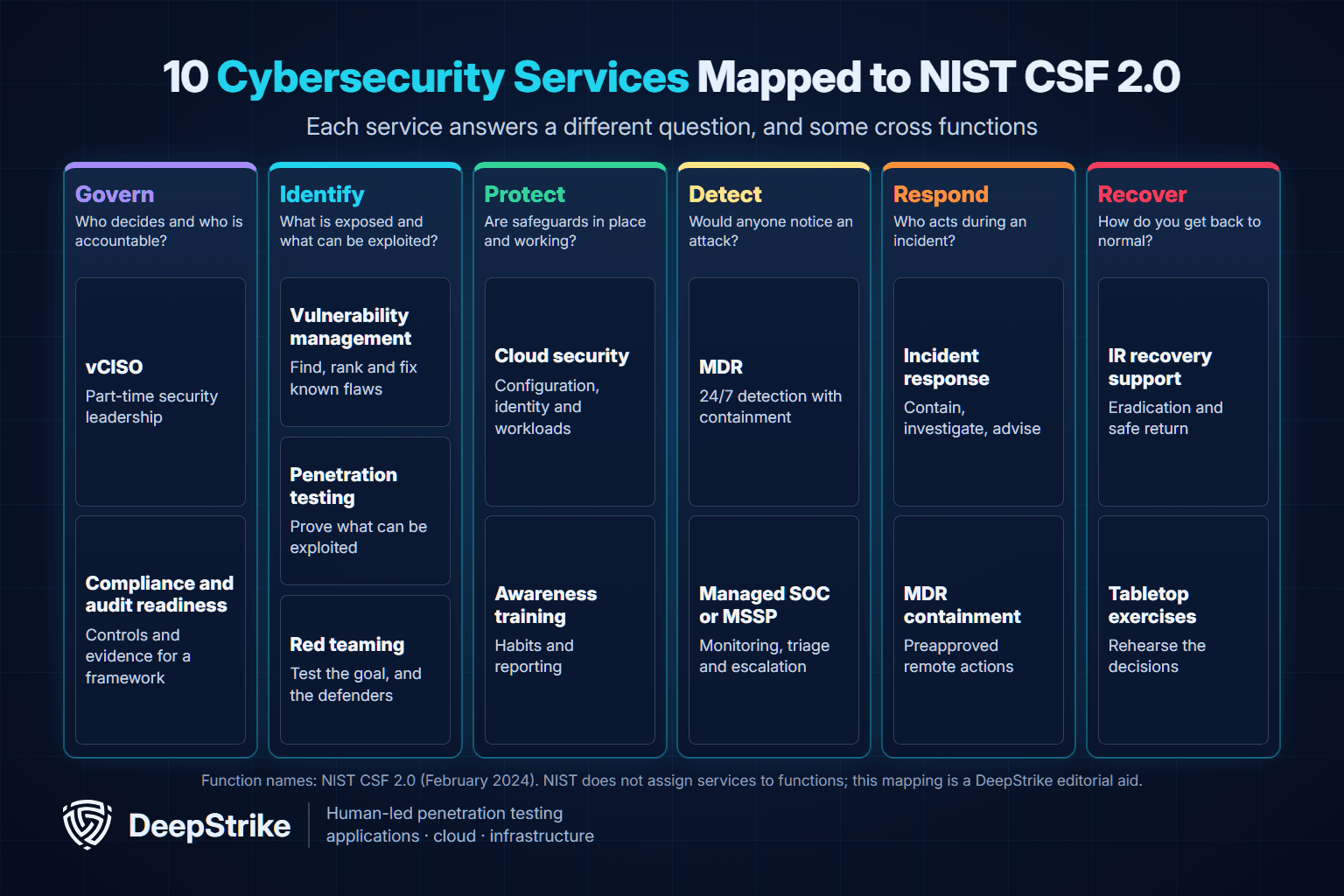
NIST's Cybersecurity Framework 2.0 (February 2024) is a useful map here. It sorts security outcomes into six functions (Govern, Identify, Protect, Detect, Respond and Recover) and applies to any organization regardless of size, sector or maturity. It does not tell you how to achieve those outcomes or which services to buy, but it does show where you have no coverage. The diagram below is our own mapping, not NIST's.
These three services run from automated scanning to full adversary emulation. If you are choosing between assessment types, our guide to security assessment services compares their scope, deliverables and cost.
A vulnerability scan uses software to look for known flaws and weak settings. Vulnerability management is the ongoing cycle around it: find, rank, fix and confirm. The PCI Security Standards Council's plain-language guide explains the limit well: a scan identifies a weakness without exploiting it, like turning a doorknob to see if it is locked rather than trying to pick the lock.
Penetration testing is authorized, scoped security testing in which people imitate real attackers. NIST's definition, from SP 800-115, stresses looking for combinations of vulnerabilities that give more access than any single flaw would. Common scopes include web applications, mobile apps, APIs, cloud and networks.
A red team is a group authorized to emulate a potential adversary against your whole organization. A penetration test tries to find as many flaws as possible within a scope. A red team pursues an objective, such as reaching a sensitive system, and also measures whether your people and tools notice.
Gartner defines MDR as remotely delivered security operations center functions covering rapid detection, analysis, investigation and response through threat disruption and containment. Its mandatory features include 24/7 staffing and remote response actions, such as quarantining a host, that go beyond alerting and are preapproved by the customer.
MITRE's SOC guide (2022) defines a security operations center as a team, mainly of cybersecurity specialists, organized to prevent, detect, analyze, respond to and report on incidents. You can build one, outsource it as a managed SOC or SOC as a service, or use a managed security service provider (MSSP), which typically runs security tools and monitors alerts for you.
These labels overlap, and vendors use them differently. A useful test is what happens after an alert fires. Some providers escalate it to your team, while others investigate and contain it. If your team has to act at 2 a.m., make sure someone there can.
Deciding between building and buying also comes down to staffing: 24/7 coverage needs several analysts and ongoing tool work. Our MSP cybersecurity statistics cover how widely these providers are used.
Incident response (IR) providers help you contain an attack, investigate what happened, preserve evidence and return to normal safely. You can call one during an emergency, but a retainer agrees on terms before you need them, so nobody is negotiating a contract mid-attack.
NIST's SP 800-61 Rev. 3 (April 2025) treats incident response as part of everyday risk management, not just a reaction, covering preparation as well as detection, response and recovery.
A vCISO is a part-time security leader, hired through a firm or as a contractor. The work usually covers risk assessment, policies, a security roadmap, vendor decisions and reporting to executives or the board.
One rule shows how outsourcing leadership works. The FTC Safeguards Rule lets the required "Qualified Individual" be employed by a service provider, but the institution keeps responsibility for compliance and must name a senior staff member to oversee that person. Even outside that rule, it is the right model: you can outsource the role, not the accountability.
Ask how many hours you get each month, how many other clients the person serves, and whether they earn commissions on products they recommend.
Compliance services get you ready for a framework: gap assessment, policies, control mapping and evidence collection. They differ from the audit itself, and buyers often blur the two.
Testing supports compliance but does not equal it. Our guides to penetration testing for compliance and IT security audits explain how testing and audits fit together.
Cloud providers do not secure everything for you. Under the AWS shared responsibility model, AWS protects the infrastructure running its services, while the customer's share depends on the service chosen and can include operating system patches, application software and firewall settings.
Cloud security services focus on your share: configuration reviews, identity and permission cleanup, architecture advice, posture monitoring and cloud penetration testing. Ask whether the provider will fix issues or only report them, and whether it covers your specific cloud platforms and SaaS applications.
Training teaches staff to recognize and report attacks. Verizon's 2026 report puts the non-intentional human element at 62% of breaches, which is why this category exists. It is also why training alone cannot be the fix: people will still make mistakes, so controls need to absorb them.
NIST's SP 800-50 Rev. 1 (September 2024) frames this as a learning program that should encourage behavior change and be measured and improved over time. Judge a program by how quickly and how often people report suspicious messages, not by course completion alone. A social engineering assessment can check the results under realistic conditions.
Vendors also sell narrower services, including identity and access management, threat intelligence, attack surface management, data security, third-party risk management and application security reviews tied to a secure SDLC. Treat them the same way: ask which question the service answers and what you will hold at the end.
| Terms | The real difference | Rule of thumb |
|---|---|---|
| Vulnerability scan vs penetration test | A scan identifies possible flaws; a tester tries to exploit them | Scan often, test on a schedule and after major change |
| Penetration test vs red team | A pentest looks for many flaws in a scope; a red team pursues one objective and tests detection | Pentest first, red team once you can detect and respond |
| MDR vs MSSP | MDR includes active containment by definition; MSSP scopes vary and may stop at alerts | Read who acts after the alert |
| MDR vs SOC | A SOC is a team or function; MDR is one way to buy SOC functions | Buy MDR when you cannot staff 24/7 |
| Readiness vs audit | Readiness prepares you; an independent party issues the report or certificate | Do not expect one firm to do both without checking independence |
| vCISO vs consultant | A vCISO holds an ongoing leadership role; a consultant delivers a defined project | Use a vCISO when decisions lack an owner |
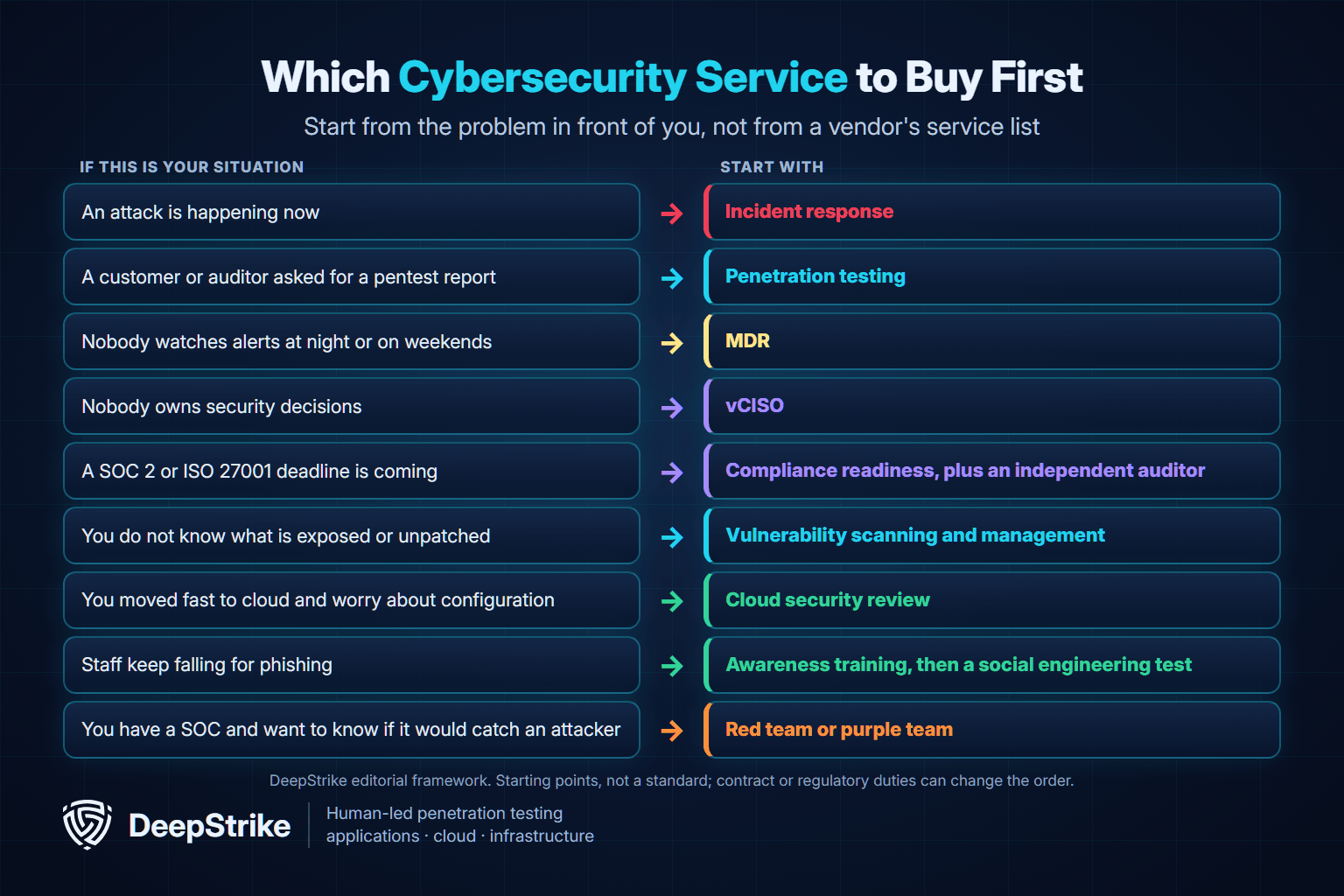
Start with the problem in front of you, not a vendor's service list.
| Your situation | Start with | Why |
|---|---|---|
| An attack is happening now | Incident response | Containment comes before any planning |
| A customer or auditor asked for a pentest report | Penetration testing | It is the specific evidence they requested |
| Nobody watches alerts at night or on weekends | MDR | Attacks do not wait for office hours |
| Nobody owns security decisions | vCISO | Other purchases need someone to direct them |
| A SOC 2 or ISO 27001 deadline is coming | Compliance readiness and an independent auditor | Evidence takes time to build |
| You do not know what is exposed or unpatched | Vulnerability scanning and management | You cannot prioritize what you cannot see |
| You moved fast to cloud and worry about configuration | Cloud security review | Misconfigurations sit on your side of the shared model |
| Staff keep falling for phishing | Awareness training, then a social engineering test | Train first, then measure |
| You have a SOC and want to know if it would catch an attacker | Red team or purple team | It tests detection, not just systems |
If nothing is urgent, build in this order. This is our editorial framework rather than a standard, and a contract or regulator can move any item earlier.
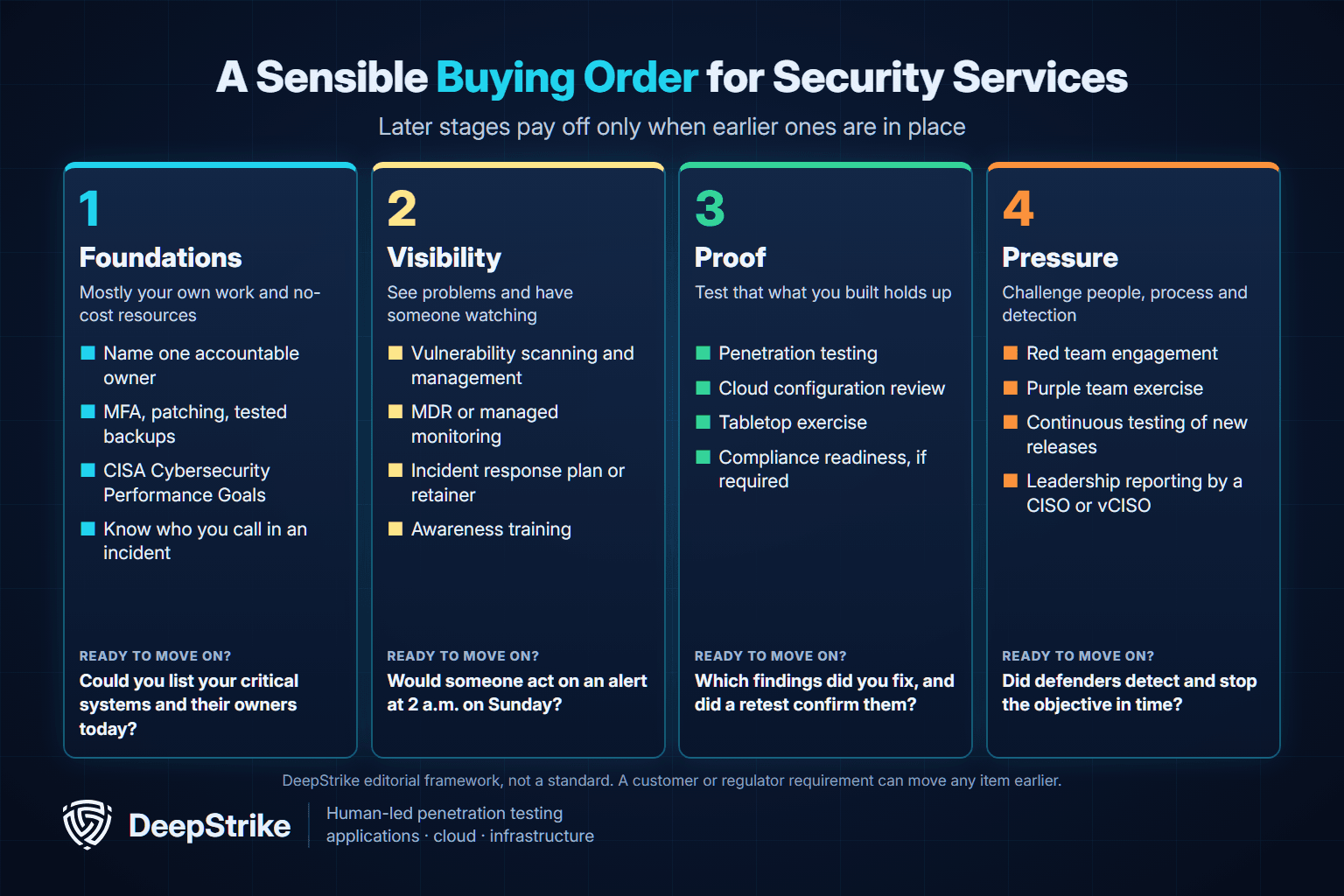
Small businesses can stop at stage two or three for a long time. Our overview of cyber attacks on small businesses helps with deciding what matters most at that size.
Before paying for anything, check what is available at no cost. CISA's No-Cost Cybersecurity Services and Tools page suggests three starting points: contact your regional cybersecurity advisor, sign up for Cyber Hygiene services and complete a Cybersecurity Performance Goals assessment. It also lists no-cost tools from other public and private organizations.
Small businesses can also use NIST's Small Business Cybersecurity Corner and its advice on choosing a vendor or service provider. Free scanning is valuable, but it is still scanning: it does not replace a penetration test when a customer or a rule requires one.
A security provider often gets deep access to your systems, which makes it a risk as well as a resource. In the Kaseya VSA attack of July 2021, attackers used a software flaw to hit managed service providers and their downstream customers with ransomware. Verizon's 2026 report found third-party involvement in 48% of breaches, up from 30% a year earlier. That figure covers all kinds of vendors, not just security providers, but the lesson applies.
Use this checklist:
If you are regulated, oversight may be a duty rather than a preference. The Safeguards Rule requires covered institutions to select capable service providers, bind them by contract and periodically assess them. NIST's SP 800-35 lists similar factors: the service arrangement, provider qualifications and viability, and the trustworthiness of its staff.
Treat these as warning signs: promises of complete security or guaranteed compliance, an inability to explain what is out of scope, and pressure to sign before you have seen a deliverable. If you are comparing bundled security subscriptions, our security as a service provider comparison and in-house vs outsourced testing guide can help.
A service contract tells you what should happen, and only testing shows what does. Each purchase can be checked:
This is the part of the list DeepStrike works on. Its penetration testing services cover web and mobile applications, cloud, infrastructure and social engineering through manual testing, alongside red team engagements. Reports include reproduction steps, root causes and remediation advice. No test can guarantee security or an audit result, but it can show which controls hold up. If that is the gap you are trying to close, you can talk to the team about scope.
Lists vary, and no official five-part list exists. Most describe security domains rather than services: network, application, cloud, endpoint or IoT, and information security. Services are the work you buy to protect those domains, so a penetration test, for example, might cover both applications and cloud.
No reliable public benchmark covers all of them, because the services are so different. Price depends on scope, company size, number of systems, coverage hours, tester or analyst skill and how much hands-on work is included. Get written scopes from several providers and compare what is included. For one category in detail, see our guide to penetration testing cost.
Start with the basics that need no vendor: MFA, updates, tested backups and a named owner. Then consider managed monitoring if nobody watches alerts, and a penetration test if customers or regulations require one. Enterprise services such as red teaming rarely make sense until those are working.
A SOC is a team or function that handles security monitoring and incidents, either in-house or outsourced. MDR is a specific managed service that delivers SOC functions remotely, including 24/7 staffing and active containment. Some organizations use MDR alongside a small internal team.
Some providers offer many services, and a single contract can be simpler. The trade-offs are independence and concentrated access. It is reasonable to buy monitoring from one firm and have a different firm test whether that monitoring works.
Usually not the services in this guide, which are built for organizations. CISA's four core steps for everyone are avoiding and reporting phishing, using strong passwords, using MFA with a password manager, and updating software. If your identity is stolen, the FTC's IdentityTheft.gov provides a recovery plan, and scams can be reported at ReportFraud.ftc.gov.
Call your incident response provider or cyber insurer if you have one, and involve legal counsel. In the U.S., you can report the incident to CISA and to the FBI's Internet Crime Complaint Center.
Cybersecurity services are not interchangeable. Testing tells you what can go wrong, monitoring tells you when it is going wrong, response limits the damage, and governance decides what deserves attention. Pick the service that answers your most urgent question, ask what you will hold at the end, and check that it works. When you are ready to test your defenses from an attacker's point of view, start with a scoped penetration test.
Mohammed Khalil is a Cybersecurity Architect at DeepStrike, specializing in advanced penetration testing and offensive security operations. With certifications including CISSP, OSCP, and OSWE, he has led numerous red team engagements, focusing on cloud security, application vulnerabilities, and adversary emulation. His work involves dissecting complex attack chains and developing resilient defense strategies for clients in the finance, healthcare, and technology sectors.

Stay secure with DeepStrike penetration testing services. Reach out for a quote or customized technical proposal today
Contact Us
