December 7, 2025
Updated: November 5, 2026
Comprehensive data protection with encryption, Zero Trust, DLP, and 24/7 threat monitoring to prevent breaches and ensure compliance.

Mohammed Khalil

Data security services are essential for any organization that handles sensitive information. These services combine tools like encryption, tokenization, and strict access controls with continuous monitoring to safeguard data throughout its lifecycle. Finance firms, healthcare providers, e-commerce sites and others with customer PII or proprietary data need robust data security to prevent breaches and maintain trust. With cyberattacks growing and regulations (HIPAA, PCI DSS, GDPR, etc.) imposing stiff penalties for failures, investing in professional Data Security Services is now a business imperative. DeepStrike’s penetration testing services test whether these defenses hold up against real attack techniques, so gaps are found, fixed and retested before attackers can exploit them.
Data security services are managed solutions and consulting that help organizations protect sensitive data from unauthorized access, leaks, or corruption. In practice, this means implementing a range of controls and technologies from encryption and tokenization to data classification, user training, and auditing that work together to keep data safe. These services give you visibility into where your data lives, who can access it, and how it’s being used. They solve problems like accidental data loss, insider threats, and targeted breaches by enforcing policies e.g. only finance team can view payment records and by monitoring for unusual activity. These often sit alongside broader security-as-a-service (SECaaS) providers.
Organizations need Data Security Services because sensitive data is a prime target. Cybercriminals relentlessly hunt for personal and financial information, exploiting any weak spots. For example, losing customer records can cost millions per breach, and errors or misuse of data are common causes of incidents. Robust data protection also addresses one common misconception: compliance alone isn’t enough. Regulations like HIPAA or PCI DSS set minimum safeguards, but attackers don’t care if you have a cert, they look for any unguarded data. In fact, compliance is the floor, not the ceiling. Even a compliant company can be breached without further security measures. Similarly, small organizations are often mistaken as safe because of their size, yet in Verizon’s 2019 DBIR, 43% of breaches involved small-business victims. Data Security Services bring expertise and automation so that no gap is overlooked, they reduce vulnerabilities, improve detection, and harden controls across your data estate.
Modern cyber threats and regulations make these services critical. Today’s attackers use AI generated phishing and malware to trick employees into exposing data or credentials, and they exploit misconfigured cloud or SaaS systems to grab data at scale. Ransomware groups have evolved to steal data for double extortion, demanding payment or threatening publication if companies don’t pay. Supply chain attacks (e.g., compromised vendors) are also growing: Verizon’s 2025 DBIR found a third party was involved in about 30% of breaches, double the prior year. All of this means that traditional perimeter tools, firewalls, antivirus are not enough. Data Security Services address the core problem, protecting the data itself wherever it resides. By encrypting and segregating data, enforcing least privilege access, and monitoring in real time, these services directly reduce breach likelihood and impact. For instance, rapid detection and response capabilities (EDR, SIEM, MDR) shorten the time attackers have inside the environment, which limits breach impact. They also reduce human-driven risk by combining user behavior analytics with training and multi-factor authentication; Verizon’s 2024 DBIR found 68% of breaches involved a non-malicious human element, such as error or falling for social engineering.
Regulatory compliance amplifies the need for data security. Regulations such as HIPAA and GLBA, and standards such as PCI DSS and SOC 2, define data protection controls. Noncompliance can mean huge fines: global privacy fines hit €1.2 billion in 2024, and data breaches erode customer trust and brand reputation. Data security services embed controls mapped to each framework’s requirements to support audit readiness, and compliance tooling can automate audit reporting for HIPAA, PCI, GDPR, SOC 2 and more. In short, these services turn compliance demands into actionable security, reducing risk and exposure to penalties.
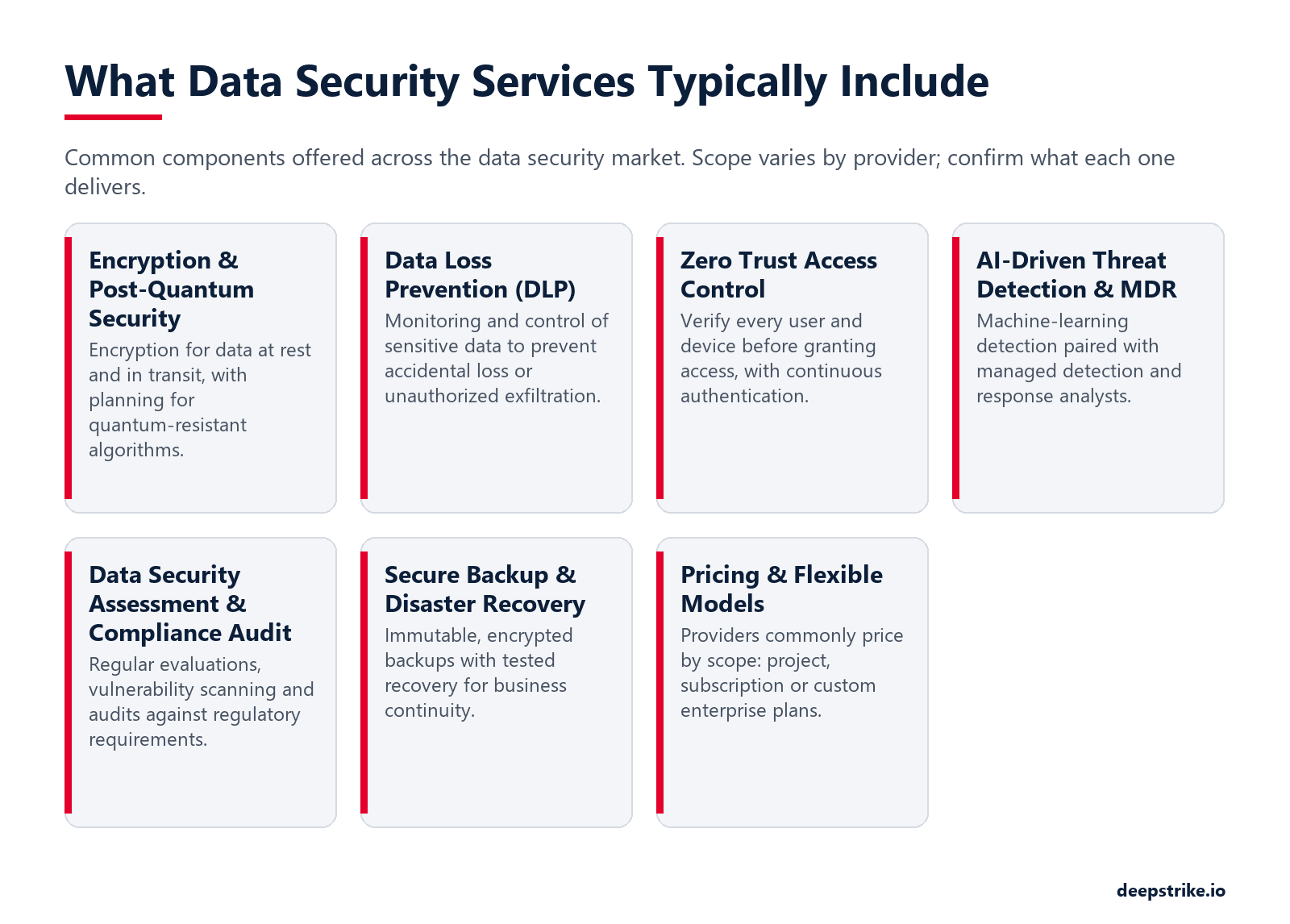
Encryption services protect data everywhere (at rest, in transit, and in use) using industry-standard ciphers and managed key stores. This includes file and database encryption, tokenization of sensitive fields, and secure key management. Providers also plan for future threats with post-quantum cryptography strategies. Designing encryption around NIST-standardized quantum-resistant algorithms and crypto-agility helps prepare data for future quantum threats. This protects financial records, medical data, intellectual property, and more from brute-force or future quantum attacks.
DLP services combine network, endpoint, and cloud-based controls to stop unauthorized data transfers. Using content inspection, machine learning classification, and user behavior analytics, they identify sensitive content (PII, credit card numbers, health records) anywhere in your organization. Policies are enforced automatically: for example, an email with a social security number triggers encryption and quarantine. This stops both malicious exfiltration and accidental leaks. Modern DLP also addresses AI data governance, it can automatically scan AI training data for privacy issues and prevent sensitive data from feeding into unapproved models. By preventing data loss and automating compliance workflows (e.g., handling GDPR subject requests), DLP solutions keep data usage safe and transparent.
Access control services apply Zero Trust principles so that no user or device has implicit access to data. This starts with strict identity and access management (IAM): role-based permissions, just-in-time access, and multi-factor authentication for all sensitive data access. Micro-segmentation policies mean that a breach in one area (e.g., a user’s workstation) doesn’t automatically expose all your data. Regular entitlement reviews prevent permission creep. Since identity-based attacks now account for about 30% of intrusions, enforcing least privilege and continuous authorization checks is critical. Privileged access management (PAM) for admin accounts and secure vaults for credentials complete the picture. Together, these controls significantly limit the blast radius if an attacker gains a foothold. Our zero trust statistics show how far adoption has actually progressed.
Threat detection services use advanced analytics and threat intelligence to spot anomalies in your data environment. These tools apply AI and machine learning to logs, file access, and network flows, detecting unusual patterns like large outbound transfers or odd access requests in real time. Any alert can trigger automated action (blocking traffic, rotating keys) and immediate notification to a SOC team. A Managed Detection and Response (MDR) service adds a human layer 24/7: security analysts investigate alerts, hunt for hidden threats, and coordinate incident response if needed. SOC-as-a-Service offerings add global threat intel feeds and speedy containment, minimizing damage from new exploits. AI-driven detection not only catches modern threats faster, it also offloads repetitive tasks so your team can focus on high-value fixes.
Before controls are implemented, an assessment analyzes your current data security posture. It covers data discovery (finding all sensitive data across databases, file shares and cloud), risk analysis of data flows, and maturity scoring against standards like ISO 27001 or CIS Controls. A data security audit identifies gaps (e.g., unencrypted repositories or excessive admin privileges) and maps them to compliance requirements (HIPAA, GLBA, PCI DSS, SOC 2). The audit results in a prioritized remediation plan. On an ongoing basis, providers support your compliance program by generating reports and documentation (audit trails, encryption summaries, policy enforcement) needed for regulators. This means smoother audits and reduced chance of fines for noncompliance.
No security strategy is complete without resilient backups. Backup services keep your most sensitive data in secure, immutable formats, often in geographically distributed locations. A sound backup solution encrypts data both in transit and at rest, so even the backup copies cannot be misused. Providers build recovery plans and run regular disaster recovery tests so you can restore data quickly after a breach or outage. This protects against modern ransomware and human error: even if attackers lock your systems, you have a clean, accessible copy of your data. These plans should be updated and retested periodically to adapt to changes in your IT environment.
Data security providers typically offer several engagement models: one-time assessments, project-based deployments, or fully managed subscriptions. Pricing usually scales with data volume and complexity. For example, an SMB might start with a fixed-scope compliance assessment, while an enterprise opts for ongoing managed monitoring. Because a breach can cost millions, compare tiers on what they cover rather than on price alone, and ask providers for a scoped quote. DeepStrike’s own plans focus on validation: a one-time penetration test, or a Premium continuous plan with ongoing testing of new features and APIs, two penetration tests a year, dark web monitoring, weekly automated vulnerability scanning and attack surface management.
| Feature | What It Means | Why It Matters |
|---|---|---|
| End to End Encryption | Encrypting data at rest and in transit using strong keys, including quantum resistant algorithms. | Keeps data unreadable to thieves or eavesdroppers, essential for compliance and trust. |
| Data Loss Prevention DLP | Automated detection and blocking of sensitive data leaks across email, endpoints, and cloud. | Prevents accidental or malicious exfiltration of PII, financial or health data. |
| Zero Trust Access Control | Strict least privilege policies, MFA, and micro segmentation for data access. | Limits each user or device to only the data they need, minimizing breach impact. |
| 24/7 Monitoring MDR/SOC | Continuous log analysis, alerts, and human driven threat hunting around the clock. | Detects and responds to attacks or anomalies rapidly, reducing breach duration and cost. |
| Backup & Recovery | Regular encrypted backups with tested restore procedures. | Ensures data can be restored after a ransomware attack or disaster, minimizing downtime. |
| Compliance Audit Support | Gap assessment against frameworks such as HIPAA, PCI DSS, SOC 2 or ISO 27001, with evidence and documentation for auditors. | Helps prepare for audits and shows which controls still need work. It does not by itself guarantee a passed audit. |
| Deployment Model | Pros | Cons |
|---|---|---|
| Cloud Based | Rapid scalability and updates via cloud provider Lower upfront hardware costs 24/7 managed security and patching Easy integration with cloud apps and AI tools | Less direct control over infrastructure Potential compliance issues with data residency Ongoing subscription costs Depends on vendor security practices |
| On Premises | Full control over hardware and network environment Greater visibility for compliance audits No reliance on external connectivity for core security functions | Higher capital expenditure for equipment and maintenance In house expertise required for updates and monitoring Slower scalability, longer deployment May lack advanced cloud native features |
Data security services are managed solutions and consulting offerings that help businesses safeguard their sensitive data. They include technologies like encryption, tokenization, and DLP, as well as policies and monitoring to control who can access data and how it’s used. In effect, these services create a protective shield around critical information to prevent unauthorized access and data breaches.
By enforcing layered controls on data. For example, encrypting data means stolen files are unreadable. DLP systems flag and block risky data transfers. Zero Trust access ensures that even if one account is compromised, the attacker can’t reach all systems. 24/7 monitoring by MDR/SOC teams catches abnormal behavior like a user suddenly downloading gigabytes of customer records so it can be stopped immediately. Together, these measures stop many attacks before data is stolen and help contain breaches faster when they occur.
Absolutely. Small and mid-sized businesses often handle customer emails, employee records, or payment info, all attractive to attackers. In fact, attackers frequently target SMBs (see our data on cyberattacks on SMBs) because they may have weaker defenses. Data security services provide SMEs with expert tools like encryption and monitoring and continuous protection that would be hard to maintain in house. This not only prevents losses and reputational damage but can be a selling point to customers who value security.
Cloud based data security leverages provider infrastructure such as AWS, Azure, or SaaS delivered tools to secure data. It scales easily, and updates are handled by the provider. On premises security means you manage servers or appliances in your own data centers. Cloud models reduce hardware costs and often include built-in redundancy, while on prem gives you maximal control over data location and network architecture. The choice depends on factors like data residency requirements, budget, and existing IT resources.
Regularly at least annually, and often more. Data environments change quickly new cloud apps, employees, threats . For high-change environments, consider quarterly or ongoing reviews. Every time you add a new application or a regulation changes, revisit your controls. Conduct continuous monitoring and annual audits to ensure policies are followed. The key is to treat data security as a living process: constantly adjust your protections based on new vulnerabilities and compliance rules.
They help meet a range of data protection and privacy laws. For example, HIPAA (healthcare data), PCI DSS (payment cards), GLBA (financial data), GDPR/CCPA (consumer privacy), and audit standards like SOC 2 and ISO 27001. Data security services map controls (encryption, logging, access management) to each regulation’s requirements, so you have evidence of safeguards and documentation for audits; compliance itself depends on your full program and the assessor.
Cost depends on scope: the number of data stores and systems, the deployment model, the compliance frameworks involved, and whether monitoring is ongoing. Ask providers for a scoped quote. For context, IBM’s 2025 Cost of a Data Breach Report puts the global average cost of a breach at $4.44 million. Investing in data security services can save far more by preventing even one breach.
Effective data security is no longer optional, it’s fundamental to every organization’s trust and compliance posture. By encrypting sensitive information, strictly controlling access, monitoring continuously, and aligning with regulations, Data Security Services dramatically reduce the risk and impact of breaches. DeepStrike’s penetration testing and continuous testing help verify that these controls hold up against real attackers. Protecting your data protects your business.

Ready to Strengthen Your Defenses?Today’s threats demand more than just awareness, they require readiness. If you're looking to validate your security posture, identify hidden risks, or build a resilient defense strategy, DeepStrike is here to help. Our team of practitioners provides clear, actionable guidance to protect your business.
Explore our penetration testing services to see how we can uncover vulnerabilities before attackers do. Drop us a line, we’re always ready to dive in.
About the Author
Mohammed Khalil is a Cybersecurity Architect at DeepStrike, specializing in advanced penetration testing and offensive security operations. With certifications including CISSP, OSCP, and OSWE, he has led numerous red team engagements, focusing on cloud security, application vulnerabilities, and adversary emulation. His work involves dissecting complex attack chains and developing resilient defense strategies for clients in the finance, healthcare, and technology sectors.

Stay secure with DeepStrike penetration testing services. Reach out for a quote or customized technical proposal today
Contact Us
