November 3, 2026
Updated: November 4, 2026
Objectives, rules of engagement, seven phases, ATT&CK mapping, TIBER-EU and DORA context, cost drivers and when to choose a red team over a pentest.

Mohammed Khalil
Red teaming is an authorized, objective-based simulation of a real adversary. Instead of listing every vulnerability in a fixed scope, a red team agrees on goals that matter to the business, such as reaching a payment system or a domain administrator account, then pursues them with the tactics a likely attacker would use, usually without warning the defenders. The result shows whether your people, processes and technology can prevent, detect and respond to a determined attack, and which specific gaps let the team through. A good assessment ends with a report, a debrief and a purple-team replay.
The US Committee on National Security Systems defines a red team as a group "authorized and organized to emulate a potential adversary's attack or exploitation capabilities" against an organization's security posture, with the aim of improving security by demonstrating the impact of successful attacks and what works for the defenders. That definition, published in the NIST CSRC glossary, contains the three ideas that separate red teaming from other security testing:
In practice, a red team assessment (also called a red team exercise or red team engagement) starts from a scenario. Someone decides who the attacker is, how they are likely to get in and what they want. The red team then has a fixed window to reach those objectives, often called flags or crown jewels, while the security operations center (SOC) and incident responders work as they normally would. Only a small control group, sometimes called the white team or control team, knows the test is running.
The term comes from US military and defense war-gaming in the early 1960s, when RAND Corporation simulations used red to represent the Soviet Union and blue to represent the United States, according to the Wikipedia entry on red teams. Security adopted the same colors: the red team attacks, the blue team defends and a purple team describes the two working together. Our guide to red team vs blue team in cybersecurity covers the roles of each team in more detail.
Red teaming and penetration testing use many of the same skills, and the same testers often do both. The difference is the question each one answers. A penetration test asks, "What exploitable weaknesses exist in this scope?" A red team asks, "Can a realistic attacker reach this objective before we notice and stop them?"
| Criterion | Penetration test | Red team assessment |
|---|---|---|
| Main goal | Find and validate as many exploitable weaknesses as possible in a defined scope | Test whether a realistic adversary can reach agreed business objectives |
| Scope | Named applications, networks, cloud accounts or APIs | The paths a chosen threat actor would use, across people, identity, technology and sometimes physical access |
| Defender awareness | Usually known to the IT and security teams | Usually unknown to the SOC and responders; only a control group knows |
| Controls tested | Mainly preventive controls and configuration | Prevention, detection, response and escalation together |
| Method | Broad coverage, efficiency over stealth | Stealth, patience and the tactics, techniques and procedures (TTPs) of a selected threat |
| Typical length | Days to a few weeks | Several weeks to several months, depending on objectives and stealth |
| Main output | Prioritized vulnerability list with fixes | Attack narrative, detection timeline, control gaps mapped to ATT&CK, plus fixes |
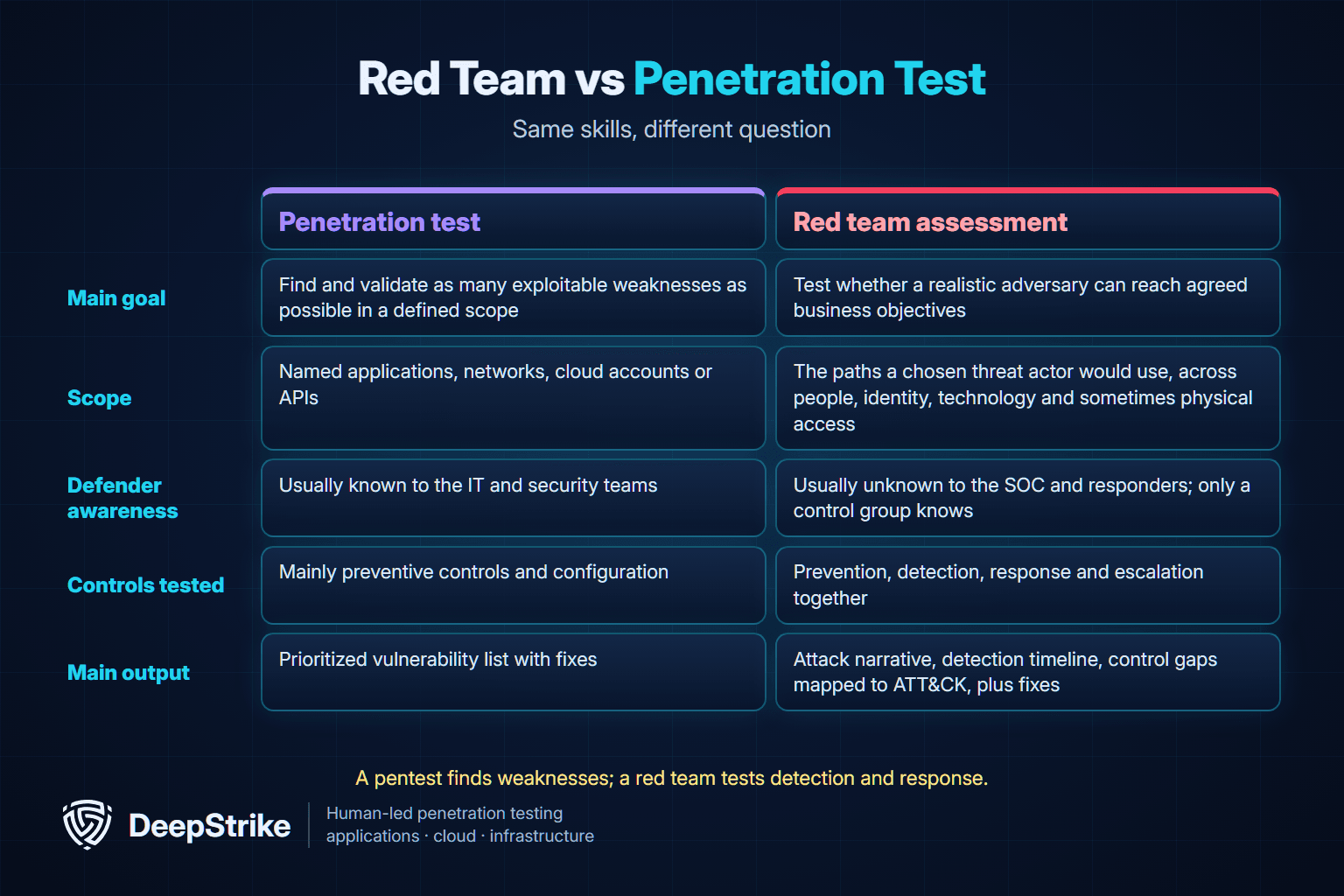
Neither test is better in general. A penetration test is the right tool for finding and fixing weaknesses in a specific system before release or for a compliance requirement. A red team is the right tool once the basics are under control and you need to know whether your monitoring and response would catch a real intrusion. For the full picture of how a scoped test works, see what penetration testing is and our penetration testing methodology guide.
Two adjacent practices are often confused with red teaming:
A red team engagement lives or dies on its planning documents. Three decisions shape everything that follows.
1. The objectives. Objectives should describe business impact, not technical tricks. "Obtain domain administrator rights" is a milestone; "Approve a fraudulent payment in the treasury system" or "Read the board's mergers and acquisitions folder" is an objective a business leader understands. Most engagements set two to four objectives tied to critical systems or data.
2. The threat profile. The scenario names a realistic adversary: a financially motivated ransomware affiliate, a state-aligned group targeting your sector, a compromised supplier or a malicious insider. Threat intelligence about that actor's known behavior decides which entry points and techniques the team will use, which keeps the test grounded in real risk instead of the testers' favorite tools.
3. The rules of engagement (ROE). The ROE is the signed agreement that makes the exercise safe and legal. It should answer at least the following questions.
| ROE element | What to agree in writing |
|---|---|
| Authorization | Who approved the test, on behalf of which legal entity, and which third-party systems need their own permission (for example, cloud or SaaS providers) |
| Objectives and flags | The exact targets that count as success and how the team proves it reached them |
| In-scope and out-of-scope | Domains, IP ranges, cloud tenants, offices and people that may or may not be targeted |
| Permitted techniques | Whether social engineering, physical access, wireless, password attacks or custom tooling are allowed |
| Prohibited actions | No destructive actions, no real data exfiltration outside agreed test data, no denial of service, no access to personal data beyond what proves the objective |
| Control team | Named contacts who know about the test, how to reach them at any hour and who can pause or stop it |
| Deconfliction | How the control team confirms whether suspicious activity is the red team or a real attacker |
| Stop conditions | Events that halt testing immediately, such as instability in a production system or discovery of a real compromise |
| Leg-ups | Pre-agreed help (for example, a test account or network access) the control team can grant if the team is stuck, so time is not wasted |
| Data handling | How credentials, screenshots and logs are stored, encrypted and destroyed after the report |
| Communication | Status meeting cadence and the secure channel used for updates |
The deconfliction and stop conditions matter more than they appear. If the SOC escalates a real incident during the test, the control team must be able to confirm within minutes whether the activity is the red team, so a genuine attack is never dismissed as "just the exercise."
Every provider names its phases differently, but a well-run engagement moves through the same seven stages. The descriptions below explain what happens and what each stage tells defenders. They are deliberately non-operational: the specific techniques depend on the agreed threat profile and must stay inside the ROE.
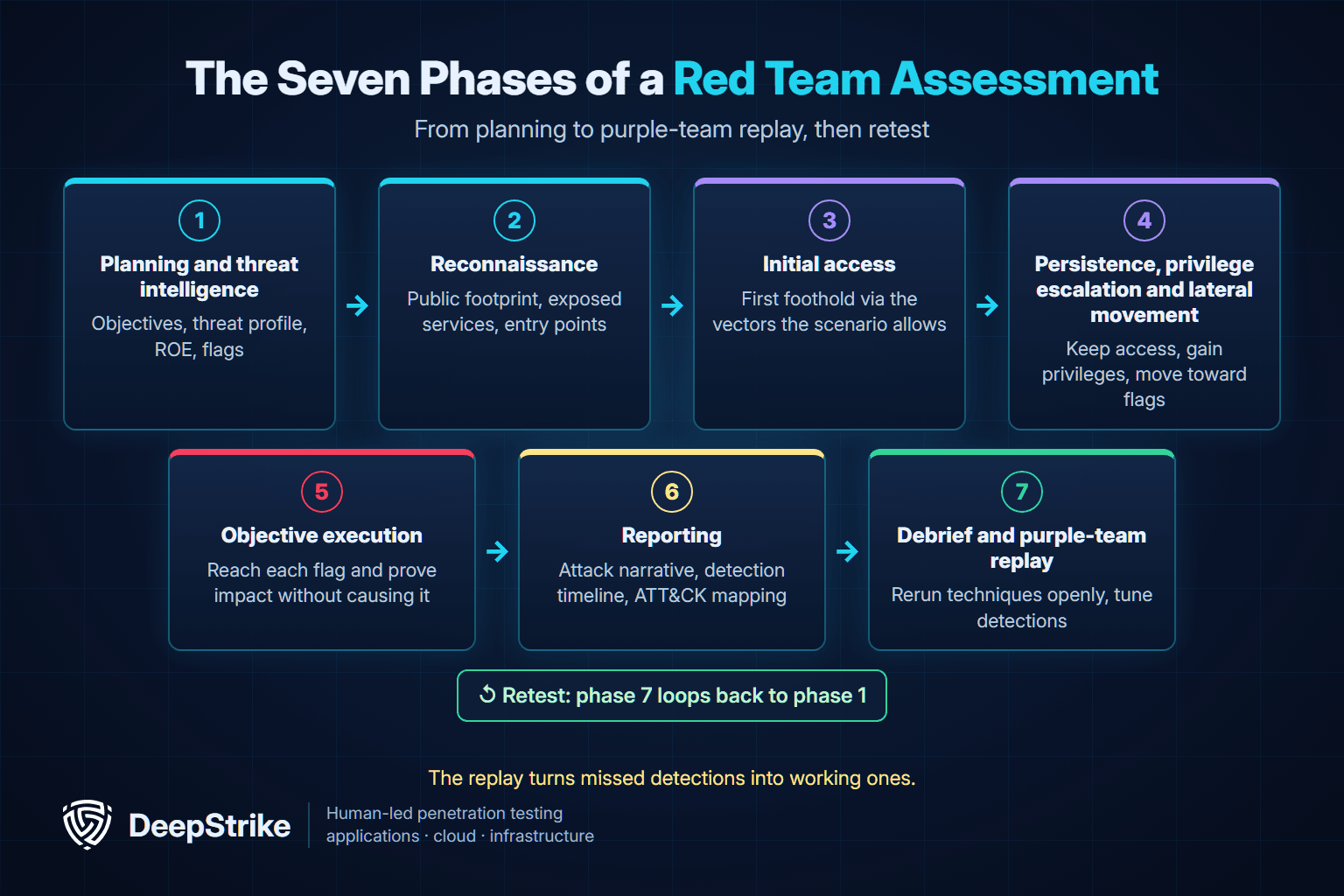
The control team and the red team agree on objectives, the threat profile, the ROE and the timeline. Threat intelligence on the chosen adversary feeds attack scenarios, and the organization's critical systems are mapped to flags. In regulated programs such as TIBER-EU, a separate threat intelligence provider writes a targeted threat intelligence report before testing begins.
The team gathers information the way a real attacker would: public employee data, exposed services, domain records, leaked credentials, technology stack clues and third-party relationships. Much of this is passive and leaves no trace on your systems.
The team attempts to gain a first foothold using the entry vectors the scenario allows. Common routes include phishing or other social engineering, exploitation of an internet-facing application or VPN, abuse of weak or reused credentials and, when approved, physical or wireless access. If a full external breach is not the point, the engagement may start from an assumed breach, where the control team provides a foothold that simulates a compromised laptop or account.
When the goal is to test people and processes rather than reach a business objective, a scoped social engineering penetration test is the better fit.
From the foothold, the team tries to keep access, gain higher privileges and move toward the systems that hold the objectives. This is where identity weaknesses, flat networks, exposed credentials and over-permissive trust relationships usually show up. The team moves deliberately and quietly, because the point is to measure whether endpoint detection, identity monitoring and the SOC notice it.
The team attempts to reach each flag and prove it, for example by reading a marker file in a restricted share, creating a harmless record in a financial system or taking a screenshot of an administrative console. Proof should demonstrate impact without causing it: no real payments, no destructive actions and no bulk copying of sensitive data.
The report should read as a story, not a list. It explains the scenario, the path the team took, every point where defenders had a chance to detect or stop the attack, what they saw and what they missed. Technical appendices give reproducible evidence and fixes. A strong red team report includes:
Our penetration testing report guide covers report structure, severity and evidence standards that also apply here.
The most valuable hours of a red team often come after it ends. In a replay, the red team walks the blue team through the attack step by step, so defenders can find the logs and telemetry they missed. In the purple-team session that follows, both teams rerun selected techniques in the open, tune detections and confirm that new alerts fire. TIBER-EU now makes this purple-team step mandatory, and many organizations treat it as the point where the investment turns into lasting detection improvements.
Our purple teaming guide shows how to plan and score that session.
Many teams replay the red team's attack path as a tabletop exercise for executives.
MITRE ATT&CK is the shared vocabulary that makes red team results comparable and actionable. MITRE describes it as a knowledge base of adversary tactics and techniques based on real-world observations. As of ATT&CK v20, released on October 13, 2026, the Enterprise matrix lists 15 tactics, from Reconnaissance (TA0043) and Initial Access (TA0001) through Lateral Movement (TA0008), Exfiltration (TA0010) and Impact (TA0040). Older guides refer to TA0005 as Defense Evasion; the current matrix names TA0005 Stealth and lists Defense Impairment (TA0112) as a separate tactic, so check which version a report uses before comparing results.
ATT&CK helps a red team engagement in three places:
For a side-by-side look at Cobalt Strike, Sliver, Mythic, Havoc, Caldera and Atomic Red Team, see our comparison of red team and C2 tools.
A simple way to turn ATT&CK mapping into a decision tool is to score each technique the team used on a four-level outcome. The table below is an illustrative example, not data from a real engagement.
| Tactic | Technique used in the scenario | Prevented | Alerted | Investigated | Missed |
|---|---|---|---|---|---|
| Initial Access | Spearphishing link (T1566.002) | No | Yes | No | Alert closed as benign |
| Credential Access | Credentials in files (T1552.001) | No | No | No | Yes |
| Lateral Movement | Remote services (T1021) | No | No | No | Yes |
| Collection | Data from network shared drive (T1039) | No | Yes | Yes | Contained after objective reached |
Read across a table like this and the priorities become obvious: the organization had telemetry for two steps, but only one alert was investigated, and nothing watched credential use or remote logons. Those gaps, not the individual vulnerabilities, are what a red team is designed to expose.
Public red team results are rare, but the US Cybersecurity and Infrastructure Security Agency (CISA) has published two detailed advisories that show what these assessments reveal.
In advisory AA23-059A, published February 28, 2023, CISA described a three-month red team assessment of a large critical infrastructure organization. The team gained initial access through spearphishing, compromised the domain and reached systems adjacent to sensitive business systems. CISA reported that the organization did not detect the red team's activity during the assessment, even when the team tried to trigger a response. Contributing issues included plaintext credentials in scripts and backups, standard users with local administrator rights on critical servers and a domain key account password that had not been changed in over a decade.
In advisory AA24-193A, published July 11, 2024, CISA described a no-notice assessment of a federal civilian agency that ran for about eight months in 2023, including three months of collaboration with defenders. The team entered through an unpatched public-facing web server and through phishing, then reached full domain compromise. CISA highlighted weak segmentation, unrestricted outbound traffic, unmanaged service accounts and a detection approach that relied on known indicators of compromise, which let the team's varied tools and behaviors go largely unnoticed.
Both advisories map the activity to MITRE ATT&CK and recommend continuously testing security controls against those techniques. The lesson for any organization is the same: vulnerabilities opened the door, but missing detection, weak identity hygiene and flat networks decided how far the attacker got.
In the European financial sector, red teaming is regulated. The EU Digital Operational Resilience Act (DORA) requires financial entities designated by their authorities to carry out threat-led penetration testing (TLPT) at least every three years. Under Article 26, each TLPT covers several or all critical or important functions and runs on live production systems. When an entity uses internal testers, it must contract external testers every third test. The detailed rules sit in the TLPT regulatory technical standards, Commission Delegated Regulation (EU) 2025/1190.
The European Central Bank's TIBER-EU framework is the reference method for this kind of intelligence-led red teaming. The Eurosystem published an update on February 11, 2025, aligning TIBER-EU with the DORA TLPT standards, making purple teaming mandatory and renaming the white team the control team. The January 2025 framework document sets out a structure worth copying even outside regulated testing:
| TIBER-EU phase | What happens | Timing in the framework |
|---|---|---|
| Preparation | Notification, initiation, scoping of critical functions and flags, procurement of the threat intelligence provider and red team | No longer than six months from the start of the test |
| Testing: threat intelligence | Targeted threat intelligence report and attack scenarios | Indicative four to six weeks |
| Testing: red team | Red team test plan, then active testing against the flags | Indicative two to three weeks of planning, then a minimum of 12 weeks of active testing |
| Closure | Red team and blue team reports, replay, purple teaming, test summary, remediation plan and attestation | Reports, replay and purple teaming within about 10 weeks; summary and remediation plan within a further 8 weeks |
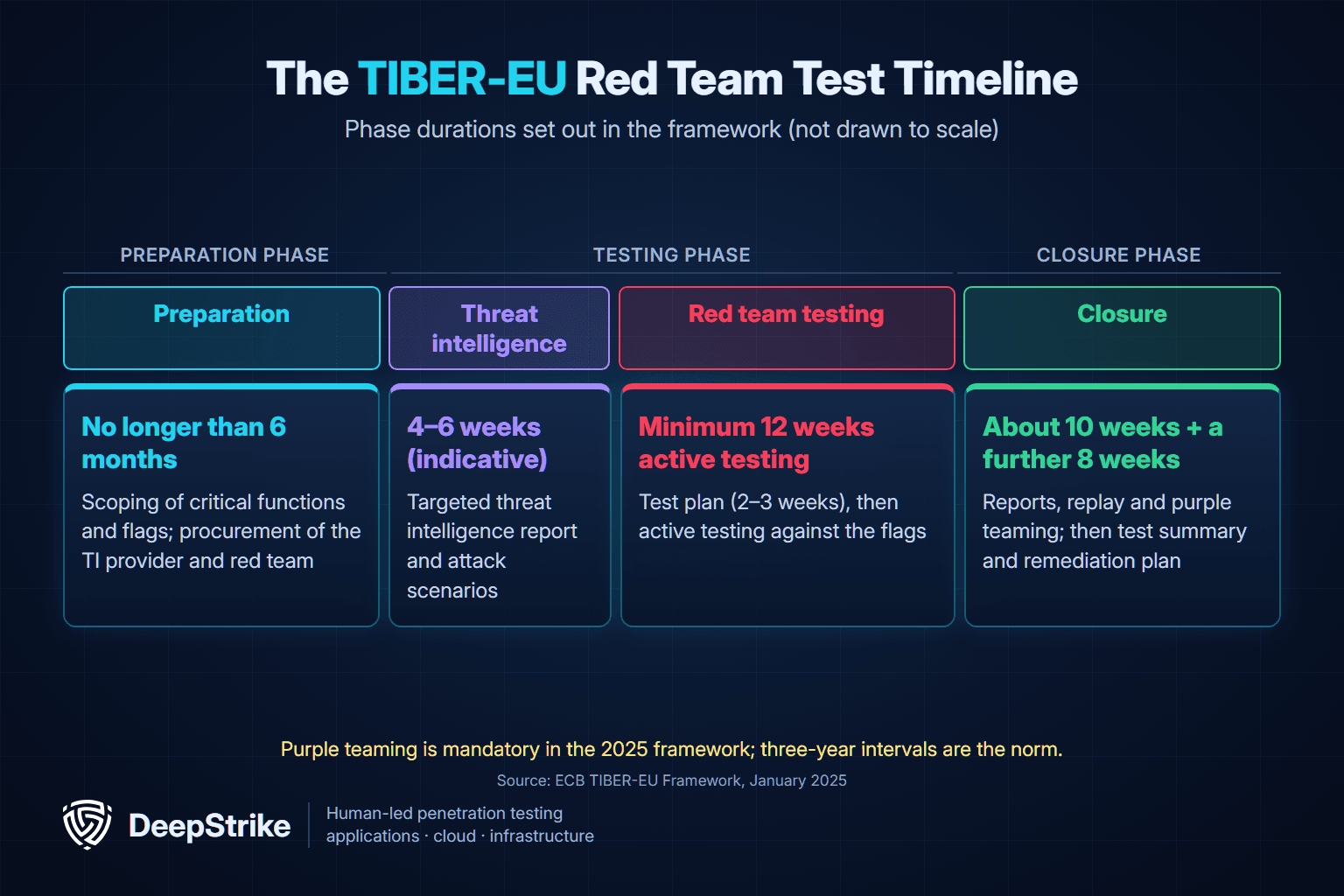
Two details from TIBER-EU are useful for any red team program. First, the framework notes that, because of the resources and costs involved, tests are not expected too often, with three-year intervals as the norm. Second, the red team report must record flags reached and not reached, attack paths and TTPs that worked and failed, deviations from the plan and any leg-ups granted. That is a strong template for any red team report. For the full framework walkthrough, read our guide to the TIBER-EU framework, and for who must comply and how, see DORA penetration testing and TLPT requirements.
Not every organization needs a full-scope, multi-month campaign. The engagement type should match the question you want answered.
| Engagement type | Starting point | Best for |
|---|---|---|
| Full-scope external | No access; the team must breach the perimeter | Testing the whole chain from initial access to objective |
| Assumed breach | A provided foothold, such as a standard user laptop or account | Focusing budget on internal detection, identity and lateral movement |
| Insider threat | Credentials and access of a specific role | Testing data access controls and monitoring of privileged users |
| Social engineering and physical | Phone, email or in-person pretexts and site access, when approved | Testing staff reporting, reception processes and physical controls |
| Cloud and SaaS focused | Cloud identities, control planes and SaaS tenants | Organizations whose crown jewels live mostly in AWS, Azure, GCP or SaaS platforms |
| AI red teaming | AI models, agents and the applications built on them | Testing prompt injection, data leakage and unsafe agent actions |
For AI models, agents and LLM applications, see our LLM and AI penetration testing service.
An assumed-breach engagement is often the most efficient first red team for organizations with mature perimeter controls, because the hardest and most uncertain step, initial access, is replaced by a realistic starting point and the testing time goes into the internal detection questions that matter most.
Red team pricing is almost always quoted per engagement, and the range is wide because the work varies so much. Rather than a price list, these are the factors that move the scope and effort up or down. Use them to compare proposals on a like-for-like basis.
When comparing quotes, ask each provider which of these factors its proposal assumes. Two proposals with very different totals often describe very different engagements. For broader context on how security testing is priced, see our guide to penetration testing cost, and for how to compare providers, our list of red team service providers.
Red teaming delivers the most value once an organization can act on what it finds. Running one too early usually produces a long list of basic issues that a penetration test would have found faster and for less effort.
Use this readiness check before commissioning a red team. If you answer "no" to several questions, start with penetration testing and fix the basics first.
| Situation | Better choice | Why |
|---|---|---|
| New application or major release | Penetration test | You need broad coverage of a specific system |
| Compliance requirement names a penetration test | Penetration test | Meets the stated control directly |
| Mature controls, untested detection | Red team | Measures whether the SOC catches a real attacker |
| Recent breach in your sector by a known group | Red team with that threat profile | Tests your defenses against that adversary's methods |
| Designated under DORA Article 26 | TLPT using TIBER-EU or the national framework | It is a legal requirement for those entities |
| Detections exist but have never been validated | Purple team, then red team | Tune the detections in the open, then test them under realistic conditions |
Many organizations combine the two: annual penetration tests on critical applications and infrastructure, and a red team every one to three years to check that detection and response keep pace. A clear penetration testing scope helps decide which assets belong in which test.
The main purpose is to test whether an organization can prevent, detect and respond to a realistic attack on the things that matter most. A red team measures the whole defense, including people and processes, rather than producing a complete list of vulnerabilities.
It depends on objectives, scope and stealth. Commercial engagements commonly run for several weeks to a few months. The two CISA assessments described above ran for about three months and about eight months. Under TIBER-EU, active red team testing alone lasts at least 12 weeks, plus preparation and closure.
Yes, when it is authorized. A red team works under signed rules of engagement from someone with the authority to approve testing of the systems, people and premises involved, plus any required permission from third-party providers. Without that authorization, the same actions would be illegal.
Usually not. Only a small control team knows about the test, so the SOC and responders react as they would to a real incident. The control team handles deconfliction and can stop the test if needed.
Red teaming is a covert test of defenses. Purple teaming is an open, collaborative session where the red and blue teams run techniques together and tune detections in real time. Purple teaming usually follows a red team engagement to turn its findings into working detections.
No. Penetration tests find and fix weaknesses across a defined scope; red teams test detection and response against a realistic attacker. Most mature programs run both, with penetration tests more often and red teams less often.
AI red teaming applies the same adversarial approach to AI models, agents and the applications built on them. It tests for issues such as prompt injection, sensitive data leakage and unsafe autonomous actions, and it complements, rather than replaces, testing of the surrounding infrastructure.
Our AI red teaming guide walks through the full method, from harm taxonomy to regression testing.
Red teaming is worth the effort when it is built around clear objectives, a realistic threat profile and rules of engagement that keep production safe, and when it ends with a replay that turns missed detections into working ones. If your controls are mature and you want to know whether your team would catch a capable attacker, start by writing down the objectives and the adversary you are most worried about.
DeepStrike's red teaming services cover objective-driven campaigns across people, identity, cloud, applications and internal networks, with detection validation and a debrief that prioritizes fixes. To discuss scope, objectives and rules of engagement, contact DeepStrike.
Mohammed Khalil is a Cybersecurity Architect at DeepStrike, specializing in advanced penetration testing and offensive security operations. With certifications including CISSP, OSCP, and OSWE, he has led numerous red team engagements for Fortune 500 companies, focusing on cloud security, application vulnerabilities, and adversary emulation. His work involves dissecting complex attack chains and developing resilient defense strategies for clients in the finance, healthcare, and technology sectors.

Stay secure with DeepStrike penetration testing services. Reach out for a quote or customized technical proposal today
Contact Us
