February 9, 2025
Updated: November 5, 2026
Top Penetration Testing Tools You Should Know

Mohammed Khalil

Penetration testing (or pen testing) is a cybersecurity practice used to identify and fix security weaknesses before attackers can exploit them. Security professionals use various tools to scan, analyze, and attack systems to uncover vulnerabilities.
Below is a list of some of the most important penetration testing tools, along with explanations of their functions and how they are used.
The first 12 tools cover most network, web, wireless and password testing. If you are planning a red team engagement rather than a scoped pentest, skip to the "Red Team and C2 Tools" section at the end, which compares Cobalt Strike, Sliver, Mythic, Havoc, Caldera and Atomic Red Team.

Metasploit is one of the most widely used penetration testing frameworks. It provides a collection of exploits, payloads, and tools that security testers use to simulate real-world cyberattacks. It allows ethical hackers to test system security by identifying weaknesses in operating systems, applications, and networks.
Key features of Metasploit include:
Metasploit is mainly used for network security testing and penetration testing training.

Nmap is a powerful open-source network scanning tool used to discover devices and analyze network security. It helps penetration testers understand the structure of a network by identifying hosts, services, and open ports.
How it works:
Nmap is widely used for reconnaissance and mapping out networks before launching an attack simulation.

Wireshark is a network traffic analysis tool that captures data packets from live networks and displays them in a human-readable format. It helps penetration testers inspect network activity to find security weaknesses, such as unencrypted passwords or suspicious traffic patterns.
Main uses of Wireshark:
Wireshark is useful for analyzing man-in-the-middle attacks, sniffing unencrypted credentials, and detecting unusual network behavior.
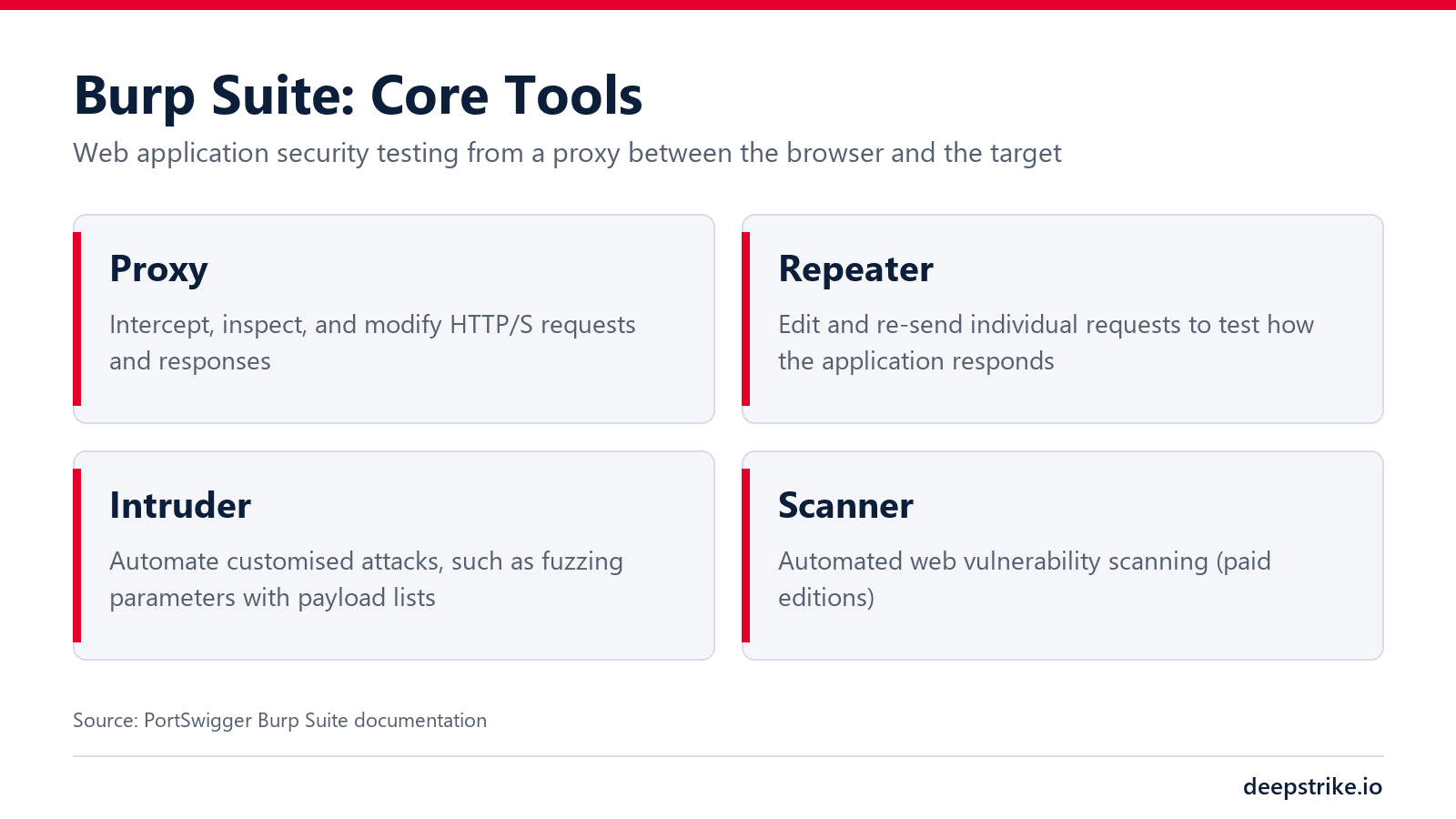
Burp Suite is a popular tool for testing web application security. It acts as a proxy between the tester's browser and the target application, allowing them to intercept and modify requests and responses.
Burp Suite is widely used for:
It is commonly used by ethical hackers and bug bounty hunters to assess web application security.

John the Ripper is a password-cracking tool that helps penetration testers evaluate the strength of user passwords. It cracks password hashes offline using wordlist, rule-based and incremental (brute-force) modes.
Features of John the Ripper:
This tool is useful for checking if users are using weak passwords and helping organizations improve their password security policies.

Aircrack-ng is a set of tools designed for testing the security of wireless networks. It can capture and analyze Wi-Fi packets, allowing testers to recover WEP keys and test WPA/WPA2-PSK passphrases against a wordlist using a captured handshake.
How Aircrack-ng works:
It is widely used for Wi-Fi security auditing to check whether wireless networks are configured securely.

Hydra is a fast, brute-force password-cracking tool that can attack multiple protocols, such as SSH, FTP, HTTP, and more. It is often used to test how easily an attacker can gain unauthorized access to systems protected by weak passwords.
Hydra can:
This tool is useful for testing login security and checking whether password policies are effective.

SQLmap is a specialized tool for detecting and exploiting SQL injection vulnerabilities in web applications. It automates the process of finding weak database queries that hackers can manipulate.
SQLmap can:
It is widely used for database security assessments and helps organizations secure their web applications from SQL-based attacks.

Nessus is a vulnerability scanner that helps security professionals find weaknesses in systems, applications, and networks. It scans devices and provides detailed reports on potential security risks.
Nessus is useful for:
It is widely used in corporate security testing to find weaknesses that need fixing.
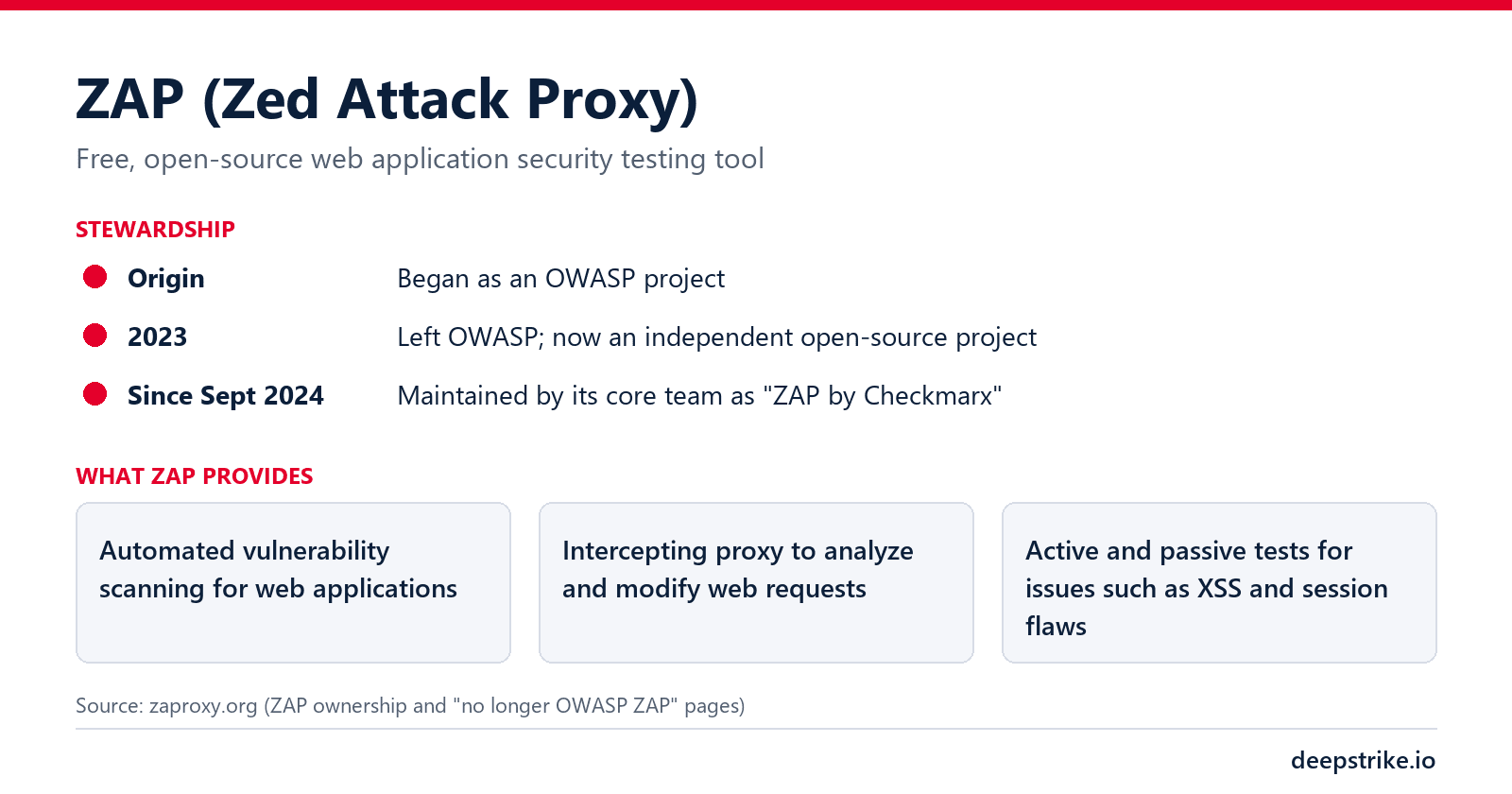
ZAP (Zed Attack Proxy) is a free, open-source web application security testing tool. It began as an OWASP project, left OWASP in 2023, and has been maintained by its core team as “ZAP by Checkmarx” since September 2024. It is designed for automated scanning and manual security testing of web applications.
ZAP provides:
It is a great tool for beginners and advanced penetration testers who want to improve the security of web applications.

Acunetix is an automated security scanner that tests websites and web applications for vulnerabilities. It helps businesses detect security flaws before attackers exploit them.
Features of Acunetix:
It is commonly used by organizations to strengthen the security of their web applications.

Cobalt Strike is a threat emulation tool used by penetration testers and red teams to simulate advanced cyberattacks. Unlike traditional penetration testing tools, Cobalt Strike focuses on post-exploitation, persistence, and command and control (C2) operations.
Key Features of Cobalt Strike:
Cobalt Strike is often used by advanced security teams to test an organization's defense systems against sophisticated cyber threats. It is also a popular tool among ethical hackers for testing how well security teams can detect and respond to cyber intrusions.
The tools above find and prove individual weaknesses. A red team engagement asks a different question: could a realistic attacker reach an agreed objective, such as domain admin or a payment system, and would your defenders notice? Answering it takes tools that keep controlled access to test systems over days or weeks and let a team of operators work together. If you are new to the practice, start with what red teaming is and how an engagement runs.
Red team tools fall into two families. Command and control (C2) frameworks give operators a team server that manages implants on in-scope hosts; MITRE groups this behavior under the Command and Control tactic (TA0011). Automated emulation platforms and test libraries run known attacker techniques on purpose, usually so the blue team can check whether each one is detected. Every tool below is dual-use, so it belongs only in engagements with written authorization, an agreed scope and rules of engagement.
| Tool | Type | License | Maintainer | Best for in authorized work | ATT&CK entry |
|---|---|---|---|---|---|
| Cobalt Strike | Commercial C2 framework | Commercial license | Fortra | Covert, full-scope red team engagements with several operators | S0154 |
| Sliver | Open-source C2 framework | GPLv3 | Bishop Fox | Cross-platform implants over mTLS, WireGuard, HTTP(S) or DNS | S0633 |
| Mythic | Open-source C2 platform | BSD 3-Clause | Cody Thomas; sponsored by SpecterOps | Plug-in agents and C2 profiles; collaborative operations and reporting | S0699 |
| Havoc | Open-source C2 framework (archived) | GPLv3 | C5pider (Paul Ungur) | Lab detection testing against a framework attackers use | S1229 |
| Caldera | Automated adversary emulation platform | Apache 2.0 | MITRE; Apache Incubator | Repeatable, automated ATT&CK operations and purple teaming | None (emulation platform) |
| Atomic Red Team | Library of single-technique tests | MIT | Red Canary and community | Checking one detection at a time | None (test library) |
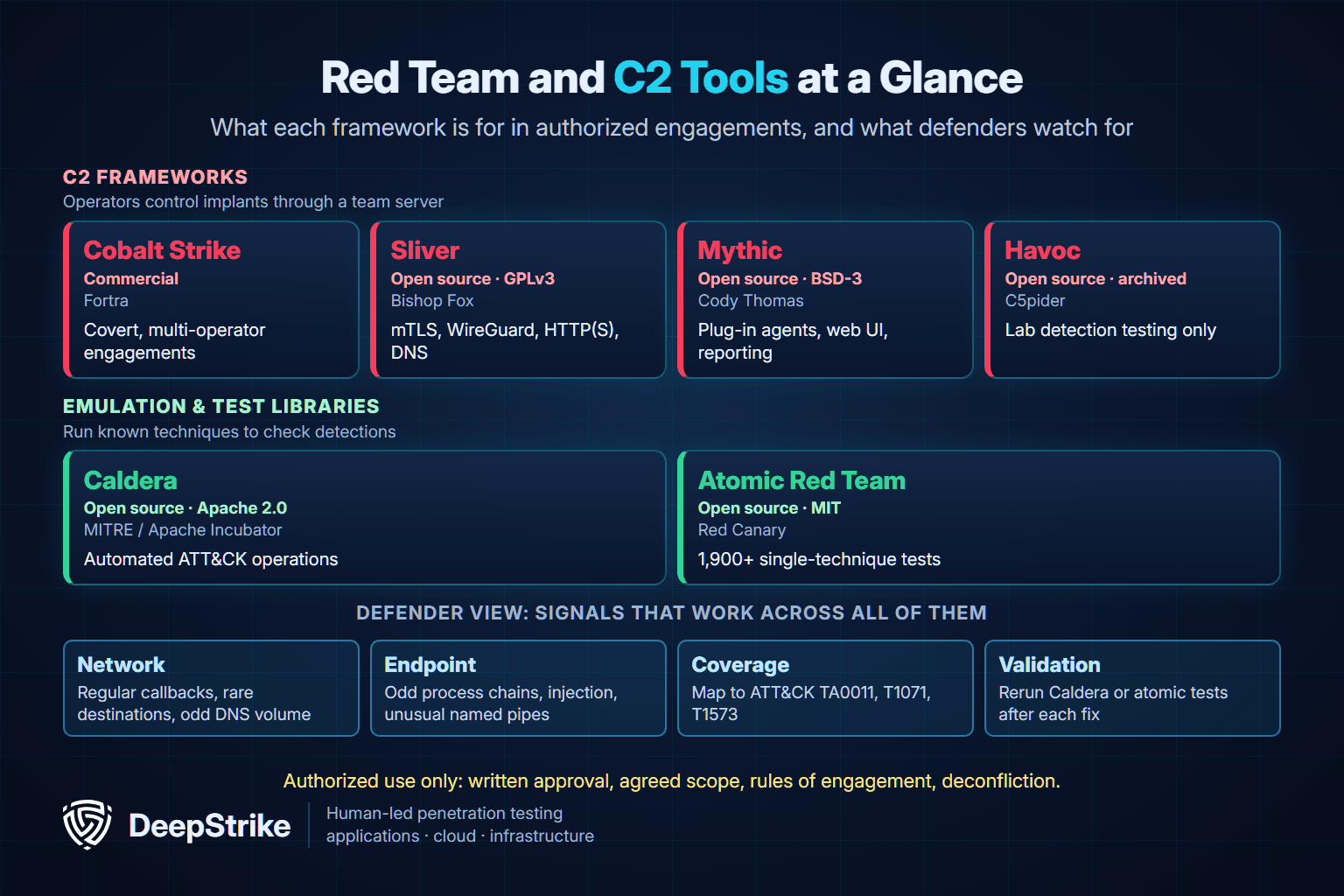
Cobalt Strike, profiled as tool 12 above, is the commercial benchmark for red team C2. It is licensed by Fortra and built for covert, full-scope engagements in which several operators share one team server. It is also the most abused tool on this list: MITRE ATT&CK lists about 30 threat groups that have used it in its Cobalt Strike entry (S0154), mostly with cracked, unlicensed copies.
Two legal and law enforcement actions show the scale of the abuse. On March 31, 2023, a US federal court let Microsoft, Fortra and Health-ISAC disrupt infrastructure running cracked, legacy copies, which Microsoft linked to more than 68 ransomware attacks on healthcare organizations in more than 19 countries. From June 24 to 28, 2024, Europol coordinated Operation Morpheus, led by the UK National Crime Agency: 690 IP addresses were flagged to providers in 27 countries, and 593 had been taken down by the end of the week.
Detection notes: because criminals use it so often, Cobalt Strike is the C2 framework most defenders already have content for. Look for regular "beacon" callbacks to rare destinations over HTTP(S) or DNS, process injection (T1055) into common Windows processes, and unusual named pipes used for host-to-host communication. A legitimate engagement should be deconflicted in advance, so the SOC can tell the red team from a real intrusion.
Sliver is an open-source, cross-platform adversary emulation framework written in Go and released under GPLv3 by the security firm Bishop Fox. Its implants run on Windows, macOS and Linux and communicate over mutual TLS, WireGuard, HTTP(S) or DNS. Teams pick it as a maintained, no-license-cost alternative to Cobalt Strike for authorized engagements; release v1.7.9 shipped on October 25, 2026.
Detection notes: each Sliver implant is compiled with its own encryption keys, so file hashes from one engagement rarely match another; detect on behavior instead. ATT&CK documents use of Sliver by groups including APT29 in its Sliver entry (S0633). Useful signals include large Go binaries running from user-writable paths, high volumes of DNS queries to a single domain, and long-lived TLS sessions to hosts with no business purpose.
Mythic is a collaborative, cross-platform red team platform created by Cody Thomas, sponsored by SpecterOps and released under the BSD 3-Clause license. It runs as a set of Docker containers with a web interface. Agents and C2 profiles are installed separately, so one Mythic server can drive agents written for different operating systems and channels. Its operation logs and ATT&CK mapping make it popular when an engagement needs clear reporting.
Detection notes: because Mythic is agent-agnostic, what defenders see depends on the agent and C2 profile in use, so focus on generic C2 behavior rather than one signature. ATT&CK notes in its Mythic entry (S0699) that deployed Mythic servers have been observed in potentially malicious infrastructure, which makes Mythic worth including in threat-hunting and detection tests.
Havoc is an open-source post-exploitation C2 framework released in October 2022 by C5pider (Paul Ungur) under GPLv3. It combines a Qt desktop client, a Go team server and a Windows agent called Demon. As of November 2026 the GitHub repository is archived (read-only), so it no longer receives fixes. That makes it a poor default for client engagements, where you want a maintained tool.
Detection notes: Havoc still matters to defenders. ATT&CK reports in its Havoc entry (S1229) that multiple threat actors have adopted it. Its agent is built to run mostly in memory and to frustrate endpoint tools, so memory scanning and behavior analytics matter more than file signatures. Running Havoc in an isolated lab is a reasonable way to check that your EDR and network monitoring catch it.
Caldera is an automated adversary emulation platform built on MITRE ATT&CK by MITRE, released under the Apache 2.0 license and now developed in the Apache Incubator (it entered incubation in December 2025). It chains ATT&CK techniques into automated operations through plugins, including emulation plans and Atomic Red Team tests. Teams use it for repeatable exercises, purple teaming and continuous security validation, where the same operation is rerun after each detection change.
Detection notes: Caldera is a validation tool, so the "detection" question is about your results, not the tool. Record which techniques produced alerts, which only produced logs and which left no trace, then rerun the operation after you tune the gaps. Tag test hosts and time windows so analysts do not escalate planned activity as a real incident.
Atomic Red Team is an MIT-licensed library of small, portable tests maintained by Red Canary and its community. Each "atomic" exercises one ATT&CK technique, and the project lists more than 1,900 tests. It is not a C2 framework; it is the fastest way to check whether a single detection fires. Many teams start purple team work with it before moving to full emulation, as covered in our purple teaming guide.
Detection notes: run atomics in a lab or on agreed test hosts with the SOC informed, review each test before use, and run the matching cleanup afterward. Pair each test with a written expected result, such as "EDR alert within five minutes", so a pass or fail is objective.
The same frameworks that red teams use appear in real intrusions, so detection work pays off twice. These practices apply to every tool above:
The right framework depends on the engagement, not on popularity. Commercial C2 brings vendor support and licensing controls; open-source C2 such as Sliver or Mythic brings transparency and no license fee but needs in-house expertise to run safely. Whatever you choose, agree on written authorization, scope, rules of engagement, a deconfliction contact (often called the white team), how test data is protected and how every implant and account is removed at the end. Our comparison of red team vs blue team vs purple team explains who does what during the exercise.
If you would rather not build and run this tooling in-house, DeepStrike's red teaming services run objective-driven adversary emulation engagements, and our list of red team service providers can help you compare options.
Penetration testing tools help security professionals identify and fix vulnerabilities before attackers can exploit them. Each tool has a specific purpose, from scanning networks to analyzing web applications and cracking passwords.
Using these tools ethically and legally is important. They should only be used with permission to avoid violating cybersecurity laws.

Stay secure with DeepStrike penetration testing services. Reach out for a quote or customized technical proposal today
Contact Us
