November 4, 2026
Updated: November 4, 2026
Phishing, vishing and physical tests explained: approvals, consent and pretext limits, click and report rates read without blame, physical safety and reporting.

Mohammed Khalil
Social engineering penetration testing is an authorized assessment of how well your people, processes and supporting controls resist manipulation. Testers run realistic but controlled phishing, phone (vishing), text message and, when approved, physical scenarios, then measure who reported the attempt, how quickly the security team responded and which business processes let the attempt succeed. A well-run test needs written approval from leadership, legal and HR, strict limits on the pretexts used and anonymized reporting. Its purpose is to fix verification steps and technical controls, not to single out the employees who clicked.
NIST's Technical Guide to Information Security Testing and Assessment, SP 800-115, describes social engineering as an attempt to trick someone into revealing information, such as a password, that can be used to attack systems. NIST lists it as a validation technique that tests "the human element and user awareness of security" and can reveal weaknesses such as failing to follow standard procedures. The same section adds a rule that still defines good practice: results should be used to improve the security of the organization and not to single out individuals.
A social engineering penetration test (also called a social engineering assessment or social engineering test) applies that idea in a scoped engagement. It answers practical questions:
The threat is real and persistent. The 2026 Verizon Data Breach Investigations Report found a non-malicious human element in 62% of breaches, named social engineering the third most common breach pattern at 16% of breaches, and reported that pretexting reached 6% of all breaches. For the full threat data, see our roundups of social engineering attack statistics, phishing statistics, vishing statistics and smishing statistics. This guide focuses on how to test your exposure safely and fairly.
Three activities are often confused. They overlap in technique but answer different questions.
| Criterion | Phishing simulation program | Social engineering penetration test | Red team assessment |
|---|---|---|---|
| Main question | Are reporting habits improving over time? | Which people-facing processes and controls fail against realistic manipulation right now? | Can a realistic adversary reach a business objective before defenders notice? |
| Who runs it | Usually the internal awareness team with a platform | Independent testers under a signed scope | Independent red team under rules of engagement |
| Channels | Mostly email, sometimes SMS | Email, voice, SMS and QR, physical and baiting, as scoped | Any vector the threat profile uses, including social engineering |
| Frequency | Recurring, often monthly or quarterly | Point in time, often yearly or after major process changes | Every one to three years in mature programs |
| Main output | Trend of report and click rates | Findings on processes and controls, with evidence and fixes | Attack narrative, detection timeline and control gaps |
A recurring phishing program builds habits. A social engineering penetration test is an independent check that also covers the channels and processes a phishing platform does not reach, such as the help desk's password reset procedure or the front desk's visitor checks. In a red team, social engineering is usually just the entry point to a larger objective; our guide to what red teaming is explains how those campaigns work.
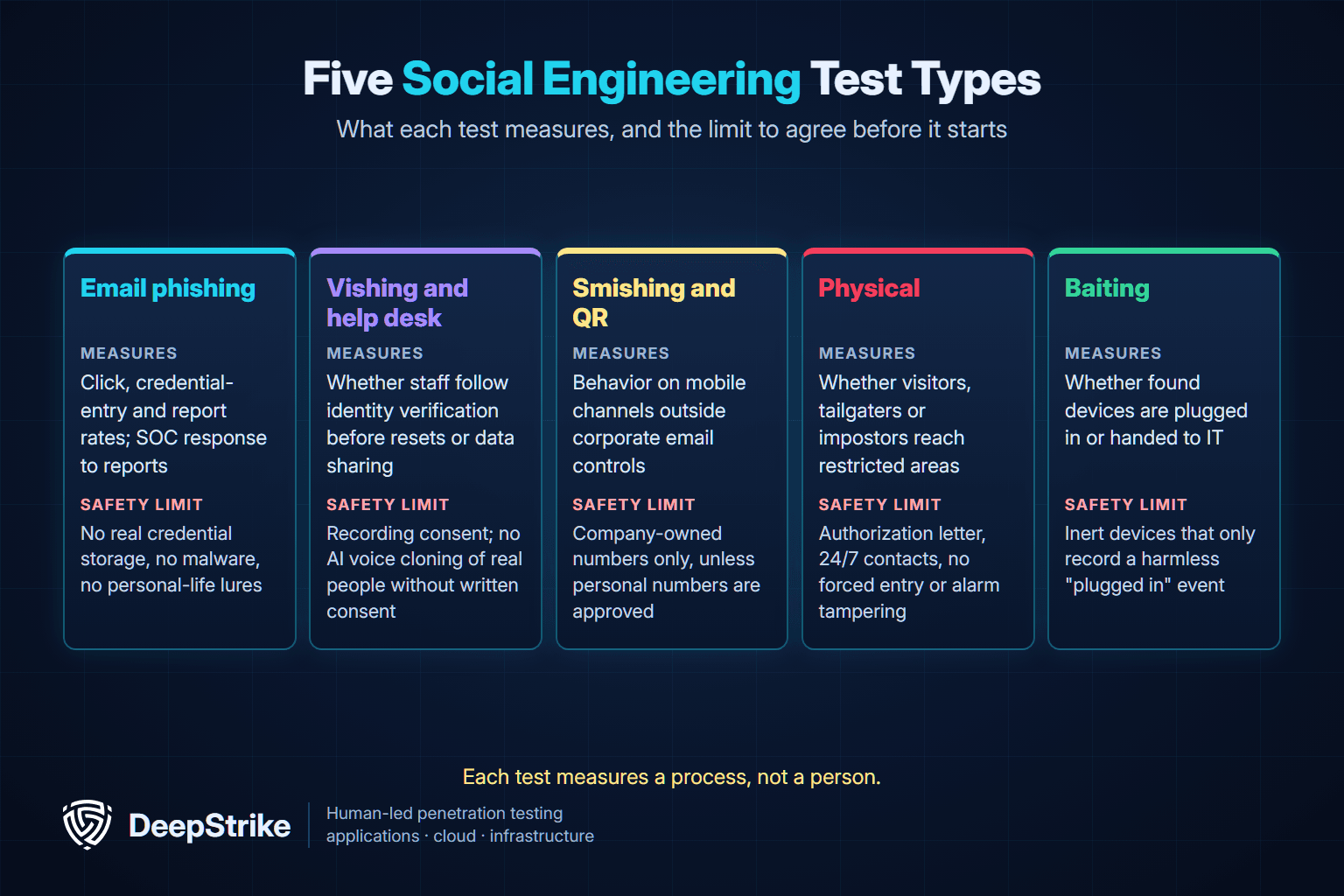
Most engagements combine two or three of the test types below. Choose them by your real exposure: a company whose help desk resets passwords by phone needs a vishing test more than a USB drop.
| Test type | What it measures | Main controls tested | Safety limit to agree up front |
|---|---|---|---|
| Email phishing assessment | Click, credential-entry and report rates; SOC response to reports | Email filtering, link protection, multifactor authentication, report button, triage | No real credential storage; no malware; no personal-life lures |
| Vishing (voice) and help desk test | Whether staff follow identity verification before resetting credentials or sharing data | Help desk verification, callback procedures, MFA reset policy | Recording consent; no AI voice cloning of real people without written consent |
| Smishing and QR phishing test | Behavior on mobile channels outside corporate email controls | Mobile device management, browser protection, reporting path for texts | Company-owned numbers only, unless personal numbers are explicitly approved |
| Physical penetration test | Whether visitors, tailgaters or impostors can reach restricted areas | Badge controls, reception procedures, staff challenge habits, guards | Authorization letter, 24/7 contacts, no forced entry or alarm tampering |
| Baiting (removable media) test | Whether found devices are plugged in or handed to IT | Device control, endpoint protection, reporting culture | Inert devices that only record a harmless "plugged in" event |
An email phishing assessment, often called a phishing simulation test, sends controlled lures to an agreed population and records what happens next. Testers describe lures by theme and difficulty, such as a document-sharing notice, a policy update or a delivery problem, and agree each theme with the control group before sending. A well-designed assessment also checks the defenders: how long it takes for the first report, whether the SOC pulls the remaining messages and whether anyone who entered a credential is contacted.
MITRE ATT&CK tracks the attacker side of this activity as Phishing (T1566) and, for information gathering, Phishing for Information (T1598). Mapping your test to those techniques makes results comparable with threat intelligence and with later red team work. For QR-code lures, our explainer on QR quishing covers why they slip past link scanning.
Voice tests check whether staff follow procedure when a caller sounds confident and urgent. The most valuable target is usually the IT help desk, because a password or multifactor reset given to the wrong person can hand over an account. ATT&CK added Spearphishing Voice (T1566.004) in 2023, and the 2026 DBIR notes that attackers impersonating help desk agents or users who need a password reset have had "moderate levels of success."
A good vishing test is scored against the written procedure, not against an agent's personality. If the procedure allows a reset after a caller gives a name and an employee ID, the finding belongs to the procedure. Pair this test with phishing-resistant authentication work; our article on MFA fatigue attacks shows how attackers combine calls with push-notification abuse.
Text-message and QR-code lures reach people on phones, where corporate email filtering and link rewriting often do not apply. The 2026 DBIR reports that in phishing simulations the median click rate for phone-centric vectors such as voice and text is about 2%, compared with 1.4% for email, a 40% relative increase. Verizon warns that the phone-centric sample is small, so treat the gap as a signal to test mobile channels, not as a precise benchmark.
Physical penetration testing checks whether someone without authorization can enter offices, data rooms or other restricted areas by tailgating, impersonating a contractor or visitor, or exploiting weak badge and reception processes. It carries the highest legal and personal-safety risk of any social engineering test, so it has its own section below.
Baiting tests leave removable media or other "found" items in common areas to see whether employees plug them in or hand them to IT. The device should do nothing except record that it was connected, so no data leaves a workstation and no code runs beyond that harmless signal. The most useful metric is how many devices were turned in or reported, not how many were connected.
Social engineering tests target people, so the rules of engagement (ROE) must protect them as well as the organization. The UK National Cyber Security Centre's phishing guidance warns that phishing simulations "can also create legal risk" and can erode trust between employees and security. Written approvals and firm limits are what keep a test from causing that harm.
| ROE element | What to agree in writing |
|---|---|
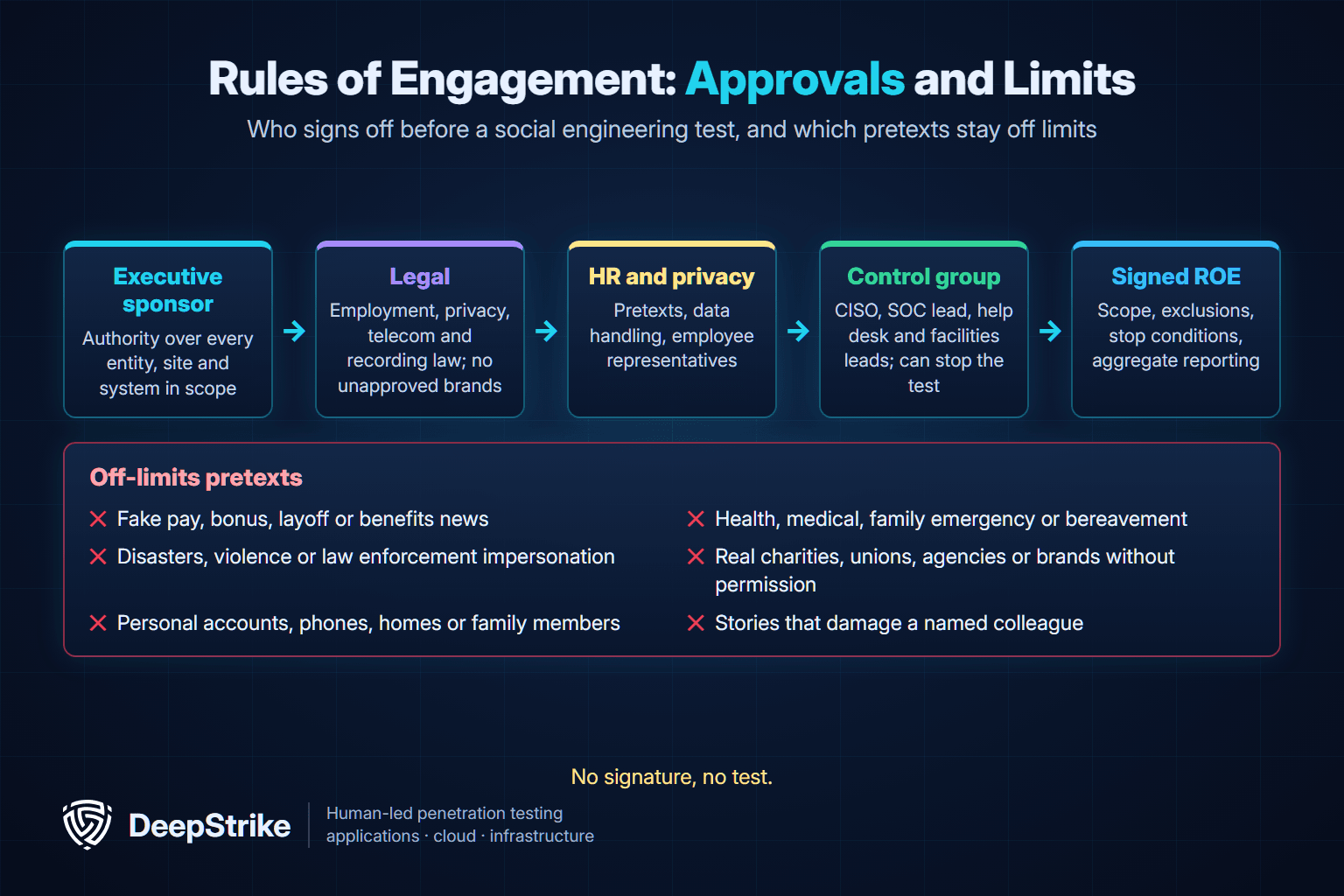
| Executive sponsor | A named leader with authority over every entity, site and system in scope signs the authorization |
| Legal review | Counsel confirms the scope fits employment, privacy, telecom and recording laws in each jurisdiction, and that third-party brands or platforms are not impersonated without permission |
| HR and employee representatives | HR approves pretexts and data handling; where works councils or unions exist, consult them as local law or agreements require |
| Privacy | What personal data testers may collect during open-source research, how it is stored and when it is destroyed |
| Control group | A small named group (for example the CISO, SOC lead, help desk manager and facilities lead) who know the test is running and can deconflict and stop it |
| Population and exclusions | Who is in scope, and who is excluded, such as people on leave, staff handling a crisis or recent victims of real fraud |
| Channels and timing | Which channels, business hours only or not, test window and blackout dates such as payroll or open enrollment |
| Data handling | Credentials entered on a test page are never stored in clear text; record only that a submission happened |
| Stop conditions | Distress, a real incident, a safety concern or a request from the control group halts the test immediately |
| Reporting rules | Results reported in aggregate by team or role, with a minimum group size, and no names shared with line managers for discipline |
Individual employees are not told the date or theme of a test, or the measurement would be meaningless. Consent therefore works at two levels. The organization consents through the signed ROE, and employees are informed in advance, through policy and onboarding, that the company runs security exercises, including simulated phishing and calls, and that results are used to improve processes rather than to punish individuals. That general notice is what makes later testing fair.
Phone recording needs separate care. US federal law allows recording when one party to the call consents (18 U.S.C. 2511), but some states require every party's consent, and other countries have their own rules. Unless legal review approves recording, testers should take notes rather than record. Synthetic voices need the same caution: in 2024 the FCC ruled that AI-generated voices count as "artificial" under the Telephone Consumer Protection Act. Do not clone or imitate a real executive's voice without that person's written consent and legal sign-off.
A pretext is the story a tester uses. Some stories cause real distress or legal exposure, and they teach nothing a gentler scenario would not. Exclude these in the ROE:
The control group should approve every scenario by theme and difficulty before launch. Testers should be able to show that each pretext maps to a threat the organization actually faces, such as invoice fraud or help desk impersonation, rather than to whatever produces the highest click rate.
Most engagements follow six steps. The detail varies by channel, but the order rarely changes.
Phishing and other social engineering tests produce numbers that are easy to misread. NIST's Phish Scale User Guide (TN 2276) defines click rate as the number of people who clicked a simulated link or attachment out of everyone who received it, and reporting rate as the number who reported it out of everyone who received it. NIST also notes that these rates "do not provide a complete picture" of phishing risk on their own.
| Metric | How to calculate it | What it tells you |
|---|---|---|
| Click rate | People who clicked ÷ people who received the lure | How convincing the lure was for this audience; mostly a lure-difficulty signal |
| Credential-entry rate | People who submitted credentials ÷ people who received the lure | Exposure that controls such as phishing-resistant MFA must absorb |
| Click-to-credential conversion | People who submitted ÷ people who clicked | Whether the landing step, browser warnings or password managers slowed people down |
| Report rate | People who reported ÷ people who received the lure | Strength of the reporting culture; the most useful trend metric |
| Time to first report | Minutes from first delivery to first report | How quickly the organization gets a warning it can act on |
| Time to containment | Minutes from first report to removal of the lure from mailboxes | Whether the SOC and email tooling turn reports into action |
| Verification compliance (vishing) | Calls where the full verification procedure was followed ÷ calls made | Whether help desk and finance procedures hold under pressure |
| Challenge rate (physical) | Attempts where staff challenged or escorted the tester ÷ attempts | Whether people feel able to question strangers |
Lure difficulty dominates click rates. In a study of more than 19,500 employees at UC San Diego Health, published at IEEE Security and Privacy 2025, average failure rates for ten simulated lures ranged from 1.82% for the easiest to 30.80% for the hardest. Over eight months, 56% of employees clicked at least one simulated link. The same organization, same people, same month can produce a "good" or "bad" click rate depending on which lure was sent.
Training moves reporting more than clicking. The UCSD researchers found no significant relationship between recent annual awareness training and failing a simulation, and an average absolute difference of only 1.7% between employees who received embedded training and those who did not.
An earlier ETH Zurich study of more than 14,000 employees over 15 months found that embedded training "does not make employees more resilient to phishing," while warnings on suspicious emails helped and employee reports proved a practical way to detect campaigns quickly. Verizon's 2025 DBIR, drawing on data from more than 7,000 organizations, found that users with training in the previous 30 days reported simulated phishing at about 21%, against a base rate of 5%, while the effect on clicking was much smaller.
Typical numbers are low, but they are not zero. The 2026 DBIR puts the median email phishing simulation click rate at 1.4%, and that median hides wide variation between lures and audiences. The NIST Phish Scale exists for this reason: it rates how hard a lure is to detect, and NIST notes that lures rated very difficult "might understandably result in high click rates," while a high click rate on an easy lure may point to a training need.
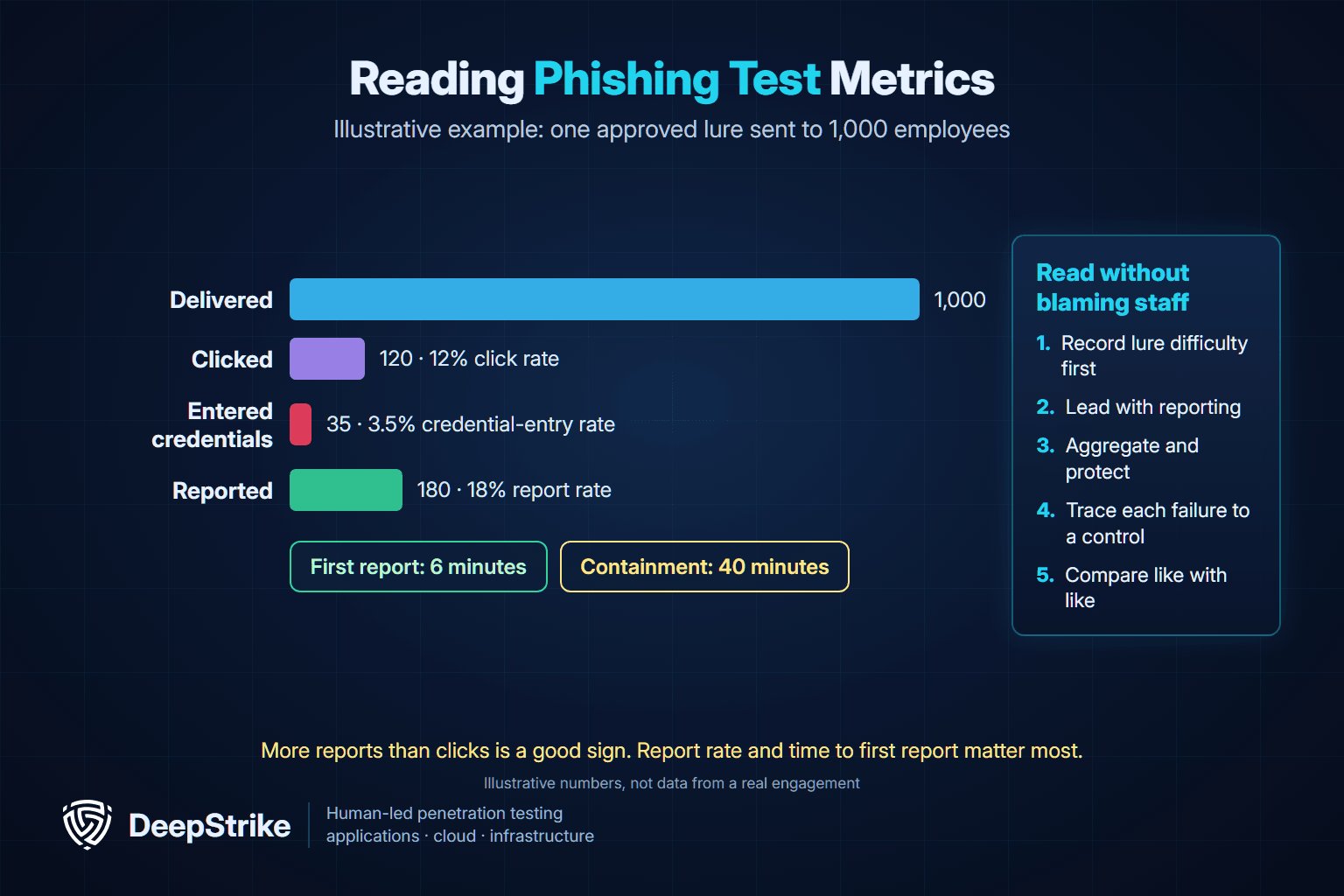
The numbers below are illustrative, not data from a real engagement. A company sends one approved lure to 1,000 employees:
Read well, this result is encouraging. More people reported the lure than clicked it, and the first warning came within minutes. The priorities are to cut the 40-minute containment time, to make sure phishing-resistant MFA would block the 35 submitted credentials, and to find out why the landing page did not trigger browser or password manager warnings. None of those fixes involves naming the 35 people.
Physical testing puts testers in front of employees, guards and sometimes police. The best-known warning is the 2019 case in which two Coalfire testers were arrested on September 11, 2019, at the Dallas County courthouse in Iowa during a physical test commissioned by Iowa's State Court Administration. As Krebs on Security reported, some buildings in scope belonged to the state and others to the county, a distinction that had not been resolved before testing. The testers were charged with burglary-related offenses, the charges were later reduced to trespass, and prosecutors dropped them on January 30, 2020. The lesson is that a contract is only as good as the signer's authority over the property.
Use this checklist before any physical test:
The report is where a social engineering test either improves processes or just embarrasses people. NIST SP 800-115 recommends a detailed report that identifies both successful and unsuccessful tactics, so the organization can tailor its awareness program. A strong report contains:
Our penetration testing report guide covers severity, evidence and structure in more depth.
| Finding pattern | Fix the process or control | Training follow-up |
|---|---|---|
| Help desk reset access after weak caller checks | Require callback to a known number or manager approval before any credential or MFA reset | Short scenario-based session for help desk staff on the new procedure |
| Many credential submissions | Phishing-resistant MFA for exposed systems, password manager adoption, browser protection | Teach the "pause and report" habit, not lure-spotting trivia |
| Few or slow reports | One-click report button, fast acknowledgment, visible thanks for reporters | Tell staff what happened to their reports |
| Reports not acted on quickly | SOC playbook to search and purge reported messages | Not a staff training issue |
| Tailgating succeeded | Turnstiles or anti-tailgating controls in sensitive areas, escort rules | Give staff a simple, approved way to ask "Can I help you?" |
| Payment changes approved by email or phone | Out-of-band verification for bank detail changes, dual approval | Targeted session for finance teams |
For finance teams, our business email compromise statistics show how payment-change fraud plays out.
Training follow-up should be short, specific and respectful. Thank reporters first. Offer people who fell for a lure a brief explanation of the cue they could have noticed, without public lists or manager escalations. Then retest the processes, not the individuals, after the fixes are in place. If attackers use phishing as an entry point in a real incident, your incident response plan should already describe how reports reach responders.
Some security leaders argue that social engineering testing only proves what everyone knows, that some people will click, while hurting trust. The criticism is fair when tests are run as gotcha exercises or reported with names. The UCSD and ETH results also show that punishing or retraining clickers changes little.
The value comes from changing the question. Instead of asking whether employees can be fooled, a good test asks whether the organization's processes and controls still hold when someone is fooled, and whether staff report quickly enough for the SOC to act. Tested that way, social engineering findings lead to concrete fixes: stronger help desk verification, phishing-resistant MFA, faster mailbox purges and better visitor controls. If your organization cannot yet act on findings like these, start with the technical basics and an internal reporting program, then commission an independent test.
Social engineering testing is an authorized exercise that uses controlled phishing, phone, text, physical or baiting scenarios to measure how well people, processes and supporting controls resist manipulation. It reports results in aggregate and focuses on fixing processes and controls.
Yes, when it is authorized in writing by someone with authority over every system, site and population in scope, and when it respects employment, privacy, telecom and recording laws in each jurisdiction. Legal and HR review before testing is the norm, and physical tests need confirmed property authority.
They should know in general, through policy and onboarding, that the organization runs security exercises and that results are not used for punishment. They should not be told the date or theme of a specific test, because that would make the results meaningless.
There is no universal target, because click rates depend mostly on lure difficulty. The 2026 Verizon DBIR reports a median email simulation click rate of 1.4%, while a large university health system study saw rates from 1.82% to 30.80% across different lures. Track click rate alongside difficulty and focus on report rate and response time.
Many organizations run an independent test once a year and after major changes to help desk, finance or access procedures, while an internal phishing program runs more often. The right cadence depends on risk, regulatory expectations and how quickly you can fix findings.
PCI DSS v4.0.1 Requirement 12.6.3.1 requires security awareness training to cover phishing and related attacks and social engineering, as published in the PCI SSC document library. That is a training requirement, not a mandate for a social engineering penetration test, although a test can provide useful evidence that training and controls work.
A phishing test uses email to measure clicks, credential entry and reporting. A vishing test uses phone calls to check whether staff, especially help desk and finance teams, follow identity verification procedures before resetting access, sharing data or changing payment details.
A social engineering penetration test is worth running when it is approved by legal and HR, limited to fair pretexts, measured with report rates and lure difficulty, and followed by fixes to verification steps and technical controls. Start by listing the processes an attacker would most like to manipulate, such as password resets, payment changes and visitor entry, and test those first.
DeepStrike's penetration testing services include social engineering assessments that simulate real-world attacks such as phishing, calling and baiting. For objective-based campaigns where phishing and pretexting are the entry point, see our red teaming services. To discuss scope and rules of engagement, contact DeepStrike.
Mohammed Khalil is a Cybersecurity Architect at DeepStrike, specializing in advanced penetration testing and offensive security operations. With certifications including CISSP, OSCP, and OSWE, he has led numerous red team engagements for Fortune 500 companies, focusing on cloud security, application vulnerabilities, and adversary emulation. His work involves dissecting complex attack chains and developing resilient defense strategies for clients in the finance, healthcare, and technology sectors.

Stay secure with DeepStrike penetration testing services. Reach out for a quote or customized technical proposal today
Contact Us
