November 5, 2026
Updated: November 5, 2026
The four layers of an organization's digital footprint, how attackers use them, how to map and shrink them safely, and how personal footprints feed spear phishing.

Mohammed Khalil

A digital footprint is the trail of data a person or organization leaves online, both what they publish on purpose (the active footprint) and what is collected or exposed without a deliberate action (the passive footprint). For an organization, it covers internet-facing assets, employee and company information, leaked credentials and secrets, and shadow IT. Attackers mine that footprint for reconnaissance and to write convincing spear phishing. You reduce it by inventorying what you own, finding what you did not know about, removing or locking down what you do not need, and testing what remains on a schedule.
Every online action leaves a record. A post, a job listing, a DNS record, a code commit, an account sign-up and a data broker profile all add to a footprint that other people can search, combine and reuse. The term is usually applied to individuals, but organizations have one too, and theirs is larger: every domain, cloud service, employee profile, vendor and leaked password is part of it.
Security teams care about the footprint because it is the raw material of reconnaissance. MITRE ATT&CK groups this pre-attack research under the Reconnaissance tactic (TA0043), and its mitigation guidance for those techniques is blunt: they "cannot be easily mitigated with preventive controls," so efforts should focus on minimizing the amount and sensitivity of data available to outsiders (MITRE M1056, Pre-compromise). In other words, the footprint is something you manage, not something a firewall blocks.
| Type | What creates it | Personal examples | Organizational examples |
|---|---|---|---|
| Active | Information published on purpose | Social posts, profiles, reviews, forum comments | Websites, press releases, job postings, public code, conference talks |
| Passive | Information collected or exposed without a deliberate publishing step | Tracking data, data broker profiles, breach records, public records | Certificate logs, DNS records, search engine indexes, leaked credentials, forgotten cloud assets |
The split matters for remediation. You can edit or delete most of an active footprint directly. A passive footprint usually needs a different lever: an opt-out request, a configuration change, a credential reset or a takedown.
| Term | What it means | How it relates |
|---|---|---|
| Digital footprint | All data about a person or organization that is available online | The whole body of exposed information |
| Attack surface | The systems, services and entry points an attacker could try to exploit | The technical part of an organization's footprint |
| OSINT | Open source intelligence: collecting and analyzing publicly available information | The method used to read a footprint, by attackers and defenders |
| Doxing | Gathering and publishing someone's personal information to harm or intimidate them | A malicious use of a personal footprint |
For the method side, see our guide to what OSINT is. For the technical side, see attack surface management.
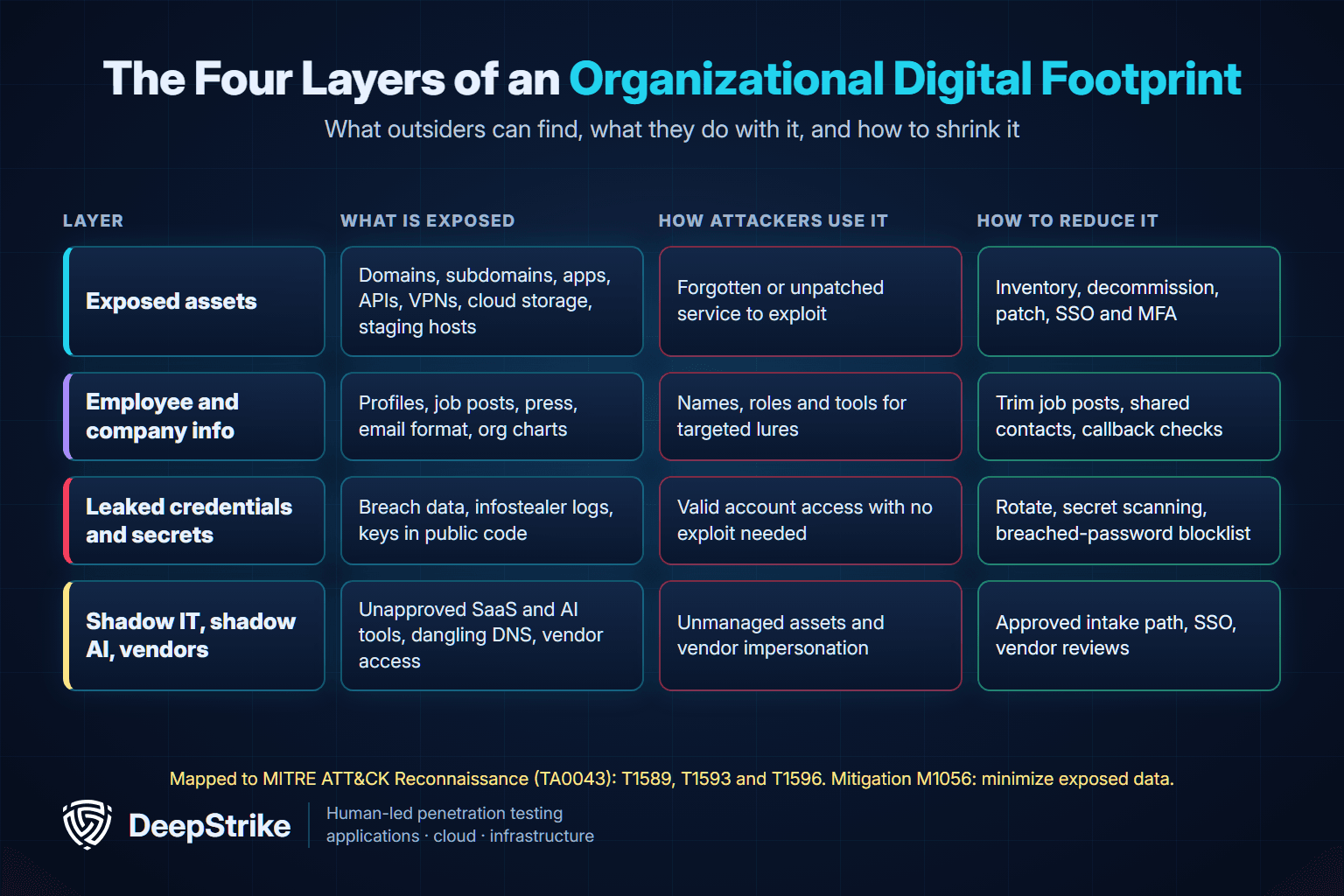
An organization's footprint has four layers. Each one answers a different question an attacker asks during reconnaissance, and each one has a different owner inside the company.
This is everything reachable from the internet: domains and subdomains, web applications, APIs, VPN and remote access gateways, mail servers, cloud storage, and test or staging hosts. Much of it is discoverable without touching your systems at all. Certificate Transparency, defined in RFC 6962, publishes TLS certificates to public logs, so a new hostname can become visible as soon as a certificate is issued for it. DNS records, search engine indexes and internet-wide scan databases add more.
The risk is concrete. Verizon's 2026 Data Breach Investigations Report found that 31% of breaches started with exploitation of a vulnerability, the first time in the report's 19 years that exploitation overtook stolen credentials as the top entry point. An asset nobody knows about is an asset nobody patches.
Attackers research people as carefully as they research servers. MITRE's Gather Victim Identity Information (T1589) technique covers employee names, email addresses and credentials, and its procedure examples include groups that gathered detailed information on target employees to improve their social engineering lures, and others that used names from earlier data breaches.
Sources are mostly ordinary business activity:
None of this is wrong to publish. The problem appears when it is combined: a name, a role, a reporting line and a vendor relationship are enough to write a believable request.
Credentials leak through third-party breaches, infostealer malware on personal or unmanaged devices, and secrets committed to public code. MITRE's Code Repositories sub-technique (T1593.003) records several groups that searched public repositories for exposed credentials and API keys, and its mitigation advice is to scan before committing and to remove leaked secrets from the commit history, not only from the latest version. GitHub's secret scanning documentation gives the practical rule: when a secret leaks, rotate it immediately, because revoking the credential matters more than rewriting history.
For the scale of the infostealer problem, see our analysis of infostealer malware and credential theft.
Shadow IT is technology the business uses without IT's knowledge: SaaS bought on a credit card, a marketing microsite on a forgotten subdomain, a file share created for one project. Each one extends the footprint without appearing in the asset register. Verizon's 2026 report adds a newer variant, shadow AI: frequent use of AI tools by employees rose from 15% to 45% in a single year, and unapproved AI use is now the third most common non-malicious data leakage activity in its dataset. Our shadow IT statistics collect the wider numbers.
Third parties belong in this layer too. Verizon reports that breaches involving a third party now account for 48% of all breaches. Your vendors' exposed systems and leaked data become part of your footprint the moment they hold your data or your credentials.
Reconnaissance turns scattered public data into a target list. The table maps each footprint layer to the MITRE ATT&CK technique that describes it and to what an attacker gets out of it.
| Footprint layer | MITRE ATT&CK technique | What the attacker learns | Typical next step |
|---|---|---|---|
| Exposed assets | T1593.002 Search Engines; T1596 Search Open Technical Databases | Hostnames, software versions, exposed login pages and files | Exploit a vulnerable or forgotten service |
| Employee information | T1589.002 Email Addresses; T1589.003 Employee Names; T1593.001 Social Media | Who works where, in which role, with which tools | Targeted phishing, vishing or impersonation |
| Leaked credentials and secrets | T1589.001 Credentials; T1593.003 Code Repositories | Working passwords, API keys, tokens | Valid account access without exploitation |
| Shadow IT and third parties | T1593 Search Open Websites/Domains | Unmanaged SaaS, subdomains, vendor relationships | Takeover of unmanaged assets; vendor impersonation |
The MITRE ATT&CK framework guide explains how reconnaissance feeds the later tactics. Two points matter for defenders. First, most of this activity happens outside your network, so you will not see it in your logs; MITRE notes that detection for these techniques is difficult and usually shifts to later stages such as initial access.
Second, the payoff is often fraud rather than malware. The FBI's 2025 Internet Crime Report recorded 1,008,597 complaints and $20.877 billion in reported losses. Phishing and spoofing produced the most complaints (191,561), and business email compromise caused $3.05 billion in losses, second only to investment fraud. The same report urges readers to be diligent with their "cybersecurity, social media footprint, and electronic interactions."
Mapping your footprint means seeing your organization the way an outsider does, then fixing what that view reveals. Keep it defensive and bounded: look only at assets and accounts your organization owns or is authorized to assess, and look at employee exposure at the level of roles and patterns, not by building dossiers on named individuals. Involve legal, HR and privacy before you review anything about employees.
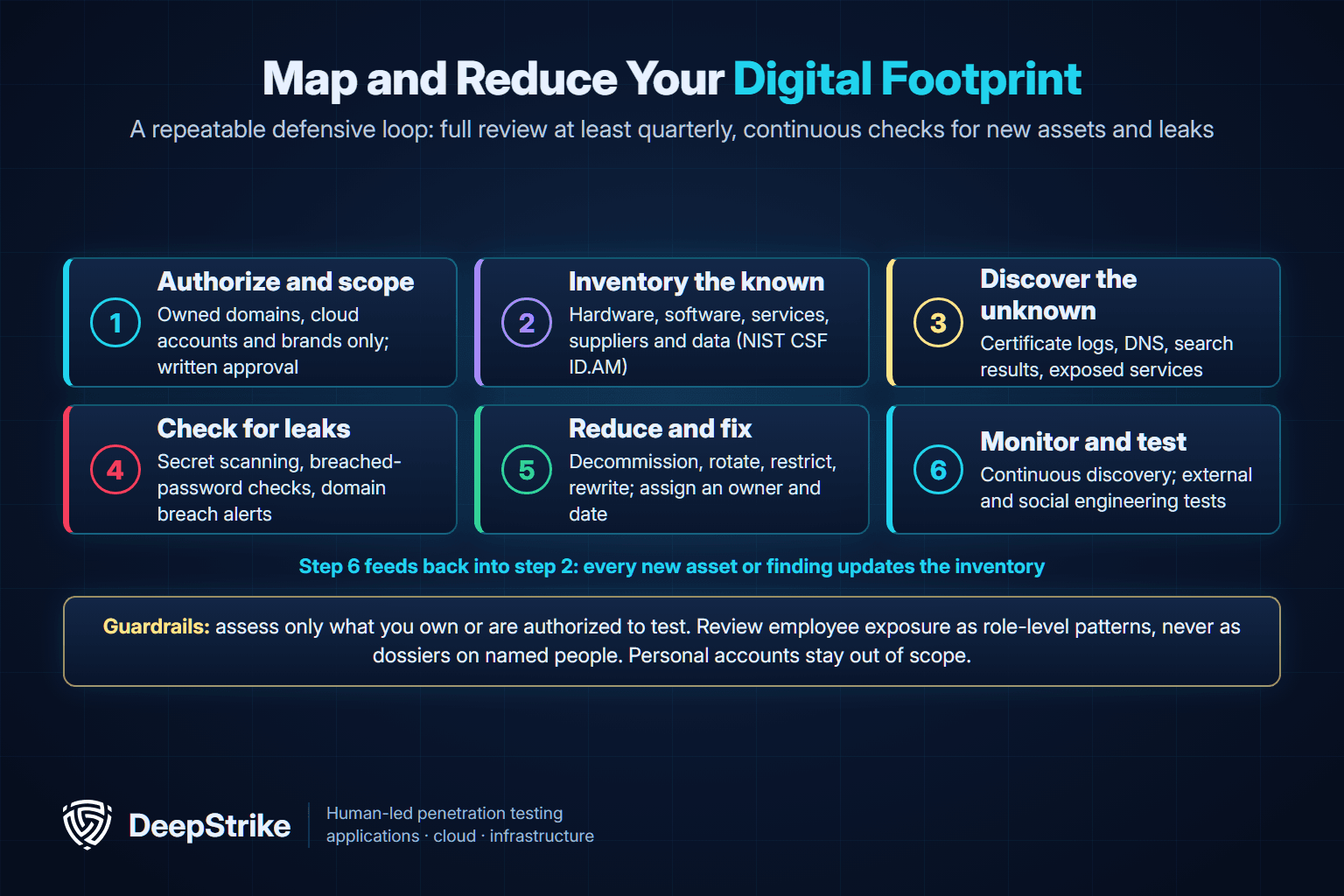
Write down which domains, cloud accounts, brands and subsidiaries are in scope, who approved the work and what is out of bounds. Third-party systems stay out of scope unless the vendor agrees. Personal accounts of employees stay out of scope entirely; the employee program in a later section is opt-in.
Pull every known asset into one list: registered domains, DNS zones, cloud accounts, IP ranges, SaaS tenants and code organizations. NIST's Cybersecurity Framework 2.0 frames this as maintained inventories of hardware (ID.AM-01), of software, services and systems (ID.AM-02), of services provided by suppliers (ID.AM-04) and of data (ID.AM-07). The gaps between this list and what you discover in the next step are the footprint you were not managing.
Compare your inventory with what the outside world can see about your own domains:
US government and critical infrastructure organizations can also enroll in CISA's no-cost Cyber Hygiene services, which scan internet-accessible assets weekly and alert on urgent findings such as known exploited vulnerabilities. CISA also recommends identifying assets that are searchable through online tools and reducing that exposure.
Turn on secret scanning for your code repositories, including the full history. Use breach notification services that let a verified domain owner see which of its addresses appear in known breaches, and feed known-compromised passwords into your password checks. NIST SP 800-63B requires verifiers to compare new passwords against a blocklist that includes passwords from previous breach corpuses, and to force a change when there is evidence an authenticator has been compromised. For monitoring options, see our review of dark web monitoring tools.
Read your public material the way a social engineer would. Look at job postings, the careers page, press releases, case studies, public slide decks, document metadata and staff directories. Ask one question of each: does this tell an outsider which tools we use, who approves payments or resets accounts, or how our email addresses are built? Record findings as patterns ("finance roles listed with direct phone numbers"), not as files on individuals.
Every finding needs an owner, a fix and a date. Rank by what an attacker could do with it: a working credential or an unpatched login page comes before an over-detailed job post. Repeat discovery on a schedule, at least quarterly for the full review and continuously for new assets and leaked credentials.
| Finding | Example | Priority | Owner |
|---|---|---|---|
| Working credential or secret | Valid API key in a public repository | Critical: rotate now | Engineering, security |
| Unknown internet-facing asset | Staging host with an exposed admin panel | High: patch, restrict or decommission | IT, engineering |
| Unmanaged SaaS or subdomain | Subdomain pointing at a deleted cloud service | High: remove the DNS record | IT |
| Over-detailed public content | Job post naming the EDR product and VPN vendor | Medium: rewrite | HR, security |
| Role-level exposure pattern | Finance staff phone numbers on a public page | Medium: replace with a shared contact | Communications |
Reduction follows a simple order: remove what you do not need, protect what you keep, and make the rest harder to misuse. The FTC's guide for businesses, Protecting Personal Information, puts the same idea in five words: take stock, scale down, lock it, pitch it and plan ahead.
| Footprint element | Reduce it | Make the remainder harder to misuse |
|---|---|---|
| Exposed assets | Decommission unused hosts; delete dangling DNS records; close unneeded ports | Patch quickly; put admin interfaces behind SSO and MFA or a VPN |
| Employee and company information | Remove internal tool names from job posts; use shared contact addresses; strip document metadata | Callback verification for payment changes and account resets |
| Leaked credentials and secrets | Rotate exposed secrets; move secrets to a vault; block breached passwords | Phishing-resistant MFA; alerting on new credential exposure |
| Shadow IT and shadow AI | Offer an approved intake path for new SaaS and AI tools; retire unused tenants | SSO enforcement; data loss controls on approved AI tools |
| Third parties | Share only the data a vendor needs; end access when contracts end | Vendor security reviews; contract notification duties |
A few points deserve emphasis:
A personal digital footprint is the same idea at the scale of one person: social media, accounts, photos, reviews, location data, public records and data broker profiles. The FTC explains that people search sites build reports from other data brokers, public social media and government records, and that someone with just your name or phone number could buy a report showing your age, past addresses, relatives and employment history.
Practical steps for individuals, all based on FTC and CISA guidance:
You cannot erase a personal footprint completely. Public records stay public, and copies of old posts can persist. The realistic goal is to shrink it, keep it current and make sure the parts that remain do not help a stranger impersonate you or reset your accounts.
This is where the personal and organizational footprints meet. A spear phishing message works because it is specific, and the specifics usually come from employees' own public profiles: a new job announcement, a conference trip, a manager's name, a vendor the team just adopted.
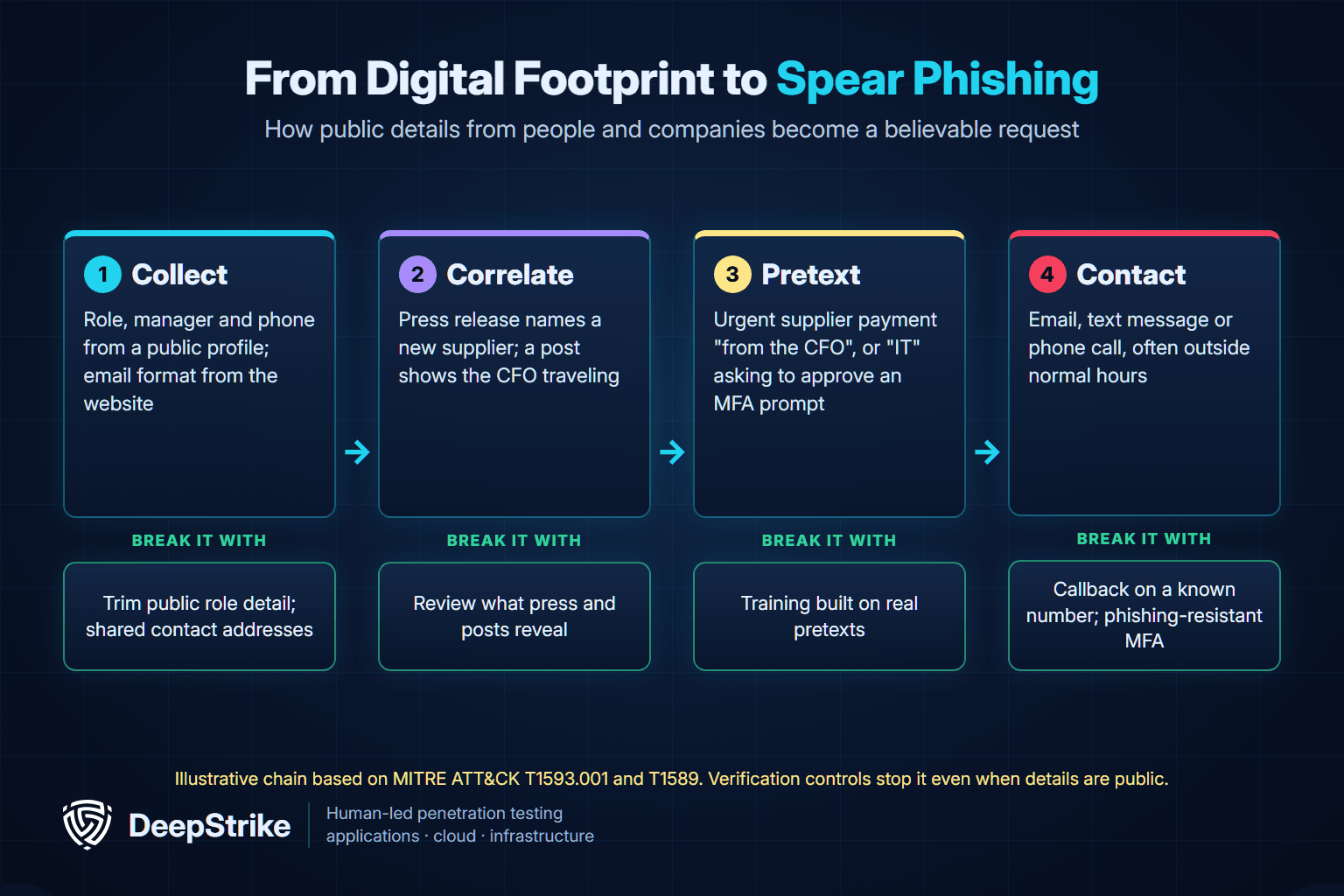
MITRE documents this pattern in Search Open Websites/Domains: Social Media (T1593.001). Its procedure examples include Kimsuky using Twitter to monitor potential victims and prepare targeted phishing emails, Lazarus Group using LinkedIn to identify and target employees in Operation Dream Job, and EXOTIC LILY copying data from social media sites to impersonate targeted people. Verizon's 2026 report adds that mobile-centric social engineering through text messages and voice calls now succeeds 40% more often than traditional email phishing, which makes personal phone numbers part of the corporate risk.
A typical chain looks like this:
The controls that break this chain are mostly organizational, not personal:
For how these attacks are built and stopped, read our spear phishing guide and our overview of what social engineering is.
An inventory shows what exists. Testing shows what an attacker could actually do with it. Three kinds of assessment map well to the footprint layers:
The useful output is not a list of everything public. It is a ranked list of exposures that led somewhere, with the fix for each.
A digital footprint is the record of data you leave online. It includes what you post and share, such as social profiles and comments, and what others collect or expose about you, such as data broker profiles, tracking data and breach records. Organizations have one too: their domains, systems, public documents, employee information and leaked credentials.
An active footprint is information you publish on purpose, such as posts, profiles and reviews. A passive footprint is collected or exposed without a deliberate publishing step, such as tracking data, data broker records, certificate logs or leaked passwords. Active data can usually be edited directly; passive data often needs an opt-out, a configuration change or a credential reset.
No. Public records, archived copies and data held by third parties mean some information will remain. You can shrink a footprint substantially by deleting unused accounts, tightening privacy settings, opting out of people search sites and, for organizations, decommissioning unused assets and rotating exposed credentials. Review it periodically, because data reappears.
It is everything about the organization that an outsider can find: internet-facing assets such as domains, applications and cloud services; information about employees and operations; leaked credentials and secrets; and shadow IT and third-party systems that hold company data. Attackers use it for reconnaissance before an intrusion or a fraud attempt.
Not quite. The attack surface is the set of systems and entry points an attacker could try to exploit. The digital footprint is broader: it also includes information about people, processes and vendors that makes social engineering and fraud easier. The attack surface is the technical subset of the organizational footprint.
Run a full review at least quarterly and after major changes such as acquisitions, cloud migrations or rebrands. Monitor new internet-facing assets and leaked credentials continuously, because both change daily. Validate the result with periodic external and social engineering tests.
A digital footprint cannot be reduced to zero, and it does not need to be. The goal is a footprint you know about, that contains nothing you do not need, and that does not hand an attacker a working credential, a forgotten server or a ready-made pretext. Start with an inventory, discover what is missing from it, fix the high-impact findings first and repeat on a schedule.
To test what an outsider can find and use, DeepStrike's penetration testing services begin with a reconnaissance phase that gathers publicly accessible data using OSINT techniques, including domains, subdomains, services and third-party software, and include social engineering simulations such as phishing and phone calls. Dark web monitoring and attack surface management are part of the Premium continuous testing plan. To scope an assessment, contact our team.
Mohammed Khalil is a Cybersecurity Architect at DeepStrike, specializing in advanced penetration testing and offensive security operations. With certifications including CISSP, OSCP, and OSWE, he has led numerous red team engagements, focusing on cloud security, application vulnerabilities, and adversary emulation. His work involves dissecting complex attack chains and developing resilient defense strategies for clients in the finance, healthcare, and technology sectors.
FTC: What To Know About People Search Sites That Sell Your Information
FTC: Protect Your Personal Information From Hackers and Scammers
FTC: Protecting Personal Information: A Guide for Business
CISA: Avoiding Social Engineering and Phishing Attacks
CISA Insights: Mitigating the Impacts of Doxing on Critical Infrastructure (May 12, 2021)
NIST: The NIST Cybersecurity Framework (CSF) 2.0, CSWP 29 (February 26, 2024)
NIST: SP 800-63B-4, Authentication and Authenticator Management (August 2025)
MITRE ATT&CK: Reconnaissance, Tactic TA0043
MITRE ATT&CK: Gather Victim Identity Information, T1589
MITRE ATT&CK: Search Open Websites/Domains: Social Media, T1593.001
MITRE ATT&CK: Search Open Websites/Domains: Code Repositories, T1593.003
MITRE ATT&CK: Pre-compromise, Mitigation M1056
Verizon: Vulnerability exploitation top breach entry point, 2026 DBIR finds (May 19, 2026)
FBI IC3: 2025 Internet Crime Report
California Privacy Protection Agency: Delete Request and Opt-out Platform (DROP)

Stay secure with DeepStrike penetration testing services. Reach out for a quote or customized technical proposal today
Contact Us
