November 6, 2026
Updated: November 6, 2026
A plain-English guide to doxing: what it means, what the law says, how to protect yourself, and what to do first if it happens to you.

Mohammed Khalil

Doxing, also spelled doxxing, is gathering someone's personal information and publishing it without consent to harass, shame, threaten or harm them. The details can include a home address, phone number, employer, family members, or financial records, and some of it may already be public somewhere. What makes it doxing is the exposure and the intent to harm. Laws vary by location: it can be a crime, a civil wrong, or legal until threats or stalking are involved. You can lower your risk, and if it happens, the order of your response matters.
If you are being doxed right now: if you are in immediate danger, call 911. Otherwise, go to "What to Do If You Have Been Doxed" below and save evidence before anything gets deleted.
The Department of Homeland Security defines doxing as gathering a person's personally identifiable information and releasing it publicly for malicious purposes such as humiliation, stalking, identity theft or harassment. CISA adds that the target can also be an organization's sensitive information.
Doxing or doxxing? Both spellings are correct and mean the same thing. DHS, CISA and Australia's eSafety Commissioner write "doxing". Hong Kong's privacy regulator and Australia's 2024 law write "doxxing". The word comes from "dropping docs", short for documents, and Wikipedia traces it to revenge tactics in 1990s hacker culture. To "dox" someone means to do this to them, and the person is "doxed" or "doxxed".
One point surprises many people. As eSafety explains, doxing is not the same as defamation, because the information is usually accurate. Being true, or being findable somewhere, does not make its use harmless.
eSafety sorts doxing into three types. The examples below are illustrative.
| Type | What it reveals | Illustrative example |
|---|---|---|
| Deanonymizing | The identity of someone who was anonymous | A pseudonymous account is publicly tied to a real name |
| Targeting | Details that let someone be contacted, located or breached | A home address or phone number is posted in a hostile thread |
| Delegitimizing | Sensitive details that damage credibility or reputation | Private medical records or personal messages are shared to shame someone |
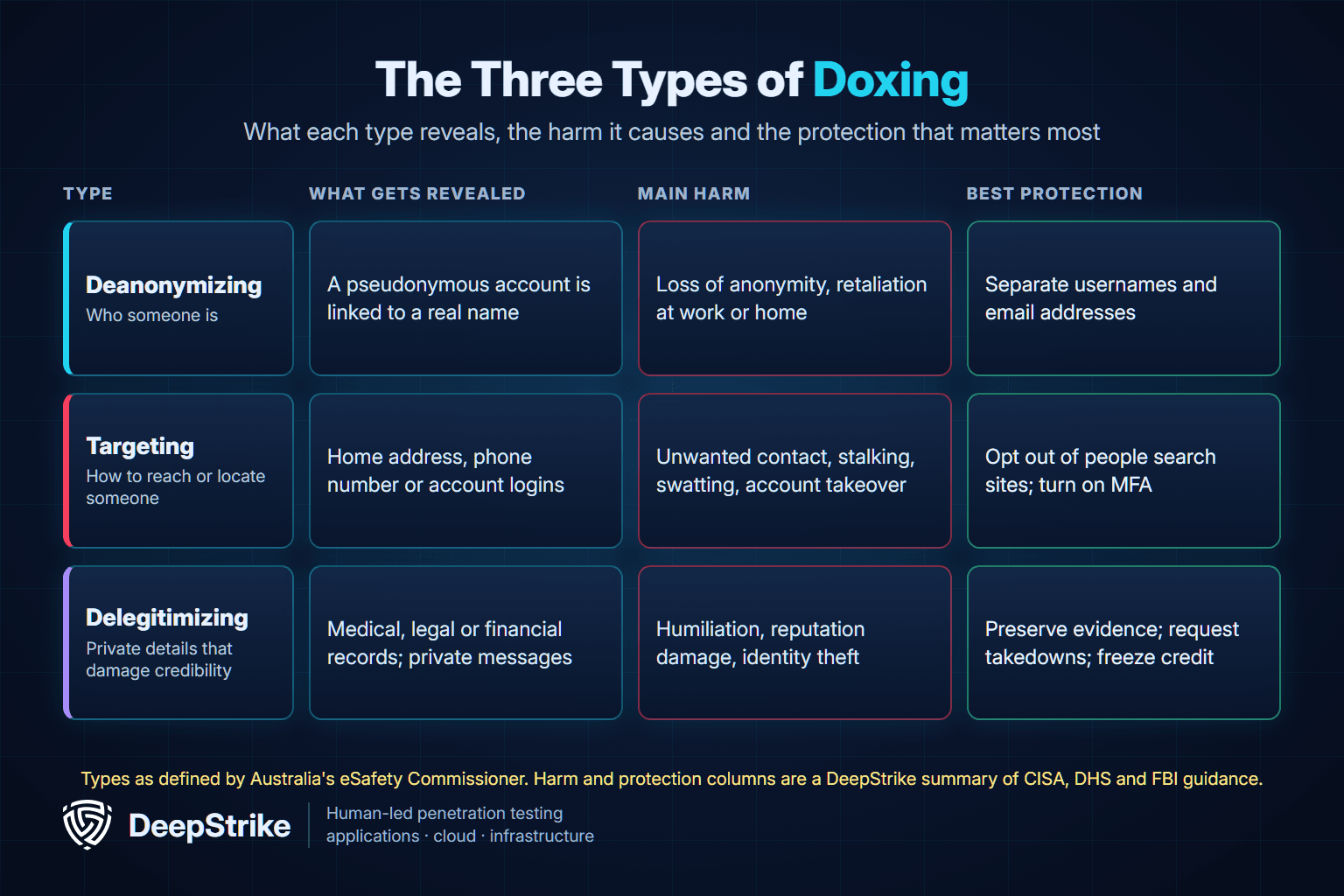
The label depends on consent, intent and effect. This table is a plain-English guide, not legal advice.
| Illustrative situation | Is it doxing? | Why |
|---|---|---|
| Posting an ex-partner's home address and urging people to "pay a visit" | Yes | Private details published with an obvious intent to cause harm |
| Sharing a stranger's employer in a hostile thread so people will complain and get them fired | Very likely | Exposure aimed at real-world consequences |
| Reposting a post that already exposed someone's address | Can be | Spreading it adds to the harm, and Hong Kong's regulator warns against re-posting |
| Giving information about a suspected crime to police | No | Reporting to law enforcement is a legitimate purpose |
| A business listing its public contact details | No | Consent, and no intent to harm |
| Reporting on a public figure's conduct in the public interest | Usually not | Often protected speech, though people may still call it doxing |
CISA lists full names, contact information, home addresses, family members, workplace details, financial information and Social Security numbers as common examples. It also names the usual places this data sits, so you know what to clean up: social media posts, property and court records, wedding announcements and obituaries, newsletters, public conferences, forums, voter registration lists, real estate listings and data brokers.
Much of it is not secret. The FTC explains that people search sites combine data broker files, public social media profiles and government records into reports that they sell to anyone who pays. Your overall digital footprint is what makes this possible, and this kind of public research, known as OSINT, is legitimate in many settings. The abuse lies in turning it against a person.
How common is it? In a September 2025 SafeHome.org survey of over 1,000 people, 4% of US adults said they had been doxxed, which the publisher projects to about 11.7 million people. That is a self-reported consumer survey, not an official count. We did not find a government figure.
Exposure is often only the first step. CISA says doxing can lead to extortion, social engineering and swatting. In practice, the harm usually falls into four groups:
These cases come from official sources:
It depends on where you are and what was done. There is no single US federal doxing crime that covers everyone, but other laws can apply. This summary is general information, not legal advice.
| Jurisdiction | Law | What it covers | Maximum penalty or remedy |
|---|---|---|---|
| US federal | 18 U.S.C. 119 | Publishing restricted personal information of covered federal officials, jurors, witnesses and informants, or their families, to threaten or incite violence | Up to 5 years in prison, a fine, or both |
| US federal | 18 U.S.C. 2261A | A course of online conduct meant to harass or intimidate that causes fear or substantial emotional distress | Varies with harm caused |
| Illinois | Civil Liability for Doxing Act, effective January 1, 2024 | Intentional publication meant to harm or harass, causing significant economic injury, emotional distress, fear of serious harm or major life disruption | Civil damages, attorney's fees and court orders |
| Other US states | Varies by state | As of June 2025, 19 states had laws addressing doxing of public officials, many of them protecting everyone | Criminal, civil or both |
| Australia | Criminal Code ss 474.17C and 474.17D, passed November 29, 2024 | Publishing personal data in a menacing or harassing way | Up to 6 years, or 7 if a group is targeted for protected attributes |
| Hong Kong | Personal Data (Privacy) Ordinance s 64, in force October 8, 2021 | Disclosing personal data without consent, with intent or recklessness about harm | Up to 2 years and HK$100,000; up to 5 years and HK$1,000,000 if harm results |
Sources for this table: 18 U.S.C. 119, 18 U.S.C. 2261A, the Illinois statute, the Council of State Governments survey, the Library of Congress summary of Australia's law and Hong Kong's privacy regulator. Wikipedia also notes dedicated provisions in Germany and the Netherlands.
The hard part is the line between speech and abuse. The Massachusetts Attorney General says collecting and publishing public information is not unlawful in itself, especially on matters of public concern, where the First Amendment may protect it. It can cross the line when it uses unlawfully obtained data, serves only to harass, incites others or involves threats. The Illinois law similarly excludes reporting crimes and constitutionally protected speech, press and protest activity. If you are considering legal action, speak with an attorney in your state.
You cannot erase everything, but you can make your details harder to find and less useful. These steps come from DHS, CISA, the FBI, the FTC and eSafety, listed roughly by how much risk they remove.
Being doxed is frightening, and it is not your fault. CISA, DHS, the FBI and state attorneys general give similar advice, and the order below puts safety first and evidence second, because evidence can vanish once posts come down.
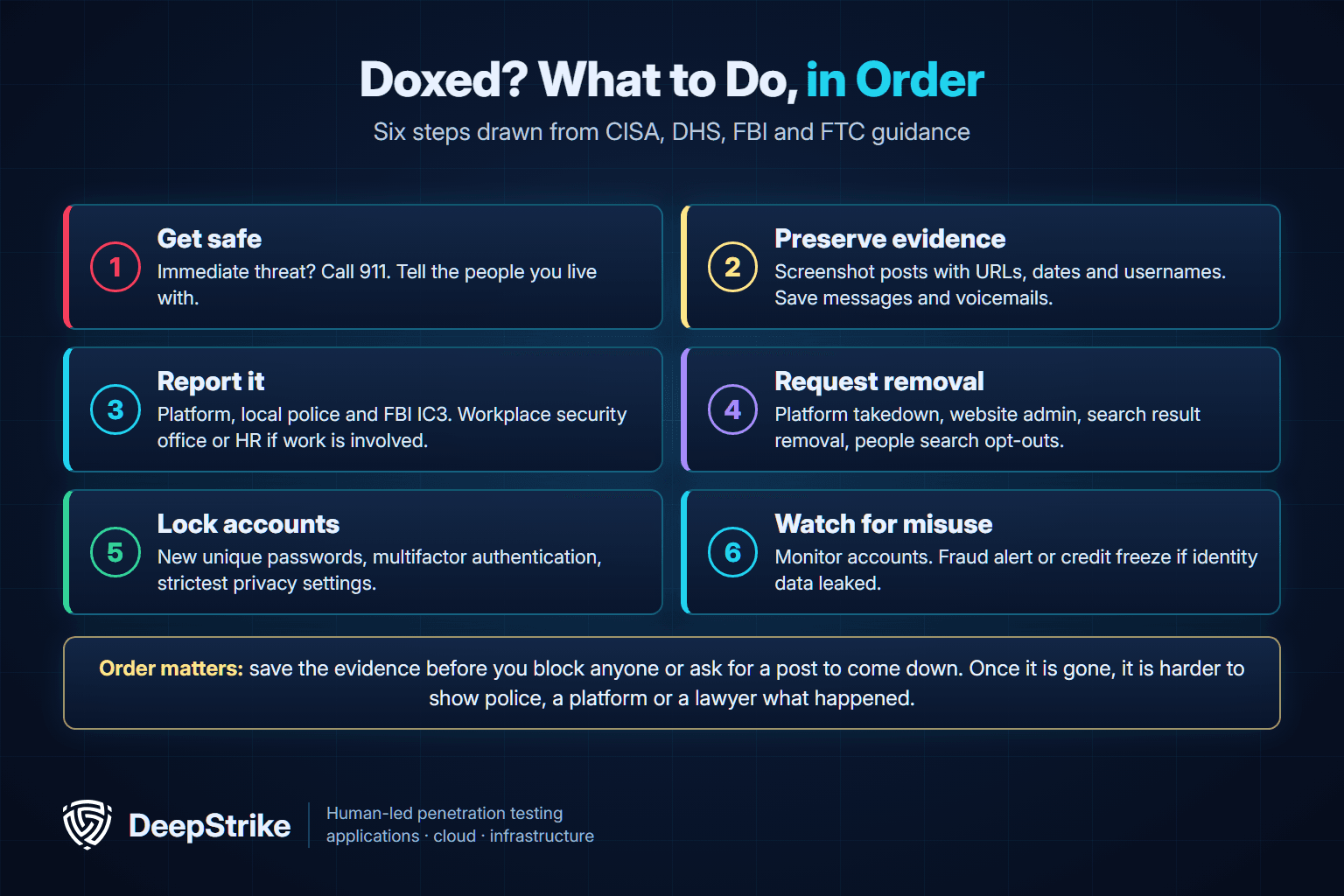
| What was exposed | Main risk | First moves |
|---|---|---|
| Home address | Stalking, unwanted visits, swatting | Tell your household and local police; agree on a plan for police contact; opt out of people search sites |
| Phone number or email | Harassment and phishing | Save messages; block after saving; treat unexpected requests with suspicion |
| Social Security or financial details | Identity theft and fraud | Place a credit freeze and fraud alert; monitor accounts; use the FTC's recovery site if misused |
| Passwords or account access | Account takeover | Change passwords and turn on multifactor authentication; review account activity |
| Workplace details | Harassment at work and impersonation | Tell your security office or HR so they can warn colleagues |
| Family members' details | Harassment of relatives | Tell them directly; help them tighten settings and save evidence |
For a credit freeze, the Consumer Financial Protection Bureau says it is free but must be placed separately at each of the three nationwide credit reporting companies. An initial fraud alert lasts up to one year. If your identity is misused, IdentityTheft.gov gives you a report and a recovery plan. It also warns that scammers impersonate the FTC, and that the agency will never tell you to move money to "protect it".
If police arrive because of a swatting call: the FBI says to stay calm, listen and cooperate. Afterward, keep usernames, email addresses, platform names, photos and videos, report it to local police, and send leads to the FBI.
Doxing does not stay personal. CISA notes that threat actors may dox organizations and staff over grievances about the organization's purpose or policies, and that leaders can be targeted because of their position, in what it calls reputation attacks. A doxed employee can also become a route into the company, because exposed details make impersonation easier. Treat doxing as both a safety issue and a security issue.
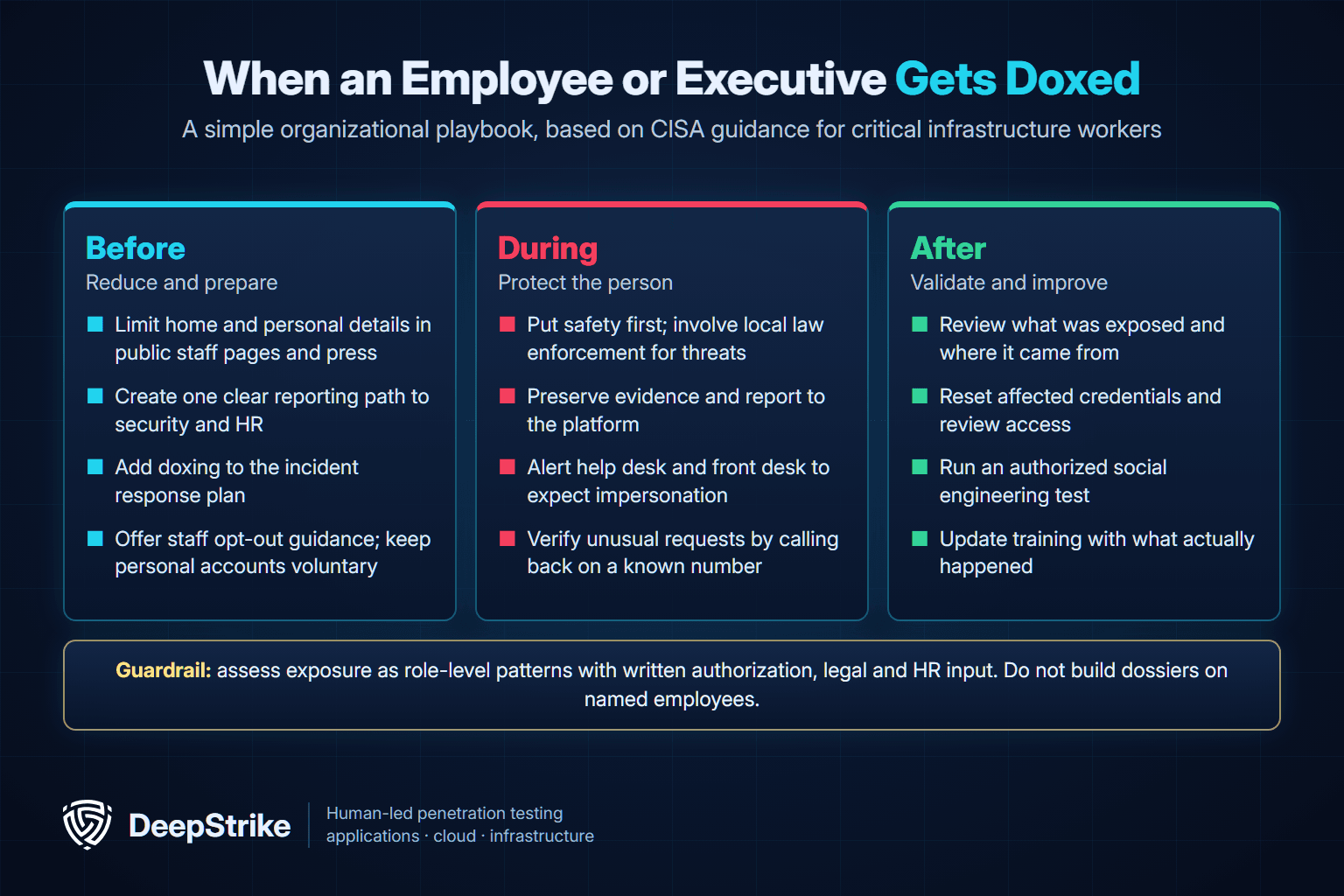
A practical response has three stages:
Testing shows whether those controls hold. An authorized social engineering penetration test can measure whether staff and help desks resist a caller who knows convincing details. Keep it within written scope, with legal and HR input, and review exposure as role-level patterns rather than files on named people. Employees' personal accounts should stay out of scope.
Both are correct. US agencies such as DHS and CISA use "doxing", while Hong Kong's regulator and Australia's law use "doxxing". The meaning is the same.
Sometimes. No single federal law covers all doxing, but federal laws on stalking and on exposing certain officials can apply, and many states have their own laws. Publishing public information is not automatically illegal, while threats, stalking or incitement can be.
Make sure you are safe, and call 911 if you are in immediate danger. Then save screenshots, URLs, dates and messages before anything is deleted, and report it to the platform and to police if there are threats.
Often not completely. Platforms can remove posts, and people search sites offer opt-outs, but copies can spread. Google notes that removing a search result does not delete the source page, and the FTC notes that information can reappear, so check back regularly.
It can be. Being public somewhere does not settle the question, because what matters is why and how it is shared. Hong Kong's regulator warns people to think twice before re-posting such messages.
Not on its own. CISA-backed swatting guidance for election workers lists a VPN as one way to conceal a device's IP address, but it sits alongside removing personal information and securing accounts. A VPN does not remove your address from public records or data broker files.
Doxing exposes personal information. Swatting is a hoax emergency report meant to send police to a location. They are linked because an exposed address can make swatting possible, and both can be crimes.
If this happened to you, start with the numbered response steps above. If you are responsible for an organization, make sure staff know how to report doxing and that your help desk can resist a well-informed impersonator. DeepStrike's penetration testing services include simulated phishing, calling and baiting within an agreed scope. If you want to scope a test, contact our team.
Mohammed Khalil is a Cybersecurity Architect at DeepStrike, specializing in advanced penetration testing and offensive security operations. With certifications including CISSP, OSCP, and OSWE, he has led numerous red team engagements, focusing on cloud security, application vulnerabilities, and adversary emulation. His work involves dissecting complex attack chains and developing resilient defense strategies for clients in the finance, healthcare, and technology sectors.

Stay secure with DeepStrike penetration testing services. Reach out for a quote or customized technical proposal today
Contact Us
