November 6, 2026
Updated: November 6, 2026
What counts as personally identifiable information, which data is sensitive, how the major privacy laws differ, and what to do when your data is exposed.

Mohammed Khalil
PII, short for personally identifiable information, is any information that can be used to identify or trace a specific person, either on its own or when combined with other information linked to them. A Social Security number can do it alone. A ZIP code and birth date can do it together. PII matters because criminals use it for identity theft and scams, and organizations that hold it can face legal duties when it is exposed. This guide covers examples, the sensitive category, how GDPR, CCPA and HIPAA differ, and what to do if yours leaks.
The US government's working definition comes from the Office of Management and Budget. OMB Circular A-130 (2016) describes PII as information that can be used to distinguish or trace an individual's identity, either alone or when combined with other information that is linked or linkable to a specific individual. The US Department of Labor uses the same wording.
The standard technical guide is NIST SP 800-122, published in April 2010. It uses an older definition and explains the words that matter:
That last word explains why PII is not a fixed list. OMB's breach memo M-17-12 says information that is not PII can become PII whenever additional information becomes available from any source. A list of credit scores with nothing else attached does not identify anyone, NIST notes. Add age, address and gender, and it probably does.
NIST's guide was written mainly for federal agencies. Private companies use it voluntarily and answer to other laws, covered below.
Direct identifiers usually point to one person without any other data: a full name, Social Security number (SSN), passport number or fingerprint.
Indirect identifiers, also called linkable or quasi-identifiers, are shared by many people: date of birth, ZIP code, gender, employer. NIST's comparison is simple. An SSN uniquely and directly identifies a person, while a telephone area code identifies a group.
Indirect identifiers become powerful in combination. In a 2000 Carnegie Mellon working paper, researcher Latanya Sweeney estimated that 87% of the US population was likely unique on just three facts: 5-digit ZIP code, gender and date of birth. That figure is still widely quoted, usually without its date.
It rests on 1990 census data. Philippe Golle repeated the analysis with 2000 census data in 2006 and got 63%. Both are estimates and both are old, but they agree on the point that matters: stripping names out of a dataset does not make it anonymous. Sweeney showed why by buying a voter list for $20, which held names next to ZIP codes, birth dates and gender, the same fields found in supposedly anonymous hospital data. The name alone was never the only risk.
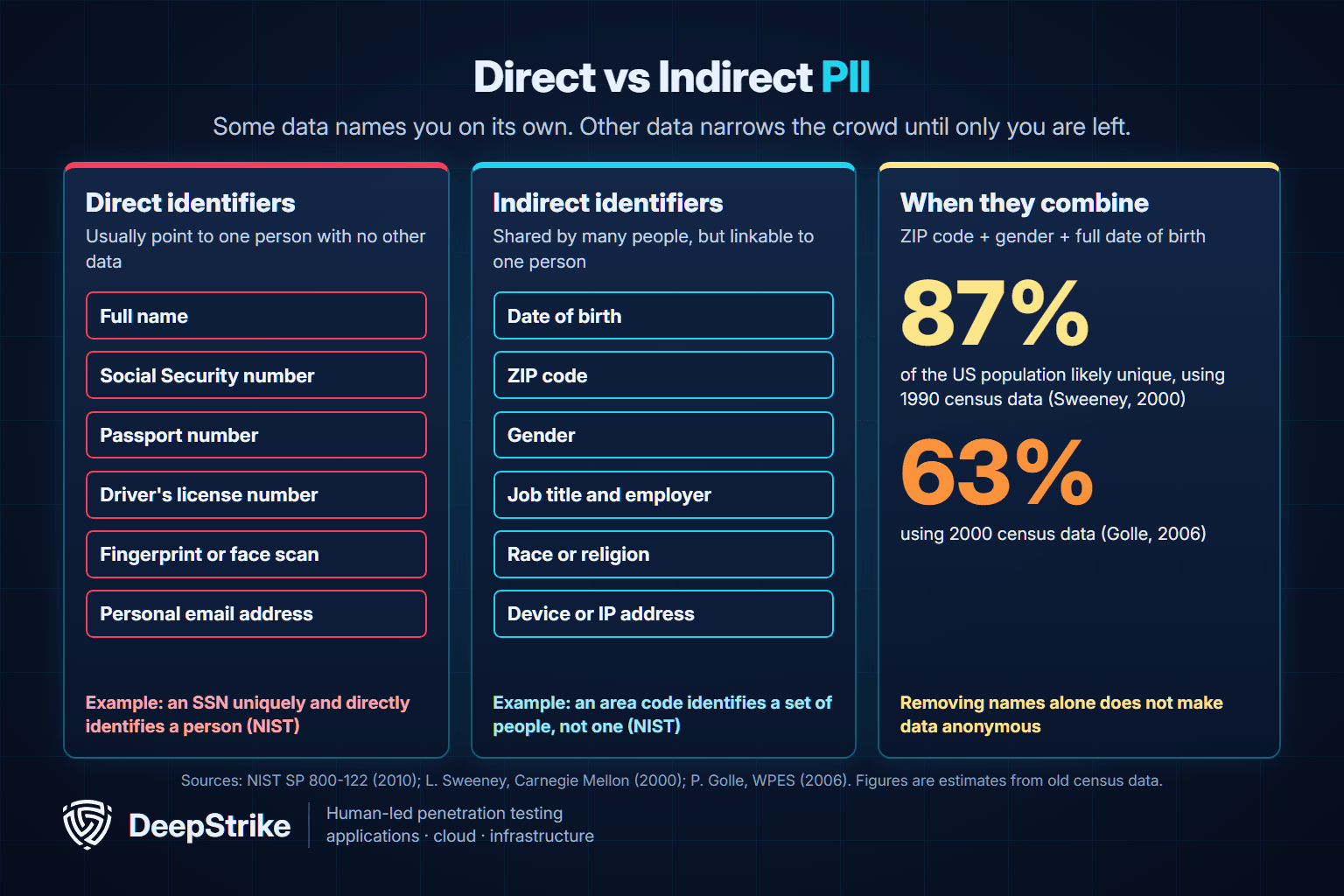
This table draws on NIST SP 800-122 and the DHS Handbook for Safeguarding Sensitive PII. Context can change the labels.
| Data | Type | Usually sensitive? | Note |
|---|---|---|---|
| Full name, maiden name, alias | Direct | No | A common name may need other details to single someone out |
| Social Security number | Direct | Yes | Partial SSNs still count as PII, NIST says |
| Passport, driver's license or state ID number | Direct | Yes | Sensitive even with no name attached |
| Fingerprint, retina scan, voice signature, facial geometry | Direct | Yes | Cannot be changed like a password |
| Bank account or credit card number | Direct | Yes | Enables financial fraud |
| Personal email address, phone number, street address | Direct | Not usually | An unlisted address or number can be sensitive |
| Photo of a face | Direct | Depends | Sensitive if used for facial recognition |
| Date of birth, place of birth | Indirect | With a name, yes | Often used to verify identity |
| ZIP code, gender, weight | Indirect | No | Risky in combination |
| Race, religion, sexual orientation | Indirect | With a name, yes | Special protection in many laws |
| Medical, education, employment, financial records | Linked | Medical, yes; others depend | PII once tied to a person |
| Static IP address, MAC address, device ID | Indirect | No | PII when it consistently links to one person or a small group |
| Account password, security answers, mother's maiden name | Linked | Yes | Opens accounts when paired with a username |
Not all PII carries the same risk. DHS guidance defines sensitive PII as information that, if lost, compromised or disclosed without authorization, could result in substantial harm, embarrassment, inconvenience or unfairness to a person. There is no single legal list, but the DHS handbook gives a practical one:
Non-sensitive PII is everything else that could identify you but would cause little harm alone, such as a work phone number on a business card. The label has limits.
First, context changes it. A name is usually not sensitive, but DHS points out that it can be on a clinic's patient list. NIST gives a similar example: the same fields (name, address, phone) carry very different risk on a newsletter list than on a list of people who work undercover in law enforcement.
Second, small pieces add up. A phone number and date of birth may not hurt you alone, but together they can make a social engineering call or message far more convincing.
Information stops being PII when it cannot reasonably be tied back to a person. Examples from official sources:
Be careful with "de-identified" or "masked" data. Replacing names with a code is pseudonymization, and under GDPR that data is still personal data if it can be used to re-identify someone. If you are unsure, treat data as PII until you can show that it cannot be linked back.
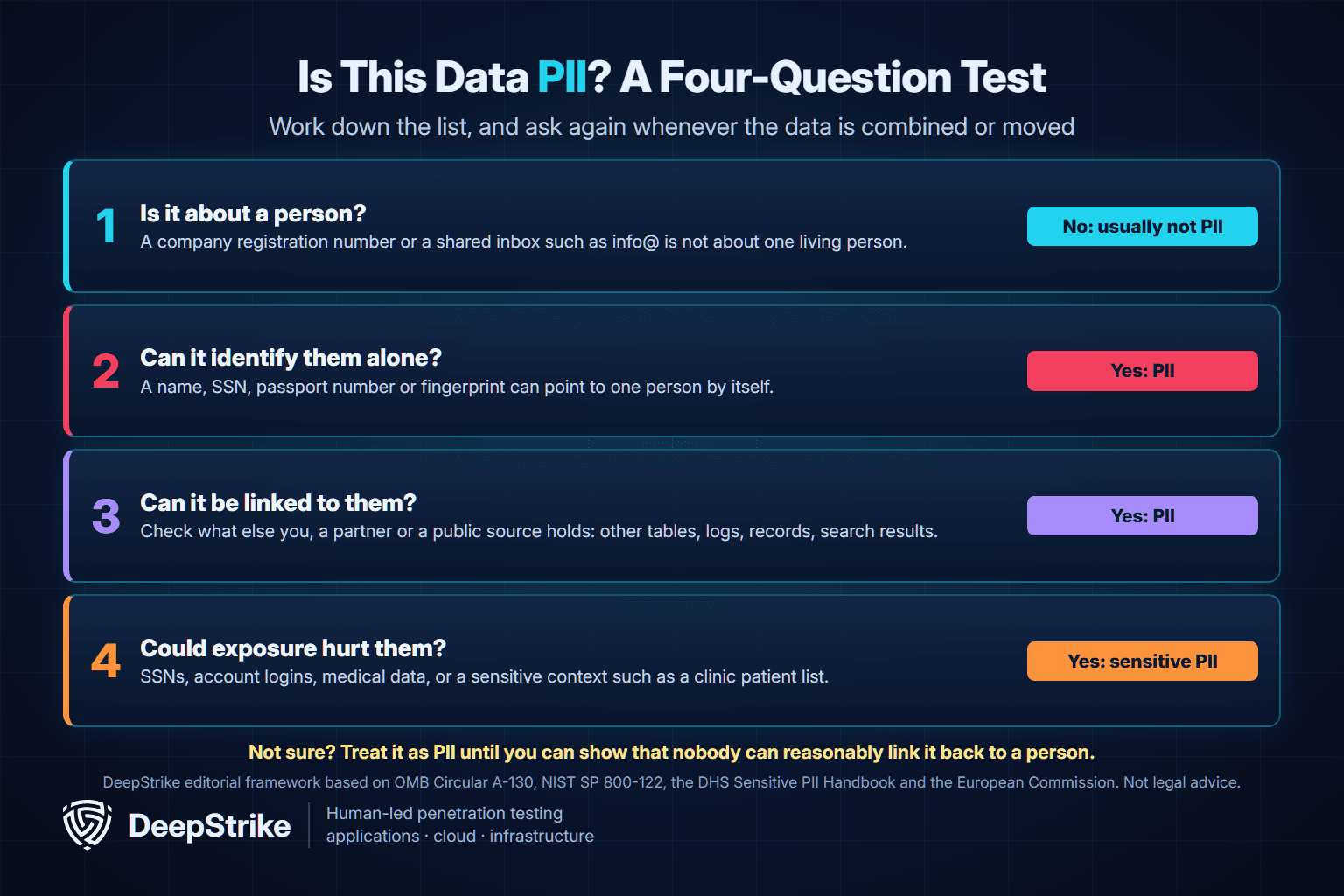
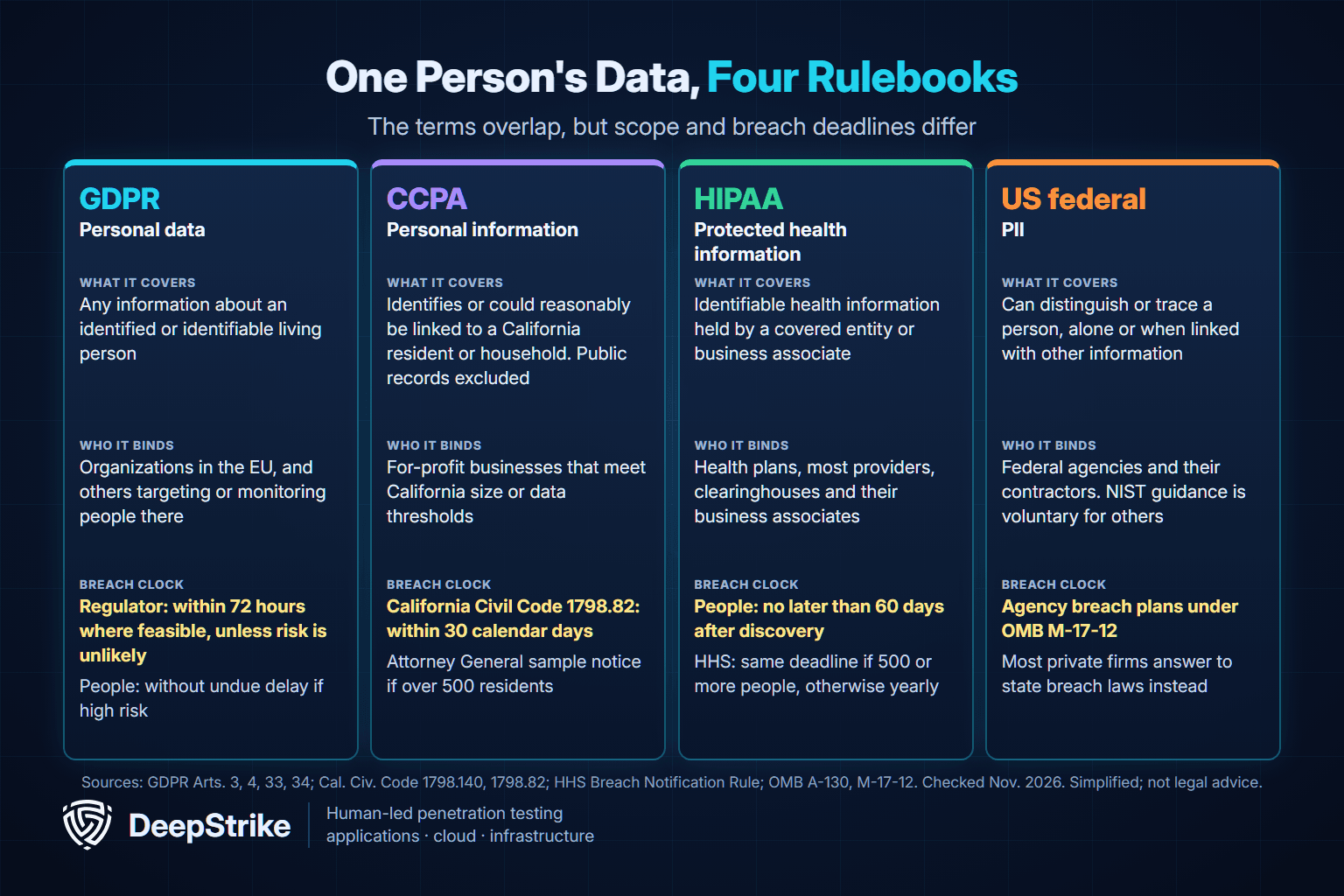
PII is mainly a US government and security term. The major privacy laws use their own terms, with different scope. The US has no single law that defines PII for every organization.
| Question | US federal PII | GDPR personal data | CCPA personal information | HIPAA protected health information |
|---|---|---|---|---|
| Who it applies to | Federal agencies and those working for them | Organizations established in the EU, and others offering goods or services to, or monitoring, people in the EU | For-profit businesses in California that meet revenue or data thresholds | Covered entities and their business associates |
| What it covers | Data that can distinguish or trace a person | Any information relating to an identified or identifiable living person | Data that identifies, relates to or could reasonably be linked with a California resident or household | Identifiable health, care or payment information |
| More protected category | Sensitive PII, by agency policy | Special categories such as health, biometric, religion | Sensitive personal information | The whole category is regulated |
| Public information | Can still be PII | Can still be personal data | Generally excluded | Identifiers alone are not necessarily PHI |
| Removed identifiers | Not PII only if it cannot be linked back | Pseudonymized data stays personal; only irreversible anonymization falls outside | Deidentified data is excluded if the business meets set conditions | Expert Determination or Safe Harbor removal of 18 identifier types |
Sources: OMB Circular A-130; GDPR Articles 3, 4 and 9; California Civil Code 1798.140 and the California Attorney General's CCPA page; HHS de-identification guidance and 45 CFR 164.514.
Three differences trip people up:
A simplified guide, not legal advice:
| Data point | US federal PII | GDPR personal data | CCPA personal information | HIPAA PHI |
|---|---|---|---|---|
| Full name | Yes | Yes | Yes | Only with health information held by a covered entity or business associate |
| Social Security number | Yes, sensitive | Yes | Yes, sensitive | Same condition |
| first.last@company.com | Yes | Yes | Yes | Same condition |
| info@company.com | Usually no | No | Usually no | No |
| IP address | Yes, if tied to a person or small group | Yes, when it can identify someone | Yes, if linked to a consumer or household | Same condition; it is on the Safe Harbor removal list |
| Diagnosis held by a wellness app outside HIPAA | Yes | Yes, special category | Yes, sensitive | No |
| Name in a public property record | Yes, low sensitivity | Yes | No, excluded as public | No |
The IRS privacy policy, for example, states that PII in a public record is still PII, while California excludes most public records from the CCPA.
PII is the raw material for impersonation. With enough of it, a criminal can try to open accounts, take out a loan, file taxes, get a job or claim benefits in someone else's name, according to IdentityTheft.gov. Our identity theft statistics cover how often that happens and what it costs.
One well-known US case shows how much a single breach can expose. In September 2017, Equifax announced a breach that exposed the sensitive personal information of about 147 million US consumers, including names, addresses, SSNs and dates of birth, as the CFPB's July 2019 settlement release describes. Unlike a card number, an SSN is hard to replace: the FTC says you generally cannot get a new one without evidence of misuse.
These steps come from CISA and the FTC.
To see what is already public about you, read our guide to your digital footprint.
A breach letter does not mean your identity has been stolen. If someone has already used your information, report it at IdentityTheft.gov, which provides recovery checklists. If not, or if you are unsure, check your credit reports, consider a freeze or a free one-year fraud alert, and accept free credit monitoring if the company offers it. Then follow the FTC's steps for the data involved:
| What was exposed | What the FTC says to do |
|---|---|
| Social Security number | Check your work history in a my Social Security account, consider locking the number with myE-Verify, file taxes early, respond to IRS letters right away |
| Password or login | Change it, and change it anywhere else you reuse it; turn on two-factor authentication; check for changes you did not make |
| Debit or credit card | Cancel the card through the number on the back; review transactions; update automatic payments |
| Bank or investment account | Tell the institution, close the account and open a new one; update automatic payments |
| Driver's license | Report it to your nearest DMV |
| Passport | Report it to the US State Department |
| Medicare, Medicaid or health insurance | Report it to the program or insurer and ask for a replacement card if needed |
| Child's information | Request a free credit freeze; ask each bureau whether a report exists for the child |
Watch for follow-up scams, and use a contact method you already trust instead of the details in a message. You can report fraud to the FTC at ReportFraud.ftc.gov.
If your organization collects PII, the risk and the legal duties are yours. This is general information, not legal advice.
The FTC's guide to protecting personal information sums up the basics in five steps: take stock of what you have, scale down to what you need, lock it, pitch what you no longer need, and plan ahead for incidents. NIST SP 800-122 adds a useful point: rate PII by the harm exposure would cause, using factors such as identifiability, quantity, field sensitivity, context of use, legal obligations and where the data lives and who can access it. That rating feeds the confidentiality side of the CIA triad.
The inventory is easy to underestimate. NIST reminds organizations to look beyond the main database: shared drives, backup tapes, contractor sites and retired hardware all count. For control depth, see our guide to data breach prevention.
Deadlines depend on the law, the data and where the affected people live.
| Law | Who must be told | Deadline | Encryption effect |
|---|---|---|---|
| GDPR | Supervisory authority, unless risk is unlikely; individuals if high risk | Authority within 72 hours where feasible; individuals without undue delay | Encryption can remove the duty to tell individuals |
| HIPAA | Individuals; HHS; media if more than 500 residents of a state are affected | No later than 60 days after discovery; HHS yearly if fewer than 500 | Only unsecured PHI triggers notice |
| California Civil Code 1798.82 | Affected residents; Attorney General sample copy if over 500 residents | Residents within 30 calendar days, with limited delays; AG within 15 calendar days of notifying residents | Encrypted data is outside the duty unless the key was also taken |
| Other US states | Set by state law | Varies | Varies |
Sources: GDPR Articles 33 and 34; HHS Breach Notification Rule; California Civil Code 1798.82, as amended effective January 1, 2026.
The FTC's breach response guide confirms that all states, the District of Columbia, Puerto Rico and the Virgin Islands have notification laws, so a national customer base means checking many of them. California's breach law also defines personal information more narrowly than the CCPA: a name plus items such as an SSN, or a login plus a password. Vendors have duties too: a GDPR processor must notify its controller, and a HIPAA business associate must notify its covered entity. For penalty amounts, see our overview of privacy law fines.
Policies say who should reach PII. Testing shows who actually can. Take your PII inventory into test scoping and make those stores explicit targets:
Agree in advance how testers will handle any real PII they reach, for example by proving access with the smallest possible sample and masking it in the report. For regulated data, our guides to penetration testing for compliance and HIPAA penetration testing cover scope and evidence. A test supports an audit; it does not by itself make an organization compliant.
Yes. NIST lists full names, maiden names and aliases as PII. A very common name may not single anyone out by itself, but it becomes identifying with almost any other detail.
It can be. NIST counts IP addresses that consistently link to a person or small group, and California law and the European Commission both treat IP addresses as potential personal information.
PHI is health, care or payment information that identifies a person and is held by a HIPAA covered entity or business associate. PII is the broader idea. PHI usually contains PII, but most PII is not PHI.
PII is a US term focused on identifying someone. Personal data is the GDPR term and covers any information relating to an identifiable living person, which makes it broader in practice.
For individuals, the most useful steps are a credit freeze, multifactor authentication and caution with unexpected messages. For organizations, start with an inventory, then test it.
DeepStrike's penetration testing services use manual testing against applications, cloud and infrastructure and deliver detailed reports, fix recommendations and an attestation letter. To talk through a scope that includes PII stores, contact our team.
Mohammed Khalil is a Cybersecurity Architect at DeepStrike, specializing in advanced penetration testing and offensive security operations. With certifications including CISSP, OSCP, and OSWE, he has led numerous red team engagements, focusing on cloud security, application vulnerabilities, and adversary emulation. His work involves dissecting complex attack chains and developing resilient defense strategies for clients in the finance, healthcare, and technology sectors.

Stay secure with DeepStrike penetration testing services. Reach out for a quote or customized technical proposal today
Contact Us
