November 4, 2026
Updated: November 5, 2026
FTC, FBI IC3, BJS, Federal Reserve and ITRC data on how common identity theft is, the top types, losses, rates by state and synthetic identity fraud.

Mohammed Khalil
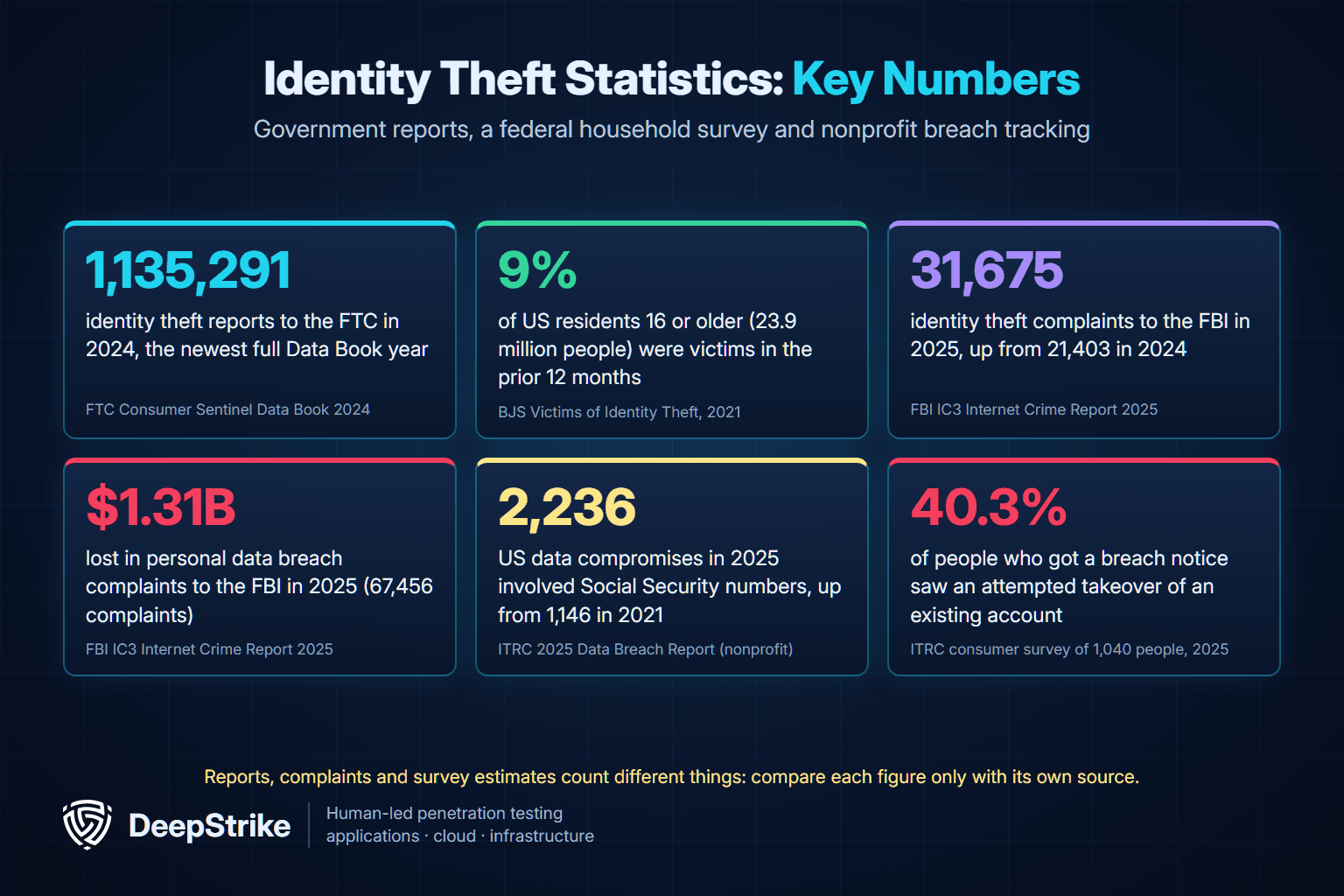
Identity theft statistics for 2026 show a common, under-reported crime increasingly fed by data breaches. The latest federal survey found 9% of US residents 16 or older, about 23.9 million people, were victims in one year. The FTC received 1,135,291 identity theft reports in 2024, its newest Data Book year. FBI identity theft complaints rose 48% in 2025, to 31,675. The nonprofit Identity Theft Resource Center counted 2,236 US data compromises in 2025 involving Social Security numbers. Below are the verified numbers, what each counts and what they mean for organizations.
Every figure below was checked against the publisher's own report or page on 5 November 2026. The sources count different things (reports, complaints, survey estimates, breach notices), so read the "What it counts" column before comparing two rows.
| Statistic | Source and date | What it counts |
|---|---|---|
| About 23.9 million people (9% of US residents 16 or older) were victims of identity theft in the prior 12 months | Bureau of Justice Statistics, Victims of Identity Theft, 2021 (October 2023) | Household survey estimate |
| 1,135,291 identity theft reports, 17.5% of all Consumer Sentinel reports | FTC Consumer Sentinel Network Data Book 2024 (March 2025) | Unverified reports filed by consumers |
| Credit card fraud was the top type, with 449,032 reports | FTC Data Book 2024 | Reports naming that type |
| Florida had the highest rate, 528 identity theft reports per 100,000 residents | FTC Data Book 2024 | Reports per 100,000 population |
| 31,675 identity theft complaints to the FBI in 2025, up from 21,403 in 2024 | FBI IC3 2025 Internet Crime Report (April 2026) | Complaints filed with IC3 |
| USD 185.8 million in losses reported in identity theft complaints in 2025 | FBI IC3 2025 Internet Crime Report | Losses named in complaints |
| 67,456 personal data breach complaints with USD 1.31 billion in reported losses in 2025 | FBI IC3 2025 Internet Crime Report | Complaints filed with IC3 |
| 2,236 US data compromises in 2025 involved Social Security numbers, up from 1,146 in 2021 | Identity Theft Resource Center (nonprofit), 2025 Annual Data Breach Report (January 2026) | Publicly reported compromises |
| 40.3% of people who received a breach notice saw an attempted takeover of an existing account | ITRC 2025 Annual Data Breach Report, consumer survey of 1,040 people | Survey of breach notice recipients |
| Synthetic identity fraud losses estimated at USD 35 billion in 2023 | Federal Reserve, FedPayments Improvement (18 November 2024) | Industry estimate cited by the Federal Reserve |
Primary sources for each row are linked in the sections below and listed under Sources and References.
As of 5 November 2026, the FTC's Consumer Sentinel reports page still lists the 2024 Data Book, published in March 2025, as its newest edition. The FTC has released 2025 totals for fraud, but not a 2025 identity theft breakdown. In testimony to the Joint Economic Committee on 25 March 2026, the FTC said consumers filed 3 million fraud reports in 2025 and reported USD 15.9 billion in losses, up from 2.6 million reports and more than USD 12 billion in 2024. Those figures cover fraud, not identity theft, so this page uses the 2024 Data Book for every FTC identity theft number and will be updated when a newer Data Book appears.
Identity theft numbers disagree because each publisher counts a different unit. Mixing them produces claims like "every few seconds someone becomes a victim" that no single dataset supports.
| Source | What it counts | Latest period | Why it is useful | Main limit |
|---|---|---|---|---|
| BJS Identity Theft Supplement | People 16 or older who say they were victims in the past 12 months | 2021 (published October 2023) | The only federal estimate of how many people experience identity theft | Data is several years old |
| FTC Consumer Sentinel | Reports filed by consumers and data contributors | 2024 (published March 2025) | Largest dataset; types, ages, states and metro areas | Unverified reports; one victim can file more than one |
| FBI IC3 | Complaints filed with the FBI's Internet Crime Complaint Center | 2025 (published April 2026) | Newest federal data; includes losses | Far fewer identity theft victims report to IC3 than to the FTC |
| ITRC (nonprofit) | Publicly reported US data compromises and victim notices | 2025 (published January 2026) | Shows the breach supply of personal data | Counts breaches and notices, not identity theft victims |
The practical rule: use BJS for "how many people", the FTC for "what kind and where", the FBI for "what was lost in reported cybercrime", and the ITRC for "where the data comes from."
The best answer to "how common is identity theft" comes from the Bureau of Justice Statistics. Its Victims of Identity Theft, 2021 report, published in October 2023 and based on the Identity Theft Supplement to the National Crime Victimization Survey (fielded July to December 2021), found:
That 7% figure explains why report-based datasets are so much smaller than the survey estimate. Most identity theft is resolved with a bank or card issuer and never reaches the police, the FTC or the FBI.
The FTC's Consumer Sentinel Network is the largest US database of identity theft reports. It collects reports filed directly with the FTC (including through IdentityTheft.gov) and from other agencies and organizations. In 2024 it received 6,471,708 reports in total, and identity theft was the second-largest of 29 categories, behind credit bureaus and information furnishers (FTC Consumer Sentinel Network Data Book 2024).
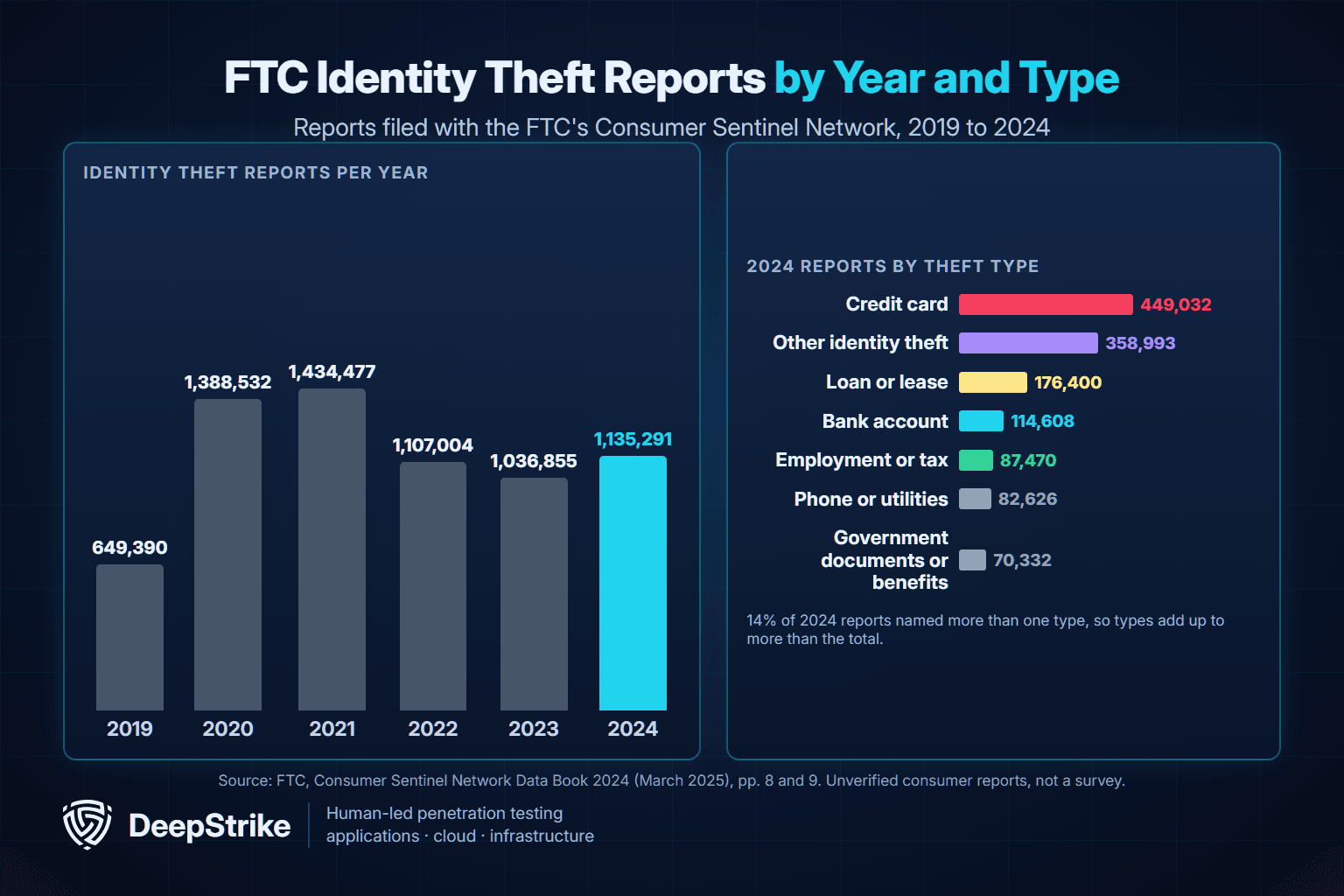
| Year | Identity theft reports to the FTC |
|---|---|
| 2019 | 649,390 |
| 2020 | 1,388,532 |
| 2021 | 1,434,477 |
| 2022 | 1,107,004 |
| 2023 | 1,036,855 |
| 2024 | 1,135,291 |
The 2024 total works out to about 3,100 reports a day (1,135,291 over 366 days; our calculation). Reports more than doubled in 2020, peaked in 2021 and then fell back. The 2024 count was about 9% higher than 2023 (our calculation). The FTC stresses that its Data Book is based on unverified reports filed by consumers, not on a survey, and that Sentinel keeps reports for five years.
The FBI's Internet Crime Complaint Center publishes the newest federal identity theft data. Its 2025 Internet Crime Report, released in April 2026, counted 1,008,597 complaints across all crime types and USD 20.9 billion in reported losses. IC3 defines identity theft as someone wrongfully obtaining and using personally identifiable information in a way that involves fraud or deception, and tracks personal data breaches as a separate category.
| IC3 crime type | 2025 complaints | 2024 complaints | 2025 reported losses | 2024 reported losses |
|---|---|---|---|---|
| Identity theft | 31,675 | 21,403 | USD 185,832,657 | USD 174,354,745 |
| Personal data breach | 67,456 | 64,882 | USD 1,314,923,988 | USD 1,453,296,303 |
| SIM swap | 971 | 982 | USD 17,366,758 | USD 25,983,946 |
Identity theft complaints rose 48% year over year and reported losses rose about 7% (our calculations from IC3's three-year comparison tables). Personal data breach complaints, where a victim's sensitive data was exposed or used without authorization, were more than twice as common as identity theft complaints and carried about seven times the losses. These complaint counts are far smaller than the FTC's because most identity theft victims never file with the FBI.
Credit card fraud has been the most reported type of identity theft to the FTC in every year since 2022. Most of it is not someone using an existing card: of the 449,032 credit card reports in 2024, 406,110 involved a new account opened in the victim's name.
| FTC identity theft type, 2024 | Reports | Largest subtypes and change from 2023 |
|---|---|---|
| Credit card | 449,032 | New accounts 406,110 (up 7%); existing accounts 52,428 (up 17%) |
| Other identity theft | 358,993 | Other 299,201 (up 46%); email or social media 22,258 (up 14%); online shopping or payment account 19,797 (up 9%) |
| Loan or lease | 176,400 | Business or personal loan 95,689 (up 18%); auto loan or lease 60,188 (up 16%) |
| Bank account | 114,608 | New accounts 62,982 (down 25%); debit cards, EFT or ACH 42,041 |
| Employment or tax-related | 87,470 | Tax fraud 54,725 (down 10%); employment or wage fraud 37,556 (up 20%) |
| Phone or utilities | 82,626 | Mobile phone new accounts 45,553 (up 5%); utilities new accounts 27,653 |
| Government documents or benefits | 70,332 | Government benefits 52,858 (down 36%) |
Source: FTC Consumer Sentinel Network Data Book 2024, pages 8 and 14. Consumers can report more than one type, and 14% of 2024 identity theft reports did, so the types add up to more than the total.
Two patterns matter for organizations. First, new-account fraud dominates: criminals use stolen personal data to open credit cards, loans, phone lines and utility accounts, which means the weak point is often an account-opening flow, not the victim's existing login. Second, email, social media and online payment account takeovers keep growing, and these start with stolen or reused credentials. Our account takeover statistics cover that side in depth. For card fraud losses, card-not-present fraud and e-skimming, see our credit card fraud statistics.
Medical identity theft is a small but serious slice of the FTC data. For PHI exposure, healthcare fraud and patient portal risk, see our separate analysis of medical identity theft statistics.
Identity theft losses are hard to total because each source measures something different:
The gap between USD 185.8 million and USD 16.4 billion is not a contradiction. Complaint data captures only the small share of victims who report to the FBI, while the survey estimates losses across the whole population, including amounts later reimbursed by banks.
The FTC ranks states by identity theft reports per 100,000 residents. In 2024 the top five were Florida, Georgia, Nevada, Texas and Delaware. California filed the most reports in absolute terms (139,665) but ranked seventh by rate.
| Rank | State | Reports per 100,000 residents | Reports |
|---|---|---|---|
| 1 | Florida | 528 | 115,840 |
| 2 | Georgia | 517 | 55,955 |
| 3 | Nevada | 466 | 14,631 |
| 4 | Texas | 393 | 116,484 |
| 5 | Delaware | 392 | 3,942 |
| 6 | Massachusetts | 388 | 27,141 |
| 7 | California | 356 | 139,665 |
| 8 | Louisiana | 346 | 15,991 |
| 9 | Illinois | 339 | 43,028 |
| 10 | Maryland | 324 | 19,990 |
| 11 | New Jersey | 313 | 29,037 |
| 12 | New York | 295 | 58,692 |
| 13 | South Carolina | 291 | 15,146 |
| 14 | Pennsylvania | 290 | 37,717 |
| 15 | Arizona | 287 | 20,863 |
| 16 | Alabama | 269 | 13,596 |
| 17 | Mississippi | 268 | 7,903 |
| 18 | Rhode Island | 264 | 2,896 |
| 19 | North Carolina | 259 | 27,466 |
| 20 | Michigan | 237 | 23,783 |
| 21 | Connecticut | 236 | 8,502 |
| 22 | Ohio | 236 | 27,766 |
| 23 | Virginia | 213 | 18,460 |
| 24 | Tennessee | 212 | 14,829 |
| 25 | Arkansas | 209 | 6,340 |
| 26 | Colorado | 208 | 12,087 |
| 27 | Indiana | 198 | 13,471 |
| 28 | Missouri | 187 | 11,535 |
| 29 | Oklahoma | 169 | 6,747 |
| 30 | Washington | 169 | 13,068 |
| 31 | Oregon | 163 | 6,898 |
| 32 | Utah | 157 | 5,224 |
| 33 | Kansas | 154 | 4,518 |
| 34 | New Mexico | 150 | 3,171 |
| 35 | New Hampshire | 150 | 2,079 |
| 36 | Wisconsin | 149 | 8,798 |
| 37 | Kentucky | 142 | 6,396 |
| 38 | Hawaii | 138 | 1,990 |
| 39 | Montana | 131 | 1,447 |
| 40 | Nebraska | 130 | 2,554 |
| 41 | Minnesota | 127 | 7,280 |
| 42 | Maine | 127 | 1,746 |
| 43 | Idaho | 125 | 2,367 |
| 44 | Iowa | 123 | 3,919 |
| 45 | Wyoming | 120 | 697 |
| 46 | North Dakota | 119 | 924 |
| 47 | West Virginia | 113 | 2,017 |
| 48 | Alaska | 106 | 780 |
| 49 | Vermont | 101 | 651 |
| 50 | South Dakota | 94 | 845 |
Source: FTC Consumer Sentinel Network Data Book 2024, page 21. Rates use 2023 US Census population estimates, and the ranking excludes reports from state-specific data contributors. States with equal rates are listed in the FTC's order. The District of Columbia (480 reports per 100,000 residents, 3,225 reports) and Puerto Rico (51 per 100,000, 1,649 reports) appear in the FTC table but are not ranked; at 480, DC's rate would sit between Georgia and Nevada.
A high rate does not prove a state has more criminals or weaker security. It reflects where victims live and how readily they report. Florida and Georgia also topped the FTC's 2024 ranking for fraud reports per capita, ahead of Delaware, Nevada and Maryland.
IC3 data shows older victims are filing more identity theft complaints and losing more. People 60 and older filed 5,359 identity theft complaints in 2025, up from 4,064 in 2024, and reported USD 48.5 million in losses, up from USD 28.5 million. They also filed 11,705 personal data breach complaints with USD 324.5 million in reported losses (FBI IC3 2025 Internet Crime Report, pages 47 and 48). Across all crime types, people 60 and older reported the largest losses of any age group in 2025, about USD 7.7 billion.
Identity theft starts with exposure. Personal data and credentials leak through data breaches, phishing, infostealer malware and password reuse, then get used to take over accounts, open new ones or build synthetic identities. This is where a consumer crime becomes an organizational security problem: much of the data that enables identity theft is stolen from companies.
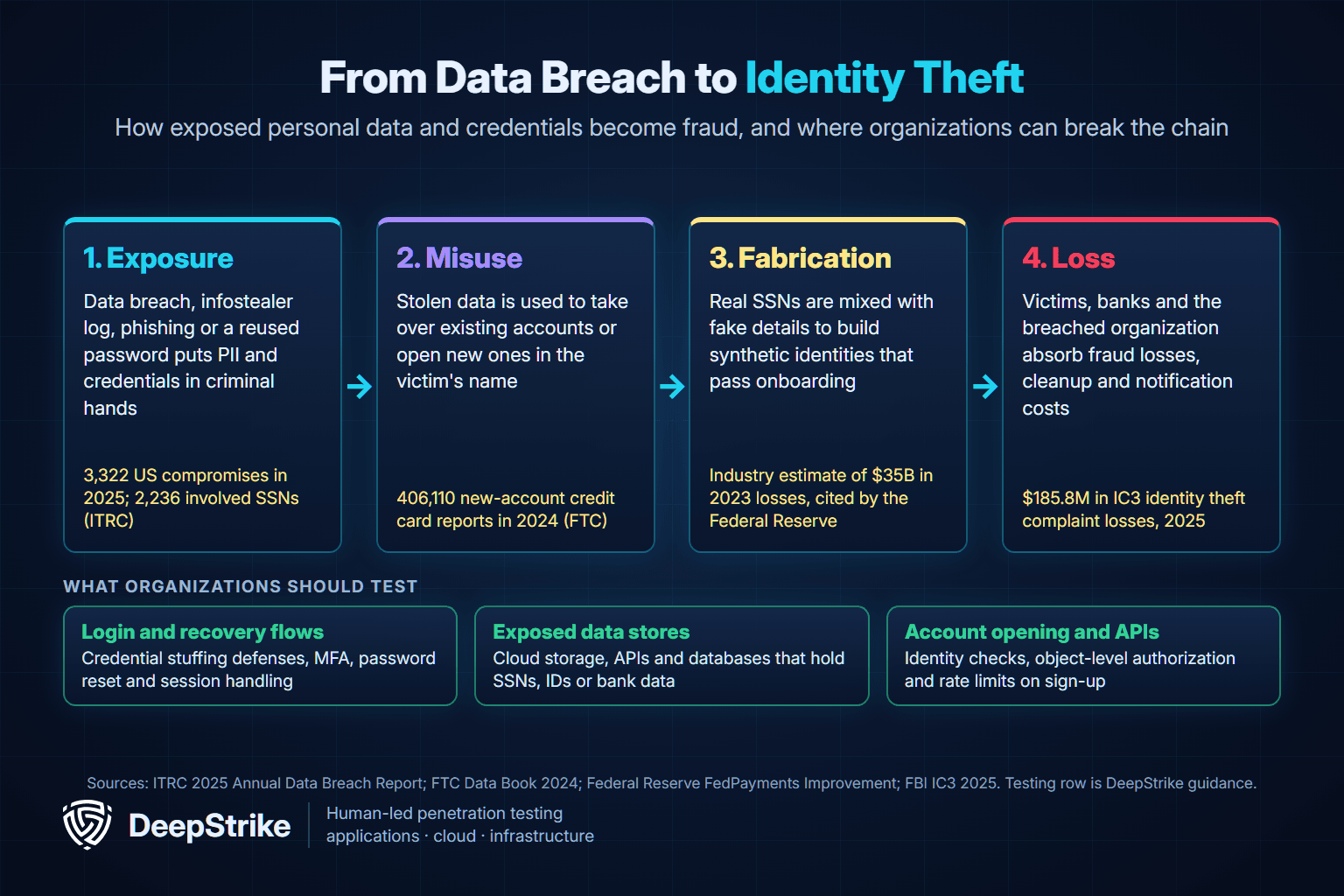
The nonprofit Identity Theft Resource Center tracked a record 3,322 US data compromises in 2025, up 5% from 3,152 in 2024, with 278,827,933 victim notices (ITRC 2025 Annual Data Breach Report, released 29 January 2026). The ITRC reports that criminals have prioritized static identifiers over easily replaced data such as card numbers:
A stolen card number can be cancelled in minutes. A Social Security number, date of birth and driver's license number stay useful for years, which is exactly what new-account fraud and synthetic identities need. Financial services was again the most breached industry, with 739 compromises. For breach volumes, causes and costs across all data types, see our data breach statistics.
Federal survey data links the two. In BJS's analysis of the 2021 survey, published in January 2024, 12% of people 16 or older had been told that an organization holding their data was breached in the prior year. Identity theft victims were twice as likely as nonvictims to have received such a notice (24% compared with 11%), and victims of multiple types of identity theft were the most likely of all (32%). The survey shows an association, not proof that a specific breach caused a specific theft, but it is the best federal evidence that breach exposure and identity theft travel together.
The ITRC's own survey of 1,040 consumers, run for its 2025 report, points the same way. Eighty percent had received a data breach notice in the past 12 months, and 88% of those reported at least one negative consequence afterward, including more phishing or scam attempts (53.7%), more spam or robocalls (49.2%) and an attempted takeover of an existing account (40.3%).
Credentials are the shortest path from a breach to identity theft. The ITRC introduced a "previously compromised data" category in 2025 to track repackaged old breach data, including two releases involving about 16 billion records with no known victim notices, and warns that this recirculated data is effective for credential stuffing and account takeover. The FBI's 2025 report highlights account takeover fraud carried out by impersonating financial institution support staff, at about 4,700 complaints and USD 359.7 million in losses, and notes that its Recovery Asset Team saw a rise in account takeover cases in 2025, some involving 50 or more simultaneous ACH transfers to different banks.
For the numbers behind leaked logins, see our compromised credential statistics, our credential stuffing statistics and our analysis of infostealer malware and credential theft.
Synthetic identity fraud is the hardest identity crime to count, because often there is no single victim to file a report. The Federal Reserve, which convened a focus group of 12 fraud experts to define it, describes synthetic identity fraud as "the use of a combination of personally identifiable information (PII) to fabricate a person or entity in order to commit a dishonest act for personal or financial gain." A typical synthetic identity combines a real Social Security number, often one belonging to a child or an older adult who rarely checks credit, with an invented name and date of birth.
The Federal Reserve does not publish its own loss total. The figures below are industry estimates that the Fed cites on its FedPayments Improvement site, and they should be read as estimates:
The Fed's 2026 material focuses on how AI is changing the problem. A June 2026 post explains that generative AI tools can now create synthetic identities and convincing supporting documents, submit applications for new bank and credit card accounts, attempt to defeat facial recognition and liveness checks during account opening, and run transactions across institutions to build credit history. It also notes that the personal data used to build these identities comes from sources including data breaches, public records and social media. That is the link back to the breach data above: every exposed Social Security number is raw material for a synthetic identity. For loss estimates, lender exposure, FinCEN filings and eCBSV data, see our full synthetic identity fraud statistics.
The statistics point to three places where an organization can break the chain between exposure and identity theft: the data it stores, the logins it protects and the accounts it lets people open. This checklist is DeepStrike's method guidance, not a requirement from any regulator.
Selection. We used only primary sources: US federal agencies (FTC, FBI IC3, BJS, the Federal Reserve) and one nonprofit that publishes its own breach data (the Identity Theft Resource Center). Every figure was read on the publisher's page or report and checked on 5 November 2026. We excluded figures that appear only in vendor blogs or aggregator pages, and we did not use 2025 FTC identity theft counts that circulate online but do not appear in a published FTC Data Book or release.
Report years. IC3 and ITRC report titles name the data year (2025). The FTC Data Book 2024 covers calendar year 2024 and was published in March 2025. The BJS figures describe 2021 and were published in October 2023 and January 2024.
Calculations. Three figures are our own arithmetic from published numbers: about 3,100 FTC identity theft reports a day (1,135,291 divided by 366), the 48% rise in IC3 identity theft complaints (31,675 against 21,403) and the 7% rise in IC3 identity theft losses. All other numbers are quoted as published.
| Source | Publisher type | Data period | Population or dataset | Method |
|---|---|---|---|---|
| BJS, Victims of Identity Theft, 2021 | US federal statistics agency | 12 months before interviews held July to December 2021 | US residents 16 or older | National household survey (NCVS Identity Theft Supplement) |
| BJS, Data Breach Notifications and Identity Theft, 2021 | US federal statistics agency | Same survey | Same | Same |
| FTC Consumer Sentinel Network Data Book 2024 | US federal agency | Calendar year 2024 | 6,471,708 reports | Unverified reports from consumers and data contributors |
| FTC testimony to the Joint Economic Committee | US federal agency | Calendar year 2025 | 3 million fraud reports | Consumer Sentinel totals; no identity theft breakdown |
| FBI IC3 2025 Internet Crime Report | US federal agency | Calendar year 2025 | 1,008,597 complaints | Complaints filed with IC3 |
| Federal Reserve, FedPayments Improvement | US central bank | 2020 to 2026 publications | Financial institutions | Definition, toolkit and cited industry estimates |
| ITRC 2025 Annual Data Breach Report | Nonprofit | Calendar year 2025 | 3,322 public compromises; survey of 1,040 consumers | Public breach notices; online survey |
Limits. Report and complaint counts measure who chose to report, not how many people were victimized. The BJS survey is the only population estimate and is several years old. ITRC counts breaches and notices, not identity theft victims. Synthetic identity loss figures are industry estimates. No single figure on this page is a complete count of US identity theft.
About 9% of US residents age 16 or older, roughly 23.9 million people, experienced identity theft in a 12-month period, according to the Bureau of Justice Statistics' latest survey (2021 data, published October 2023). About 22% had experienced it at some point in their lives. The FTC received 1,135,291 identity theft reports in 2024, about 3,100 a day.
Credit card fraud. The FTC received 449,032 credit card identity theft reports in 2024, and 406,110 of them involved a new account opened in the victim's name rather than misuse of an existing card. Loan or lease fraud and bank account fraud follow.
By rate, Florida, with 528 identity theft reports per 100,000 residents in the FTC's 2024 Data Book, followed by Georgia (517), Nevada (466), Texas (393) and Delaware (392). By total reports, California had the most, with 139,665.
The newest federal data says yes. Identity theft complaints to the FBI rose 48% in 2025, to 31,675, and reported losses rose to USD 185.8 million. FTC identity theft reports rose about 9% in 2024 to 1,135,291, although they remain below the 2021 peak of 1,434,477.
It depends on the source. The BJS survey estimated USD 16.4 billion in losses in 2021 across all victims. Complaints to the FBI listed USD 185.8 million in identity theft losses in 2025, plus USD 1.31 billion in personal data breach complaints. The USD 15.9 billion the FTC reported for 2025 covers fraud, not identity theft.
The Federal Reserve cites industry estimates of USD 20 billion in synthetic identity fraud losses for US financial institutions in 2020 and USD 35 billion in 2023. Some payments experts quoted by the Fed estimate synthetic identities make up 1% to 3% of US bank and fintech accounts. The Fed's 2026 guidance warns that generative AI now automates identity creation, applications and liveness checks.
They supply much of the data it needs. BJS found identity theft victims were twice as likely as nonvictims to have received a data breach notice (24% compared with 11%), and the ITRC found 40.3% of people who got a breach notice saw an attempted takeover of an existing account. Compromises involving Social Security numbers nearly doubled between 2021 and 2025.
Minimize and map the static identifiers they store, test the APIs and storage that hold them, harden login and recovery flows against credential stuffing and account takeover, and test account-opening flows for identity verification bypasses. Then retest after fixes.
The numbers show a steady supply chain: breaches expose identifiers that cannot be changed, stolen credentials enable account takeover, and synthetic identities exploit account opening. Organizations cannot stop consumers from being targeted, but they can reduce how much usable data leaks from their systems and how easily stolen data works against their logins and sign-up flows.
If you want to know whether your APIs, login and recovery flows or account-opening process would hold up against these attacks, DeepStrike's penetration testing services provide manual testing with fix recommendations for every finding.
Mohammed Khalil is a Cybersecurity Architect at DeepStrike, specializing in advanced penetration testing and offensive security operations. With certifications including CISSP, OSCP, and OSWE, he has led numerous red team engagements, focusing on cloud security, application vulnerabilities, and adversary emulation. His work involves dissecting complex attack chains and developing resilient defense strategies for clients in the finance, healthcare, and technology sectors.

Stay secure with DeepStrike penetration testing services. Reach out for a quote or customized technical proposal today
Contact Us
