November 6, 2026
Updated: November 6, 2026
The patterns Venmo and the FTC warn about, why recovery depends on who pressed send, and who to report it to.

Mohammed Khalil
Venmo scams are tricks that get you to send money, share a login code, or hand over an item before a payment is real. The most common versions are fake Venmo emails, texts and calls, "accidental" payments from strangers, and online buyers or sellers you don't know. What you can recover depends on who pressed send. Venmo treats a payment someone else made from your account very differently from one you approved after being deceived, which may not be reversible. Report it in the Venmo app right away, then to the FTC.
A note on sources: DeepStrike isn't affiliated with Venmo or PayPal. Scammers impersonate the Venmo brand, and Venmo publishes its own Common Scams page. The steps below come from Venmo and government sources, checked November 6, 2026. Venmo's terms can change, and this is general information, not legal or financial advice.
The fastest test is to leave the message and check the app yourself. If there's a real problem or a real request, it will be in your account. Venmo says an email about a payment request that doesn't appear in the app or on the website may be fraudulent.
Venmo also publishes a clear list of things it won't do. According to its scam guidance and login security page, Venmo will never:
If someone asks for any of these, it's a scam. Other warning signs from Venmo's phishing guidance and the FTC include:
These are forms of social engineering: the scammer works on the person, not the app. In March 2026 testimony, the FTC reported more than 1 million imposter scam reports for 2025, with over $3.5 billion in reported losses. That covers all impersonation, and the FTC's payment-method data groups payment apps together, so neither figure isolates Venmo.
This table summarizes the patterns in Venmo's guidance and its safety guide. The sections after it cover the most searched ones.
| Scam | What you see | Safe response |
|---|---|---|
| Fake email or text | Locked account, suspicious login or cash prize, with a link | Don't click. Open the app yourself |
| Fake Venmo call | "Support" asks you to read back a code | Hang up. Never share the code |
| Accidental payment | A stranger pays you, then asks for it back | Don't return it. Contact Venmo Support |
| Overpayment | A buyer pays too much and wants the difference | Don't refund it. Contact support |
| Fake payment proof | A screenshot or email says you've been paid | Check your Venmo balance and feed in the app |
| Seller who disappears | Great deal, pay first, don't mark it as a purchase | Use the purchase toggle or a business profile |
| Fake friend | Lookalike profile with an urgent request | Contact your friend outside Venmo |
| Fake tech support | A support line asks for a Venmo payment | Go to the company's site directly |
| Check for Venmo | You deposit a check and send money back | Don't exchange a check for a Venmo payment |
| Romance, job or rent request | An online contact, employer or landlord wants money moved or paid first | Don't send money to people you haven't met or verified |
These messages claim your account is locked, a login looks suspicious, or you've won money. The link leads to a fake page that collects your password or account details. Our smishing statistics show how widespread this delivery method has become.
Don't click the link or open attachments. Open the app or type venmo.com yourself, then forward the email to phishing@venmo.com and delete it, as Venmo instructs. If you entered your details, go to the steps in the What to Do section below.
A scammer tries to sign in to your account, which triggers a code to the phone number on file. They then call you, pretend to be Venmo, and ask you to read the code back, often claiming they're checking suspicious transactions or your identity.
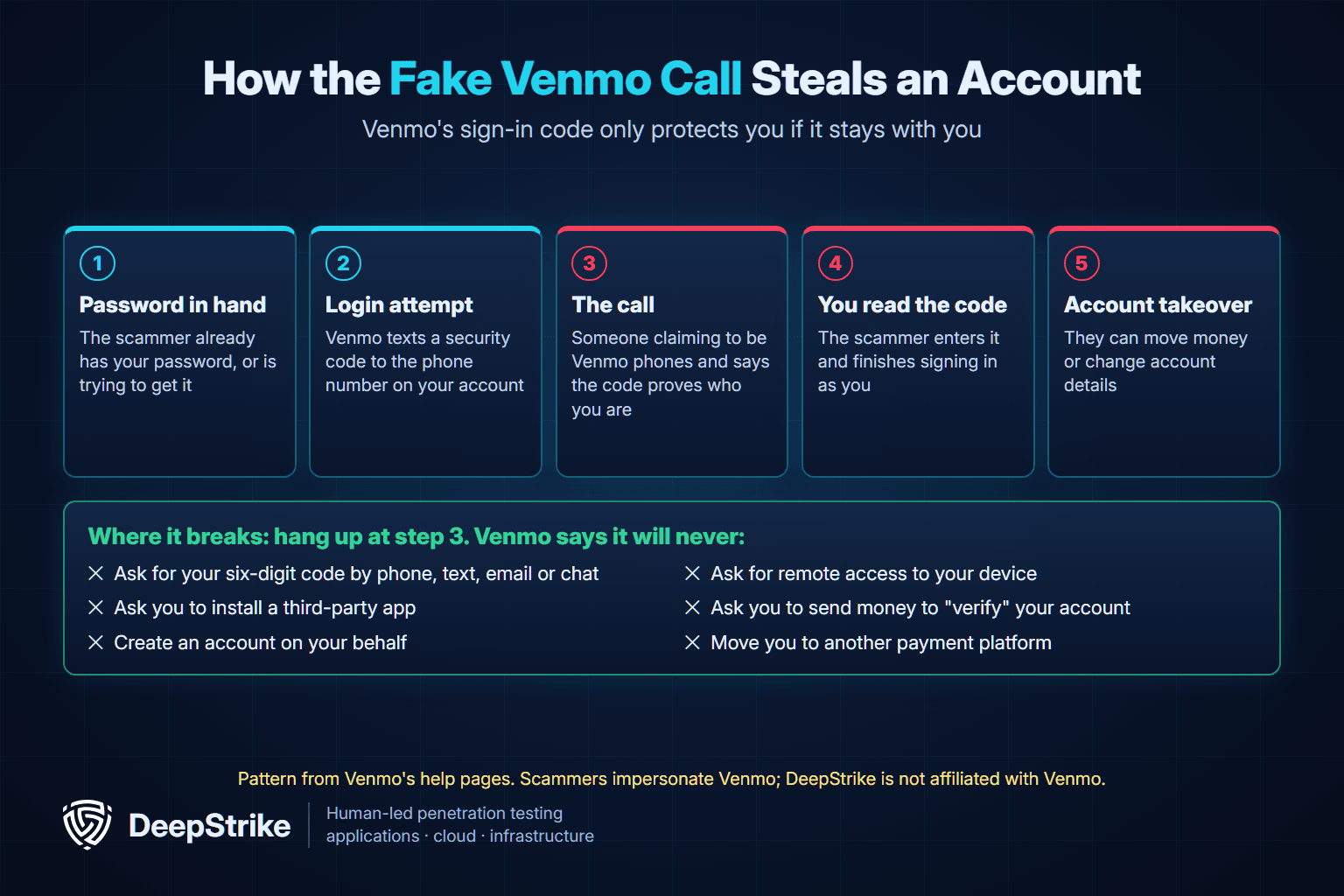
Variations include asking you to log in to an account they "created for you" or to send money to another Venmo account to protect it. Hang up and open the app. Voice phishing works because a confident caller and a real code arriving on your phone seem to confirm each other.
A stranger sends you money, then messages you to say it was a mistake and asks you to send it back. If that payment came from a stolen card or compromised account, it can be reversed later. The money you sent back is a separate payment, and you approved it yourself.
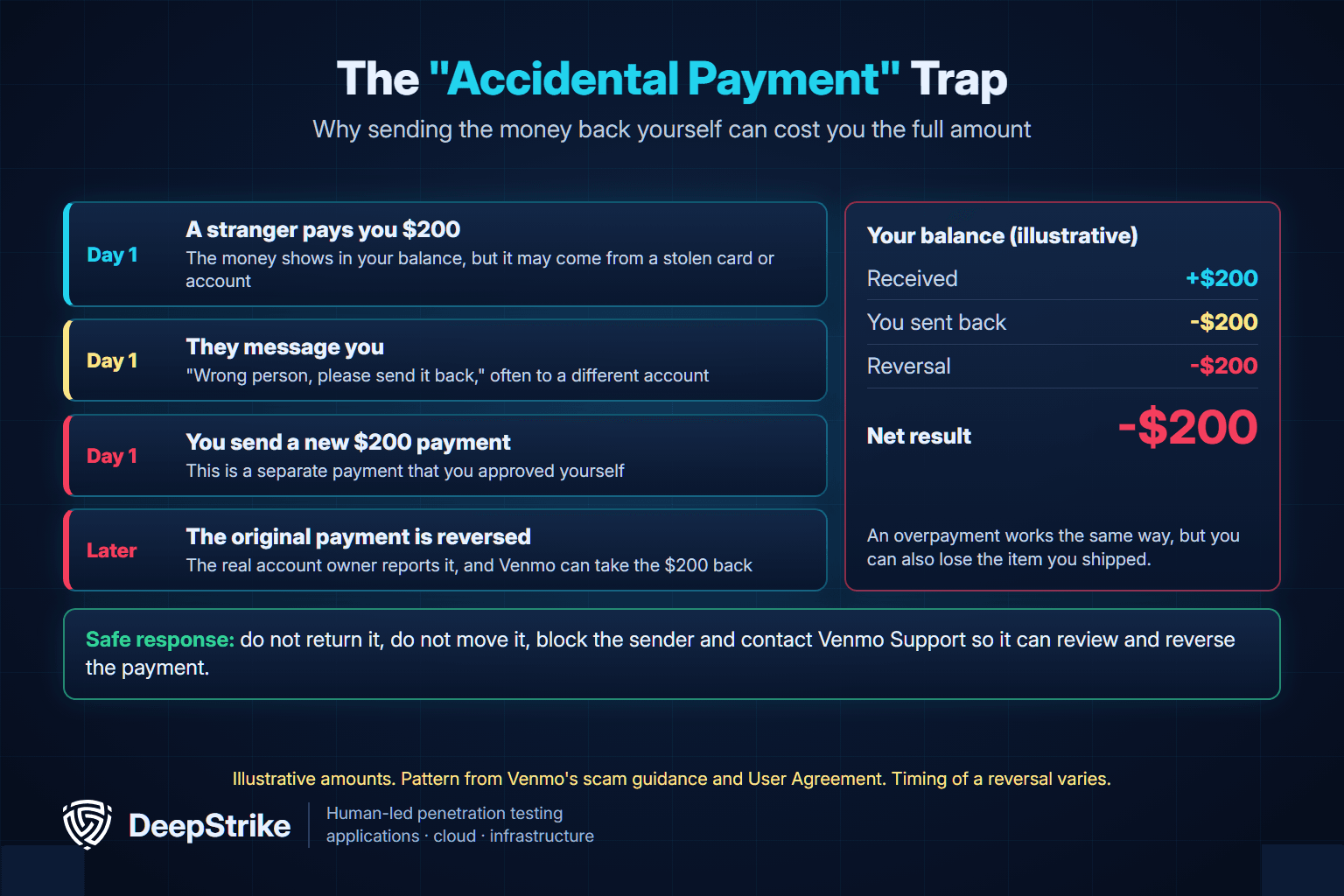
The amounts are only an illustration, and people do mistype usernames. Either way, Venmo's advice is the same: don't return the payment or move the money. Contact Support so it can review the payment, and consider blocking the sender.
These often start with a listing on a site such as Facebook Marketplace. Venmo's guidance describes three patterns:
Under its User Agreement, Venmo may hold you liable for a payment that's later invalidated, so a balance isn't final. In 2018, the FTC alleged Venmo told users money was available without adequately disclosing it could be frozen or removed. PayPal settled the case.
Venmo advises against selling to strangers on a personal account unless the buyer marks the payment as a purchase or you use a business profile. Its safety guide also suggests considering cash.
The classic version is an in-demand item at a good price: concert tickets, game consoles, sneakers or phones. You pay first, then get fake shipping details or silence. Venmo also flags pet deposits and rental deposits with no paperwork or keys.
The tell is a seller asking you not to mark the payment as a purchase. That toggle is what brings an eligible payment under Purchase Protection. It also costs the seller a 2.99% fee, which gives them a ready-made excuse.
Move quickly, and don't feel embarrassed: these scams are designed to fool careful people. Follow the steps that apply to you:
Sometimes. It turns on who pressed send, because each answer leads to a different process.
| What happened | Venmo process | Time limit | Realistic outlook |
|---|---|---|---|
| Someone else sent money from your account | Unauthorized Transaction claim | Tell Venmo at once; 60 days from the statement can limit recovery | Strongest route; Venmo says it covers the full amount when the protection applies |
| You paid for an eligible item with the purchase toggle or a business profile | Purchase Protection claim | 180 days from the payment date | Possible refund after investigation; exclusions apply |
| You sent a personal payment after being deceived | Report it and ask | Report right away | Hardest; Venmo says it may not be reversible |
| Someone paid you and wants money back | Contact Venmo Support | Right away | Don't send money back; the original can be reversed |
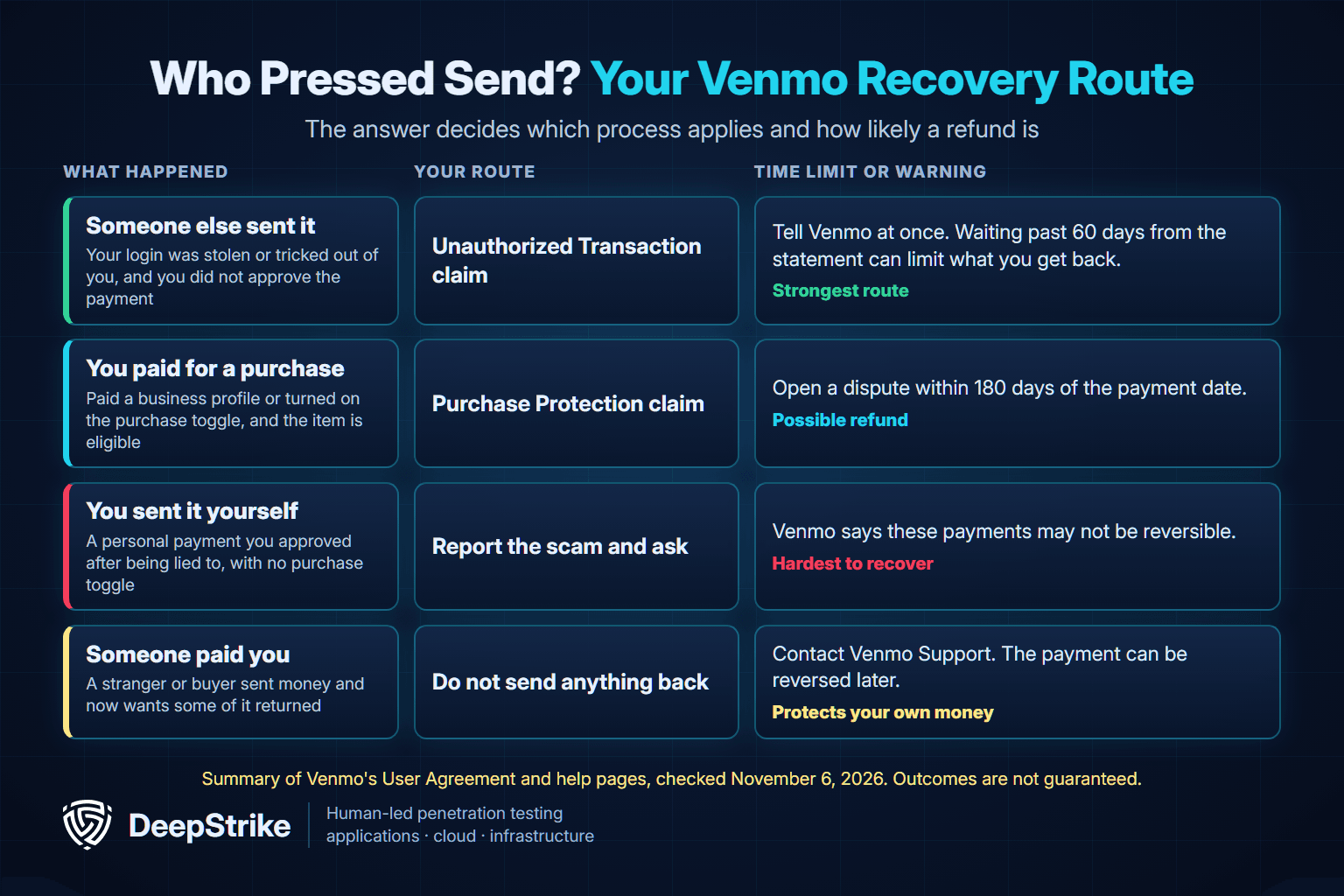
Venmo's User Agreement defines an Unauthorized Transaction as money sent from your account that you didn't authorize and that didn't benefit you. Its own example is someone who steals or fraudulently obtains your password and uses it to send a payment. When the protection applies, Venmo says it covers the full amount if you cooperate and follow its procedures.
Tell Venmo at once. If you wait more than 60 days after the statement, you may not get back money lost after that point if Venmo could have stopped it. For errors, Venmo generally decides within 10 business days and can take up to 45 days with a provisional credit, or longer for new accounts and point-of-sale transactions.
The exception is giving someone your login on purpose: Venmo says you're responsible if they exceed the access you granted. If you were tricked into giving up a code, say so plainly. CFPB compliance guidance describes a transfer made with login credentials obtained through fraudulent inducement as an unauthorized transfer under Regulation E. How that applies to your case depends on the investigation and the facts.
Purchase Protection can apply when an item never arrives, or is damaged, incomplete or different from what was described. You need a business profile payment, an eligible debit card, in-app or QR checkout, or a personal payment with the purchase toggle on. The toggle alone isn't enough, because the item must be eligible:
One caution: Venmo's Helpful Information page still says its purchase program doesn't apply to payments made in the app, which conflicts with its Purchase Protection pages. We've followed the User Agreement and the program page, but confirm with Venmo before relying on coverage for a big purchase.
Venmo says payments you approved yourself may not be reversible and are harder to recover. Its buying and selling FAQ says it may be unable to recover money lost through non-approved purchases and suggests considering local law enforcement.
The law doesn't clearly solve this. A Maryland Attorney General advisory explains that a bank may not refund a victim because the victim authorized the transfer, even if they were tricked, and calls the definition of "authorized" murky. Report it anyway. Venmo says quick reports also help stop the same scammer from reaching others.
| Where | Use it for | What to expect |
|---|---|---|
| Venmo in-app chat | Any scam, unauthorized payment or stranger's payment | Venmo can investigate your account |
| phishing@venmo.com | Fake Venmo emails and websites | Venmo reviews submissions |
| ReportFraud.ftc.gov | Any scam | Shared with law enforcers; the FTC doesn't resolve individual reports |
| FBI IC3 | Cyber-enabled fraud | Reviewed and passed on as appropriate; no status updates |
| CFPB complaint form | A problem with how a money transfer company handled your case | The CFPB sends complaints to the company for a response |
| State attorney general | Consumer complaints in your state | Services vary by state |
The reporting links are ReportFraud.ftc.gov, the FBI's IC3 and the CFPB complaint portal. The FTC's recovery guidance also names your state attorney general.
Watch for a second scam. After a loss, you may hear from someone offering to get your money back for a fee. The FTC says never to pay upfront for help with a refund, and IC3 says it doesn't work with law firms or crypto services to recover funds.
The code-reading call isn't only a consumer problem. MITRE ATT&CK T1566.004 documents voice phishing combined with multi-factor authentication requests to get people to give up their codes, and related attacks such as MFA fatigue abuse the same trust. CISA warns that not all forms of MFA are equally secure and that some are vulnerable to phishing.
Three practical controls follow:
An authorized test shows whether those rules hold under pressure. A social engineering penetration test measures how staff and processes respond to realistic pretexts, within an agreed scope. DeepStrike's penetration testing services include simulated social engineering such as phishing, calling and baiting. No test guarantees people won't be fooled, but it shows where to focus training and controls. If that would help your team, talk to us.
Yes. Scammers can send fake messages, request money, pay you with stolen funds, or sell things they don't have. Most depend on you acting before you check, so opening the app and verifying the person stops many of them.
Messages change, but the patterns stay consistent: fake account alerts, fake support calls, accidental payments and purchases from strangers. If a message worries you, don't use its link or number. Open the app, or review Venmo's scam page.
It depends on the case. Venmo says unauthorized transactions can be refunded after review, and eligible purchases may be covered by Purchase Protection. Payments you approved yourself are harder to recover and may not be reversible.
Venmo says it doesn't mean your account was hacked, and it can happen with similar usernames. Don't return or move the money. Contact Venmo Support, and consider blocking the sender.
Venmo says it encrypts bank details and doesn't share your full financial information with people you pay. The more practical risk is someone getting into your account or tricking you into sharing details. A unique password, an app lock and never sharing your code all help against account takeover.
Not automatically. A business profile can still be fake or fail to deliver, but paying one can bring eligible items under Purchase Protection. Venmo says approved business accounts show "Eligible items covered by Purchase Protection" under the Pay button. Check for that label before you pay.
Most Venmo scams come down to a request to act before you can check. Open the app yourself, keep your code private, don't return money from strangers, and use the purchase toggle when you buy. If it's already happened, work out who pressed send, report it to Venmo right away, and file with the FTC.
Mohammed Khalil is a Cybersecurity Architect at DeepStrike, specializing in advanced penetration testing and offensive security operations. With certifications including CISSP, OSCP, and OSWE, he has led numerous red team engagements, focusing on cloud security, application vulnerabilities, and adversary emulation. His work involves dissecting complex attack chains and developing resilient defense strategies for clients in the finance, healthcare, and technology sectors.

Stay secure with DeepStrike penetration testing services. Reach out for a quote or customized technical proposal today
Contact Us
