November 5, 2026
Updated: November 5, 2026
Federal Reserve, FinCEN, SSA, TransUnion and Equifax data on synthetic identity fraud losses, lender exposure, prevalence, eCBSV and AI-driven growth.

Mohammed Khalil
Synthetic identity fraud statistics are hard to pin down because the crime has no obvious victim. A fraudster pairs a real Social Security number with a fake name and birth date, builds credit, then disappears with the money. The Federal Reserve cites an industry estimate of USD 35 billion in synthetic identity fraud losses for 2023. TransUnion measured USD 2.4 billion of US credit available to suspected synthetic identities in June 2026. Yet banks filed only about 3,000 suspicious activity reports naming it in 2021. Below are the definition, the verified numbers and what each one measures.
| Statistic | Figure | Source and date | What it measures |
|---|---|---|---|
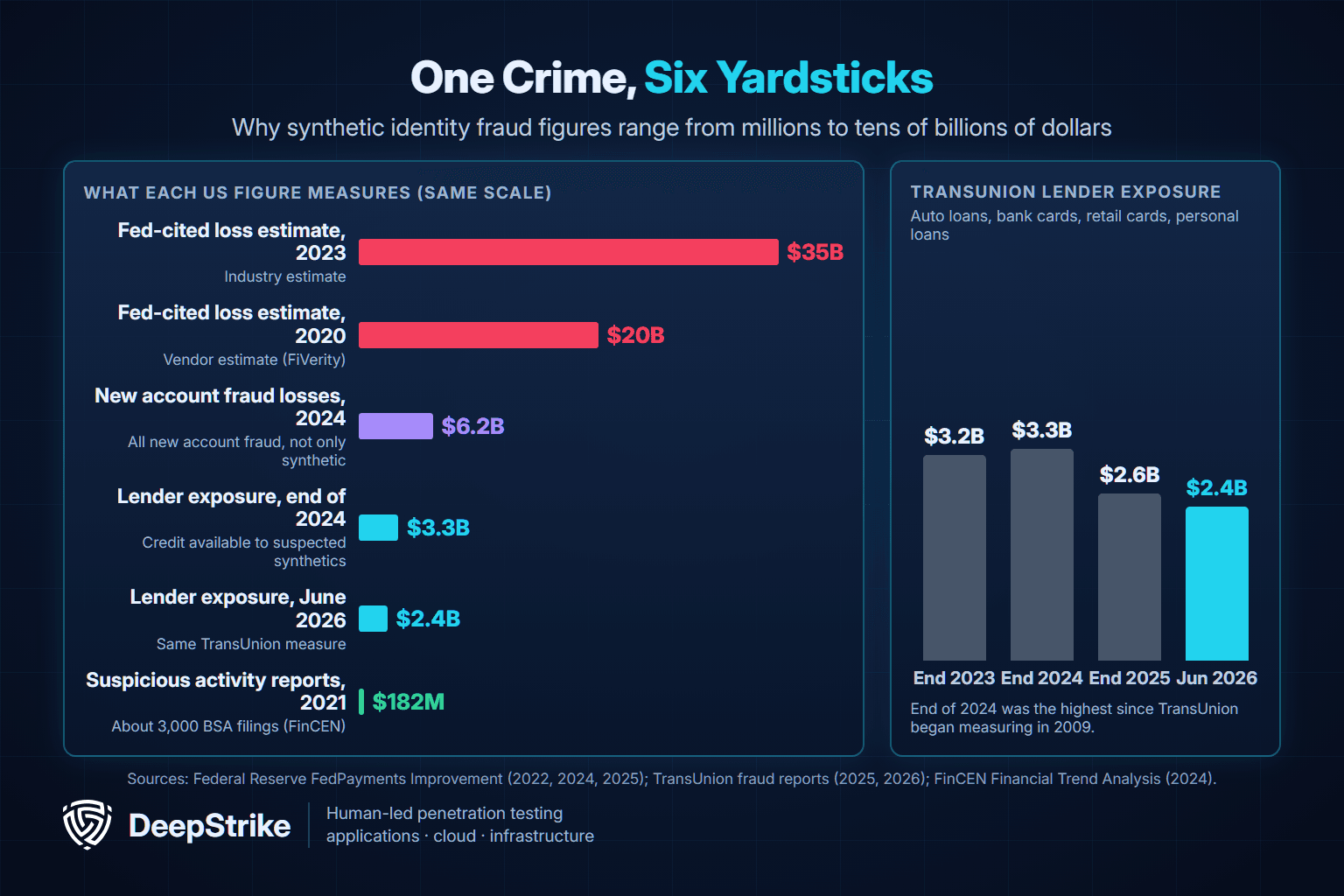
| Estimated synthetic identity fraud losses, 2023 | USD 35 billion | Federal Reserve, FedPayments Improvement (November 2024) | Industry estimate cited by the Fed |
| Estimated losses to US financial institutions, 2020 | USD 20 billion | Federal Reserve press release (February 2022), citing a 2021 FiVerity report | Vendor estimate cited by the Fed |
| US lender exposure to suspected synthetic identities, June 2026 | USD 2.4 billion | TransUnion, Top Fraud Trends H2 2026 (October 2026) | Credit available to suspected synthetics in four loan and card types, not realized losses |
| US lender exposure, end of 2024 | USD 3.3 billion, a record since 2009 | TransUnion, H1 2025 State of Omnichannel Fraud | Same measure |
| Share of US bank and fintech accounts that may be synthetic | 1% to 3% | Federal Reserve, FedPayments Improvement (September 2025) | Estimate by payments experts the Fed quotes |
| Suspicious activity reports naming synthetic identity, 2021 | About 3,000 reports, USD 182 million | FinCEN Financial Trend Analysis (January 2024) | Bank Secrecy Act filings |
| Global growth of synthetic identity fraud, 2025 | Eightfold; 11% of all fraud recorded | LexisNexis Risk Solutions Cybercrime Report (March 2026) | Vendor network data, global |
| Average charged-off loss per known synthetic identity | About USD 13,000 | Equifax (January 2026) | Tradelines opened since 2022, credit bureau data |
| Business leaders least prepared for synthetic identity fraud | 53% | TransUnion business fraud survey (June 2026) | Survey of fraud and risk decision makers |
| US data breaches that exposed full Social Security numbers, 2025 | 78% | TransUnion, H1 2026 Top Fraud Trends | TransUnion analysis of US breaches |
| Federal SSN verification service cost through fiscal 2024 | USD 66.3 million, with 21 participating entities | Social Security Administration, Federal Register (April 2025) | eCBSV development and operating cost |
| New account fraud losses, 2024 | USD 6.2 billion | Federal Reserve, FedPayments Improvement (September 2025), citing an off-site report | All new account fraud, not only synthetic |
Primary sources for each row are linked in the sections below and listed under Sources and References.
Synthetic identity fraud is the use of real and fake personal information to create a person who does not exist, then using that identity to obtain credit, open accounts or move money. The Federal Reserve, after convening a focus group of 12 fraud experts, recommends this definition: "the use of a combination of personally identifiable information (PII) to fabricate a person or entity in order to commit a dishonest act for personal or financial gain" (Federal Reserve, Synthetic Identity Fraud). The definition is voluntary and creates no reporting requirement, which is one reason the numbers below are so uneven.
The Fed's 2019 white paper describes three ways a synthetic identity is built (Federal Reserve white paper, July 2019):
| Question | Traditional identity theft | Synthetic identity fraud |
|---|---|---|
| Whose identity is used? | A real person's full identity | A new identity built from real and fake pieces |
| Who notices first? | Usually the victim, through bills or credit alerts | Often nobody; the SSN owner may be a child or an older adult who rarely checks credit |
| How fast is it detected? | Relatively quickly | Months or years later, if ever |
| How is the loss booked? | Fraud loss | Often a credit loss or charge-off |
| Who absorbs the cost? | Victim and lender | Mostly lenders, plus the SSN owner when records get mixed |
That last row matters for statistics. When a synthetic identity defaults, the lender usually sees an ordinary bad debt with no one to collect from. The Fed's white paper notes that experts believe the number of synthetic identities in portfolios is underestimated for this reason. For identity theft against real people, see our identity theft statistics.
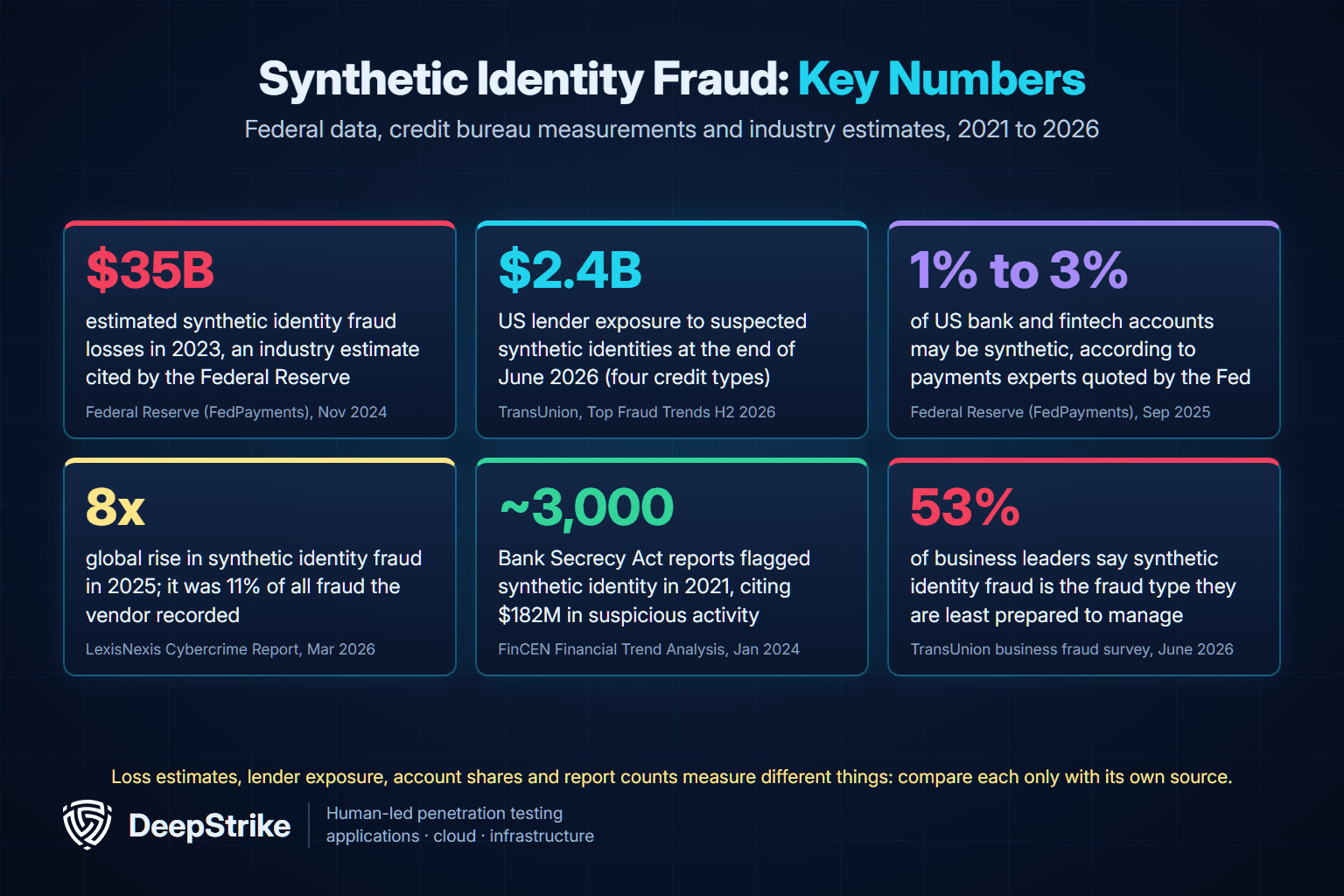
Most schemes follow four stages: fabricate the identity, apply for credit, build a credit history, and "bust out" by maxing out every line at once. A September 2025 Fed post notes that once an account is open, a criminal may wait months or even years before monetizing it, seasoning it with small deposits, withdrawals and credit applications in the meantime (FedPayments Improvement, September 2025).
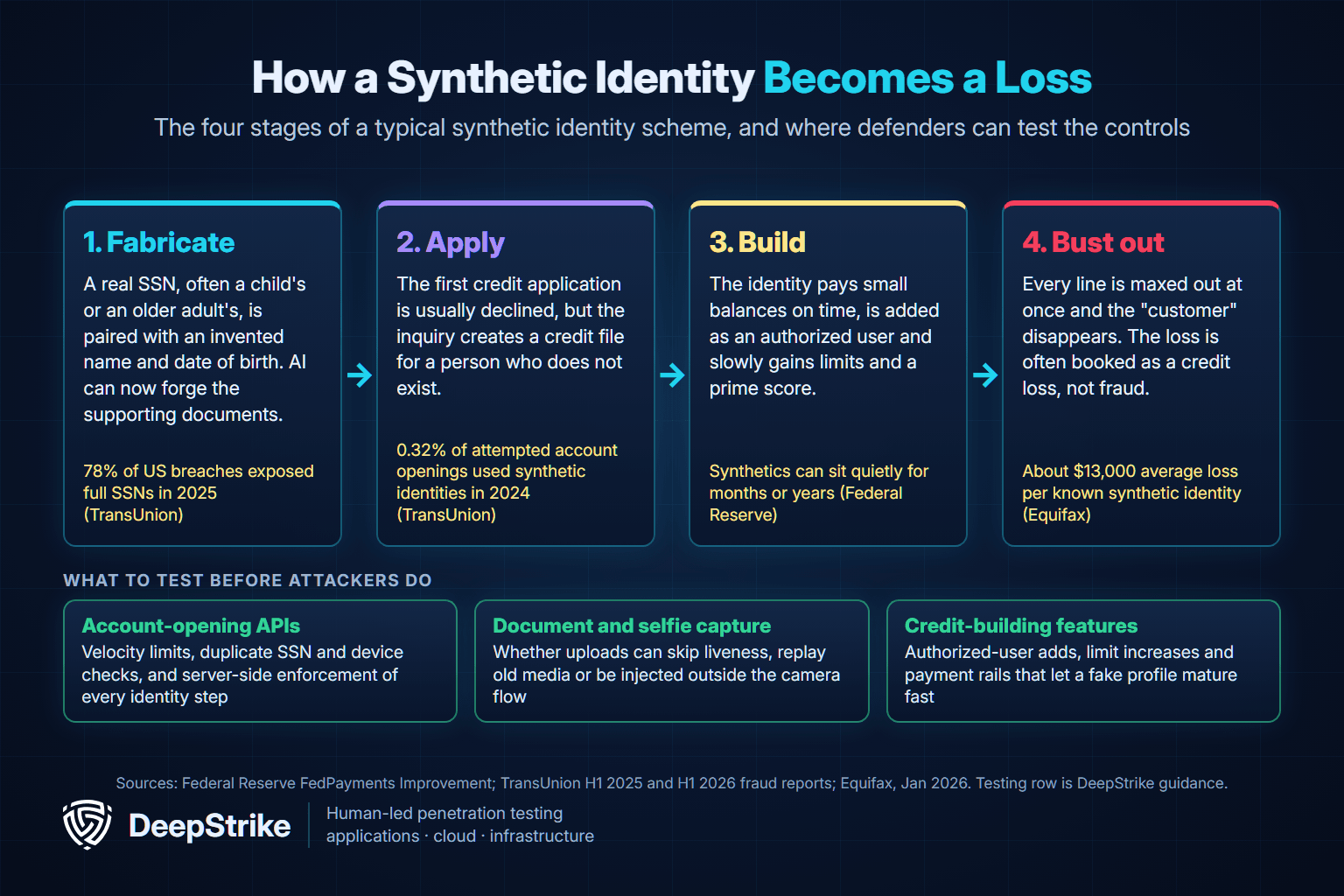
Published figures range from USD 182 million to USD 35 billion because they measure different things. None of them is an official count of US synthetic identity fraud losses, because no such count exists.
| Figure type | Example | What it actually counts | Main limit |
|---|---|---|---|
| Industry loss estimate | USD 35 billion (2023), USD 20 billion (2020) | Modeled annual losses, relayed by the Federal Reserve | Method not published on the Fed pages; the 2020 figure comes from a fraud software vendor |
| Lender exposure | USD 2.4 billion (June 2026) | Credit available to suspected synthetic identities in auto loans, bank cards, retail cards and personal loans | Potential loss at a point in time; four credit types only |
| Suspicious activity reports | About 3,000 reports, USD 182 million (2021) | Bank Secrecy Act filings that named synthetic identity | Only what institutions detected and labeled as synthetic |
| Account share | 1% to 3% of bank and fintech accounts | Experts' estimate of synthetic accounts on the books | Estimate, not a measured census |
| Share of all fraud | 11% of fraud, eightfold growth (2025) | Fraud events in one vendor's global network | Global and network-specific; not US losses |
| Survey answer | 53% least prepared; 18% call it their largest loss source | Opinions of fraud and risk decision makers | Perception, not measured loss |
Our calculation shows the size of the gap: the USD 182 million that institutions reported to FinCEN for 2021 is about 0.5% of the USD 35 billion estimate the Fed cites for 2023 (different years, so treat it as an order of magnitude). Either most synthetic identity losses are never recognized as synthetic, or the industry estimates are high. Fraud experts quoted by the Fed lean toward the first explanation: losses get booked as credit losses.
The Federal Reserve does not produce its own loss count, but it has published three industry estimates over time. Each is labeled here with its origin.
These numbers come from different methods, so the rise from USD 6 billion to USD 35 billion should not be read as a measured trend line.
TransUnion publishes the most consistent recurring US figure: the total credit that suspected synthetic identities can access in four products (auto loans, bank credit cards, retail credit cards and unsecured personal loans). It is a measure of potential loss, not money already lost, and TransUnion notes that the true exposure may be larger because it covers only the credit types it measures.
| Date | US lender exposure to suspected synthetic identities | Source |
|---|---|---|
| End of 2023 | About USD 3.2 billion | TransUnion H1 2025 report (end-2024 figure was 3% higher) |
| End of 2024 | USD 3.3 billion, the highest since TransUnion began measuring in 2009 | TransUnion H1 2025 State of Omnichannel Fraud |
| End of 2025 | USD 2.6 billion | TransUnion H1 2026 Top Fraud Trends |
| 30 June 2026 | USD 2.4 billion, of which USD 1.5 billion in auto loans | TransUnion H2 2026 Top Fraud Trends |
The October 2026 TransUnion release gives the June 2026 total; Help Net Security reports the auto lending share. The H1 2025 report also found that 0.32% of attempted account openings at the end of 2024 used synthetic identities and that bank card inquiries from synthetic identities passed 1% for the first time (TransUnion H1 2025 report).
Exposure fell between 2024 and mid-2026. That does not mean the problem shrank: exposure falls when synthetics bust out and accounts are charged off, and when lenders cut credit to suspected identities. The survey data in the prevalence section points the other way.
The Financial Crimes Enforcement Network analyzed every Bank Secrecy Act report filed in 2021 (FinCEN Financial Trend Analysis, January 2024):
The GAO repeated the USD 182 million figure when it reviewed the federal SSN verification service in 2024. The small number reflects detection and labeling, not the real scale. A synthetic identity that busts out often looks like a customer who simply stopped paying.
What fraud teams say, from TransUnion's June 2026 survey of fraud and risk decision makers:
Auto lending carries the largest exposure in TransUnion's data, about USD 1.5 billion of the USD 2.4 billion measured in June 2026. Equifax's auto data shows why it hurts:
The pattern fits the bust-out model: a synthetic identity that has built a prime score can qualify for a large car loan, then default on it.
The Federal Reserve's June 2026 post explains that generative AI combined with automation now lets criminals run four steps of a synthetic identity scheme at scale (FedPayments Improvement, June 2026):
Regulators see the same shift. On 13 November 2024, FinCEN issued an alert (FIN-2024-Alert004) after observing an increase in suspicious activity reports describing deepfake media, particularly fraudulent identity documents used to get around identity verification (FinCEN). TransUnion's H1 2026 report found that 8.3% of global digital new account creation transactions in 2025 were suspected digital fraud, the riskiest stage of the customer lifecycle it measured.
For deepfake volumes, liveness bypass data and detection research, see our deepfake statistics.
Synthetic identities are a mostly American problem because US credit relies on a static identifier, the Social Security number. The Fed's 2019 paper names three causes: the near-universal use of SSNs as identifiers, data breaches that expose more personal data, and gaps in the credit process.
For the full breach picture, see our data breach statistics and fintech breach statistics.
Congress responded directly. Section 215 of the Economic Growth, Regulatory Relief, and Consumer Protection Act of 2018 directed the Social Security Administration to build a service that lets financial institutions check, with the consumer's consent, whether a name, SSN and date of birth match SSA records. The result is the Electronic Consent Based SSN Verification service (SSA eCBSV), which returns a yes or no match and a death indicator.
| eCBSV metric | Figure | Source |
|---|---|---|
| Launch | June 2020 | GAO-24-106770 (September 2024) |
| Spending, fiscal 2018 to 2023 | About USD 62 million | GAO |
| User fees collected through fiscal 2023 | About USD 25 million (40% of cost) | GAO |
| Total cost through fiscal 2024 | About USD 66.3 million; USD 25.5 million unrecovered | SSA notice, Federal Register (7 April 2025) |
| Fees collected in fiscal 2024 | About USD 16.1 million | SSA notice |
| Participating permitted entities assumed for fiscal 2025 | 21 | SSA notice |
| Projected verifications | 68 million a year | SSA notice |
| Annual subscription fee from April 2025 | USD 5,100 (up to 10,000 checks) to USD 5,878,125 (up to 200 million checks) | SSA notice |
| Cost recovery target | Break-even by fiscal 2027 | SSA notice |
Our calculation from the April 2025 fee table: the top-tier fee works out to about 51 cents per check at 10,000 verifications a year and under 3 cents per check at 200 million. The GAO found low participation was the main obstacle: users had not grown much since enrollment opened in fiscal 2022, and industry participants found mismatch results hard to interpret. GAO records that SSA lowered fees in 2025 and, in January 2026, provided a plan to open eCBSV to entities beyond the original permitted financial institutions by June 2026. The April 2025 Federal Register notice has the full fee table.
eCBSV confirms that a name, SSN and date of birth belong together. It cannot tell whether the person applying is that person, which is why it works best alongside device, document and behavioral checks.
The numbers point to account opening as the main battleground, with the attack automated and increasingly AI-assisted. Fraud models are one control; the application logic around them is another, and it is where security testing helps. This checklist is DeepStrike's method guidance, not a regulatory requirement.
Synthetic identities are a new-account problem; stolen credentials used against existing accounts are a different one, covered in our account takeover statistics.
Selection. We used US federal sources (Federal Reserve, FinCEN, GAO, Social Security Administration) for definitions, filings and program data; credit bureau and fraud-analytics publishers (TransUnion, Equifax, LexisNexis Risk Solutions) for exposure, loss and network data, named as vendor data in each sentence; and one nonprofit (ITRC) for breach counts. Every figure was read on the publisher's page or report and checked on 5 November 2026. We did not use vendor figures that appear only in marketing material without a date or method.
Labels. "Estimate" means a modeled figure, usually relayed by the Federal Reserve. "Exposure" means credit available to suspected synthetic identities. "Survey" means respondents' answers. "Our calculation" marks our arithmetic: the 0.5% comparison of FinCEN reports with the Fed-cited estimate (USD 182 million divided by USD 35 billion) and the eCBSV cost per check (USD 5,100 divided by 10,000; USD 5,878,125 divided by 200 million).
| Source | Publisher type | Data period | Population or dataset | Method |
|---|---|---|---|---|
| Federal Reserve, FedPayments Improvement | US central bank | 2019 to 2026 publications | Payments industry | Definition, white paper and cited industry estimates |
| FinCEN Financial Trend Analysis | US Treasury bureau | Calendar year 2021 | About 3.8 million BSA reports | Automated and manual review of filings |
| GAO-24-106770 | US federal audit agency | Fiscal 2018 to 2023 | eCBSV program | Document review, SSA data, 16 industry interviews |
| SSA Federal Register notice | US federal agency | Through fiscal 2024; fees from April 2025 | eCBSV program | Agency cost and fee data |
| TransUnion fraud reports | Credit bureau | 2009 to June 2026; survey June 2026 | US consumer credit data; 1,600 fraud and risk decision makers in eight markets | Proprietary exposure formula; survey |
| Equifax | Credit bureau | Tradelines since 2022; data to December 2025 | US consumer credit files | Proprietary synthetic risk score |
| LexisNexis Risk Solutions Cybercrime Report | Risk analytics vendor | January to December 2025 | More than 116 billion transactions, global | Network fraud classification |
| ITRC 2025 Annual Data Breach Report | Nonprofit | Calendar year 2025 | Public US breach notices | Compromise tracking |
Limits. No US agency counts synthetic identity fraud losses. Loss estimates use unpublished methods, exposure is not loss, and suspicious activity reports capture only what institutions recognized. Vendor network shares are global. Treat every figure as an indicator of scale, not a precise total.
Synthetic identity fraud is creating a fictitious person from a mix of real and fake personal information, typically a real Social Security number with an invented name and date of birth, and using that identity to open accounts or borrow money. The Federal Reserve defines it as using a combination of PII to fabricate a person or entity for a dishonest act or financial gain.
No official count exists. The Federal Reserve cites industry estimates of USD 20 billion in losses for US financial institutions in 2020 and USD 35 billion in 2023. TransUnion measured USD 2.4 billion in US lender exposure to suspected synthetic identities in June 2026, and Equifax puts the average loss per known synthetic identity at about USD 13,000.
Payments experts quoted by the Federal Reserve estimate synthetic identities make up 1% to 3% of US bank and fintech accounts. LexisNexis Risk Solutions found synthetic identities in 11% of the fraud it recorded globally in 2025, an eightfold rise from 2024. TransUnion found 0.32% of attempted account openings used synthetic identities at the end of 2024.
Identity theft uses a real person's identity, so the victim usually notices and reports it. Synthetic identity fraud creates a new identity from real and fake data, so there is often no one to notice. The loss tends to land on lenders and is frequently recorded as a bad debt rather than fraud.
Lenders and card issuers absorb most of the losses. People whose Social Security numbers are used can also be harmed when their records get mixed with a synthetic identity. The Federal Reserve notes the SSNs often belong to children, older adults or homeless people, who are less likely to check their credit.
eCBSV is the Social Security Administration's Electronic Consent Based SSN Verification service, launched in June 2020. With the consumer's consent, it tells a financial institution whether a name, SSN and date of birth match SSA records. It helps catch identities that do not match, but it cannot confirm that the applicant is the real number holder, so it works best with other checks.
Yes, according to the Federal Reserve and FinCEN. The Fed says generative AI can now create identities and documents, submit applications, attempt to pass facial recognition and liveness checks, and mature accounts at scale. FinCEN reported an increase in suspicious activity reports describing deepfake identity documents in November 2024.
Combine identity data checks (including SSN verification), device and behavioral signals and consortium data with sound application security. Test that every onboarding step is enforced server-side, that velocity and duplicate checks hold under automation, that document and selfie capture cannot be bypassed, and that credit-building features have abuse limits.
Synthetic identity fraud is measured in very different ways, but the sources agree on the direction: more stolen SSNs, more automated applications and more AI-made documents aimed at account opening. Fraud models catch part of it. The rest depends on whether your onboarding APIs, verification steps and credit features enforce the controls they are supposed to.
If you want to know whether your account-opening and lending flows would hold up against automated synthetic identity attacks, DeepStrike's penetration testing services provide manual testing of web applications, APIs and mobile apps, with fix recommendations for every finding. For the wider sector picture, see our financial services cybersecurity statistics.
Mohammed Khalil is a Cybersecurity Architect at DeepStrike, specializing in advanced penetration testing and offensive security operations. With certifications including CISSP, OSCP, and OSWE, he has led numerous red team engagements, focusing on cloud security, application vulnerabilities, and adversary emulation. His work involves dissecting complex attack chains and developing resilient defense strategies for clients in the finance, healthcare, and technology sectors.

Stay secure with DeepStrike penetration testing services. Reach out for a quote or customized technical proposal today
Contact Us
