July 21, 2026
Updated: July 21, 2026
A buyer and security-leader guide to scope, preparation, reporting, remediation, and retesting

Mohammed Khalil
Important authorization note: External penetration testing requires explicit written authorization and must stay within approved assets, dates, techniques, and safety limits. Public accessibility is not permission to test. Third-party, cloud, shared, partner, or customer-owned systems may require separate approval. Testing should be conducted by qualified personnel under agreed rules of engagement. This article is educational and is not legal advice.
External penetration testing often called external network penetration testing is an authorized, time-bounded assessment of approved internet-facing systems from an outside-attacker perspective. Testers combine discovery, manual analysis, and controlled validation to determine whether exposed weaknesses can lead to unauthorized access or meaningful business impact. Scope may include public IPs, VPNs, remote-access gateways, DNS, email services, web applications, APIs, and cloud-hosted workloads, but none is included automatically. The statement of work and rules of engagement define targets, access, depth, timing, techniques, and safety limits. Unlike a scanner export, a professional external pentest validates selected risks in context; it does not prove the internal environment, every application workflow, or the organization as a whole is secure.
The result is a snapshot under stated conditions. It describes what qualified testers assessed during a defined period not a permanent guarantee that every weakness has been found or that the wider environment is secure. NIST SP 800-115 remains useful for planning, conducting, analyzing, and following up technical security assessments, although it predates many modern cloud and API patterns.
Coverage follows the objective and contract. External network penetration testing usually centers on internet-reachable hosts and services. Authenticated application, API, identity, or cloud control-plane depth may require separate credentials, test tenants, specialists, and test cases.
| Asset Category | Examples | Typical External Test Focus | Scope / Approval Note |
|---|---|---|---|
| Public IP ranges | IPv4 blocks, static cloud IPs | Reachable services, admin exposure, configuration | Verify allocation, ownership, NAT, and active hosts. |
| Edge devices | Firewalls, gateways, reverse proxies | Internet-visible interfaces and edge settings | Use tighter limits for fragile or managed devices. |
| VPN and remote access | SSL VPN, RDP gateway, zero-trust portal | Authentication surface, versions, access policies | Broad password attacks need explicit approval. |
| Internet-facing servers | Web, mail, file transfer, DNS | Exposure, patching, configuration, unsafe defaults | Flag legacy or availability-sensitive systems. |
| DNS | Authoritative zones, public records | Delegation, records, and configuration | Registrar or hosted DNS may be third-party owned. |
| Email gateways | SMTP and external mail controls | Observable service and mail-security settings | Phishing and mailbox access are separate scopes. |
| Web applications | Customer, admin, and public portals | Surface review or stated application depth | Authenticated logic needs explicit coverage; see web application penetration testing. |
| Public APIs | REST, GraphQL, partner endpoints | Exposure; authorization only when included | Provide specs, roles, test data, and rate limits. |
| Cloud-hosted workloads | Public VMs, load balancers, endpoints | Internet-reachable workload exposure | Cloud IAM, storage, serverless, and Kubernetes are separate decisions. |
| Identity portals | SSO, federation, customer identity | External authentication and access paths | Provider rules and test accounts may apply. |
| File transfer | SFTP, managed transfer portals | Exposure, authentication, configuration, access | Minimize access to real data. |
| Public admin interfaces | Device, hosting, database consoles | Unauthorized reachability and access control | Set strict stop and escalation rules. |
| CDN and WAF paths | Edge and origin hostnames, cached routes | Through-edge testing; approved origin phase if included | Record whether testing used edge, origin, or both. |
| IPv6 exposure | Global addresses, AAAA-linked hosts | IPv6 services and control differences | Include IPv6 or document its exclusion. |
| Subsidiary assets | Acquired domains, inherited ranges | Authorized exposure tied to the objective | Corporate relationship alone is not permission. |
An external pentest starts from the internet, but each visible asset still needs verified ownership, an approved scope, and clear testing boundaries.
Exclusions vary, but high-risk, disruptive, third-party, or post-compromise activity requires explicit approval and safety planning.
| Area | Default Treatment | Why | What Is Needed to Include It |
|---|---|---|---|
| Unowned or uncontrolled assets | Excluded | Visibility is not legal authority | Ownership evidence and written authorization. |
| Third-party SaaS or managed platforms | Excluded | Shared infrastructure and provider terms | Vendor permission, tenant boundary, approved plan. |
| Cloud provider infrastructure | Excluded | Customers authorize only their resources | Provider policy and customer-resource-only scope. |
| Customer or partner environments | Excluded | Separate organizations and data | Their authorization and isolated arrangements. |
| Internal subnets and Active Directory | Excluded | Outside the external boundary | Separate internal or assumed-breach scope. |
| Physical access | Excluded | Different legal and safety risks | Site-specific authorization and controls. |
| Social engineering or phishing | Excluded | Human targets create distinct risk | Approved recipients, timing, content, escalation. |
| Denial-of-service or exhaustion | Prohibited by default | May disrupt production or shared services | Exceptional approval, safeguards, recovery plan. |
| Destructive actions | Prohibited | May corrupt data or operations | Prefer non-destructive proof; executive exception only. |
| Real customer data beyond minimum proof | Avoided | Privacy and contractual exposure | Data-minimization, handling, notification, stop rules. |
| Persistence or malware deployment | Excluded | Extends risk beyond validation | Separate red-team plan, containment, cleanup. |
| Broad credential attacks | Excluded or constrained | Lockout and service-impact risk | Approved accounts, rates, thresholds, monitoring. |
| Production payment abuse | Prohibited by default | Financial and customer impact | Dedicated test instruments and processor approval. |
| Unapproved pivoting | Excluded | A foothold does not expand scope | Pre-approved targets or rapid scope change. |
| Assessment | Starting Perspective | Primary Scope | What It Answers | Not Automatically Covered |
|---|---|---|---|---|
| External network pentest | Internet, outside trusted network | Public hosts, gateways, services | Can an outsider exploit perimeter infrastructure? | App logic, cloud IAM, internal movement. |
| Web application pentest | Browser and application roles | Routes, sessions, workflows, logic | Can application flaws expose data or functions? | Full perimeter or cloud controls. |
| API pentest | API consumer and defined roles | Endpoints, objects, authorization | Can API access control or workflows be abused? | Non-API infrastructure. |
| Cloud pentest | Cloud tenant and approved identities | IAM, storage, workloads, control plane | Can cloud permissions create exploitable paths? | Provider infrastructure or other tenants. |
| Internal / Active Directory test | Internal access or assumed breach | Hosts, identity, segmentation, AD | What can an insider or foothold reach? | Initial internet exposure. |
| Red-team assessment | Objective-led simulation | People, process, technology, detection | Can an adversary reach a goal and be detected? | Exhaustive vulnerability coverage. |
An internet-facing application may be reachable in a network pentest without authenticated workflow, business-logic, role, or API authorization testing. A public cloud IP also does not include IAM, storage, containers, serverless, or organization policy. Use the internal vs external penetration testing guide when choosing the starting perspective.
Inventory and authorization are separate. A domain may be third-party hosted, an IP may belong to a CDN, and a discovered hostname may not be approved.
| Scope Layer | Inventory Inputs | Ownership Evidence | Depth Decision | Common Exclusion / Risk |
|---|---|---|---|---|
| Domains and subdomains | DNS, certificates, CMDB, cloud records | DNS control and application owner | Discovery, service review, or app depth | Forgotten or vendor-managed hosts. |
| IPv4 ranges | RIR, ISP, firewall/NAT records | Allocation and network owner | Range discovery plus approved active hosts | Leased, reassigned, or partner addresses. |
| IPv6 ranges | IPAM, cloud interfaces, AAAA | Allocation and network control | Equivalent validation or explicit exclusion | Parallel exposure and inconsistent controls. |
| ASN/provider context | Routing and provider records | Route ownership and assignment | Inventory clue, not blanket scope | ASN may include unrelated customers. |
| Cloud public addresses | Cloud inventory, load balancers, DNS | Account/project and resource IDs | Workload-only or separate cloud assessment | Ephemeral and provider-managed services. |
| CDN/WAF-fronted assets | DNS chains, edge and origin records | Tenant and origin ownership | Through edge, approved origin, or both | Provider testing or unapproved bypass. |
| VPN and remote access | IAM, network, gateway records | Service owner and tenant control | Unauthenticated review or approved roles | Lockouts and provider limits. |
| Email and DNS | MX/NS records, provider consoles | Domain and tenant control | Observable configuration and approved tests | Provider infrastructure and human targeting. |
| Web apps and APIs | Route/API catalog, gateway records | Application owner and deployment | Surface review or authenticated assessment | Unknown roles, endpoints, partner APIs. |
| Third-party hosted systems | Vendor register, contracts, DNS | Contract and vendor permission | Observe only until approved | Shared tenancy, data, provider policy. |
| Subsidiaries/acquisitions | Legal inventory and regional CMDBs | Entity authorization and local owner | Separate scope line and contacts | Unclear ownership or control. |
| Shadow/forgotten assets | Reconnaissance candidates | Verify before active testing | Report; add only through change control | Discovered does not mean authorized. |
| Model | Information Provided | Strength | Limitation | Best Use |
|---|---|---|---|---|
| Black-box / unknown | Seed domains or minimal context | Tests discovery and visible exposure | Discovery time and ownership ambiguity | Measure what an outsider can find. |
| Grey-box / partially known | Verified assets, context, limited accounts | Improves coverage and efficiency | Less pure discovery realism | Most buyer-led assessments. |
| Known-asset external | Fixed targets and service context | Predictable effort and transparent coverage | Misses unknown exposure unless discovery is added | Tightly controlled or compliance-bound scope. |
Labels vary. State the exact information, credentials, roles, targets, and exclusions; do not rely on “black box” or “grey box” alone. Authenticated application depth remains a separate decision.
This lifecycle aligns with planning and evidence principles in PTES pre-engagement interactions, NIST guidance, and the stable OWASP Web Security Testing Guide when web components are explicitly included. For broader framework detail, use DeepStrike’s penetration testing methodology guide.
The External Exposure Validation Loop is an editorial framework for this guide, not a confirmed proprietary service methodology:
The loop prevents testing visible but unauthorized assets and stopping at report delivery.
The External Exposure Validation Loop connects attack-surface discovery to authorized testing, remediation, and verified closure.
Production testing can reveal realistic exposure, but it is not inherently non-disruptive. The rules of engagement (RoE) should make the operating boundary unambiguous. Broader scoping decisions are covered in the penetration testing scope guide.
| RoE Item | Decision to Record | Why It Matters |
|---|---|---|
| Written authorization | Authorizers, signatures, covered testers | Establishes permission. |
| Exact targets | Domains, IPs, assets, tenants, environments | Prevents third-party testing. |
| Dates and time zone | Start, end, controlling time zone | Bounds authorization. |
| Testing windows | Allowed daily windows | Protects operations. |
| Blackout periods | Releases, payroll, events, freezes | Avoids sensitive periods. |
| Source systems/IPs | Expected sources and changes | Supports monitoring and allowlists. |
| WAF/CDN approach | Through edge, approved origin, or both | Defines tested traffic paths. |
| Knowledge model | Announced, limited-knowledge, deconflicted | Balances realism and control. |
| SOC/help-desk coordination | Who knows and expected alert handling | Avoids confusion. |
| Allowed techniques | Approved categories and validation depth | Ties work to objectives. |
| Prohibited techniques | DoS, destruction, real-data access, persistence | Reduces unacceptable risk. |
| Rate/concurrency limits | Per-service limits and stop rules | Protects fragile systems. |
| Account lockout protection | Test accounts, exclusions, thresholds | Protects real users. |
| Production safety | Fragile assets, backups, recovery readiness | Supports controlled response. |
| Third-party approval | Evidence and contact per provider-owned asset | Visibility is not permission. |
| Cloud policy review | Applicable rules and notifications | Provider policies change. |
| Critical escalation | Trigger, channel, recipients, deadline | Enables prompt treatment. |
| Emergency stop | Process and authorized callers | Stops testing quickly. |
| Incident handling | When test activity becomes an incident | Preserves roles and evidence. |
| Evidence collection | Minimum proof and prohibited data | Limits exposure. |
| Data handling | Encryption, access, transfer, location | Protects engagement data. |
| Retention/deletion | Retention term and confirmation | Limits long-term risk. |
| Communication cadence | Kickoff, checkpoints, closeout | Maintains awareness. |
| Retest rules | Window, eligible findings, new scope | Avoids closure disputes. |
Legal, procurement, security, asset owners, cloud teams, and operations may all need to review the engagement documents. Cloud rules must be checked on the test date: AWS permits testing only for listed services and conditions; Microsoft publishes unified rules for Microsoft online assets; and Google Cloud says notification is not required for project testing but activity must comply with its terms and affect only the customer’s projects.
| Preparation Item | Owner | Evidence / Input | Risk If Missing |
|---|---|---|---|
| Business objective | Security sponsor | Decision and success criteria | Generic scan. |
| Authoritative inventory | Infrastructure/cloud | CMDB, IPAM, DNS, cloud export | Missing or misowned targets. |
| Public IP/domain list | Network/DNS | IPv4, IPv6, domains, subdomains | Coverage gaps. |
| Architecture/data flow | Architecture/product | Diagram and trust boundaries | Weak impact and safety context. |
| Web/API/cloud components | AppSec/cloud | Catalog, roles, specifications | Specialist depth omitted. |
| Ownership records | Legal/asset owners | Allocation, tenant, contract evidence | Unauthorized testing risk. |
| Third-party approvals | Vendor management | Written permission and limits | Improper shared-service testing. |
| Provider policy review | Cloud/service owner | Current policy; ticket if needed | Account or service action. |
| WAF/CDN details | Network/AppSec | Edge and origin paths | Unclear tested path. |
| Test accounts/data | Product/IAM | Isolated roles and synthetic data | Shallow or unsafe auth testing. |
| Production/staging decision | Business owner | Equivalence and risk decision | Unrealistic or disruptive results. |
| Backup/recovery readiness | Operations | Relevant recovery confirmation | Unprepared instability response. |
| SOC notification model | SOC lead | Deconfliction or detection plan | Mishandled alerts. |
| Emergency contacts | Sponsor/operations | Primary and backup contacts | Slow stop response. |
| Windows/blackouts | Change management | Calendar and time zone | Operational collision. |
| Compliance objective | GRC/assessor | Requirement and system boundary | Evidence misses the need. |
| Report audience | Sponsor/GRC/engineering | Executive and technical recipients | Poorly calibrated report. |
| Remediation owner | Security/engineering | Ticket workflow and service owners | Findings stall. |
| Retest expectations | Sponsor/provider | Eligibility, deadline, status format | Ambiguous closure. |
Give every bidder the same scope brief: active hosts, ranges, domains, IPv6, asset types, apps/APIs, cloud platforms, roles, access, windows, restrictions, reporting, compliance mapping, and retesting. Address-space size alone can mislead. See the penetration testing quote guide.
An appropriately scoped engagement may identify:
A finding is not proof of exploitability. Safe validation and business context improve prioritization, while untested internal systems, workflows, source code, and future changes remain outside the result.
| Assessment | Main Question | Frequency Model | Manual Validation | Best Used When | Limitation |
|---|---|---|---|---|---|
| External scan | What known issues appear on reachable assets? | Recurring or event-driven | Limited | Broad hygiene checks | May lack context or impact. |
| External pentest | Can selected weaknesses create meaningful impact? | Periodic and change-driven | Core | Controlled validation | Time-bounded, not continuous. |
| EASM | What public assets and changes are visible? | Continuous | Selective | Inventory drift | Discovery is not authorization. |
| Web/API pentest | Can roles, objects, or workflows be abused? | Release-, risk-, or cadence-driven | Core | Application and API risk | Not perimeter or cloud coverage. |
| Cloud pentest | Can IAM, configuration, or workloads be abused? | Change-, risk-, or cadence-driven | Core | Cloud paths matter | Provider infrastructure excluded. |
| Internal pentest | What can an insider or foothold reach? | Periodic and change-driven | Core | AD and post-breach impact | Not initial internet exposure. |
| Red team | Can an adversary achieve a goal and evade or trigger defenses? | Objective-led | Extensive | Detection and response realism | Not exhaustive coverage. |
| BAS | Do controls respond to repeatable simulations? | Recurring or continuous | Low to moderate | Scaled control validation | Library and environment limit realism. |
| Continuous pentesting | Can validation keep pace with change? | Continuous program | Model-dependent | Fast-changing estates | May mean scanning unless defined. |
For the broad distinction between scanning and human-led validation, see vulnerability assessment vs penetration testing.
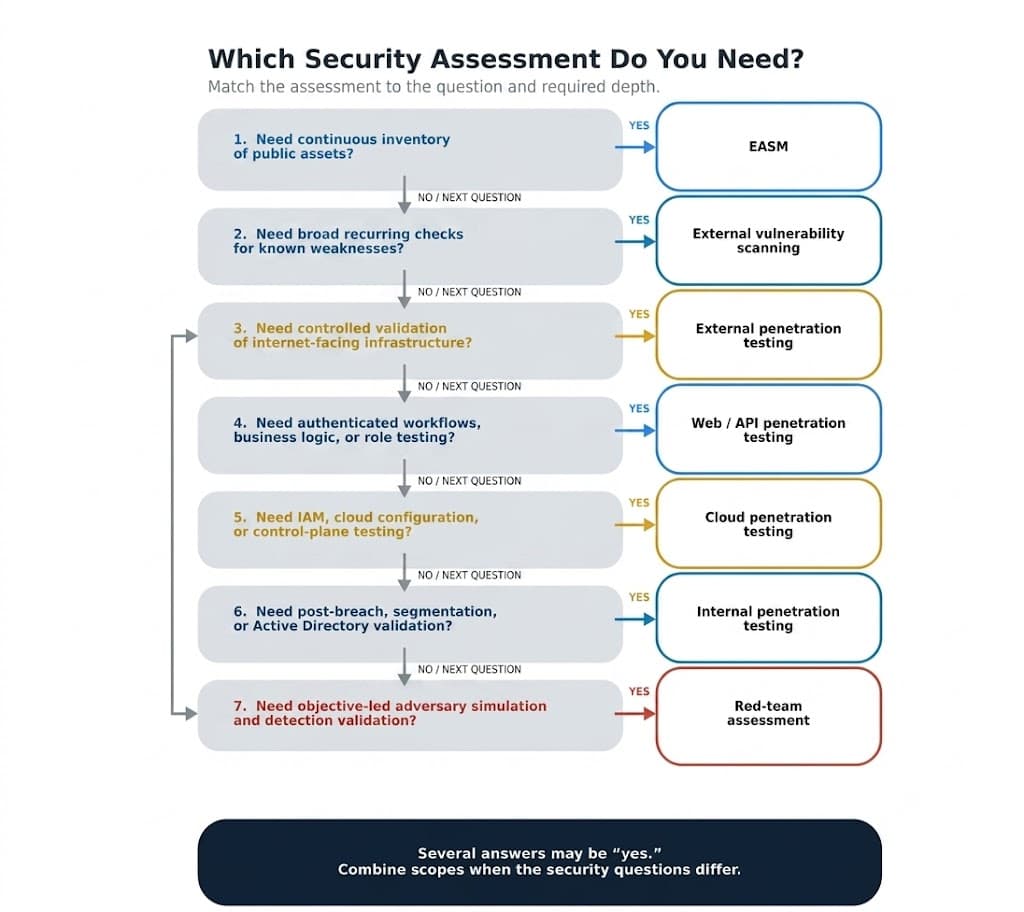
Choose the assessment based on the security question, starting perspective, and required depth not the label alone.
| Report Element | Audience | What Good Looks Like |
|---|---|---|
| Executive summary | Executives, risk, audit | Business outcomes, not counts alone. |
| Objectives | All stakeholders | Questions the test was meant to answer. |
| Scope | Technical, GRC | Exact authorized assets and boundaries. |
| Tested assets | Technical | What received active testing. |
| Untested/excluded assets | Technical, risk | Reasons, assurance impact, follow-up. |
| Dates and conditions | All stakeholders | Period, environment, traffic path, assumptions. |
| Methodology summary | Technical, GRC | High-level approach tied to scope. |
| Limitations | Risk, technical | Time, access, WAF, instability, third parties. |
| Coverage summary | Technical, procurement | Activities by asset or scope layer. |
| Critical notifications | Sponsor, risk | What was escalated, when, and how. |
| Validated findings | Technical | Reproducible facts, affected assets, safe evidence. |
| Severity rationale | Risk, technical | Severity plus exposure and business context. |
| Business impact | Executives, owners | Plausible consequence in the tested environment. |
| Safe evidence | Technical | Minimum proof; sensitive data minimized. |
| Attack-path narrative | All stakeholders | How weaknesses combine when relevant. |
| Remediation guidance | Engineering | Specific fixes and verification criteria. |
| Discovery/ownership notes | Asset management | Discovered but unauthorized or untested assets. |
| Retest status | Risk, engineering | Fixed, partial, open, not retested, out of scope. |
| Residual-risk notes | Risk owner | What remains after fixes or controls. |
| Optional compliance mapping | GRC/auditor | Accurate scope mapping, not certification. |
A scanner export is not a complete report. Agree acceptance criteria before testing and use the penetration testing report guide for deeper anatomy. If CVSS is used, name the version and explain that it measures vulnerability severity, not full business risk; see FIRST’s CVSS documentation.
Use a managed closure process:
Retest evidence should name the tested version or configuration. A compensating control may reduce risk without removing the defect; mark a finding fixed only when the agreed criterion is met.
There is no universal timeline. Effort depends on active hosts, service diversity, application/API/cloud depth, roles, discovery needs, edge controls, production limits, third-party coordination, reporting, and retesting.
Ask providers to separate kickoff, active testing, reporting, review, remediation, and retest dates. A small set of similar hosts may take less effort than one critical portal with several roles.
| Cost Driver | Why It Changes Effort | Buyer Question |
|---|---|---|
| Active hosts | Each live target needs analysis | How are active hosts estimated? |
| Address ranges | Sparse or large ranges add discovery | Range size, live assets, or both? |
| Service diversity | Protocols need different expertise | Which service classes are included? |
| Applications/APIs | Roles and workflows add test cases | Is authenticated depth included? |
| Cloud complexity | IAM and managed services need specialist review | Workload-only or control plane? |
| Authentication/roles | Each role expands access testing | How many roles and tenants? |
| Discovery requirements | Unknown inventory consumes time | What seed data is provided? |
| Critical systems | Safety controls add coordination | Which systems need special handling? |
| Production restrictions | Low rates and narrow windows extend work | What blackouts or fragility apply? |
| Manual validation depth | Controlled proof needs expert time | How is testing validated beyond scans? |
| Reporting/evidence | Custom formats add review | Which deliverables are required? |
| Compliance mapping | Framework mapping needs scoped expertise | Which requirements and systems? |
| Retesting | Verification is separate work | Which findings, window, and rounds? |
| Urgency/scheduling | Compressed dates affect staffing | Is the deadline fixed? |
Use DeepStrike’s penetration testing cost guide for pricing context. Compare proposals against the same scope.
Use a risk- and change-based schedule. Common triggers include an initial baseline; a major infrastructure change; a new public service; a cloud migration; material firewall, VPN, WAF, CDN, DNS, or identity change; a merger or acquisition; a security incident; a material shift in exposure; a customer or contract requirement; and a recurring assurance program.
Continuous monitoring detects change faster but does not replace periodic human validation; a yearly pentest does not provide continuous inventory. Follow the exact current framework and scope. For example, PCI DSS v4.0.1 Requirement 11.4.3 requires applicable external penetration testing at least every 12 months and after significant infrastructure or application changes. This applies to the defined PCI scope, not every organization or system.
| Context | How External Testing May Help | What Must Be Verified | Caveat |
|---|---|---|---|
| PCI DSS | Supports testing of the applicable CDE perimeter and critical systems | Current version, CDE, Req. 11.4, changes, retest, segmentation | Req. 11.4.3 applies at least annually and after significant change within scope. |
| SOC 2 | May evidence security and risk-mitigation controls | Criteria, system description, controls, audit period, auditor expectations | No universal statutory annual external-pentest rule. |
| ISO/IEC 27001 | May support risk treatment and technical testing evidence | ISMS scope, risk assessment, selected controls, SoA | No universal cadence follows from the standard title. |
| HIPAA | May support risk analysis and safeguards for ePHI systems | Current rule, ePHI scope, risk analysis, counsel | Annual-pentest language remains proposed, not current. |
| FedRAMP | May support assessment evidence for an authorization boundary | Current 2026 path, boundary, rules, agency and 3PAO direction | Use the active path; do not apply legacy or draft guidance. |
| Customer reviews | Provides time-bounded evidence of testing and remediation | Requested scope, age, sharing limits, closure status | A summary may omit material limitations. |
| Cyber insurance | May support underwriting questions | Policy wording, request, period, acceptable evidence | No guarantee of eligibility, pricing, or claims. |
| Internal risk management | Validates selected scenarios and priorities | Criticality, threat model, appetite, ownership | One input to risk decisions, not the whole program. |
The PCI Security Standards Council is the authority for current PCI DSS text, and its penetration-testing guidance is supplemental rather than a replacement for the standard. AICPA’s Trust Services Criteria are outcome-based criteria for SOC engagements. HHS’s current HIPAA Security Rule summary expressly distinguishes the rule in effect from the proposed modifications. FedRAMP now has 2026 paths and rules, so the organization and its assessor should use the current FedRAMP rules applicable to the authorization.
A pentest can contribute evidence to a wider assurance program. It does not independently certify PCI DSS, SOC 2, ISO/IEC 27001, HIPAA, FedRAMP, a customer requirement, or an insurance decision. Confirm scope with the relevant QSA, CPA/auditor, certification body, 3PAO, legal counsel, compliance advisor, customer, or insurer.
| Buyer Question | Strong Answer Should Clarify | Red Flag |
|---|---|---|
| What is in scope? | Targets, asset types, environments, depth, assumptions | “Everything external” without a target list. |
| Network, app, API, or cloud? | Separate activities, roles, and coverage | A port scan sold as all four. |
| How is ownership verified? | Inventory, authorization, third-party process | Testing every discovered asset. |
| What manual validation occurs? | How alerts are triaged and impact proven safely | Scanner output sold as a pentest. |
| Which methodology is used? | How the approach maps to this scope | Framework logos without a plan. |
| How is production protected? | Rates, blackouts, stop rules, fragile assets | “Testing is always non-disruptive.” |
| What is in the RoE? | Targets, techniques, contacts, data, escalation, retest | No written boundaries. |
| How are cloud rules handled? | Current provider policy and tenant limits | Assuming payment authorizes provider testing. |
| How are third parties handled? | Written approval or exclusion | Public visibility treated as permission. |
| Who performs the work? | Relevant experience of assigned testers | Unknown team or hidden subcontracting. |
| How are critical findings escalated? | Trigger, channel, recipient, timing | Waiting for the final report. |
| What reporting is supplied? | Scope, coverage, limitations, findings, remediation | No sample or coverage statement. |
| How is evidence protected? | Access, encryption, retention, deletion | Vague or unlimited retention. |
| What quality review occurs? | Technical peer review and factual QA | No named review process. |
| What remediation support is included? | Clarification and fix criteria | Generic “patch it” guidance. |
| How does retesting work? | Eligibility, window, rounds, statuses, new scope | Terms appear after delivery. |
| What assumptions/exclusions apply? | Explicit list tied to price and schedule | Important exclusions in boilerplate. |
| How are scope changes priced? | Approval and change-order rules | Open-ended charges or silent reduction. |
| Can we see a sanitized report? | Representative structure and evidence quality | No alternative demonstration. |
| Can experience be evidenced? | Relevant examples or references when available | Certifications treated as a guarantee. |
Certifications can support due diligence, but they do not guarantee testing depth, communication, or report quality. Evaluate the assigned people, scope, evidence, safety process, and deliverables together.
Use this safe planning template before requesting proposals. Legal and procurement review may be appropriate.
| Field | Buyer Entry |
|---|---|
| Engagement objective | Question the test must answer. |
| Business context | Critical services, users, data, constraints. |
| Compliance/customer driver | Exact requirement, contract, or assurance need. |
| In-scope domains | Approved domains, subdomains, discovery rules. |
| In-scope IP ranges | Approved IPv4 ranges in the signed scope. |
| In-scope IPv6 ranges | Approved prefixes or explicit exclusion. |
| In-scope services | VPN, mail, transfer, servers, identity portals. |
| Web applications/APIs | URLs, roles, tenants, specs, required depth. |
| Cloud-hosted assets | Provider, account/project, resource IDs, allowed services. |
| Out-of-scope assets | Third parties, customer systems, fragile functions. |
| Ownership/approvals | Evidence for ranges, tenants, providers, entities, vendors. |
| Access model | Black-box, partially known, or known-asset inputs. |
| Credentials/test accounts | Synthetic users, roles, MFA, lockout controls. |
| Test environment | Production, staging, or phased; equivalence notes. |
| WAF/CDN approach | Through edge, approved origin, both, or observe only. |
| Authorized dates/time zone | Fixed start/end and daily windows. |
| Blackout periods | Releases, financial events, peaks, freezes. |
| Rate/concurrency limits | Service-specific limits agreed with owners. |
| Allowed techniques | Approved validation categories. |
| Prohibited techniques | DoS, destruction, persistence, broad credential attacks, real-data access. |
| SOC notification model | Announced, deconflicted, limited knowledge, detection objective. |
| Critical escalation contact | Primary/backup recipients and secure channel. |
| Emergency stop process | Authorized callers and acknowledgement process. |
| Data handling/retention | Minimum collection, encryption, access, transfer, deletion. |
| Reporting audience/format | Executive, technical, GRC, accurate mappings if needed. |
| Remediation owner | Team and ticket workflow. |
| Retest window/terms | Eligible findings, deadline, rounds, statuses. |
| Assumptions | Active hosts, credentials, provider access, dependencies. |
| Acceptance criteria | Coverage statement, QA, evidence, review meeting. |
It is an authorized, time-bounded assessment of approved internet-facing systems from an outside-attacker perspective. Testers combine discovery, analysis, and controlled validation. The signed scope not public reachability defines what is permitted.
It commonly covers approved public IPs, gateways, VPNs, DNS, mail, servers, and exposed services. Web, API, cloud IAM, identity, and third-party depth require explicit inclusion.
External network testing emphasizes hosts, gateways, and exposed services. Web application testing examines sessions, roles, workflows, business logic, and authorization. Visibility alone does not include authenticated application depth.
No. A scan automates broad checks. A pentest adds human triage, context, and safe validation of selected weaknesses and attack paths. A scanner export alone is insufficient.
External testing starts from the internet. Internal testing starts inside the network or from an assumed foothold and examines identity, segmentation, lateral movement, and privileged access.
Only when the contract says so. Cloud IAM, storage, serverless, Kubernetes, organization controls, API authorization, and authenticated roles require a defined scope and provider-boundary review.
It can be conducted in production, but it is not risk-free. Authorization, rate limits, blackout periods, test accounts, recovery readiness, escalation, and an emergency stop process reduce risk.
There is no universal duration. Effort depends on active hosts, service diversity, specialist depth, roles, production windows, reporting, and retesting. Separate testing, reporting, and retest dates.
Cost follows effort. Main drivers are active assets, service diversity, roles, application or cloud depth, safety limits, reporting, urgency, and retesting. Compare bids against the same scope.
Use risk, change, contracts, and applicable framework requirements. Test after material exposure changes and on a suitable recurring schedule. PCI DSS has specific in-scope cadence requirements; many contexts do not.
Expect objectives, exact scope, tested and untested assets, conditions, limitations, coverage, validated findings, safe evidence, impact, remediation, retest status, and residual risk. A scanner export is insufficient.
No. A pentest can contribute evidence, but compliance also depends on scope, controls, documentation, remediation, and assessor interpretation. Confirm expectations with the relevant assessor or authority.
External penetration testing provides an outside-in view of approved internet-facing exposure, but its value depends on verified ownership, explicit written authorization, clear technical depth, and safe operating boundaries. A useful engagement distinguishes infrastructure from web, API, cloud, internal, and red-team coverage; reports what was and was not tested; and continues through remediation and retesting.
DeepStrike can discuss an authorized scope, safety boundaries, reporting, and remediation through its penetration testing services. Confirm targets, timeline, deliverables, data handling, and retesting during scoping.
Mohammed Khalil, CISSP, OSCP, OSWE, is a Cybersecurity Architect at DeepStrike specializing in penetration testing, application security, cloud security, API security, and offensive security operations.

Stay secure with DeepStrike penetration testing services. Reach out for a quote or customized technical proposal today
Contact Us
