July 8, 2026
Updated: August 10, 2026
A practical guide to defining penetration testing scope, assets, exclusions, rules of engagement, scope of work, retesting, and compliance boundaries before testing begins.

Mohammed Khalil
A penetration testing scope is the documented boundary of an authorized security test. It defines what will and will not be tested, including applications, APIs, IP ranges, cloud accounts, mobile apps, user roles, environments, and third-party systems. It also defines how testing may occur: allowed methods, prohibited techniques, time windows, rate limits, test accounts, cloud-provider restrictions, data handling rules, communication paths, critical-finding escalation, deliverables, and retesting expectations. A clear scope protects the business and the testing team by ensuring that every activity is authorized, safe, useful, and tied to a business or compliance objective.
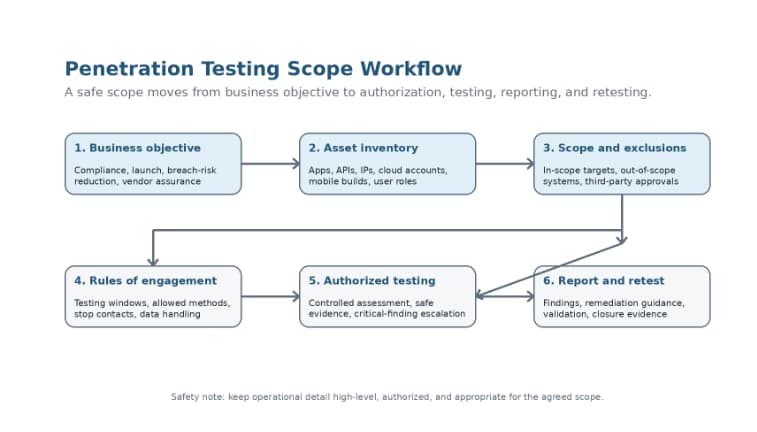
Figure 1. Penetration testing scope workflow from business objective through retesting.
Penetration testing scope is the agreed boundary of a security testing engagement. It identifies the exact systems, applications, networks, APIs, cloud resources, user roles, environments, and business processes that testers may assess. It also states what must not be tested. Scope answers the question: “Where may testers operate, and where must they stop?”
Scope is different from methodology. Methodology describes the testing approach. Scope defines the authorized boundary. Scope is also different from the final report. The report documents what was found inside the agreed boundary. Scope is not permission to attack anything that appears technically connected to the target. If a system is not authorized, it is out of scope until the client and provider approve a written change.
Good scope protects both sides. The client avoids accidental testing of third-party systems, customer tenants, fragile production systems, or regulated data flows that were not approved. The testing team avoids legal ambiguity and can focus on the systems that matter most.
| Item | What It Defines | Who Uses It | Why It Matters |
|---|---|---|---|
| Scope | The systems, assets, environments, roles, and boundaries included or excluded from testing. | Client, security team, provider, legal, procurement | Prevents unauthorized testing and keeps effort focused on approved assets. |
| Rules of Engagement | How testing is performed: allowed techniques, prohibited actions, testing windows, escalation, stop conditions, and safety controls. | Provider, client security team, IT operations, SOC | Controls operational risk during live testing. |
| Statement of Work | Commercial project terms: objective, high-level scope, timeline, deliverables, responsibilities, acceptance criteria, and payment structure. | Procurement, legal, management, provider | Turns the engagement into an agreed business contract. |
| Methodology | The testing approach, assessment phases, evidence standards, and technical coverage framework. | Testing team and technical stakeholders | Ensures consistent testing depth without making the scope unlimited. |
| Authorization Letter | Formal written permission to test the defined assets under agreed rules. | Asset owner, provider, legal, security leadership | Creates a clear legal basis for authorized testing. |
| NDA / Data Handling Agreement | Confidentiality, evidence handling, sensitive data storage, retention, and deletion rules. | Legal, privacy, client team, provider | Protects sensitive data, credentials, screenshots, logs, source code, and findings. |
| Report Deliverables | Executive summary, technical findings, severity definitions, evidence, remediation guidance, and compliance mapping. | Executives, security, developers, auditors | Aligns the output with stakeholder needs before testing starts. |
| Retesting Agreement | Which fixes will be retested, how many rounds are included, and when verification must occur. | Client remediation teams and provider | Prevents post-report disputes and supports closure of findings. |
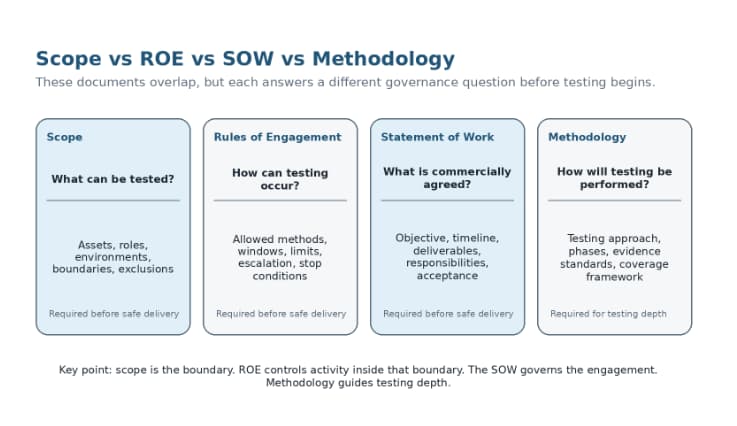
Figure 2. Scope, rules of engagement, statement of work, and methodology answer different pre-test questions.
| Scope Component | What to Define | Example |
|---|---|---|
| Business objective | Why the test is being performed. | SOC 2 evidence, pre-launch review, breach-risk reduction, cloud migration, PCI scope validation. |
| Asset list | Exact assets included in the test. | Domains, subdomains, app URLs, IP ranges, APIs, cloud account IDs, mobile app builds. |
| Asset ownership | Who owns or controls each asset. | Owned by engineering, hosted in AWS account X, third-party approval required. |
| Environment | Production, staging, QA, DR, or dedicated test tenant. | Production web app and staging API, excluding development tenant. |
| User roles and credentials | Roles and access levels provided to testers. | Unauthenticated user, standard user, admin, support role, API service token. |
| Test type | Black-box, gray-box, white-box, external, internal, compliance, red team, or continuous testing. | Gray-box web and API test with test accounts and API documentation. |
| Allowed techniques | High-level methods permitted under the engagement. | Manual testing, authenticated testing, safe scanning, configuration review, cloud posture review. |
| Prohibited techniques | Actions that are not approved. | Denial-of-service, destructive data changes, phishing, physical access, password spraying, production data extraction. |
| Testing windows | When testing can occur. | Weeknights after 9 p.m.; no testing during month-end close. |
| Rate limits | Traffic limits to protect systems. | Low-rate scanning only; avoid load testing unless separately approved. |
| Data handling | How sensitive evidence is captured, stored, shared, and deleted. | Use test data; mask PII in screenshots; encrypt report delivery. |
| Third-party approvals | External vendors, cloud providers, SaaS platforms, or customer tenants requiring permission. | Cloud tenant approval, payment gateway sandbox use, CDN vendor notification. |
| Emergency contacts | Who can pause testing and who receives urgent findings. | CISO, SOC lead, application owner, cloud operations lead.CISO, SOC lead, application owner, cloud operations lead. |
| Reporting format | Expected output and audience. | Executive summary, technical findings, evidence, remediation guidance, retest status. |
| Retesting | How fixes will be verified. | One retest round within 30 days for critical and high findings. |
| Compliance mapping | Frameworks or audit boundaries relevant to the scope. | PCI DSS CDE, SOC 2 production systems, ISO 27001 ISMS scope, HIPAA ePHI systems. |
| Assumptions and constraints | Dependencies that affect coverage. | Client will provide working accounts, diagrams, API docs, and test data before kickoff. |
Use this checklist before a scoping call or RFP. It keeps the conversation focused on the systems that matter and reduces the chance of missed assets, unsafe testing, or unclear deliverables.
| Checklist Item | Why It Matters | Owner |
|---|---|---|
| Business objective | Determines the depth and type of testing needed. | CISO / security lead |
| Asset inventory | Prevents vague target lists and missed systems. | IT / engineering |
| Application and API inventory | Many business risks live in APIs and authenticated workflows. | AppSec / product engineering |
| Cloud accounts and architecture | Defines tenant boundaries, IAM review scope, and provider-policy constraints. | Cloud team |
| User roles and test accounts | Enables authorization and business-logic testing. | Application owner |
| Sensitive data classification | Controls evidence handling and production safety. | Privacy / data owner |
| Third-party dependencies | Identifies systems requiring separate approval. | Vendor management |
| Testing windows and blackout periods | Protects production operations and business processes. | Operations |
| Emergency stop contacts | Allows testing to pause quickly if risk appears. | SOC / IT operations |
| Report and retest expectations | Aligns deliverables with executives, engineers, and auditors. | Security / compliance |
| Area | In-Scope Example | Out-of-Scope Example | Why It Matters |
|---|---|---|---|
| Domains and websites | app.company.com and admin.company.com | Third-party marketing microsite not controlled by the client | Prevents testing assets the client does not own. |
| Subdomains | payments.company.com and portal.company.com | Unowned partner subdomain or old acquisition domain without approval | Reduces accidental third-party testing. |
| APIs | Public REST API and authenticated partner API | Vendor API endpoints or customer tenant APIs | API abuse can affect third parties and customers. |
| Mobile apps | Current iOS and Android test builds | Deprecated apps or personal employee devices | Ensures testers use correct binaries and safe devices. |
| Cloud accounts | Specific AWS account, Azure subscription, or GCP project | Other tenants, shared provider infrastructure, or vendor-managed accounts | Cloud scope must respect account boundaries and provider policies. |
| Production data | Synthetic or test data in production-like workflows | Real customer PII, PHI, card data, or credentials unless explicitly approved | Protects regulated and sensitive data. |
| Social engineering | Approved phishing simulation to a defined group | Unapproved phone calls, impersonation, or physical intrusion | Social testing requires explicit HR/legal approval. |
| Denial-of-service | Usually excluded unless a separate resilience test is approved | Any traffic intended to degrade service availability | DoS testing is high risk and commonly prohibited in standard pentests. |
| Source code / CI-CD | Repository review if white-box testing is approved | Unapproved production pipelines or secrets stores | CI/CD access can expose sensitive systems. |
| Internal network | Listed VLANs, subnets, and domains | Guest Wi-Fi, partner networks, or legacy segments not approved | Internal testing can disrupt operations if boundaries are unclear. |
| Active Directory | Defined AD domain and test accounts | External trusts or legacy forests not approved | AD testing needs strict privilege and safety limits. |
| Logging and SIEM | Coordination with monitoring teams and alert validation if approved | Treating SOC systems as test targets without approval | Detection validation is different from penetration testing unless scoped. |
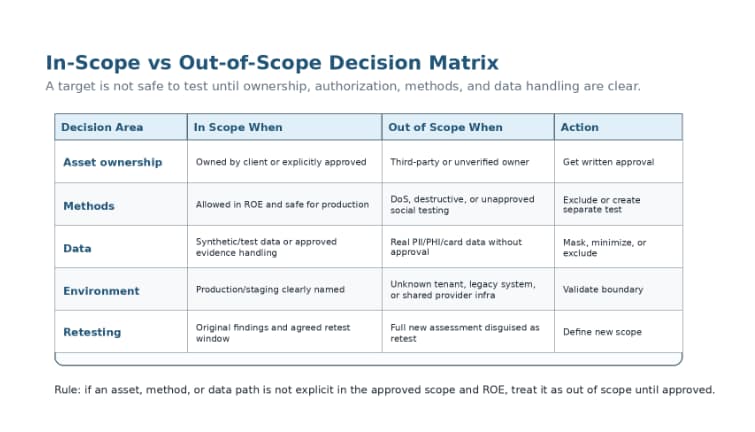
Figure 3. In-scope versus out-of-scope decision matrix for safer engagement boundaries.
| Test Type | Typical Scope Inputs | Common Exclusions | Special Risks |
|---|---|---|---|
| Web application | URLs, roles, workflows, auth flows, admin panels, file upload, payments, linked APIs. | Destructive actions, real payment abuse, live customer data extraction. | Business logic and access control need credentialed coverage. |
| API | Base URLs, endpoints, OpenAPI docs, tokens, roles, tenants, rate limits. | Third-party APIs, real financial actions, unapproved load testing. | Object-level authorization and data exposure need role/tenant context. |
| Cloud | Accounts, subscriptions, projects, IAM roles, regions, services, network boundaries. | Provider infrastructure, other tenants, DDoS, unmanaged SaaS platforms. | Provider policies, IAM access, and logging must be reviewed. |
| External network | IP ranges, domains, exposed services, scan limits, testing windows. | Unowned ranges, high-volume stress testing, unrelated hosted systems. | False positives and service disruption risk increase with broad scans. |
| Internal network / AD | Subnets, AD domains, user roles, connectivity, sensitive systems, domain controllers. | Destructive AD actions, password resets, unapproved credential capture. | Credential handling and production stability are key. |
| Mobile | iOS/Android builds, OS versions, test devices, backend APIs, test accounts. | Personal devices, unsupported app versions, unapproved jailbreak/root testing. | Backend API scope must be aligned with mobile app testing. |
| Wireless | SSIDs, locations, APs, bands, encryption, testing windows. | Neighboring networks or radio interference. | Wireless testing can affect nearby networks if not controlled. |
| Social engineering | Target groups, methods, volume limits, approved lures, HR/legal approval. | Unapproved phishing, vishing, physical entry, or impersonation. | Human testing requires strict authorization and duty-of-care limits. |
| Red team | Objectives, target data, allowed paths, stop conditions, escalation, detection rules. | Activities outside the agreed objective or geographic/legal boundary. | Goal-based scope must be tightly governed. |
| Compliance pentest | Audit boundary, in-scope systems, control objectives, evidence needs. | Systems outside the control boundary unless connected to in-scope assets. | Auditors need traceable evidence and clear exclusions. |
| Continuous testing | Approved asset inventory, change triggers, cadence, retesting model. | Unapproved new assets or aggressive automated testing. | Scope must be kept current as assets change. |
For a web application penetration test, scope should define every application entry point, domain, subdomain, authentication flow, user role, sensitive workflow, and linked backend service that testers may assess. A web app scope that only lists the homepage is usually too thin because risk often lives in authenticated areas, admin portals, file uploads, multi-step workflows, payment flows, and API calls behind the user interface.
Include production versus staging decisions, test accounts, role coverage, test data, safe handling of uploads, payment sandbox instructions, rate limits, and any restrictions around destructive actions. OWASP WSTG and OWASP ASVS can help shape coverage expectations, but they do not replace the need for a written client-approved boundary.
An API scope should define base URLs, endpoints, HTTP methods, authentication mechanisms, tokens, roles, tenants, schemas, documentation, expected workflows, rate limits, and third-party integrations. API testing often fails when the provider receives only a domain name instead of a real endpoint inventory and role matrix.
Useful API scope inputs include OpenAPI specifications, Postman collections, test tenants, sample tokens, normal user and admin roles, abuse-case notes, and clear exclusions for production-destructive actions. OWASP API Security Top 10 coverage is especially relevant for broken object-level authorization, broken function-level authorization, excessive data exposure, and unrestricted resource consumption.
Cloud testing scope should identify the exact cloud accounts, subscriptions, projects, regions, services, IAM boundaries, logging systems, storage locations, network segments, Kubernetes clusters, serverless functions, databases, and CI/CD integrations included in the assessment. Cloud scope must also respect cloud-provider policies and tenant boundaries.
The scope should clarify whether the engagement includes configuration review, attack-path validation, identity and access management review, public exposure review, storage and secrets checks, container security, cloud network paths, logging coverage, and resilience assumptions. Denial-of-service and provider infrastructure testing are normally excluded unless the provider and client explicitly approve a separate test.
External network scope should list IP ranges, domains, exposed services, VPN gateways, scan windows, scanning intensity, emergency contacts, and any fragile systems. Everything outside the approved IP ranges and domains should be treated as out of scope until ownership is confirmed.
External testing should not become uncontrolled internet-wide scanning. The scope should set safe scanning rates, blackout windows, and escalation paths. High-impact exploit attempts, service degradation, or attacks against managed third-party infrastructure should require additional written approval.
Internal network and Active Directory testing require tighter operational controls because they can affect authentication, endpoints, file servers, domain controllers, business applications, and user productivity. Scope should list subnets, AD domains, forests, trusts, connectivity method, test accounts, segmentation boundaries, sensitive systems, and prohibited actions.
The scope should define credential handling, whether credential exposure simulation is allowed, how evidence will be captured safely, and which systems are too fragile for active testing. Actions such as password resets, domain changes, destructive scripts, production data extraction, and endpoint disruption should be excluded unless explicitly approved for a controlled scenario.
Mobile scope should list iOS and Android app versions, build type, test devices, supported OS versions, backend APIs, test accounts, local storage review, authentication flows, session handling, transport security, and whether rooted or jailbroken device testing is permitted.
Use OWASP MASVS and related OWASP mobile testing resources to shape coverage. The scope should avoid testing personal employee devices, real customer accounts, unsupported app versions, or backend systems that have not been approved. If the mobile app relies on APIs, the API scope must be aligned with the mobile test.
Red team and social engineering scopes should be objective-based and tightly governed. They should define goals, target groups, allowed techniques, prohibited techniques, payload safety, HR/legal approval, communications rules, stop conditions, data handling, and escalation paths.
Do not treat social engineering as a casual add-on. Phishing, vishing, physical access, badge testing, or USB-drop exercises should require explicit written authorization, limited targets, approved pretexts, and a duty-of-care plan. This article should not include phishing templates, payloads, evasion steps, or instructions for bypassing detection.
Compliance scoping should map tested systems to the relevant audit boundary and evidence requirements. It should not imply that a penetration test alone satisfies an entire framework or regulation. The safest wording is that scoped penetration testing can support security validation and audit evidence where relevant.
| Compliance Context | Scope Considerations | Evidence to Preserve | Caveat |
|---|---|---|---|
| SOC 2 | Systems supporting the relevant Trust Services Criteria and customer-data environment. | Scope list, report date, tested systems, findings, remediation evidence. | SOC 2 does not impose one universal pentest requirement for every company; map testing to the organization’s controls and risk assessment. |
| PCI DSS | Cardholder data environment, connected systems, external and internal exposure, segmentation validation where used. | Network diagrams, in-scope asset list, test report, segmentation validation evidence, retest evidence. | Confirm the current PCI DSS wording during publication and avoid treating systems as excluded unless segmentation is validated. |
| ISO 27001 | Systems within the ISMS scope and technical vulnerability management processes. | Risk treatment records, technical testing evidence, remediation tracking. | Control references differ by ISO version; map scope to the version used by the organization. |
| HIPAA | Systems processing or supporting ePHI, access controls, audit controls, transmission security, backup and incident workflows. | Risk analysis support, testing evidence, remediation records, safeguards evidence. | HIPAA does not explicitly mandate a named pentest cadence; frame testing as support for risk analysis and security evaluation. |
| FedRAMP | Cloud service authorization boundary, required attack vectors, testing rules, reporting expectations. | Rules of engagement, authorization boundary, final test report, POA&M updates where applicable. | Confirm the current FedRAMP penetration test guidance and agency-specific requirements during publication. |
| GDPR Article 32 | Systems processing EU personal data, confidentiality, integrity, availability, resilience, and testing of security measures. | Evidence of technical and organizational security testing, remediation, and control review. | Testing can support Article 32 diligence but does not guarantee GDPR compliance. |
| Cyber insurance | Critical assets, externally exposed systems, identity controls, ransomware resilience, backup and incident response evidence. | Test report, remediation evidence, asset coverage, insurer-requested evidence. | Policy wording varies; do not claim a pentest guarantees coverage or approval. |
Rules of engagement define how testing is performed inside the approved scope. Written authorization confirms that the asset owner approves testing under those rules. Both should be completed before testing starts.
| ROE Item | What to Define | Why It Matters |
|---|---|---|
| Authorized targets | Exact systems, networks, apps, APIs, cloud accounts, and roles approved for testing. | Anything not listed should be treated as out of scope. |
| Testing period | Start date, end date, allowed time windows, blackout periods. | Protects business operations and production change windows. |
| Allowed methods | High-level classes of activity permitted by the client. | Prevents misunderstanding about scanning, manual testing, social engineering, or cloud review. |
| Prohibited actions | DoS, destructive testing, unapproved phishing, physical access, data extraction, password resets. | Reduces risk of disruption, legal issues, and unsafe testing. |
| Emergency stop | Who can pause testing and how to communicate the stop. | Allows fast response if testing affects availability or business operations. |
| Critical-finding escalation | Who receives urgent notification and what information is included. | Prevents critical issues from waiting until the final report. |
| Data handling | Storage, masking, retention, transfer, and deletion of sensitive evidence. | Protects PII, PHI, credentials, source code, logs, and screenshots. |
| Third-party approvals | Cloud, vendor, payment, customer, or SaaS permissions. | Client approval may not cover third-party systems. |
| Communication cadence | Daily updates, Slack/Teams channel, kickoff, closeout, and report review. | Keeps stakeholders informed without flooding them. |
| Out-of-scope handling | How testers handle accidental discovery of unlisted assets. | Prevents uncontrolled scope expansion. |
This template is a high-level planning aid, not legal language. Legal and procurement teams should adapt it to the organization’s contracting requirements.
| SOW Section | Recommended Content |
|---|---|
| Objective | State the business reason: compliance evidence, application launch, breach-risk reduction, cloud review, vendor assurance, or red team simulation. |
| Scope summary | Summarize in-scope assets, environments, roles, and test types. |
| Assets | List domains, IP ranges, app URLs, APIs, mobile apps, cloud accounts, internal ranges, and AD domains. |
| Exclusions | Name excluded assets and prohibited actions. |
| Rules of engagement | Reference the detailed ROE document covering allowed methods, windows, contacts, and safety limits. |
| Testing windows | Define dates, hours, blackout periods, and maintenance conflicts. |
| Responsibilities | Client provides access, documentation, test accounts, approvals, and contacts; provider performs authorized testing and reporting. |
| Data handling | Define evidence handling, masking, encryption, retention, and deletion requirements. |
| Deliverables | Executive summary, technical report, evidence, remediation guidance, optional presentation, and retest output. |
| Retesting | Define included retest rounds, timeline, accepted evidence, and what is outside retest scope. |
| Acceptance criteria | Define when the project is complete: report delivery, review call, retest completion, or client acceptance. |
| Question | Why It Matters | Example Answer |
|---|---|---|
| What is the primary objective? | Determines test type, depth, and report focus. | Prepare for SOC 2 review and validate the new API before launch. |
| Which assets are in scope? | Creates the approved target list. | app.example.com, api.example.com, AWS prod account, mobile iOS and Android apps. |
| Which assets are excluded? | Prevents unauthorized testing. | Third-party support portal, legacy domain, customer tenants, and payment gateway live environment. |
| Which environments are included? | Controls production risk. | Production web app and staging API; development excluded. |
| Which user roles are available? | Enables authorization and business logic testing. | Admin, standard user, support user, unauthenticated role. |
| Are APIs included? | APIs are often missed if only the web UI is scoped. | Yes; OpenAPI spec and Postman collection available. |
| What cloud accounts are included? | Defines cloud boundaries. | AWS account 123456789012 and Azure subscription production. |
| What sensitive data is present? | Shapes evidence handling and legal review. | Customer PII, account records, internal financial data. |
| Are third-party approvals required? | Avoids testing vendors without permission. | CDN vendor and payment sandbox approval needed. |
| What testing windows apply? | Protects operations. | After 9 p.m.; no testing during payroll processing. |
| What rate limits apply? | Prevents unintended load. | Low-rate scans; avoid brute-force and stress testing. |
| Who are emergency contacts? | Allows quick escalation. | SOC lead, application owner, cloud operations lead. |
| What reporting format is required? | Aligns deliverables with stakeholders. | Executive summary, technical report, compliance mapping, remediation table. |
| Is retesting included? | Sets closure expectations. | One retest round for critical and high findings within 30 days. |
| What is the remediation workflow? | Helps findings become actionable. | Jira tickets assigned to app owners with severity-based SLAs. |
Scope is one of the strongest drivers of penetration testing cost and timeline. Do not include invented prices in this article unless DeepStrike provides approved pricing. Explain the relationship qualitatively and link to a cost article for pricing detail.
| Scope Driver | Impact on Cost / Timeline | Quality Consideration |
|---|---|---|
| Asset count | More apps, IPs, APIs, and cloud resources require more tester time. | Too broad a scope can create shallow coverage. |
| Application complexity | Custom auth, multi-tenant logic, payments, and admin workflows increase effort. | Manual testing depth matters more than scanning volume. |
| User roles | Each role adds authorization and workflow testing. | Role coverage is essential for access-control findings. |
| API endpoints | Large endpoint inventories require more review and test data. | Good documentation improves efficiency. |
| Cloud complexity | Multiple accounts, IAM paths, containers, serverless, and CI/CD expand scope. | Cloud scopes need provider-policy and boundary clarity. |
| Production restrictions | Narrow windows and low rate limits increase calendar time. | Safety may require slower testing. |
| Compliance mapping | Evidence and control mapping add reporting time. | Audit usefulness improves when scope maps to controls. |
| Retesting | Included retest rounds add effort after remediation. | Retesting improves closure confidence. |
| Reporting depth | Executive, technical, and compliance reports require different levels of detail. | Better reporting makes findings easier to fix. |
Retesting should not be left vague. Define it before the engagement starts so security, engineering, and compliance stakeholders know what closure means.
| Area | What to Define | Safe Publish Guidance |
|---|---|---|
| Retest window | When retesting must occur after remediation. | Example: within 30 days of fix submission, if agreed. |
| Retest rounds | Number of included verification rounds. | Avoid implying unlimited retesting unless verified. |
| Retest boundary | Only original findings or full rescan. | Most retests verify original findings, not a new pentest. |
| Evidence | Screenshots, logs, requests, affected assets, and remediation notes. | Do not expose sensitive data in evidence. |
| Severity definitions | How critical/high/medium/low are determined. | Use a consistent severity model and business context. |
| Executive summary | Plain-language risk themes and business impact. | Useful for leadership and audit committees. |
| Technical findings | Reproduction detail, impact, affected assets, and remediation. | Keep exploit detail safe and appropriate for authorized stakeholders. |
| Compliance mapping | Framework/control references where needed. | Avoid claiming the report proves total compliance. |
| Remediation ownership | Who receives tickets and who approves closure. | Improves accountability after the report. |
| Mistake | Why It Hurts | Better Approach |
|---|---|---|
| Testing without written authorization | Creates legal and operational risk. | Require approved scope, ROE, and authorization before testing. |
| Vague asset list | Leads to missed systems or accidental overreach. | List exact domains, IPs, apps, APIs, accounts, and environments. |
| Not validating ownership | May cause testing against third-party systems. | Confirm every asset is owned or approved. |
| Forgetting APIs | Leaves major data paths untested. | Include API inventory and documentation. |
| Ignoring cloud/IAM | Misses identity and configuration risk in SaaS environments. | Scope cloud accounts, IAM, storage, and logging where relevant. |
| No test accounts | Limits assessment to unauthenticated coverage. | Provide roles and test data. |
| No third-party approval | Can trigger vendor abuse responses or legal concerns. | Get permission for vendors, cloud tenants, and integrations. |
| No rate limits or blackout windows | Can disrupt production. | Define safe windows and traffic limits. |
| No data handling rules | Risks mishandling sensitive evidence. | Define masking, storage, transfer, and deletion. |
| No retesting agreement | Creates disputes after remediation. | Define retest rounds, windows, and scope. |
| Under-scoping to reduce cost | Misses critical business systems. | Use risk-based prioritization instead of arbitrary exclusions. |
| Over-scoping without priority | Dilutes depth and increases cost. | Focus on high-value assets and create phases. |
| Confusing scanning with pentesting | May produce shallow results. | Define manual validation and reporting expectations. |
| Mixing red team and pentest scope | Creates unclear objectives and safety rules. | Separate vulnerability-focused pentests from goal-based red team exercises. |
| Preparation Item | Why It Matters | Owner |
|---|---|---|
| Asset inventory | Provider needs exact systems to scope correctly. | IT / system owners |
| Business objective | Guides scope depth and reporting. | CISO / security leadership |
| Compliance driver | Defines audit boundary and evidence needs. | Compliance / GRC |
| Architecture diagrams | Shows connected systems and dependencies. | Engineering / cloud team |
| User roles and test accounts | Enables authenticated testing. | Application owner |
| API documentation | Improves API coverage and efficiency. | Engineering / AppSec |
| Cloud account structure | Defines tenant and IAM boundaries. | Cloud team |
| Third-party approvals | Prevents unauthorized vendor testing. | Vendor management / legal |
| Data classification | Controls evidence handling. | Privacy / data owner |
| Testing windows | Avoids operational conflicts. | Operations |
| Emergency contacts | Supports rapid escalation. | SOC / IT operations |
| Reporting requirements | Ensures output fits executive, technical, and audit needs. | Security / compliance |
| Retesting expectations | Defines closure process. | Project owner / engineering |
| Legal and procurement documents | Supports NDA, SOW, authorization, and ROE. | Legal / procurement |
Penetration testing scope is the documented boundary of an authorized test. It lists which assets, environments, roles, systems, APIs, networks, cloud accounts, and mobile apps may be tested, and which are excluded. It also defines rules such as testing windows, allowed methods, data handling, escalation, reporting, and retesting expectations.
A scope should include the business objective, asset list, ownership, environments, user roles, test accounts, allowed and prohibited methods, testing windows, rate limits, data handling rules, third-party approvals, emergency contacts, deliverables, compliance mapping, and retesting expectations.
Anything not explicitly approved is out of scope. Common exclusions include third-party systems, unapproved cloud tenants, denial-of-service testing, destructive actions, real customer data extraction, physical access, social engineering, and production systems that the client does not want tested.
Scope defines what can be tested. Rules of engagement define how testing can occur. Scope lists assets and boundaries. ROE covers testing windows, methods, safety limits, escalation paths, communication, stop conditions, and data handling.
A penetration testing scope of work is the contract-level description of the engagement. It typically includes the objective, approved assets, exclusions, timeline, responsibilities, deliverables, reporting expectations, retesting terms, and acceptance criteria.
List application URLs, subdomains, roles, authentication flows, sensitive workflows, admin functions, file uploads, payment flows, test accounts, environments, linked APIs, rate limits, and exclusions such as destructive actions or live payment abuse.
Define API base URLs, endpoints, methods, authentication, tokens, roles, tenants, documentation, test data, rate limits, allowed methods, prohibited actions, and third-party dependencies. Include abuse cases and authorization testing where appropriate.
List cloud accounts, subscriptions, projects, regions, services, IAM roles, VPCs, storage, databases, containers, serverless functions, logging, key management, and provider-policy constraints. Avoid testing provider infrastructure or other tenants.
Scope affects cost because asset count, application complexity, user roles, API size, cloud complexity, compliance evidence, testing windows, reporting depth, and retesting all affect effort. A narrow scope can reduce cost but may miss critical risks; a broad scope can reduce depth if the budget is fixed.
A compliance scope should identify the systems inside the audit boundary, map them to relevant controls or obligations, define evidence needs, and clarify exclusions. The article should avoid saying a pentest alone satisfies a complete compliance framework.
No. Professional penetration testing should not start without written authorization from the asset owner. The authorization should reference the approved scope and rules of engagement.
Retesting should define which findings are verified, how many rounds are included, the retest window, what evidence is required, and whether retesting is limited to original findings or includes a broader reassessment.
A clear penetration testing scope is the foundation of an authorized, safe, and useful security assessment. It defines which systems can be tested, how testing can occur, which actions are prohibited, how evidence is handled, and how results will be reported and retested. Without scope, a penetration test can become legally ambiguous, operationally risky, or too shallow to support real security decisions.
Once the scope is defined, use it as the baseline to choose a penetration testing provider in the USA without comparing vendors against different assumptions.
The strongest scopes connect business objectives to approved assets: web applications, APIs, cloud environments, mobile apps, external networks, internal networks, Active Directory, compliance-controlled systems, and, where appropriate, red team scenarios. They also define written authorization, rules of engagement, cost and timeline assumptions, reporting depth, remediation ownership, and retesting expectations.
DeepStrike can support authorized, scoped assessments across web applications, APIs, cloud environments, mobile apps, networks, and red team scenarios. Scoping should be approved before testing begins and reviewed against legal, compliance, operational, and business requirements. The result should be a test that covers the right systems, avoids unsafe activity, and produces evidence stakeholders can use for remediation and risk decisions.
Mohammed Khalil is a Cybersecurity Architect at DeepStrike, specializing in advanced penetration testing and offensive security operations. With certifications including CISSP, OSCP, and OSWE, he has led red team and application security engagements across technology, finance, healthcare, cloud, and regulated environments. His work focuses on real-world attack path validation, application vulnerabilities, API security, cloud security, identity exposure, breach-risk reduction, and adversary emulation.

Stay secure with DeepStrike penetration testing services. Reach out for a quote or customized technical proposal today
Contact Us
