June 3, 2026
Updated: August 10, 2026
A practical guide to how companies estimate pentest quotes, scope, cost drivers, timelines, deliverables, and retesting terms.

Mohammed Khalil
A penetration testing quote is an estimate of the scope, consultant effort, timeline, deliverables, and retesting terms required to assess a defined set of systems. Companies usually estimate a pentest quote by reviewing the target type, number of assets, application or environment complexity, user roles, authentication flows, testing depth, reporting expectations, compliance context, and whether remediation validation is included.
A quote is not just a price. A strong quote should explain what will be tested, what is excluded, how testing will be performed, what access the testers will receive, how long the work will take, what the report will include, and what happens after remediation. The cheapest quote may exclude authenticated testing, API coverage, business logic testing, manual validation, or retesting, so buyers should compare what is included rather than only the final number.
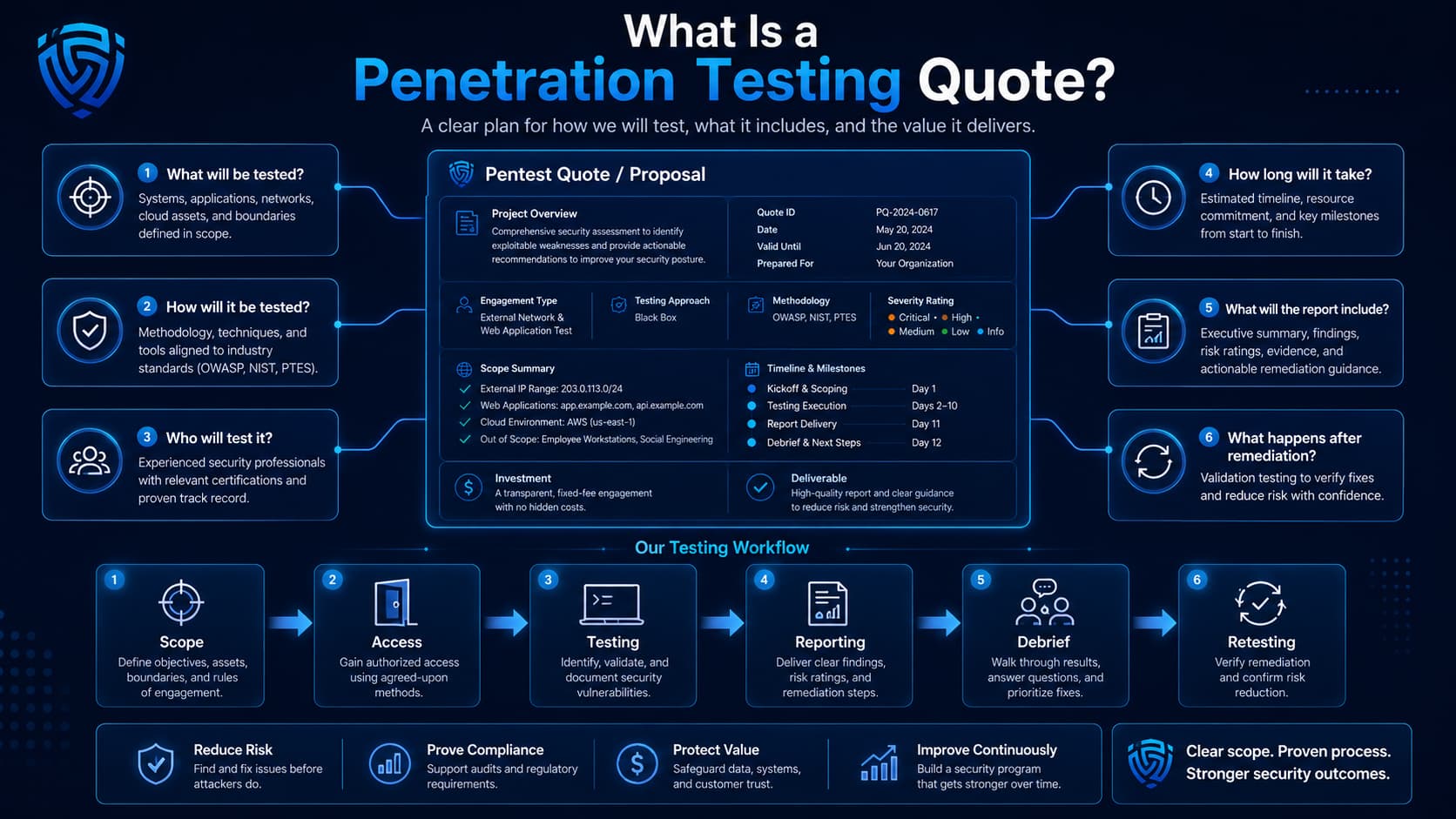
A penetration testing quote, also called a pentest quote, proposal, estimate, or statement of work, is a scoped offer from a security provider. It defines the work required to test a specific set of applications, APIs, networks, cloud environments, mobile apps, or systems.
In a mature buying process, the quote should function like a mini project plan. It should identify the testing objective, scope, access model, methodology, timeline, deliverables, communication process, assumptions, exclusions, and commercial terms. It should also explain whether retesting is included after remediation.
This matters because penetration testing is not a uniform product. A quote for one external network range is not comparable to a quote for a multi-tenant SaaS platform with web applications, APIs, SSO, multiple user roles, cloud infrastructure, and compliance reporting. The quote should help the buyer understand risk coverage, not only cost.
A useful quote should answer six questions: what will be tested, how it will be tested, who will test it, how long it will take, what the report will include, and what happens after the organization fixes the findings.
| Quote Component | What It Should Explain | Why It Matters |
|---|---|---|
| Scope | The exact systems, applications, APIs, IP ranges, cloud accounts, mobile builds, and environments included or excluded. | Prevents gaps, misunderstandings, and unrealistic expectations. |
| Testing objectives | Whether the purpose is risk validation, product launch, compliance evidence, customer review, or recurring security assurance. | Different objectives require different depth, evidence, and reporting. |
| Assets and environments | Production, staging, internal networks, external assets, user portals, admin portals, APIs, and test data requirements. | Helps the provider estimate time and avoid testing the wrong environment. |
| Methodology | How manual testing, automation, exploitation, verification, and reporting will be performed. | Separates a real pentest from a scanner export. |
| Access model | Black-box, grey-box, or white-box testing, including credentials, source code, API docs, and architecture details. | Affects both effort and coverage. |
| Testing window | Approved dates, business-hour restrictions, blackout periods, and production safety constraints. | Controls operational risk and scheduling. |
| Timeline | Kickoff, access setup, testing period, reporting date, debrief, remediation window, and retest timing. | Gives stakeholders a realistic project plan. |
| Deliverables | Executive summary, technical report, evidence, reproduction steps, remediation guidance, and optional compliance mapping. | Determines whether the output is useful to executives, engineers, and auditors. |
| Critical finding escalation | How urgent findings will be reported before the final report. | Critical issues should not wait until the end of the engagement. |
| Retesting | Whether fixes will be validated, which findings are eligible, and the retest window. | Confirms remediation and reduces post-test uncertainty. |
| Assumptions and exclusions | Client responsibilities, credential availability, excluded systems, third-party boundaries, and change-order rules. | Clarifies what the quote does not cover. |
| Pricing model | Fixed fee, day-rate estimate, time-and-materials, subscription, retainer, or custom SOW. | Explains how the final price was built. |
Scope is the foundation of a penetration testing quote. Before pricing an engagement, vendors need to understand what will be tested and how deeply. Scope usually includes the asset type, asset count, user roles, authentication model, data sensitivity, and operational boundaries.
A good scoping questionnaire should ask for target URLs, IPs, applications, APIs, environments, roles, authentication methods, testing windows, sensitive workflows, compliance drivers, reporting needs, and retesting expectations. The more accurate this information is, the more accurate the quote will be.
Penetration testing cost is usually driven by consultant effort. Consultant effort depends on how many days or hours are required for scoping, access setup, discovery, manual testing, exploit validation, documentation, reporting, debriefing, and retesting.
The simplest pricing logic is: estimated consultant effort plus reporting effort plus retesting or project-management overhead. The actual commercial model may vary, but the underlying driver is usually time and depth.
Common pricing models include fixed-scope fixed-fee quotes, day-rate-based estimates, time-and-materials estimates, subscription or continuous testing models, recurring retainers, and custom enterprise statements of work. Fixed-fee quotes work well when scope is clear. Time-and-materials can work when scope is uncertain but requires stronger budget control. Continuous models can be useful for teams that release frequently.
Published market ranges vary widely by region, scope, firm reputation, and testing depth. Treat public pricing ranges as orientation only. A formal quote should be based on confirmed scope, not a generic package label.
When pricing differences come from vendor model and testing depth, use a dedicated guide to compare U.S. penetration testing providers before treating quotes as equivalent.
| Cost Driver | Why It Changes Effort | Buyer Question to Ask |
|---|---|---|
| Asset count | More applications, APIs, hosts, IPs, and environments require more discovery and validation. | How many targets are included, and what is excluded? |
| Application complexity | Complex workflows, custom logic, payment flows, admin functions, and integrations require deeper manual testing. | Which high-risk features and workflows are included? |
| API complexity | Authentication, authorization, object access, rate limits, and undocumented endpoints require manual validation. | Are all APIs and documented endpoints included? |
| User roles | Each role adds authorization and access-control test cases. | How many roles and tenant scenarios will be tested? |
| Authentication model | SSO, OAuth, SAML, MFA, custom tokens, and service accounts increase setup and test depth. | Which login and token flows are in scope? |
| Black, grey, or white box | Less context can increase discovery time; more context can improve coverage and root-cause analysis. | What information will we provide to testers? |
| Internal vs external scope | Internal testing may include lateral movement, identity systems, segmentation, and privileged access paths. | Does the quote include internal testing or only public-facing assets? |
| Cloud complexity | IAM, storage, containers, serverless, secrets, databases, and managed services need cloud-specific review. | Which cloud accounts and services are in scope? |
| Mobile coverage | Android and iOS testing requires app builds, device setup, runtime testing, and API review. | Are mobile apps and backend APIs included? |
| Business logic depth | Custom workflows require human reasoning and abuse-case testing. | Will testers evaluate business logic or only technical vulnerabilities? |
| Compliance mapping | Mapping findings to audit controls and evidence requirements adds reporting effort. | Is compliance mapping required? |
| Reporting depth | Detailed evidence, reproduction steps, remediation guidance, and executive summaries require analyst time. | Can we see a sanitized sample report? |
| Retesting | Fix validation adds work after remediation. | Is retesting included, and what is the retest window? |
| Urgency and testing windows | Rush timelines, weekend work, or narrow windows require more coordination. | Are there deadlines or blackout constraints? |
The timeline in a penetration testing quote should include more than active testing days. A complete timeline usually includes proposal review, kickoff, access setup, reconnaissance, testing, manual validation, report writing, quality assurance, debrief, remediation, and retesting.
A small narrow-scope assessment may take several business days. A standard web, API, or network assessment often takes one to two weeks. Multi-application or internal-and-external scopes may take two to four weeks. Enterprise, cloud, mobile, source-assisted, or compliance-heavy work can require four or more weeks. These are planning ranges, not guarantees.
Common timeline blockers include missing credentials, incomplete API documentation, unstable staging environments, delayed MFA or SSO setup, unclear scope, production testing restrictions, third-party authorization delays, and slow remediation before retesting.
Two quotes can differ significantly because they are not always quoting the same work. A lower price may reflect a smaller scope, less manual validation, fewer roles, no retest, or a scanner-heavy methodology.
| Quote Difference | Lower-Cost Version | Higher-Quality Version | Buyer Risk |
|---|---|---|---|
| Scanner-only vs manual | Automated scans with limited review. | Manual-first testing supported by automation. | Business logic and chained attacks may be missed. |
| Unauthenticated vs authenticated | Tests only public endpoints. | Tests logged-in flows and protected functions. | Most real application risk may remain untested. |
| Single role vs multiple roles | One account or role is tested. | Multiple roles and tenant boundaries are tested. | Authorization flaws may be missed. |
| Web-only vs web plus API | Browser-facing UI only. | Frontend, APIs, admin functions, and backend workflows. | Backend risk can remain invisible. |
| No retest vs retest included | Findings are delivered once. | Fixes are validated after remediation. | Remediation may fail without confirmation. |
| High-level report vs developer-ready report | Generic list of issues. | Evidence, reproduction steps, impact, and remediation guidance. | Engineers may struggle to fix findings. |
| Vague scope vs precise scope | Broad marketing terms. | Defined assets, roles, assumptions, and exclusions. | Buyer cannot compare vendor proposals fairly. |
A vendor cannot price accurately without scoping information. Buyers should prepare a clear intake package before requesting a quote.
| Testing Model | What Testers Receive | Best For | Limitation |
|---|---|---|---|
| Black box | Minimal information and no credentials. | External realism and internet-facing exposure checks. | Can miss authenticated workflows, business logic, and role-based access issues. |
| Grey box | Test accounts, documentation, architecture context, API specs, and defined scope. | Most business-critical web, API, mobile, and SaaS tests. | Requires client preparation but usually provides better coverage. |
| White box | Source code, architecture, logs, configuration, and deeper implementation context. | High-risk systems, source-assisted testing, and root-cause analysis. | Requires more coordination and sometimes more stakeholder involvement. |
For most commercial applications, grey-box testing should be the minimum baseline. It lets testers spend less time guessing and more time validating authorization, business logic, API behavior, and remediation-quality findings.
A strong proposal should be structured, specific, and comparable. It should not rely on vague claims such as “complete security audit” without explaining what will actually happen.
Buyers should compare quotes line by line. The best quote is not always the cheapest; it is the one that gives the right level of risk coverage for the business objective.
| Evaluation Criteria | Strong Quote | Weak Quote |
|---|---|---|
| Scope clarity | Lists exact assets, roles, environments, inclusions, and exclusions. | Uses vague phrases such as “full test” or “all systems.” |
| Manual testing depth | Explains manual validation, exploitation, and business logic testing. | Relies mainly on scanner output. |
| Authenticated coverage | Includes credentials, roles, APIs, and protected workflows. | Only tests unauthenticated surfaces. |
| API and business logic | Explicitly includes APIs, object access, role checks, and workflow abuse. | Treats APIs as optional or ignores logic testing. |
| Report quality | Provides evidence, reproduction steps, impact, and fix guidance. | Provides a generic issue list. |
| Retesting | Includes a defined retest window and scope. | Retesting is missing or unclear. |
| Communication | Defines kickoff, status updates, escalation, debrief, and closure. | Only promises final report delivery. |
| Compliance support | Explains how evidence can support control validation. | Makes broad compliance promises without scope detail. |
| Price transparency | Explains effort, assumptions, and pricing model. | One number with no explanation. |
Buyers can reduce cost by improving scoping efficiency, not by removing critical testing depth from important systems.
Do not reduce cost by removing authenticated testing, API coverage, business logic testing, or retesting from critical systems. Those are often the areas where the highest-value findings appear.
| Engagement Type | Primary Cost Drivers | Buyer Should Clarify |
|---|---|---|
| Web application pentest | Number of apps, roles, forms, workflows, authentication, business logic, and admin functions. | Which applications, roles, pages, APIs, and workflows are included? |
| API penetration test | Endpoint count, documentation quality, roles, tokens, object access, rate limits, and business logic. | Are authenticated roles, APIs, and documented plus undocumented endpoints included? |
| Cloud penetration test | Cloud accounts, IAM, storage, containers, serverless, secrets, and managed services. | Which cloud accounts, services, and permissions are in scope? |
| Mobile application pentest | Android/iOS platforms, app builds, local storage, runtime behavior, APIs, and test devices. | Are backend APIs and both mobile platforms included? |
| Network penetration test | IP ranges, internal vs external scope, segmentation, VPN, directory services, and lateral movement. | How many IPs, hosts, and network segments are included? |
| Red team assessment | Objectives, duration, stealth, phishing rules, identity attacks, detection testing, and target goals. | What objective defines success, and what techniques are allowed? |
| Continuous penetration testing | Recurring test cadence, release frequency, retesting, platform features, and ongoing validation. | How many test days or validation cycles are included per period? |
A penetration testing quote can support compliance and customer security reviews, but it does not automatically make an organization compliant. It provides evidence that security testing was planned, performed, documented, and followed by remediation activity where needed.
For PCI DSS environments, the quote should align with the systems and testing expectations relevant to current PCI DSS penetration testing requirements, including Requirement 11.4 where applicable. It should avoid outdated requirement references and should clearly define the cardholder data environment, connected systems, segmentation scope, testing methodology, remediation validation, and evidence retention needs.
For SOC 2, ISO 27001, HIPAA, GDPR, vendor due diligence, and enterprise customer reviews, the quote should explain how the test supports risk assessment, control validation, remediation tracking, and reporting evidence. Exact scope should be confirmed with the relevant auditor, QSA, legal counsel, or compliance advisor.
Avoid broad claims such as “this quote makes you compliant.” A safer position is: the engagement can provide evidence for security testing and remediation, but compliance depends on the full control environment, audit scope, and remediation status.
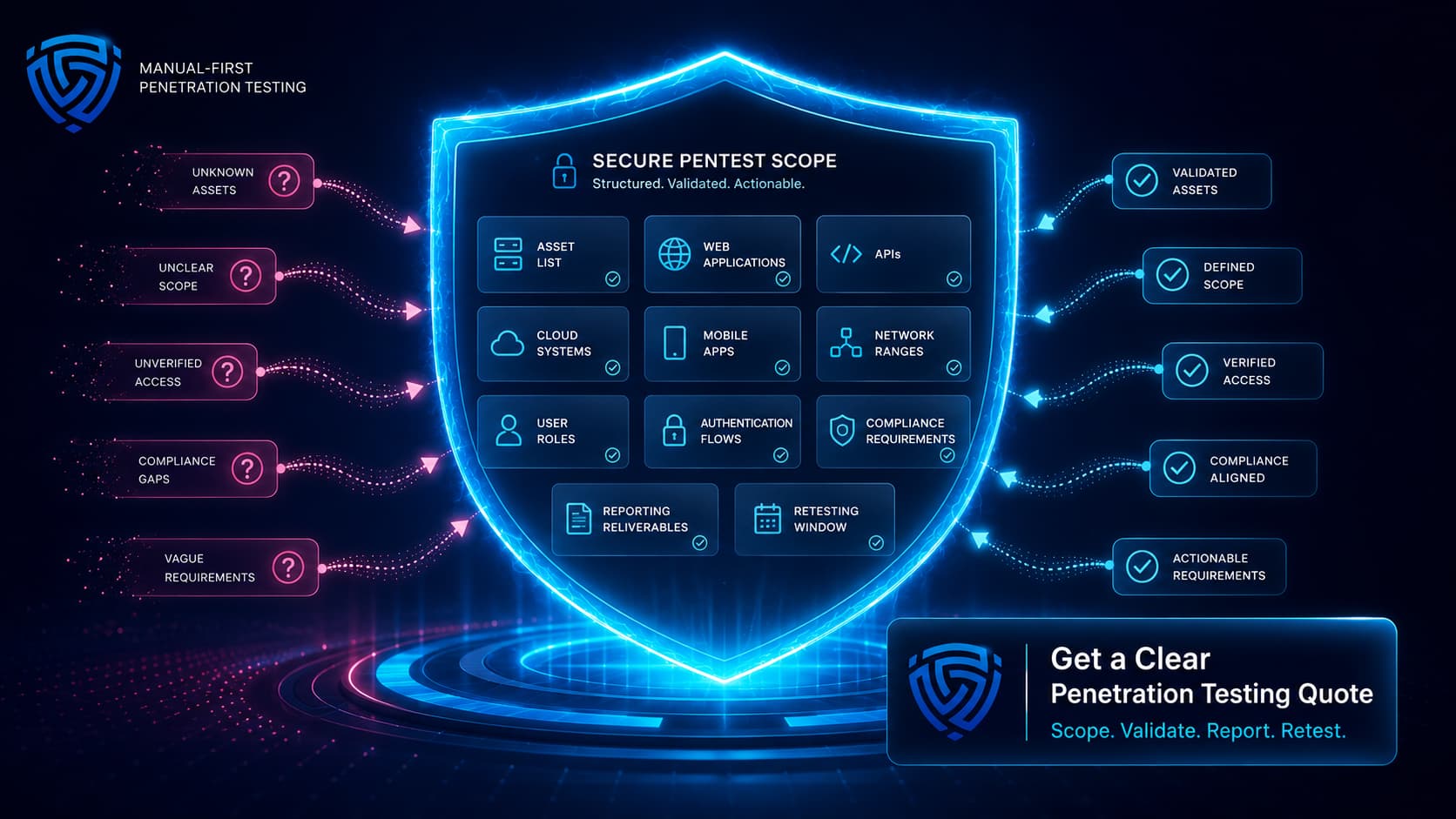
A penetration testing quote is more than a number. It is a structured estimate of risk coverage, scope, consultant effort, timeline, deliverables, remediation support, and retesting. Buyers should compare quotes based on what they include, what they exclude, and how clearly they explain testing depth.
The strongest quote is not necessarily the highest or lowest price. It is the quote that matches the business objective, covers the right systems and roles, validates real exploitability, provides developer-ready evidence, and gives the organization a clear path from testing to remediation.
DeepStrike helps organizations scope manual-first penetration testing engagements with clear deliverables, practical remediation guidance, and retesting support. The goal is to help buyers understand exactly what risk coverage they are paying for before testing starts.
What is a penetration testing quote?
A penetration testing quote is an estimate of the scope, effort, timeline, deliverables, and retesting terms for a pentest engagement. It explains what will be tested, how testing will be performed, what the report will include, and what assumptions or exclusions apply.
What should be included in a penetration testing quote?
A good quote should include scope, objectives, methodology, access model, testing window, timeline, deliverables, critical finding, escalation, retesting, assumptions, exclusions, pricing model, and commercial terms.
Why do penetration testing quotes vary so much?
Quotes vary because vendors may be quoting different levels of scope, manual testing, authenticated coverage, API coverage, reporting depth, tester seniority, and retesting. Two quotes with the same title may not represent the same work.
How do companies estimate penetration testing cost?
Cost is usually estimated from consultant effort. Vendors estimate how many days or hours are required for discovery, manual testing, validation, reporting, debriefing, and retesting, then apply their pricing model.
How long does penetration testing take?
A small narrow-scope test may take several business days. Standard web, API, or network tests often take one to two weeks. Larger or more complex engagements may take several weeks or more, especially when reporting and retesting are included.
What information do vendors need to prepare a quote?
Vendors usually need asset lists, applications, APIs, IP ranges, environments, user roles, authentication details, cloud context, sensitive workflows, deadlines, reporting expectations, and retesting requirements.
Is the cheapest penetration testing quote a bad idea?
Not always, but it can be risky. A low price may mean limited scope, scanner-heavy testing, no authenticated coverage, no API testing, or no retesting. Buyers should verify exactly what is included.
Should retesting be included in the quote?
Yes, for most serious engagements. Retesting confirms whether fixes actually resolved the findings. If retesting is not included, buyers should ask how fixes will be validated and what the additional cost would be.
How do I compare two pentest quotes?
Compare scope, methodology, authenticated testing, API and business logic coverage, tester experience, report quality, retesting terms, communication process, compliance mapping, assumptions, exclusions, and price transparency.
Can a penetration testing quote support compliance audits?
Yes, if the scope and deliverables align with the audit or security review. A pentest report can support evidence for security testing and remediation, but it does not by itself make an organization compliant.
Mohammed Khalil, CISSP, OSCP, OSWE, is a Cybersecurity Architect specializing in penetration testing and offensive security. He has more than 10 years of experience helping organizations validate security controls across web, mobile, cloud, API, and compliance-driven environments, including SOC 2, PCI DSS, HIPAA, and ISO 27001.

Stay secure with DeepStrike penetration testing services. Reach out for a quote or customized technical proposal today
Contact Us
