November 4, 2026
Updated: November 4, 2026
The TTP model, the 15 Enterprise tactics in v20, how to read the matrix, defender and red team use cases, and how ATT&CK compares with the Cyber Kill Chain and D3FEND.

Mohammed Khalil
The MITRE ATT&CK framework (formally MITRE ATT&CK®) is a free, public knowledge base of how real attackers behave, organized by their goals (tactics) and the methods used to reach them (techniques and sub-techniques), with documented real-world procedures. It works as a shared language: defenders map detections to it to find coverage gaps, threat analysts tag adversary activity with it, and red teams use it to plan emulations and report results. The current version, ATT&CK v20, was released on October 13, 2026 and covers Enterprise, Mobile and ICS environments.
Key facts as of November 2026:
ATT&CK stands for Adversarial Tactics, Techniques, and Common Knowledge. MITRE describes it as "a globally-accessible knowledge base of adversary tactics and techniques based on real-world observations." In practice, it is a catalog with an ID for every documented attacker behavior, from sending a phishing attachment (T1566.001) to encrypting data for impact (T1486). When an analyst writes T1003.001 in a report, every reader knows the behavior is credential theft from LSASS memory.
ATT&CK started inside MITRE in 2013. According to MITRE's ATT&CK FAQ, the team needed to document the tactics, techniques and procedures that advanced persistent threats used against Windows enterprise networks for a research project called FMX, which tested how well endpoint telemetry and analytics could catch attackers after a compromise. MITRE's design and philosophy paper says the first model was created in September 2013 and released publicly in May 2015 with 96 techniques. The knowledge base has since grown to cover Linux, macOS, cloud, identity providers, network devices, containers, mobile devices and industrial control systems.
Two design choices explain why ATT&CK is so widely adopted:
"TTPs" is shorthand for tactics, techniques and procedures. ATT&CK adds a fourth level, the sub-technique, between technique and procedure. MITRE's FAQ defines each level with a simple question.
| Level | Question it answers | MITRE definition in brief | Example | ID format |
|---|---|---|---|---|
| Tactic | Why? | The adversary's tactical goal, the reason for an action | Credential Access | TA0006 |
| Technique | How? | The action taken to achieve the tactical goal | OS Credential Dumping | T1003 |
| Sub-technique | How, more specifically? | A lower-level description of the behavior | LSASS Memory | T1003.001 |
| Procedure | What exactly was observed? | The specific implementation an adversary used in the wild | Using PowerShell to inject into lsass.exe and scrape credentials from memory | Listed under "Procedure Examples" on the technique page |
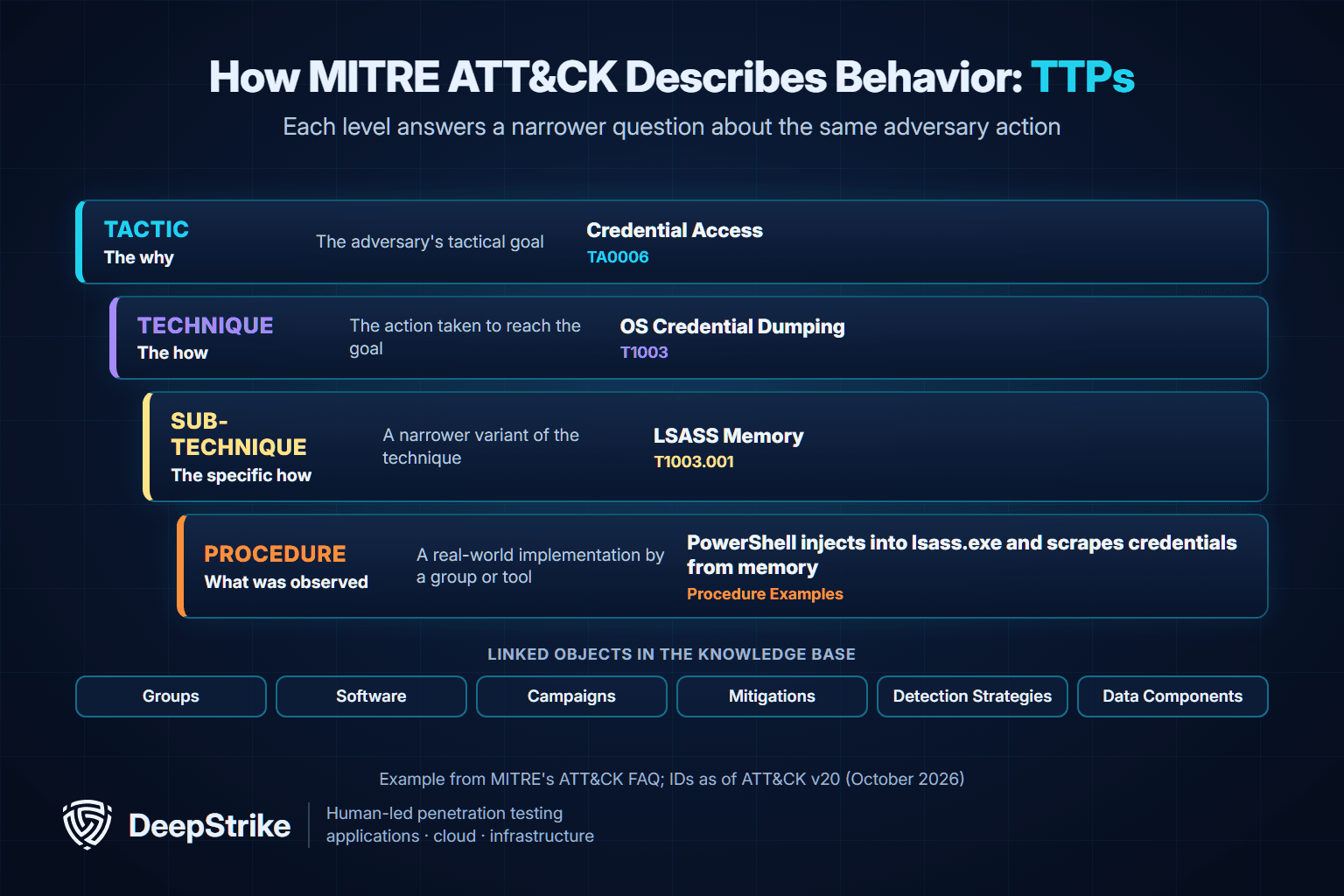
The difference between sub-techniques and procedures trips up many readers. MITRE explains that sub-techniques categorize behavior, while procedures describe actual in-the-wild use. A single procedure can contain several techniques: the PowerShell example above combines PowerShell execution, process injection and LSASS credential dumping. That matters when you map an incident, because one observed action may deserve more than one technique ID.
Around these four levels, ATT&CK links other objects that make it useful for operations:
ATT&CK is organized into three technology domains, each with its own matrix. The counts below come from MITRE's v20 release notes.
| Matrix | What it covers | Tactics | Techniques | Sub-techniques |
|---|---|---|---|---|
| Enterprise | Windows, macOS, Linux, cloud (IaaS, SaaS, Office Suite, Identity Provider), network devices, containers and ESXi, plus pre-compromise activity | 15 | 227 | 479 |
| Mobile | Android and iOS devices | 12 | 78 | 47 |
| ICS | Industrial control systems such as controllers, HMIs and engineering workstations | 12 | 78 | 26 |
Each domain has its own tactic list. The Mobile tactics still include Defense Evasion (TA0030), and the ICS tactics use Evasion (TA0103), so the Enterprise split described below does not apply to them. ATT&CK for ICS also has two tactics found nowhere else: Inhibit Response Function (TA0107), where the attacker tries to stop safety and protection functions from responding, and Impair Process Control (TA0106), where the attacker tries to manipulate or damage the physical process. If you test industrial networks, our guide to OT/ICS penetration testing shows how to map findings to ATT&CK for ICS without putting a live process at risk.
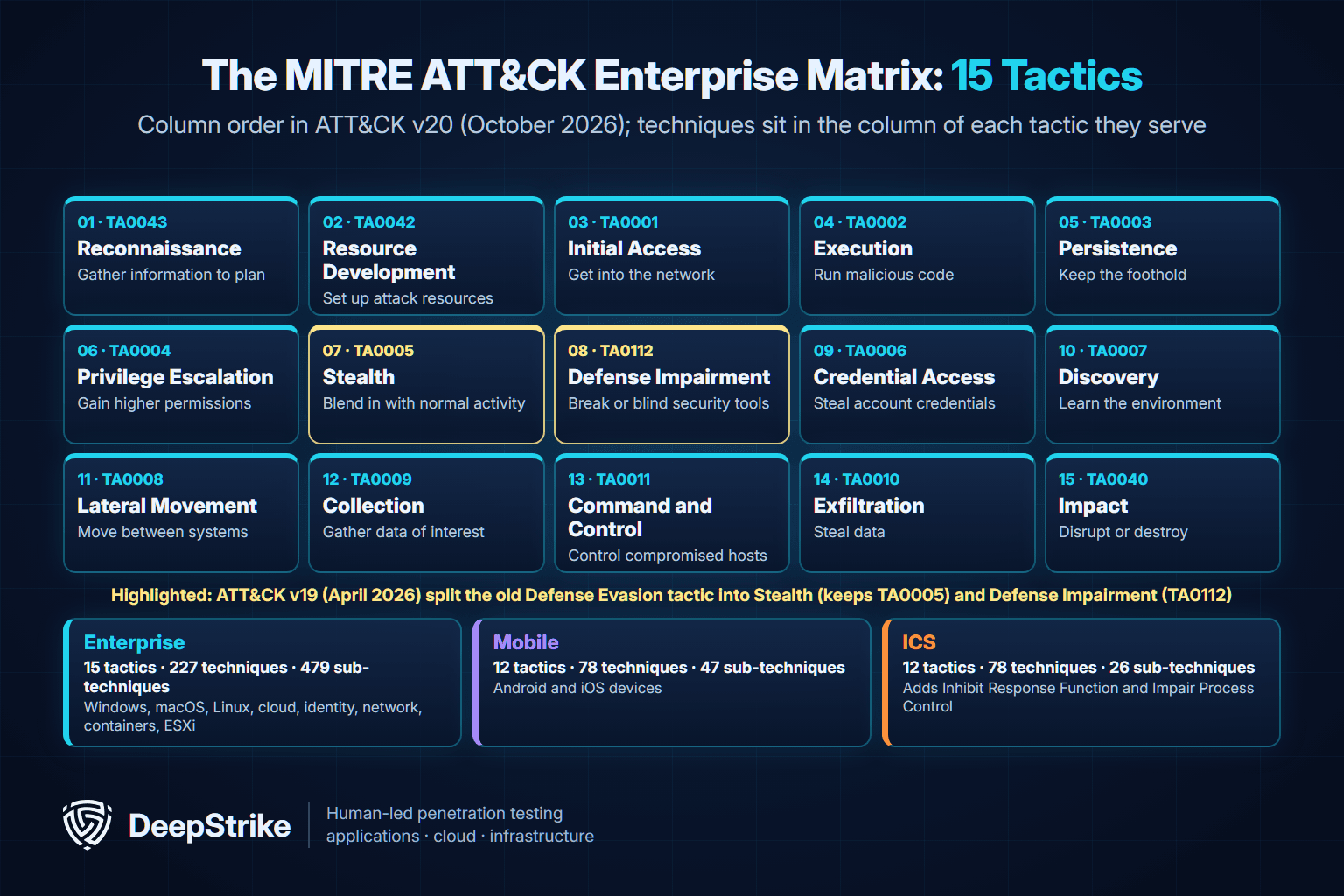
The Enterprise tactics page lists 15 tactics in this column order. The goals below summarize MITRE's own one-line descriptions.
| # | ID | Tactic | The adversary is trying to... |
|---|---|---|---|
| 1 | TA0043 | Reconnaissance | gather information to plan future operations |
| 2 | TA0042 | Resource Development | establish resources such as infrastructure, accounts and tools |
| 3 | TA0001 | Initial Access | get into your network |
| 4 | TA0002 | Execution | run malicious code or instructions |
| 5 | TA0003 | Persistence | maintain a foothold |
| 6 | TA0004 | Privilege Escalation | gain higher-level permissions |
| 7 | TA0005 | Stealth | hide and conceal actions so they look like normal behavior |
| 8 | TA0112 | Defense Impairment | break security mechanisms, pipelines and tooling so defenders cannot see or trust what is happening |
| 9 | TA0006 | Credential Access | steal account names and passwords |
| 10 | TA0007 | Discovery | figure out the environment |
| 11 | TA0008 | Lateral Movement | move through the environment |
| 12 | TA0009 | Collection | gather data of interest |
| 13 | TA0011 | Command and Control | communicate with compromised systems to control them |
| 14 | TA0010 | Exfiltration | steal data |
| 15 | TA0040 | Impact | manipulate, interrupt or destroy systems and data |
Reconnaissance and Resource Development describe activity before the attacker touches your network, so their techniques carry the "PRE" platform label. They are harder to detect directly but useful for threat intelligence and attack surface work. For how attackers gather this pre-compromise information from public sources, see our guide to OSINT and the Reconnaissance tactic.
If you learned ATT&CK before 2026, you learned 14 Enterprise tactics, including Defense Evasion (TA0005). MITRE's v19 release notes (April 28, 2026) describe the change directly: the biggest change in v19 was "the split of the Defense Evasion Tactic in Enterprise ATT&CK into the Stealth and Defense Impairment Tactics."
The two new tactics separate two different attacker goals:
Some technique IDs changed with the split. On attack.mitre.org on November 4, 2026, the old Disable or Modify Tools sub-technique T1562.001 redirects to T1685, and the old Clear Windows Event Logs sub-technique T1070.001 redirects to T1685.005 under Defense Impairment. Detection rules, SIEM tags and Navigator layers that hard-code the old IDs need a review.
Older reports are not wrong; they use an older version. CISA's February 2024 Volt Typhoon advisory, AA24-038A, states that it uses ATT&CK for Enterprise version 14 and groups activity under a "Defense Evasion" heading. Always record which ATT&CK version a mapping uses before you compare results over time.
| Release | Date | What changed |
|---|---|---|
| ATT&CK v18 | October 28, 2025 | Detection Strategies and Analytics replaced technique detections; Data Sources deprecated; Enterprise still had 14 tactics |
| ATT&CK v19 | April 28, 2026 | Defense Evasion split into Stealth and Defense Impairment (15 Enterprise tactics); sub-techniques added to ICS |
| ATT&CK v20 | October 13, 2026 | New campaigns, including attacks on U.S. water utilities; AI-focused and AI-enabled Enterprise techniques; new ICS execution and command and control techniques |
Source: MITRE ATT&CK version history and release notes.
Open the Enterprise matrix and it looks like a wall of boxes. Five rules make it readable:
To work with the matrix rather than just read it, use the ATT&CK Navigator, MITRE's free web tool for annotating the matrix. You create "layers" that color, score or comment on techniques, for example the techniques a threat group is known to use or the techniques your SOC can detect. Navigator can also load older ATT&CK versions, which helps when you compare old and new mappings.
MITRE's Center for Threat-Informed Defense describes ATT&CK as "an important foundation for threat-informed defense." The idea is simple: prioritize defenses around the behaviors the adversaries you actually face are known to use, instead of around a generic checklist. In practice, that means four steps:
A coverage map is a Navigator layer that scores each relevant technique by what your controls do against it. A simple four-level scheme works better than a binary yes or no:
| Score | Meaning | Typical next action |
|---|---|---|
| Prevented | A control blocks the behavior | Keep it tested; confirm it cannot be bypassed easily |
| Detected | An alert fires and reaches an analyst | Measure time to triage and response |
| Logged only | Telemetry exists but no rule fires | Write or tune a detection |
| Not visible | No telemetry or no rule | Add data collection first, then detection |
This scheme is DeepStrike editorial guidance, not a MITRE standard. Two cautions apply. First, a mapped technique is not a covered technique until someone has tested it, because one procedure can trigger a rule while another variant of the same technique slips past. Second, a heat map is a planning tool, not a score to report upward; 60% coverage of irrelevant techniques is worth less than 30% coverage of the techniques your adversaries actually use. Track detection speed alongside coverage, for example with mean time to detect.
Government advisories increasingly ship with ATT&CK mappings, which turns intelligence into test cases. AA24-038A maps Volt Typhoon activity to techniques such as Exploit Public-Facing Application (T1190), LSASS Memory (T1003.001) and Valid Accounts (T1078). The authoring agencies then recommend testing your existing security controls against the mapped techniques: select a technique from the advisory, align your security technologies to it, test them, analyze detection and prevention performance, repeat for all technologies, and tune people, processes and technology based on the results. The same advisory points readers to CISA's Decider tool and to CISA and MITRE's Best Practices for MITRE ATT&CK Mapping for help mapping activity themselves.
Defenders automate parts of that loop. Breach and attack simulation platforms run scripted technique tests on a schedule, and a continuous threat exposure management (CTEM) program uses ATT&CK-mapped validation to confirm which exposures attackers could really use.
Tagging alerts and incident timelines with technique IDs helps responders see where an intrusion sits in the lifecycle and what usually comes next. An alert for LSASS access (T1003.001) should trigger a look for Lateral Movement techniques, because attackers steal credentials to use them. Consistent tags also let you compare incidents over time and feed lessons back into your coverage map and incident response plan.
ATT&CK was built partly for adversary emulation: the design paper notes that both the emulation team and the defender team in MITRE's FMX research used it. Offensive teams still use it in three ways.
An emulation plan describes, step by step, how a test team will reproduce a specific adversary's behavior in your environment. A typical build looks like this:
You do not have to start from scratch. The Center for Threat-Informed Defense maintains a free Adversary Emulation Library with full emulation plans for groups such as APT29, FIN6, FIN7, menuPass, OilRig, Sandworm, Turla and Wizard Spider, and micro emulation plans for compound behaviors such as webshells. Caldera, MITRE's open-source automated adversary emulation platform built on ATT&CK, was contributed to the Apache Incubator on May 20, 2026 and continues as Apache Caldera (Incubating).
Emulation is the core of a red team engagement: an objective-based exercise that tests whether people, processes and technology can prevent, detect and respond to a realistic attacker. For how the attack and defense sides work together, see red team vs blue team.
ATT&CK makes offensive reports actionable for defenders. A useful ATT&CK-mapped report, or a penetration testing report with an ATT&CK appendix, records for every step:
| Field | Why it helps |
|---|---|
| Timestamp, source and target host, account | Lets the SOC find the exact events in its logs |
| Tactic and technique ID, with ATT&CK version | Gives a stable, shared label for the behavior |
| What the team did, at a high level | Explains the procedure without publishing a weapon |
| Prevention and detection outcome | Shows which controls worked and which did not |
| Time to detect and respond, where observed | Measures the response, not just the alert |
| Recommended fix and owner | Turns the finding into work |
A scoped penetration test can use ATT&CK too. Findings such as password spraying (T1110.003) or an exploited internet-facing application (T1190) map naturally. Remember that ATT&CK labels behaviors; the vulnerability itself still belongs in CVE and CWE terms.
The most valuable step often comes after the report. In a purple teaming session, the red team replays its techniques one at a time while defenders watch their tools, tune detections and retest on the spot. ATT&CK IDs keep both teams talking about the same thing.
These three frameworks are often compared, but they answer different questions. The Lockheed Martin Cyber Kill Chain, from a 2011 white paper by Hutchins, Cloppert and Amin, describes an intrusion in seven phases: reconnaissance, weaponization, delivery, exploitation, installation, command and control (C2), and actions on objectives. MITRE D3FEND is a knowledge graph of defensive countermeasure techniques linked to ATT&CK techniques; it is funded by the NSA Cybersecurity Directorate and organizes countermeasures into seven tactics: Model, Harden, Detect, Isolate, Deceive, Evict and Restore.
| Aspect | MITRE ATT&CK | Cyber Kill Chain | MITRE D3FEND |
|---|---|---|---|
| Perspective | Attacker behavior | Attacker lifecycle | Defender countermeasures |
| Structure | 15 Enterprise tactics, hundreds of techniques and sub-techniques | 7 sequential phases | 7 defensive tactics and their techniques |
| Granularity | Detailed, with procedures and IDs | High level | Detailed, mapped to ATT&CK techniques |
| Grounding | Public threat reporting | Intrusion analysis model | Technical sources such as patents and specifications |
| Best for | Detection engineering, threat intel, emulation, reporting | Explaining an attack to leadership; "break the chain" thinking | Choosing and describing controls for a technique |
| Main limitation | Coverage maps can be mistaken for protection | Weaker on post-compromise behavior | Does not prioritize countermeasures or rate their effectiveness |
MITRE's own design paper makes the distinction clear: high-level lifecycle models such as the Cyber Kill Chain help explain adversary goals, but they do not convey individual actions or how those actions relate to data sources and defenses. D3FEND's FAQ is equally candid: it standardizes defensive vocabulary but "does not prescribe specific countermeasures, it does not prioritize them, and it does not characterize their effectiveness."
Most mature programs use all three together. The kill chain frames the story for executives, ATT&CK describes exactly what the attacker did, and D3FEND names the countermeasures that could stop or reveal each step.
For the seven stages, defender actions and a real campaign walked through them, see our guide to the cyber kill chain.
The scenario below is an illustrative example, not a real incident or a DeepStrike engagement. It shows how a red team exercise against a fictional mid-size company would be mapped. Technique IDs and D3FEND IDs were checked against ATT&CK v20 and D3FEND 1.6.0 on November 4, 2026. Actions are described at a high level, with lab-built, harmless payloads assumed throughout.
| Step | What the red team did | Tactic | ATT&CK technique | Detection outcome | Example countermeasure (D3FEND) |
|---|---|---|---|---|---|
| 1 | Emailed a harmless test document to an approved list of users | Initial Access | Spearphishing Attachment (T1566.001) | Missed: the mail gateway delivered it | Email Filtering (D3-EF), File Analysis (D3-FA) |
| 2 | A user opened the document | Execution | User Execution: Malicious File (T1204.002) | Detected: endpoint alert raised | Dynamic Analysis (D3-DA) |
| 3 | The document started a PowerShell script that called back to the team | Execution | PowerShell (T1059.001) | Logged only: script logging on, no rule | Script Execution Analysis (D3-SEA) |
| 4 | Created a scheduled task to survive reboots | Persistence | Scheduled Task (T1053.005) | Missed | Scheduled Job Analysis (D3-SJA) |
| 5 | Attempted to read credentials from LSASS memory | Credential Access | LSASS Memory (T1003.001) | Detected: alert raised and triaged | Credential Hardening (D3-CH) |
| 6 | Used a captured account to open RDP to a file server | Lateral Movement | Remote Desktop Protocol (T1021.001) | Logged only: logon event, no alert | Multi-factor Authentication (D3-MFA) |
| 7 | Copied planted canary files to an approved cloud storage account | Exfiltration | Exfiltration to Cloud Storage (T1567.002) | Missed | Outbound Traffic Filtering (D3-OTF) |
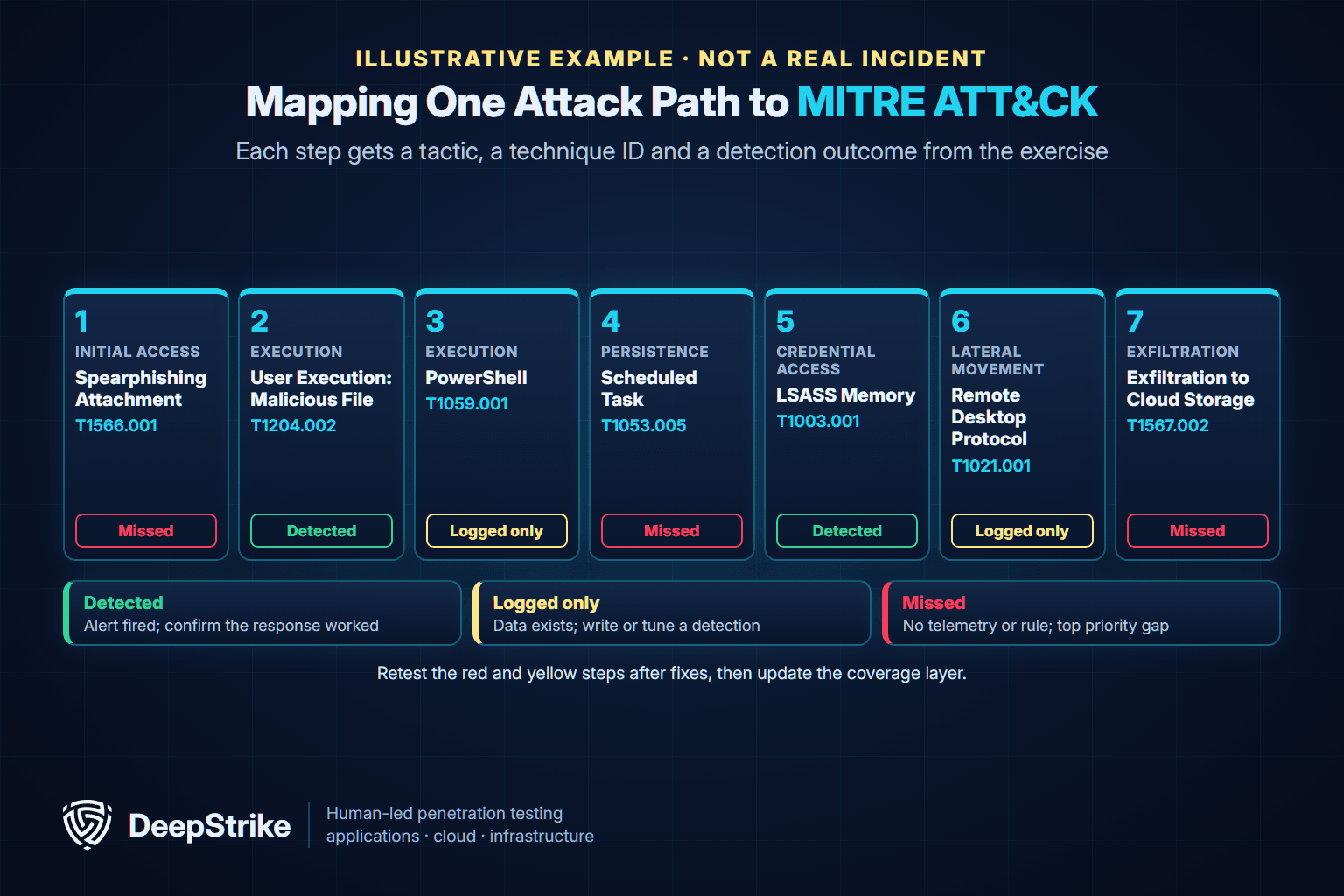
After the exercise, the blue team turns this table into a Navigator layer: two techniques detected, two logged only and three missed. The priorities follow from the outcomes:
Notice what the mapping adds. A list of findings would say "PowerShell not monitored" and "RDP allowed." The ATT&CK version shows that a single chain of seven behaviors went from email to data theft, and exactly which links in that chain your defenses can already break.
ATT&CK stands for Adversarial Tactics, Techniques, and Common Knowledge. MITRE asks that the first reference in writing use "MITRE ATT&CK" and that the name is never abbreviated or hyphenated.
Security teams use it as a common language for attacker behavior. Defenders map detections to it to find coverage gaps, threat intelligence analysts tag adversary activity with it, incident responders use it to structure timelines, and red teams use it to build emulation plans and report results that defenders can act on.
In ATT&CK v20 (October 2026), the Enterprise matrix has 15 tactics, and the Mobile and ICS matrices have 12 each. Enterprise went from 14 to 15 tactics in v19 (April 2026), when Defense Evasion was split into Stealth and Defense Impairment.
In ATT&CK v19, released April 28, 2026, MITRE split Enterprise Defense Evasion into two tactics. Stealth keeps the ID TA0005 and covers blending in with normal activity. Defense Impairment (TA0112) covers disabling or undermining security tools and logging. Some techniques received new IDs, such as Disable or Modify Tools, now T1685. The Mobile matrix still uses Defense Evasion (TA0030).
A tactic is the attacker's goal (why), a technique is how they achieve it, a sub-technique is a more specific how, and a procedure is the exact implementation observed in a real attack. For example: Credential Access, OS Credential Dumping, LSASS Memory, and a specific group's use of PowerShell to scrape LSASS memory.
Yes. MITRE states that ATT&CK is open and available to any person or organization at no charge, subject to its terms of use. You may not use the ATT&CK name in a way that implies MITRE endorses a product or service.
MITRE publishes major releases twice a year, typically in April and October, with minor releases for corrections in between. The current version is v20, released October 13, 2026.
The Cyber Kill Chain is a seven-phase, high-level model of an intrusion from reconnaissance to actions on objectives. ATT&CK is far more detailed, with 15 Enterprise tactics and hundreds of techniques grounded in real reporting, and it covers post-compromise behavior in depth. Many teams use the kill chain to explain an attack and ATT&CK to analyze and test against it.
D3FEND is MITRE's knowledge graph of defensive countermeasures, funded by the NSA Cybersecurity Directorate. It organizes countermeasures into seven tactics (Model, Harden, Detect, Isolate, Deceive, Evict and Restore) and links them to the ATT&CK techniques they address.
It is one of the most widely used, but it does a different job from governance frameworks. Programs are usually structured with frameworks such as the NIST Cybersecurity Framework, ISO/IEC 27001 or the CIS Critical Security Controls, while ATT&CK describes the threats those programs must handle. Most mature teams use ATT&CK alongside one of them.
ATT&CK tells you what attackers do. The only way to know what your defenses do against it is to test. Start with a coverage layer for the adversaries that matter to you, then validate the gaps with an exercise that behaves like those adversaries.
DeepStrike's red teaming services run objective-driven campaigns across people, identity, cloud, applications and internal systems, with adversary profiles that include nation-state or APT group simulation. Each engagement measures your SOC, alerting and response workflows against realistic tradecraft and ends with a debrief covering attacker pathways, evidence, remediation priorities and retest-ready next actions. To scope an exercise around the threats you face, contact DeepStrike.
Mohammed Khalil is a Cybersecurity Architect at DeepStrike, specializing in advanced penetration testing and offensive security operations. With certifications including CISSP, OSCP, and OSWE, he has led numerous red team engagements for Fortune 500 companies, focusing on cloud security, application vulnerabilities, and adversary emulation. His work involves dissecting complex attack chains and developing resilient defense strategies for clients in the finance, healthcare, and technology sectors.

Stay secure with DeepStrike penetration testing services. Reach out for a quote or customized technical proposal today
Contact Us
