November 4, 2026
Updated: November 4, 2026
Safety-first rules of engagement, Purdue levels, IEC 62443 zones and conduits, six testing phases and a fix-first list for industrial networks.

Mohammed Khalil
OT/ICS penetration testing is an authorized, controlled attempt to find and prove how an attacker could reach and affect industrial control systems such as SCADA servers, HMIs, engineering workstations and controllers. Unlike an IT pentest, it puts safety and availability ahead of coverage. Testers start with architecture review and passive traffic analysis, test the IT/OT boundary and remote access only with approval, and keep live controllers out of active testing, using test benches or replicas instead. The result is a prioritized list of exposures that could cause loss of view or control of a physical process.
"OT penetration testing", "SCADA penetration testing" and "ICS penetration testing" describe the same discipline at different scopes. The method in this guide is built on public guidance from NIST, CISA and MITRE, and it contains no exploit steps or commands.
An ICS penetration test simulates a realistic attacker against an industrial environment to answer one question: could someone get from where they start (the internet, a vendor connection, the corporate network) to a position where they can change or blind the process? Testers validate the paths they find with the least intrusive evidence that proves them, and they stop short of anything that could move equipment.
It is not the same as an OT security assessment. An assessment reviews architecture, configurations and policies against a standard. A penetration test adds controlled proof that weaknesses can be chained. Most good OT engagements combine both, and many begin as an assessment and earn their way to active testing.
| Term | What it covers | Examples |
|---|---|---|
| Operational technology (OT) | Any programmable system that monitors or controls physical processes, events or equipment | Industrial control, building automation, transportation, physical access systems |
| Industrial control system (ICS) | The control systems inside OT that run an industrial process | SCADA, distributed control systems (DCS), PLC-based control |
| SCADA | Supervisory control and data acquisition: centralized monitoring and control of geographically spread assets | Pipelines, electric grids, water distribution |
| DCS | Distributed control system: control of a process within one site | Refineries, chemical plants, power stations |
| PLC and RTU | Controllers that execute logic and read or drive field devices | Line controllers, substation and pump-station RTUs |
| HMI | Operator screens used to view and command the process | Control room displays, panel PCs |
| Engineering workstation | The computer used to program and configure controllers | Vendor engineering software, project files |
| Data historian | A database of process values over time, often shared with business users | Production and quality reporting |
| Safety instrumented system (SIS) | Independent controls that bring the process to a safe state when limits are exceeded | Emergency shutdown, burner management |
NIST's Guide to Operational Technology (OT) Security, SP 800-82 Rev. 3 uses this broader "OT" framing and covers industrial control, building automation, transportation and physical access systems. NIST released SP 800-82 Rev. 4 as an initial public draft on September 21, 2026, with comments open through November 30, 2026; Rev. 3 remains the final version until then.
In IT, the main concerns are usually confidentiality and integrity of data. NIST SP 800-82 Rev. 3 states that for OT the primary concerns include safety, fault tolerance and the protection of people, equipment and the environment, and that "any security measure that impairs safety is unacceptable." That one sentence changes how every phase of a test is designed.
| Factor | Typical IT pentest | OT/ICS pentest |
|---|---|---|
| Top priority | Find as many exploitable issues as possible | Never affect safety or the running process |
| Availability | Short disruption is often tolerable | Unplanned outages are unacceptable; outages are planned days or weeks ahead |
| Device tolerance | Servers handle scans well | Controllers can be resource-constrained, timing-sensitive and react badly to unexpected traffic |
| Protocols | Modern, authenticated protocols | Industrial protocols that often lack authentication and integrity checks |
| Patching | Regular and often automated | Slow; updates need vendor and owner testing and may need revalidation |
| Software lifespan | Years | Often decades, including operating systems no longer supported |
| Vendor terms | Owner decides | Vendor-qualified configurations and support terms can limit what may be installed or changed |
| Who must approve | Security and IT owners | Plus operations, control engineering, safety and sometimes the system vendor |
| Main test location | Production | Architecture review, passive capture, test benches and replicas; production only where approved |
The caution is grounded in real incidents. NIST SP 800-82 Rev. 3 records accidental events in which a simple ping sweep on an active SCADA network caused a robotic arm in standby to swing 180 degrees, and another sweep caused a semiconductor fabrication control system to hang, destroying $50,000 worth of wafers. In a third case, a penetration test of a natural gas utility's corporate IT network strayed into a segment connected to the SCADA system and locked it up, leaving the utility unable to send gas through its pipelines for four hours.
Vendor and warranty terms are a practical constraint too. NIST advises following vendor recommendations for controllers and other systems with time-dependent code, and notes that vendors may test security software only against specific supported versions. Before a test, check support agreements for anything that could be voided by installing software, changing configurations or connecting test equipment, and involve the vendor when the agreement requires it.
The threat is no longer theoretical. In CISA advisory AA24-038A (February 7, 2024), CISA, NSA, FBI and international partners reported that the PRC state-sponsored group Volt Typhoon had compromised IT environments of critical infrastructure organizations, primarily in the Communications, Energy, Transportation Systems and Water and Wastewater Systems sectors. The agencies assessed with high confidence that the actors were pre-positioning on IT networks "to enable lateral movement to OT assets to disrupt functions," and had kept access in some victim IT environments for at least five years.
Three details from the advisory map directly onto an OT test plan:
Attackers using simple tools are active as well. In May 2025, CISA, FBI, EPA and DOE published Primary Mitigations to Reduce Cyber Threats to Operational Technology, warning that internet-connected OT devices "are quickly found by searching for open ports on public IP ranges" and that targeted systems used default or easily guessed passwords. New product vulnerabilities also arrive constantly through CISA's ICS advisories, which list affected products, versions and vendor mitigations.
For industry-level context, see our manufacturing cybersecurity statistics and energy and utilities cybersecurity statistics.
The rules of engagement (RoE) are the most important document in an OT test. They decide what may be touched, when, by whom and what happens if something looks wrong. NIST's OT discussion of penetration testing (control CA-8) says testing "is used with care on OT networks," suggests a "replicated, virtualized, or simulated system" as a compensating approach, and recommends scheduling tests during planned OT outages where production systems must be involved.
| Rule | What it means in practice | Who signs off |
|---|---|---|
| Passive first | Begin with documents and passive traffic capture; no packets are sent to OT devices | Security lead and OT owner |
| No active scanning of live controllers without explicit approval | PLCs, RTUs, safety systems and field devices are excluded from active scans unless a named owner approves a specific, limited action | Control engineering and safety owner |
| Defined test windows | Active steps in OT zones happen only in agreed windows, ideally planned outages or low-risk periods | Operations manager |
| Operator on call | A plant or control-room operator who can see process state is available for every active step | Operations |
| Stop conditions | Any alarm, unexpected device behavior, latency change or operator concern pauses testing immediately | All parties; anyone may call a stop |
| Rollback plan | Current configurations, controller logic and backups are verified before testing, with a tested restore procedure | Control engineering |
| Safety systems excluded | SIS and emergency shutdown systems are reviewed on paper and by architecture, not tested actively | Safety owner |
| Test benches and replicas | Exploitability of controllers and protocols is proven on identical spare hardware, a lab or a digital twin | Control engineering and vendor where required |
| Out-of-scope list | Named systems, networks and actions that must never be touched | Security lead and OT owner |
| Communication plan | Who is told before, during and after each window, and how to reach them | Program manager |
About digital twins and test benches. A replica is the safest place to prove that a controller or protocol weakness is real. Its value depends on fidelity: the same firmware, configuration and logic as production. When the replica differs, label findings as "validated on bench" and confirm the production configuration by review rather than by testing.
About passive discovery. NIST explains that passive scanning adds no traffic to the network and can reveal manufacturers, part numbers and firmware versions, but it cannot see devices that are not communicating and often needs days of capture. NIST also cautions that active scans "may cause device instability or interfere with the device process state." Plan passive capture long enough to cover normal operating cycles.
Testers need a map of trust boundaries before they can test them. Two models provide it.
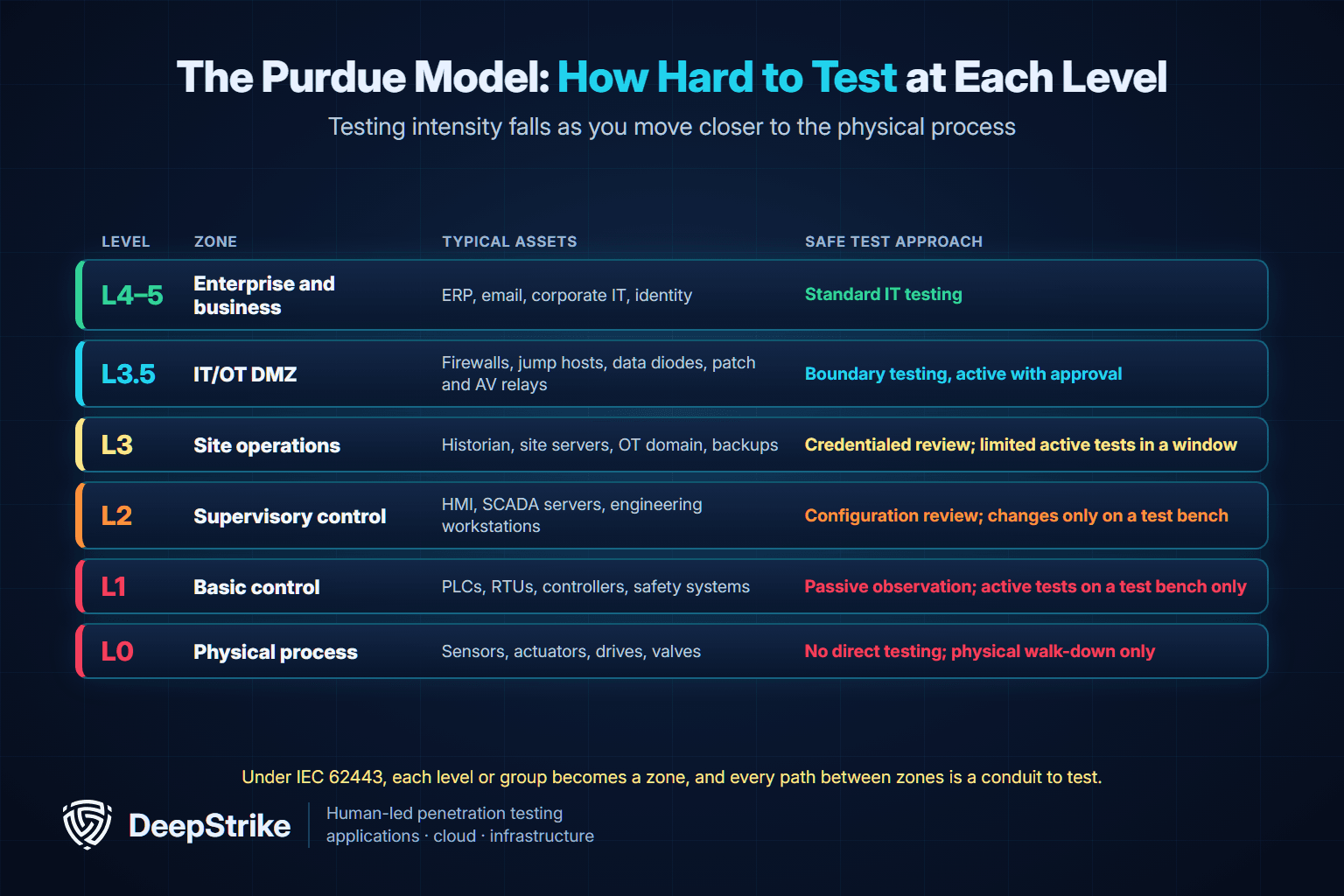
The Purdue model organizes an industrial environment into levels, from the physical process up to the enterprise. NIST SP 800-82 Rev. 3 lists it alongside ISA-95 levels and the IIoT three-tier model as industry-recognized ways to organize OT segmentation, and recommends firewall rules that only permit connections between adjacent levels, for example preventing Level 4 devices from talking directly to Levels 2, 1 or 0.
| Level | Zone | Typical assets | What to test and how |
|---|---|---|---|
| 4–5 | Enterprise and business | ERP, email, identity, corporate IT | Standard IT testing; look for paths and credentials that lead toward OT |
| 3.5 | IT/OT DMZ | Firewalls, jump hosts, data diodes, patch and antivirus relays, historian replicas | Active boundary testing with approval; rule review; segmentation validation |
| 3 | Site operations | Historian, site servers, OT domain controllers, backups | Credentialed configuration review; limited active tests in a window |
| 2 | Supervisory control | HMIs, SCADA servers, engineering workstations | Configuration and access review; risky changes proven on a bench |
| 1 | Basic control | PLCs, RTUs, controllers, safety controllers | Passive observation only in production; active checks on a test bench |
| 0 | Physical process | Sensors, actuators, drives, valves | No direct testing; physical walk-down and documentation review |
Real plants rarely match the model exactly. Flat networks, dual-homed workstations, cellular modems and cloud connections all cut across levels, and finding those shortcuts is one of the most valuable things a test does.
The ISA/IEC 62443 series sets requirements and processes for secure industrial automation and control systems, shared across asset owners, product suppliers, integrators and service providers. Its parts include 3-2 (security risk assessment for system design), 3-3 (system security requirements and security levels), 2-4 (requirements for IACS service providers), 4-1 (secure product development lifecycle) and 4-2 (technical requirements for components).
CISA and partner agencies summarize the two core ideas in their August 2025 asset inventory guidance for OT owners and operators, which draws on IEC 62443-3-2:
For a tester, this turns into a simple scoping rule: every conduit is a test case. For each one, confirm what traffic is allowed, whether anything else gets through, how it is monitored and whether it can be bypassed. Where an organization has set target security levels for its zones under 62443-3-3, findings can be reported against those targets instead of a generic severity scale.
A safe OT test moves from low-risk to higher-risk activity, and each step needs the previous one to be complete. The six phases below follow that order. Use the penetration testing methodology you already know for the IT parts; the OT parts are where the safety rules apply.
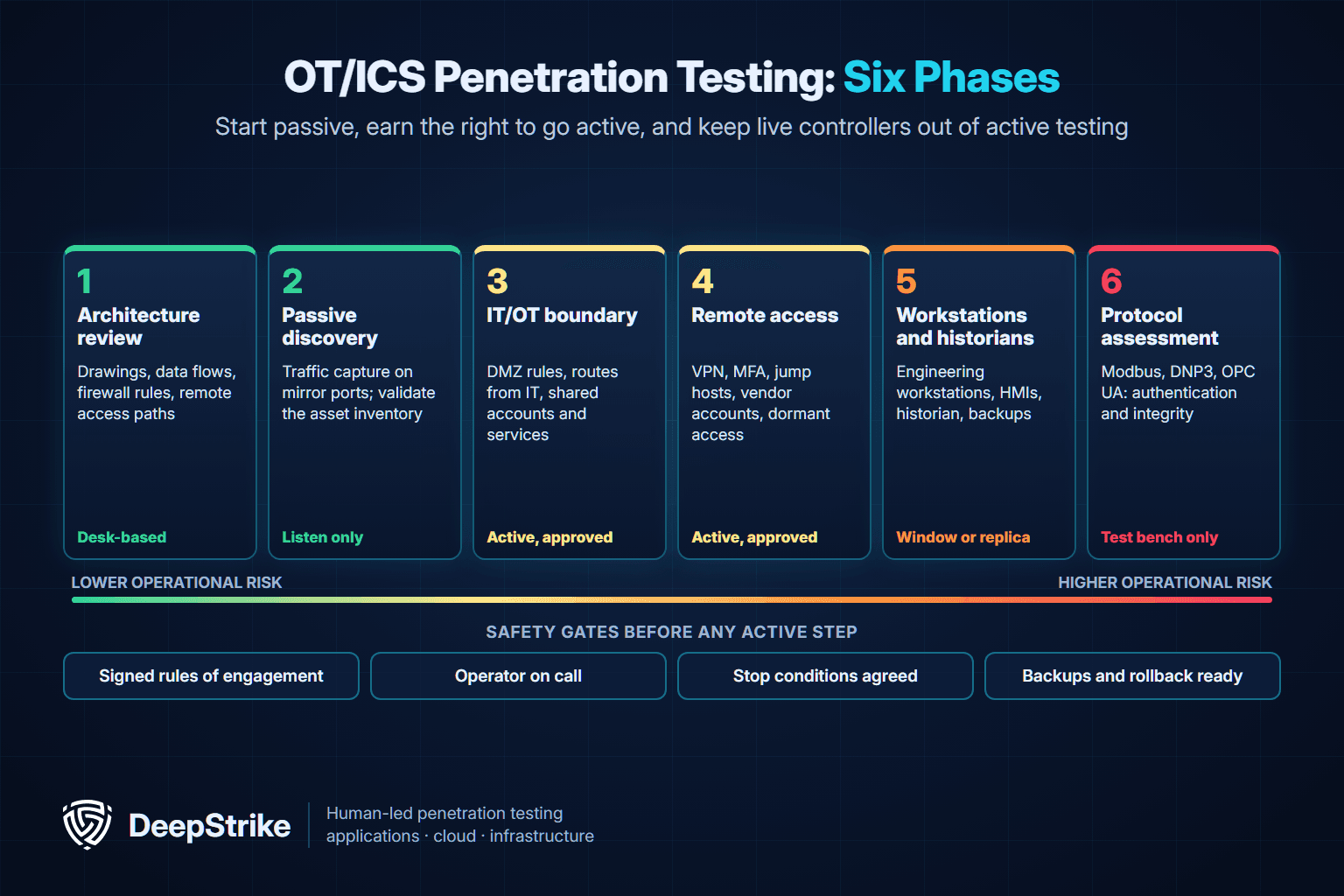
Start on paper. Collect network drawings, the asset inventory, firewall rule sets, remote access designs, vendor connection lists, data flows to business systems and the safety system architecture. Interview the people who run the plant, because the "as-operated" network often differs from the drawings. The Volt Typhoon advisory explicitly recommends an accurate "as-operated" OT network map that identifies IT and OT interdependencies.
Outputs: a zone and conduit map, a list of trust boundaries to test, the out-of-scope list and draft rules of engagement. Many serious findings, such as an unexpected IT-to-Level 2 route or a forgotten vendor modem, appear in this phase before a single packet is sent.
Capture traffic from switch mirror ports or network taps in each zone and compare what you see with the inventory. CISA's asset inventory guidance treats an accurate inventory as the foundation of OT security, and passive data is how a test checks it. Look for:
This is where most real attack paths live, and it is usually where active testing begins. With approval and inside the agreed window, test from the corporate network toward the DMZ and from the DMZ toward Level 3 and below. Confirm that only documented flows pass, that the DMZ really terminates connections rather than routing them through, and that shared services such as Active Directory, file shares, backups and antivirus or patch servers do not create a bridge.
Credentials are a large part of this phase. The Volt Typhoon actors used elevated credentials taken from IT to target OT, so check whether IT accounts or reused passwords work on OT systems and whether the OT domain trusts the corporate domain. Techniques here overlap with internal penetration testing and network penetration testing; the difference is the destination and the stop conditions.
Remote access is how vendors, integrators and engineers reach OT, and it is a frequent entry point. CISA's primary OT mitigations call for a private connection, a VPN with a strong password and phishing-resistant multifactor authentication, least privilege by asset and role, and disabling dormant accounts. The Volt Typhoon advisory adds that all IT-to-OT paths should pass through an intermediary such as a firewall, bastion host, "jump box" or DMZ that is closely monitored.
Test whether each of those controls holds in practice:
Engineering workstations are the keys to the plant: they hold the software and project files used to change controller logic. HMIs give operators view and command of the process, and historians are often the most connected OT system because business users need their data. Test these hosts in a window or on replicas:
Industrial protocols were mostly designed for closed, trusted networks. NIST SP 800-82 Rev. 3 notes that "many OT protocols have no authentication at any level," which creates the potential to replay, modify or spoof data, and that integrity checks are not built into most OT protocols. The assessment question is not "can we send a command?" but "what stops an unauthorized system from sending one, and would anyone notice?" Answer it with passive evidence in production and prove anything stronger on a bench.
| Protocol | Where you find it | What to assess conceptually | Safe way to assess |
|---|---|---|---|
| Modbus | Manufacturing, building systems, many PLCs and RTUs | Whether any host on the segment can read or write values; which hosts actually send writes | Passive capture to map masters and writers; any write test only on a bench |
| DNP3 (IEEE 1815) | Electric and water utilities, SCADA to RTU links | Whether secure authentication is supported and enabled; which masters talk to which outstations | Passive capture and configuration review; validation on a bench or replica |
| OPC UA | Newer plants, data integration between OT and IT | Whether the built-in security (certificates, signing, encryption, user authentication) is actually configured, and how certificates are trusted | Configuration review and certificate trust review; avoid active probing of production servers |
OPC UA is a good example of why configuration matters. The OPC Foundation describes OPC UA security as a suite of controls including X.509 certificates, message signing and encryption, yet those protections only help when they are turned on and certificates are managed. CISA ICS advisories regularly include OPC UA products as well, so check versions against them.
Mature programs sometimes run objective-based exercises that emulate a named threat, such as reaching the engineering workstation from a phishing foothold. The same safety rules apply, and the final objective is usually demonstrated on a replica. See what red teaming is for how objective-based testing differs from a scoped pentest.
MITRE ATT&CK for ICS catalogs adversary behavior against industrial systems in 12 tactics (version 20), including two that only exist in OT: Inhibit Response Function and Impair Process Control. Mapping findings to techniques helps defenders build detections and helps leadership see how findings chain together.
| Example finding | ATT&CK for ICS technique | Why it matters |
|---|---|---|
| HMI or remote access portal reachable from the internet | Internet Accessible Device (T0883) | Direct entry without touching IT |
| Vendor VPN without MFA | External Remote Services (T0822) | A common initial access path |
| Default or reused passwords on OT systems | Valid Accounts (T0859) | Legitimate logins blend into normal activity |
| Remote desktop from IT into Level 2 | Remote Services (T0886) | Lateral movement across the boundary |
| Unpatched, internet-facing or DMZ service with a known CVE | Exploitation of Remote Services (T0866) | Access through a published vulnerability |
| Engineering software reachable with no logging of logic changes | Program Download (T0843) | Controller logic could change unnoticed |
| Writable set points with no limits | Modify Parameter (T0836) | Direct effect on the process |
MITRE's technique pages describe each of these in detail, including detections and mitigations: Internet Accessible Device (T0883), External Remote Services (T0822), Valid Accounts (T0859), Remote Services (T0886), Exploitation of Remote Services (T0866), Program Download (T0843) and Modify Parameter (T0836).
New to ATT&CK? Start with how the MITRE ATT&CK framework is structured.
An OT report has two audiences: engineers who must fix things without disrupting production, and leaders who must fund and schedule the fixes. A solid penetration testing report for OT includes:
Treat results like any other vulnerability management input, but with OT change management: owners, deadlines and approved maintenance windows.
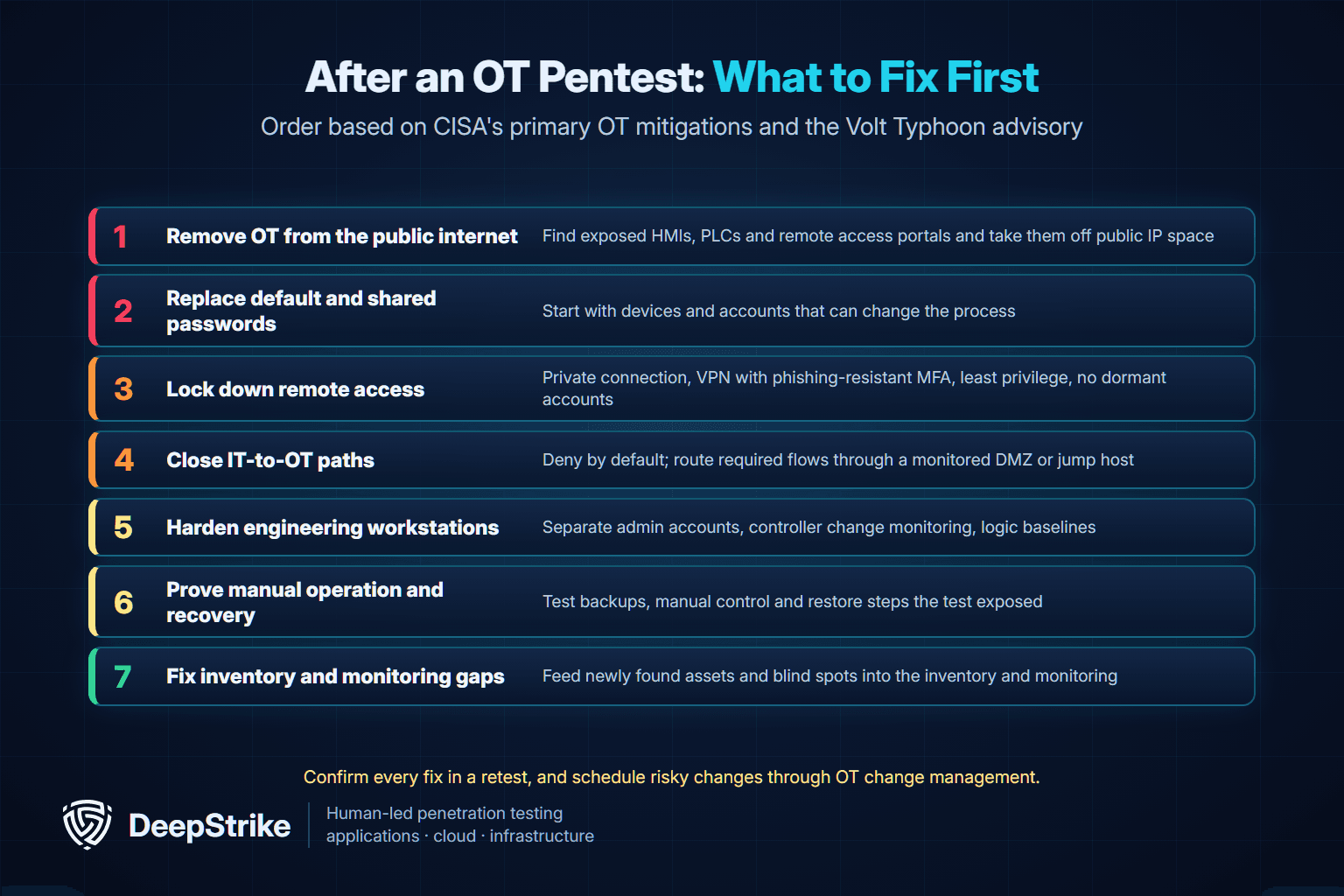
OT remediation competes with production schedules, so order matters. The sequence below follows CISA's primary OT mitigations and the Volt Typhoon advisory, and it puts high-impact, low-disruption fixes first.
There is no single required cadence for every industry, so tie testing to risk and change:
Because full OT tests are slow and careful, many organizations rotate through zones and sites rather than testing everything at once.
Ask any provider, including us, these questions before you sign:
ICS is the broad term for systems that control industrial processes. SCADA is one type of ICS that monitors and controls assets spread over large areas, such as pipelines or power grids, from a central location. Distributed control systems (DCS) and PLC-based control are other types of ICS.
OT is the widest category: any programmable system that interacts with the physical world, including building automation, transportation and physical access systems. ICS is the part of OT that runs industrial processes. NIST SP 800-82 Rev. 3 uses OT as the umbrella term.
It can be, when the test is designed for OT. That means passive discovery first, written rules of engagement, test windows, an operator on call, stop conditions, verified backups, safety systems excluded from active testing and controller-level proof on a test bench or replica. IT-style scanning of a live SCADA network is not safe; NIST documents incidents where a ping sweep moved a robotic arm and a pentest locked up a gas utility's SCADA system.
Avoid active scanning of production PLCs unless a named owner approves a specific, limited action in a planned window. NIST warns that active scans can cause device instability or interfere with process state. Passive traffic analysis can identify most communicating devices, including models and firmware versions, without sending traffic.
It is a reference model that organizes an industrial environment into levels: the physical process (Level 0), basic control (Level 1), supervisory control (Level 2), site operations (Level 3), an IT/OT DMZ (often called Level 3.5) and enterprise systems (Levels 4 and 5). Security teams use it to plan segmentation and to decide how cautiously to test each level.
A zone is a group of assets that share the same security requirements. A conduit is the controlled communication path between zones that allows only authorized traffic. In a pentest, each conduit becomes a test case.
Typically six areas: architecture review, passive discovery, the IT/OT boundary, remote access and jump hosts, engineering workstations, HMIs and historians, and a conceptual assessment of industrial protocols such as Modbus, DNP3 and OPC UA, with risky steps proven on a bench.
It is NIST's Guide to Operational Technology (OT) Security. Revision 3, published in September 2023, is the current final version. Revision 4 was released as an initial public draft on September 21, 2026, with comments due November 30, 2026.
An OT penetration test is worth doing only if it is safe, so start where the risk is lowest: map your zones and conduits, run passive discovery, and check your environment against the fix-first list. Then bring in testers who will respect your rules of engagement for the active steps.
DeepStrike performs OT/ICS penetration testing. Our penetration testing services include manual testing, a detailed report with fix recommendations, re-testing to confirm fixes, an attestation letter and a technical presentation for your engineers. To discuss your environment, test windows and rules of engagement, contact DeepStrike.
Mohammed Khalil is a Cybersecurity Architect at DeepStrike, specializing in advanced penetration testing and offensive security operations. With certifications including CISSP, OSCP, and OSWE, he has led numerous red team engagements for Fortune 500 companies, focusing on cloud security, application vulnerabilities, and adversary emulation. His work involves dissecting complex attack chains and developing resilient defense strategies for clients in the finance, healthcare, and technology sectors.

Stay secure with DeepStrike penetration testing services. Reach out for a quote or customized technical proposal today
Contact Us
