July 19, 2026
Updated: August 10, 2026
Compare in-house, outsourced, and hybrid penetration testing across total cost, expertise, independence, governance, speed, and scalability.

Mohammed Khalil
Choose in-house testing when demand is continuous and you can sustain qualified staff, governance, quality assurance, and specialist coverage. Outsource when testing is periodic or requires independent challenge, niche expertise, or short-notice capacity. Use a hybrid model when internal context and speed must coexist with external depth. Decide using demand, expertise, independence, control, data constraints, and fully loaded cost. This is a delivery-model decision who performs the work not a choice between internal and external test scope.
This guide helps security, technology, risk, and procurement leaders design a repeatable penetration testing program. Although DeepStrike provides penetration testing services, the framework evaluates in-house, outsourced, and hybrid delivery using the same criteria.
Match the operating model to actual demand. In-house teams provide fixed capacity and close engineering integration. Outsourced providers provide external capacity and specialist depth. A hybrid program partitions work by cadence, risk, expertise, or assurance purpose.
Table 1. In-House vs Outsourced vs Hybrid
| Decision factor | In-house | Outsourced | Hybrid | What the reader should verify |
|---|---|---|---|---|
| Who performs the test | Employees assigned to authorized testing | Contracted provider or consultant | Employees plus selected providers | Named individuals, employer, subcontractors, and accountability |
| Organizational context | Usually strongest and fastest to acquire | Must be transferred during onboarding | Internal context guides external depth | Architecture, business logic, data flows, and threat assumptions |
| Specialist breadth | Bound by hiring, training, and retention | Can be broad if the assigned team is proven | Core skills inside; niche skills on demand | Named tester experience for the exact scope |
| Availability | Fast when capacity is free | Subject to procurement and scheduling | Routine access plus reserved external capacity | Backlog, lead time, and emergency options |
| Scalability | Slow to change; limited by headcount | Can scale, but provider capacity is not unlimited | Elastic around a stable core | Surge commitments and contingency plans |
| Independence considerations | Requires separation from system ownership and self-review | External status helps perspective but does not remove conflicts | External assurance can challenge internal work | Reporting line, prior design work, incentives, and conflicts |
| Data and access control | Fewer external transfers; insider controls still matter | Adds vendor, access, residency, and retention exposure | Partition sensitive work and enforce common controls | Least privilege, encryption, retention, deletion, and auditability |
| Cost structure | Mostly fixed capacity plus variable specialist gaps | Mostly variable fees plus internal coordination | Fixed core plus targeted variable spend | Comparable scope, depth, QA, support, and retesting |
| Reporting | Can be tailored to engineering; assurance format must be governed | Often formal, but quality varies | Common template with independent sections where needed | Audience, evidence, severity method, and remediation clarity |
| Knowledge retention | High if people and records remain | Depends on handover and provider continuity | Internal owner preserves context across engagements | Repository, workshops, decision log, and staff turnover plan |
| Main operational risk | Blind spots, key-person dependency, and capacity limits | Quality variance, context gaps, scheduling, and vendor exposure | Unclear ownership and duplicated effort | Single points of failure and unassigned decisions |
| Best-fit conditions | Continuous demand, mature governance, strong hiring, fast integration | Periodic demand, niche scope, surge need, or external challenge | Continuous core demand plus specialist or assurance needs | Evidence for demand, constraints, and review triggers |
Several overlapping terms describe different decisions:
An external provider can perform both internal and external tests, and a qualified employee can also perform either scope when properly authorized. See DeepStrike’s separate guide to internal vs external penetration testing for the test-origin decision.
An in-house program uses employees whose roles, methods, and authorization explicitly include penetration testing. Dedicated testers may provide formal capacity, documentation, peer review, and governance that occasional testing by product security or engineering staff does not automatically supply.
The strongest advantage is context. Internal testers can understand architecture, trust boundaries, business logic, past incidents, and engineering ownership without rebuilding that knowledge for every engagement. They can join design reviews, test before release, validate fixes quickly, and track recurring weakness classes. Sensitive evidence can remain inside internal systems, although insider, endpoint, and access controls still apply.
That proximity is especially valuable in high-change environments using continuous penetration testing. Frequent validation can shorten feedback loops, but only if testing remains risk-prioritized and does not become repetitive scanning under a penetration-testing label.
The trade-off is fixed capacity. The organization must recruit and retain testers, fund tools and safe infrastructure, maintain methodology and QA, and cover leave, turnover, and specialist gaps. A one-person function creates a single point of failure and cannot credibly provide equal depth across every technology.
Familiarity can normalize weaknesses. Internal testers may inherit assumptions or review systems they helped design. Where independence matters, separate testing from target ownership, require peer review and escalation, and define external-challenge triggers. A developer testing their own code may improve security, but the work is not an independent penetration test without defensible separation of duties.
Outsourced testing includes fixed-scope projects, specialist boutiques, large consultancies, retainers, human-led PTaaS, and crowdsourced programs. The label does not determine quality: a boutique may offer senior depth but limited surge capacity, while a larger provider may assign a delivery team different from the sales team. A platform may improve workflow without proving manual-testing depth.
The main benefits are specialist access, elastic capacity, and a fresh perspective. A qualified provider can support niche technologies, launches, acquisitions, and independent challenge. An external report may also support customer or assessor confidence. Verify the named team, comparable work, methodology, QA, and conflicts; none of those benefits is automatic.
External delivery adds procurement, scheduling, secure access, architecture briefing, report handling, retesting, and knowledge-transfer work. Quality depends on the assigned tester and scope not only the brand or certifications. Confirm subcontractors, crowd participants, locations, screening, and which entity remains accountable.
Continuity also needs design. A provider can change staff, become unavailable at a critical release, or accumulate too much program knowledge in one commercial relationship. Preserve evidence internally, require a usable handover, and maintain a fallback. For a fuller procurement workflow, use DeepStrike’s guide on how to choose a penetration testing company. This section stays focused on the operating model rather than vendor ranking.
For a U.S.-focused outsourced model, compare external penetration testing companies in the USA before selecting the provider that will supply specialist capacity.
The same factor can point in different directions. “Fast” may mean an available employee, a pre-booked provider retainer, or both. Use the implication column to turn each comparison into a decision question.
Detailed comparison matrix. Delivery-model trade-offs and their decision implications.
| Factor | In-house | Outsourced | Hybrid | Decision implication |
|---|---|---|---|---|
| Control | Direct priorities and daily management | Control through contract, scope, and oversight | Direct core control; contracted specialist work | Choose the governance burden you can actually sustain. |
| Context | Deepest institutional knowledge | Context must be transferred and tested | Internal context briefs external specialists | Complex business logic strengthens Build or Blend signals. |
| Speed | Quick if capacity is available | Lead time for procurement and scheduling | Routine internal response plus external reservation | Measure time from approved scope to start, not sales promises. |
| Testing cadence | Efficient for steady, repeatable demand | Efficient for discrete or irregular demand | Core cadence inside; campaigns outside | Model annual demand and backlog by risk tier. |
| Skill diversity | Limited by headcount and development plan | Potentially broad, subject to assignment | Sustain common skills; buy rare skills | Map skills to actual technologies before comparing cost. |
| Independence | Requires separation and review | Adds outside perspective; conflicts still possible | External challenge tests internal assumptions | Document purpose-specific independence criteria. |
| Scalability | Headcount changes slowly | Variable capacity, but not guaranteed | External surge around stable internal team | Obtain evidence of reserved capacity and substitutions. |
| Data handling | Fewer external transfers | Third-party access and evidence lifecycle | Partition scope with shared minimum controls | Decide where credentials, screenshots, and reports may exist. |
| Reporting | Highly tailored to internal workflow | Formal deliverable; quality and relevance vary | Common severity model and two audiences | Define evidence, executive summary, and remediation expectations. |
| Knowledge transfer | Natural if documentation and retention are strong | Must be contracted and operationalized | Internal owner absorbs and reuses lessons | Require workshops, repository updates, and decision records. |
| Quality assurance | Build peer review and escalation internally | Review provider QA and tester supervision | Cross-review can improve calibration | Ask who technically reviews findings and handles disputes. |
| Recruitment exposure | High | Low for testers, not for internal owner | Moderate | Test local hiring feasibility and turnover sensitivity. |
| Vendor exposure | Low, except tools and specialists | High | Moderate and diversified if designed well | Assess concentration, subcontractors, solvency, and exit plan. |
| Fixed vs variable cost | Mostly fixed | Mostly variable | Fixed core plus variable demand | Align with budget preference and demand uncertainty. |
| Specialist systems | Works only if rare skills are sustainable | Strong when the provider proves exact expertise | Often the most practical allocation | Name the system and required evidence; do not accept generic claims. |
| High-change environments | Strong for embedded, frequent feedback | Works with retainer or recurring access | Strong when core tests are frequent and deep tests periodic | Measure release-driven demand and retest latency. |
| Independent assurance | Possible with defensible separation | Often easier to explain, never automatic | External review supplements internal work | Verify the specific framework, contract, assessor, and reporting line. |
This framework is a decision aid not a validated score, regulatory test, or financial model. Mark the strongest signal, retain the evidence, and give non-negotiable constraints more weight than a simple total. A cluster suggests a starting model; judgment still applies.
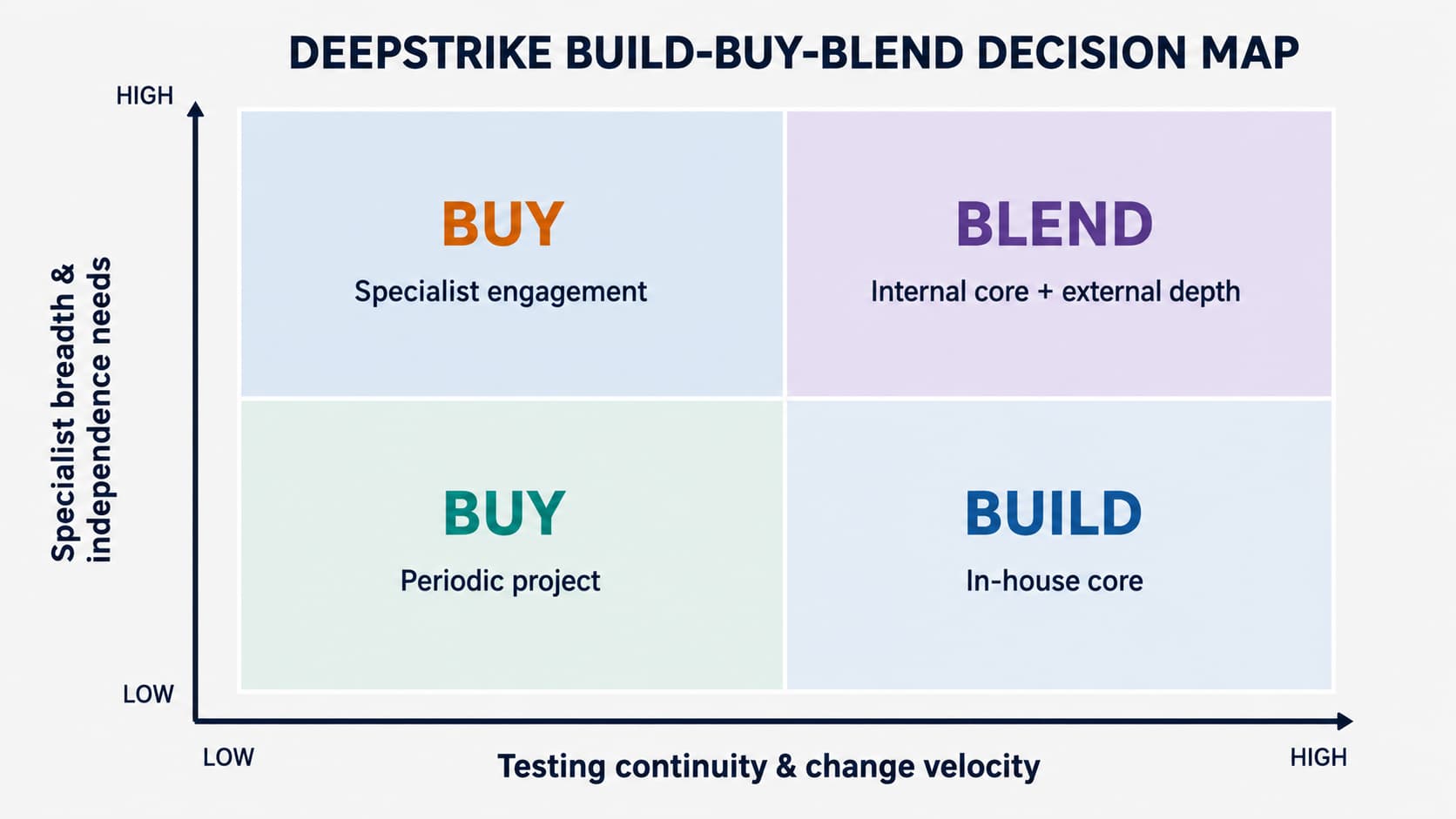
Build–Buy–Blend worksheet. Mark the strongest signal and retain the evidence used.
| Decision factor | Build signal | Buy signal | Blend signal | Your evidence / decision |
|---|---|---|---|---|
| 1. Testing frequency | Continuous, predictable demand | Periodic or irregular engagements | Steady core plus peaks | Annual scope, backlog, and retest demand |
| 2. Change and release velocity | Daily or frequent releases need embedded feedback | Stable releases allow planned testing | Fast routine work plus milestone assurance | Release calendar and change-trigger history |
| 3. System number and diversity | Large repeatable estate on a common stack | Small estate or highly varied scopes | Common platforms inside; unusual systems outside | Asset inventory and technology map |
| 4. Specialist skills | Core skills are recruitable and continuously used | Rare expertise is episodic | Frequent core skills plus niche needs | Skill-to-scope coverage matrix |
| 5. Independence or external evidence | Governance can create sufficient separation | External challenge or named third party is required | Internal testing plus selected external assurance | Framework, contract, assessor, and conflict criteria |
| 6. Hiring and retention capacity | Competitive hiring, management, and development are realistic | Talent cannot be sustained economically or operationally | Small core is sustainable; full breadth is not | Time-to-hire, turnover, career path, coverage plan |
| 7. Response and retest speed | Immediate access is routinely needed | Planned SLA is sufficient | Internal triage plus external reserved response | Observed start and retest latency |
| 8. Data and access restrictions | External access is materially constrained | Controlled external access is acceptable | Sensitive scopes inside; others external | Residency, access, customer, and cloud-policy constraints |
| 9. Surge capacity | Demand is stable within planned capacity | Peaks dominate the workload | Baseline team with contracted surge | Launch, incident, acquisition, and migration forecast |
| 10. Program maturity | Methods, QA, governance, and metrics are established | External structure can accelerate execution | Internal owner governs a mixed program | Named owner, methodology, evidence repository, and review cadence |
Use four decision rules as a reasonableness check:
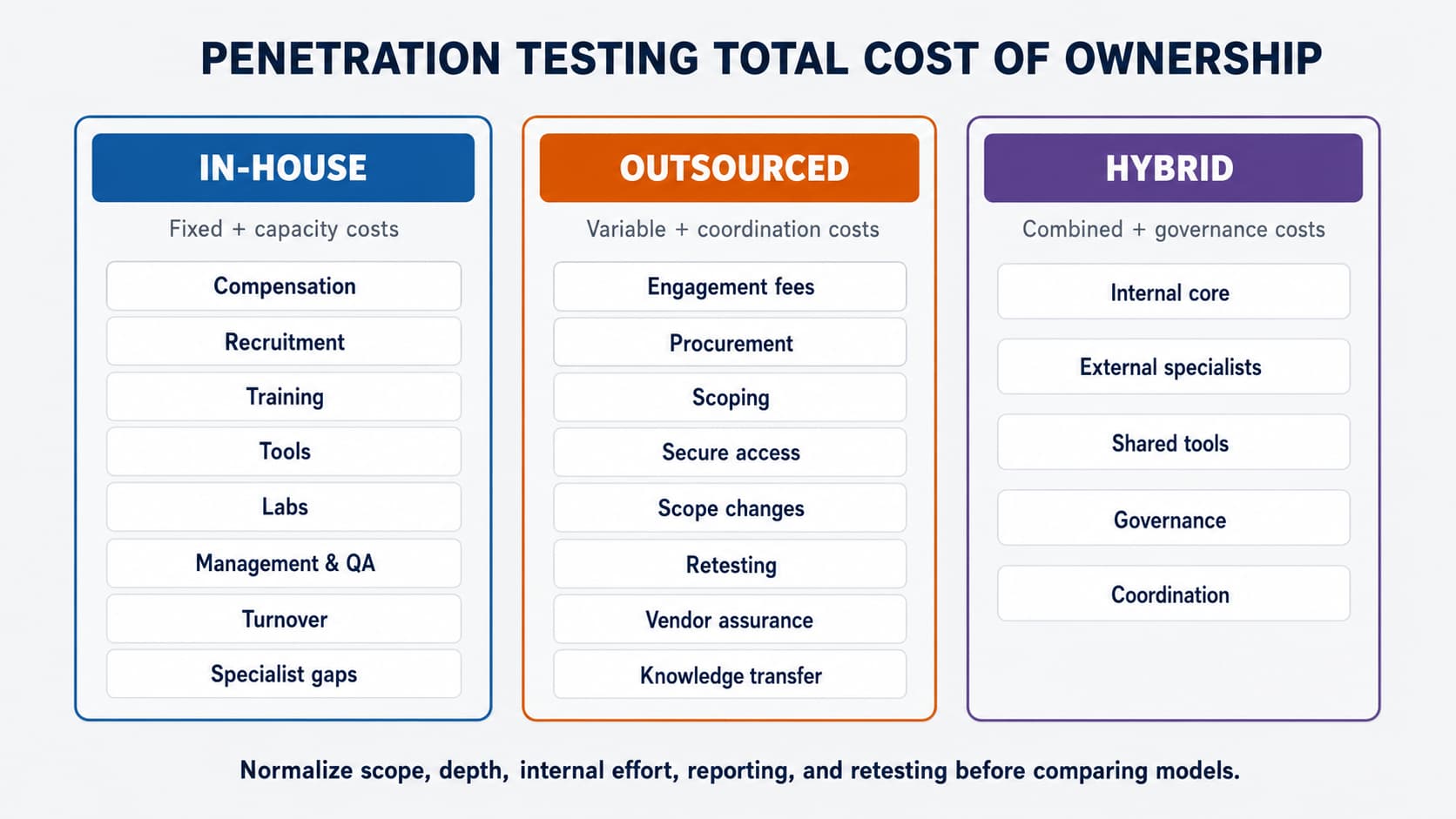
Comparing one salary with one provider quote is misleading. Salary omits recruitment, benefits, management, training, tools, labs, leave, turnover, QA, and remaining specialist gaps. A project fee omits procurement, scoping, secure access, coordination, remediation support, retesting, and knowledge transfer. Normalize scope, depth, reporting, and timing before comparing models.
Annual In-House TCO = Fully Loaded Compensation + Recruitment and Onboarding + Training and Certifications + Tools and Licenses + Test Labs and Infrastructure + Management and Quality Assurance + Coverage and Turnover Cost + External Specialists Still Required
Annual Outsourced TCO = Engagement or Retainer Fees + Procurement and Due Diligence + Internal Scoping and Coordination + Secure Access and Data Handling + Scope Changes or Rush Fees + Remediation Support + Retesting + Vendor Assurance and Knowledge Transfer
Annual Hybrid TCO = Core Internal Capability + Selected External Engagements + Shared Tooling or Platform Cost + Coordination and Governance Cost
A one-person internal function may look economical while hiding leave coverage, limited peer review, specialist gaps, and continuity risk. Outsourcing has a parallel concentration risk when one provider or assigned tester holds most program knowledge.
Table 2. Total Cost of Ownership Worksheet
| Cost or effort factor | In-house input | Outsourced input | Hybrid input | Evidence needed |
|---|---|---|---|---|
| People and compensation | Salary, benefits, payroll burden, management time | Internal owner and coordinator time | Core team plus internal vendor-management time | HR cost model, role design, time allocation |
| Recruitment and onboarding | Sourcing, interview time, vacancy, ramp-up | Provider sourcing and due diligence | Core hiring plus provider onboarding | Time-to-hire, procurement effort, ramp assumptions |
| Training and specialist depth | Courses, practice time, certifications, conferences | Included skills or separately priced specialists | Internal development plus targeted external skills | Annual skills plan and scope-to-skill map |
| Tools, licenses, and labs | Commercial tools, safe infrastructure, maintenance | Usually embedded in fee; verify pass-through costs | Internal toolset plus platform or shared costs | License quotes, lab design, platform terms |
| Management and QA | Methodology, peer review, supervision, calibration | Internal review of provider scope and quality | Shared standards and cross-review | QA process, reviewer time, dispute log |
| Capacity, leave, and turnover | Backfill, downtime, succession, contractor cover | Provider substitution and availability risk | Internal continuity plus external surge | Capacity plan, contingency commitments, turnover history |
| Engagement or retainer fees | External specialist work still required | Base scope, travel, expenses, optional services | Selected assurance and specialist engagements | Comparable proposals and scope assumptions |
| Scoping and coordination | Asset-owner and engineering time | Procurement, briefings, access, scheduling | Ongoing program coordination across both teams | Time records or planning estimates by role |
| Secure access and data handling | Internal access administration and evidence systems | Access setup, transfer, residency, retention, deletion | Common controls plus scope partitioning | Access design, data flow, retention schedule |
| Scope change and urgency | Backlog and opportunity cost | Change orders, rush work, rescheduling | Internal triage with external flex | Historical change rate and rush policy |
| Remediation and retesting | Tester and engineering time | Support terms, retest limits, follow-up fees | Internal remediation ownership plus assigned retests | Contract, backlog, observed turnaround |
| Governance and knowledge transfer | Documentation, metrics, evidence retention | Vendor assurance, workshops, handover, exit | Shared repository and operating reviews | Repository, RACI, handover criteria, exit plan |
Model at least three organization-specific demand scenarios:
For each scenario, compare all three TCO formulas using equivalent coverage and quality. A practical break-even point exists only when fully loaded in-house cost is no higher than an equivalent outsourced scope after internal effort and remaining specialist spend. Without equivalent skill, reporting, and retesting terms, the comparison is not meaningful.
Release frequency increases testing and retesting demand; technology diversity can preserve specialist spend after an internal team is built. Avoid price per finding: it rewards volume rather than coverage, attack-path insight, or remediation value.
For detailed pricing drivers rather than universal numbers, see DeepStrike’s guide to penetration testing cost and pricing factors.
Organizational independence is not identical to external employment. It depends on reporting lines, self-review, target responsibility, prior design work, incentives, and reporting freedom. An internal tester may be sufficiently independent under defensible separation; an external provider may still face conflicts, commercial pressure, or a scope too narrow for meaningful challenge.
PCI DSS provides a concrete example. As of July 19, 2026, the PCI SSC Document Library lists PCI DSS v4.0.1 as the current standard. Requirements 11.4.2 and 11.4.3 address internal and external penetration testing, respectively. They allow the work to be performed by a qualified internal resource or qualified external third party, require organizational independence, and state that the tester is not required to be a QSA or ASV. PCI SSC describes v4.0.1 as a limited revision with no requirements added or deleted in its v4.0.1 publication notice.
The wording separates test viewpoint from tester affiliation: “internal” and “external” describe the test, while “qualified internal resource” and “qualified external third party” describe who may perform it. Supporting guidance must not override the current standard.
Do not generalize PCI to every assurance regime. SOC 2, HIPAA, ISO/IEC 27001, GDPR, NIST guidance, contracts, and sector rules differ. A test may support assurance without being universally mandated or required to be outsourced. Verify the current framework, jurisdiction, entity type, contract, and assessment method.
Informational note: this guide is not legal, regulatory, or audit advice. Penetration testing alone does not prove compliance or guarantee audit acceptance; applicable requirements and contractual expectations should be confirmed for the specific organization and assessment.
Every assessment should be authorized in writing, limited to an approved scope, governed by Rules of Engagement, coordinated with asset owners, and supported by safety controls, escalation paths, and stop procedures. NIST SP 800-115 provides an assessment-plan and Rules of Engagement template covering authorized and excluded systems, permitted activity, incident handling, data handling, reporting, and accountable signatures. Those controls apply whether testers are employees or providers.
Outsourcing adds vendor and data-transfer risk; in-house delivery adds employee, endpoint, insider, and continuity risk. Choose the model whose controls and accountability make risk visible and manageable.
Company size alone is a weak selector. Treat these scenarios as starting hypotheses and test them against actual demand, constraints, and evidence.
Table 3. Scenario Recommendations
| Organization scenario | Likely starting model | Reason | Internal responsibility that remains | Reconsideration trigger |
|---|---|---|---|---|
| Early-stage startup with no dedicated security team | Outsourced | Demand is usually periodic and internal specialist coverage is limited | Named owner, inventory, scope, authorization, access, remediation | Frequent releases create sustained backlog or a security hire can be supported |
| Growing SaaS company with frequent releases | Hybrid | Internal context and fast validation matter; external depth covers specialist and assurance work | Product-security owner, risk-based scope, engineering coordination | Core demand becomes stable enough to add staff or external use becomes minimal |
| Mid-market company with a small security team | Outsourced or hybrid | A small team may govern testing but not cover every scope | Program owner, vendor oversight, remediation and evidence | Backlog, response time, or repeated common scopes justify a core tester |
| Large enterprise with mature AppSec program | In-house or hybrid | Continuous demand and engineering integration can justify fixed capacity | Independent governance, QA, skill and capacity planning | Specialist, surge, acquisition, or assurance demand changes |
| Highly regulated organization | Hybrid is a common starting hypothesis | Internal control and context may coexist with external evidence or challenge | Requirement interpretation, data controls, risk acceptance | A specific framework or contract clearly permits or requires a different arrangement |
| One-time customer or audit request | Outsourced | A discrete engagement avoids building idle capacity | Confirm requirement, scope, authorization, remediation, evidence retention | Requests become recurring or cover many products |
| Cloud, mobile, OT, hardware, mainframe, or specialist scope | Outsourced specialist or hybrid | Rare skills may not justify permanent coverage | Internal architecture context, safe access, specialist validation | The scope becomes frequent enough to develop and retain expertise |
| Acquisition or major migration | Hybrid or outsourced surge | Time-bound, diverse scope can exceed normal capacity | Asset discovery, prioritization, integration decisions, remediation | The temporary peak ends or a recurring estate remains |
| Organization with a strong internal red team | In-house plus selected external challenge | The team has context and capability, but external review can test assumptions and evidence | Governance, separation from target ownership, finding follow-through | Internal independence weakens or specialist gaps expand |
| Strict data-access constraints | In-house or tightly controlled hybrid | External transfer or personnel access may be limited | Access architecture, authorization, monitoring, evidence controls | A compliant external enclave, on-site model, or contractual route becomes feasible |
Hybrid is an operating process, not simply two sources of testers. Divide work by risk, cadence, and specialization; standardize scope, severity, evidence, and remediation.
The internal team maintains asset context, prioritizes scope, coordinates engineering, performs qualified routine validation, owns remediation and retest scheduling, and manages risk acceptance. The external team supplies specialist testing, independent challenge, unfamiliar attack-path analysis, assurance work, and surge capacity. Both sides validate scope and Rules of Engagement, calibrate findings, support remediation, and review program metrics.
In the map, “accountable” owns the decision and “responsible” performs the work; tailor “consulted” and “informed” to the environment. Keep one internal accountable owner even when the provider performs testing.
Table 4. Hybrid Responsibility Map
| Activity | Internal owner | External tester | Engineering / operations | Risk / compliance | Required evidence |
|---|---|---|---|---|---|
| Asset and risk prioritization | Accountable; maintains inventory and priorities | Consulted on testability and effort | Consulted on changes and owners | Consulted on assurance needs | Approved risk-ranked scope and asset record |
| Scope and Rules of Engagement | Accountable; authorizes and coordinates | Responsible for test plan and constraints | Consulted on safety and windows | Consulted on legal, compliance, and evidence | Signed authorization, scope, exclusions, contacts, stop rules |
| Internal routine testing | Responsible where qualified; records evidence | Consulted or quality challenge | Enables access; receives findings | Informed | Test record, methodology, evidence, peer review |
| External specialist or assurance testing | Accountable for provider and access | Responsible for approved execution | Enables systems and monitors impact | Consulted on evidence purpose | Named team, activity log, protected evidence, report |
| Finding calibration | Accountable for common severity model | Responsible for technical defense | Consulted on context and feasibility | Consulted on risk and acceptance policy | Finding record, evidence, rationale, dispute decision |
| Remediation | Tracks ownership and deadlines | Consulted on root cause and fix options | Responsible for implementation | Accountable for formal risk acceptance | Ticket, owner, target date, exception or acceptance |
| Retesting | Accountable for readiness and schedule | Responsible when assigned | Provides fixed build and safe access | Informed or consulted for closure evidence | Retest result linked to original finding and change |
| Evidence, metrics, and improvement | Accountable for repository and program review | Provides SLA, lessons, and handover data | Provides remediation feedback | Reviews assurance evidence and trends | Evidence index, metrics, recurring-class actions, review minutes |
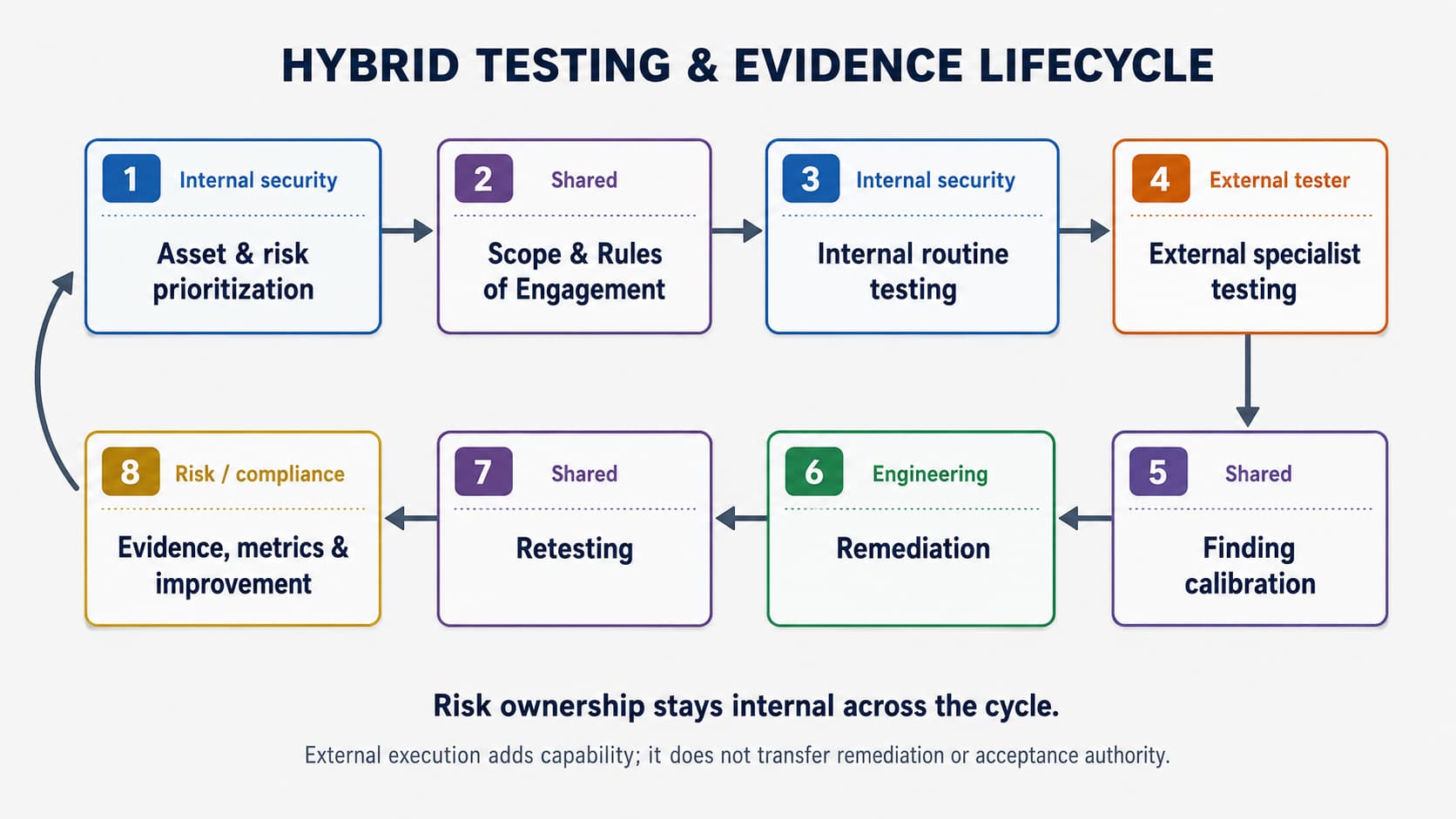
Outsourced execution never makes penetration testing ownerless. At minimum, the organization needs the following internal capabilities:
A provider may advise, but the organization must retain each decision and its evidence.
The CREST Guide to Penetration Testing 2022 similarly frames penetration testing as a managed program with preparation, consistent delivery, follow-up, and maturity not a stand-alone technical event.
Do not use vulnerability count as the primary success metric. It changes with scope, maturity, thresholds, duplication, and tester behavior, and can reward inflation. Use balanced program measures:
Interpret metrics together. Faster starts with more exclusions may be a false improvement; fewer disputes may mean better calibration or weaker challenge. Review the evidence and incentives behind every number.
In-house testing is performed by employees; outsourced testing is performed by a contracted provider or consultant. The difference is who supplies the testers and capacity not what system is tested. A hybrid model divides work by cadence, expertise, independence, or surge demand.
No. In-house describes the tester’s organizational relationship; internal describes a test viewpoint. A provider can perform an internal test, and an employee can test the external perimeter. Separating the terms prevents scope and compliance mistakes.
No. Independence still depends on conflicts, prior design work, reporting freedom, incentives, and scope. Document the applicable standard and conflicts. An internal tester may also be sufficiently independent under defensible separation from ownership and self-review.
Yes. PCI DSS v4.0.1 Requirements 11.4.2 and 11.4.3 permit a qualified internal resource or external third party, with organizational independence; the tester need not be a QSA or ASV. Confirm current PCI SSC text, scope, assessor expectations, and stricter contract terms.
It is more defensible when risk-prioritized demand is sustained, releases need frequent feedback, context improves testing, and qualified staff can be recruited, retained, managed, and reviewed. Compare fully loaded TCO under low, base, and high demand; no universal threshold exists.
Benefits include specialist expertise, external perspective, surge capacity, and variable cost. Risks include quality variation, context loss, scheduling delay, subcontractor opacity, data exposure, weak knowledge transfer, and provider concentration. Control them through named-team verification, written authorization, Rules of Engagement, least privilege, evidence controls, retesting terms, performance measures, and an internal owner.
Not automatically. Hybrid helps when continuous demand coexists with specialist, surge, or independent-challenge needs, but it can add coordination cost, inconsistent severity, duplicated work, and unclear ownership. Use it only when explicit allocation and evidence rules outperform a simpler model.
The organization must retain an accountable owner, asset knowledge, risk-based scope, authorization, Rules of Engagement approval, access coordination, remediation ownership, retest decisions, evidence, vendor oversight, and risk acceptance. A provider may support these activities but cannot assume residual risk or system ownership without separate authorization and governance.
Let the work determine the model. Build for continuous demand and close engineering integration when talent, QA, coverage, and independence are sustainable. Buy for periodic demand, niche skills, external challenge, or variable capacity. Blend when a capable internal core still needs specialist depth, assurance, or surge support.
Use a simple final decision sequence:
If your analysis points toward external or hybrid support, DeepStrike’s penetration testing services team can help define a safe scope and assess whether a project, retainer, or recurring testing model fits your environment.
Mohammed Khalil is a Cybersecurity Architect at DeepStrike specializing in advanced penetration testing and offensive security. His certifications include CISSP, OSCP, and OSWE. His work focuses on application security, API security, cloud security, identity exposure, attack-path validation, and remediation-focused security testing.

Stay secure with DeepStrike penetration testing services. Reach out for a quote or customized technical proposal today
Contact Us
