November 4, 2026
Updated: November 5, 2026
How often MSPs are breached, why one compromise reaches many clients, RMM abuse, regulation and client demand, each with its source, date and limits.

Mohammed Khalil
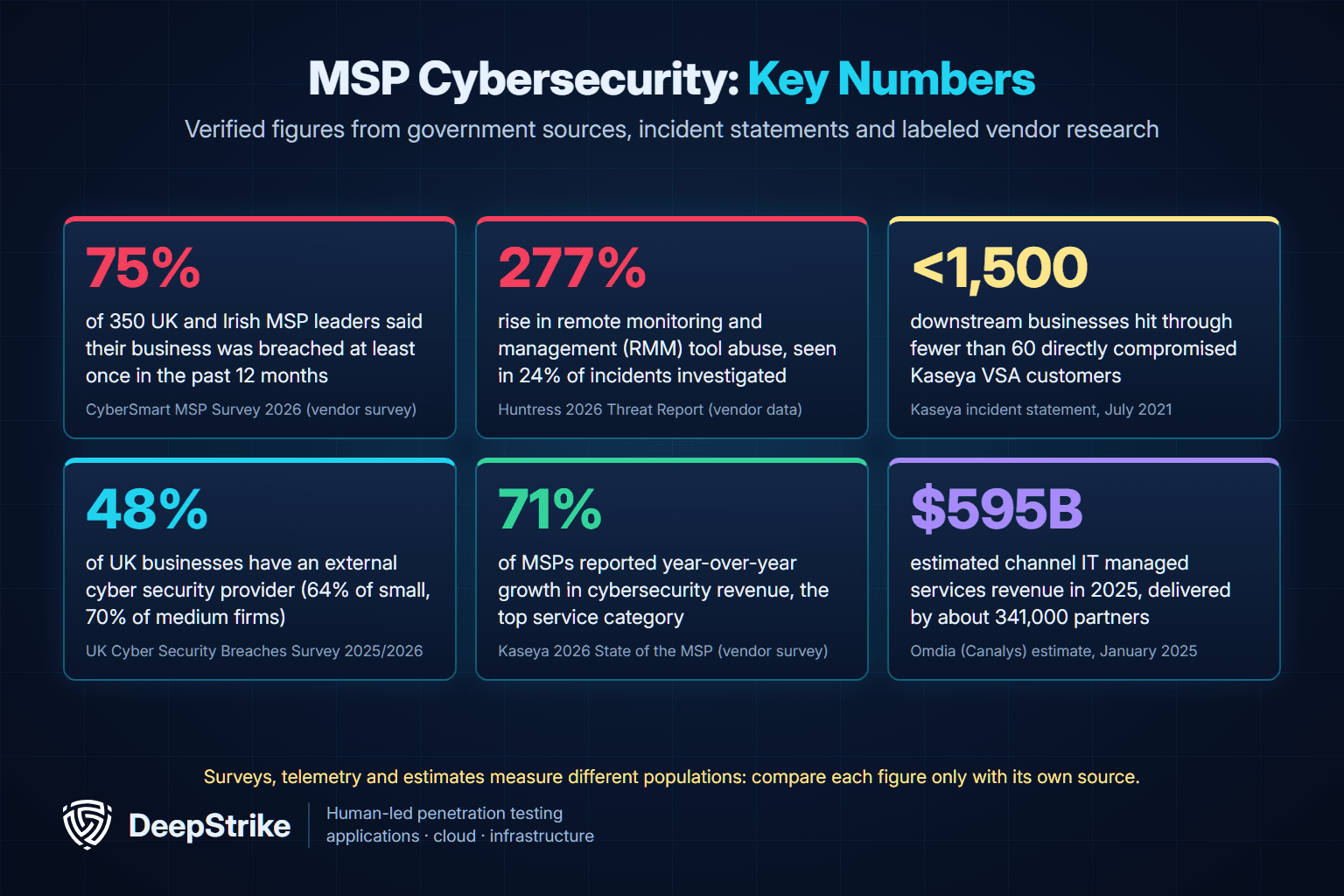
MSP cybersecurity statistics for 2026 show an industry that attackers treat as a shortcut. One breached managed service provider can reach every client it manages. In CyberSmart's 2026 survey, 75% of UK and Irish MSP leaders said their business had been breached at least once in the past year. Huntress saw abuse of remote monitoring and management (RMM) tools rise 277%. The Kaseya VSA attack of July 2021 reached fewer than 1,500 downstream businesses through fewer than 60 MSP customers. And 71% of MSPs grew their security revenue. Here are the verified MSP statistics and what to test.
Every figure below was checked on the publisher's own page, report or filing on 5 November 2026. Vendor research is labeled as such. Read the "What it measures" column before comparing two rows.
| Statistic | Source and date | What it measures |
|---|---|---|
| 75% of MSP leaders said their business was breached at least once in 12 months; 54% twice or more | CyberSmart MSP Survey 2026 (vendor survey) | 350 MSP and MSSP leaders in the UK and Ireland, surveyed by OnePoll |
| RMM tool abuse rose 277% year over year and appeared in 24% of incidents | Huntress 2026 Cyber Threat Report, 17 February 2026 (vendor telemetry) | Incidents across more than 230,000 organizations Huntress protects |
| Fewer than 60 Kaseya customers directly compromised; fewer than 1,500 downstream businesses affected | Kaseya incident statement, July 2021; CISA and FBI response from 2 July 2021 | One ransomware incident against MSP software |
| APT10 reached victim companies in at least 12 countries through MSPs | US Department of Justice, indictment unsealed 20 December 2018 | Criminal charges in one espionage campaign |
| More than 140 resellers and technology service providers targeted; as many as 14 compromised | Microsoft, 24 October 2021 | One nation-state campaign, May to October 2021 |
| 48% of UK businesses have an external cyber security provider (64% of small, 70% of medium) | UK Cyber Security Breaches Survey 2025/2026, 30 April 2026 | Representative survey of 2,112 UK businesses |
| 15% of UK businesses review cyber risks from their immediate suppliers; 6% review the wider supply chain | UK Cyber Security Breaches Survey 2025/2026 | Same survey |
| 12,867 active MSPs in the UK, employing 343,762 people | UK DSIT research on MSPs, 12 November 2025 | Companies House-based market study, as of March 2025 |
| USD 595 billion in channel IT managed services revenue in 2025, from about 341,000 partners | Omdia (Canalys) estimate, 15 January 2025 | Analyst forecast, not a measurement |
| 71% of MSPs reported year-over-year growth in cybersecurity revenue | Kaseya 2026 State of the MSP, 14 April 2026 (vendor survey) | 1,061 MSPs surveyed in November 2025 |
| 61% of MSPs say most or all clients turn to them for cybersecurity advice | Kaseya 2026 State of the MSP (vendor survey) | Same survey |
| Customers look to their MSP to act as CISO for 46% of their needs on average; 84% of MSPs expect that demand to grow | Sophos 2026 MSP Perspectives, 15 September 2026 (vendor survey) | MSP estimates of their customer base |
| More than 84,000 alerts targeted edge device vulnerabilities in MSP-managed environments | ConnectWise 2025 MSP Threat Report, 25 February 2025 (vendor research) | ConnectWise telemetry from January 2024 |
| 48% of breaches involved a third party, up 60% from the prior edition | Verizon 2026 Data Breach Investigations Report | Breach dataset, all sectors |
Primary sources for each row are linked in the sections below and listed under Sources and References.
Four kinds of evidence sit in this table, and they should not be blended:
None of these numbers adds up to a single "MSP breach rate."
The Five Eyes joint advisory AA22-131A defines MSPs as "entities that deliver, operate, or manage ICT services and functions for their customers via a contractual arrangement". The advisory adds that MSP services "usually require both trusted network connectivity and privileged access to and from customer systems" (CISA, 11 May 2022).
The EU's NIS2 Directive uses a similar definition in Article 6(39). It treats a managed security service provider (MSSP) as an MSP that carries out or assists with cybersecurity risk management.
That privileged, persistent access is what makes MSP statistics a security topic rather than an IT services topic. MITRE ATT&CK tracks the abuse of this access as Trusted Relationship (T1199). In this technique, an attacker compromises a provider and then uses the provider's legitimate connection to reach the customer.
All market sizes in this section are estimates.
Market reports sold by research resellers often quote far larger or smaller totals for "managed services." They use different definitions, such as including or excluding telecoms, vendor-delivered services or managed security. Treat any single market figure as a range, and check what it includes before comparing it with another.
The best representative data comes from the UK government's Cyber Security Breaches Survey 2025/2026. It surveyed 2,112 UK businesses between August and December 2025 and was published on 30 April 2026:
(GOV.UK, Cyber Security Breaches Survey 2025/2026)
The same survey shows how rarely those businesses check the providers they rely on. Only 15% of businesses formally reviewed the cyber risks posed by their immediate suppliers, and 6% looked at their wider supply chain. The figures rise with size, to 30% of medium and 48% of large businesses reviewing immediate suppliers. In other words, about half of UK businesses hand security work to an outside provider, but most never assess that provider's own risk. For the attack and cost data on small companies themselves, see our small business cybersecurity statistics.
CyberSmart's 2026 MSP Survey, run with OnePoll among 350 MSP and MSSP leaders in the UK and Ireland, found:
CyberSmart notes that "a breach" ranges from a minor incursion to a business-critical compromise. Read the 75% as a measure of how often something gets through, not of how often MSPs suffer major incidents. This is a vendor survey of one region.
Kaseya's 2025 Global MSP Benchmark Report surveyed 841 MSPs in November 2024. It shows attacks becoming routine across MSP client bases:
(Kaseya 2025 Global MSP Benchmark Report, PDF)
Kaseya is an MSP software vendor, so this is vendor research.
ConnectWise, which sells RMM and security software to MSPs, publishes an annual MSP Threat Report from its Cyber Research Unit. The 2025 edition found:
The 2026 edition, released on 5 March 2026, is mostly qualitative. Its defining finding is that attackers in 2025 relied on trusted identities, VPN access and legitimate tools rather than new exploits. In multiple cases, full domain compromise followed within hours of a successful VPN login. All ConnectWise figures are vendor research.
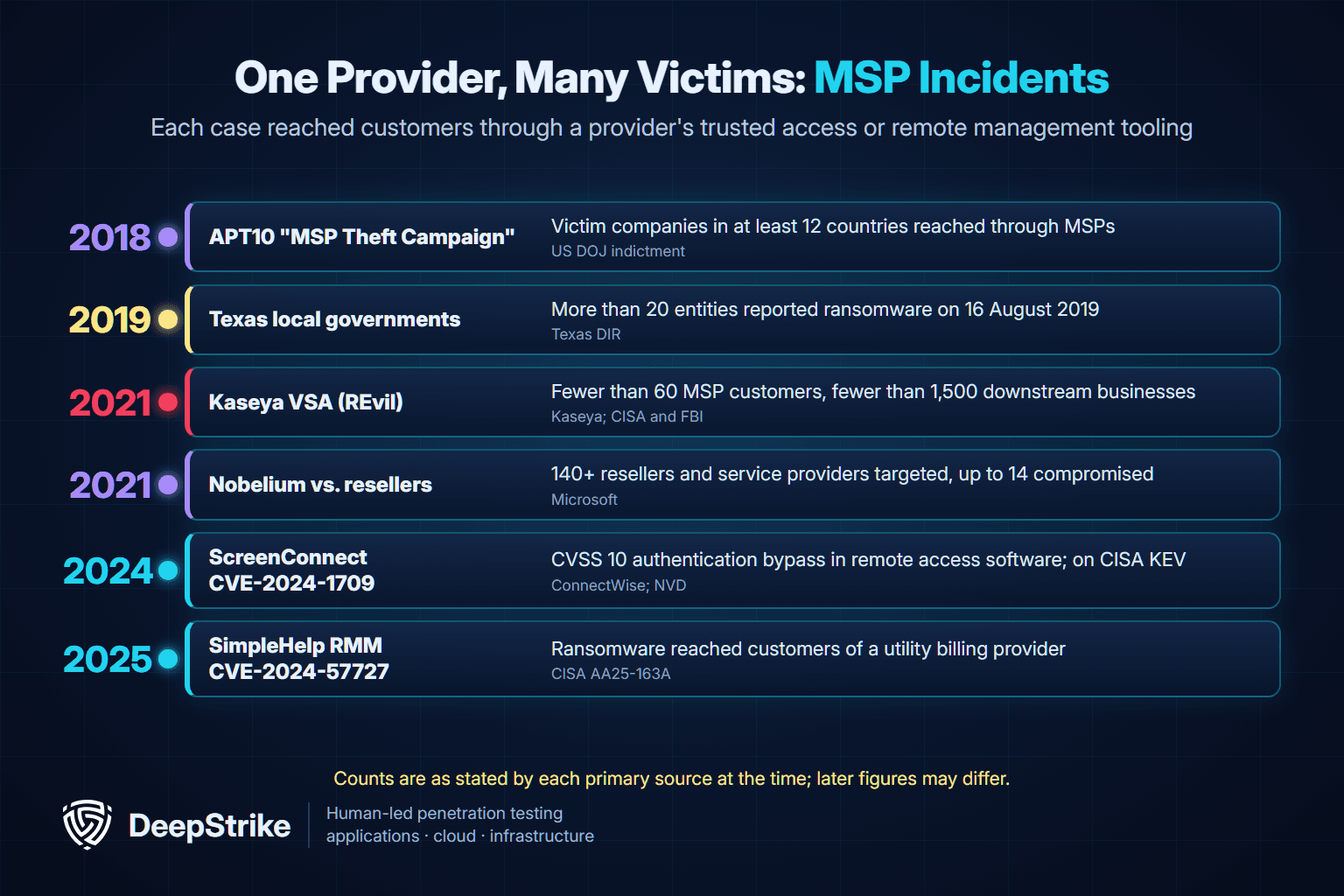
The Five Eyes agencies warned in May 2022 that they expected malicious actors, including state-sponsored groups, to "step up their targeting of MSPs". In their words, "a vulnerable MSP" can serve "as an initial access vector to multiple victim networks, with globally cascading effects". The record before and since bears that out.
| Year | Incident | What happened | Primary source |
|---|---|---|---|
| 2018 | APT10 "MSP Theft Campaign" | Stolen MSP administrator credentials used to reach client networks; victim companies in at least 12 countries | US DOJ indictment, 20 December 2018 |
| 2019 | Texas local governments | More than 20 entities, mostly small local governments, reported ransomware on 16 August 2019 | Texas Department of Information Resources, 5 September 2019 |
| 2021 | Kaseya VSA (REvil ransomware) | Zero-day flaws in on-premises VSA used to push ransomware; fewer than 60 Kaseya customers directly compromised, fewer than 1,500 downstream businesses | Kaseya incident statement; CISA and FBI guidance, 12 July 2021 |
| 2021 | Nobelium campaign against resellers | More than 140 resellers and technology service providers targeted with password spray and phishing; as many as 14 compromised | Microsoft, 24 October 2021 |
| 2024 | ConnectWise ScreenConnect | CVE-2024-1709, an authentication bypass rated CVSS 10 in widely used remote access software, added to CISA's KEV catalog on 22 February 2024 | ConnectWise security bulletin; NVD |
| 2025 | SimpleHelp RMM | Ransomware actors exploited unpatched SimpleHelp (CVE-2024-57727) to compromise customers of a utility billing software provider | CISA advisory AA25-163A, 12 June 2025 |
Sources for the table:
Two patterns repeat. First, the multiplier is real. Using Kaseya's own upper bounds, roughly 25 downstream businesses were affected for every directly compromised customer (1,500 divided by 60; our calculation). Second, attackers rarely need anything exotic. Stolen administrator credentials, password spraying and unpatched remote access software account for most of the cases above. Our supply chain attack statistics cover the broader category. Verizon's 2026 DBIR puts third-party involvement at 48% of breaches, and that page analyzes the cost and case data in depth.
Remote monitoring and management software is how MSPs do their job, and that is why attackers want it:
For MSPs, the lesson is that the RMM console, the PSA system and the remote access gateway are the highest-value assets they own. Once an attacker controls those systems, moving from one client environment to the next looks like ordinary administration. Our guide to lateral movement explains how attackers pivot after that first foothold and how to detect it.
MSPs sit in the middle of their clients' supply chains, and they have suppliers of their own. CyberSmart's 2026 survey found:
For clients, the practical question is how to manage that dependency: contracts, access reviews and evidence of testing. Our guide to third-party risk management covers the program side. The third-party data breach statistics page tracks vendor-caused breach data across all supplier types.
For most of their history, MSPs were not regulated as a category. That changed in Europe first.
MSPs' own view of their exposure is very different. In CyberSmart's 2026 survey, 76% of respondents said their MSP falls into scope of the bill, and 45% of those said they were already fully prepared. The gap between about 9% of all UK MSPs and 76% of respondents probably reflects a panel weighted toward larger providers and uncertainty about the final definitions. It is also a warning: many MSPs that assume they are in scope have not yet seen the final criteria.
In the US, there is no MSP-specific statute, but federal guidance is explicit. AA22-131A recommends that MSPs and their customers:
The demand side is where MSP statistics turn into a business decision.
| Measure | Figure | Source |
|---|---|---|
| MSPs with year-over-year growth in cybersecurity revenue | 71% (highest of any service category) | Kaseya 2026 State of the MSP |
| MSPs ranking security among their top revenue sources | 52% (second only to endpoint and network management) | Kaseya 2026 State of the MSP |
| MSPs offering security services (antivirus, EDR, automated pentesting, dark web monitoring, email security) | 72% | Kaseya 2026 State of the MSP |
| MSPs offering regulatory compliance and reporting services | 42% | Kaseya 2026 State of the MSP |
| MSPs naming enhanced security services (including penetration testing) as their top revenue source | 33% in 2025, up from 22% | Kaseya 2025 Global MSP Benchmark |
| Average share of customers looking to their MSP to act as CISO | 46% | Sophos 2026 MSP Perspectives |
| MSPs providing at least one compliance service, and all seven services Sophos analyzed | 99% and 6% | Sophos 2026 MSP Perspectives |
| MSPs offering managed detection and response (MDR) | 81% (94% in the US) | Sophos MSP Perspectives 2024 |
| MSPs reporting more demand for cyber insurance support | 99% | Sophos MSP Perspectives 2024 |
| MSPs expected to help customers meet compliance needs | 61% | CyberSmart MSP Survey 2026 |
All rows are vendor surveys:
Three conclusions follow:
No public dataset measures MSP demand for manual penetration testing directly. Kaseya groups "automated pentesting" with antivirus and email security, so its 72% overstates how many MSPs offer human-led testing. Treat the testing figures above as indicators of direction, not of market share.
The statistics point to a short list of systems where an MSP compromise starts or spreads. The table maps each one to the evidence above and to what a penetration test should validate. It is DeepStrike method guidance, not data from the cited studies.
| Where MSP risk concentrates | Evidence that signals the risk | Why attackers want it | What testing should validate |
|---|---|---|---|
| RMM and PSA consoles | RMM abuse up 277% and in 24% of incidents (Huntress 2026); Kaseya VSA 2021 | One login can push scripts or software to every managed endpoint | MFA, role separation, internet exposure and patch level of the console |
| Remote access and VPN edge | 84,000-plus edge alerts (ConnectWise 2025); VPN entry in 2025 cases (ConnectWise 2026) | Exposed gateways and valid credentials give a first foothold | External exposure, credential reuse and MFA bypass paths |
| Privileged and delegated admin accounts | APT10 used stolen MSP admin credentials (DOJ 2018); Nobelium targeted resellers (Microsoft 2021) | Standing admin rights reach many client tenants | Least privilege, unused accounts and tenant isolation |
| Shared tooling across clients | ScreenConnect and SimpleHelp flaws (2024, 2025) | A flaw in one stack becomes a flaw in every client stack | Segmentation between client environments and the MSP network |
| Client-facing portals and apps | Not measured by the cited studies; common in MSP service catalogs | Web apps and APIs hold client data and credentials | Authentication, authorization and data exposure |
| Backup and recovery systems | Ransomware groups targeting backups early (ConnectWise 2026) | Destroying backups forces payment | Backup isolation, restore testing and admin separation |
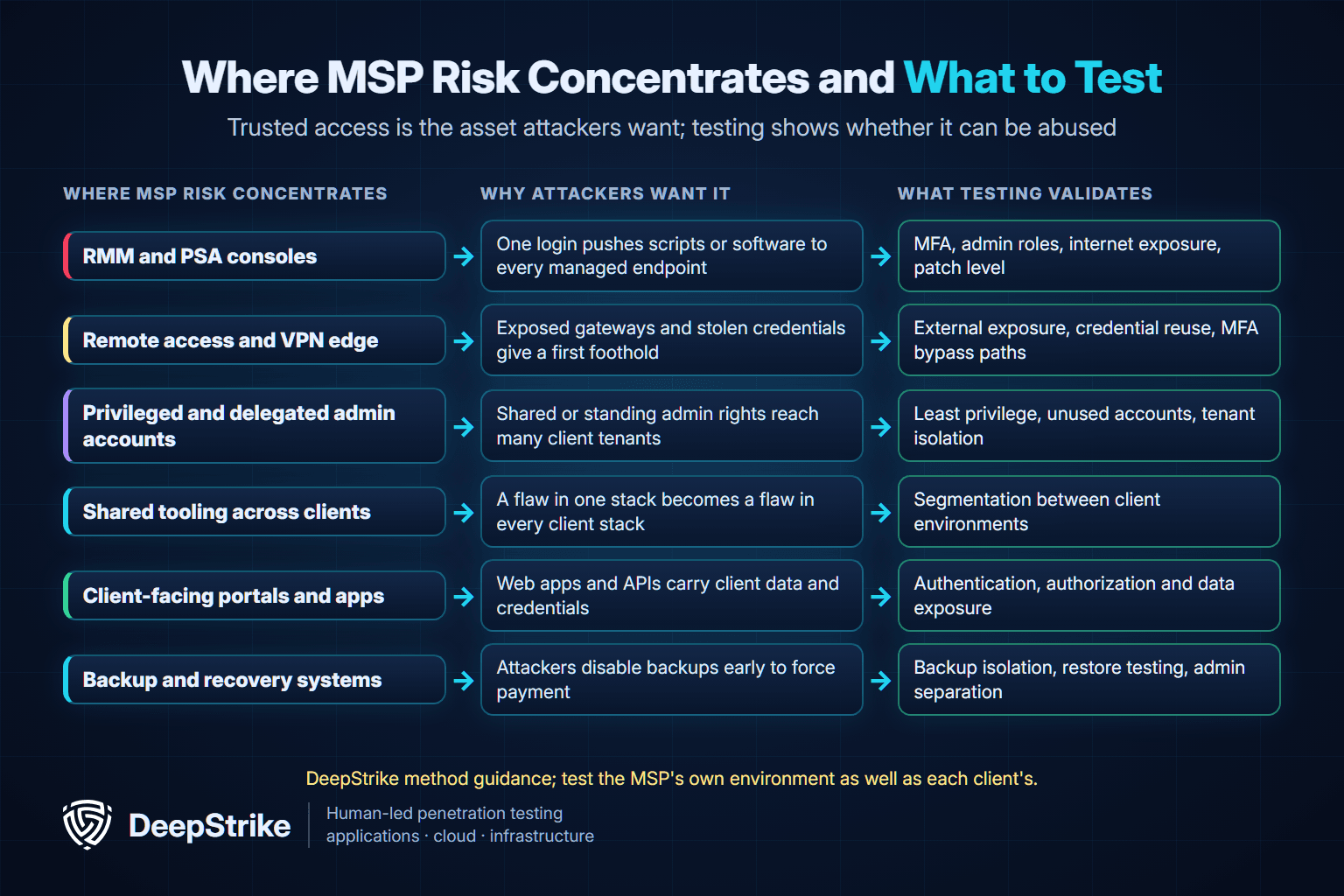
The table is deliberately about access rather than malware. In almost every case above, the attacker used the same paths the MSP uses to do its work. That is why testing should cover the MSP's own environment as well as each client's. An internal penetration test shows how far an attacker can move once inside.
You cannot defend trusted access that you have never tested. This sequence lets an MSP, or a client reviewing its MSP, establish a baseline in about a quarter. It is DeepStrike method guidance, not a requirement from any standard.
For smaller clients, the same logic applies at lower scale. Our guide to penetration testing for startups and small businesses explains how to scope a first test on a limited budget.
Selection. We included a statistic only if we could read it on the original publisher's page, report or filing and record its date, sample and method. We prioritized:
We then used MSP vendor surveys and telemetry with published scope (Kaseya, ConnectWise, Sophos, CyberSmart, Huntress) and labeled each as vendor research. Market sizes are labeled as estimates.
Exclusions. We excluded figures that appear only on vendor blogs or market-report resellers without a traceable study. We also excluded paywalled analyst forecasts we could not read (including Omdia's 2026 MSP report) and figures quoted second-hand from LinkedIn posts.
Report years. Report titles carry the publication year, not the year of the events. Kaseya's 2026 report surveyed MSPs in November 2025. The CSBS 2025/2026 ran fieldwork from August to December 2025. Huntress and ConnectWise 2026 describe activity in 2025.
Calculations. Two derived figures appear on this page:
All other numbers are quoted as published.
| Source | Publisher type | Data period | Sample or dataset | Method |
|---|---|---|---|---|
| CISA AA22-131A, AA23-025A, AA25-163A | US and Five Eyes government advisories | 2022 to 2025 | Incident response and threat intelligence | Joint advisories |
| US DOJ APT10 indictment | Criminal filing | 2006 to 2018 | One campaign | Indictment allegations |
| Kaseya incident statement | Company statement on its own incident | July 2021 | Kaseya VSA customers | Company investigation with Mandiant |
| Microsoft Nobelium post | Company threat intelligence | May to October 2021 | Microsoft reseller ecosystem | Customer notifications |
| UK DSIT MSP research | Government-commissioned market study | As of March 2025 | 12,867 MSPs on Companies House | Frontier Economics and Glass.AI |
| UK Cyber Security Breaches Survey 2025/2026 | Official statistics | August to December 2025 | 2,112 businesses, 1,085 charities | Random probability phone and online survey |
| Omdia (Canalys) MSP trends 2025 | Analyst firm | Forecast for 2025 | Channel managed services | Market estimate |
| Kaseya 2026 State of the MSP | MSP software vendor survey | November 2025 | 1,061 MSPs | Structured questionnaire |
| Kaseya 2025 Global MSP Benchmark | MSP software vendor survey | November 2024 | 841 MSPs | Structured questionnaire |
| ConnectWise MSP Threat Reports 2025 and 2026 | MSP software vendor research | 2024 and 2025 activity | ConnectWise partner telemetry and investigations | Threat research |
| Huntress 2026 Cyber Threat Report | Security vendor telemetry | 2025 activity | 4M+ endpoints, 230,000+ organizations | Incident telemetry |
| Sophos MSP Perspectives 2024 and 2026 | Security vendor surveys | March 2024; 2026 | 350 MSPs (2024); not stated (2026) | Vanson Bourne survey (2024) |
| CyberSmart MSP Survey 2026 | Security vendor survey | 12 months to 2026 | 350 MSP leaders, UK and Ireland | OnePoll survey |
| Verizon 2026 DBIR | Breach research | November 2024 to October 2025 | All-sector breach dataset | Incident and breach data |
Limits. No source gives a representative global MSP breach rate, and none is claimed here. Vendor surveys reflect each vendor's panel or customers. UK government data covers the UK only. Incident counts reflect what each source knew when it published.
In CyberSmart's 2026 survey of 350 UK and Irish MSP leaders, 75% said their business was breached at least once in the past 12 months, and 54% were breached two or more times. These are self-reported breaches of any severity, so they include minor incidents. No representative global MSP breach rate exists.
MSPs hold trusted, privileged access to many client networks at once. The Five Eyes advisory AA22-131A warns that one vulnerable MSP can be an initial access vector to multiple victim networks. In the Kaseya VSA attack of July 2021, fewer than 60 MSP customers were directly compromised, but fewer than 1,500 downstream businesses were affected.
On 2 July 2021, REvil affiliates exploited zero-day vulnerabilities in Kaseya's on-premises VSA remote management product. They used it to push ransomware to endpoints managed by Kaseya's MSP customers. Kaseya reported fewer than 60 directly compromised customers and fewer than 1,500 affected downstream businesses. CISA and the FBI coordinated the US response, and Kaseya released a patch on 11 July 2021.
Omdia (Canalys) estimated that channel IT managed services revenue would reach about USD 595 billion worldwide in 2025, up about 13%, delivered by about 341,000 partners. In the UK, government research counted 12,867 active MSPs generating an estimated GBP 51 billion in revenue as of March 2025. Both are estimates.
In the UK, 48% of businesses had an external cyber security provider in the Cyber Security Breaches Survey 2025/2026. That includes 64% of small and 70% of medium businesses. Comparable representative US data is not published.
Increasingly, yes. The EU's NIS2 Directive lists managed service providers and managed security service providers as a sector of high criticality. The UK's Cyber Security and Resilience Bill, introduced in November 2025, would bring medium and large MSPs under the NIS Regulations. The US has no MSP-specific statute, but CISA and partner agencies publish detailed guidance.
Many offer some form of security testing, but few have in-house penetration testers. Kaseya's 2026 survey found 72% of MSPs offer security services, a category that includes automated pentesting alongside antivirus and email security. The skills shortage pushes most MSPs to partner for specialist services. White label and resale partnerships let an MSP deliver human-led penetration testing under its own brand.
The numbers agree on three things. MSPs are a preferred target because one breach reaches many clients. The paths attackers use are the same RMM, remote access and admin accounts MSPs rely on every day. And clients increasingly expect their MSP to prove security, not just provide tools.
For MSPs, MSSPs and VARs that want to offer that proof without building a testing team, DeepStrike's MSP partnership program offers three models:
Partners get dedicated partner support, training and a platform with client reporting. If you want to add human-led penetration testing to your service catalog, apply to become a DeepStrike partner.
Mohammed Khalil is a Cybersecurity Architect at DeepStrike, specializing in advanced penetration testing and offensive security operations. With certifications including CISSP, OSCP, and OSWE, he has led numerous red team engagements, focusing on cloud security, application vulnerabilities, and adversary emulation. His work involves dissecting complex attack chains and developing resilient defense strategies for clients in the finance, healthcare, and technology sectors.

Stay secure with DeepStrike penetration testing services. Reach out for a quote or customized technical proposal today
Contact Us
