November 5, 2026
Updated: November 5, 2026
How DDoS attacks work, the three attack types, record attacks from primary sources, why booters are illegal, and how to prevent and safely test.

Mohammed Khalil
What is a DDoS attack? It is an attempt to knock a website, application or network offline by flooding it with more traffic than it can handle, sent from many machines at once. Most attacks come from botnets of hijacked devices, and many are bought from illegal "booter" services. This guide explains how DDoS attacks work, the three main types, what record attacks show, why stressers are against the law, and how to prepare. It also covers how authorized DDoS resilience testing is run safely with your ISP and cloud provider.
A distributed denial-of-service (DDoS) attack is a cyberattack that makes an online service unavailable by exhausting its bandwidth, connection capacity or computing resources with traffic from many sources at the same time. Legitimate users then cannot reach the service. A DDoS attack targets availability; it does not by itself steal or change data.
The CISA, FBI and MS-ISAC guide to DDoS attacks defines a denial-of-service attack as one that exhausts a target's resources so legitimate users are denied access. It becomes a DDoS attack when the traffic comes from more than one attacking machine working in concert. MITRE ATT&CK tracks the behavior as two techniques: Network Denial of Service (T1498), which floods bandwidth, and Endpoint Denial of Service (T1499), which exhausts a host or application.
| DoS attack | DDoS attack | |
|---|---|---|
| Sources | One machine or connection | Many machines, often thousands to millions |
| Typical scale | Limited by one sender's bandwidth | Can exceed the capacity of most networks |
| Blocking by source address | Often enough | Rarely enough; sources are spread across the internet |
| Common tooling | A single script or exploit | Botnets, reflection through third-party servers, rented booter services |
| Main defense | Patch, filter or rate-limit the single source | Upstream absorption plus filtering at several layers |
A single-source DoS can still matter when it exploits a software flaw, such as a request that crashes a server. But the distributed version is what most people mean today, because spreading the attack across many sources makes it both larger and much harder to block.
Every DDoS attack has the same basic shape: many senders, one target, and a goal of exhausting something the target needs. What changes is where the traffic comes from and which resource it attacks.
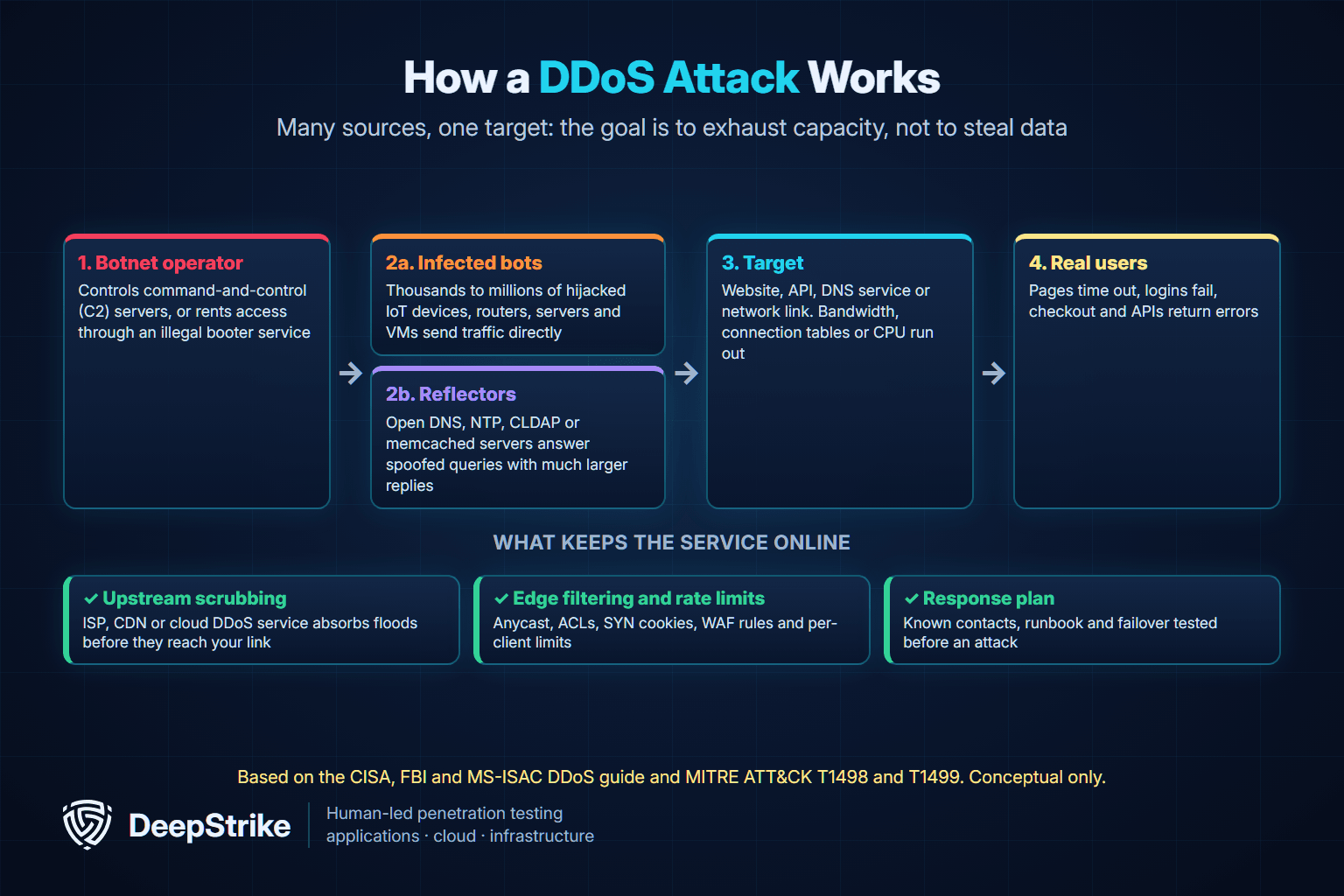
In a direct flood, the bots send packets or requests to the target themselves. In a reflection attack, the attacker sends small queries to public servers, such as DNS resolvers or other UDP services, but forges the source address so the replies go to the victim. When the reply is much larger than the query, the attack is also an amplification attack. MITRE lists this as Reflection Amplification (T1498.002).
The 2018 attack on GitHub shows how strong amplification can be. According to GitHub's incident report, attackers abused memcached servers left open to the internet, a vector with an amplification factor of up to 51,000. Each byte the attacker sent could produce up to 51 KB aimed at GitHub.
Reflection depends on IP address spoofing, which is only possible because many networks still forward packets with forged source addresses. The long-standing fix is ingress filtering, published in 2000 as RFC 2827 (BCP 38), which tells networks to drop outbound packets whose source address does not belong to them.
Most DDoS traffic comes from devices whose owners have no idea they are taking part. Routers, IP cameras, digital video recorders and TV boxes are favorite targets because they are always online, rarely patched and often shipped with default passwords.
Taking down C2 servers does not clean the infected devices. They stay vulnerable until patched or replaced, which is why new botnets keep reusing the same device pool. For the scale of the IoT problem, see our IoT hacking statistics.
DDoS attacks fall into three broad types, the same categories CISA, the FBI and MS-ISAC use: volumetric, protocol and application-layer. They differ in what they exhaust, so the right defense differs too.
| Type | Layer | Measured in | What it exhausts | Examples | First-line defense |
|---|---|---|---|---|---|
| Volumetric | Network and transport (L3/L4) | Bits per second (Gbps, Tbps) | Bandwidth of the target's link or its provider | UDP floods; DNS, NTP, CLDAP and memcached reflection | Upstream scrubbing and anycast capacity |
| Protocol | Network and transport (L3/L4) | Packets per second | Connection state in servers, firewalls and load balancers | SYN floods, ACK floods, fragmented-packet floods | SYN cookies, stateless edge filtering |
| Application (L7) | Application (HTTP, DNS, APIs) | Requests per second | CPU, memory, database and application workers | HTTP floods, cache-busting requests, slow requests, HTTP/2 Rapid Reset | WAF and bot rules, rate limits, caching, patching |
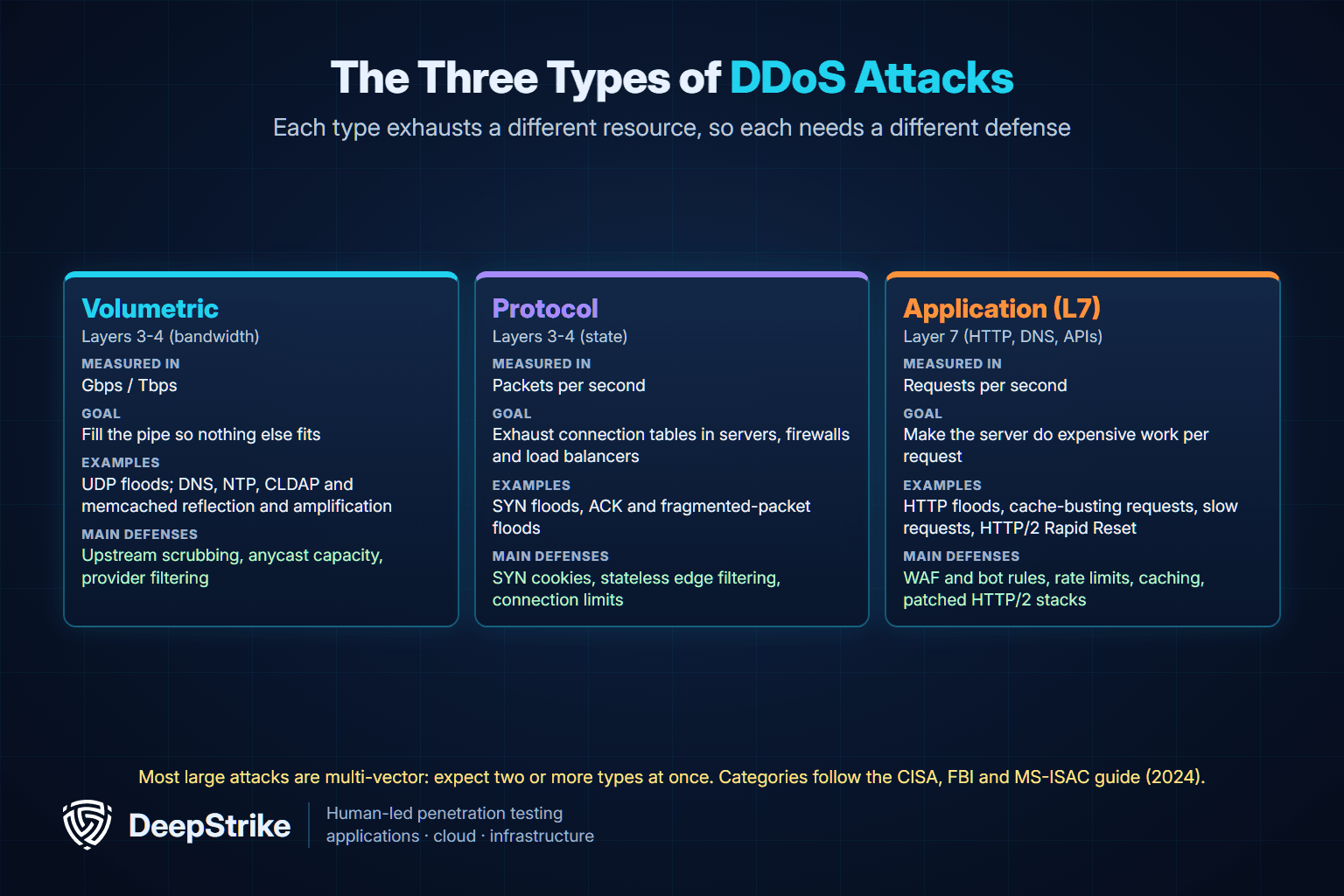
Volumetric attacks try to fill the pipe. If a server sits behind a 10 Gbps link and receives 100 Gbps of junk, legitimate packets cannot get through, no matter how well the server itself is configured. These attacks are usually UDP floods or reflection and amplification attacks, and they are the ones that set size records. Because the bottleneck is upstream of you, the only real defense is capacity upstream: your ISP, a CDN or a cloud DDoS service that can absorb and filter the flood before it reaches your link.
Protocol attacks target the state that network devices keep. The classic case is the SYN flood. A TCP connection begins with a SYN packet, and the server holds a half-open connection while it waits for the client to finish the handshake. Flood the server with SYNs that never complete and its connection table fills up. The IETF's RFC 4987 on TCP SYN flooding documents the attack and mitigations such as SYN cookies, which let a server avoid storing state until the handshake completes. Firewalls and load balancers are often the first devices to fail, because they track state for everything behind them.
Application-layer attacks send requests that look legitimate but are expensive to answer: search queries, login attempts, uncached pages or API calls that hit the database. They need far less bandwidth than volumetric floods, so they can slip past defenses that only watch traffic volume.
The largest documented example is HTTP/2 Rapid Reset. In August 2023, Google mitigated an attack peaking above 398 million requests per second, more than seven times its previous record. The technique abused HTTP/2 stream cancellation and is tracked as CVE-2023-44487, which NVD describes as exploited in the wild from August through October 2023. The lesson for defenders: some L7 attacks are fixed with a patch, not more bandwidth. Our web application security guide covers the application-side controls that also blunt L7 floods.
Real attacks often combine types, for example a UDP flood to saturate the link while an HTTP flood hits the login page. Attackers also switch vectors mid-attack to see what gets through. Some send ransom notes demanding payment to stop or to avoid an attack. Others are political: almost 80% of the EU incidents in ENISA's 2025 threat landscape data were hacktivist DDoS campaigns, and some state-aligned groups pose as hacktivists. Our cyber warfare statistics put those numbers in context.
A DDoS attack can also be a distraction. The CISA, FBI and MS-ISAC guide warns that attackers may use a DDoS attack to divert attention from malware deployment or data theft, and tells victims to keep watching for other compromise during the response.
Record sizes are easy to misquote, so the table below uses only figures published by the organization that saw or mitigated the attack. For counts, trends and industry breakdowns, see our DDoS attack statistics, which tracks the numbers quarter by quarter.
| Year | Event | Peak reported | Vector | Reported by |
|---|---|---|---|---|
| 2016 | Attack on KrebsOnSecurity (September 20) | More than 620 Gbps | Mirai IoT botnet | CISA alert |
| 2016 | Attack on French host OVH (late September) | At least 1.1 Tbps, possibly 1.5 Tbps | Mirai IoT botnet | CISA alert |
| 2016 | Attack on a DNS provider (October) | More than 80 websites made inaccessible | IoT devices; booter service | FBI IC3 PSA |
| 2018 | GitHub (February 28) | 1.35 Tbps; 126.9 million packets per second | Memcached amplification | GitHub incident report |
| 2023 | Google services and customers (August) | More than 398 million requests per second | HTTP/2 Rapid Reset (CVE-2023-44487) | Google Cloud |
| 2025 | Cloudflare customers (fourth quarter) | 31.4 Tbps in a 35-second attack | Aisuru-Kimwolf botnet | Cloudflare 2025 Q4 report |
| 2025 | "Night Before Christmas" campaign (from December 19) | Up to 24 Tbps, 9 billion packets per second and 205 million requests per second | Aisuru-Kimwolf botnet | Cloudflare 2025 Q4 report |
Sources for the table: CISA's Mirai alert, the FBI IC3 public service announcement on booter services, GitHub's incident report, Google Cloud's Rapid Reset post and Cloudflare's 2025 Q4 report, which describes the 31.4 Tbps attack as the largest ever disclosed publicly.
Three lessons stand out:
A booter or stresser is a website that sells DDoS attacks as a service. A customer picks a target and a duration, pays, and the service launches the attack using a botnet or reflectors it controls. Many of these sites claim they are "stress testing" tools for checking your own network.
In the United States, using them against someone else is a federal crime. The FBI states plainly that participating in DDoS attacks and DDoS-for-hire services is illegal, and that booter and stresser services "have no legitimate use" (FBI). The FBI's IC3 public service announcement explains that launching an attack, whether with your own botnet or by hiring a booter, can be prosecuted under the Computer Fraud and Abuse Act (18 U.S.C. § 1030). Consequences listed include seizure of devices, arrest, prison and fines. Hiring someone else to do it is not a defense.
Law enforcement has acted on this repeatedly under Operation PowerOFF, an international effort against DDoS-for-hire services:
How do you tell a stresser from a legitimate test?
| Legitimate load or DDoS resilience test | Booter or stresser service | |
|---|---|---|
| Target ownership | Verified; written authorization from the asset owner | Not checked; any IP or website can be entered |
| Traffic source | Controlled test infrastructure | Hijacked devices and abused third-party servers |
| Upstream providers | Notified, and testing follows their policies | Not involved; their networks are abused |
| Safety controls | Agreed rate caps, test window, contacts and a kill switch | None |
| Output | Measurements and a report you can act on | Downtime for someone else |
| Legal status | Lawful when authorized and within provider terms | Illegal to use against others; operators and customers prosecuted |
If a service lets you attack a target without proving you own it, it is a booter, whatever it calls itself.
Not every slowdown is an attack. A product launch, a viral post or a broken deployment can look similar. The CISA, FBI and MS-ISAC guide lists these common indicators:
Patterns that point toward an attack rather than real demand include traffic from unusual countries or networks, a flood of one packet type or request path, many requests with identical or nonsensical headers, and a sharp spike that does not match marketing activity. If you see these, contact your ISP or DDoS provider first. CISA notes they can tell you whether the problem is an outage on their side, an attack on their network that affects you indirectly, or an attack aimed at you.
You cannot stop someone from targeting you, so DDoS defense is about absorbing, filtering and recovering. The approach below follows the before, during and after structure of the CISA, FBI and MS-ISAC guide.
| Control | What good looks like | How to verify |
|---|---|---|
| Upstream protection | Always-on or fast on-demand DDoS mitigation for every critical service | Provider contract and dashboard show each asset covered |
| Origin exposure | Origin accepts traffic only from the CDN or protection service | Review firewall rules and DNS history for exposed origin IPs |
| Protocol hardening | SYN cookies on; connection and timeout limits tuned | Configuration review of servers, firewalls and load balancers |
| Application limits | Rate limits on login, search and costly API routes; caching for static content | Review WAF and gateway rules; confirm behavior at low test rates in staging |
| Patching | Known DoS flaws such as CVE-2023-44487 fixed in proxies and servers | Version and advisory check |
| Own network hygiene | No open resolvers or exposed amplification services; source filtering in place | External exposure review |
| Monitoring and alerting | Alerts on traffic, error-rate and latency anomalies reach an on-call person | Trigger a test alert |
| Response plan | Named contacts, provider escalation numbers and decision rights written down | Tabletop exercise with providers |
| Testing | Defenses validated under controlled load at least once a year and after major changes | Report from an authorized resilience test |
Protection that has never been tested is an assumption. A DDoS resilience test sends controlled, authorized traffic at your own services to confirm that detection, mitigation and your team's runbook work as expected. Done properly, it is a coordinated exercise with your providers, not a surprise attack on your own infrastructure.
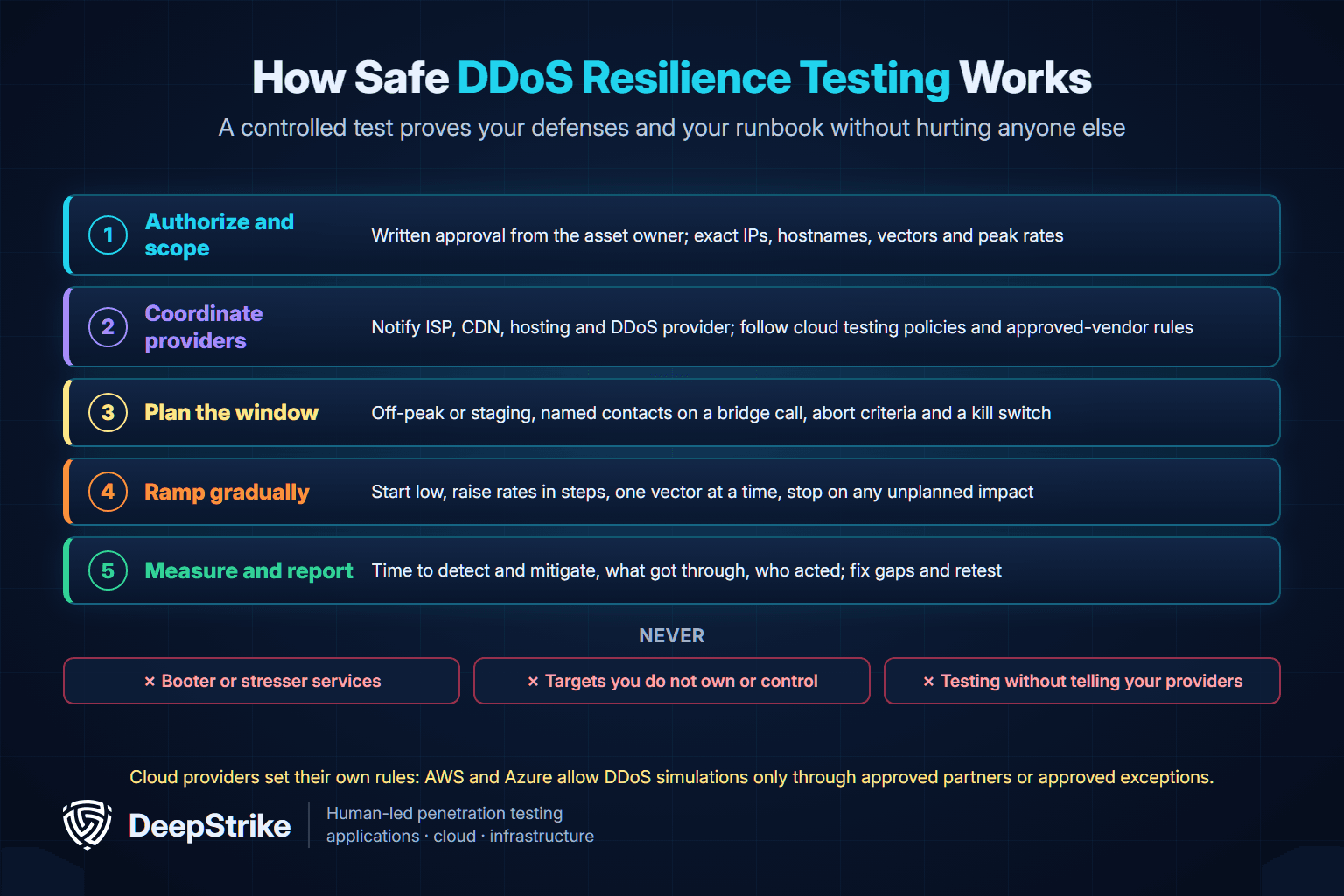
The asset owner signs off in writing on the exact targets (IP addresses and hostnames), the attack types to simulate, the maximum rates, the dates and the people who can stop the test. Nothing outside that scope is touched, and shared infrastructure that serves other customers needs extra care.
Traffic in a DDoS test crosses networks you do not own. Upstream providers must know about it in advance, both to avoid harming their other customers and so their own defenses do not treat the test as a real attack. Cloud providers publish specific rules:
| Provider | Rule for DDoS simulation (checked November 5, 2026) |
|---|---|
| AWS | Tests must be run by a pre-approved AWS DDoS Test Partner against resources protected by AWS Shield Advanced, within published caps such as 20 Gbps and 50,000 requests per second; other vendors or larger tests need an exception request at least 14 days ahead |
| Microsoft Azure | Simulations only through Microsoft's approved testing partners, against your own Azure public IP addresses protected by Azure DDoS Protection; Microsoft recommends staging environments or nonpeak hours |
| ISP, CDN and DDoS provider | Notify in advance and follow their terms; confirm contacts for the test window |
The full terms are in the AWS DDoS simulation testing policy and Microsoft's Azure DDoS Protection simulation guide. Other hosting providers have their own rules, so check before you schedule anything.
Choose a staging environment or off-peak hours, set up a bridge call with your team, the tester and provider contacts, and agree abort criteria. Any unexpected impact on production users or third parties ends the test immediately through a kill switch the tester controls.
A safe test starts well below the expected mitigation threshold and raises the rate in steps, one vector at a time. That shows where mitigation engages and whether anything degrades before it does. It also limits harm if a control fails.
The value of a test is in what you measure:
Fix the gaps, then retest. Not every check needs high traffic. Reviewing provider settings, origin exposure, rate-limit rules and the runbook finds many problems without sending any load. Those checks fit well alongside a network penetration test, which looks at the same perimeter from an intrusion point of view.
What a safe test never includes: booter or stresser services, reflection through third-party servers, targets you do not own or control, or traffic your providers have not been told about.
Yes. In the United States, launching a DDoS attack against systems you do not own, or paying a booter or stresser service to do it, can be prosecuted under the Computer Fraud and Abuse Act. The FBI says DDoS-for-hire services have no legitimate use. Testing your own systems is lawful when it is authorized and follows your providers' terms.
Most are short. Cloudflare reported that 96% of network-layer attacks it mitigated in the third quarter of 2026 ended in under 10 minutes, and the record 31.4 Tbps attack lasted 35 seconds. Campaigns can still run for hours or days, with repeated bursts. Our DDoS statistics page tracks duration trends.
Look for sudden slowness or unavailability together with abnormal traffic, high CPU or memory use, and floods of one packet type, path or source pattern that do not match real customer activity. Contact your ISP or DDoS provider to confirm whether the traffic is an attack aimed at you.
Sometimes, but rarely quickly. Traffic comes from hijacked devices or spoofed addresses, so the visible sources are victims, not the attacker. Law enforcement traces operators through C2 servers, payments and booter-site records, which is how Operation PowerOFF identifies administrators and customers.
A DoS attack comes from one source, so blocking that source often stops it. A DDoS attack comes from many sources at once, usually a botnet or reflectors, which makes it larger and much harder to filter.
Not on its own. It attacks availability, not confidentiality. But CISA warns that attackers can use a DDoS attack as a distraction while they install malware or steal data, so keep monitoring for intrusion during any attack.
Only small ones. A firewall cannot help if the flood fills the link in front of it, and stateful firewalls can themselves be overwhelmed by protocol attacks. Large attacks must be absorbed upstream by your ISP, a CDN or a DDoS protection service.
DDoS protection usually fails in the gaps: an exposed origin server, an on-demand service nobody switches on, a rate limit that was never set, or a runbook without current provider contacts. The checks that matter are concrete. Confirm what is protected, how fast mitigation engages, and whether your team and providers act as planned.
DeepStrike can run authorized DDoS resilience testing, coordinated with your ISP and cloud providers. Our penetration testing services also cover infrastructure, cloud and red team engagements carried out manually, with clear reports and actionable fix recommendations. To discuss scope, contact DeepStrike.
Mohammed Khalil is a Cybersecurity Architect at DeepStrike, specializing in advanced penetration testing and offensive security operations. With certifications including CISSP, OSCP, and OSWE, he has led numerous red team engagements, focusing on cloud security, application vulnerabilities, and adversary emulation. His work involves dissecting complex attack chains and developing resilient defense strategies for clients in the finance, healthcare, and technology sectors.
CISA: Heightened DDoS Threat Posed by Mirai and Other Botnets
MITRE ATT&CK: Network Denial of Service (T1498)
MITRE ATT&CK: Endpoint Denial of Service (T1499)
RFC 2827 (BCP 38): Network Ingress Filtering
RFC 4987: TCP SYN Flooding Attacks and Common Mitigations
Cloudflare: 2025 Q4 DDoS Threat Report
Cloudflare: DDoS Threat Report 2026 Q3
Google Cloud: Google mitigated the largest DDoS attack to date, peaking above 398 million rps
GitHub: February 28th DDoS Incident Report
FBI IC3: Booter and Stresser Services Increase the Scale and Frequency of DDoS Attacks
U.S. Department of Justice: Authorities disrupt world's largest IoT DDoS botnets (March 19, 2026)
KrebsOnSecurity: Six Charged in Mass Takedown of DDoS-for-Hire Sites
The Hacker News: U.S. Seizes NightmareStresser Domains

Stay secure with DeepStrike penetration testing services. Reach out for a quote or customized technical proposal today
Contact Us
