November 5, 2026
Updated: November 5, 2026
How botnets recruit and control devices, what they are used for, the Mirai, 911 S5 and Raptor Train cases, and how to detect and prevent infections.

Mohammed Khalil
What is a botnet? It is a network of computers, routers, cameras and other internet-connected devices that criminals have infected with malware and control remotely, usually without the owners noticing. Botnets power DDoS attacks, credential stuffing, spam and anonymous proxy services. This guide explains how botnets recruit and control devices, what they are used for, and what the Mirai, 911 S5 and Raptor Train cases teach. It then covers how to spot an infected device on a corporate network and how to keep your devices out of botnets.
A botnet is a group of internet-connected devices that have been compromised with malware and can be controlled remotely, as one unit, by an attacker. Each infected device is called a bot or zombie. The owner usually sees nothing wrong, because the device keeps working normally while it carries out the attacker's tasks in the background.
The FBI defines a botnet in a 2025 public service announcement as "a network of Internet-connected devices compromised by malware that can be controlled remotely without the owners' knowledge." MITRE ATT&CK describes the same thing from the attacker's side: adversaries either rent an existing botnet, for example from a booter or stresser service, or build their own by compromising third-party systems, then use it for large-scale phishing, DDoS attacks or to hide their infrastructure.
| Term | Meaning |
|---|---|
| Bot or zombie | One infected device that takes orders from the botnet's operator |
| Bot herder or operator | The person or group that controls the botnet |
| Command and control (C2) | The infrastructure the operator uses to send orders to bots |
| Recruitment | How new devices get infected and added |
| Botnet-as-a-service | Renting botnet access to other criminals, for DDoS, proxies or malware delivery |
| Residential proxy | Traffic routed through an infected home or office connection so it looks like a normal user |
Any device with an internet connection and enough computing power can become a bot: Windows PCs, Android phones and TV boxes, home and small-office routers, firewalls, network storage, IP cameras and digital video recorders. Routers and IoT devices are especially attractive because they run all the time, are rarely monitored and often keep factory passwords or old firmware for years.
Every botnet follows the same three-stage pattern. First, the operator recruits devices by infecting them. Second, each infected device connects back to the operator's control system and waits for instructions. Third, the operator uses the combined bandwidth, computing power and IP addresses of thousands or millions of devices, or rents that capacity out to other criminals.
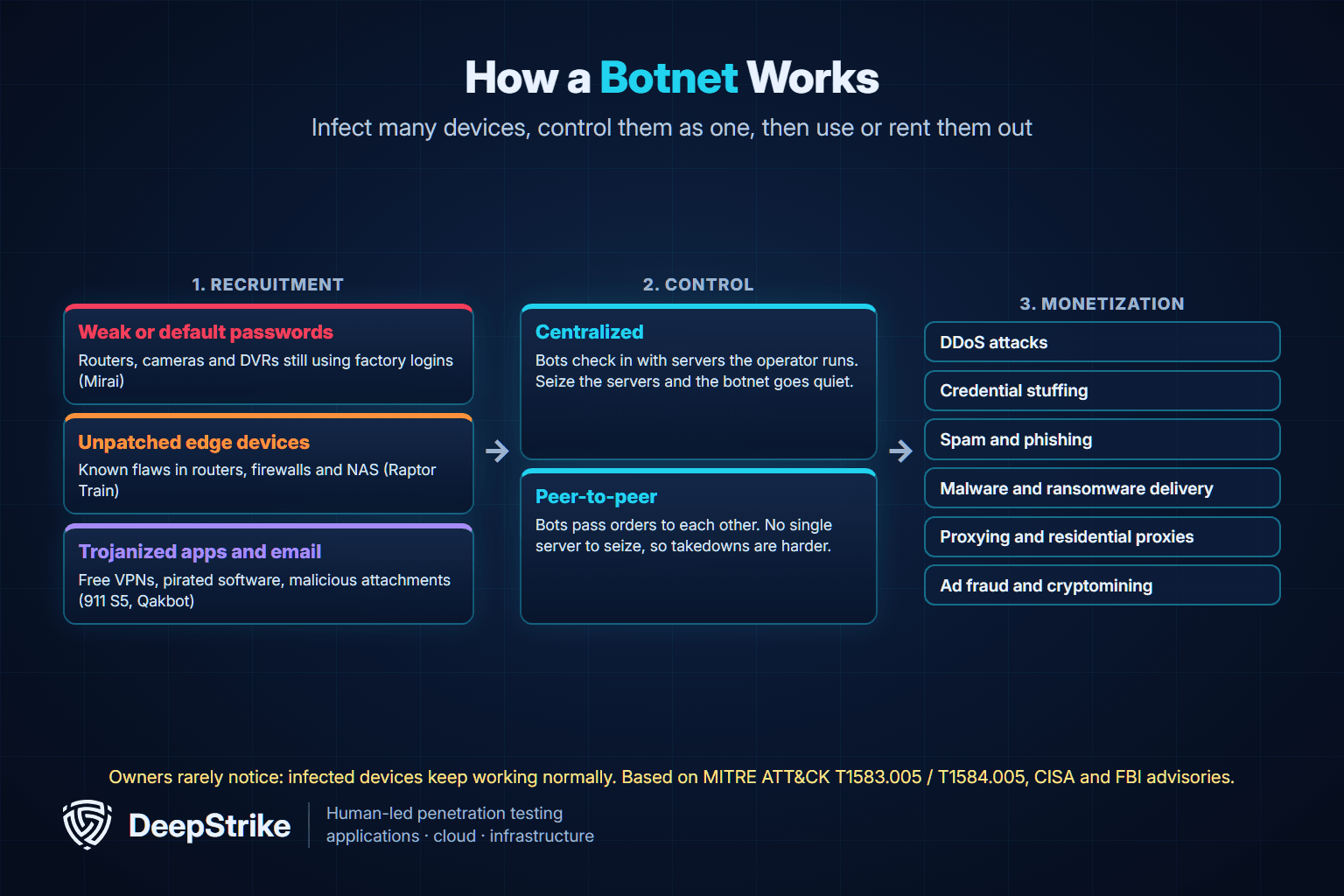
Government advisories and court records show four recruitment routes again and again:
The first two routes explain why IoT and network devices dominate modern botnets. Our IoT hacking statistics show how large and exposed that device population is.
Once a device is infected, it needs a way to receive orders. There are two broad models, and the difference matters mostly for how hard the botnet is to shut down.
| Centralized (client-server) | Peer-to-peer (P2P) | |
|---|---|---|
| How orders arrive | Bots check in with servers or domains the operator runs | Bots pass orders to each other; any bot can relay them |
| Strength for the attacker | Simple and fast to manage at large scale | No single server whose loss stops the botnet |
| Weakness | The control servers are a single point of failure | Slower to update and more complex to run |
| What a takedown looks like | Seize or take over the servers and domains, as in Qakbot, 911 S5 and Raptor Train | Harder; often requires taking over the peer network or cleaning bots directly |
| What defenders see | Regular outbound connections from many devices to the same small set of destinations | Infected devices talking to many other internet hosts, often unusual for that device type |
Many botnets mix the two, and operators often add layers, such as management servers behind the control servers, to make seizures harder. The Raptor Train advisory, for example, describes a tier of management servers and a web application that let customers task infected devices. For defenders, the practical point is the same either way: an infected device has to talk to the outside world, and that traffic is where you catch it.
A botnet is infrastructure. Its value is that thousands of real devices on real internet connections can act at once, and that their traffic is hard to tell apart from normal users. That makes botnets useful for almost every large-scale attack.
| Use | What the botnet provides | Harm to the device owner | Dated example |
|---|---|---|---|
| DDoS attacks | Combined bandwidth of many devices aimed at one target | Slow connection; your IPs appear in attack traffic | Mirai's attacks on Krebs on Security and OVH, September 2016 |
| Credential stuffing | Login attempts spread across many residential IPs to dodge rate limits | Your IPs get blocked or flagged by other sites | Residential proxies sold through 911 S5 were used for financial fraud |
| Spam and phishing | Millions of sending addresses | Your mail domain or IP gets blocklisted | Emotet and Qakbot email campaigns |
| Malware and ransomware delivery | A foothold inside networks that can be sold | Ransomware in your own network | Qakbot access used by Conti, REvil and Black Basta, per DOJ |
| Proxying and hiding | Attack traffic that appears to come from ordinary devices | Crimes traced to your IP address | Raptor Train used as a proxy to conceal state-linked hacking |
| Residential proxy networks | Rented "clean" home IP addresses | Investigations and blocks land on you | 911 S5: more than 19 million IP addresses |
| Ad fraud and cryptomining | Fake clicks and stolen computing power | Higher power use, slower devices | The Mirai authors' separate clickfraud botnet, 2016–2017 |
DDoS. The best-known use. Botnets aim the traffic of many devices at one website, network or DNS service until it fails. Our guide to what a DDoS attack is explains the attack types and defenses, and our DDoS attack statistics track record sizes and trends.
Credential stuffing. Attackers take username and password pairs leaked from one breach and try them on other sites. MITRE tracks this as Credential Stuffing (T1110.004) and OWASP lists it as automated threat OAT-008. Botnets and residential proxies let attackers spread attempts across thousands of addresses so each one stays under per-IP limits. See our credential stuffing statistics for how common it is, and our guide to password spraying for the related low-and-slow technique.
Proxying and residential proxy networks. Instead of attacking anyone directly, the botnet rents out its bots' internet connections. Criminals route their traffic through a victim's home or office IP, so fraud checks see what looks like a normal customer. MITRE tracks this as Proxy (T1090). The 911 S5 case below shows how large this business became. Cryptomining on infected devices falls under Resource Hijacking (T1496).
Mirai is the clearest example of how a botnet works and why IoT devices became the main target.
How it spread. Mirai scanned the internet for cameras, routers and digital video recorders and tried a short list of 62 default usernames and passwords. Because so many devices still used factory logins, that list was enough to take over hundreds of thousands of them. CISA notes that Mirai lived in the device's memory, so a reboot removed it, but a device that still used the same password was reinfected quickly.
What it did. On September 20, 2016, a Mirai botnet hit the Krebs on Security website with an attack above 620 Gbps, one of the largest on record at the time. A separate Mirai attack on the French host OVH reached at least 1.1 Tbps later that month. In October 2016, an attack using IoT devices on a DNS provider made more than 80 websites unreachable, according to an FBI IC3 public service announcement.
Who built it. In December 2017 the Justice Department announced guilty pleas from three young men, Paras Jha, Josiah White and Dalton Norman, for creating and operating Mirai under the Computer Fraud and Abuse Act. Court records state that over 300,000 devices ultimately became part of the botnet, which the group used for attacks, extortion of hosting companies and paid rentals. Two of them also admitted running a second botnet of more than 100,000 devices, mostly home routers, for advertising click fraud.
Why it still matters. At the end of September 2016, Jha published Mirai's source code online. That turned one botnet into a malware family. The Raptor Train botnet that U.S. agencies exposed in 2024 was built on Mirai-family malware, and the record-setting IoT botnets disrupted by the Justice Department in 2026 followed the same playbook of mass IoT infection.
The lesson for organizations. Mirai did not need sophisticated exploits. It needed devices with factory passwords exposed to the internet. Nearly a decade later, that is still the first thing to check.
On May 29, 2024, the Justice Department announced that a court-authorized international operation had dismantled 911 S5, which FBI Director Christopher Wray called "likely the world's largest botnet ever."
According to the indictment, from 2014 through July 2022 the administrator, YunHe Wang, and others spread malware that compromised millions of residential Windows computers associated with more than 19 million unique IP addresses, including 613,841 in the United States. The malware came bundled with free VPN programs such as MaskVPN and DewVPN and with pirated software. Wang allegedly ran about 150 dedicated servers to control the infected computers and sold access to their IP addresses as a residential proxy service.
The harm came from the customers. The government estimates that 560,000 fraudulent unemployment insurance claims originated from compromised 911 S5 IP addresses, resulting in confirmed fraud losses of more than $5.9 billion. Wang allegedly received about $99 million from the service between 2018 and July 2022. He was arrested on May 24, 2024, and charged with computer fraud and with conspiracy to commit computer fraud, wire fraud and money laundering. Authorities seized assets worth about $30 million, 23 domains and more than 70 servers, including those behind the rebranded service Cloudrouter. The Treasury Department sanctioned Wang and two associates the day before the announcement. The charges are allegations until proven in court.
Why it matters to businesses. The victims were ordinary computers, many owned by individuals and businesses. The FBI's guidance specifically warns organizations with bring-your-own-device policies that employees' personal machines may have been connected to the botnet, and lists the VPN apps involved. A free VPN on an employee laptop is a botnet risk, not just a policy issue.
On September 18, 2024, the FBI, NSA and U.S. Cyber Command's Cyber National Mission Force, with partners in Australia, Canada, New Zealand and the United Kingdom, published a joint advisory on a botnet run by Integrity Technology Group, a Beijing company the FBI links to the hacking group known as Flax Typhoon.
Key facts from the advisory:
The same day, the Justice Department announced a court-authorized operation in which the FBI took control of the botnet's infrastructure and sent commands that disabled the malware on infected devices. During the operation, someone launched a DDoS attack against the infrastructure the FBI was using, which failed to stop the disruption. Lumen's Black Lotus Labs had first identified and named the botnet Raptor Train in July 2023. For the group behind it and its other campaigns, see our profile of Flax Typhoon and the Raptor Train botnet.
Why it matters to businesses. Raptor Train shows that botnets are not only a criminal nuisance. A state-linked group used ordinary routers and cameras, many of them in U.S. homes and offices, as cover for intrusions. The advisory's mitigations are a ready-made checklist for any organization, and they appear in the prevention section below.
Takedowns have shifted from arresting individuals to seizing control infrastructure and cleaning infected devices directly.
| Date | Botnet | Reported size | Action and source |
|---|---|---|---|
| December 2017 | Mirai | Over 300,000 IoT devices | Three creators pleaded guilty (DOJ) |
| January 2021 | Emotet | Several hundred servers | International takeover of infrastructure coordinated by Europol |
| August 2023 | Qakbot | More than 700,000 computers | FBI-led operation removed the malware; $8.6 million in cryptocurrency seized (DOJ) |
| May 2024 | 911 S5 | More than 19 million IP addresses | Botnet dismantled; administrator arrested (DOJ) |
| May 2024 | Operation Endgame (dropper botnets) | More than 100 servers and 2,000 domains | Four arrests; Europol called it the largest ever operation against botnets |
| September 2024 | Raptor Train | Over 260,000 devices | Court-authorized FBI operation disabled the malware (DOJ, FBI, NSA) |
| March 2026 | Aisuru, KimWolf, JackSkid and Mossad | More than 3 million devices | Command-and-control infrastructure disrupted with Canada and Germany (DOJ) |
Sources: Europol on Emotet, DOJ on Qakbot, Europol on Operation Endgame and DOJ on the 2026 IoT botnet action, plus the Mirai, 911 S5 and Raptor Train sources above.
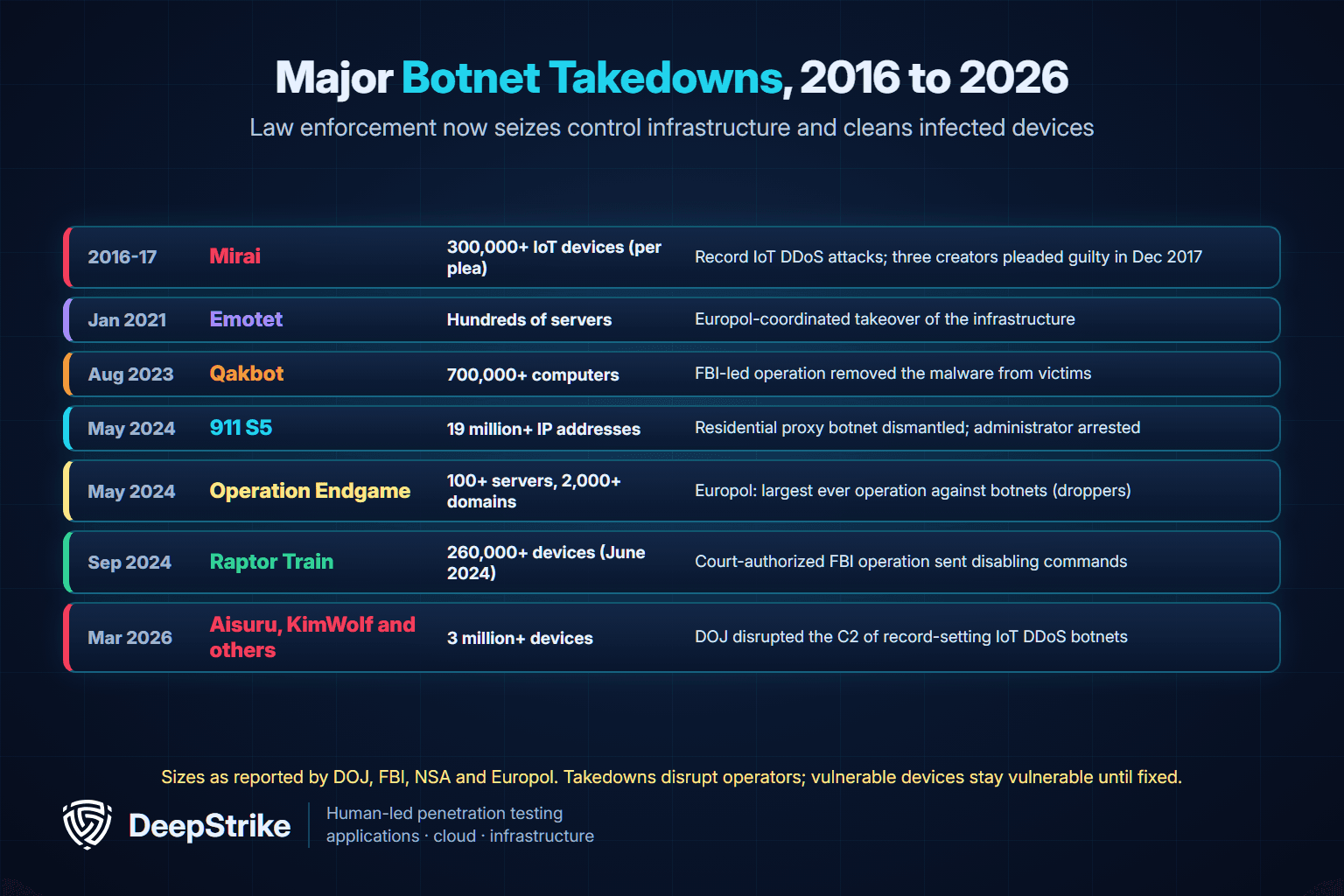
One pattern stands out. Takedowns remove an operator, but they do not fix the devices. Mirai's code lived on after its authors pleaded guilty, and the 2026 botnets recruited the same kinds of devices. Your own devices stay vulnerable until you patch, reconfigure or replace them.
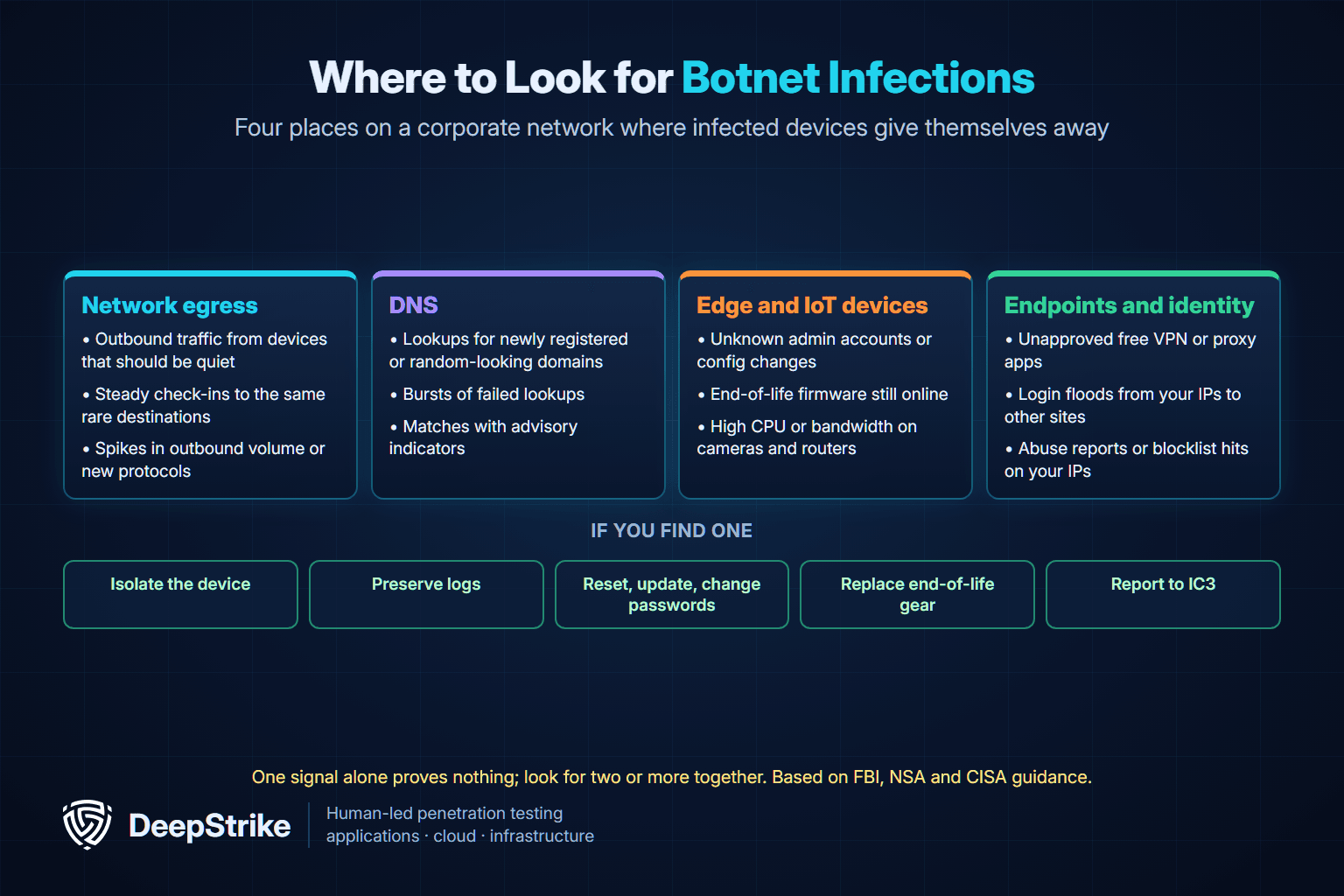
Botnet malware is built to stay quiet, so there is rarely one obvious symptom. Watch for combinations of these:
The FBI stresses that one indicator alone does not prove compromise. Treat each one as a reason to look closer.
In a company, the most reliable way to find bots is to watch what devices send out, not only what comes in. An infected device must reach its operator, and most corporate devices have a small, predictable set of destinations.
| Signal | Where to look | Data source |
|---|---|---|
| Outbound connections from devices that should not initiate them (cameras, printers, building systems) | Firewall and proxy logs, NetFlow | Egress logs compared with an asset inventory |
| Regular "check-in" connections from one or many devices to the same rare destination | Network monitoring, NDR | Flow data over days, not minutes |
| Lookups for newly registered, random-looking or rare domains; bursts of failed lookups | DNS resolver logs | Protective DNS or resolver logging |
| Sudden outbound volume, new protocols or connections to many external hosts | Firewall, NetFlow | Traffic baselines per device group |
| Logins or high request rates from your IP addresses to other companies' sites | Abuse reports, threat intelligence feeds | Abuse mailbox, blocklist monitoring |
| Unknown accounts, firmware changes or exposed management interfaces on edge devices | Device configs, external attack surface scans | Configuration backups and change tracking |
| Unapproved VPN or proxy software on endpoints | EDR and software inventory | Endpoint telemetry |
| Matches with published indicators from government advisories | SIEM | Advisory appendices, such as the Raptor Train indicators |
Three practical points make detection work:
The Raptor Train advisory, the 911 S5 guidance and CISA's Mirai alert recommend largely the same controls. The checklist below combines them, with a way to verify each one.
| Control | What good looks like | How to verify |
|---|---|---|
| No default passwords | Every router, camera, NAS and appliance has a unique, strong admin password | Credential audit of all devices in the inventory |
| Patching and firmware updates | Edge and IoT devices on supported firmware; known exploited flaws fixed first | Compare versions with vendor advisories and CISA's Known Exploited Vulnerabilities catalog |
| Replace end-of-life gear | No unsupported device faces the internet | Inventory with vendor support dates |
| Disable unused services | UPnP, remote management and file sharing turned off where not needed | External scan of management interfaces |
| Network segmentation | IoT and building systems on their own segment with only the access they need | Test that the IoT segment cannot reach servers or user networks |
| Egress filtering | Devices can reach only the destinations they need; IoT has little or no direct internet access | Firewall rule review; test outbound connections from each segment |
| Approved software only | No free VPNs, proxy apps or pirated software on company or BYOD devices | EDR software inventory; BYOD policy checks |
| Monitoring | Egress, DNS and edge-device logs collected and baselined | Alert review; detection test |
| Login protection | MFA, bot detection and rate limits on customer and employee logins | Review against credential stuffing scenarios |
| Planned reboots | Scheduled restarts for routers and IoT devices, as the advisory suggests | Device schedules |
For patch priorities, start with the flaws in CISA's Known Exploited Vulnerabilities catalog, because those are the ones attackers already use, including to recruit edge devices into botnets.
Buying decisions matter too. The FBI's BADBOX 2.0 warning shows that some cheap devices arrive already infected. Buy network and IoT equipment from vendors that publish security updates, and avoid devices that need apps from unofficial stores.
For customer-facing logins, assume some of the traffic comes from botnets and residential proxies. Blocking by IP address alone fails when attackers have millions of clean residential IPs, so combine MFA, breached-password checks and behavioral bot detection.
Most botnet-prevention controls are configuration claims: "IoT is segmented", "no default passwords", "edge devices are patched." Testing turns those claims into evidence. An authorized assessment should show:
An external and internal network penetration test covers most of this list, and a network penetration test is the usual place to start. Testing is done only on systems you own or are authorized to test, without real malware, and without touching third-party devices.
Look for unexplained network activity, a slow or hot device, unknown programs such as free VPN apps, and your IP address appearing on blocklists. Run a reputable anti-malware scan and check the FBI's published guidance for named botnets such as 911 S5. In a company, egress and DNS logs are more reliable than symptoms on the device.
Yes. Infecting devices without permission, running a botnet and renting one are crimes in the United States under the Computer Fraud and Abuse Act and in most other countries. The Mirai creators pleaded guilty to conspiracy charges, and the alleged 911 S5 administrator faces up to 65 years in prison if convicted on all counts.
There is no single agreed measure. The FBI called 911 S5, with more than 19 million IP addresses, "likely the world's largest botnet ever" when it was dismantled in May 2024. For DDoS power, the IoT botnets disrupted in March 2026 were behind record-breaking attacks.
Yes. Android phones, TV streaming boxes, smart TVs, cameras and routers can all be infected. The FBI's BADBOX 2.0 warning describes millions of infected IoT devices, many of them cheap TV boxes that were compromised before they were sold.
Sometimes, briefly. Mirai-style malware runs in memory, so a reboot clears it, but the device is reinfected quickly if it keeps the same password or vulnerability. Reboot, reset, update the firmware and change the password, or replace the router if it is no longer supported.
A bot herder is the person or group that controls a botnet. They manage the command-and-control infrastructure, add new devices and either use the botnet themselves or rent it out to other criminals.
A botnet is the network of infected devices. A DDoS attack is one thing a botnet can do with them: flood a target with traffic. Botnets are also used for credential stuffing, spam, fraud and proxying.
Every botnet in this guide grew by finding devices someone forgot: a camera with a factory password, a router that missed a firmware update, a free VPN on a laptop. The defense is concrete. Know what you have, fix what is exposed, segment what you cannot fix, and watch what leaves your network.
DeepStrike's penetration testing services cover infrastructure, cloud and red team engagements carried out manually, with clear reports and actionable fix recommendations. A network test can show which of your devices could be recruited into a botnet and whether your monitoring would notice. To discuss scope, contact DeepStrike.
Mohammed Khalil is a Cybersecurity Architect at DeepStrike, specializing in advanced penetration testing and offensive security operations. With certifications including CISSP, OSCP, and OSWE, he has led numerous red team engagements, focusing on cloud security, application vulnerabilities, and adversary emulation. His work involves dissecting complex attack chains and developing resilient defense strategies for clients in the finance, healthcare, and technology sectors.
FBI IC3: Home Internet Connected Devices Facilitate Criminal Activity (BADBOX 2.0), June 5, 2025
FBI IC3: Guidance on the 911 S5 Residential Proxy Service, May 29, 2024
CISA: Heightened DDoS Threat Posed by Mirai and Other Botnets
Europol: World's most dangerous malware EMOTET disrupted through global action, January 27, 2021
Europol: Largest ever operation against botnets hits dropper malware ecosystem, May 30, 2024
U.S. Department of Justice: Authorities disrupt world's largest IoT DDoS botnets, March 19, 2026
MITRE ATT&CK: Acquire Infrastructure: Botnet (T1583.005)
MITRE ATT&CK: Compromise Infrastructure: Botnet (T1584.005)
MITRE ATT&CK: Brute Force: Credential Stuffing (T1110.004)
MITRE ATT&CK: Resource Hijacking (T1496)

Stay secure with DeepStrike penetration testing services. Reach out for a quote or customized technical proposal today
Contact Us
