August 25, 2025
Updated: November 5, 2026
Enterprise-grade cost breakdown, compliance pricing, and risk-based ROI modeling for 2026 security budgets.

Mohammed Khalil
How much does a penetration test cost? In 2026, most professional penetration tests cost $5,000 to $50,000 per engagement. A single web application or a small external network usually falls between $5,000 and $30,000, while internal, cloud and multi-application scopes run $10,000 to $50,000 or more. Large enterprise programs can pass $100,000 a year. The price is tester-days multiplied by a day rate, and public GSA CALC+ data puts penetration tester rates at a median of about $156 per hour. Quotes under about $4,000 are usually automated scans, not manual tests.
Choose Your Path
If you ask how much does a penetration test cost, you’ll get a wide range: roughly $5K for a simple test up to $50K or more for a complex one. However, the more important question is what drives that price. In today’s threat environment, the real value of a test depends on depth and breadth. Automated scans alone are insufficient in 2026; skilled experts must perform manual validation, logic checks, and attack simulations to identify exploitable vulnerabilities. In short, pentesting should be viewed as a strategic control that can prevent costly breaches. For example, IBM reports average data breach costs of $4.99M globally in its 2026 report. Investing in robust testing (even if it costs tens of thousands of dollars) is often justified when measured against these multi‑million‑dollar losses. To see how DeepStrike scopes engagements and what drives a quote, see our penetration testing pricing page.
Hay una guía sobre este tema en español: el costo de las pruebas de penetración.
Penetration testing is a structured security assessment that combines automated vulnerability discovery with manual exploit validation to identify real world attack paths and reduce breach probability.
Three things changed in 2026: AI is speeding up exploits, with IBM's 2026 Cost of a Data Breach Report finding that one in four malicious breaches was AI-enabled; regulators are imposing new controls; and cyber insurers are tightening underwriting, with some requiring proof of rigorous pentesting. Together, these shifts push teams toward deeper, more frequent tests linked to risk reduction and compliance outcomes.
The landscape continues to evolve in 2026. Rapid advances in AI have accelerated cyber risks; attackers now deploy autonomous, adaptive tools to probe and exploit targets with unprecedented speed. For example, IBM’s 2026 Cost of a Data Breach Report found that one in four malicious breaches was AI-enabled, up 56% year over year, and that these breaches cost about $6 million on average, roughly $1 million above the global average (see our AI cyber attack statistics). In response, cyber risk is firmly a board level issue, as leaders recognize that AI driven threats and complex supply chain vulnerabilities can trigger systemic events.
On the risk management side, cyber insurance trends are also shifting. After years of a buyer friendly market, insurers are beginning to tighten underwriting criteria again as losses mount. Carriers now scrutinize security controls more strictly, and some require proof of rigorous pentesting to qualify for coverage. These dynamics underline why penetration testing remains a critical investment: the potential losses from a successful exploit are climbing, while insurers expect proactive controls. Cost also depends on in-house versus outsourced penetration testing.
Overall, the 2026 update reinforces the message that pentesting isn’t optional. AI is speeding up exploits, regulators are imposing new controls, and the cyber insurance market is less forgiving of gaps. Security teams must adapt by planning deeper, more frequent tests, and by explicitly linking test budgets to risk reduction and compliance outcomes.
As regulatory enforcement intensifies globally, penetration testing budgets are increasingly classified as mandatory control validation costs rather than discretionary security spending.
The significant variation in pentest pricing comes down to a few key factors, and each one belongs in the scope brief behind your penetration testing quote:
The size and intricacy of your environment are the single biggest drivers of cost. More assets and complex systems require more tester time. Vendors typically quantify scope by metrics like:
There is also a complexity multiplier effect. Testing two standalone apps is one thing; testing two apps that interact multiplies the effort. The tester must examine each app plus the communication channel and potential pivot paths between them, which can create multi stage attack scenarios. Businesses searching for the best way to protect ecommerce shipments explained should distinguish physical shipment protection from website security. The linked guide addresses the latter; testing storefronts, administrative interfaces, and connected order systems adds scope that should be reflected in the penetration testing quote.
The information you provide to the tester defines the methodology and thus the effort required:
Price depends more on scope than on box type: white box adds code-review effort, while black box adds reconnaissance time.
For example, in depth engagements might include manual exploit chaining across multiple vulnerabilities, business logic abuse detection, and specialized authentication bypass testing as part of a multi stage attack simulation. In larger engagements, Test Management Tools can help keep these different test activities, findings, and follow-up work organized throughout the assessment. Each of these activities requires additional time from senior testers (often $200–$300+/hour) and possibly custom tools, which raises the price. Tests that include these advanced, multi stage assessments deliver deeper risk visibility, but the higher labor intensity is reflected in higher cost tiers.
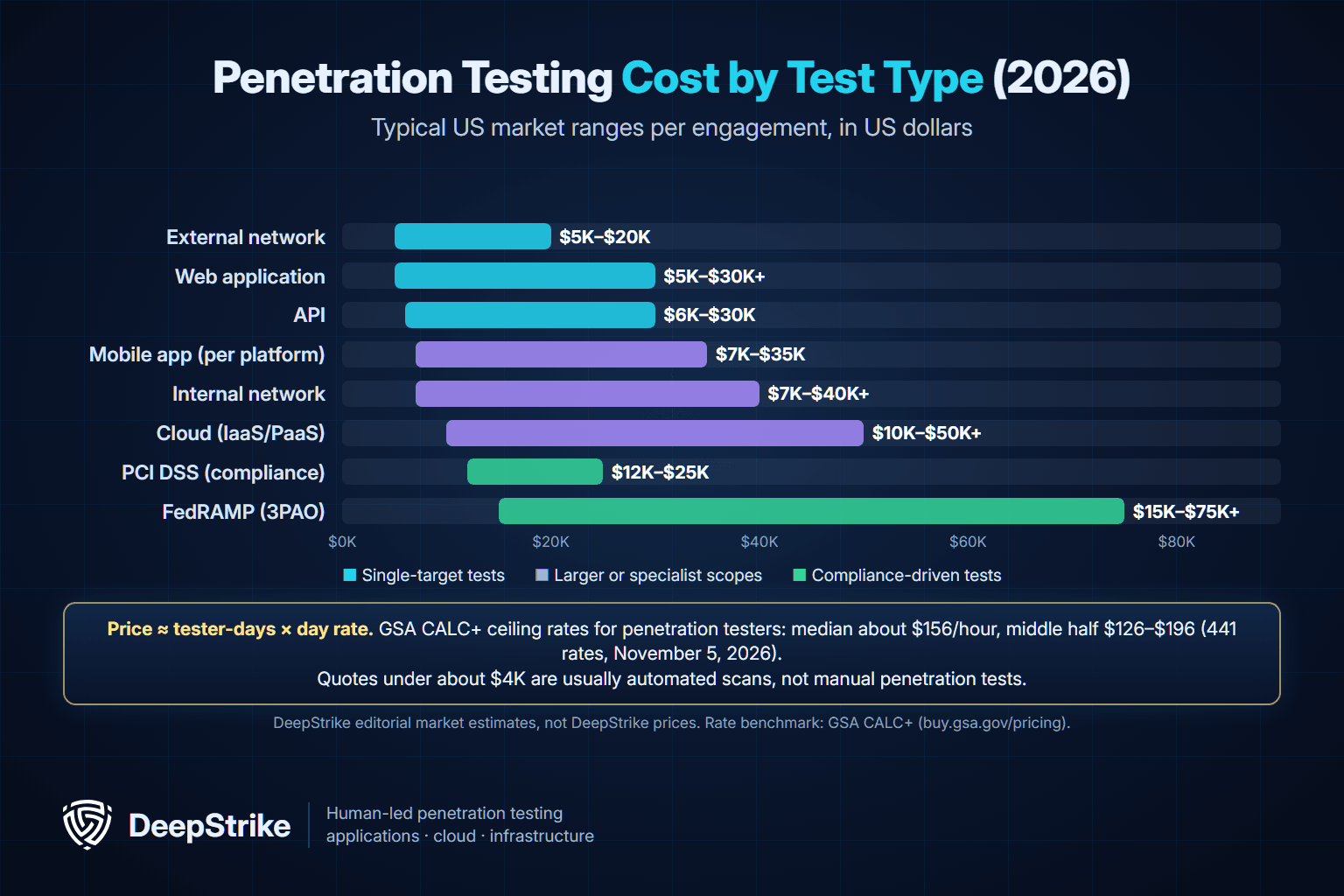
Typical market ranges by asset type (DeepStrike editorial estimates, not DeepStrike prices) are:
Web and network tests are generally at the lower end of enterprise ranges, while comprehensive mobile or multi cloud audits push higher. Exact quotes depend on the total number of apps, nodes, and their criticality.
When buying a penetration test, you are purchasing an expert’s time and creativity. Hourly rates for skilled testers typically range from $100 to $300, with experienced consultants commanding premium rates. Look for teams with respected certifications (e.g. OSCP, CISSP) and a strong track record. Senior testers can uncover complex business logic flaws and chaining issues that junior or automated tests miss. While their hourly rates are higher, their findings often deliver a much greater return on investment by preventing serious breaches.
These experts follow established methodologies from authoritative bodies like the OWASP Web Security Testing Guide and NIST SP 800 115. In procurement, you should validate that the vendor’s process includes manual validation steps (e.g. logic testing, exploitation) beyond just automated scanning.
Most vendors price a penetration test by the tester-day, so the rate is the second half of every quote. For a public benchmark, the U.S. General Services Administration publishes the labor ceiling rates on its contracts in GSA CALC+. On November 5, 2026, CALC+ held 441 rates for labor categories titled penetration tester. The median was about $156 per hour, the middle half fell between about $126 and $196, and the full range ran from about $57 to $321.
Experience moves the rate. Categories that require up to 3 years of experience had a median of about $133 per hour, 4 to 7 years about $162, and 8 or more years about $193. These are federal ceiling rates, not commercial list prices, but they show where the senior-tester rates discussed above sit in the market.
To turn a rate into a budget, multiply by 8 hours and by the tester-days in scope. At the CALC+ median, one tester-day costs about $1,250, so a 4-day external test comes to about $5,000 and a 10-day web application and API test to about $12,500 before reporting and retesting. If a quote implies far fewer days than the scope needs, ask what was left out.
To help with budgeting, here is an overview of typical cost ranges grouped by category:
| Category | Item | Typical range (USD) | Note |
|---|---|---|---|
| Methodology | Black box | $5,000–$50,000 | Extra reconnaissance time |
| Methodology | Grey box | $6,000–$35,000 | Balance of realism and efficiency |
| Methodology | White box | $7,000–$40,000+ | Adds code and configuration review |
| Asset | Web application | $5,000–$30,000+ | Driven by roles and endpoints |
| Asset | Network | $5,000–$40,000+ | Driven by IP count and segments |
| Asset | API | $6,000–$30,000 | Driven by endpoint count and logic |
| Asset | Mobile app | $7,000–$35,000 | Per platform (iOS or Android) |
| Asset | Cloud (IaaS/PaaS) | $10,000–$50,000+ | Multi-account and multi-cloud cost more |
| Compliance | PCI DSS | $12,000–$25,000 | CDE and segmentation testing |
| Compliance | HIPAA | $10,000–$50,000 | Evidence for risk analysis |
| Compliance | SOC 2 | $5,000–$20,000 | Audit evidence |
| Compliance | ISO 27001 | $5,000–$50,000 | Evidence for Annex A 8.8 / 8.29 |
| Compliance | FedRAMP | $15,000–$75,000+ | Authorized 3PAO, by impact level |
| Organization size | Small (≤150 staff) | $8,000–$20,000 / yr | Basic annual tests |
| Organization size | Mid-market (150–500) | $20,000–$50,000 / yr | Expanded testing |
| Organization size | Enterprise (500+) | $50,000–$150,000+ / yr | Continuous program plus red teaming |
These are illustrative ranges; actual budgets should be tailored to the organization’s size and risk profile.
Most providers quote per engagement, but a few publish prices. The figures below were checked on October 30, 2026. They are different units of purchase, so compare what each one covers before comparing totals.
The figures below are illustrative assumptions, not a DeepStrike quote. They show how scope turns into tester time and cost.
Ask every bidder to state their day count and assumptions for the same scope. That tells you more than the total alone.
Compliance driven tests typically cost more than purely technical assessments. Mandated tests become formal audit exercises with strict documentation. For example:
Beware of compliance checkbox tests. A narrowly scoped, cheap test may satisfy auditors but leave you vulnerable to real attacks outside the compliance framework.
Larger, more complex organizations need more extensive testing programs. Here are common annual security testing budgets by size:
As your organization grows, you should shift from one off tests to a programmatic approach where continuous or periodic testing is integrated into the security lifecycle.
The location and reputation of your provider also matter:
In summary, don’t assume cheaper always means bad or good. Focus on proven methodology, references, and the scope of work.
How you procure testing can also affect cost:
Automated and AI-assisted testing is usually priced per target or per scan, which is why it can cost a fraction of a manual engagement, as the published autonomous offer above shows. The trade-off is depth: tools find known weakness patterns quickly, while business logic flaws, authorization gaps and chained attack paths still need a human tester. Our guides to automated penetration testing and manual vs automated penetration testing explain where each fits.
PTaaS subscriptions sit in between: an annual fee covers a set number of tests or assets plus platform access. To compare them with project pricing, divide the contracted annual fee only by the tests the contract actually commits to, and check whether retests and new features are included.
The U.S. Bureau of Labor Statistics does not track penetration testers as a separate occupation. The closest one, information security analysts, whose duties include checking systems for vulnerabilities, had a median pay of $129,180 a year, or $62.11 an hour, in May 2025, and BLS projects 21% employment growth for 2025 to 2035. Benefits, training, certifications and tool licenses come on top of salary.
One employee also cannot cover every specialty or provide independent testing on their own. PCI DSS Requirement 11.4.1 accepts a qualified internal resource only when organizational independence of the tester exists, and many customers and auditors still expect an external report. For most organizations, an in-house tester complements external tests rather than replacing them.
Frame pentest cost as an investment in risk reduction. IBM’s 2026 data makes the case: the average breach worldwide now costs about $4.99M, compared to a test that typically costs $5K–$50K. A $30K test is about 1/166 of that figure. That ratio is not an ROI by itself: the return depends on how much the test actually reduces the probability of a breach, which the model below makes explicit.
A more structured way to quantify this is enterprise risk modeling. The fundamental formula is:
Expected Loss = Probability of Breach × Potential Impact.
By reducing the probability of a breach, even a modest investment can dramatically lower expected losses.
Expected Loss = Probability of Breach × Breach Impact.
The table below shows an illustrative example comparing scenarios: The following model assumes a constant breach impact to isolate the financial effect of probability reduction.
| Scenario | Annual Breach Probability | Breach Impact | Expected Annual Loss |
|---|---|---|---|
| No Testing | 20% | $4,000,000 | $800,000 |
| Annual PenTest | 5% | $4,000,000 | $200,000 |
| Continuous Validation | 2% | $4,000,000 | $80,000 |
Illustrative Example: Even this simple model shows that reducing breach probability (from 20% to 5% or 2%) cuts expected losses by hundreds of thousands of dollars. (In this example, continuous testing reduces expected loss from $800K to $80K.) By continuously testing and fixing vulnerabilities, you drive down the probability P, which in turn dramatically lowers the annualized risk. Over multiple years, those savings compound. For instance, dropping annual breach chance from 20% to 5% not only saves $600K this year, but also means far fewer breaches over time.
Instead of focusing on a simple cost-to-breach ratio, enterprise leaders should emphasize risk reduction and quantified loss avoidance when justifying budgets.
Remember, the vendor’s invoice is only part of the total. Budget also for:
In planning, add about 20% extra budget (or more) for these internal and follow up costs beyond the vendor quote.
To obtain comparable quotes, provide vendors with a clear, detailed scope. Key steps include:
A well scoped RFP reduces guesswork and ensures all bidders quote on the same basis.
For the full request process, a copy-ready checklist and how to compare bids line by line, see our guide to getting a penetration testing quote. If you are ready to scope a test, contact DeepStrike for a quote based on your confirmed scope.
Penetration test pricing typically ranges from about $5,000 to $50,000, depending on the scope and complexity. The lower end covers small, straightforward tests; more complex tests (multiple apps, networks, or specialized environments) go toward the higher end.
Engaging an external firm generally falls in the same $5K–$50K+ range. These prices assume hiring an experienced third party consultant or service, which is standard practice for unbiased security assessments.
UK penetration testing services are often billed by day. Typical daily rates are around £800–£1,500. The final project cost equals the daily rate multiplied by the number of days needed (based on scope). A complex engagement can run into the tens of thousands of pounds.
Very low priced offerings (e.g. under $4K) usually aren’t full pentests. They are often just automated vulnerability scans with little or no manual validation. Such quick scans will miss many issues that a true pentest would catch. Always verify that a low quote includes comprehensive manual testing. If a scan or assessment is what you actually need, our vulnerability assessment cost guide shows how to price it.
Becoming a certified pentester requires training and exams. Costs vary widely by certification and by whether training is bundled with the exam, from several hundred dollars for an exam alone to a few thousand dollars for course-plus-exam packages. Check current prices directly with the certifying bodies (for example EC-Council for CEH, OffSec for OSCP, and ISC2 for CISSP).
An external network test (internet facing infrastructure) typically costs $5,000–$20,000, depending on size and complexity. An internal network test (testing from inside the firewall) is more involved (credential based access, more machines, segmentation), often running $7,000–$40,000. The internal test’s higher end accounts for larger environments and additional authentication focused testing. For what each test covers and which to run first, see our internal vs external penetration testing comparison.
Yes. When you compare pentest cost to breach cost, the investment becomes clear. IBM’s 2026 report puts the global average breach cost at $4.99M. A $10K–$50K test that prevents even one breach provides a huge return on investment in terms of losses avoided. Pentesting is a proactive risk management expense, often paid back many times over by preventing high cost incidents.
Rates depend on seniority and market. As a public benchmark, U.S. GSA CALC+ ceiling rates for penetration tester labor categories had a median of about $156 per hour on November 5, 2026, with the middle half between about $126 and $196. Senior specialists at commercial firms can charge more. Most vendors price by the tester-day, so multiply the hourly rate by about 8 to compare day rates.
As planning ranges, a small external network test takes a few tester-days, a standard web application and API test takes one to two weeks of testing, and larger internal, cloud or multi-application scopes take several weeks. Reporting usually adds a few days. Duration drives cost because vendors price by tester-days. For how often to repeat the test, see our guide on how frequently to perform penetration testing.
Most startups begin with one focused web application and API test, which usually sits in the lower part of the $5,000 to $30,000 web application range. The small-business budgets above, $8,000 to $20,000 a year, cover one or two such tests. Our guide to penetration testing for startups and small businesses explains how to scope a first test around customer and SOC 2 requirements.
In short, penetration testing should be viewed as a financial and strategic decision at the board or CISO level, not just an IT expense line item.
Ready to Strengthen Your Defenses? The threats of 2026 demand more than just awareness; they require readiness. If you're looking to validate your security posture, identify hidden risks, or build a resilient defense strategy, DeepStrike is here to help. Our team of practitioners provides clear, actionable guidance to protect your business. Explore our Penetration Testing Services to see how we can uncover vulnerabilities before attackers do. Drop us a line, we’re always ready to dive in.
About the Author: Mohammed Khalil is a Cybersecurity Architect at DeepStrike, specializing in advanced penetration testing and offensive security operations. With certifications including CISSP, OSCP, and OSWE, he has led numerous red team engagements, focusing on cloud security, application vulnerabilities, and adversary emulation. His work involves dissecting complex attack chains and developing resilient defense strategies for clients in the finance, healthcare, and technology sectors.

Stay secure with DeepStrike penetration testing services. Reach out for a quote or customized technical proposal today
Contact Us
