November 24, 2026
Updated: November 24, 2026
DPP 2.7.2 rules, who needs a test, the four scope categories, who can run it, retest rules and US pricing for SP-API solution providers.

Omar Hashim

Amazon SP-API penetration testing is mandatory for any Selling Partner API solution provider whose systems hold buyer PII. Section 2.7.2 of Amazon's Data Protection Policy requires a test at least every 365 days, using an industry-recognized methodology, across your network, cloud, web apps, APIs, databases, storage and any mobile or desktop apps. You must fix critical findings within 7 days and high findings within 30, then retest. A focused test usually costs $5,000 to $10,000, while full scopes cost more.
Key takeaways
Facing an Amazon security review deadline? DeepStrike scopes SP-API tests against DPP 2.7.2 and can start within 48 hours. Talk to our testers about your integration.
Amazon SP-API penetration testing is an authorized, mostly manual attack simulation against the systems you build around the Selling Partner API: your web app, APIs, cloud accounts, databases and networks. It proves which weaknesses a real attacker could exploit to reach seller or buyer data held by your application.
You never test Amazon's own SP-API endpoints. The engagement stays inside your boundary, using test seller accounts and synthetic data, and it ends with a report of findings, evidence and recommended actions, followed by a retest after you fix them. Amazon treats the test as one control in a wider vulnerability management program that also includes 30-day scans and pre-release code scans. Platform owners increasingly gate data access this way; the Google CASA assessment plays a similar role for apps that touch Gmail and Drive data.
Your Amazon SP-API app needs a penetration test only if a system that stores its SP-API data holds personally identifiable information (PII). The obligation does not depend on company size, revenue or whether you list in the Selling Partner Appstore. It depends on the data you keep.
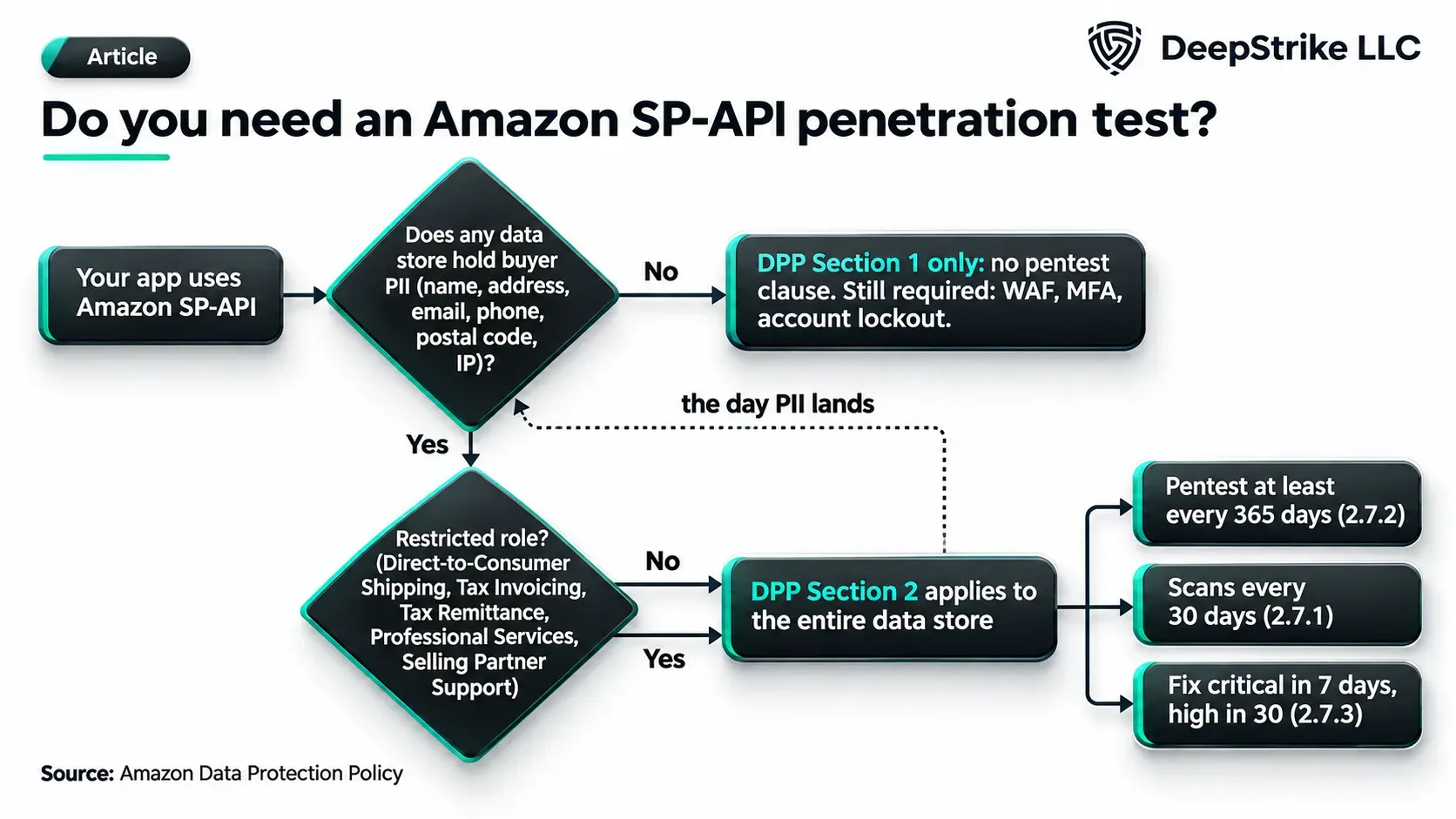
Amazon's Data Protection Policy splits its security rules into two sections. Section 1, General Security Requirements, binds every solution provider and contains no penetration testing clause. It still requires a web application firewall on every public endpoint "regardless of protocol," multi-factor authentication for all user accounts and account lockout after ten failed logins.
Section 2 holds the pentest clause, and its trigger is precise: "If an Amazon Services API contains PII, or PII is combined with non-PII, then the entire data store must comply." The DPP defines PII broadly. Its list includes a customer's name, address, email, phone number, gift message, purchases, IP address, geolocation and postal code. Amazon also states that PII is granted "for select tax and merchant-fulfilled shipping purposes, on a must-have basis," so most apps that hold PII got it through a Restricted role. The table below compares what each section requires.
| Requirement | Section 1: every solution provider | Section 2: data stores that hold PII |
|---|---|---|
| Who it applies to | Every developer and service provider using SP-API | Any data store holding PII, or PII combined with non-PII |
| Penetration testing | Not required by Section 1 | At least every 365 days (2.7.2) |
| Vulnerability scanning | Not required by Section 1 | Every 30 days, after significant changes and before each release (2.7.1) |
| Fix deadlines | None set | Critical in 7 days, high in 30 days (2.7.3) |
| Perimeter and access | WAF on every internet-facing endpoint, MFA, lockout after ten failed logins, quarterly access reviews (1.1, 1.2, 1.4) | All Section 1 controls, plus a quarterly asset inventory and change management (2.3) |
| Encryption | TLS 1.2 or higher in transit (1.5); API keys and other credentials encrypted at rest (1.4.2) | All PII encrypted at rest with at least AES-128 or RSA-2048, managed through a KMS (2.4) |
| Data retention | Delete data within 30 days of Amazon's notice or when a customer revokes access (1.7) | Delete PII no later than 30 days after order delivery (2.1) |
| Logging | Monitor authentication activity (1.2.2) | Keep logs for 12 months, keep PII out of them and review them every 2 weeks (2.6) |
| Incident response | Report incidents to security@amazon.com within 24 hours and name an IMPOC (1.6) | Same as Section 1, plus a geographically separate backup site (2.7.4) |
Amazon marks a role Restricted when it "requires sensitive information, which might include personally identifiable information." The current Selling Partner API roles page lists five Restricted roles. If your developer profile holds any of them, plan for Section 2 and the annual test.
| Restricted role | What it gives your app | Why it touches PII |
|---|---|---|
| Direct-to-Consumer Shipping | Order reports, tracking reports, EasyShip and shipping operations | Shipping needs buyer names and addresses |
| Tax Invoicing | Tax reports and order data for invoice generation | Tax invoices require buyer details |
| Tax Remittance | FBA sales reports and order data to calculate sales tax | Tax calculation may use PII |
| Professional Services | Add-on services such as assembly and installation | Technicians need buyer contact details |
| Selling Partner Support | A seller's Amazon support case data | Amazon flags it as sensitive information that might include PII |
Some AI-generated answers still list role names that are not on this Restricted list, so check the roles page itself before you scope anything. A Restricted role is the clearest signal, but not the only one. If buyer data reaches your systems through a report, notification or support workflow, the Section 2 trigger still applies, because the requirement follows the data rather than the role name.
Private developers are not exempt. The DPP applies to "all systems that store, process, or otherwise handle data vended and retrieved from the Amazon Services API," and the August 2026 policy changes apply to all solution providers. A brand building an internal tool for its own seller account falls under Section 2 the moment that tool stores buyer PII.
Agencies are covered too, because the DPP defines Solution Providers as "Developers and Service Providers." Token mechanics do not change the answer either. According to Amazon's Orders API migration guide, Restricted Data Tokens "are not required to access Personally Identifiable Information (PII) in v2026-01-01," so an integration can receive PII without ever generating an RDT. Finally, one PII column in a shared database pulls the entire data store into scope.
Amazon's Data Protection Policy requires, in clause 2.7.2, that a solution provider holding PII "perform penetration testing at least every 365 days using an industry-recognized methodology." That rule sits inside clause 2.7, Vulnerability Management, which also requires a documented plan or runbook, and the surrounding clauses set the clocks.
| DPP clause | Requirement | Clock |
|---|---|---|
| 2.7 | Documented vulnerability management plan and/or runbook | Maintained continuously |
| 2.7.1 | Vulnerability scanning | At least every 30 days |
| 2.7.1 | Change-triggered scanning | After significant network, application or infrastructure changes |
| 2.7.1 | Code scanning | Before each software release |
| 2.7.2 | Penetration testing with an industry-recognized methodology | At least every 365 days |
| 2.7.3 | Fix critical vulnerabilities | 7 days from discovery |
| 2.7.3 | Fix high-risk vulnerabilities | 30 days from discovery |
The DPP says "at least every 365 days," not "annually" or "once per calendar year." Treat it as a rolling clock that starts when your last test closed. A test that finished on March 10 is due again within 365 days, around March 10 the following year, not by December 31. Teams that book their next test "sometime next year" often slip past the window while waiting for a vendor slot.
Between tests, change does not stop the clock. Significant changes trigger a vulnerability scan under 2.7.1, but they do not automatically require a new pentest. When you add a major system, such as a new API, a new cloud account or a mobile app, add it to the next test's scope or commission a targeted test so your evidence covers what is actually running.
Amazon does not name a required standard. Its vulnerability management guide points to the OWASP Top 10 for common risks, and testers usually combine several recognized frameworks. Name each one, with its version, in the report so a reviewer can see what was covered.
| Methodology | Covers | Use it for |
|---|---|---|
| OWASP Web Security Testing Guide | Web application test cases | The seller-facing web app |
| OWASP API Security Top 10 (2023) | API-specific risks such as broken object level authorization | Every SP-API facing and internal API |
| NIST SP 800-115 | Planning, executing and reporting technical tests | The overall engagement structure |
| PTES | Pre-engagement through reporting phases | Rules of engagement and phases |
| OWASP MASVS | Mobile app security requirements | Seller or warehouse mobile apps |
Mixing frameworks is normal. A typical SP-API engagement follows the OWASP Web Security Testing Guide for the web app, the OWASP API Security Top 10 for every endpoint, NIST SP 800-115 for planning and reporting, and OWASP MASVS for mobile apps. What a reviewer needs is traceability: each finding should map to a named test category. Our pentest methodology guide explains how these frameworks fit together in one engagement.
DPP 2.7.3 sets two deadlines: critical vulnerabilities within 7 days of discovery and high-risk vulnerabilities within 30 days. They apply to findings from scans, pentests and code scans alike. The clock starts at discovery, not when the final report arrives, so a critical flaw confirmed on day three of testing is due on day ten.
The DPP sets no deadline for medium or low findings, and it does not define "critical" or "high." Agree a scoring method, such as CVSS v4.0, with your tester before work starts. You may see 21-day or 60-day deadlines quoted online. Those figures are not in the DPP. If Amazon sets specific dates inside your own assessment case, follow the case, but the policy itself sets 7 and 30 days.
Two revisions shaped today's rules. The November 2025 DPP update took effect on November 25, 2025, and the August 2026 policy update took effect on August 25, 2026. Continued use of the API after each date counts as acceptance.
| Effective date | What changed |
|---|---|
| November 25, 2025 | Renamed "Developer" to "Solution Provider"; added account lockout after ten failed logins, ten-password history and API key rotation; required TLS 1.2+ and a key management system; made an Incident Management Point of Contact mandatory; raised log retention to 12 months; added the 7-day critical and 30-day high fix deadlines; added subcontractor risk assessments |
| August 25, 2026 | Required a WAF for internet-facing endpoints, storage encryption on all devices, a 15-minute screen lock and a 30-minute lockout after ten failed logins; required encryption of all credentials at rest and deletion within 30 days when required; expanded vulnerability scanning and penetration testing "including for Application Programming Interfaces" |
If your last report predates August 25, 2026 and its scope says only "web application," rescope the next test and list every API by name. Both revisions apply to every solution provider, not only new applicants, so an app approved in 2024 must meet the 2026 rules today. Check WAF coverage, credential encryption and lockout settings before the test starts, because a tester will report each gap as a finding.
An SP-API penetration test covers every system that processes, stores or transmits Amazon data, because DPP 2.7.2 defines scope by data rather than by asset type. Start from your network architecture and data flow diagrams, which DPP 1.1.3 already requires you to maintain, and trace every place Amazon data travels. Our guide to scoping a penetration test walks through that mapping step.
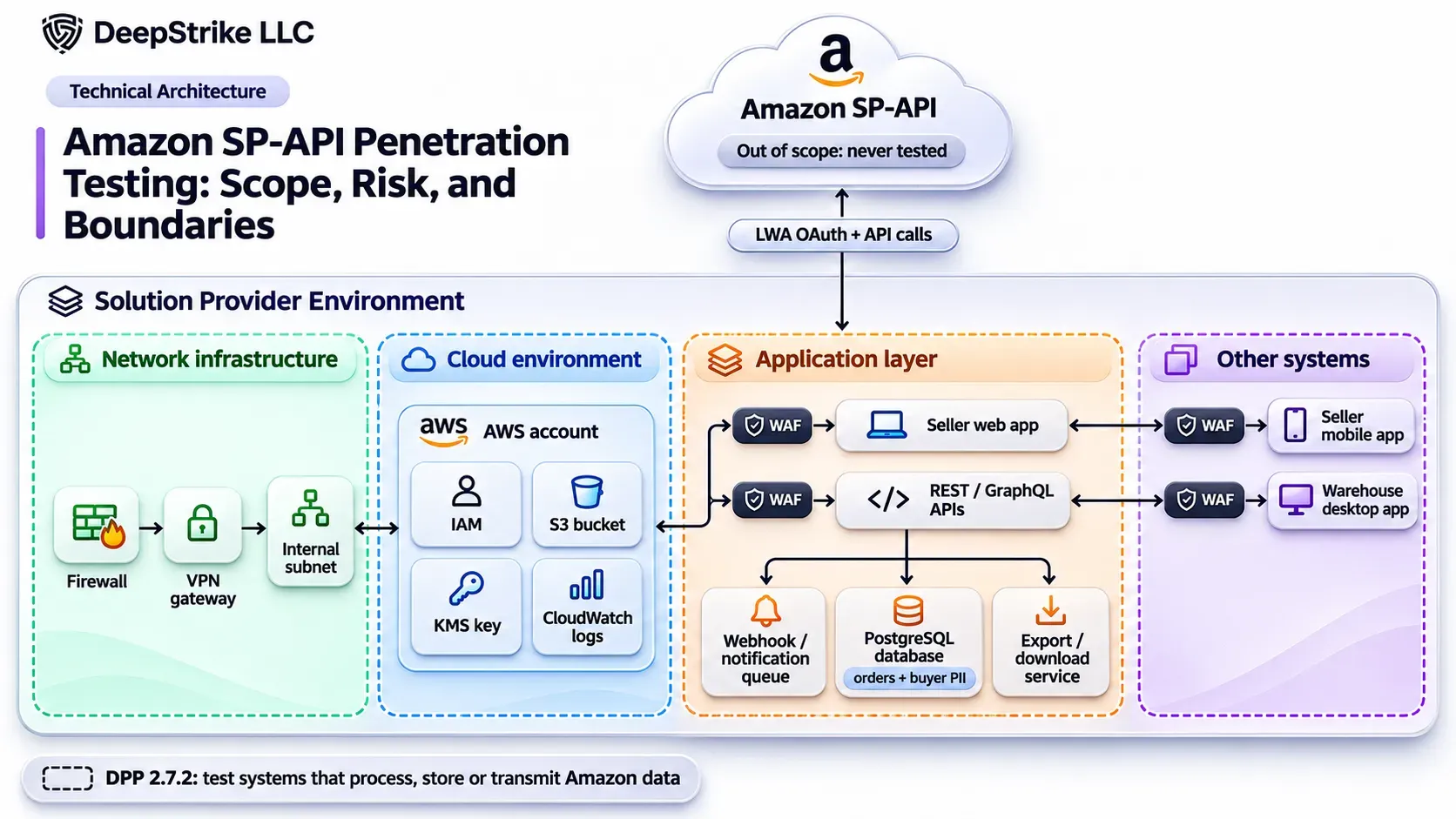
The DPP lists four categories, and the test "must assess vulnerabilities across external-facing components, application functionality, access controls, system configurations, and interfaces." APIs sit inside the application-layer category rather than forming a separate fourth one, but the August 2026 update made clear that every API must be tested.
| DPP category | What it means for an SP-API integration | Typical test type |
|---|---|---|
| Network infrastructure | Internet-facing hosts, VPNs, firewalls, routers, switches and internal boundaries around order data | External and internal network test |
| Cloud environments | AWS, Azure or Google Cloud accounts: IAM, storage policies, key management, logging | Cloud penetration testing |
| Application-layer assets | Seller-facing web app, every API and webhook, the OAuth flow, databases and object storage holding PII | Web application penetration testing and API penetration testing |
| Other in-scope systems | Mobile apps for sellers or warehouse staff, desktop tools that touch Amazon data | Mobile application testing |
Draw the boundary generously. A central logging stack, a CI/CD pipeline that holds deployment keys, or an internal support tool that can view orders all process Amazon data, even when they sit outside the main application. Leaving them out creates gaps that a reviewer or auditor can spot, and those shared systems are often where attackers find the easiest path to buyer data.
DeepStrike runs each category as its own workstream inside one DPP-mapped engagement, combining web application penetration testing, API penetration testing, cloud penetration testing and mobile application testing.
Scanners find missing patches. The findings that actually expose buyer data in SP-API integrations are logic flaws in how your app separates sellers, stores tokens and moves data between components. A good tester spends most of the engagement on the cases below, each tied to the DPP control it proves.
| Test case | What the tester tries | DPP control it evidences |
|---|---|---|
| Seller isolation | Change order, report or seller IDs to read another seller's orders, labels or exports (IDOR) | 1.3 least privilege, 1.8 data attribution |
| LWA token storage | Find Login with Amazon refresh tokens or client secrets in databases, logs, environment variables or front-end code | 1.4.2 programmatic credentials, 2.5 no hardcoded secrets |
| Authorization flow | Tamper with OAuth state and redirect values to bind a victim seller's authorization to an attacker's tenant | 1.3, 1.4 |
| Exports and download links | Open generated CSVs or label PDFs through guessable or unauthenticated URLs | 1.3, 2.4 encryption at rest |
| Webhooks and queues | Spoof or replay notification handlers and check queue permissions | 1.1.1, 1.3 |
| Server-side request forgery | Make import or callback features fetch cloud metadata or internal services | 1.1.1 |
| PII in logs | Search application logs, traces and error pages for buyer names and addresses | 2.6.1 |
| Retention | Find PII older than 30 days after delivery in databases, backups, caches and search indexes | 2.1, 1.7 |
| WAF coverage | Reach endpoints that bypass the WAF, including GraphQL, WebSockets and gRPC | 1.1.1 |
| Admin access | Check MFA enforcement, lockout after ten attempts and escalation into support or admin roles | 1.2.2, 1.4.1 |
| IAM blast radius | Measure how far a compromised workload's credentials reach into PII buckets and keys | 1.3, 2.4 |
None of these cases touches Amazon's systems. Testers create two or more test seller tenants, swap identifiers between them and replay tokens across tenants, which proves isolation without exposing real buyer data. This is also where manual testing earns its cost, since every case depends on your application's own business logic rather than a known signature. Our guides to IDOR vulnerabilities, OAuth security weaknesses and GraphQL attack techniques explain the underlying attack classes in more depth.
You test only what you control. Amazon's SP-API endpoints are out of scope, and so is AWS itself. The AWS penetration testing policy lets customers test their own AWS infrastructure on permitted services "without prior approval," requires prior approval for any testing that includes command and control, and does not permit assessments of AWS infrastructure or AWS services themselves.
Use sandbox applications, test seller accounts and synthetic tenants instead of real buyer records. DPP 2.5 requires separate test and production environments, yet 2.7.2 covers the systems that actually hold Amazon data, so your rules of engagement should name the production components in scope and the safe techniques allowed against them. Our AWS penetration testing methodology covers those rules of engagement in more depth.
Your own team can do the pentest if its testers are qualified, but an independent firm produces evidence that is easier to defend if Amazon audits you. The DPP itself names no tester qualification, approved vendor or report format, so Amazon's guidance and audit rights fill the gap.
Amazon's Key Security Control Guidance says to "perform annual penetration testing using qualified security professionals or third-party firms." A qualified internal security team is therefore acceptable for the pentest itself. The same guide's cadence table lists "Conduct formal third-party security assessments" as a separate annual task, so plan for outside review either way.
Independence matters at audit time. Under DPP Section 3, Amazon or "an independent certified public accounting firm selected by Amazon" may audit your systems. A report from an outside firm with named testers, dates and a stated methodology is easier to defend than engineers testing code they wrote. Enterprise customers buying your integration also tend to ask for third-party evidence.
No. Amazon publishes no approved vendor list, accreditation requirement or official report template for SP-API penetration tests. CREST accreditation and certifications such as OSCP, OSWE or OSEP are reasonable signals of tester quality, and many buyers use them as a yardstick, but none is an Amazon rule.
One DPP clause does apply to the firm you hire. Clause 2.8 requires "regular third-party risk assessments on an annual basis of vendors or subcontractors before granting them access to Amazon data." Your pentest firm is one of those vendors. Assess it, limit what buyer data it can see, and keep the assessment with your evidence.
The right firm treats the DPP as an evidence specification, not just a hacking exercise. Use these checks during vendor selection, before you sign a statement of work.
No, neither a vulnerability scan nor SP-API Guard is enough, because the DPP lists scanning (2.7.1) and penetration testing (2.7.2) as separate duties and neither tool replaces the human-led test. The SP-API Guard implementation guide describes Guard as a serverless application that scans AWS data against the DPP and returns findings after 24 hours. It is useful preparation, and you choose whether to share its report with Amazon. Neither Guard nor a scanner tests business logic or seller isolation. Run Guard before your pentest to clear configuration gaps cheaply, so testers can focus on logic flaws. Amazon's Security Compliance Self-Check helps you gauge readiness too, but it is a questionnaire, not a test. A continuous penetration testing program can cover the 30-day scan cadence between annual tests.
| Activity | What it does | DPP cadence | Satisfies 2.7.2? |
|---|---|---|---|
| Vulnerability scan | Detects known vulnerabilities and misconfigurations automatically | Every 30 days and after significant changes | No |
| SP-API Guard | Checks AWS configuration against DPP controls | On demand | No |
| Code scan (SAST or DAST) | Finds flaws in code before release | Before every release | No |
| Penetration test | Human-led exploitation, including business logic and seller isolation | At least every 365 days | Yes |
An Amazon SP-API penetration test usually costs between $5,000 and $50,000, depending on how many applications, APIs, cloud accounts and user roles sit in scope. Amazon charges nothing for the test itself; you pay the testing firm. The ranges below follow the US market rates in our penetration testing cost guide.
Pricing follows tester days. A focused integration needs about a week of skilled time, while a full DPP scope across several systems can take a month. Offers far below these ranges, especially under about $4,000, are usually automated scans with little manual validation, and they rarely prove seller isolation.
| Scope | Typical systems in scope | Typical tester days | Typical cost (USD) |
|---|---|---|---|
| Focused | One seller-facing web app and its API, up to three user roles, light cloud review | 4 to 7 | $5,000 to $10,000 |
| Multi-tenant SaaS | Web app, several APIs and webhooks, seller isolation across roles, full AWS account review | 8 to 15 | $10,000 to $25,000 |
| Full DPP scope | Everything above, plus external and internal network, mobile or desktop apps, multiple clouds | 15 to 30 | $25,000 to $50,000+ |
| Standalone retest | Validation of fixes after remediation | 1 to 3 | $2,000 to $5,000 |
Treat the table as a starting point, not a quote. Two apps with the same number of endpoints can differ by thousands of dollars if one has five user roles and the other has one, because each role multiplies the authorization checks a tester must run. Ask any vendor to show the tester days behind its number.
Scope size drives cost more than anything else. Every additional API, webhook family and user role adds test cases, and seller isolation testing scales with the number of roles and tenants you ask the tester to cross. A single AWS account with a handful of services costs far less to review than several accounts across regions or clouds.
Access also changes the bill. Grey-box testing with test seller accounts, API documentation and architecture diagrams cuts discovery time, so the same budget buys deeper testing. Internal network testing needs VPN or agent access, which adds setup days. Urgent start dates, mobile and desktop apps, and extra deliverables such as attestation letters push the price up, while an included retest keeps your total predictable.
The pentest is one line in a recurring budget. Plan for engineering time to fix critical findings within 7 days and high findings within 30, plus the retest, which some firms bill separately. Continuous obligations add tooling costs: vulnerability scanning every 30 days, a WAF in front of every internet-facing endpoint, and log storage for at least 12 months.
Weigh that against the downside. IBM's 2026 breach report puts the global average cost of a data breach at $4.99 million, a 12% increase over the previous year. For an SP-API vendor the bigger risk is commercial: the DPP warns that non-compliance "may result in suspension or termination of Amazon Services API access," which can stop your product for every seller at once.
Get a fixed-price SP-API pentest quote. DeepStrike maps every finding to the DPP 2.7.2 categories and includes free remediation retesting for 12 months. See pentest pricing or send us your architecture for a scoped proposal.
After the pentest finds vulnerabilities, Amazon's remediation clocks start right away, and the work is not finished until a retest proves the fixes work. Plan remediation capacity before testing begins, not after the report lands.
Amazon's vulnerability management guide is explicit: "After the remediation stage, solutions providers must run a second pen test to validate that all identified vulnerabilities have been completely remediated." A developer's note that a bug is fixed is not evidence. The retest is.
Schedule the retest so critical fixes are validated soon after the 7-day deadline and high-risk fixes inside the 30-day window. Keep the retest results, with dates, attached to the original report so one document tells the whole story: what was found, when, who fixed it and how the fix was verified. DeepStrike includes free remediation retesting for 12 months, so a fix shipped in month four can still be validated without a new purchase order.
The DPP has no extension clause for the 7-day and 30-day deadlines. If a critical fix needs more time, reduce the exposure first: disable the affected feature, add a WAF rule as a virtual patch, or restrict access to the vulnerable endpoint. Document the compensating control, the owner and the target date, and follow any instructions in your Amazon case.
For medium and low findings, which carry no DPP deadline, record a written risk decision with a named owner and a review date in your vulnerability management plan. Keep a findings register covering asset, discovery date, severity, owner, deadline, fix evidence and retest outcome. Reviewers and auditors ask for exactly that trail.
Your pentest report for Amazon should include test dates, scope mapped to the four DPP categories, the methodology, findings with recommended actions, and retest results. Amazon issues no official template, but its guidance makes one item mandatory: "The pen tester must include a recommended actions section in the report." For a general view of structure, see what a pentest report contains.
A reviewer reads the report to confirm three things: that the test happened inside the 365-day window, that it covered the right systems, and that findings were fixed. Build every section around those questions.
| Report section | Why it matters for Amazon |
|---|---|
| Cover page with test start and end dates | Proves the 365-day window |
| Scope mapped to the four DPP categories, with every API listed | Shows 2.7.2 coverage |
| Methodology names and versions | Proves an industry-recognized methodology |
| Tester names and qualifications | Supports "qualified security professionals" |
| Findings with severity, evidence and reproduction steps | Starts and justifies the 7-day and 30-day clocks |
| Recommended actions for every finding | Explicitly required by Amazon's guidance |
| Retest results with dates | Proves remediation |
| Limitations and exclusions | Shows exactly what was not tested |
You can reuse a pentest from SOC 2 penetration testing or ISO 27001 work if it meets these conditions. It must be dated within 365 days, cover your SP-API systems and APIs, test seller isolation, and include recommended actions and retest results. Keep the final version, retest included, as one dated document you can hand over unchanged if Amazon or its auditor asks.
Most rejections come from paperwork that does not match reality, not from failed exploits. Amazon's public developer registration guide says your Security Controls answers "should accurately reflect how you implement the security requirements" in the AUP, DPP and Solution Provider Portal Agreement. Answers that contradict your privacy policy or procedures invite questions.
On the report side, the usual gaps are a scope line that says only "web app," missing test dates, a methodology named without a version, findings without recommended actions and no retest. Timing sinks applications too. Amazon asks follow-up questions through your case, and "cases without responses within five days are closed." Assign an owner to watch the case inbox during review.
After you submit to Amazon, a Restricted-role application goes through a structured business, security and technical review, and Amazon keeps the right to audit you for as long as you hold the access.
According to Amazon's developer profile guide, standard roles get a basic review that "typically takes one to two weeks." Restricted roles go through three stages: a business review, a security review in which Amazon "verifies your compliance documentation," and a technical review where "you meet with an Amazon solution architect." Amazon publishes no duration for the Restricted path.
The public developer guide describes the same process as two phases: business verification and profile assessment, then a data security assessment of your "data flow architecture and implementation of PII protection controls." Expect an architecture review with the SP-API Solutions Architecture team, which "can involve a demo through screen sharing." Your pentest report, data flow diagrams and control evidence carry that conversation.
Approval is not the end of scrutiny. DPP Section 3 requires you to keep the books and records needed to verify compliance for the term of your agreement and 12 months after it, and to certify compliance in writing when Amazon asks. Amazon, or an independent CPA firm it selects, may audit "the books, records, facilities, operations, and security of all systems" involved in handling Amazon data.
If an audit finds gaps, you fix them at your own cost and provide remediation evidence, such as policies, screenshots or screen sharing, until Amazon gives written approval. This is why a dated, methodology-named report with documented retests matters long after your role is approved. It is the evidence you will hand an auditor months later.
To stay compliant every year, you run the annual pentest alongside recurring duties: scans every 30 days, quarterly access reviews and asset inventories, a six-month incident response review, and yearly key rotation, training and vendor assessments. Amazon's Key Security Control Guidance and the DPP set the cadences below. Put them in a shared calendar, because auditors ask for evidence of each one, not just the annual test. Missing the quieter tasks is how otherwise strong teams fall out of compliance between pentests. Give each row a named owner, a recurring ticket and a place to store evidence, so the proof exists before anyone asks for it.
| Cadence | Task | Source |
|---|---|---|
| Within 24 hours | Report security incidents to security@amazon.com; remove access for leavers | DPP 1.6.3, 1.2.3 |
| Every 2 weeks | Review logs, or review them in real time with a SIEM | DPP 2.6.1 |
| Every 30 days | Run vulnerability scans; update anti-malware where updates are manual | DPP 2.7.1, 1.1.1 |
| Every release | Scan code before shipping | DPP 2.7.1 |
| Quarterly | Review all personnel and service access; update the PII asset inventory; test backup restores | DPP 1.2.2, 2.3.1; Amazon guidance |
| Every 6 months | Review and verify the incident response plan | DPP 1.6.2 |
| Every 365 days | Run the penetration test, rotate API keys, train approved users, assess vendors, complete the third-party security assessment | DPP 2.7.2, 1.4.2, 1.2.4, 2.8; Amazon guidance |
DeepStrike tests SP-API integrations with manual-first penetration tests built around the DPP. We scope each engagement against the four 2.7.2 categories, list every API by name, and focus on the flaws scanners miss: seller isolation, Login with Amazon token handling, exports and authorization logic. Findings appear on our platform in real time, so your 7-day and 30-day clocks start with a fix plan.
DeepStrike was founded in 2016 by bug bounty hunters, and our team ranks in the top 100 on crowd-security leaderboards. We have served more than 700 customers with 98% retention, and Clutch named us a 2025 Top Penetration Testing Company.
Every report names its methodology and version, includes recommended actions and records retest results, with retesting free for 12 months. No vendor can guarantee Amazon's approval, but our evidence holds up in review and audit. Explore our penetration testing services and request a scoped proposal for your integration.
These frequently asked questions cover what SP-API teams most often ask about Amazon's penetration testing requirement, each answered in a few sentences.
Only if your systems hold PII. The test requirement sits in DPP Section 2, which applies when an Amazon Services API contains PII or PII is mixed with non-PII; the entire data store must then comply. Apps that never receive PII follow Section 1, which has no penetration testing clause.
Not under the DPP, as long as no data store holds PII. Section 1 still applies, so you need a WAF on internet-facing endpoints, MFA and account lockout. Check your reports carefully, because Amazon's PII definition includes postal codes, purchases and IP addresses when they can identify a customer.
At least every 365 days, counted from your last test rather than the calendar year. Between tests, DPP 2.7.1 requires vulnerability scans every 30 days, scans after significant changes and code scans before each release. Plan the next test well before the window closes, because vendor calendars fill up.
DPP 2.7.3 gives you 7 days for critical vulnerabilities and 30 days for high-risk ones, both counted from discovery rather than from the report date. The policy sets no deadline for medium or low findings. If Amazon sets different dates inside your assessment case, follow the case.
Yes, if they are qualified. Amazon's Key Security Control Guidance calls for annual testing by "qualified security professionals or third-party firms." The same guide lists formal third-party security assessments as a separate annual task, and an independent report is easier to defend if Amazon audits you.
No. Amazon publishes no approved vendor list, accreditation requirement or report format. CREST accreditation and certifications such as OSCP or OSWE are useful signals of tester quality, but the DPP only requires an industry-recognized methodology and coverage of the systems that handle Amazon data.
No. You test only the systems you control: your applications, APIs, cloud accounts, databases and networks. AWS's penetration testing policy lets you test your own AWS resources on permitted services without prior approval, but customers may not assess AWS infrastructure or AWS services themselves.
Most engagements cost $5,000 to $50,000. A focused test of one web app and its API typically runs $5,000 to $10,000, a multi-tenant SaaS with several APIs and an AWS review $10,000 to $25,000, and full DPP scope $25,000 or more. Offers under about $4,000 are usually automated scans.
A focused test usually needs 4 to 7 tester days, plus a few days to write the report, while larger scopes take two to six weeks. After that, plan remediation inside the 7-day and 30-day clocks and a retest. DeepStrike can start an engagement within 48 hours.
Yes, if it meets the DPP on its own terms. It must be dated within the last 365 days, cover your SP-API systems including every API and cloud account, test seller isolation across roles, name its methodology and include recommended actions plus retest results.
Not routinely. The DPP has no clause requiring you to submit reports on a schedule. You provide evidence when your review case or an audit asks for it, and Section 3 requires you to keep records for the agreement term plus 12 months afterward.
No. SP-API Guard checks your AWS configuration against the DPP and returns findings after 24 hours, and vulnerability scans detect known issues. Neither tests business logic or seller isolation, and the DPP lists scanning (2.7.1) and penetration testing (2.7.2) as separate duties.
These references are the primary sources behind this guide, all read on November 24, 2026.

Stay secure with DeepStrike penetration testing services. Reach out for a quote or customized technical proposal today
Contact Us
