September 6, 2026
Updated: September 15, 2026
State-directed intelligence collection and for-profit crime, run by the same operators with the same infrastructure, is what makes APT41 unusual.
Abdalla Mohamed
Updated: September 2026
APT41 is a prolific Chinese state-sponsored threat group that is unique for combining government espionage with financially motivated cybercrime in the same operations. Linked to China's Ministry of State Security and tracked in MITRE ATT&CK as G0096, it is also called Double Dragon, Wicked Panda, Brass Typhoon, BARIUM, and Winnti. Active since at least 2012, APT41 is known for software supply chain attacks, video-game currency theft, and rapidly weaponizing new vulnerabilities to breach targets worldwide.
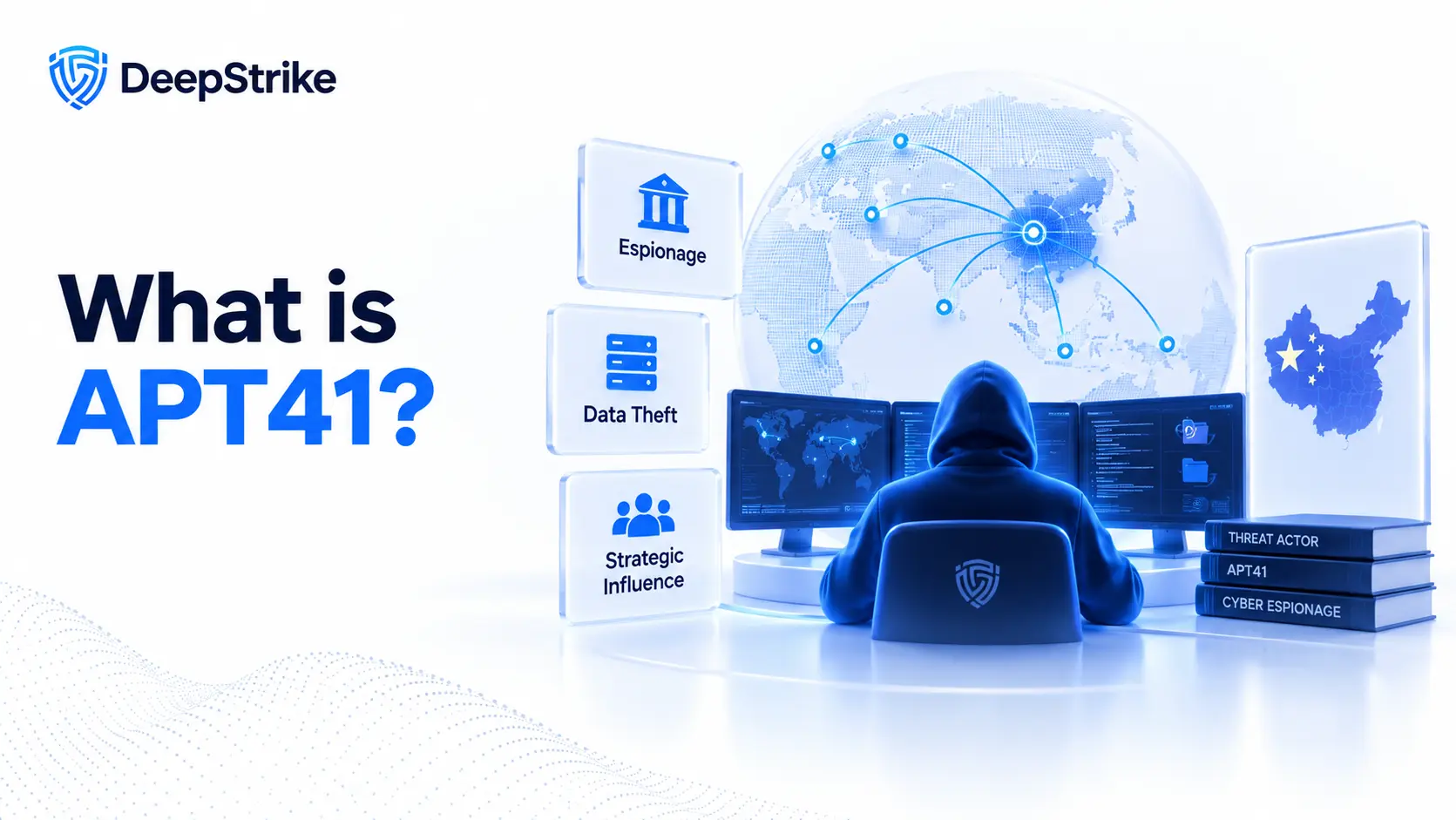
APT41 is a Chinese cyber threat group that runs two missions at once: state-directed intelligence collection and for-profit cybercrime. That duality is what makes it stand out. Most Chinese state groups, like Volt Typhoon or Silk Typhoon, stick to espionage. APT41 does both, often with the same tools and infrastructure, which is why researchers call it Double Dragon.
Security firms and law enforcement link APT41 to China's Ministry of State Security (MSS), likely through state-backed contractors rather than direct government employees. The original 2019 FireEye report that named the group assessed that individual members conducted financially motivated operations against the video game industry as early as 2012, then balanced those personal-gain campaigns alongside state espionage from 2014 onward. That blurred line between state power and crime sits at the heart of APT41 and makes it a defining actor in the state-sponsored APT landscape.
APT41's espionage targeting tracks China's strategic priorities, hitting healthcare, high-tech, telecommunications, media, shipping and logistics, automotive, and government. Its criminal side keeps returning to video games for source code, digital certificates, and virtual currency. It is one of the most consequential groups in any list of the world's top hacking groups.
Because APT41 overlaps with clusters that different vendors discovered separately, it carries a long alias list. Many refer to the same group or a sub-cluster within the APT41 umbrella.
| Alias | Assigned by |
|---|---|
| APT41 | Mandiant / Google |
| Double Dragon | Mandiant (dual mission) |
| Wicked Panda | CrowdStrike |
| Brass Typhoon | Microsoft (current) |
| BARIUM | Microsoft (former) |
| Winnti | Kaspersky, ESET (shared toolset) |
| Earth Baku | Trend Micro |
| Blackfly / Grayfly | Symantec |
| HOODOO | |
| Suckfly | Symantec |
The keyword to watch is APT41, but any of these names in a report should trigger the same response. Note that Winnti is both a malware family and a broad label some vendors apply across several China-nexus groups, so it is wider than APT41 alone.
The reason APT41 gets its own profile is the dual mission. Explicit financial targeting is rare among Chinese state groups, and APT41 has run both kinds of operation concurrently for years. On the espionage side it steals intellectual property, call records, and strategic data, and it has reconnoitered targets ahead of real-world events, in one case a hotel reservation system before Chinese officials stayed there. On the criminal side it has manipulated in-game virtual currencies, stolen game source code, abused digital certificates, and attempted to deploy ransomware for profit.
That combination has practical consequences for defenders. The group reinvests skills learned in cybercrime, especially against the tightly-secured video-game industry, into its espionage tradecraft. It steals code-signing certificates from game studios and reuses them to sign espionage malware. And it behaves like a group that enjoys some protection at home, running for-profit intrusions that other state actors would avoid. This mix of motives resembles North Korea's Lazarus Group, which likewise pairs espionage with revenue generation, a pattern explored in how North Korean hackers stole billions in crypto.
APT41's history spans supply chain sabotage, mass exploitation, and stealthy cloud espionage.
APT41 is a specialist in software supply chain compromise. In 2017 it injected malicious code into a legitimate, signed update of Netsarang server software in the operation Kaspersky named ShadowPad, reaching hundreds of companies worldwide. Crucially, APT41 limits follow-on payloads to selected victims by matching system identifiers, so a broad compromise hides a narrow set of real targets. It has repeatedly injected malware into trusted software before distribution, one of the hardest attack patterns to defend against.
In September 2020 the US Department of Justice unsealed charges against five Chinese nationals and two Malaysian associates tied to APT41, for intrusions against more than 100 companies including software developers, telecoms, social media, and video-game firms. The FBI added the Chinese defendants to its Cyber Most Wanted list. The indictments named the group publicly but did little to slow its operations.
APT41 demonstrated its speed by compromising at least six US state government networks between 2021 and 2022. It broke in by rapidly weaponizing new vulnerabilities, including the Log4Shell flaw (CVE-2021-44228) within hours of disclosure and a zero-day in the USAHERDS animal-health application (CVE-2021-44207). That agility, turning a public disclosure into a live intrusion faster than most teams can patch, is a hallmark of the group and a core reason patch management speed matters.
In July 2024 Mandiant and Google's Threat Analysis Group detailed a sustained campaign, tracked in MITRE ATT&CK as C0040, against shipping and logistics, media and entertainment, technology, and automotive organizations in Italy, Spain, Taiwan, Thailand, Turkey, and the UK, with some victims compromised since 2023. The campaign introduced the DUSTTRAP plugin framework and is the clearest recent example of the group's tradecraft, walked through step by step below.
In May 2025, Google's Threat Intelligence Group disclosed TOUGHPROGRESS, malware delivered from a compromised government website that used Google Calendar for command and control. The malware hid encrypted commands inside calendar event descriptions, blending into legitimate cloud traffic so it rarely tripped host defenses. Google disrupted the campaign by dismantling the attacker-controlled Calendar and Workspace infrastructure. It followed VOLDEMORT, malware Proofpoint attributed to APT41 in late 2024 that abused Google Sheets for C2.
In early 2026, Check Point documented a cluster it named Silver Dragon operating under the APT41 umbrella, targeting government ministries across Southeast Asia and Europe using Cobalt Strike, custom loaders, and Google Drive as a covert C2 channel. It shows the group is still actively evolving its tooling.
APT41's MITRE ATT&CK group ID is G0096. Searching for APT41 MITRE surfaces the full catalog; the techniques below recur across campaigns and make a practical detection checklist.
| Technique | ATT&CK ID | How APT41 uses it |
|---|---|---|
| Exploit public-facing application | T1190 | Rapid n-day and zero-day exploitation (Log4Shell, USAHERDS) |
| Phishing: spear-phishing attachment | T1566.001 | Malicious compiled HTML (.chm) lures |
| Supply chain compromise | T1195.002 | Trojanized signed software updates (ShadowPad) |
| Server software component: web shell | T1505.003 | ANTSWORD and BLUEBEAM web shells for persistence |
| Hijack execution flow: DLL side-loading | T1574.002 | Loading DUSTTRAP via a legitimate signed binary |
| Subvert trust controls: code signing | T1553.002 | Stolen gaming-company certificates to sign malware |
| Exfiltration to cloud storage | T1567.002 | Staging data to OneDrive with PINEGROVE |
| Web service C2 | T1102 | Google Calendar, Sheets, Drive, and Workspace |
| Process injection: process hollowing | T1055.012 | Injecting payloads into svchost.exe |
Its malware arsenal spans more than 40 families, including the Winnti and HIGHNOON backdoors, POISONPLUG, Cobalt Strike BEACON, and the newer DUSTPAN and DUSTTRAP loaders, TOUGHPROGRESS, and VOLDEMORT. APT41 has also deployed rootkits and MBR bootkits on high-value targets, a rare capability among Chinese groups.
The APT41 DUST campaign shows how the group moves from a foothold to bulk data theft while staying quiet.
certutil.exe to fetch the DUSTPAN dropper, disguised as a normal Windows binary and made persistent with a Windows service..text section, loads it into memory, then restores the original file on disk to defeat endpoint scans.The whole chain leans on legitimate binaries, cloud services, and stolen trust, a form of living off the land that leaves minimal forensic traces.
APT41 wins on speed, stolen trust, and cloud blending, so defenses should shorten your exposure window and watch the trust and egress paths it abuses. Validate each control with real testing rather than assuming it holds.
APT41 weaponizes new vulnerabilities within hours, so prioritize rapid patching of internet-facing systems and disciplined attack surface management. Track known exploited vulnerabilities and treat any public-facing web application, VPN, or management interface as a priority target. A mature vulnerability management program that measures time-to-patch is your best counter to the group's agility.
Monitor web servers for new or modified web shells and for suspicious child processes like certutil.exe or rundll32.exe spawned by web server accounts. Alert on DLL side-loading from unusual paths, and do not treat a valid code signature as proof of safety, since APT41 signs malware with stolen certificates. Understanding these pass-the-hash and credential abuse style trust attacks helps tune detections.
Because APT41 uses Google Calendar, Sheets, Drive, Workspace, and OneDrive for command and control and data theft, monitor outbound traffic to cloud APIs for anomalies, restrict which cloud apps can be reached from servers, and baseline normal cloud usage so covert channels stand out. Egress filtering and cloud audit logging are essential.
Vet third-party software and updates, monitor for unexpected changes to signed binaries, and segment build and production environments. Rehearse your incident response plan for a stealthy, long-dwell intrusion, and remember APT41 returns quickly after remediation, so eviction must be complete. Because the group also runs ransomware and financially motivated operations, treat any APT41 indicator as both an espionage and a criminal threat.
Assumptions about patch speed, web-shell detection, and cloud egress are exactly what APT41 exploits. Regular penetration testing and red team exercises prove whether a fresh n-day, a signed loader, or a Calendar-based C2 channel would actually be caught in your environment before the group finds the gap first.
APT41 collapses the neat categories most defenses are built around. It is a state espionage group and a criminal crew, it uses espionage-grade malware for profit, and it moves from a public vulnerability disclosure to a live breach faster than many organizations can react. If your playbook assumes nation-state actors only want quiet intelligence and criminals only want fast money, APT41 breaks both assumptions at once.
For most organizations the practical takeaway is that APT41's techniques, rapid n-day exploitation, web shells, stolen code-signing certificates, and cloud services abused for C2, are now common across the threat landscape. It is one of several China-nexus groups, alongside Mustang Panda and UNC3886, whose tradecraft sets the standard others copy. Hardening against Double Dragon hardens you against a large share of everything else.
APT41 is a Chinese state-sponsored threat group, tracked as MITRE ATT&CK G0096, that is unique for running government espionage and financially motivated cybercrime side by side. Active since at least 2012, it is also known as Double Dragon, Wicked Panda, Brass Typhoon, BARIUM, and Winnti.
Researchers and US law enforcement link APT41 to China's Ministry of State Security, likely operating through state-backed contractors. In 2020 the US Department of Justice indicted five Chinese nationals connected to the group for intrusions against more than 100 companies worldwide.
APT41's MITRE ATT&CK group identifier is G0096. The catalog maps it to techniques such as exploit public-facing application (T1190), web shell (T1505.003), DLL side-loading (T1574.002), code signing abuse (T1553.002), and web service C2 (T1102).
The name Double Dragon, coined by Mandiant, reflects the group's dual mission: it conducts Chinese state espionage and simultaneously runs for-profit cybercrime. That combination is rare among Chinese state groups, most of which focus purely on intelligence collection.
APT41 is best known for software supply chain attacks like ShadowPad, for financially motivated theft against the video-game industry, and for rapidly weaponizing vulnerabilities such as Log4Shell. Recent campaigns include APT41 DUST and the Google Calendar C2 malware TOUGHPROGRESS.
Partly. APT41 uses the Winnti malware family and overlaps with activity some vendors label Winnti, but Winnti is a broader term applied across several China-nexus groups that share tools. APT41 is a specific group within that wider Winnti ecosystem.
Worried about a fast-moving, dual-purpose adversary like APT41? DeepStrike's penetration testing and red team services stress-test your patch speed, web-facing systems, and cloud defenses the way Double Dragon would. Explore our US penetration testing services to find the gaps before an adversary does.

Stay secure with DeepStrike penetration testing services. Reach out for a quote or customized technical proposal today
Contact Us
