November 18, 2025
Updated: November 5, 2026
Compare VAPT (Vulnerability Assessment and Penetration Testing) providers for 2026, from specialist testing firms to large consultancies, with each provider's documented scope and buying considerations.

Mohammed Khalil
In today’s cyber risk landscape, a single breach can cost an enterprise millions. For example, IBM's 2026 Cost of a Data Breach Report puts the global average breach cost at $4.99 million. Rising adoption of AI and cloud services is expanding the attack surface, giving adversaries new vectors. Meanwhile, regulatory pressures GDPR, PCI DSS, ISO 27001, SOC 2 and others are mandating regular security assessments and imposing hefty fines for noncompliance. The VAPT market is mature and growing: valued at about $3.4 billion in 2025 and projected at $12.35 billion by 2033. These trends mean that VAPT (the combination of vulnerability scanning and penetration testing) is a strategic necessity, not optional. This list compares providers against the criteria below and is not sponsored. It covers technical depth, automation vs manual testing balance, compliance support, and domain fit, so buyers can shortlist candidates against the same criteria.
For a broader comparison across testing types and regions, see our global list of top penetration testing companies.
Disclosure: DeepStrike, the publisher of this guide, is a penetration testing provider and is included in this list. DeepStrike lists itself first as the publisher; the list order is not a quality ranking. Weigh our entry the way you would any vendor's description of its own service, and compare scope, sample reports and references for every provider before you buy.
For a broader comparison of testing approaches, see Top Penetration Testing Solutions.
VAPT (Vulnerability Assessment and Penetration Testing) is a structured security validation methodology that combines automated vulnerability discovery with manual exploit validation to identify real world attack paths and reduce breach probability.
We compared vendors against the following technical and business criteria:
Each vendor’s section below summarizes what its public pages document against these criteria, with Buyer fit notes signaling their target market or specialties. The list is not a score or ranking.
Selecting a VAPT vendor involves key trade offs and common pitfalls. First, beware scan only providers that promise fast turnarounds but skip manual validation. A checklist driven scan may find obvious flaws but miss real world attack chains. Instead, look for ethical hackers willing to exploit chained vulnerabilities. Avoid under scoping: clearly define all in scope assets and test depth (e.g. do not just test a network perimeter scan without in depth web/mobile analysis).
U.S. buyers can also review our shortlist of USA penetration testing companies before evaluating each vendor’s VAPT depth and delivery model.
Other mistakes include excluding retesting. Confirm whether retesting of fixes is included, for how long, and at what cost; terms vary by provider. Neglecting this means you may still have vulnerabilities you believe are fixed. Also beware junior only teams. Some large consultancies rotate inexperienced staff through tests. Check if the vendor guarantees senior or CREST accredited testers. A small specialized firm often places certified experts (OSCP, OSWE) on every engagement, while a big firm might assign junior analysts.
Ensure the provider’s compliance focus matches your needs. Testing for certification requirements (ISO 27001, PCI DSS, etc.) is different from testing for actual security posture. Some firms speak ISO language (offering checkbox reports) rather than demonstrating attacker techniques. A good provider balances compliance and realistic exploits.
Finally, align on delivery and scope: clarify reporting format, retesting, and any integration with development workflows. Look for transparent methodology (we recommend reviewing sample reports or dashboards). In sum, verify the people and process, not just the brand. A selective shortlist driven by expertise and methodology, not marketing hype, will yield a more reliable partner.
Public offering: DeepStrike's penetration testing services describe human-led testing across applications, cloud environments, and infrastructure, supported by a findings and collaboration platform. Its public process covers planning, reconnaissance, vulnerability discovery, controlled exploitation, reporting, and technical support. Published reports include reproduction steps, remediation guidance, and root-cause information; the proposal should define exact coverage and commercial terms.
VAPT relevance: Founded in 2016, DeepStrike LLC is headquartered in Newark, Delaware, has 11–50 employees, and also publishes a business address in Dubai, UAE (IFZA Business Park). Define tester locations, permitted subcontracting, and data-handling restrictions in the engagement agreement.
Team certifications: OSCP, OSWE, OSEP, OSWP, GXPN, GWAPT, eCPPT, eMAPT, eWPT, CREST CPSA, CRTP, CRTE, and Microsoft Azure Security Engineer Associate, as shown on DeepStrike's services page.
Official sources: Pricing , Contact Us
Buyer fit: Engineering teams that need application, cloud, or infrastructure testing with direct remediation collaboration.
| Documented strengths | Limits and buying considerations |
|---|---|
| Human-led testing with reproduction evidence, root-cause information, and remediation guidance. | The service description is not an independently measured quality comparison. Assess the assigned team and a relevant sample report. |
| The published Basic plan lists Slack collaboration, customizable reports, and 12 months of remediation retesting. | No numeric price is displayed on the pricing page. Basic is a one-shot test; recurring coverage belongs to a different plan, with contract-specific terms. |
| Team certifications shown on the services page include OSCP, OSWE, OSEP, OSWP, GXPN, GWAPT, eCPPT, eMAPT, eWPT, CREST CPSA, CRTP, CRTE, and Microsoft Azure Security Engineer Associate. | These are individual tester credentials, not a company-level accreditation; ask which certified testers will be assigned to your engagement. |
Public offering: OffSec's penetration testing page describes hands-on assessments of networks, systems, and applications focused on validating real-world exploitability, advanced attack simulation that is first rehearsed against a lab model of the client environment, and application security assessments using reverse engineering, protocol analysis, and fuzzing. It states that in-house experts who teach, develop tools, and author books perform the tests, and that it is not a checklist service. Rules of engagement are agreed up front, and the report describes findings and recommended fixes.
VAPT relevance: OffSec's testing covers the exploitation side of VAPT rather than broad vulnerability scanning. It states that it works with an average of about 10 clients per year, one customer at a time, with a two-week minimum engagement; confirm availability, tester assignment, and data-handling terms in the agreement.
Official sources: https://www.offsec.com/organizations/penetration-testing/
Buyer fit: Mature, well-defended organizations that want manual testing and attack simulation rather than broad vulnerability coverage.
| Documented strengths | Limits and buying considerations |
|---|---|
| Hands-on testing focused on validating exploitability, plus advanced attack simulation and application security assessment. | The page does not describe a vulnerability scanning component or retesting; scope these separately if you need full VAPT coverage. |
| Tests are performed by the in-house team associated with Kali Linux and Exploit-DB. | The stated model of about 10 clients per year, one at a time, can limit scheduling; confirm dates early. |
Public offering: NCC Group describes a hybrid approach that pairs automated tools with manual testing, with fully automated, semi-automated, or manual options to match depth and budget. Published test types cover networks and device configuration reviews, web and mobile applications with source code review, cloud configuration and container reviews, attack simulation (red, purple, and black teaming), AI/ML systems, hardware and embedded devices, cryptography, and blockchain. A continuous penetration testing offering covers web applications, web services, APIs, and mobile apps.
VAPT relevance: NCC Group's site lists a vulnerability scanning and management service alongside penetration testing, so both halves of VAPT can come from one provider. Confirm which regional practice and contracting entity will deliver the work, the accreditations that entity holds, and where test data will be stored.
Official sources: https://www.nccgroup.com/penetration-testing-services/; https://www.nccgroup.com/contact-us/
Buyer fit: Organizations coordinating varied environments, specialist asset types, or several regional assessment teams.
| Documented strengths | Limits and buying considerations |
|---|---|
| Automated, semi-automated, and manual testing options across network, application, cloud, hardware, and AI/ML targets. | Ask for the manual and automated split for each asset; the depth option chosen determines what the test can establish. |
| Continuous penetration testing and a separate vulnerability scanning and management service are listed. | Configuration and design reviews are not exploitation-based testing; keep them distinct from pentest coverage in the statement of work. |

Public offering: Deloitte's Cyber Attack Surface Management offering combines vulnerability management and scanning, manual and automated penetration testing, cloud and OT testing, hardware testing, code scanning, red and purple teaming, and breach and attack simulation. Its penetration testing description covers cloud, infrastructure, applications, OT, and large language models, with testing over several days or weeks or as a continuous service. Regional Deloitte practices also publish threat-led penetration testing for TIBER-EU and DORA.
VAPT relevance: Deloitte publishes vulnerability management and penetration testing within the same service line, which suits buyers who want both delivered as one program. Offerings vary by country practice; confirm the contracting Deloitte firm, assigned testers, and data-handling terms in the engagement letter.
Official sources: https://www.deloitte.com/global/en/services/consulting-risk/services/deloitte-cyber-attack-surface-management.html; https://www.deloitte.com/lu/en/services/risk-advisory/services/threat-led-penetration-testing.html
Buyer fit: Large and multinational organizations that want vulnerability management, penetration testing, and red teaming coordinated with wider risk advisory.
| Documented strengths | Limits and buying considerations |
|---|---|
| Vulnerability scanning, vulnerability management, and manual and automated penetration testing are published in one offering. | Services vary by country practice; request the scope, methodology, and a sample report from the team that will deliver. |
| Published options include OT, hardware, LLM, and continuous testing, plus red teaming and breach and attack simulation. | Multidisciplinary engagements can add coordination steps; agree timelines, named testers, and retest terms in the proposal. |
Public offering: Mandiant's Google Cloud service describes consultant-led penetration tests tailored to critical systems, networks, applications, and physical controls. Published options include internal and external testing, web and mobile applications, cloud, social engineering, embedded devices and IoT, and industrial control systems. Deliverables include an executive summary, technical reproduction documentation, risk analysis, and tactical and strategic remediation recommendations.
VAPT relevance: Mandiant's published service is consultant-led penetration testing rather than vulnerability scanning; pair it with a vulnerability management program if you need both halves of VAPT. Confirm the contracting entity, regional availability, assigned consultants, and data-processing arrangements for your scope.
Official sources: https://cloud.google.com/security/consulting/mandiant-penetration-testing
Buyer fit: Organizations scoping an assessment around sensitive information, critical functions, or high-consequence systems.
| Documented strengths | Limits and buying considerations |
|---|---|
| Published assessment options span applications, networks, cloud, physical controls, and specialist systems such as ICS and IoT. | Define the threat assumptions and selected targets; a broad catalog does not establish that every attack path is included. |
| Deliverables include executive reporting, reproduction documentation, risk analysis, and tactical and strategic remediation. | Red team, incident response, and advisory services require their own scope; do not assume they accompany a penetration test. |
Public offering: Bishop Fox lists application penetration testing (including mobile assessments and secure code review), cloud security assessments of AWS, GCP, Azure, and Kubernetes, external and internal network testing, hardware and IoT testing, AI/LLM security assessments, and partner assessments such as CASA and ioXt. Its Continuous Security Testing service combines attack surface discovery, attack surface testing, and emerging threat testing. Deliverables include a detailed report with prioritized findings and remediation guidance, weekly status reports, and post-engagement reviews.
VAPT relevance: Bishop Fox's continuous service adds ongoing attack surface discovery and testing to point-in-time assessments, which can cover the discovery side of VAPT. It lists headquarters in Tempe, Arizona; confirm tester locations and data access for your engagement.
Official sources: https://bishopfox.com/services/penetration-testing-services; https://bishopfox.com/contact
Buyer fit: Technology companies with complex applications, cloud environments, or products that need several offensive security specialties.
| Documented strengths | Limits and buying considerations |
|---|---|
| Application, cloud, network, hardware, and AI/LLM assessments, plus continuous attack surface testing. | Specialties such as source code review or hardware testing need explicit inclusion in scope. |
| Published deliverables include prioritized findings, remediation guidance, weekly status reports, and post-engagement reviews. | Continuous exposure testing and a scoped penetration test are different purchases; choose against your objective. |
Public offering: Cobalt describes itself as a pentesting-as-a-service (PTaaS) provider backed by a network of vetted security experts. Its catalog covers web, API, mobile, desktop, and AI/LLM application testing, internal, external, and cloud network testing, cloud configuration reviews, red teaming, and secure code reviews, plus autonomous pentesting with pentester oversight and DAST for continuous monitoring of web applications and APIs. Teams collaborate with testers through Slack, Microsoft Teams, or in-platform chat and push findings to tools such as Jira and GitHub.
VAPT relevance: Cobalt's platform centralizes findings from pentests, DAST, attack surface management, and code reviews, so scanning and manual testing results can sit in one place. Confirm which work is human-led versus autonomous, where assigned testers are located, and where platform data is processed.
Official sources: https://www.cobalt.io/services; https://www.cobalt.io/contact-us
Buyer fit: Engineering teams that want on-demand testing with findings flowing into developer workflows.
| Documented strengths | Limits and buying considerations |
|---|---|
| One platform combines human-led pentests, autonomous testing, DAST, and code review findings. | Product labels do not establish identical testing work; the order form should state the human and automated effort purchased. |
| Collaboration through Slack, Teams, and in-platform chat, plus integrations such as Jira, GitHub, and Azure DevOps. | Testers come from a network; ask how tester continuity and specialist skills are assigned to your assets. |
Public offering: IOActive's full-stack security assessments cover penetration testing of mobile applications, infrastructure, wireless, cloud environments, embedded devices, and web services, alongside code review, reverse engineering, side-channel analysis and fault injection, and silicon security. It states that its testing incorporates each client's industry requirements and risk factors, focuses on the highest-risk vulnerabilities, and provides actionable remediation recommendations.
VAPT relevance: IOActive's published strength is depth on hardware and embedded targets rather than broad vulnerability scanning; confirm whether routine vulnerability assessment is in scope. Its site describes teams across the globe without naming a delivery office, so define tester locations and data handling in the agreement.
Official sources: https://ioactive.com/service/penetration-testing/; https://ioactive.com/contact-us/
Buyer fit: Organizations testing embedded devices, hardware, or specialized technology alongside conventional infrastructure and applications.
| Documented strengths | Limits and buying considerations |
|---|---|
| Hardware-level services include reverse engineering, side-channel analysis, fault injection, and silicon security. | Specialist hardware work needs its own scope, timeline, and lab logistics; it is not implied by an infrastructure test. |
| Testing covers mobile, infrastructure, wireless, cloud, embedded, and web services. | The page does not describe report formats; request a sample report for your asset type. |

Public offering: Coalfire's DivisionHex practice offers threat-informed penetration testing, adversary services that test people, processes, and technology together, and compliance testing that pairs Coalfire's 3PAO experience with hands-on testing for PCI, HIPAA, and FedRAMP requirements. The published scope ranges from AI-integrated systems to physical access points.
VAPT relevance: DivisionHex describes penetration testing as validating and prioritizing vulnerabilities, and its compliance testing targets framework-driven requirements. If Coalfire also performs your audit or assessment, confirm how testing independence is handled, along with the delivering entity and data-handling terms.
Official sources: https://coalfire.com/services/security/offensive-security-services-coalfire-divisionhex
Buyer fit: Regulated organizations and cloud providers that need penetration testing aligned with PCI DSS, HIPAA, or FedRAMP requirements.
| Documented strengths | Limits and buying considerations |
|---|---|
| Compliance testing builds on Coalfire's 3PAO experience for PCI, HIPAA, and FedRAMP. | Map technical attack objectives and audit obligations separately; a compliance-focused test may not cover every attack path. |
| Threat-informed penetration testing sits alongside adversary services (red teaming). | The page lists no standalone vulnerability assessment service; scope scanning separately if you need it. |
Public offering: LevelBlue's offensive security solutions, supported by its SpiderLabs consultants and researchers, include end-to-end penetration testing, expert-led red teaming and simulated attacks, threat hunting, and a vulnerability management service that continuously identifies, prioritizes, and remediates weaknesses. Findings are integrated into its Fusion platform, and the services sit within a wider managed security portfolio.
VAPT relevance: LevelBlue lists both penetration testing and ongoing vulnerability management, so it can cover both halves of VAPT alongside managed security. The page states it uses onshore, offshore, and federally cleared staff; define tester locations, subcontracting, and data handling in the agreement.
Official sources: https://www.levelblue.com/solutions/offensive-security-solutions; https://www.levelblue.com/company/contact
Buyer fit: Organizations that want penetration testing and vulnerability management from the provider that runs their managed security services.
| Documented strengths | Limits and buying considerations |
|---|---|
| Penetration testing, red teaming, threat hunting, and vulnerability management are published as one offensive security line. | The page does not break out penetration test types or report contents; request the methodology and a sample report. |
| Findings are integrated into the Fusion platform alongside managed security data. | When the same provider monitors your environment, agree how testing independence and findings escalation will work. |
| Company | Specialization | Testing Depth Model | Best For | Region | Compliance Alignment | Ideal Org Size |
|---|---|---|---|---|---|---|
| DeepStrike | Application, API, cloud, and infrastructure testing | Human-led testing with reproduction evidence | Engineering teams needing remediation collaboration | Remote delivery; HQ Newark, Delaware | Testing scoped to requirements such as ISO 27001, SOC 2, HIPAA | Mid–Large |
| Offensive Security | Advanced attacks, adversary emulation | Manual (no scan only) | Mature, well-defended organizations wanting manual attack simulation | Global | N/A (exploitation-focused testing) | Large |
| NCC Group | Broad technical assurance across many asset types | Hybrid (scans + manual) | Organizations with varied environments or specialist asset types | Global | Confirm the accreditations held by the delivering entity | Large |
| Deloitte | Risk advisory & compliance, enterprise IT | Hybrid | Multinational corporations | Global | SOC 2, ISO 27001, NIST | Large |
| Mandiant | Incident response, threat intelligence | Consultant-led penetration testing | Assessments of critical, high-consequence systems | Global | Not stated on the service page; confirm framework mapping | Large |
| Bishop Fox | Application, cloud, hardware, and AI/LLM assessments; continuous attack surface testing | Hybrid (manual + continuous scan) | Technology companies with complex applications, cloud, or products | Global | SOC 2, ISO 27001, PCI DSS | Mid–Large |
| Cobalt | Pentest as a Service (platform + pentesters) | PTaaS (human-led testing, autonomous testing, DAST) | DevOps centric teams, continuous testing | Global | ISO 27001, SOC 2, PCI DSS | SMB–Mid |
| IOActive | IoT/OT/Automotive/hardware security, research | Manual (deep manual testing) | Embedded devices, hardware, and specialized technology | Global | NIST, industry specific regs | Mid–Large |
| Coalfire | Offensive testing (DivisionHex) and compliance testing for FedRAMP, PCI, HIPAA | Hybrid | Highly regulated enterprises (cloud) | Global | FedRAMP, PCI DSS, HIPAA, ISO | Large |
| Trustwave (LevelBlue) | Managed security, SIEM, and penetration tests | Pen testing plus managed vulnerability management | Organizations wanting testing from their managed security provider | Global | PCI DSS, GDPR, SOC 2 | Mid–Large/Enterprise |
Enterprises with a global asset base and complex compliance demands usually fit large consultancies or MSSPs that can scale across hundreds of targets, typically at higher rates. SMBs and agile teams often fit specialized firms, subscription models, or PTaaS, testing their most critical apps or cloud workloads first. Either way, compare quotes against the same scope.
The choice between an enterprise focused VAPT provider and a boutique partner often comes down to cost vs depth and risk profile. Large consultancies or MSSPs (like Deloitte or Trustwave) bring broad capabilities and compliance muscle but usually charge higher rates; ask each provider how much manual testing is in the quote. They scale well for hundreds of targets at once, but smaller companies might overpay for resources they don’t need. In contrast, specialized firms (DeepStrike, Bishop Fox, IOActive) tend to focus on technical depth. Commercial models vary by provider, and expert testing may require smaller scopes to keep projects affordable; compare quotes against the same scope.
For enterprises, the ability to cover a global asset base and meet complex compliance demands is crucial. Big firms or any provider with global offices might be better equipped here. SMBs and agile teams may prefer the flexibility of a smaller vendor’s subscription model or PTaaS, which can fit faster timelines and iterative development.
In terms of risk exposure, larger organizations usually need to minimize it across a vast infrastructure, so even if penetration testing is costly, it’s justified by higher absolute risk. SMBs might target their most critical apps or cloud workloads first.
Boutique firms often provide deeper manual testing per hour, which is a trade off: more thorough results but requiring realistic project budgets. Automation focused services reduce costs but might miss logic or chain exploits (hence the emphasis on genuine penetration testing).
In summary, an enterprise should plan on investing more for comprehensive coverage and compliance assurance, accepting longer lead times. An SMB might optimize for faster, agile testing (even if somewhat narrower in scope) and consider PTaaS or smaller providers. Always verify that the chosen model (e.g. automated scans vs manual pentests) aligns with the organization’s security maturity and regulatory obligations.
FAQs
Costs vary by scope, vendor, and delivery model. Cost depends on the number and type of assets, testing depth (automated, manual or both), access model, compliance reporting needs and retesting terms, and providers quote it per engagement. Subscription models (continuous testing) might be structured monthly. Automated only scans can cost much less, but true penetration tests with skilled consultants command higher fees. Ask each provider for a quote against the same scope so prices are comparable, and ensure the quote covers all desired assets, retesting, and deliverables.
Enterprise engagements usually include an initial scoping meeting, on premise or remote testing of agreed systems (e.g. networks, servers, apps), both internal and external scans. It often covers automated scans, manual vulnerability validation, exploitation of critical issues, and a comprehensive report with risk analysis. Additional services may include social engineering (phishing), physical testing, or specific standards validation if requested.
ISO 27001 does not explicitly require penetration testing, but a mature Information Security Management System will include regular testing. PCI DSS requires quarterly external scans and annual penetration tests of the cardholder data environment. For SOC 2 (Type II) audits, penetration testing is recommended to demonstrate controls. Regulatory standards increasingly expect VAPT or equivalent assessments; consult your certifying body or framework guidance.
Duration depends on scope size, environment access, and reporting and retest needs, and providers set it per engagement; ask each provider for a schedule covering testing, reporting, and fix verification. Continuous testing programs run indefinitely with periodic check-ins. Factoring in scheduling, briefings, testing, remediation time, and retesting is important. Never rush critical tests; building buffer time for fix verification is wise.
As a rule of thumb, conduct a full penetration test at least annually, or after any major changes (new network segments, big software releases, cloud migrations). Many companies test quarterly or biannually when compliance mandates or high risk justifies. Continuous scanning or more frequent automated tests (monthly/weekly) are becoming best practice, with full manual tests less often but triggered by significant changes or threat alerts.
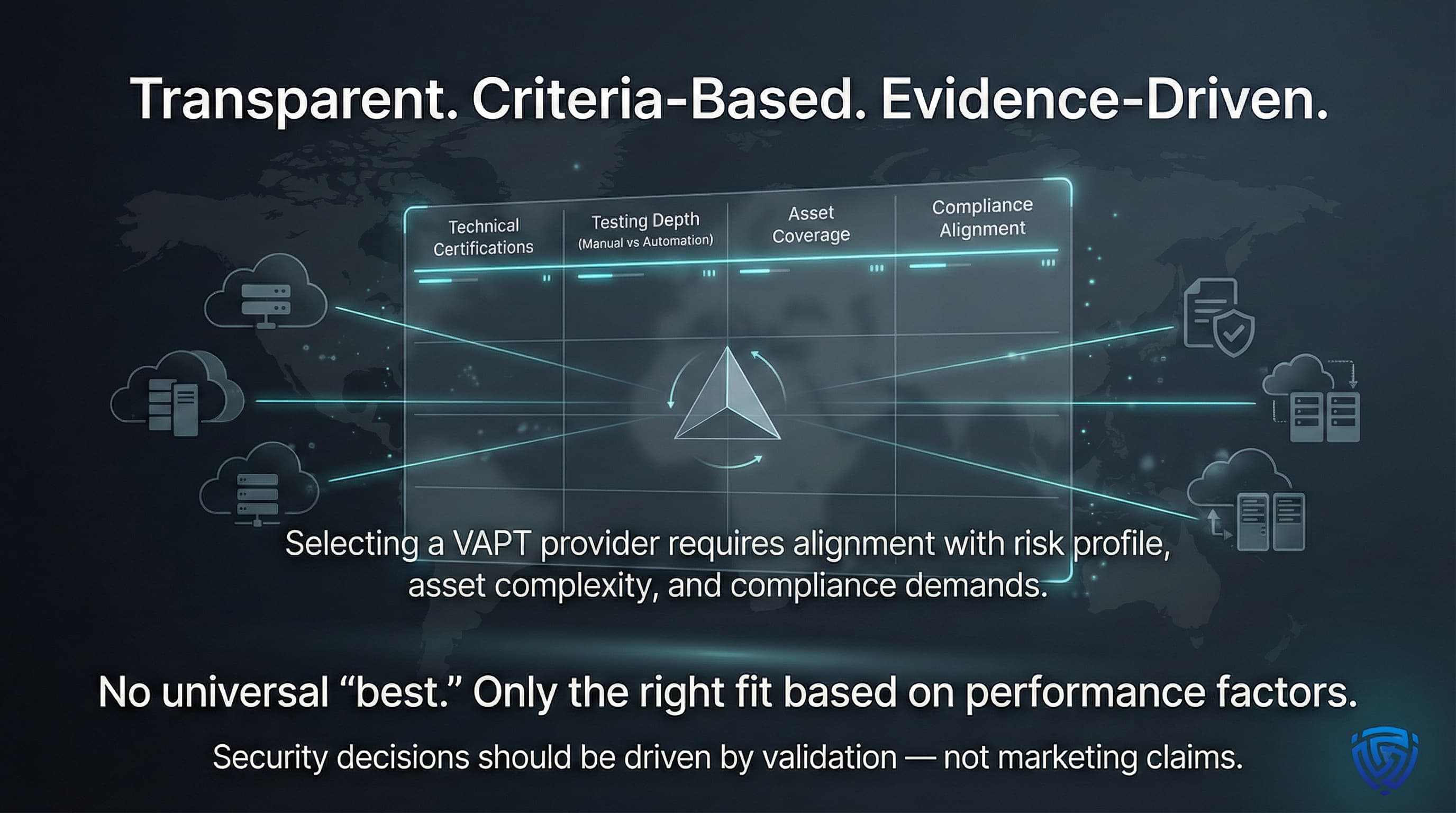
This analysis compares VAPT service providers worldwide against the criteria above. By focusing on technical certifications, testing depth (automation vs manual), coverage of assets, and compliance alignment, we have described where each provider fits. Readers should select among the providers above by matching their organizational needs (e.g. enterprise vs SMB) and risk profile. Ultimately, no single vendor is universally best; instead, this structured vendor comparison helps security leaders identify the right cybersecurity partner based on documented scope and fit, not marketing claims. Organizations whose requirement is adversary simulation rather than scoped vulnerability testing should look at red teaming as a service instead. DeepStrike's own service pages cover web application, cloud, mobile application, and continuous penetration testing.
About the Author: Mohammed Khalil is a Cybersecurity Architect at DeepStrike, specializing in advanced penetration testing and offensive security operations. With certifications including CISSP, OSCP, and OSWE, he has led numerous red team engagements, focusing on cloud security, application vulnerabilities, and adversary emulation. His work involves dissecting complex attack chains and developing resilient defense strategies for clients in the finance, healthcare, and technology sectors.

Stay secure with DeepStrike penetration testing services. Reach out for a quote or customized technical proposal today
Contact Us
