September 24, 2025
Updated: November 11, 2026
NCA ECC/SAMA/CST-CRF/PDPL alignment, PTaaS vs one-off tests, ROI, pricing, and vendor comparisons.

Mohammed Khalil
Direct answer: The top penetration testing companies in Saudi Arabia in 2026 include DeepStrike, Buguard, Cipher, NourNet, RedTeam Labs, Secmentis, and Security Matterz. The right choice depends on testing depth, Saudi compliance fit, reporting quality, retesting support, industry experience, and whether the buyer needs one-time VAPT or continuous penetration testing.
Comparing providers beyond Saudi Arabia? Our worldwide list of penetration testing companies covers firms that deliver testing across regions. For a neighboring GCC market, see Qatar's penetration testing companies. Buyers with UAE operations that also need SOC, MDR, or compliance support can compare the top cybersecurity companies in the UAE. For other GCC markets, see our lists of penetration testing companies in Kuwait, Bahrain and Oman.
Disclosure: DeepStrike, the publisher of this guide, is a penetration testing provider and is included in this list. Weigh our entry the way you would any vendor's description of its own service, and compare scope, sample reports and references for every provider before you buy.
This guide covers providers for organizations in Saudi Arabia. Buying from the United States? See our list of top penetration testing companies in the U.S. or DeepStrike's penetration testing services.
Use this table as a fast buyer filter before reviewing the detailed vendor profiles below.
| Provider | Best fit | Strengths | Buyer checks |
|---|---|---|---|
| DeepStrike | Human-led application, cloud, and infrastructure testing | Reproduction evidence, remediation guidance, 12 months of retesting on the Basic plan | Remote delivery; confirm tester locations and data handling |
| Buguard | Riyadh-based offensive security + cyber intelligence | Web, mobile, infrastructure testing and code review; compliance advisory | Confirm methodology, manual vs platform testing, and retesting terms |
| Cipher | Red team services + managed detection and response | Penetration testing, social engineering, red team missions, xMDR | No Saudi office listed; confirm delivery location and data handling |
| NourNet | Existing NourNet infrastructure or managed security customers | Vulnerability and exposure management, 24x7 SOC, cloud and network security | Pentesting is not a named service; confirm scope and who performs it |
| RedTeam Labs | VAPT across network, web, mobile, API, cloud, IoT | Scanning-to-exploitation process with fix validation | Offices listed in Dubai and India; confirm KSA delivery |
| Secmentis | Remote penetration testing + vulnerability assessment | Network, web, mobile, wireless, and physical tests | Europe-headquartered; confirm KSA delivery coverage |
| Security Matterz | Managed testing within managed security contracts | Managed pentesting and vulnerability assessment, SOC, NCA/SAMA consulting | Confirm whether pentest is standalone or bundled |
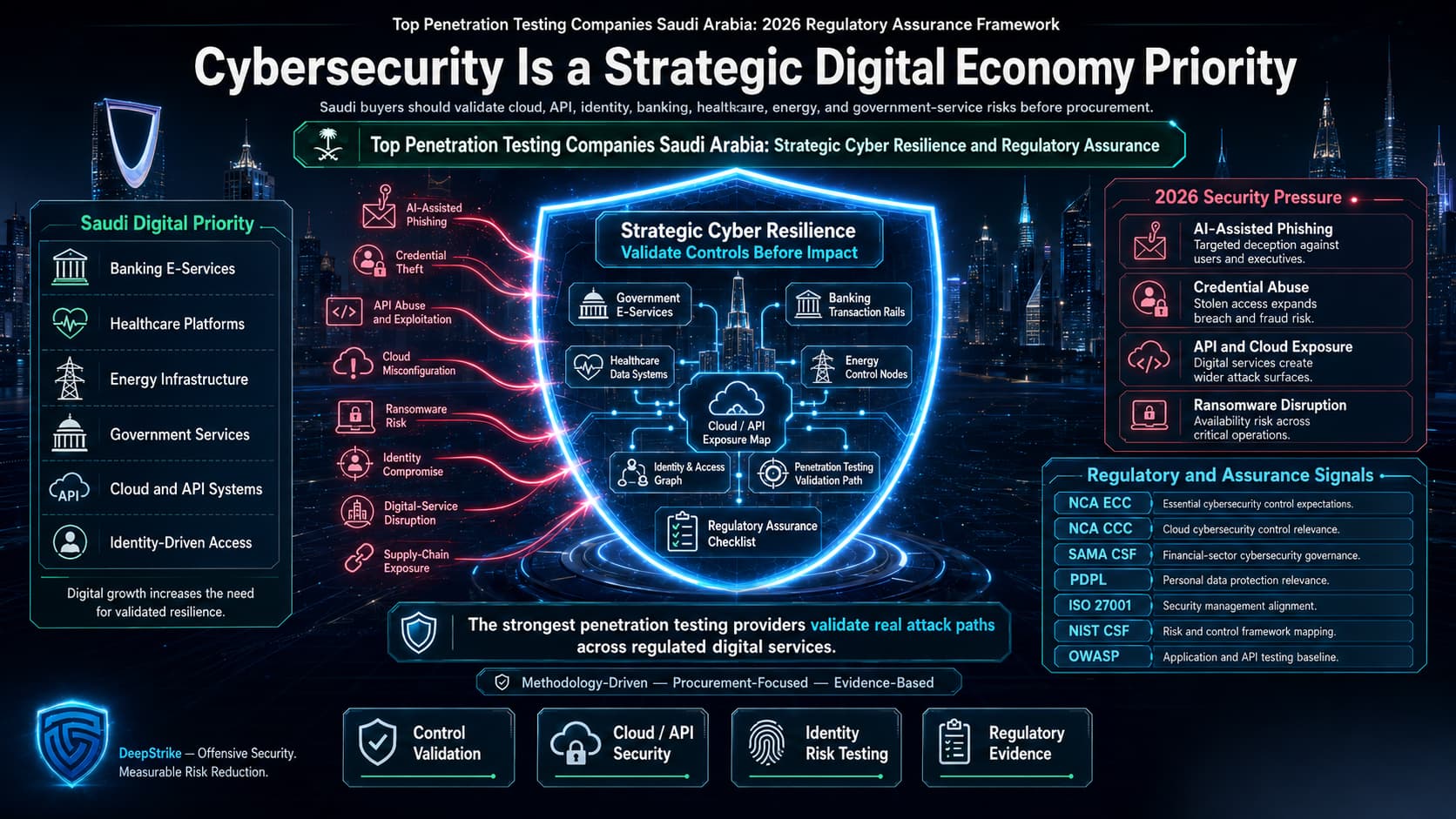
Saudi Arabia’s national vision and digitalization efforts have made cybersecurity a strategic priority. By 2026 the Kingdom’s digital economy is booming, with e‑services across banking, healthcare, energy, and government, all demanding robust defenses. At the same time, regulatory frameworks have tightened.
The Saudi National Cybersecurity Authority NCA publishes Essential Cybersecurity Controls ECC as baseline requirements, updated for 2024. Financial firms regulated by SAMA Saudi Central Bank must conduct annual penetration tests on internet‑facing systems.
Telecom and IT service providers fall under the Communications, Space & Technology Commission’s (CST, formerly CITC) Cybersecurity Regulatory Framework (CRF). And the new Personal Data Protection Law (PDPL) mandates strong security for any personal data, implying regular VAPT to ensure safe handling. In short, cutting-edge penetration testing services are no longer optional in KSA, they are essential for compliance and risk management.
Moreover, the stakes are high: IBM’s 2026 Cost of a Data Breach Report puts the global average cost of a data breach at $4.99 million. Saudi organizations cannot afford long recovery times or fines. As local firms accelerate digital transformation, using continuous security testing is now considered best practice.
Vulnerability Assessment and Penetration Testing (VAPT) providers are the focus of this guide. We’ll cover how Saudi businesses should pick a pentest partner, followed by profiles of leading Saudi VAPT providers. Along the way we’ll explain key trends, from manual vs. automated testing to the rise of PTaaS (Penetration Testing as a Service), and show how penetration testing supports measurable risk reduction, audit readiness, and better remediation decisions.
Choosing a pentest vendor is about more than just credentials; it’s about fit. Here are some must‑haves: Buyers elsewhere in Asia can compare penetration testing companies in India using the same criteria.
This list was evaluated using buyer-relevant criteria rather than marketing claims alone: manual testing depth, Saudi compliance fit, reporting quality, retesting support, industry relevance, pricing transparency, and suitability for one-time VAPT versus continuous PTaaS. Editorial note: DeepStrike publishes this list and lists itself first; list order is not a quality ranking.
Public offering: DeepStrike's penetration testing services describe human-led testing across applications, cloud environments, and infrastructure, supported by a findings and collaboration platform. Its public process covers planning, reconnaissance, vulnerability discovery, controlled exploitation, reporting, and technical support. Published reports include reproduction steps, remediation guidance, and root-cause information; the proposal should define exact coverage and commercial terms.
Saudi Arabia relevance: Founded in 2016, DeepStrike LLC is headquartered in Newark, Delaware, has 11–50 employees, and also publishes a business address in Dubai, UAE (IFZA Business Park). It delivers testing remotely for Saudi clients; define tester locations, permitted subcontracting, and data-handling restrictions in the engagement agreement.
Team certifications: OSCP, OSWE, OSEP, OSWP, GXPN, GWAPT, eCPPT, eMAPT, eWPT, CREST CPSA, CRTP, CRTE, and Microsoft Azure Security Engineer Associate, as shown on DeepStrike's services page.
Official sources: Pricing , Contact Us
Buyer fit: Engineering teams that need application, cloud, or infrastructure testing with direct remediation collaboration.
| Documented strengths | Limits and buying considerations |
|---|---|
| Human-led testing with reproduction evidence, root-cause information, and remediation guidance. | The service description is not an independently measured quality comparison. Assess the assigned team and a relevant sample report. |
| The published Basic plan lists Slack collaboration, customizable reports, and 12 months of remediation retesting. | No numeric price is displayed on the pricing page. Basic is a one-shot test; recurring coverage belongs to a different plan, with contract-specific terms. |
| Team certifications shown on the services page include OSCP, OSWE, OSEP, OSWP, GXPN, GWAPT, eCPPT, eMAPT, eWPT, CREST CPSA, CRTP, CRTE, and Microsoft Azure Security Engineer Associate. | These are individual tester credentials, not a company-level accreditation; ask which certified testers will be assigned to your engagement. |
Public offering: Buguard lists web, mobile, and infrastructure penetration testing and code security review, describing testing designed to identify and validate exploitable vulnerabilities across applications and infrastructure, with detailed reporting and a remediation roadmap. Alongside testing, it offers the Dark Atlas cyber intelligence platform (dark web monitoring, threat intelligence, attack surface management, and brand protection), the Strike Atlas platform for continuous validation of defenses, compliance advisory, and cyber defense services.
Saudi Arabia relevance: Buguard publishes a Riyadh address (3102 Alghat, Hay Almasif). Its site does not name a testing accreditation, so ask for tester credentials, and define tester locations, the role of automated tooling, and data handling in the agreement.
Official sources: https://buguard.io/services/penetration-testing; https://buguard.io/contact
Buyer fit: Saudi organizations that want application and infrastructure testing alongside threat intelligence and attack surface monitoring from a local provider.
| Documented strengths | Limits and buying considerations |
|---|---|
| Web, mobile, and infrastructure testing plus code security review, with a remediation roadmap. | The service page does not name its methodology or retesting terms; request both in writing with a sample report. |
| Dark Atlas intelligence and Strike Atlas continuous validation sit alongside the testing services. | Clarify which findings come from platform-based automated testing and which from manual testers. |
Public offering: Cipher's Red Team Services (RTS) cover security auditing, internal and external penetration testing, social engineering through phishing, vishing, and in-person tests, and red team missions that simulate real attacks to test detection and incident response. Described deliverables include a remediation roadmap and, for red team missions, risk management strategies and action plans. Cipher's core managed offering is xMDR, a managed detection and response service, alongside managed security, PCI-DSS, and GRC services.
Saudi Arabia relevance: Cipher's contact page lists offices in the United States, Spain, Portugal, Brazil, and Paraguay, and no office in Saudi Arabia. Confirm the contracting entity, where testers are based, and where test data will be processed and stored.
Official sources: https://www.cipher.com/cybersecurity-solutions/our-solutions/security-services-rts; https://www.cipher.com/contact-us
Buyer fit: Organizations that want red teaming and penetration testing tied to managed detection and response.
| Documented strengths | Limits and buying considerations |
|---|---|
| Penetration testing, social engineering, and red team missions are published as one red team service line. | No Saudi office is listed; confirm local delivery, travel for on-site work, and data residency. |
| Red team missions are framed around testing detection and incident response. | The page lists no testing accreditations; request tester credentials and a sample report. |
Public offering: NourNet's cybersecurity services page lists vulnerability and exposure management (vulnerability management, attack-surface and configuration review, and remediation tracking and validation), a 24x7 SOC with SIEM and MDR, incident response, cloud and network security, identity and access security, and data and application security. The page does not list penetration testing or red teaming as named services and directs cybersecurity enquiries to its contact form.
Saudi Arabia relevance: NourNet lists its head office at Al-Umam Center, Salah El-Dine Road, Riyadh, with a Riyadh data center and offices in Jeddah and Dammam. Because penetration testing is not a named service, confirm whether testing is delivered in-house or subcontracted, and define tester locations and data handling in the agreement.
Official sources: https://www.nournet.sa/cybersecurity-services/; https://www.nournet.sa/contact-us-locations/
Buyer fit: Organizations already using NourNet for connectivity, cloud, or managed security that want vulnerability management from the same provider.
| Documented strengths | Limits and buying considerations |
|---|---|
| Vulnerability and exposure management includes remediation tracking and validation. | Penetration testing is not listed as a named service; request the testing scope, methodology, and a sample report. |
| Riyadh, Jeddah, and Dammam locations plus a 24x7 SOC. | When the same provider runs your infrastructure or SOC, agree how testing independence will be maintained. |
Public offering: RedTeam Labs lists network penetration testing, web and mobile application security, API security, cloud security, and IoT security, plus red teaming and compliance consulting. Its Saudi network testing page describes a process of reconnaissance, vulnerability scanning, exploitation, post-exploitation, reporting with prioritized recommendations, and validation testing to confirm fixes.
Saudi Arabia relevance: RedTeam Labs publishes pages for Saudi buyers but lists its offices in Dubai, UAE, and Kozhikode, India, with no Saudi address. Confirm the contracting entity, where testers are based, and data-handling terms in the agreement.
Official sources: https://theredteamlabs.com/penetration-testing-company-in-saudi-arabia/; https://theredteamlabs.com/
Buyer fit: Small and mid-sized organizations that want combined vulnerability assessment and penetration testing with fix validation.
| Documented strengths | Limits and buying considerations |
|---|---|
| The published process runs from vulnerability scanning through exploitation to validation testing of fixes. | No Saudi office is listed; confirm on-site availability and where data is handled. |
| Coverage includes network, web, mobile, API, cloud, and IoT targets. | The site does not list specific accreditations; ask for named testers' credentials and a sample report. |
Public offering: Secmentis lists external, internal, web application, mobile application, wireless, and physical penetration testing, plus vulnerability assessment of external or internal infrastructure. Other services include incident response, security hardening with client IT staff, managed security, DDoS stress testing and protection, and social engineering.
Saudi Arabia relevance: Secmentis states that it is headquartered in Europe and that services can be performed and coordinated remotely; it lists the Middle East among served regions but no Saudi address. Confirm the contracting entity, tester locations, and data-handling terms, especially for physical or on-site testing.
Official sources: https://www.secmentis.com/penetration-testing; https://www.secmentis.com/contact
Buyer fit: Organizations comfortable with remote delivery that want a defined set of infrastructure, application, and wireless tests.
| Documented strengths | Limits and buying considerations |
|---|---|
| Published test types include physical and wireless testing alongside network and application tests. | No GCC office is listed; on-site tests need travel and scheduling terms in the proposal. |
| Vulnerability assessment and security hardening are offered alongside penetration testing. | The site lists no accreditations; request tester credentials and a sample report. |

Public offering: Security Matterz offers Managed Penetration Testing, described as penetration testing as a service that simulates attacks on systems, applications, and networks, and Managed Vulnerability Assessment for continuous evaluation of infrastructure. Its consultation services list vulnerability assessment, infrastructure penetration testing, red teaming, web application vulnerability assessment and penetration testing, mobile application penetration testing, and source code review, alongside managed SOC, MDR, incident response, and governance services.
Saudi Arabia relevance: Security Matterz lists its address at Al Taawun Center, Othman Ibn Affan Road, Riyadh, describes a locally operated SOC, and lists NCA and SAMA regulatory compliance among its consultation topics. Define tester locations, subcontracting, and data handling in the agreement.
Official sources: https://www.securitymatterz.com/managed-security-services; https://www.securitymatterz.com/consultation-services; https://www.securitymatterz.com/contact-us
Buyer fit: Saudi organizations that want testing and vulnerability assessment bundled with a managed SOC and compliance advisory.
| Documented strengths | Limits and buying considerations |
|---|---|
| Both managed and project-based testing are listed, including red teaming and source code review. | Confirm whether testing is sold standalone or only within a managed security contract. |
| A locally operated SOC and NCA and SAMA compliance consulting from Riyadh. | When the same provider monitors your environment, agree how testing independence and findings escalation will work. |
No single approach suffices. Automated tools vulnerability scanners, DAST/IAST, etc. rapidly cover large codebases and infrastructure, and catch common flaws SQLi, XSS, misconfigurations in bulk. They are scalable and ideal for continuous scanning. However, they often miss complex, logic-based vulnerabilities like chained exploits, business‑logic bugs or novel attack paths. That’s where manual penetration testing shines: skilled hackers can creatively think like adversaries to uncover what automation overlooks. For example, manual testing can explore custom authentication flows or combine minor findings into critical breach scenarios beyond most scanners.
In practice, top KSA firms use both. A typical engagement starts with automated discovery, then manual experts dig in. This hybrid model yields the best coverage. For instance, Security Matterz lists both managed vulnerability assessment and managed penetration testing. Ultimately, Saudi organizations should insist on a documented methodology: automated scans as a baseline, followed by thorough manual exploitation of high-impact targets.
With digital services updating constantly, traditional annual pentests leave unacceptable gaps. Enter Penetration Testing as a Service (PTaaS), a subscription model offering ongoing security assessments. Some providers offer subscription or continuous testing. The idea is simple: don’t wait months to find a breach; identify and fix vulnerabilities before attackers strike. PTaaS is intended as an ongoing, proactive approach that identifies, tests, tracks and helps mitigate dangerous vulnerabilities before exploitation. In other words, continuous pentesting narrows the window of exposure.
In the Saudi market, PTaaS can suit fintechs, large enterprises and DevOps-centric shops. Continuous testing platforms often integrate with development tools (CI/CD pipelines, bug trackers) so developers see issues in real time. DeepStrike and Indusface are examples of firms with such offerings. The outcome: security teams sleep easier knowing defenses evolve alongside applications. For organizations bound by SAMA or NCA standards, PTaaS also simplifies audit cycles by generating a steady stream of evidence, rather than a one-off report.
Finance and fintech buyers should prioritize SAMA alignment, API security, authentication testing, and retesting evidence. Government and critical infrastructure buyers should prioritize NCA ECC mapping, documented scope, executive reporting, and sector-specific evidence. Ecommerce, SaaS, and healthcare buyers should prioritize web, API, cloud, payment, privacy, and access-control testing under PDPL-sensitive environments.
Penetration testing finds exploitable weaknesses before attackers do. Its value depends on whether findings are fixed and verified; the cost of a single breach (IBM’s 2026 global average is $4.99M) is a useful reference point when sizing a testing budget.
In Saudi Arabia, where cyber incidents and audit obligations are rising, the money saved by avoiding just one breach often far exceeds annual penetration testing budgets. In short, pentesting remains a high-value security investment when it turns attack prevention into measurable remediation and risk reduction.
This guide profiles DeepStrike, Buguard, Cipher, NourNet, RedTeam Labs, Secmentis, and Security Matterz. Their service scope, accreditations, and Saudi presence differ; check each profile’s limits and ask every provider for tester credentials, a sample report, and how it maps testing to NCA ECC, SAMA, or PDPL requirements.
Pentesting helps organizations uncover security flaws before attackers do, crucial in a market under heavy regulation. Saudi laws and directives (NCA ECC, SAMA audits, CST CRF, PDPL) effectively require regular security assessments for many entities. By conducting pentests, companies support compliance and reduce breach risk; IBM’s 2026 Cost of a Data Breach Report puts the global average breach cost at $4.99M. Pentesting also bolsters customer trust in sectors like finance and healthcare.
At minimum, companies should test annually, as many regulations mandate e.g. SAMA requires yearly tests of customer-facing systems . However, with agile development and evolving threats, many firms now test quarterly or on each major release. Continuous PTaaS subscriptions can automate this cadence. In high-risk sectors banking, oil & gas, government , more frequent or ongoing testing is recommended.
Automated tools (scanners) efficiently cover large systems but only catch common issues. Manual testing (skilled ethical hackers using creative techniques) uncovers complex vulnerabilities like logic flaws or chained exploits that tools miss. The best approach is a combination: automated scans for breadth, plus manual attack simulations for depth. Ask each provider how it combines automated and manual testing.
PTaaS is a subscription model for pentesting. Instead of one-off tests, clients get continuous, on-demand assessments via a platform. New code pushes trigger scans, and all findings flow into a real-time portal. PTaaS is growing in KSA because it matches the fast pace of devops. It keeps security always on, detecting vulnerabilities before a formal audit. DeepStrike's testing, for example, is supported by a findings and collaboration platform.
Costs depend on scope, asset types, authenticated vs unauthenticated testing, retesting, reporting and on-site needs, and pricing is quoted per engagement. Request fixed-scope quotes from several providers. For a broader cost model, see DeepStrike’s penetration testing cost guidance, then compare what each Saudi quote includes: retesting, reporting, remediation support, and compliance mapping.
It depends on who regulates you. Entities within the NCA ECC’s scope (government bodies and critical national infrastructure operators) must meet its penetration testing control, and SAMA-regulated financial institutions are expected to penetration-test customer and internet-facing services at least annually. Telecom and IT providers should check CST’s CRF. For other organizations, PDPL requires appropriate security measures but does not name penetration testing; many choose regular testing to evidence those measures.
Look for internationally recognized certs: OSCP/OSWE, CREST, CISSP, CEH are common. National schemes such as India’s CERT-In empanelment don’t apply in Saudi Arabia, but ISO 27001 certification or PCI QSA credentials can signal rigor. Some companies advertise CREST membership or other accreditations; ask for the certificate and the accredited entity name.
Any sector processing sensitive data needs pentests, but key ones include: Finance and Banking (SAMA rules), Oil & Gas/Energy (critical infrastructure), Healthcare (patient data under PDPL), Government (national security), and Telecom/IT (CST CRF). Even SMBs handling customer data or operating e-commerce platforms benefit from affordable VAPT solutions.
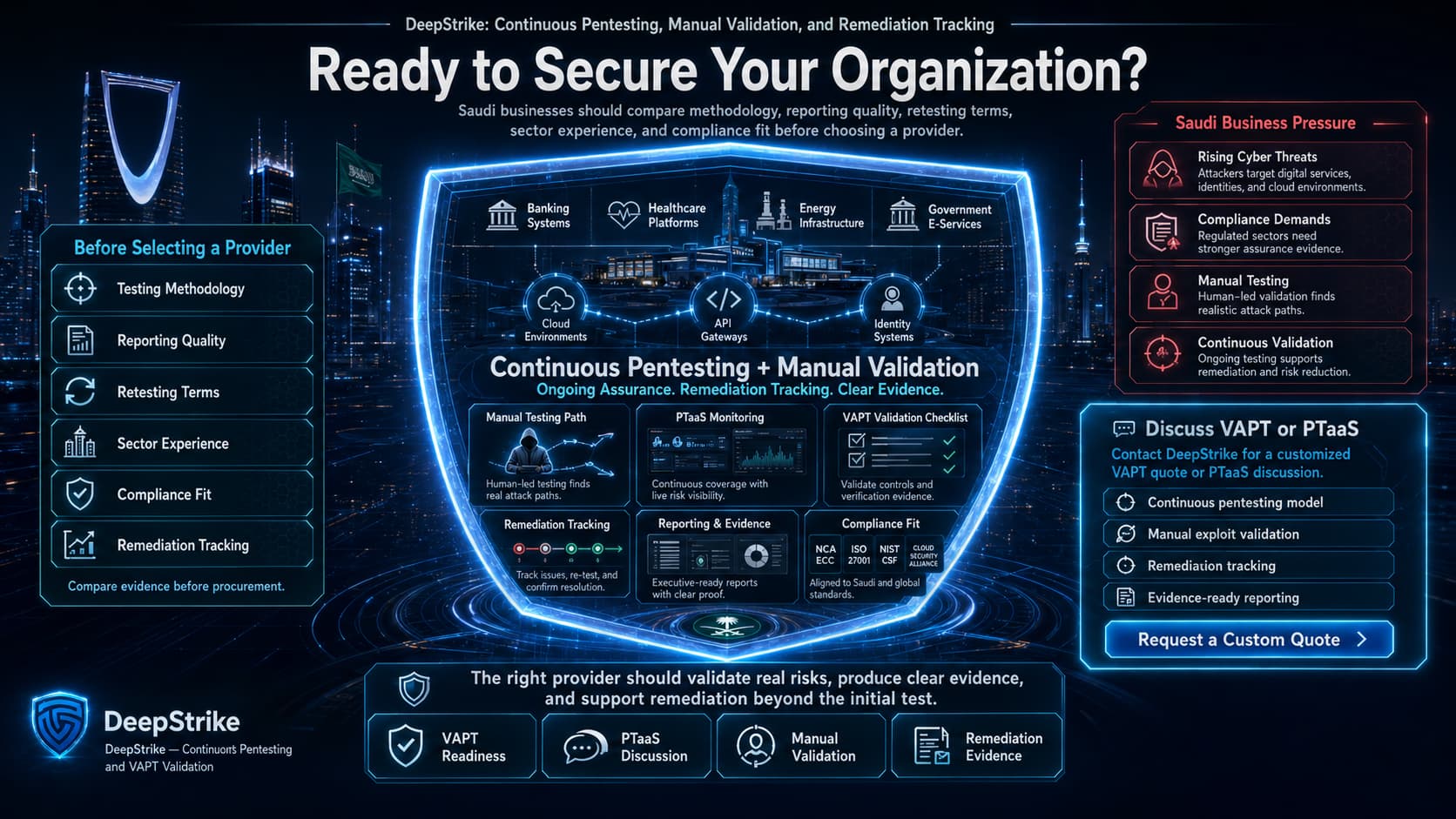
Saudi businesses face increasing cyber threats and compliance demands. Before selecting a provider, compare testing methodology, reporting quality, retesting terms, sector experience, and compliance fit. DeepStrike’s continuous pentesting model, combined with manual testing, may be suitable for organizations that need ongoing validation and remediation tracking. Contact DeepStrike for a customized VAPT quote or PTaaS discussion. Specific DeepStrike options include web application, cloud, mobile application, and red teaming as a service.
Mohammed Khalil is a Cybersecurity Architect at DeepStrike, specializing in advanced penetration testing and offensive security operations. With certifications including CISSP, OSCP, and OSWE, he has led numerous red team engagements, focusing on cloud security, application vulnerabilities, and adversary emulation. His work involves dissecting complex attack chains and developing resilient defense strategies for clients in the finance, healthcare, and technology sectors.

Stay secure with DeepStrike penetration testing services. Reach out for a quote or customized technical proposal today
Contact Us
