January 30, 2026
Updated: September 14, 2026
A comprehensive guide to Canada’s leading cybersecurity companies across pentesting, MDR, IAM, IR, and compliance.

Mohammed Khalil
This list helps CISOs, IT managers, and security buyers in Canada evaluate and compare leading cybersecurity vendors. We highlight:
As cyber threats grow more sophisticated, choosing the right cybersecurity provider is critical. In 2026, Canada’s market is booming projected to reach over CAD 10 billion by 2033 driven by factors like AI powered attacks, ransomware trends, and tightening regulations e.g. PIPEDA updates, Bill C 26. Organizations face new challenges such as AI assisted phishing, IoT vulnerabilities, and API exploits, so picking a partner who understands these recent ransomware attack trends is vital. A Canadian friendly approach adds value: on shore SOCs and knowledge of local privacy laws PIPEDA, provincial rules simplify compliance.
This article is an independent, research driven ranking of Canada’s top cybersecurity firms both homegrown and international across pen testing, managed detection, identity/security services, and more. We follow a transparent methodology in the next section and focus on unbiased analysis. The goal is to help you shortlist providers and make an informed buying decision not to sell any single vendor.
Common Pitfalls: Buyers often get dazzled by buzzwords or licenses alone. Avoid focusing only on marketing claims like industry leading or slogans. Beware vendors that only resell tools or offer automated scans without expert analysis, these tend to miss deep issues. Don’t assume a large brand means better service, boutique firms or specialists can outperform on cost and expertise for many needs. Also, compare like with like: a penetration tester isn’t the same as a 24/7 SOC provider. For a testing-focused shortlist, see the top penetration testing companies in Canada.
Red Flags: Watch out for lack of transparency. If a vendor won’t clarify pricing, certifications of their staff e.g. CISSP, OSCP, CREST, or their reporting standards, it’s a warning sign. Providers should openly share methodologies e.g. compliance mappings, incident response plans, and evidence of past audits. If they can’t detail their network security architecture, firewalls, EDR, etc. or supply chain vetting, that’s concerning .
What Matters: Instead, emphasize a vendor’s proven expertise and fit for your situation. Look for:
See our penetration testing best practices and network vulnerability research for more on what to expect from expert security assessments.
Why They Stand Out: DeepStrike is a Canadian based specialist focused on high end penetration testing and red team engagements. Its senior consultants, many with CISSP, OSCP, OSWE certifications, simulate real world attacks manually, uncovering deep business logic and chain of exploit vulnerabilities that automated scans often miss. The firm’s expertise in cloud and API security is notable, they use custom tooling alongside continuous research into new exploits. DeepStrike’s flexibility more than large consultancies allows tailored scopes from IoT/OT pentesting to hybrid cloud app assessments. Their reports are lauded for clarity and actionability, often mapping findings to compliance standards SOC 2, ISO 27001 to support remediation and audits. This mix of technical rigor, innovation AI assisted analysis when appropriate, and attention to Canadian regulations e.g. localized data handling advice make DeepStrike a top choice.
Key Strengths:
Potential Limitations:
Best For: Highly secure organizations seeking deep, custom attack simulations especially enterprises and regulated firms in finance, healthcare, or government. Also well suited for cloud first companies and teams needing expert advice on cloud/API threat models.
Editorial note: DeepStrike is included in this list based on the same evaluation criteria applied to all providers.
Why They Stand Out: eSentire is a pioneer of Canadian MDR services, offering continuous, around the clock monitoring via its Atlas XDR platform. It combines AI analytics with expert human analysts to rapidly detect and contain threats. Financial services, healthcare and legal clients trust eSentire’s median containment times often cited under 15 minutes for breaches. The company has deep experience with regulated industries, frequently helping organizations meet FINTRAC, PCI, and HIPAA requirements. eSentire’s SOC is based in North America including Canadian team members, ensuring data sovereignty and bilingual support. Recent enhancements include custom compliance automations and specialized hunting for emerging threats e.g. AI enabled deepfake fraud detection.
Key Strengths:
Potential Limitations:
Best For: Mid market to large enterprises especially regulated ones requiring robust, 24/7 monitoring and quick incident response. Organizations that need a set and forget SOC service with compliance aligned reporting and no in-house security team.
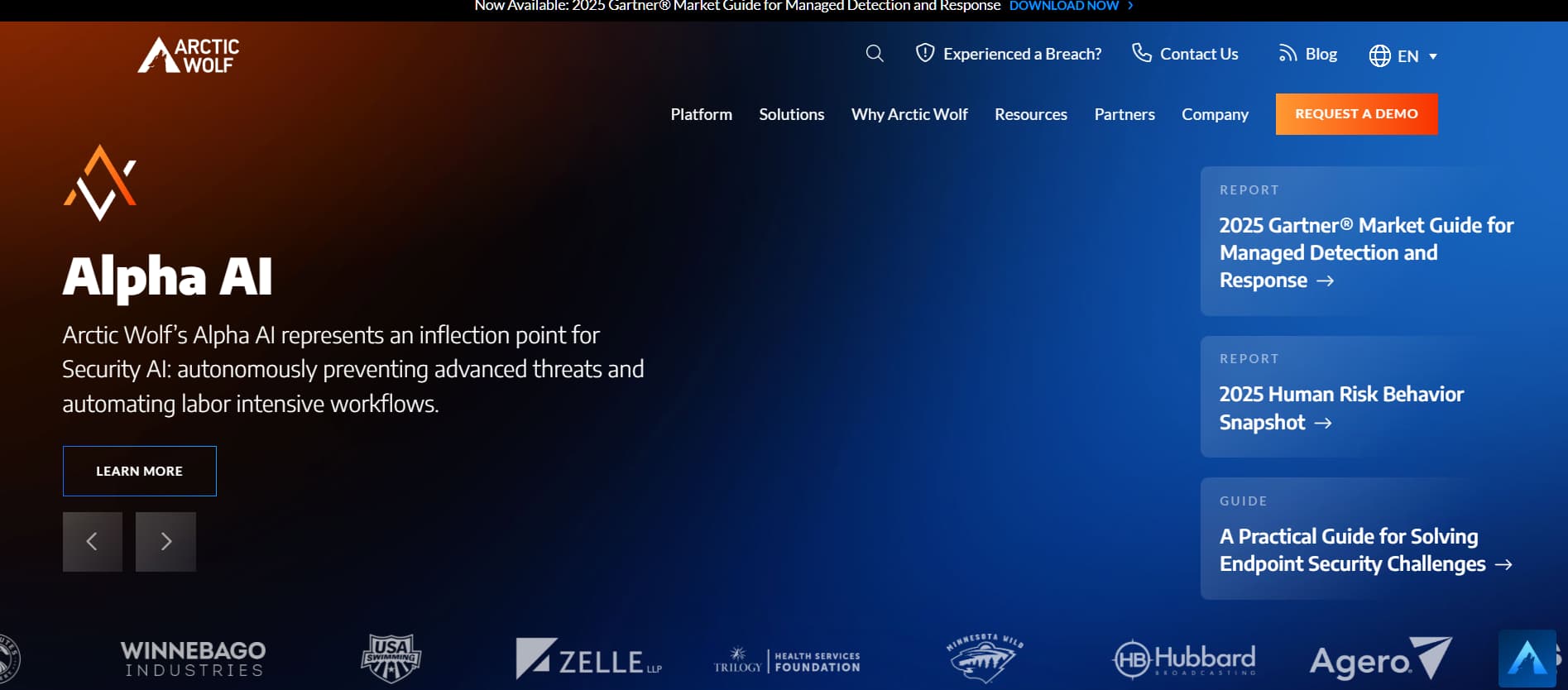
Why They Stand Out: Arctic Wolf delivers its MDR services through a cloud native Security Operations Cloud and a concierge SOC model. Its AI driven platform Alpha AI reduces false positives and provides continuous threat monitoring. Notably, customers receive financial breach protection up to USD 3M as part of some service tiers. Arctic Wolf’s Canadian presence including a Waterloo office provides local support and compliance alignment for bilingual clients. In 2026, Arctic Wolf focuses on early threat detection and automated compliance reporting e.g. adapting to Canada’s Digital Privacy Act changes. With a 24/7 SOC and full spectrum threat management, they are built to handle globally distributed IT environments.
Key Strengths:
Potential Limitations:
Best For: Large enterprises and organizations in regulated industries needing a comprehensive, managed security solution. Ideal for companies with sophisticated infrastructures, multiple offices, cloud environments that require continuous threat coverage and strong regulatory support.
Why They Stand Out: Telus Security leverages Telus’s national fiber network to offer SOC as a Service and managed security solutions designed for Canadian businesses. All SOC operations are on shore in Canada, addressing strict data sovereignty requirements. Telus provides 24/7 monitoring, DDoS defense, managed firewalls, and cloud security often bundled with Telus telecom contracts. The company emphasizes compliance: clients gain local support for PIPEDA, provincial laws BC/Alberta Privacy Acts, and can use Telus Secure for encrypted connectivity. Their offerings are tailored to customers needing Canadian regulatory assurance e.g. public sector and telecom giants.
Key Strengths:
Potential Limitations:
Best For: Canadian mid market to enterprise organizations needing local support and compliance first security. Particularly well suited for public sector, telecom, and companies already on Telus networks. Also a fit for firms seeking an MSSP with national reach and incident response retainers.
Why They Stand Out: 1Password is a Canadian born leader in securing credentials and secrets. Its platform manages logins, API keys, certificates, and enforces multi factor authentication across teams. Over 165,000 organizations worldwide use 1Password for developers, SMBs and large companies alike. 1Password emphasizes data residency with Canadian cloud options and compliance mapping SOC 2, PCI DSS, HIPAA for Canadian clients. Their strong balance of user friendly design and enterprise grade controls makes it a popular choice for identity security.
Key Strengths:
Potential Limitations:
Best For: Any Canadian organization, from SMBs to large enterprises, that needs to strengthen credential hygiene and enforce strong authentication. Especially valuable for tech savvy teams and DevOps groups that need secure secret storage.
Why They Stand Out: CyberArk is a pioneer in privileged account security and identity management. It provides vaulting for high risk credentials and just in time privilege elevation. In Canada, CyberArk serves many enterprises and government clients, helping them enforce least privilege policies and meet audits. The company continuously innovates e.g. AI driven privilege monitoring, session firewall tech to catch credential theft and insider threats in real time. With an Ottawa operations center and strong partner network, CyberArk ensures local support.
Key Strengths:
Potential Limitations:
Best For: Large Canadian organizations especially in finance or public sector with complex IT environments and stringent compliance needs. Ideal when privileged credentials are a major risk factor e.g. critical infrastructure, DevOps pipelines.
Why They Stand Out: IBM’s long history and vast resources translate into a comprehensive suite of security solutions. Through IBM Canada, customers access local experts and labs e.g. Markham tech center with direct lines to IBM’s global threat research. Notably, IBM’s WatsonX AI is used for advanced threat hunting and predictive security analytics, claiming to detect breaches faster than earlier models. IBM offers everything from SIEM to cyber range training. Its IBM Security Connect platform can centralize alerts across an entire hybrid cloud. For Canadian clients, IBM provides free threat intel sharing IBM Shield and tailored security consulting for complex transformation projects.
Key Strengths:
Potential Limitations:
Best For: Large enterprises and public institutions needing end to end security architecture and a single provider approach. Excellent for organizations already invested in IBM software or looking for global threat intel and heavy compliance consulting e.g. big banks, governments.
| Company | Specialization | Best For | Region | Compliance | Ideal Size |
|---|---|---|---|---|---|
| DeepStrike | Pentesting, Red Team, Cloud | Enterprise/Regulated, DevOps security | Canada HQ | SOC 2, ISO 27001, NIST, PIPEDA guidance | Mid-Enterprise |
| eSentire | Managed Detection & Response | 24/7 SOC coverage, Regulated industries | Canada HQ | PCI DSS, HIPAA, PIPEDA, SOC 2 | Mid-Enterprise |
| Arctic Wolf | MDR/XDR, SOC Services | Large Enterprises, Distributed IT | Global Ops in ON | ISO 27001, SOC 2, NIST, PIPEDA ready | Enterprise |
| Telus Security | MSSP, SOC, DDoS, Cloud Security | Canadian Enterprise, Data sovereignty | Canada HQ | PIPEDA, Provincial Privacy Acts, ISO | Mid-Enterprise |
| 1Password | Identity & Password Management | All sizes needing secure credentials | Canada HQ | SOC 2, PCI DSS, ISO 27001, GDPR | SMB-Enterprise |
| CyberArk | Privileged Access Management | Large enterprises with sensitive assets | Global CAN HQ | ISO 27001, SOX, PCI, NIST, CIS benchmarks | Enterprise |
| IBM Canada | SIEM, Threat Intel, Cloud Security | Large enterprises, Government | Global CAN ops | FISMA, ISO 27001, SOC 2, HIPAA, NIST | Enterprise |
| Qualysec | Penetration Testing | SMB to mid market needing pentests | Global no CAN HQ | ISO 27001, CREST | SMB-Mid |
| Absolute Software | Endpoint Resilience | Hybrid workforces needing device recovery | Canada HQ | ISO 27001, GDPR | Enterprise |
| Cyderes Herjavec | MDR, Threat Intel | Regulated sectors needing hunting & identity | Canada HQ | NIST, PCI, SOC 2 | Mid-Enterprise |
Table: Comparison of leading cybersecurity vendors in Canada, highlighting each company’s specialization, target use case, regional presence, compliance strengths, and ideal customer size.
Choosing between large firms and boutique providers depends on your organization’s size, risk profile, and budget. Enterprises with thousands of users, complex infra often benefit from established integrators and global MSSPs. These firms offer extensive SLAs, full time SOCs, and broad service catalogs SIEM deployments, XDR platforms, and managed firewalls. For example, an international bank might choose Arctic Wolf or IBM for their scale, as well as auditing bodies that expect formal processes. Large providers can also coordinate multi region rollouts and absorb heavy compliance audits.
Boutique firms and specialized MSSPs shine for SMBs and agile teams. A smaller company may not need a full SOC, instead, on demand pentesting and incident response retainers can deliver higher ROI. Specialists often provide deeper hands on analysis e.g. DeepStrike’s custom pentests and can adapt quickly to unique business contexts. They may offer more transparent pricing models for instance, per test or retainer based versus enterprise contracts. However, the trade off is that a small firm may not have 24/7 monitoring resources, instead, they assume the client has some internal security operations and just needs expert augmentation or consulting.
In terms of cost vs value, large MSSPs come with higher minimums and tiered contracts, which can include lock in. Smaller firms or platforms often with automated tooling allow you to spin up services as needed, paying only for the work done. For example, automated penetration testing services charge monthly or per scan fees that suit tight budgets. But note: cheaper options may skip manual verification, so ensure any automated provider still involves human review.
Ultimately, assess your priorities: if you need round the clock threat coverage and can’t afford downtime, a large SOC driven provider is worthwhile. If your main concern is assuring code quality and compliance through occasional tests, or rapidly improving security posture on a limited budget, a focused consultant or smaller MDR provider may outperform on cost effectiveness.
Our rankings are based on a consistent, criteria driven methodology, applied equally to all vendors. We evaluated each candidate on multiple dimensions:
Each company in the list below was vetted under these criteria. We avoided mere marketing hype and focused on evidence based differentiation. When relevant, Canadian specific considerations of data residency, local laws were applied.
Prices vary widely by scope. Broadly, professional penetration tests range from ~$5,000 to $50,000 for small to medium assessments, while large enterprise projects with multiple networks or apps can exceed $100,000. Very low cost offerings under ~$4K tend to be superficial scans. Costs depend on the number of assets, complexity, methodology black box vs. white box, and tester experience. Always confirm what’s included in the executive report, retest, etc..
Both matter, but certifications signal proven expertise. Tools scanners, EDR, XDR platforms are only as good as the humans operating them. A tester with OSCP or CISSP and years of experience will often find subtle issues with a tool called can't. Weigh vendor qualifications: look for industry standard certs e.g. OSCP, CISSP, or CREST accreditation and frameworks ISO 27001, SOC 2 in addition to asking about their tooling. A mature provider uses best of breed tools and expert judgment, these are complementary.
Typically 1-4 weeks for a mid sized engagement. The duration is pre-set with the vendor based on scope and resources. Small web app tests might wrap up in a week, sprawling networks can take several weeks. Factors include number of systems, complexity, and required methodologies black/grey/white box. Time also covers report writing and reviews. Plan ahead: last minute tests incur premiums and may be rushed.
A professional penetration test report includes: an Executive Summary high level findings and business impact for leadership, Methodology scope and testing approach, and Detailed Findings of each vulnerability’s description, affected components, severity rating, CVSS/CWE identifiers, proof of concept, and recommended fixes. Good reports prioritize issues by risk, include evidence screenshots, logs, and provide actionable remediation advice. They often map items to compliance standards e.g. PCI DSS Requirement 6.1 failed with this issue so you can easily use the report for audits.
At minimum, annually, or after any significant change. Many regulations mandate yearly pentests for example, PCI DSS requires annual tests and after major system changes. High risk organizations financial, healthcare, critical infra may test quarterly or more frequently. As a rule of thumb, do a full test whenever you deploy new critical systems, merge networks, or after major code releases. Continuous vulnerability scanning and regular patching should complement your testing schedule. Always align testing cadence with your risk profile and compliance rules.
For many mid to large organizations, yes. MDR provides 24/7 threat monitoring and expert response without the overhead of running your own SOC. It’s especially valuable if you lack internal security staff. Costs can be per endpoint hundreds per device per year, which often proves cost effective given the high potential cost of breaches. Just verify that the MDR provider uses human analysts not just automated alerts and offers transparent incident handling procedures.
Don’t choose based on price alone. Look at what’s included: the number and type of testers, testing depth black/white/grey box, retest policy, and how findings are delivered. Check if the firm follows recognized frameworks OWASP, NIST and if their report template meets your needs. Validate the team’s certifications and request sample reports redacted to judge quality. Also confirm project management details timeline, communication process. The cheapest vendor may skip manual verification to ensure you’re getting senior expertise, not just a checklist scan.
Cybersecurity is a rapidly evolving landscape, especially in 2026with AI driven threats and stricter regulations. Making the right choice of partner can mean the difference between resilience and a costly breach. We have objectively ranked Canada’s leading cybersecurity firms based on technical credentials, service scope, compliance alignment, and client trust. We encourage you to use these insights from DeepStrike’s advanced pentesting to Telus’s data centric SOC as a starting point. Compare offerings, ask vendors the right questions, see How to Choose, and consider a trial or reference checks. The optimal provider is the one that aligns expertise with your organization’s size, industry, and risk profile. Stay informed and make a data driven decision to strengthen your defenses. Organizations with operations in other Commonwealth markets can run the same comparison against the top cybersecurity companies in Australia.
About the Author
Mohammed Khalil is a Cybersecurity Architect at DeepStrike, specializing in advanced penetration testing and offensive security operations. With certifications including CISSP, OSCP, and OSWE, he has led numerous red team engagements for Fortune 500 companies, focusing on cloud security, application vulnerabilities, and adversary emulation. His work involves dissecting complex attack chains and developing resilient defense strategies for clients in the finance, healthcare, and technology sectors.

Stay secure with DeepStrike penetration testing services. Reach out for a quote or customized technical proposal today
Contact Us
