Penetration testing has shifted from a compliance checkbox to a board-level KPI, and the numbers explain why: vulnerabilities are being published at a record pace, most breaches still trace to known, unpatched flaws, and organizations are pouring money into offensive security to validate that their defenses actually work. This is a curated, sourced set of penetration testing statistics for 2026, covering market size, adoption and frequency, the vulnerabilities pentests keep finding, the remediation gap, industry differences, and the AI-era trends reshaping the field.
Updated: August 2026. Refreshes market-size, breach-cost, CVE, and adoption figures to 2026 sources (MarketsandMarkets, IBM 2025, NVD, Verizon 2025 DBIR).
Headline statistics (2026)
| Statistic | Figure | Source |
|---|
| Global penetration testing market (2026) | ~$3.1 billion, heading to $7.4B by 2034 | MarketsandMarkets / Fortune |
| PTaaS market (2026) | ~$0.72 billion, to $1.98B by 2031 | MarketsandMarkets |
| Organizations using PTaaS | 70%+ | Industry surveys |
| Orgs that increased pentest spend last year | ~85% | Industry surveys |
| Orgs testing only 1-2 times per year | ~43% | Industry surveys |
| New CVEs published in 2025 | 48,185 (record, +20.6%) | CVE Program / NVD |
| Breaches from known, unpatched vulnerabilities | ~60% | Industry analyses |
| Vulnerability exploitation as breach initial access | ~20% (+34% YoY) | Verizon 2025 DBIR |
| Global average breach cost (2025) | $4.44M ($10.22M US) | IBM 2025 |
The one-line takeaway: spending on pentesting is rising fast, but the remediation gap and the flood of new vulnerabilities mean the testing has to be continuous, not annual, to keep up.
Market size and growth
- The global penetration testing market is roughly $3.1 billion in 2026 and projected to reach about $7.4 billion by 2034, growing at a low-double-digit CAGR, according to Fortune Business Insights market data.
- The PTaaS (penetration-testing-as-a-service) segment is around $0.72 billion in 2026 and forecast to hit $1.98 billion by 2031 in the MarketsandMarkets PTaaS forecast, growing faster than the market overall as buyers move from one-off engagements to continuous testing.
- Web/application penetration testing is the largest slice, about 33% of the PTaaS market in 2026.
- BFSI (banking, financial services, insurance) is the largest end-use segment at roughly 25%, driven by strict regulation.
- North America holds the largest regional share (~35-40%), while Asia-Pacific is the fastest-growing region.
The growth story is simple: as breaches rise and regulations tighten, offensive security has become a standard line item rather than a luxury.
More market and budget data points:
- US enterprises spend roughly $187,000 per year on penetration testing, on the order of 10% of the IT security budget.
- Overall security budgets are rising at the large majority of companies, yet about 1 in 3 organizations still cite budget constraints as a barrier to pentesting.
- A single standalone penetration test commonly runs $5,000 to $100,000+, with many mid-market engagements landing in the $10,000-$30,000 range depending on scope and depth.
Adoption and testing frequency
- Over 70% of firms now use PTaaS, with more planning to adopt it, reflecting the shift to continuous testing models covered in our PTaaS guide.
- ~85% of organizations increased their pentest spending in the past year, even under budget pressure.
- ~43% of organizations still test only once or twice a year, leaving long windows where new code and new vulnerabilities go unvalidated.
- A growing cohort has moved to quarterly or continuous testing, but only a small share (~1 in 10) tests monthly or more.
- Outsourcing dominates: roughly half of organizations rely on third-party testers for objectivity, while many run a hybrid model that pairs external attackers' perspective with internal context.
Sourcing and staffing splits:
- Roughly half of organizations rely exclusively on third-party testers for objectivity and specialized skills.
- A large share have built in-house testing capability, and about 60% run a hybrid model, combining internal context with an external attacker's perspective.
- Regulated sectors lead: pentest adoption exceeds 70% in finance and healthcare and keeps climbing.
The persistent gap here is cadence: IT changes daily, but most testing programs still validate security only once or twice a year, which is the core argument for continuous penetration testing.
Vulnerability discovery and severity
- Web application flaws dominate pentest findings, and a large share of breaches involve exploiting web-app vulnerabilities.
- Weak, default, and reused passwords are consistently among the most common findings, one survey of pentesters ranked them the single most encountered issue.
- Security misconfiguration (OWASP A05) is a top category, frequently making up 20-30% of findings.
- Broken access control and weak authentication remain high-frequency, high-impact findings that lead to account takeover.
- Injection issues persist: SQL injection remains a common critical web flaw, and cross-site scripting (XSS) is still among the most reported bugs.
- Record CVE volume: a record 48,185 CVEs were published in 2025 (up 20.6% over 2024) according to the 2025 CVE data review, roughly 131 per day, far outpacing most organizations' remediation capacity, as our full vulnerability statistics breakdown shows.
- Exploitation is up: the Verizon 2025 DBIR found vulnerability exploitation now drives about 20% of breaches, up 34% year over year, with edge-device and VPN exploitation rising sharply.
More findings and severity data:
- An estimated ~73% of breaches involve exploiting a web-application vulnerability at some point in the chain.
- XSS accounts for roughly a quarter of web findings, down from higher shares in prior years as frameworks improved defaults.
- Over half of published CVEs in recent years were rated High or Critical severity, yet only about 6% of all vulnerabilities are ever observed exploited in the wild, which is exactly why exploit-based prioritization beats severity-only triage.
- Social engineering stays effective: phishing simulation click rates run 10-20%, and credential-based findings feed directly into account-takeover chains.
Most of what pentests find is not exotic. It is misconfiguration, weak credentials, and missing patches, the same fundamentals attackers exploit, which is why our software testing vs security testing guide stresses layered testing.
The remediation gap
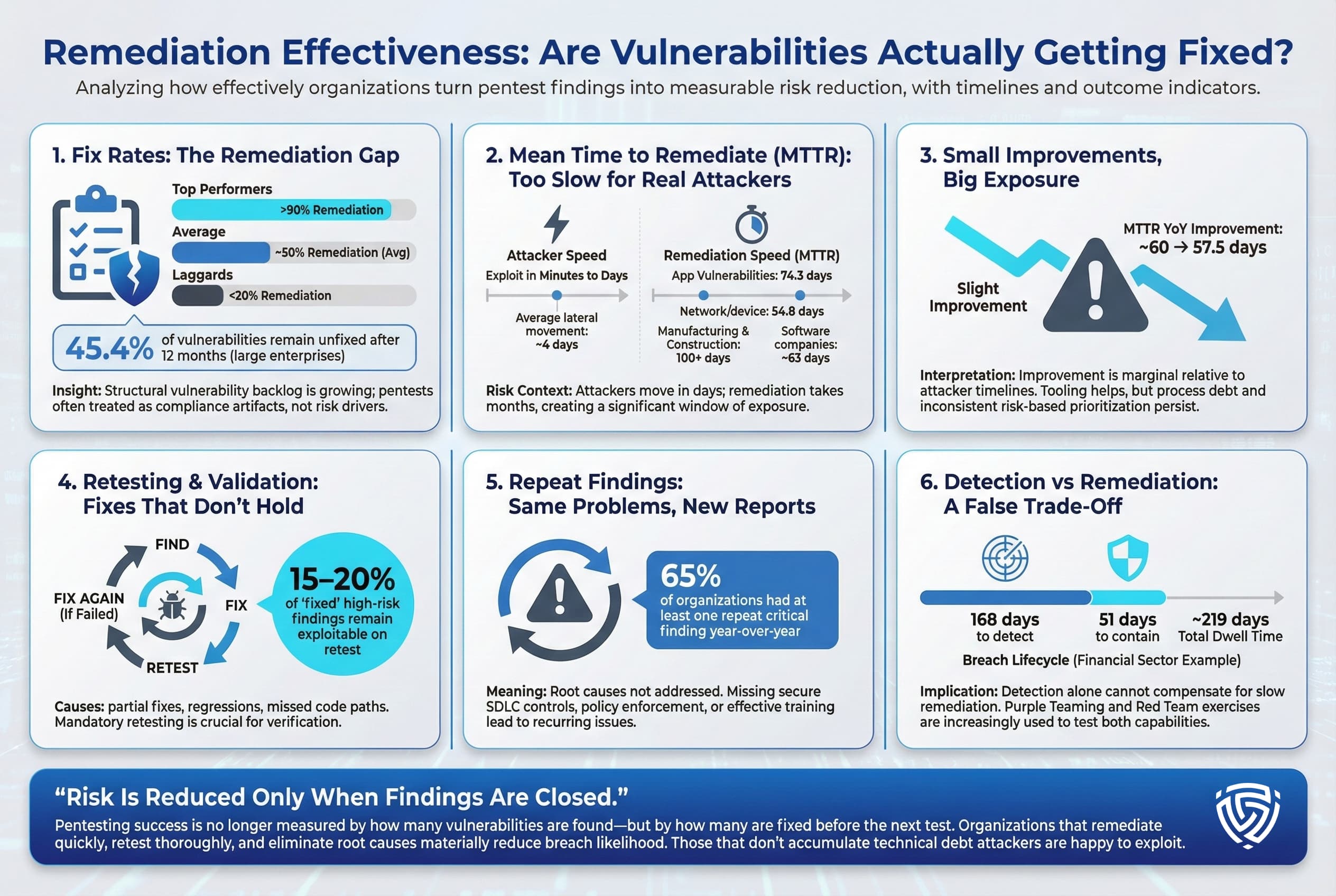
The data's most sobering theme is that finding vulnerabilities is not the hard part, fixing them is.
- ~60% of breaches stem from known, unpatched vulnerabilities, not zero-days.
- The average time to remediate a critical application vulnerability runs on the order of weeks to months, while attackers weaponize new flaws in days.
- A large share of discovered vulnerabilities remain unremediated a year later in big enterprises, reflecting resource and prioritization constraints.
- Because fixes lag, pentests frequently rediscover the same issues engagement after engagement.
Concrete remediation data points:
- The mean time to remediate a critical application vulnerability runs around 74 days in many datasets, versus attackers weaponizing fresh flaws in days.
- Large enterprises still leave roughly 45% of discovered vulnerabilities unresolved after 12 months.
- High-performing programs remediate the large majority of serious findings, while laggards fix well under a quarter, a wide maturity spread.
The lesson is that testing without a disciplined remediation and re-test loop produces reports, not risk reduction, which is why prioritization frameworks (CISA KEV, EPSS) covered in our patch management guide matter as much as the test itself.
Breach costs and ROI
- IBM's 2025 Cost of a Data Breach put the global average at $4.44 million (down 9%, first decline in five years, driven by faster AI-assisted detection), while the US average rose to $10.22 million, a figure we break down by sector in our data breach cost analysis.
- Healthcare remains the costliest sector at roughly $7.42 million per US breach, the highest of any industry for the 14th straight year.
- Organizations using AI and automation in security saved an average of around $1.9 million per breach and cut the breach lifecycle by dozens of days.
- The ROI case for pentesting is straightforward: the annual cost of a testing program is a rounding error against a single multi-million-dollar breach, and testing directly shortens the detection window that dominates breach cost. For real pricing, see our penetration testing cost guide.
Industry breakdown
| Sector | Pentest posture |
|---|
| Financial services (BFSI) | Highest maturity and the largest market segment (~25%), driven by PCI DSS, SOX, and high breach costs |
| Healthcare | Fast-growing pentest adoption; costliest breaches (~$7.42M US), heavy IoMT and ransomware exposure |
| Retail / e-commerce | Focus on web, API, and payment testing; card-not-present fraud and PII exposure |
| Technology / SaaS | Continuous and API-heavy testing; frequent product changes |
| SMBs | Lag badly, a minority have ever run a full pentest, despite being frequent attack targets |
Supporting industry figures:
- Healthcare: the vast majority of healthcare organizations have suffered a breach in the past three years, and IoMT plus ransomware exposure keeps costs highest of any sector.
- Retail: a large share of retail data leaks involve customer PII, pushing focus onto web, API, and payment-flow testing.
- SMBs: only about a third of small businesses have ever run a full penetration test, despite over half of cyberattacks targeting smaller companies, and a major breach forcing a meaningful fraction out of business within months.
The SMB gap is the starkest: smaller firms are attacked constantly yet test the least, and a major breach can be existential for them. Our cyber attacks on small businesses analysis covers why.
Emerging trends: cloud, API, and AI
The attack surface pentests must cover has expanded well beyond the classic web app.
- APIs are a top risk. A majority of organizations have experienced an API security incident, yet mature API and cloud testing lags adoption. API tests routinely surface broken object-level authorization and excessive data exposure, the focus of API penetration testing.
- Cloud misconfiguration is a leading breach cause, and testing the cloud control plane is now table stakes.
- AI and LLM features are a new frontier. Reports of AI-related vulnerabilities surged in 2025, with prompt injection the fastest-growing class, and bug-bounty programs added AI targets in large numbers. The risks are catalogued in the OWASP LLM Top 10.
- AI is changing how pentesters work. A large majority of security researchers now use AI tools to scale reconnaissance and triage, but human expertise remains essential for the creative, chained exploits automated tools miss.
Emerging-surface data points:
- A majority of organizations reported an API security incident in the past year, yet only around a quarter have mature API and cloud testing, a clear coverage gap.
- Reports of AI-related vulnerabilities surged in 2025, with prompt injection the fastest-growing class, and over a thousand bug-bounty programs added AI targets.
- Roughly 70% of security researchers now fold AI tooling into their workflow, "bionic" testing that scales coverage without replacing human judgment.
What the statistics mean
Read together, the numbers tell a consistent story:
- Investment is rising, but so is the gap. Budgets and adoption are up, yet the flood of new CVEs and the remediation lag mean many organizations are validating security slower than their environments change.
- Fundamentals dominate findings. Misconfiguration, weak credentials, and missing patches, not zero-days, are what pentests keep uncovering and what breaches keep exploiting.
- Cadence is the differentiator. Annual testing cannot keep pace with continuous change; the organizations pulling ahead have moved to continuous or PTaaS models.
- Testing only pays off with remediation. A pentest that is not followed by prioritized fixes and re-testing produces a report, not security.
Best practices informed by the data
- Test continuously, not annually. Match validation cadence to your rate of change.
- Prioritize remediation by real exploit risk (CISA KEV, EPSS), not raw severity, and re-test to confirm closure.
- Cover the full modern surface: web, API, cloud, mobile, and AI/LLM features, not just the classic web app.
- Fix the fundamentals first: enforce phishing-resistant MFA, kill default and reused passwords, and close misconfigurations, the highest-frequency findings.
- Combine automation with human testers: scanners for coverage, skilled pentesters for the chained, business-logic exploits that automation misses.
Conclusion
The 2026 penetration testing statistics point one direction: the threat volume and the remediation gap have outgrown once-a-year testing, and the organizations reducing real risk are the ones testing continuously, prioritizing by exploitability, and actually closing what they find. Numbers on a report do not reduce risk; a disciplined test-fix-retest loop does.
DeepStrike's penetration testing is manual-first and adversary-realistic, finding the chained, exploitable issues that scanners miss and validating that your fixes hold. To scope an engagement, see our penetration testing services.
FAQ
How big is the penetration testing market in 2026?
The global penetration testing market is roughly $3.1 billion in 2026 and is projected to reach about $7.4 billion by 2034. The faster-growing PTaaS segment is around $0.72 billion in 2026, forecast to reach $1.98 billion by 2031, reflecting the industry-wide shift from one-off engagements to continuous testing.
How often do organizations run penetration tests?
Roughly 43% of organizations still test only once or twice a year, which leaves long windows where new code and vulnerabilities go unvalidated. A growing minority has moved to quarterly or continuous testing, but only about one in ten tests monthly or more. The gap between IT change velocity and testing cadence is the field's biggest weakness.
What vulnerabilities do penetration tests find most often?
The most common findings are fundamentals: weak, default, or reused passwords; security misconfiguration; broken access control; and weak authentication, alongside classic web flaws like SQL injection and cross-site scripting. Most breaches exploit these known issues rather than zero-days.
What percentage of breaches come from unpatched vulnerabilities?
Around 60% of breaches stem from known, unpatched vulnerabilities rather than novel zero-days. With a record 48,185 CVEs published in 2025 and remediation of critical flaws often taking weeks, the backlog is the core problem, which is why prioritizing by exploit risk (CISA KEV, EPSS) matters more than raw severity.
How much does a data breach cost, and how does pentesting help?
IBM's 2025 report put the global average breach at $4.44 million and the US average at $10.22 million, with healthcare highest at about $7.42 million. Faster detection is the biggest cost reducer, and penetration testing directly supports that by finding and helping close exploitable gaps before attackers reach them.
Is AI changing penetration testing?
Yes. AI-related vulnerabilities surged in 2025, with prompt injection the fastest-growing class, adding a whole new testing surface catalogued in the OWASP LLM Top 10. AI also augments how testers work, most researchers now use AI tools for reconnaissance and triage, but human expertise remains essential for creative, chained exploits automation cannot find.