September 12, 2025
Updated: November 5, 2026
Compare leading mobile app pentest vendors by delivery model, MASVS coverage and retesting, with published prices checked October 2026.

Mohammed Khalil

The best mobile application penetration testing vendors in 2026 combine OWASP MAS aligned methodology with manual, attacker minded testing and a workflow that gets findings to developers quickly. Mobile specialists suit mobile first and regulated teams, enterprise PTaaS platforms suit large app portfolios, and manual led consultancies suit high stakes apps. Few vendors publish prices; Schellman's published floor for a mobile app test is $14,500, and Halo Security's general pentest pricing starts at $3,950 (see our penetration testing cost guide). Use the comparison table and the 7 step checklist below to choose the right fit.
For a broader comparison across testing types and regions, see our list of the top penetration testing companies worldwide.
Looking for a test rather than a shortlist? See DeepStrike's mobile application penetration testing service, or read our step by step Android and iOS penetration testing guide.
Key Facts
| Vendor | Delivery model | Mobile scope | Verified detail (Nov 2026) | Best fit |
|---|---|---|---|---|
| NowSecure | Mobile only PTaaS: automated testing plus expert led pentests | Mobile specialist (iOS and Android) | ISO/IEC 17025-accredited lab (MASA, MASVS L1) and Google ADA MASA authorized lab; offers NIAP-aligned testing | Large mobile portfolios and DevSecOps teams |
| NetSPI | Enterprise PTaaS with an in house team | Mobile is one of many asset types | 350+ in house security experts; real time dashboards and remediation testing | Enterprises running one program across many assets |
| Cobalt | PTaaS with the vetted Cobalt Core tester community | iOS and Android on real devices; methodology informed by OWASP MASVS | 500+ vetted pentesters; unlimited retesting within a 7 day SLA | Fast moving product teams |
| BreachLock | AI assisted platform plus CREST certified testers | Human led mobile testing | Stated CREST certified pentesters; retesting (confirm manual retest terms in the quote) | SMB and mid market compliance programs |
| Bishop Fox | Manual led consultancy | iOS, Android and their APIs | Follows OWASP MSTG and MASVS; HQ Tempe, Arizona | High stakes, mission critical apps |
| DeepStrike | Human led testing with a findings and collaboration platform | iOS and Android with backend APIs | Basic plan lists Slack collaboration and 12 months of remediation retesting | Engineering teams that want direct remediation collaboration |
| Appknox | Mobile security platform plus manual pentests | Mobile specialist | Storeknox app store monitoring; binary SBOM; claims under 1% false positives | End to end mobile AppSec programs |
| Sophos (formerly Secureworks) | Intelligence led consultancy | No dedicated mobile app test listed | Completed Secureworks acquisition in February 2025 | Sophos customers testing network and web estates |
How we chose these vendors: each one offers iOS and Android application testing (Sophos is kept because Secureworks appeared in earlier versions of this list), publishes its methodology or credentials, and was checked against its own website in November 2026. Figures such as integration counts or false positive rates are the vendors' own claims.
Disclosure: DeepStrike, the publisher of this guide, is a penetration testing provider and is included in this list. Weigh our entry the way you would any vendor's description of its own service, and compare scope, sample reports and references for every provider before you buy.
In today's digital economy, mobile applications are the primary interface between businesses and their customers, holding and transmitting vast quantities of sensitive data. This central role has transformed them into a prime target for cybercriminals, making strong mobile application security a fundamental business requirement.
As organizations navigate 2026 and beyond, a strategic mobile app penetration testing solution has become an indispensable part of a resilient cybersecurity posture. This proactive security assessment, which simulates real world attacks to identify vulnerabilities before they can be exploited, serves as a critical defense against a rapidly evolving and increasingly hostile threat landscape.
The mobile threat landscape keeps shifting, and our penetration testing statistics roundup tracks the latest breach and testing data. For mobile specific figures, see our mobile security statistics page.
Mobile devices are a large part of that exposure. In Q1 2025, Lookout detected more than one million mobile phishing attacks against enterprise users and found over 193,000 malicious or vulnerable apps on enterprise devices.
This surge is not merely a matter of volume but also of sophistication. The democratization of advanced attack tools, including AI assisted malware, means that highly effective offensive capabilities are no longer the exclusive domain of nation state actors but are accessible to a broad spectrum of cybercriminals.
Third party code is a major contributor. Most apps ship SDKs and open source libraries their team did not write, which is why OWASP ranks Inadequate Supply Chain Security as M2 in its Mobile Top 10.
This creates a large, often unmonitored attack surface. Basic hygiene is also frequently missed: tokens, credentials and personal data stored insecurely on the device remain a common finding (OWASP M9, Insecure Data Storage).
The malware itself keeps evolving. In early 2026, Kaspersky found a new version of the SparkCat crypto stealer hidden in apps on both Google Play and the App Store; the iOS variant used Apple's Vision framework for optical character recognition.
In Q1 2026, Kaspersky blocked 2,676,328 malware, adware and unwanted software attacks on mobile devices and found more than 306,000 malicious installation packages, 162,275 of them tied to mobile banking Trojans. One off, static security measures are not enough against threats at that volume.
A proactive, adversarial approach through penetration testing is essential to uncover these hidden risks before they result in a catastrophic breach.
Failing to secure mobile applications is a financial and legal liability, not only a technical one. The IBM Cost of a Data Breach Report 2026 puts the global average cost of a breach at $4.99 million, a record high, and found that one in four malicious breaches was AI enabled, costing $6 million on average.
A single, unmitigated vulnerability in a mobile application can trigger a multi million dollar crisis, making the typical cost of a professional penetration test a remarkably high return investment in risk mitigation.
The regulatory landscape has also become increasingly punitive. Stringent data protection and privacy laws such as the General Data Protection Regulation (GDPR) in Europe, the Health Insurance Portability and Accountability Act (HIPAA) in the U.S. healthcare sector, the Payment Card Industry Data Security Standard (PCI DSS) for financial transactions, and the California Consumer Privacy Act (CCPA) impose severe penalties for non compliance.
European regulators issued about €1.2 billion in GDPR fines in 2024, according to DLA Piper's annual GDPR fines survey, and these regulations explicitly or implicitly require regular security assessments and risk analysis. For organizations in regulated industries, a documented, professionally executed penetration test is critical evidence of due diligence for auditors and regulators.
The convergence of security and privacy mandates is also expanding the scope of what a penetration test must cover. The inclusion of "Inadequate Privacy Controls" (M6) in the OWASP Mobile Top 10 underscores this shift.
A modern assessment must go beyond identifying technical exploits to evaluate how an application handles and protects personally identifiable information (PII) throughout its entire lifecycle. This fusion of disciplines reflects the growing expectation that applications must be secure by design and private by design.
While mitigating financial risk and satisfying compliance are powerful drivers, the most forward thinking organizations view strong security as a strategic business enabler. In a saturated digital marketplace, user trust is a fragile and invaluable asset.
A security breach can irrevocably damage a brand's reputation and erode customer confidence, leading to user attrition and lost revenue. Conversely, a demonstrable commitment to security, validated by rigorous, independent testing, becomes a powerful competitive differentiator.
Companies that embed security into their development culture and deliver secure by design products foster higher levels of user trust, which translates directly into greater customer retention, loyalty, and lifetime value. When customers feel confident that their sensitive data is protected, they are more likely to engage with an application, recommend it to others, and remain loyal to the brand.
Therefore, investing in high quality mobile application penetration testing transcends its function as a risk mitigation tool. It becomes a proactive investment in brand integrity and customer relationships.
By commissioning and acting upon the findings of a thorough penetration test, an organization sends a clear signal to the market that it prioritizes the safety and privacy of its users. This commitment builds the digital trust that is the foundation of sustainable business growth in the modern economy.
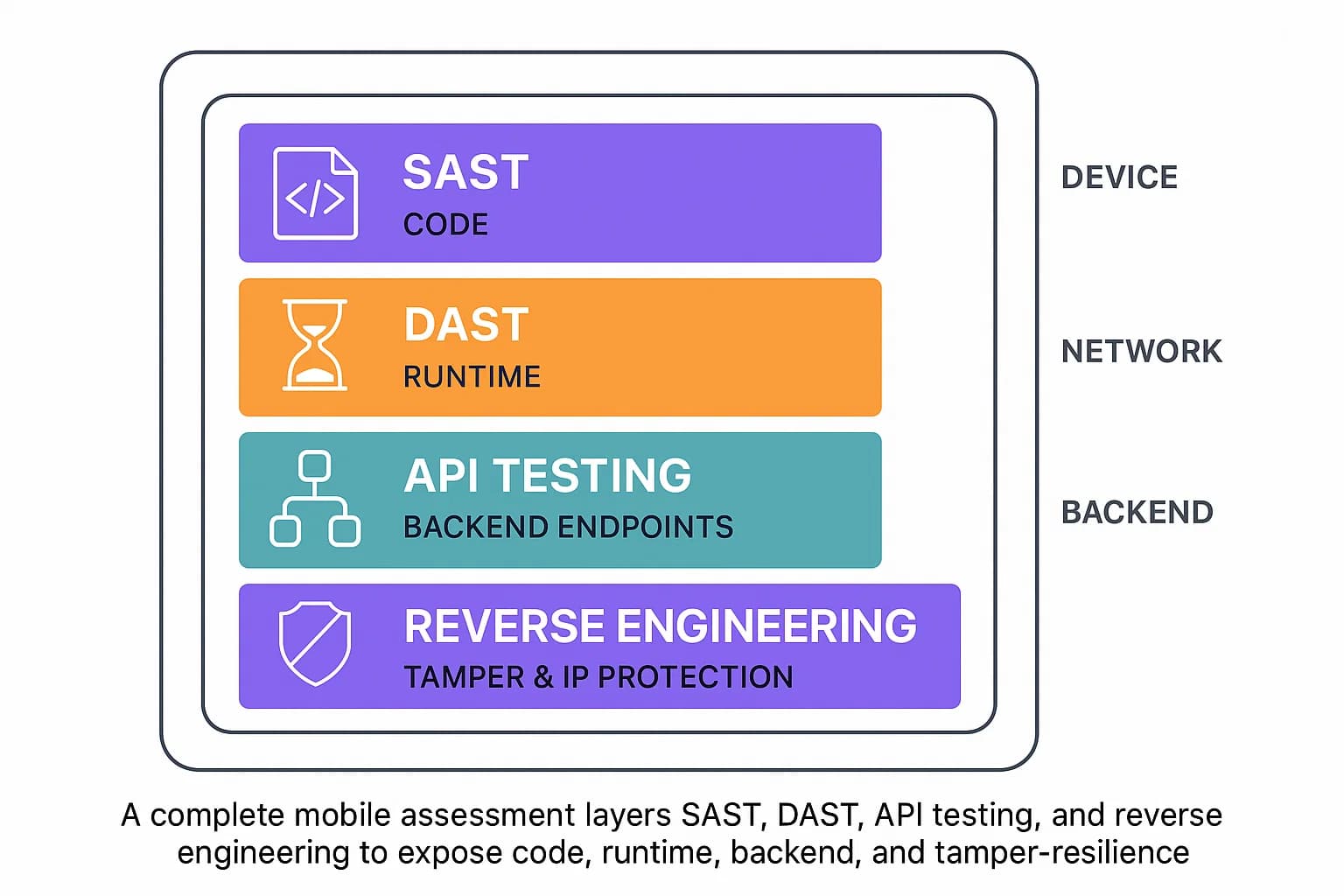
To effectively procure and use mobile application penetration testing services, decision makers must have a foundational understanding of the discipline's core components, methodologies, and governing standards.
A penetration test is not an arbitrary or unstructured exercise; it is a systematic and methodical security assessment that simulates the tactics, techniques, and procedures of real world attackers to identify and validate exploitable vulnerabilities.
This section deconstructs the key elements of a professional mobile pen test, providing the technical context necessary to evaluate vendors and interpret their findings.
At its core, mobile application penetration testing is a comprehensive security checkup designed to uncover an iOS or Android application's most critical weaknesses by subjecting it to a series of controlled, simulated attacks.
The primary goal is to identify flaws in areas such as data storage, authentication, encryption, session handling, and API communications before malicious actors can discover and exploit them. A thorough assessment encompasses several key testing techniques that work in concert to provide a complete view of the application's security posture.
The core components of a comprehensive mobile pen test include:
The methodology of a penetration test is defined by the amount of information and access provided to the testing team. The choice of methodology is not merely a technical detail but a strategic decision that should align with the specific goals of the assessment. Each approach simulates a different type of threat actor and provides a unique perspective on the application's security.
The selection of a methodology should be driven by the primary risk an organization seeks to mitigate. A black box test is ideal for validating perimeter defenses, a white box test is suited for deep code assurance and insider threat modeling, and a gray box test excels at identifying privilege escalation and abuse case vulnerabilities.
The field of mobile security has matured significantly, moving from a collection of ad hoc techniques to a structured, engineering like discipline. At the heart of this professionalization is the Open Worldwide Application Security Project (OWASP), a non profit foundation that develops and maintains the industry's most respected frameworks for application security.
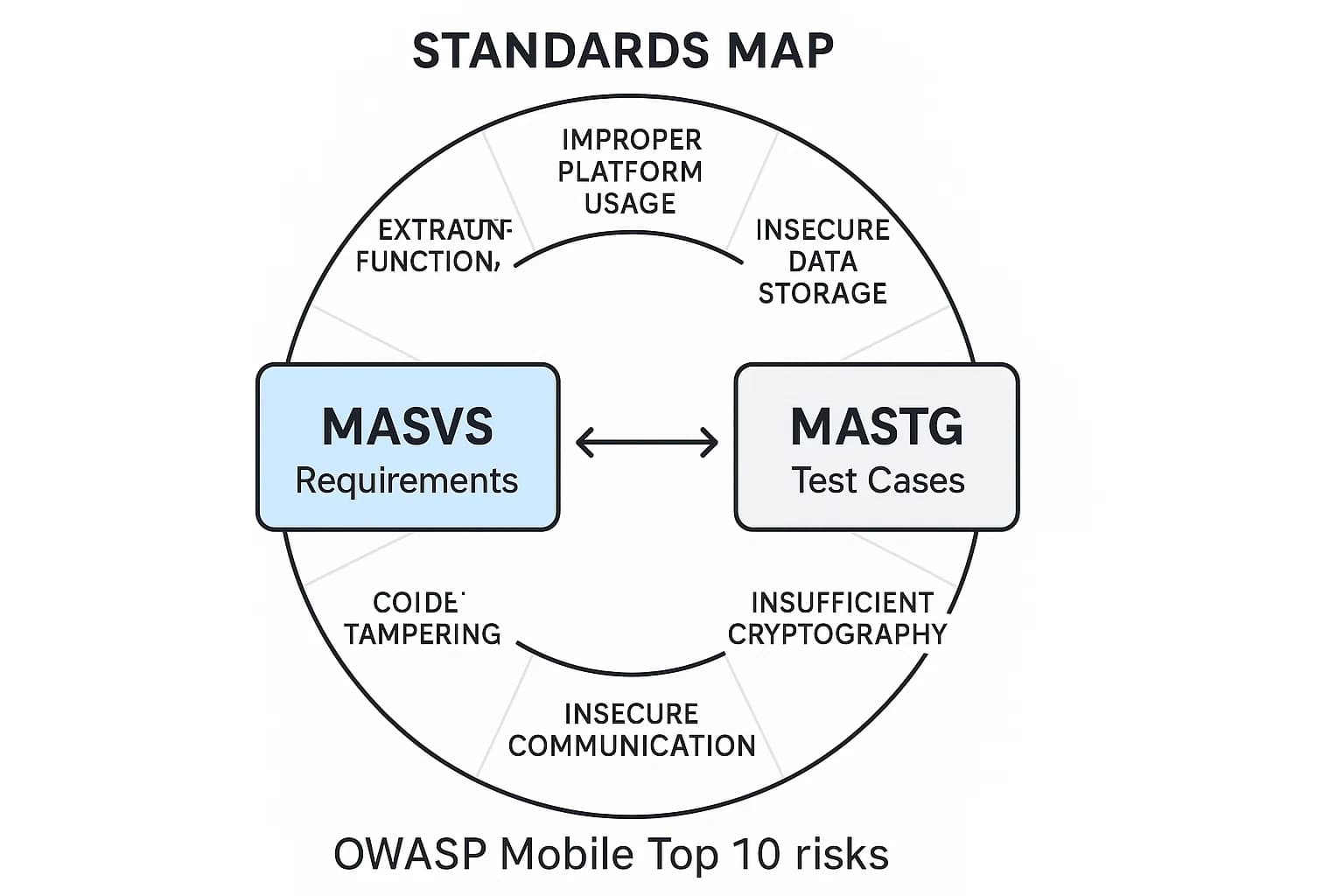
For mobile applications, the cornerstone is the OWASP Mobile Application Security Verification Standard (MASVS), which provides a complete, end to end framework for defining, enumerating, and testing security controls.
A high quality, professional penetration test is not an arbitrary process but a systematic validation of an application against the OWASP MAS framework. This provides a universal benchmark for assessing the quality and completeness of a vendor's work. The key components include:
The relationship between these components is crucial: the MASVS defines the security requirements, and the MASTG provides the test cases to verify them. When procuring a penetration test, decision makers should ensure that the vendor's methodology is explicitly aligned with these OWASP standards.
A final report that maps its findings back to specific MASVS controls demonstrates a level of rigor and professionalism that is the hallmark of a top tier assessment.
While the MASVS and MASTG provide the comprehensive framework for testing, the OWASP Mobile Top 10 serves as a vital awareness document that highlights the most critical and prevalent security risks found in mobile applications today.
This list, updated periodically based on extensive data collection and analysis, helps organizations prioritize their security efforts by focusing on the most common attack vectors. A professional penetration test should, at a minimum, provide thorough coverage of these ten risk categories.
The OWASP Mobile Top 10 2024 edition, still the current release in 2026, includes:
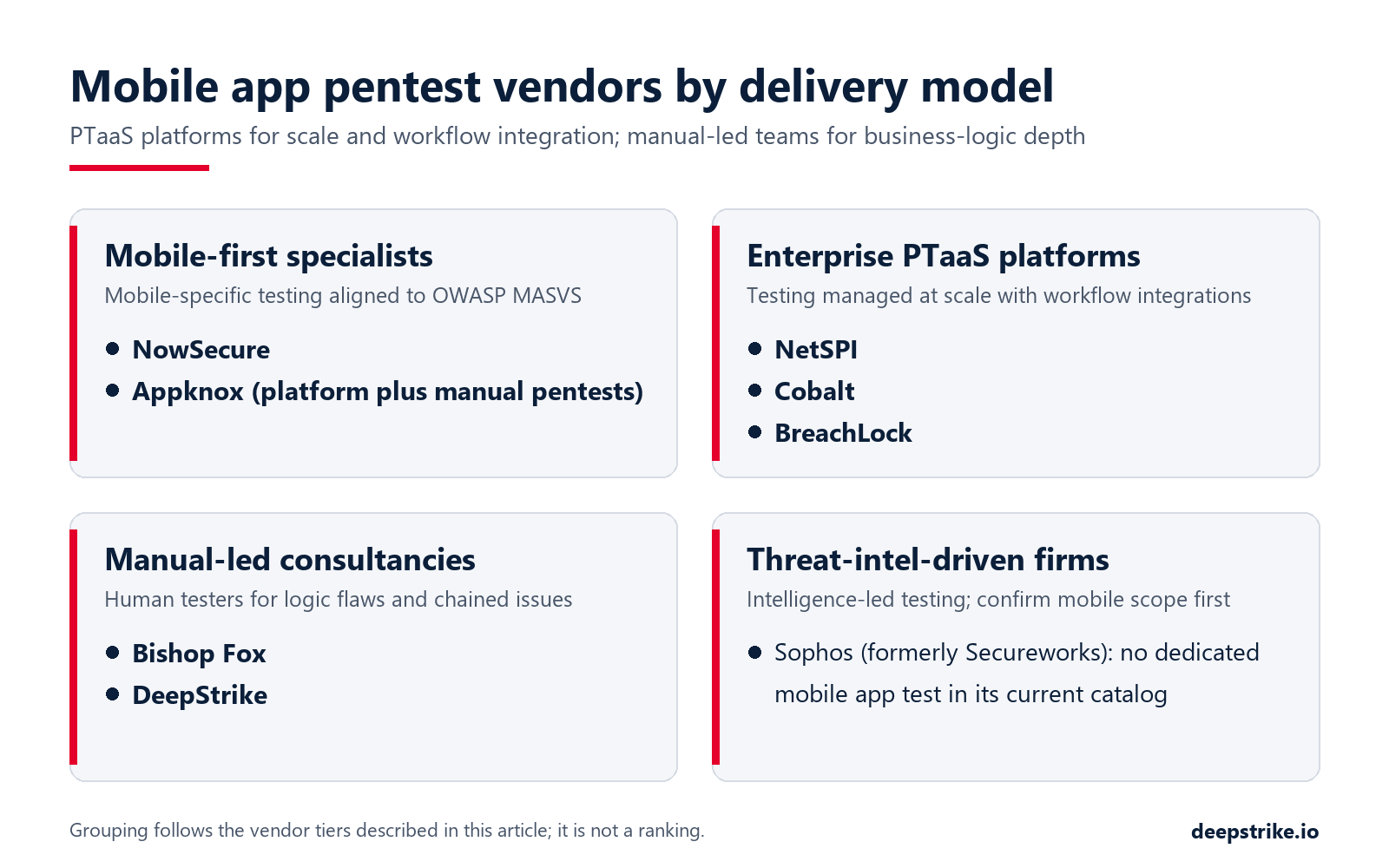
Selecting a mobile application penetration testing vendor is a critical decision that directly impacts an organization's security posture. The market is diverse, with providers ranging from technology driven platforms to elite, human led consultancies.
This landscape is undergoing a fundamental bifurcation, splitting into two primary service delivery models: Platform Led and Talent Led. The optimal choice depends on an organization's specific needs, security maturity, development practices, and risk appetite.
Platform led vendors, often categorized under Penetration Testing as a Service (PTaaS), emphasize scalability, speed, and integration into the software development lifecycle (SDLC). Talent led consultancies, in contrast, highlight the deep expertise of their human testers and their ability to uncover complex, business logic flaws that automated tools often miss. For web estates, see DeepStrike's web application penetration testing services.
Penetration Testing as a Service (PTaaS) represents a modern approach to security testing, moving away from traditional, point in time engagements toward a more continuous, collaborative, and integrated model.
However, the term "PTaaS" has become widely used, and true PTaaS is defined not just by a web portal for report delivery but by a technology platform that offers real time visibility, deep integration with developer workflows, and a blend of automated and manual testing capabilities.
Public offering: NowSecure combines automated mobile app security testing (static and binary analysis of the IPA or APK, dynamic analysis on physical iOS and Android devices, runtime SDK analysis, and a mobile SBOM) with guided testing and penetration testing as a service for business logic abuse and chained findings. Each finding includes evidence, an OWASP MASVS mapping, and remediation guidance, and results can flow into CI/CD tools such as GitHub Actions, GitLab, Azure DevOps, Jenkins, CircleCI, and Bitrise.
Mobile testing relevance: NowSecure states that it co-leads the OWASP Mobile Application Security project and that its lab holds A2LA accreditation to ISO/IEC 17025:2017 for MASA and MASVS Level 1 testing. The pages reviewed do not list an office address; confirm tester locations, test device handling, and app data retention in the agreement.
Certifications: NowSecure lists ISO/IEC 17025 accreditation (MASA, MASVS L1) and Google ADA MASA authorized lab status, and offers NIAP-aligned testing.
Official sources: https://www.nowsecure.com/solutions/by-need/mobile-app-security-testing/; https://www.nowsecure.com/demo/
Buyer fit: Organisations with many mobile apps or frequent releases that want automated testing on every build plus expert pentests for high-risk releases.
| Documented strengths | Limits and buying considerations |
|---|---|
| Testing on physical devices with MASVS-mapped findings, plus an ISO/IEC 17025-accredited lab for MASA and MASVS Level 1. | Automated build testing and expert pentests are different services; confirm how much manual testing your plan includes. |
| CI/CD integrations and risk-based policies can block releases on defined findings. | The pages reviewed do not describe a retest process; agree how fixes are verified. |
Public offering: NetSPI's application penetration testing covers web, API, mobile (Android and iOS), thick client, and virtual applications, combining manual expert testing with commercial, open source, and proprietary tools. Its mobile testing examines the file system, application memory, network communications, and GUI against the OWASP Mobile Top 10, and its platform provides validated, prioritised findings, PDF reports, remediation testing, and real-time dashboards.
Mobile testing relevance: NetSPI states that it has operated since 2001 with more than 350 in-house experts, employed rather than outsourced, and announces that NetSPI and Synack are now one company. Mobile testing is one service among 50+ pentest types; confirm the assigned mobile testers, tester locations, and data handling in the agreement.
Official sources: https://www.netspi.com/netspi-ptaas/application-penetration-testing/; https://www.netspi.com/contact/
Buyer fit: Large enterprises that want mobile testing inside one PTaaS programme covering web, API, cloud, and network assets.
| Documented strengths | Limits and buying considerations |
|---|---|
| Published mobile scope (file system, memory, network, GUI) and remediation testing with real-time dashboards. | The page references the OWASP Mobile Top 10 rather than MASVS; ask whether reports can map findings to MASVS controls. |
| 350+ in-house experts across application, cloud, AI/ML, and red team testing. | The page lists no company-level accreditations; ask for tester credentials and a sample mobile report. |
Public offering: Cobalt's mobile application pentest covers iOS and Android apps on real devices, with a methodology informed by OWASP MASVS that includes certificate pinning bypass, traffic interception, data-at-rest and in-transit analysis, and static analysis of the app binary. Testing is human-led by the Cobalt Core, findings are reported in real time with reproduction steps and remediation guidance, and the platform routes them to tools such as Jira, GitHub, and Azure DevOps.
Mobile testing relevance: Cobalt describes the Cobalt Core as 500+ vetted pentesters with an average of 11 years of experience, collaborating through Slack, Microsoft Teams, or in-platform chat, and offers unlimited retesting within a 7-day SLA. Because testers come from a distributed community, define tester vetting, locations, and data access in the agreement.
Official sources: https://www.cobalt.io/services/application-security/mobile-app-pentest; https://www.cobalt.io/contact-us
Buyer fit: Product teams that want platform-managed mobile tests aligned with frequent release cycles.
| Documented strengths | Limits and buying considerations |
|---|---|
| Real-device iOS and Android testing informed by OWASP MASVS, with real-time findings and unlimited retesting within a 7-day SLA. | API testing is a separate Cobalt service; include backend APIs in scope explicitly. |
| 50+ integrations and Slack, Teams, or in-platform chat with testers. | Testers are drawn from the Cobalt Core community; confirm who is assigned and how app data is handled. |
Public offering: BreachLock describes its mobile app penetration testing for Android and iOS as human-delivered and AI-powered, guided by the OWASP Mobile Top 10, with grey-box testing using supplied builds and test credentials. Published use cases include SOC 2, HIPAA, GDPR, ISO 27001, and PCI DSS, and its platform offers evidence collection, real-time insights, and remediation guidance for DevOps teams.
Mobile testing relevance: BreachLock lists BreachLock Inc. in New York and BreachLock NL B.V. in Amsterdam, states that testing is performed by CREST-certified pentesters, and describes retesting (confirm manual retest terms in the quote). Confirm which entity contracts, where testers are located, and how app builds and credentials are handled.
Official sources: https://www.breachlock.com/products/mobile-penetration-testing/; https://www.breachlock.com/about/contact/
Buyer fit: SMB and mid-market teams that need compliance-oriented mobile tests with platform-based reporting.
| Documented strengths | Limits and buying considerations |
|---|---|
| Android and iOS testing with compliance-oriented reporting and retesting (confirm manual retest terms in the quote). | The mobile page does not list backend API testing; include APIs in scope explicitly. |
| Stated use of CREST-certified individual pentesters. | Individual certifications are not a company-level accreditation; ask which certified testers are assigned. |
This category of vendors relies on manual testing by experienced consultants. They specialize in deep, manual analysis designed to uncover complex, subtle, and high impact vulnerabilities such as business logic flaws and chained exploits that automated platforms can miss. They are the choice for organizations with mission critical applications where the highest level of assurance is required.
Public offering: Bishop Fox's mobile application assessment covers iOS and Android apps, their supporting APIs and services, and server-side components, including authentication and authorization, data storage and encryption, transport security, backend integrations, and business logic abuse. Testing follows the OWASP MSTG and MASVS and combines manual and runtime analysis with binary review; with source code (a hybrid assessment) testers use it to locate vulnerabilities, otherwise they reverse engineer the binary. Reports give prioritised remediation steps tailored to the application.
Mobile testing relevance: Bishop Fox lists its headquarters in Tempe, Arizona, and its mobile page states that testing runs on virtualized devices. The pages reviewed do not list a company-level accreditation; define tester locations and data handling in the agreement.
Official sources: https://bishopfox.com/services/mobile-application-assessment; https://bishopfox.com/contact
Buyer fit: Organisations with high-stakes iOS or Android apps that want manual-led testing of the app, its APIs, and server-side components.
| Documented strengths | Limits and buying considerations |
|---|---|
| Published scope includes the app, supporting APIs, and server-side components, aligned with OWASP MSTG and MASVS. | Testing runs on virtualized devices; ask whether physical-device testing is available if your app relies on hardware-backed features. |
| Optional source-code-assisted (hybrid) assessments alongside binary reverse engineering. | No company-level accreditation is listed on the pages reviewed; ask for tester credentials and a sample report. |
Public offering: DeepStrike's penetration testing services describe human-led testing across applications, cloud environments, and infrastructure, supported by a findings and collaboration platform. Its public process covers planning, reconnaissance, vulnerability discovery, controlled exploitation, reporting, and technical support. Published reports include reproduction steps, remediation guidance, and root-cause information; the proposal should define exact coverage and commercial terms.
Mobile testing relevance: Founded in 2016, DeepStrike LLC is headquartered in Newark, Delaware, has 11–50 employees, and also publishes a business address in Dubai, UAE (IFZA Business Park). Its mobile application penetration testing service covers iOS and Android apps and the APIs they call; define tester locations, permitted subcontracting, and data-handling restrictions in the engagement agreement.
Team certifications: OSCP, OSWE, OSEP, OSWP, GXPN, GWAPT, eCPPT, eMAPT, eWPT, CREST CPSA, CRTP, CRTE, and Microsoft Azure Security Engineer Associate, as shown on DeepStrike's services page.
Official sources: Pricing , Contact Us
Buyer fit: Engineering teams that need application, cloud, or infrastructure testing with direct remediation collaboration.
| Documented strengths | Limits and buying considerations |
|---|---|
| Human-led testing with reproduction evidence, root-cause information, and remediation guidance. | The service description is not an independently measured quality comparison. Assess the assigned team and a relevant sample report. |
| The published Basic plan lists Slack collaboration, customizable reports, and 12 months of remediation retesting. | No numeric price is displayed on the pricing page. Basic is a one-shot test; recurring coverage belongs to a different plan, with contract-specific terms. |
| Team certifications shown on the services page include OSCP, OSWE, OSEP, OSWP, GXPN, GWAPT, eCPPT, eMAPT, eWPT, CREST CPSA, CRTP, CRTE, and Microsoft Azure Security Engineer Associate. | These are individual tester credentials, not a company-level accreditation; ask which certified testers will be assigned to your engagement. |
This category includes vendors that bring a unique strategic advantage to their testing, such as using real time threat intelligence to simulate current attack campaigns or offering a unified platform that goes beyond testing to cover the entire mobile security lifecycle.
Public offering: Sophos Security Testing lists external and internal penetration testing, wireless network penetration testing, and web application security assessments, using a goal-based methodology and threat intelligence from Sophos X-Ops. Sophos completed its acquisition of Secureworks in February 2025, and the former Secureworks penetration testing page now points to this service. The page does not list a dedicated mobile application test.
Mobile testing relevance: No dedicated mobile app test is listed as of November 2026, so confirm mobile scope directly before shortlisting; if mobile is in scope, agree whether the app binary, its APIs, or both are tested, and define tester locations and data handling.
Official sources: https://www.sophos.com/en-us/products/advisory-services/security-testing; https://www.sophos.com/en-us/products/contact-request
Buyer fit: Sophos customers who want network and web testing informed by Sophos threat research alongside their detection and response coverage.
| Documented strengths | Limits and buying considerations |
|---|---|
| Goal-based testing informed by Sophos X-Ops threat intelligence. | No dedicated mobile application test is listed; confirm mobile capability before shortlisting. |
| External, internal, wireless, and web application testing from one provider. | Buyers who need MASVS-aligned mobile testing may need a mobile specialist alongside. |
Public offering: Appknox runs binary SAST, DAST, and API security testing on compiled Android and iOS apps on real devices, without needing source code, and can run from CI/CD on every build. It also offers expert-led manual penetration testing, Storeknox app store monitoring for fake or repackaged apps, binary-based SBOM generation, and Privacy Shield analysis of trackers, permissions, and data flows. Findings map to standards including OWASP MASVS, the OWASP Mobile Top 10, PCI DSS, HIPAA, GDPR, NIST, and DORA.
Mobile testing relevance: Appknox claims under 1% false positives and cites a 4.8/5 Gartner Peer Insights rating; its home and contact pages do not list a headquarters or office address. Confirm where testing staff are located and where uploaded app binaries and results are stored.
Official sources: https://www.appknox.com/penetration-testing; https://www.appknox.com/contact
Buyer fit: Mobile-first organisations that want automated scanning on every build, manual pentests, and app store monitoring in one platform.
| Documented strengths | Limits and buying considerations |
|---|---|
| Real-device binary SAST, DAST, and API testing plus manual pentests, Storeknox, and SBOM in one platform. | The false positive figure is the vendor's own claim; validate it in a pilot on one of your apps. |
| Findings map to MASVS, the Mobile Top 10, and regulatory frameworks. | Platform scanning and manual testing are separate components; confirm how much manual testing each release receives. |
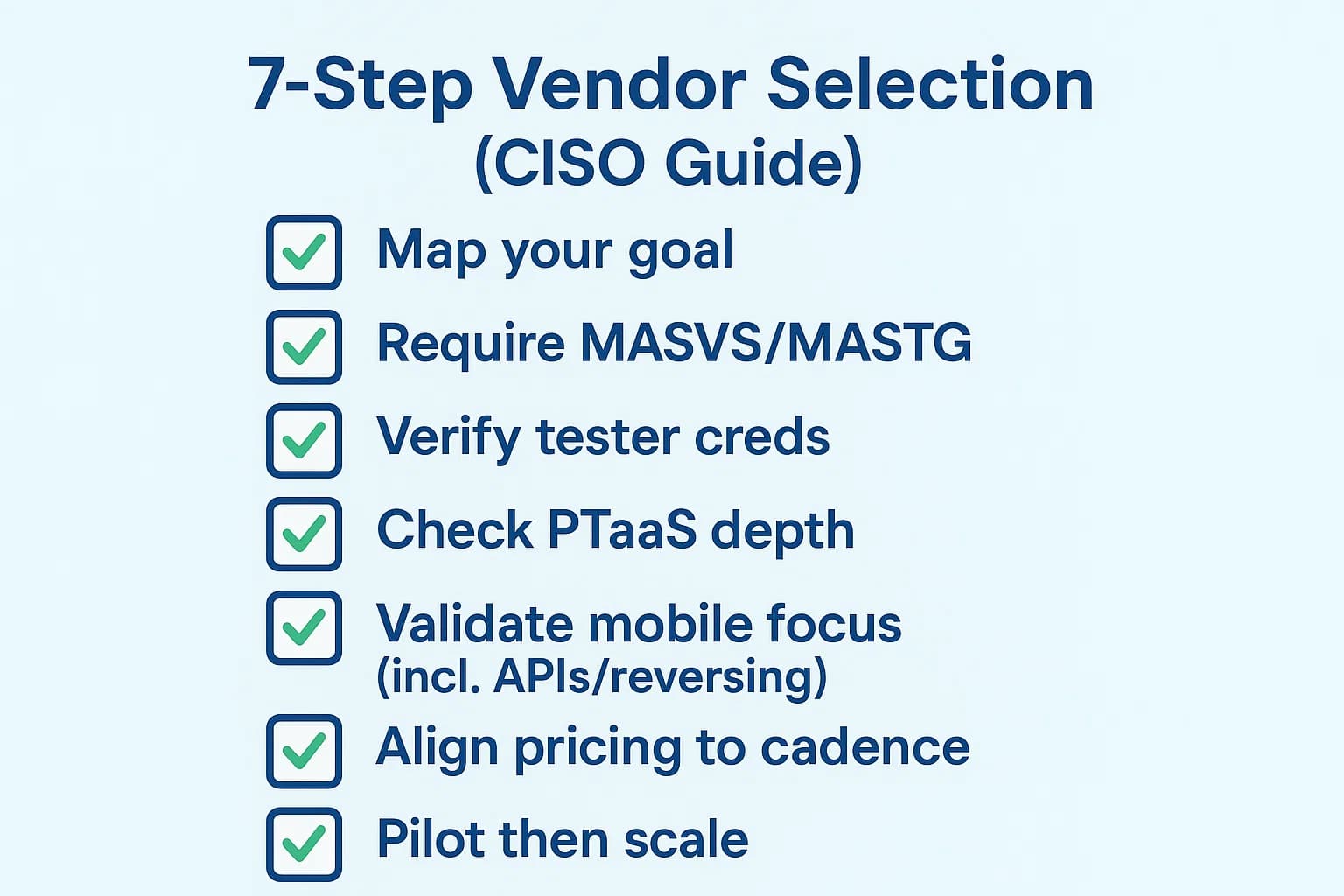
The procurement of a penetration testing service is a critical decision that requires a nuanced evaluation beyond a simple comparison of price lists. A successful engagement depends on finding a partner whose expertise, methodology, and delivery model align with the organization's specific security goals and operational workflows.
The most crucial, yet often overlooked, aspect of this evaluation is the vendor's approach to remediation support. The ultimate goal of a penetration test is not merely to discover vulnerabilities but to ensure they are effectively remediated.
A vendor that acts as a collaborative partner in the fixing process, rather than one that simply delivers a report, provides exponentially more value by directly contributing to risk reduction. This section provides a checklist of key criteria for CISOs and technology leaders to use when evaluating potential vendors.
Certifications and accreditations serve as an essential, third party validation of a vendor's capabilities and professionalism. They provide a baseline of assurance that the company and its testers adhere to rigorous industry standards.
The most effective penetration tests are not purely manual or purely automated; they use a hybrid approach that combines the strengths of both.
A modern penetration test should not operate in a silo. Its value is maximized when its outputs are seamlessly integrated into the organization's existing development and security workflows. This is where a continuous penetration testing platform provides significant advantages over a traditional model that ends with the delivery of a static PDF report.
Key questions to ask a potential vendor include:
The final report is the primary deliverable of a penetration test, and its quality is a direct reflection of the quality of the engagement. A valuable report is one that drives action, not one that gathers dust.
A high quality report should include:
Budgeting for mobile application penetration testing requires a clear understanding of market pricing, the factors that influence cost, and the framework for justifying the investment to stakeholders.
As organizations increasingly view security as a continuous process rather than a one time event, the financial model is shifting from a focus on the "cost per test" to the "cost of a program." This reflects a move towards treating security testing as a recurring operational expense (OpEx) that aligns with modern, agile development practices, rather than a standalone capital expense (CapEx).
Penetration testing vendors typically offer several pricing models, and understanding their structure is key to finding the best fit for an organization's budget and testing cadence.
Few vendors publish mobile pentest prices, but the published figures give a useful reference point. Schellman (schellman.com) says to expect no less than $14,500 per mobile app test, and Halo Security (halosecurity.com) says a simple penetration test of any type generally starts at $3,950; that is a general pentest price, not a mobile-specific one. Testing both iOS and Android, including the backend APIs, or scoping for compliance usually raises the quote, and DeepStrike quotes each engagement per scope. Ask whether a low quote includes manual testing or only automated scanning.
Several key factors influence the final cost of an engagement:
Justifying the cost of a penetration test to non technical stakeholders and executive leadership requires framing it not as an expense, but as a high return investment in risk mitigation. The return on investment (ROI) can be demonstrated with a simple, powerful equation that compares the cost of the test to the potential cost of a data breach.
The core calculation is as follows:
Expected loss avoided = annual probability of a breach × cost of a breach × reduction in that probability from testing and fixing
An illustrative example, using assumptions rather than benchmarks: take the $4.99 million global average breach cost from IBM's 2026 report and a $15,000 test. If testing and fixing the findings lowers the chance of a breach this year by just one percentage point, the expected loss avoided is about $49,900, more than three times the cost of the test. Plug in your own breach likelihood and cost figures to build the case for your board.
This section provides direct, authoritative answers to common questions about mobile application penetration testing, serving as a quick reference guide for key concepts and terminology.
The OWASP Mobile Application Security Verification Standard The OWASP MASVS is the industry's gold standard for mobile app security. It provides a comprehensive, community vetted checklist of security requirements that a secure mobile app should meet. A vendor that aligns their testing methodology with the MASVS and its companion, the Mobile Application Security Testing Guide OWASP Mobile Application Security Testing Guide (MASTG), demonstrates a commitment to a rigorous, repeatable, and thorough assessment process. This alignment ensures that the test isn't just an ad hoc collection of techniques but a systematic validation against a globally recognized benchmark, giving you higher confidence in the results.
The choice between Penetration Testing as a Service (PTaaS) and traditional, project based pentesting depends on your development speed and security goals. Traditional pentesting is a point in time assessment, ideal for annual compliance checks or pre launch validation. PTaaS, on the other hand, is a subscription based model that offers a platform for continuous testing, real time results, and deep integration with developer tools like Jira. For mobile apps developed in an agile or DevOps environment with frequent updates, PTaaS is generally better because it aligns security with the speed of development, shortens the time to fix vulnerabilities, and makes retesting seamless. This explains why continuous penetration testing matters for modern applications.
Few vendors publish prices. Schellman says to expect no less than $14,500 per mobile app test, and Halo Security says a simple penetration test of any type generally starts at $3,950 (both checked November 2026). Testing both iOS and Android, the app's complexity (screens, user roles, APIs), the testing methodology (black, white or gray box) and compliance requirements such as HIPAA or PCI DSS all raise the price.
A typical mobile application penetration test takes between one to three weeks to complete, depending on the application's complexity and the scope of the engagement. A simple application might be assessed in 5-7 business days, while a complex financial or healthcare application with numerous features and user roles could require 10-15 business days or more for a thorough evaluation.
A high quality penetration test report is more than just a list of vulnerabilities. It should be an actionable document that drives remediation. Key components include:
Testing the mobile APIs is a critical part of a comprehensive assessment, because the backend is where many of the most serious findings sit. Testers use an intercepting proxy tool like Burp Suite to capture and analyze all the network traffic between the mobile app and its backend servers. By examining these API requests and responses, they can test for a wide range of vulnerabilities, including broken authentication and authorization (like issues with OAuth security best practices, injection flaws, excessive data exposure, and other weaknesses outlined in the OWASP API Security Top 10.
Professional penetration testers use a sophisticated toolkit to analyze and assess mobile applications. While the tester's skill is the most important factor, these tools are essential for modern mobile security assessments.
DeepStrike runs human-led iOS and Android tests, including the APIs they call, with reproduction evidence and remediation guidance. Let’s tailor a pilot on your highest risk app.
Mohammed Khalil is a Cybersecurity Architect at DeepStrike, specializing in advanced penetration testing and offensive security operations. With certifications including CISSP, OSCP, and OSWE, he has led numerous red team engagements, focusing on cloud security, application vulnerabilities, and adversary emulation. His work involves dissecting complex attack chains and developing resilient defense strategies for clients in the finance, healthcare, and technology sectors.

Stay secure with DeepStrike penetration testing services. Reach out for a quote or customized technical proposal today
Contact Us
