November 6, 2026
Updated: November 6, 2026
The status of the $177 million AT&T settlement, who qualified, what the payments may be, and how to spot fake settlement messages.

Mohammed Khalil
The AT&T data breach settlement is a $177 million class action deal covering two incidents AT&T announced in 2024. A federal court granted final approval on October 2, 2026, but as of November 7, 2026, no payments have gone out and no payment date has been announced. The settlement administrator says payments are not expected in 2026. The claim deadline passed on December 18, 2025, so you can't file now. If you filed a valid claim, you don't need to do anything. Anyone charging a fee to release your money is likely a scammer.
| Question | Answer as of November 7, 2026 |
|---|---|
| Is the settlement approved? | Yes. Final approval was granted on October 2, 2026. |
| Total amount | $177 million: $149 million for the first incident and $28 million for the second. |
| Can I still file a claim? | No. The deadline was December 18, 2025. |
| Have payments started? | No. The administrator said on October 30, 2026 that payments have not been issued. |
| When will I be paid? | No date has been announced. Payments are not expected in 2026. |
| How much will I get? | Tier payments are estimated at about $6.50 to $40. Documented losses can go up to $5,000 or $2,500. |
| Do I need to do anything? | Not if you filed a valid claim, unless your address changed. |
The approval and amounts come from the October 2, 2026 court opinion, signed by Senior Judge Sidney A. Fitzwater after Judge Ada E. Brown recused. The payment status comes from the October 30 update by the administrator, Kroll Settlement Administration.
This guide is general information, not legal advice. DeepStrike is a cybersecurity company with no role in this case and no affiliation with AT&T, the administrator or the court. For your own claim, the official settlement website is the only source that counts.
The settlement combines two events with different data. The difference decides which payments applied to you.
| Detail | First incident (AT&T 1) | Second incident (AT&T 2) |
|---|---|---|
| Announced | March 30, 2024 | July 12, 2024 |
| What was exposed | Some mix of names, addresses, phone numbers, emails, birth dates, passcodes, billing account numbers and Social Security numbers | Phone numbers, interaction counts, call durations and, for some people, cell site IDs |
| What was not exposed | AT&T said no personal financial information or call history | Call or text content, names, Social Security numbers and birth dates |
| Age of the data | 2019 or earlier, per AT&T | May 1 to October 31, 2022, plus January 2, 2023 |
| Scale | About 7.6 million current and 65.4 million former account holders | Nearly all AT&T wireless customers, reported as about 109 million accounts |
| Where it came from | Source not established publicly by AT&T at the time | An AT&T workspace on a third-party cloud platform hosted by Snowflake |
The first incident. AT&T said in March 2024 that AT&T-specific fields were in a data set released on the dark web about two weeks earlier, and that it was still assessing the source. It reset the passcodes of 7.6 million customers. The plaintiffs' complaint alleges a compromise in 2019 and says the data appeared on the dark web by August 20, 2021. Those are allegations, and AT&T settled without admitting liability or wrongdoing.
The second incident. AT&T's SEC filing says it learned on April 19, 2024 that a threat actor claimed to have copied its call logs, and that files were taken between April 14 and April 25, 2024. The Justice Department twice determined that a delay in public disclosure was warranted. AT&T also warned that even without names, public tools can often link a phone number to a name. Reuters reported the figure of about 109 million accounts.
The criminal case. Connor Riley Moucka pleaded guilty on August 5, 2026 to a conspiracy that used stolen logins against at least 165 customers of a cloud software company. The Justice Department release doesn't name AT&T, but CyberScoop lists AT&T among the victims. Sentencing was set for October 27, 2026; we could not confirm the outcome.
For wider context, see our data breach statistics and telecom cybersecurity statistics.
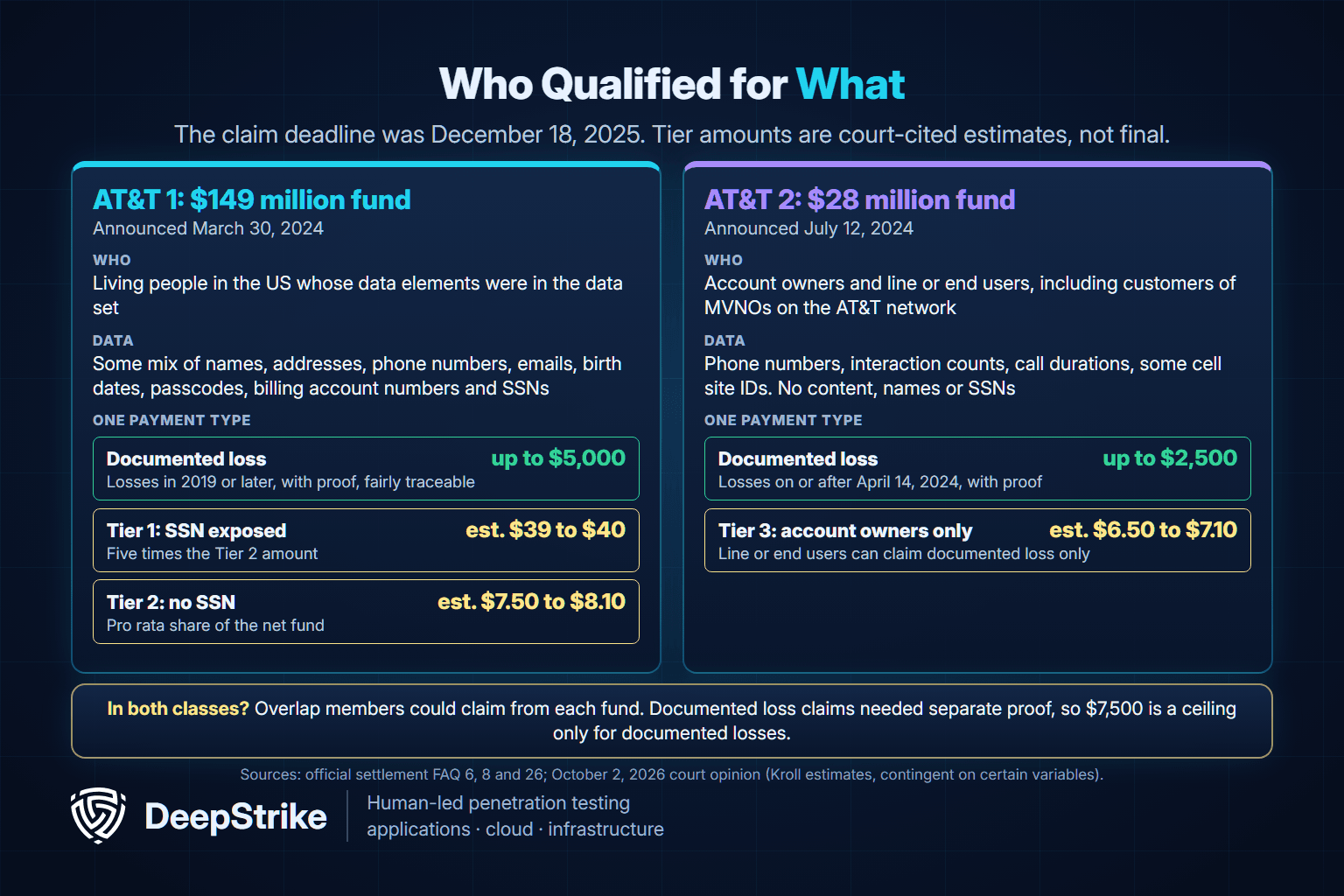
There are two settlement classes, and you could be in one, both or neither. Membership depended on whether your data was involved, not simply on being an AT&T customer.
How do you know if you were included? The official FAQ points to three kinds of proof: an AT&T notice from March or April 2024 about the first incident, a notice about your call and text records for the second, or a Class Member ID on a postcard or email sent by the administrator in 2025. If you aren't sure, the FAQ says to call the administrator at (833) 890-4930.
Most people will get a small tier payment. The $5,000 and $2,500 figures are caps for documented losses, not typical payouts.
| Payment type | Who it applied to | Amount | Status of the figure |
|---|---|---|---|
| Documented loss, AT&T 1 | AT&T 1 members with proof of losses in 2019 or later | Up to $5,000 | Cap set by the settlement |
| Documented loss, AT&T 2 | AT&T 2 members with proof of losses on or after April 14, 2024 | Up to $2,500 | Cap set by the settlement |
| Tier 1 | AT&T 1 members whose Social Security number was exposed | About $39 to $40 | Kroll estimate cited by the court |
| Tier 2 | AT&T 1 members whose Social Security number was not exposed | About $7.50 to $8.10 | Kroll estimate cited by the court |
| Tier 3 | AT&T 2 account owners only | About $6.50 to $7.10 | Kroll estimate cited by the court |
The court describes the tier estimates as contingent on certain variables, so treat them as a guide. The opinion's list labels Tier 2 under AT&T 2, while the official website and FAQ place Tier 2 in AT&T 1, so we follow the official definition above.
About the $7,500 figure. It is simply $5,000 plus $2,500, for someone in both classes with documented losses at both caps. The FAQ says the same proof can't be used twice.
What counted as a documented loss. Unreimbursed costs fairly traceable to the incidents, such as identity theft losses, related expenses and credit monitoring. The FAQ excludes medical bills, emotional distress, estimated lost wages or time, and credit score drops.
Tier payments are small because they are shares of what remains after court-approved costs, split across millions of claims. These figures come from the court opinion.
| Item | Amount |
|---|---|
| Total settlement funds | $177,000,000 |
| Attorneys' fees (one-third of each fund) | About $59,000,000 |
| Litigation costs | $1,060,051 |
| Administration charges approved so far | $18,856,175 |
| Service awards (36 class representatives at $1,500) | $54,000 |
| Left before further costs and documented losses (DeepStrike arithmetic) | About $98,030,000 |
The court reserved judgment on about $4 million more in estimated administration costs, and documented-loss payments come out before tier payments. The FAQ says those are applied up to $25 million for AT&T 1. No money reverts to AT&T. If funds remain, the court ordered redistribution to claimants to be considered first, where feasible.
The opinion reports 4,918,073 claims received: 1,654,046 allowed as Tier 1, 687,859 as Tier 2 and 1,582,248 as Tier 3. Another 1,099,732 were rejected, including 804,381 declined for fraud. These are claim counts, not people, and they may change.
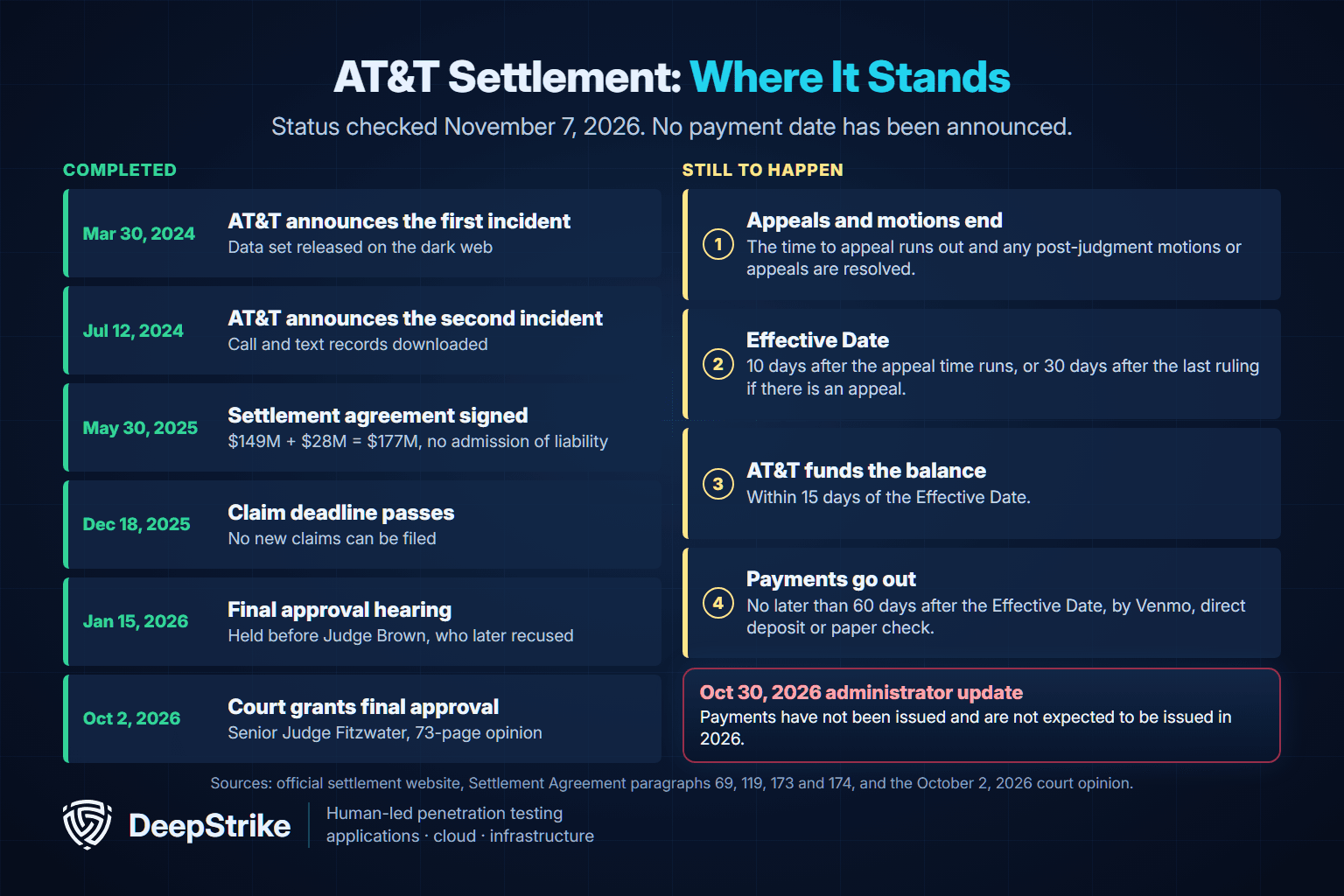
No date has been announced. The administrator's October 30, 2026 update says payments can't be made until the settlement becomes effective, which happens only after the time to appeal has ended and any post-judgment motions or appeals are resolved. It adds that payments are not expected in 2026.
Some October headlines said payments had started or were weeks away. The administrator's later update says they have not been issued, so go with the official site.
Here is how the Settlement Agreement sets the sequence:
A best-case calculation. Federal rules generally give 30 days to appeal, which from October 2 lands on Sunday, November 1, and rolls to Monday, November 2. Add 10 days for an Effective Date of November 12, then 60 days for an outer limit of about January 11, 2027. That only works if no appeal or qualifying motion was filed, and it is DeepStrike's arithmetic, not an announced date.
What we could not confirm. We could not verify from a current docket whether anyone appealed. About 45 objectors filed objections, and the court noted that one argument "may be raised on appeal". An appeal could add months or longer. The FAQ also says distribution begins only after all claim forms have been reviewed.
How you'll be paid. The agreement says payment goes by Venmo or direct deposit, based on what you elected on your claim form, or by paper check if you didn't elect electronic payment or your details were wrong. Checks must be cashed within 180 days. To update your address, use the phone number, mail address or Contact section on the official website.
| Your situation | What it means | What to do |
|---|---|---|
| You filed a valid claim | You are waiting for the Effective Date | Nothing, unless your contact details changed |
| You got a Notice of Deficient Claim Form | The response deadline was September 8, 2026 | If you missed it, you may get substantiated losses or a tier payment, whichever is higher, or nothing if class membership wasn't verified (FAQ 30 and 34) |
| You got a Notice of Denial | You may be able to cure a denial for unverified class membership | Mail the response form by the date in your own notice, as the notice instructs |
| You never filed | You won't receive a payment | No new claims are accepted, and you can't sue AT&T or other released parties, including Snowflake, over these incidents (FAQ 11 and 22) |
| You opted out by November 17, 2025 | You get no payment but keep your right to pursue your own claim | Ask your own lawyer; the court said most of the 10,741 requests were late or non-compliant |
The FAQ gives 22 days from the notice date to cure a denial, while the opinion describes 21 days from the email for claims flagged as fraudulent, so use the date in your notice. The administrator won't accept documents by email.
Parts of the official FAQ still carry wording from before approval. The October 30 banner on the home page is the newest statement.
A well-publicized settlement with millions of waiting claimants gives scammers an easy story to copy. Anyone doing that is impersonating the settlement, not acting for it. As of our check, we found no official alert describing a specific campaign, and DeepStrike has no connection to AT&T, Kroll or the court. The checklist below is ours, built from the official process and FTC guidance. It isn't a copy of any real message.
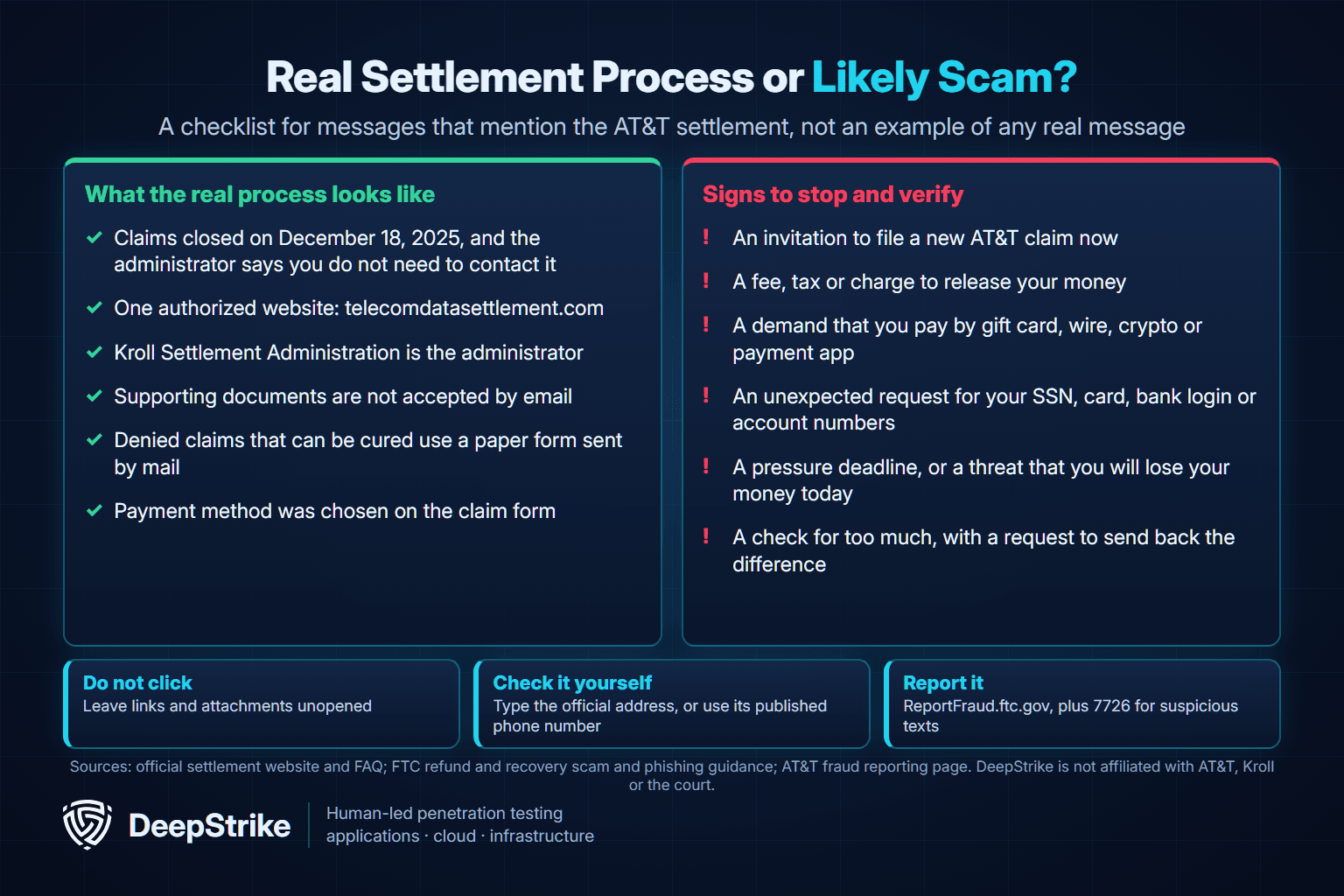
What the real process looks like:
Warning signs, from the FTC's guidance on refund and recovery scams:
An offer to file a new AT&T claim is also a red flag, since the deadline has passed. Because real payments can go to Venmo or a bank account, a request to "update" those details deserves a check through the official site. That's our inference, not a reported campaign.
What to do with a suspicious message:
Fake notices are a form of social engineering, and breached personal details can turn them into spear phishing.
These steps come from IdentityTheft.gov and the FCC.
Reducing your digital footprint limits what a scammer can combine with breached data. For the wider trend, see our identity theft statistics.
Search results often mix these up.
| Matter | What it was about | What it means for you |
|---|---|---|
| $177 million class action settlement | The two incidents announced in 2024 | Covered in this guide |
| FTC refunds | Slowing data speeds on unlimited plans, not a breach | A separate refund program with its own administrator |
| FCC $13 million settlement (September 2024) | A January 2023 breach of a vendor's cloud environment | A government enforcement action with security commitments |
The FTC's refund page says it is sending Zelle payments to some people who didn't cash an earlier payment, and that it never asks for money to receive a refund. The FCC announcement sets out the consent decree terms.
Settlements are only part of the bill, as our guide to the average cost of a data breach shows. Four points from this case are worth acting on.
Stolen logins can be enough on a SaaS data platform. AT&T's filing doesn't state how the workspace was accessed, so this is campaign-level evidence, not an AT&T finding. Mandiant's analysis of the UNC5537 campaign traced compromises to credentials stolen by infostealer malware and named three factors: no multi-factor authentication, credentials never rotated, and no network allow lists. It found no evidence of a breach of Snowflake's own enterprise environment.
Metadata counts as sensitive data. The second incident had no names, content or Social Security numbers, and it still produced a $28 million fund. If your data classification treats logs and records as low risk, revisit it.
Retention and vendors extend your exposure. The first data set dated from 2019 or earlier, and most affected accounts were former accounts by 2024. The FCC matter turned on a vendor that should have returned or destroyed customer data years before it was breached. Build deletion and oversight into your third-party risk management.
Plan for what follows disclosure. AT&T's filing says it learned of the second incident from a threat actor's claim, partway through the download window. Ask whether your team would have caught a bulk export itself. Then cover customer communications in your incident response plan, including how customers can recognize real messages.
Testing can check these points with evidence:
| Question to test | What it validates |
|---|---|
| Can a stolen employee or service credential reach customer data in a SaaS or cloud platform? | MFA coverage, allow lists and credential rotation |
| Would a large export from that platform raise an alert someone acts on? | Logging and detection |
| Does old or vendor-held data still sit where it can be reached? | Retention and vendor controls |
A test doesn't guarantee security or settle legal exposure, but it replaces assumptions with findings. DeepStrike's penetration testing services and cloud penetration testing can scope these questions. If you want to talk it through, contact DeepStrike.
Yes. It is a court-approved class action in the US District Court for the Northern District of Texas, MDL No. 3:24-md-03114. Kroll Settlement Administration runs it, and telecomdatasettlement.com is the only authorized website. Scam messages can still copy its name.
Not according to the administrator. Its October 30, 2026 update says payments have not been issued and are not expected in 2026.
Without documented losses, court-cited estimates are about $39 to $40 for Tier 1, $7.50 to $8.10 for Tier 2 and $6.50 to $7.10 for Tier 3. With approved documentation, payments can reach $5,000 for the first incident and $2,500 for the second.
No. The deadline was December 18, 2025, and the administrator says claims can no longer be submitted. Be wary of anyone offering to file one now.
If you filed a claim, wait, keep your details current and verify any settlement message through the official website. If you run security for an organization, start with one question from this case: could a stolen login reach your customer data on a platform you don't host?
Mohammed Khalil is a Cybersecurity Architect at DeepStrike, specializing in advanced penetration testing and offensive security operations. With certifications including CISSP, OSCP, and OSWE, he has led numerous red team engagements, focusing on cloud security, application vulnerabilities, and adversary emulation. His work involves dissecting complex attack chains and developing resilient defense strategies for clients in the finance, healthcare, and technology sectors.

Stay secure with DeepStrike penetration testing services. Reach out for a quote or customized technical proposal today
Contact Us
