August 24, 2026
Updated: August 24, 2026
Onion vs garlic routing, circuits vs tunnels, exits vs outproxies: where each anonymity network actually wins.
Abdalla Mohamed
The Tor vs I2P question comes up whenever someone digs past the surface of anonymity networks, because the two projects solve overlapping problems in genuinely different ways. In one line: Tor is built for reaching the normal internet anonymously, while I2P is built as a self-contained anonymous network where the services live inside. One routes you out; the other routes you in. This guide compares their architecture, encryption, speed, anonymity research, and real use cases, with a table for every difference that matters.
Updated: August 2026. Reflects current software (Tor Browser 15.x and the Arti client; Java I2P 2.13.0 and i2pd 2.61.0) and the current I2P cryptography (ECIES-X25519, which replaced ElGamal).
Use Tor when you want to browse the public internet anonymously or reach .onion sites; it has millions of estimated users, a large relay network, and two decades of scrutiny behind it. Use I2P when you want services hosted inside an anonymous network, peer-to-peer file sharing, or in-network mail and chat; that is what its architecture was designed for. For how these tools compare with VPNs, see our Tor vs VPN vs proxy comparison.
| Question | Tor | I2P |
|---|---|---|
| Main job | Anonymous access to the internet | An anonymous internet of its own |
| Best at | Browsing the clearnet and .onion sites | Hosting hidden services, P2P, in-network apps |
| Users / routers (approx.) | Millions of estimated Tor users | 40K+ active I2P routers |
| Routing | Onion routing, bidirectional circuits | Garlic routing, unidirectional tunnels |
| Reaching normal websites | Core feature, thousands of exits | Afterthought, a handful of outproxies |
Neither is simply "better." They optimize for different jobs, and the rest of this guide shows exactly where each one wins.
Tor, originally The Onion Router, anonymizes your traffic by relaying it through three volunteer-run relays (guard, middle, and exit), wrapping it in three layers of encryption so no single relay sees both who you are and what you are visiting. It grew out of onion routing research at the US Naval Research Laboratory in the 1990s, became open source in 2002, and has been run by the nonprofit Tor Project since 2006, a story we trace in who created the dark web. Most people use it through Tor Browser, and we break down the full mechanics, from the ntor handshake to directory authorities, in our guide to how Tor works.
The key design choice: Tor is client-first. You are a client by default, relays are run by a smaller set of volunteers, and the network's map is maintained by a small group of trusted directory authorities that publish a signed consensus.
I2P, the Invisible Internet Project, takes the opposite approach: it is a network-first design where anonymity comes from everyone participating in a shared, decentralized mesh. It began in 2001 as the Invisible IRC Project, was rebuilt and renamed I2P in 2003 by an anonymous developer known as jrandom, and survived his abrupt disappearance in 2008 to reach its current releases under a volunteer team. Two implementations exist today: the original Java I2P (version 2.13.0, released July 2026) and i2pd, a lighter C++ router (version 2.61.0, released July 2026).
Inside I2P you find eepsites (I2P's equivalent of onion sites), the built-in I2PSnark torrent client, mail systems like SusiMail and the serverless I2P-Bote, and IRC, all reachable only from within the network. Three design choices define it:
If terms like darknet and dark web are still fuzzy, our dark web vs darknet vs Tor explainer sorts the vocabulary; I2P is a darknet in the strict sense, just like Tor.
Here is the full side-by-side. Every row is expanded in a later section.
| Dimension | Tor | I2P |
|---|---|---|
| Primary purpose | Anonymous clearnet access + onion services | Self-contained anonymous network |
| Routing technique | Onion routing | Garlic routing (bundled messages) |
| Path structure | One bidirectional circuit (3 relays) | Separate one-way inbound + outbound tunnels (3 hops each by default) |
| Path lifetime | New circuits roughly every 10 minutes | Tunnels expire and rebuild roughly every 10 minutes |
| Network map | ~9 directory authorities publish a signed consensus | NetDB: a Kademlia-style DHT served by floodfill routers |
| Who relays traffic | Volunteer relays (~8,000) | Every participant, by default |
| Switching model | Circuit-switched streams | Packet-switched messages |
| Transport protocols | TCP only | NTCP2 (TCP) and SSU2 (UDP) |
| Current key exchange | ntor (curve25519) | ECIES-X25519-AEAD-Ratchet |
| Hidden services | Onion services (.onion, 56-char v3) | Eepsites (.i2p, 52-char b32) |
| Clearnet exit | Thousands of exit relays | A handful of volunteer outproxies |
| Users / routers (approx.) | Millions of estimated Tor users | 40K+ active I2P routers |
| Governance | Tor Project nonprofit, paid staff, audits | Volunteer community, historically anonymous devs |
| Client software | Tor Browser, Arti (Rust) | Java I2P, i2pd (C++) |
Tor and I2P solve many of the same sub-problems, so a lot of the difference is vocabulary. I2P's own documentation publishes a translation table in its official comparison with Tor; these are the pairs worth knowing.
| Tor term | I2P term | What it is |
|---|---|---|
| Relay / node | Router | A machine that forwards traffic |
| Circuit | Tunnel | The encrypted path your traffic takes |
| Directory (authorities) | NetDB (floodfill routers) | How the network learns who is in it |
| Exit node | Outproxy | The hop that touches the normal internet |
| Onion service | Eepsite / I2P Site | A service hidden inside the network |
| Hidden service descriptor | LeaseSet | How a hidden service publishes reachability |
| Router descriptor | RouterInfo | A node's published contact card |
| Cell | Message | The unit of traffic |
| Entry guard | Fast peer | A trusted, stable first hop |
Keep this table handy; the rest of the comparison reads much more easily once "outproxy means exit node" is automatic.
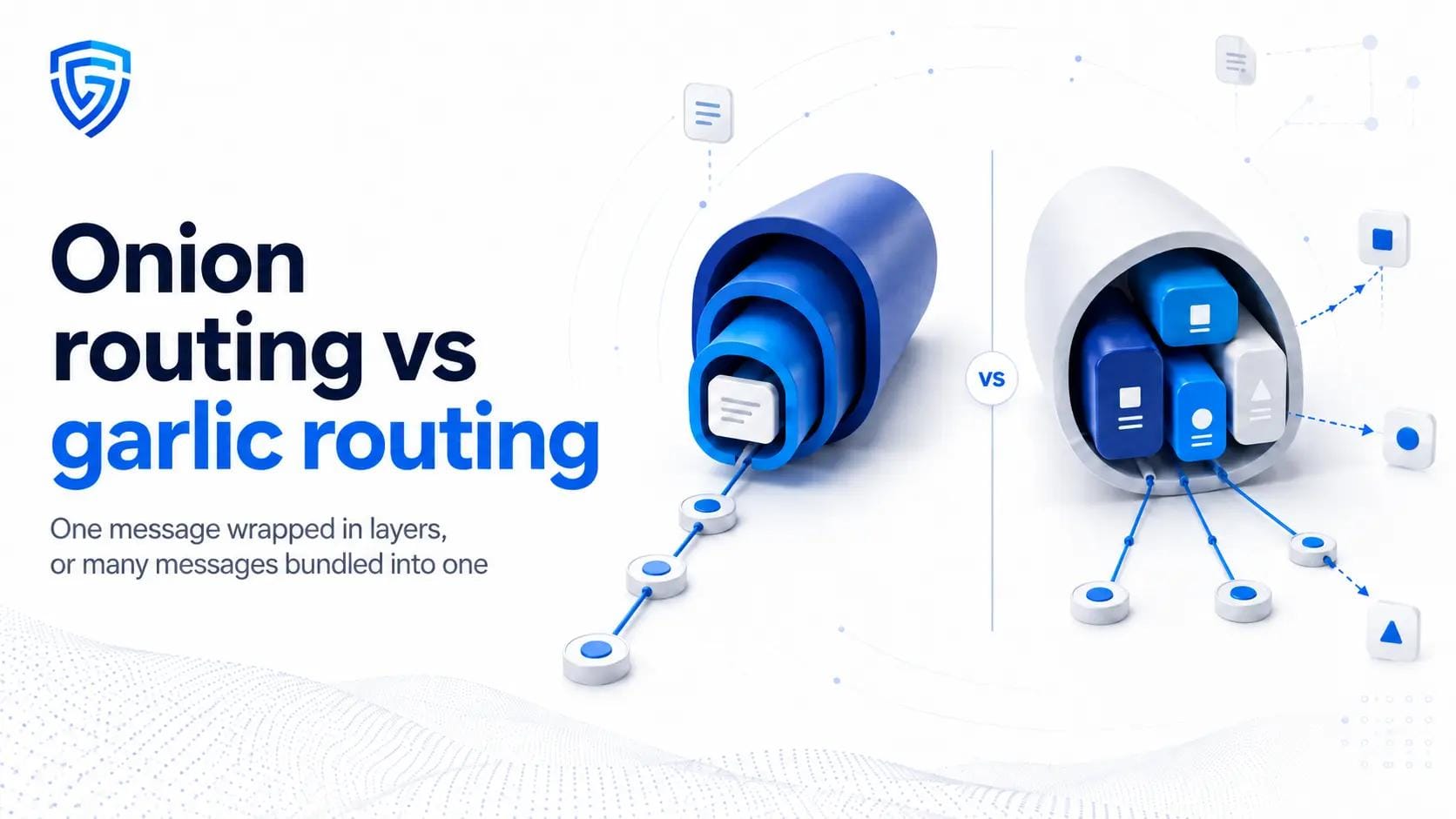
The most quoted difference is the routing metaphor, and it is more than branding.
Onion routing wraps a single message in one encryption layer per hop. Your Tor client encrypts a cell three times; the guard peels the first layer, the middle the second, and the exit the third, so each relay learns only its neighbors. One message, one path, layer by layer.
Garlic routing, described in I2P's technical documentation, extends that idea by bundling multiple messages, called cloves, into a single encrypted "garlic". One bundle can carry your web request, a delivery status message, and routing instructions for the far end, each clove with its own destination. Bundling makes individual messages harder to isolate and count, which raises the cost of some traffic-analysis techniques.
| Property | Onion routing (Tor) | Garlic routing (I2P) |
|---|---|---|
| Unit sent | One message per path | Multiple messages bundled per garlic |
| Layered encryption | Yes, one layer per relay | Yes, plus end-to-end clove encryption |
| Path direction | Same circuit both ways | Different tunnels each way |
| Message mixing | No bundling | Cloves from different flows can share a bundle |
| Current cryptography | ntor handshake, AES-CTR layers | ECIES-X25519 with ChaCha20/Poly1305 |
One myth to retire: garlic routing is not "onion routing but more encrypted." Both encrypt in layers with modern primitives. The real differences are message bundling and tunnel directionality, not encryption strength.
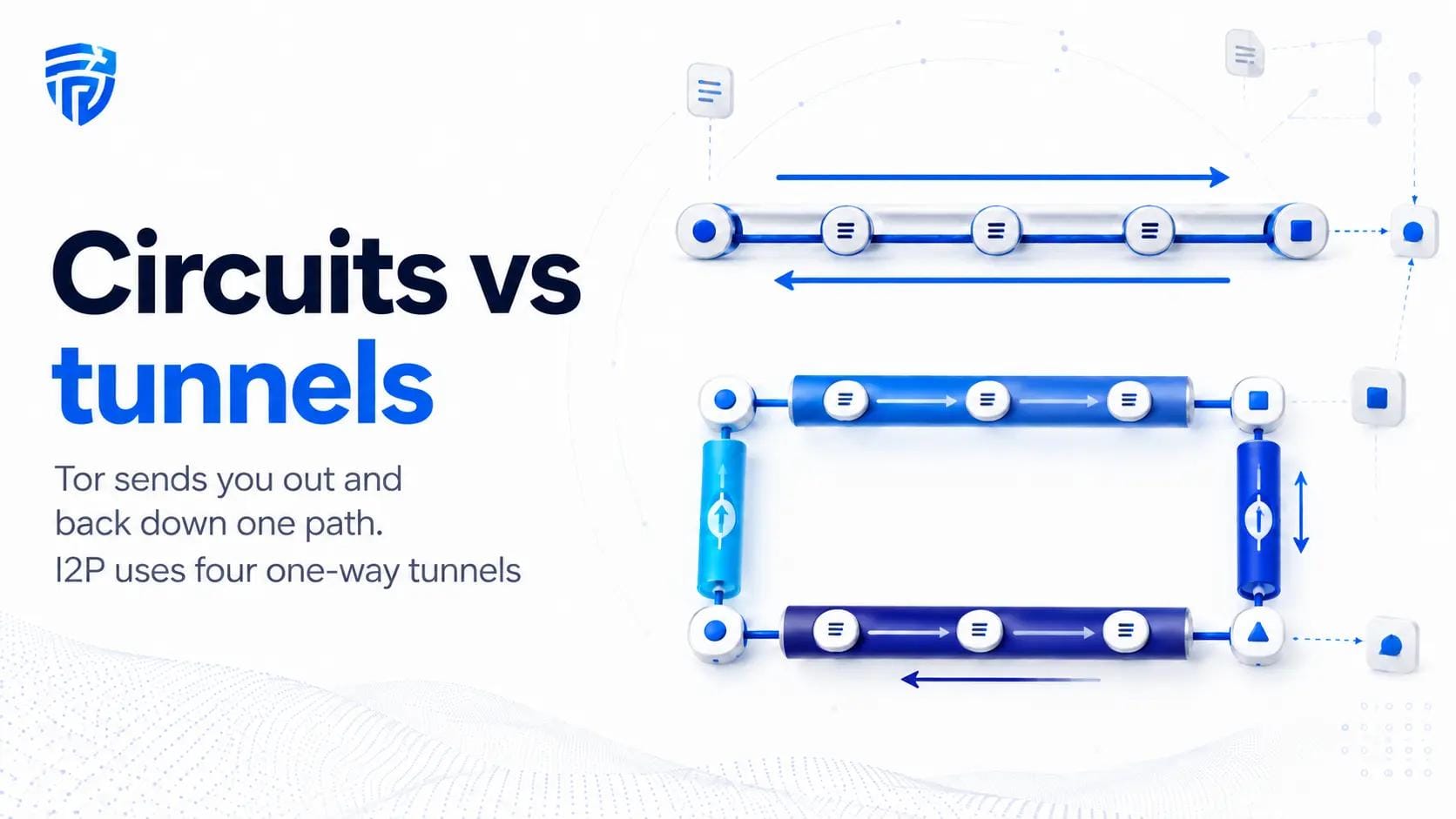
The deepest divergence is what a "path" is in each network.
In Tor, your client builds one bidirectional circuit: requests go out through guard, middle, and exit, and responses come back along the same three relays in reverse. Circuits persist for around ten minutes for new connections and are managed against a global network view distributed by the directory authorities.
In I2P, paths are unidirectional and paired. Your router builds outbound tunnels for traffic you send and separate inbound tunnels for traffic addressed to you, each defaulting to three hops. A full round trip to an eepsite therefore crosses four tunnels: your outbound, their inbound, their outbound, and your inbound. An observer who compromises part of one direction sees only half the conversation's path, and because tunnels expire roughly every ten minutes, the target moves constantly.
The network-map difference matters just as much:
The honest version of the security comparison has two halves that point in different directions.
On paper, I2P's architecture complicates several attacks. Unidirectional tunnels mean an attacker needs visibility into both directions to correlate a full conversation. Short tunnel lifetimes shrink the window any compromised position is useful. Garlic bundling makes message counting noisier, and there is no central directory to subvert.
In practice, Tor has the stronger security record. Security for anonymity networks is not only design; it is scrutiny, funding, and crowd size:
| Security dimension | Tor | I2P |
|---|---|---|
| Anonymity set (crowd size) | Millions of estimated users | 40K+ active routers |
| Central trust point | Directory authorities (small, audited set) | None, but floodfills are attackable |
| Best-known attack class | End-to-end correlation, malicious exits | Sybil/eclipse on floodfills, tunnel correlation |
| Published research volume | Very large, two decades | Much smaller |
| Anti-censorship tooling | Bridges + pluggable transports | Limited |
| Funded security team | Yes (nonprofit, paid staff) | Volunteer |
So "is I2P more anonymous than Tor" has no one-word answer: I2P's design frustrates some attacks Tor accepts, while Tor's scale and scrutiny defeat attacks I2P cannot afford to absorb. For common browsing threat models, Tor is generally the better-studied choice and offers the larger anonymity set, while I2P retains architectural advantages for specific in-network use cases.
For ordinary clearnet browsing, Tor will generally be the more practical and often faster option. Its relays include high-bandwidth dedicated servers, its circuit-switched design suits request-and-response traffic, and academic measurements have consistently found lower latency and quicker page loads on Tor than I2P for comparable fetches.
I2P's performance story is different rather than simply worse. Because every participant relays traffic and the network supports UDP through SSU2, I2P handles long-lived, high-throughput, in-network transfers, exactly the shape of BitTorrent traffic, better than its browsing latency suggests. Expect eepsites to load noticeably slower than clearnet sites over Tor, and expect in-network torrents to run steadily in the background.
Two caveats keep this honest: throughput on both networks varies enormously with path selection and congestion, and I2P performance depends on how much bandwidth your own router shares, since you are part of the infrastructure you are using.
This is the starkest practical difference, and the one that decides most users' choice.
Tor treats clearnet access as its core product. Thousands of volunteer exit relays carry traffic to normal websites, exit policies are managed, and abuse handling is an organized (if thankless) part of the ecosystem.
I2P treats the clearnet as out of scope. The equivalent role, the outproxy, barely exists: a small number of volunteer services carry HTTP and HTTPS out of the network, and since 2022 the default for new installs has been a single nonprofit-operated service, StormyCloud. That concentration is the point to understand: routing your clearnet browsing through one default outproxy is a very different trust proposition from choosing among thousands of Tor exits.
| Clearnet access | Tor | I2P |
|---|---|---|
| Exit capacity | Thousands of exit relays | A handful of outproxies |
| Default behavior | Any circuit can exit | One default outproxy (StormyCloud) |
| Protocol support | TCP (browser traffic, most tools) | HTTP/HTTPS proxying |
| Designed for it? | Yes, core use case | No, an afterthought by design |
| Cross-network reach | Can reach .onion + clearnet, not .i2p | Can reach .i2p, limited clearnet, no .onion |
Note the last row: onion sites and eepsites are separate worlds. Tor cannot open .i2p addresses, and I2P cannot open .onion addresses; each network resolves only its own hidden services.
Both networks let you host a service whose location is hidden even from its visitors, but naming and discovery work differently.
Tor onion services use self-authenticating v3 addresses: 56 base32 characters derived from the service's ed25519 key. There is no naming layer; you get the address from somewhere trustworthy or you do not find the site, a problem we cover in onion sites and .onion links and in our review of dark web search engines.
I2P eepsites have two address forms, per I2P's naming documentation: a permanent cryptographic b32 address (52 base32 characters ending .b32.i2p, the hash of the site's destination key) and optional human-readable .i2p names. The readable names are not a DNS: each router keeps a local address book, seeded by community registration services, and a name only works for you if it is in your book. Jump services bridge the gap by redirecting unknown names. It is a petname system, decentralized and censorship-resistant, but names are not globally unique or universally resolvable.
| Hidden services | Tor onion service | I2P eepsite |
|---|---|---|
| Address form | 56-char .onion (v3, ed25519-derived) | 52-char .b32.i2p, plus optional .i2p petnames |
| Naming layer | None by design | Local address books + registration/jump services |
| Reachability record | Descriptor on Tor's hidden service directories | LeaseSet in the NetDB |
| Typical content | Whistleblower drops, mirrors, markets, forums | Forums, trackers, dev services, personal sites |
| Hosting culture | Larger, more visited | Smaller, more P2P-flavored |
"Is I2P better than Tor" only makes sense per use case. Here is the honest mapping.
| Your goal | Better fit | Why |
|---|---|---|
| Browse the normal web anonymously | Tor | Exits are the core feature; huge anonymity set |
| Visit .onion sites | Tor | Only Tor resolves onion services |
| Evade national censorship | Tor | Bridges + pluggable transports exist for exactly this |
| Host a hidden service long-term | Depends | Tor for reach and audience; I2P's architecture was purpose-built for in-network hosting |
| Anonymous torrenting / P2P | I2P | Built-in I2PSnark keeps swarms in-network; the Tor Project explicitly asks users not to torrent over Tor |
| In-network mail, IRC, forums | I2P | SusiMail, I2P-Bote, and Irc2P live natively inside |
| Maximum crowd to blend into | Tor | Millions of estimated users vs 40K+ active I2P routers |
| Research/curiosity about decentralized designs | I2P | The more radical architecture of the two |
The torrenting row deserves emphasis because it is the one place the answer flips hard: BitTorrent over Tor leaks identifying data through client behavior, is unsupported over UDP, and burdens exit operators, while I2P was effectively shaped by its file-sharing community and handles it natively.
The three-way comparison adds the third classic anonymity network, Freenet, renamed Hyphanet in 2023. It solves yet another problem: not anonymous communication but anonymous, censorship-resistant publishing. Content is uploaded into a distributed encrypted datastore across participants' disks, so a file stays retrievable after its publisher goes offline, and its friend-to-friend darknet mode restricts connections to people you already trust.
| Dimension | Tor | I2P | Freenet / Hyphanet |
|---|---|---|---|
| Core job | Anonymous access | Anonymous network | Anonymous publishing/storage |
| Content lives | On live servers | On live routers' services | In a distributed datastore |
| Publisher offline = content gone? | Yes | Yes | No, content persists |
| Clearnet access | Yes, core feature | Barely (outproxies) | No |
| Live services (chat, dynamic sites) | Yes | Yes | Mostly static content |
| Friend-to-friend mode | No | No (peers are public) | Yes, darknet mode |
| Founded | 2002 (Tor Project 2006) | 2003 (from IIP, 2001) | 2000 (Hyphanet since 2023) |
A useful shorthand: Tor hides the reader, I2P hides the network, Freenet hides the library.
Yes, and it is common among researchers. They are separate programs using separate ports and separate networks, so running both on one machine is unremarkable: Tor Browser for clearnet and onion browsing, an I2P router for eepsites and in-network apps. Privacy-focused operating systems ship both, and some users chain them for specific tasks, though chaining adds latency and complexity without automatically adding anonymity. Treat them as complementary tools in one kit, the same way we frame Tor against VPNs and proxies: different instruments for different jobs, not competitors for one crown.
Every comparison should end with the failure modes the two networks share, because attackers target these instead of the cryptography.
For defenders, Tor vs I2P is not an academic taste test; it defines where your monitoring can see. Credential dumps, initial-access sales, and leak-site chatter concentrate on Tor today, and our dark web statistics roundup shows how much of that economy is measurable. But marketplace takedowns push operators toward alternative rails, and I2P's eepsites and in-network trackers appear repeatedly as fallback infrastructure after major Tor market seizures. A threat-intelligence program that only watches .onion space has an I2P-shaped blind spot.
The same logic applies to your own perimeter: anonymity networks are how real attackers will probe you, which is why testing that simulates them matters. DeepStrike's penetration testing is manual-first and adversary-realistic, probing your external surface the way an anonymous attacker would, and telling you exactly what they would find before they do.
Neither is better overall; they target different jobs. Tor is better for anonymous clearnet browsing, censorship evasion, and blending into a large crowd. I2P is better for in-network hidden services, torrenting, and decentralized applications. Pick by use case, and use both if your needs span both.
Architecturally, I2P's unidirectional tunnels and lack of central directories complicate some attacks. Practically, Tor's far larger user base, funding, and two decades of published scrutiny make it the better-studied and larger-anonymity-set choice for most common browsing use cases. Published research has deanonymized I2P services through its floodfill system.
Onion routing sends one message wrapped in one encryption layer per hop. Garlic routing, I2P's variant, bundles several messages ("cloves") into one encrypted package and sends them through one-way tunnels. The practical differences are message bundling and tunnel directionality, not stronger encryption.
Yes. They are independent programs and networks, so you can run both on the same machine: Tor Browser for clearnet and .onion browsing, and an I2P router for eepsites and in-network apps. Chaining one through the other is possible but adds latency without automatic anonymity gains.
No. Onion services exist only inside Tor, and eepsites exist only inside I2P; neither network resolves the other's addresses. I2P can reach a limited slice of the normal internet through volunteer outproxies, but for .onion sites you need Tor.
Running I2P, like running Tor, is legal in most jurisdictions including the United States. The networks are neutral infrastructure used for both legitimate and criminal purposes; legality attaches to what you do over them, not to the software itself. Some restrictive countries block or discourage both.
I2P hosts eepsites (in-network websites), anonymous torrenting through the built-in I2PSnark client, mail via SusiMail and the serverless I2P-Bote, IRC, and other peer-to-peer applications. Its design keeps traffic inside the network, which suits hosting and file sharing more than ordinary web browsing.
For web browsing, no; measurements consistently show Tor loading pages faster, and eepsites feel slower than clearnet sites over Tor. I2P holds its own for long-running in-network transfers like torrents, where its packet-switched design and UDP transport work in its favor.

Stay secure with DeepStrike penetration testing services. Reach out for a quote or customized technical proposal today
Contact Us
