August 23, 2026
Updated: August 24, 2026
Five terms, one clear map: clearnet, deep web, dark web, darknet, and where Tor actually sits.
Abdalla Mohamed
The terms in the dark web vs darknet vs Tor debate get mixed up constantly, even in news reports, and the confusion hides a simple structure once you see it. In one line: a darknet is a hidden network, the dark web is the content hosted on those networks, and Tor is the most popular darknet (and the software you use to reach it). They are not three names for the same thing; they describe three different layers, the network, the content, and the tool. This guide untangles all of them, along with the deep web and the clearnet, using clear comparison tables so the distinctions actually stick.
Updated: August 2026. Definitions reflect current usage of clearnet, deep web, dark web, darknet, and the main darknets (Tor, I2P, and Freenet/Hyphanet).
Here is the whole distinction in one table. Everything else in this guide expands on it.
| Term | What it actually is | Simple analogy |
|---|---|---|
| Clearnet (surface web) | The normal, public internet indexed by search engines | The high street: open, signposted, easy to find |
| Deep web | Everything not indexed by search engines (email, banking, databases) | The private offices behind the shops: not secret, just not public |
| Dark web | Hidden content that needs special software to reach | A members-only room you need a specific key to enter |
| Darknet | The hidden network that hosts the dark web | The building and wiring that room is inside |
| Tor | The most popular darknet, and the software to access it | The specific key most people use |
The single sentence to remember: the darknet is the network, the dark web is the content on it, and Tor is the darknet most people mean.
For a fuller side-by-side, here is how the five terms compare across the dimensions that matter.
| Dimension | Clearnet | Deep web | Dark web | Darknet | Tor |
|---|---|---|---|---|---|
| Category | The open internet | Unindexed content | Hidden content | A network | A darknet + software |
| Indexed by Google? | Yes | No | No | N/A (it's a network) | N/A (it's a network) |
| Special software needed? | No | No (just a login) | Yes | Yes | Yes (Tor Browser) |
| Roughly how big? | Small share of the web | The vast majority of the web | A tiny slice of the deep web | A few networks | The largest darknet |
| Typical examples | News sites, blogs, shops | Email, bank portals, paywalled pages | .onion sites, hidden forums | Tor, I2P, Freenet | .onion sites |
| Legal to access? | Yes | Yes | Yes (the network is neutral) | Yes | Yes |
Notice that "dark web" and "darknet" sit in different rows because they are different kinds of thing, one is content, the other is a network. That is the distinction almost every casual explanation gets wrong.
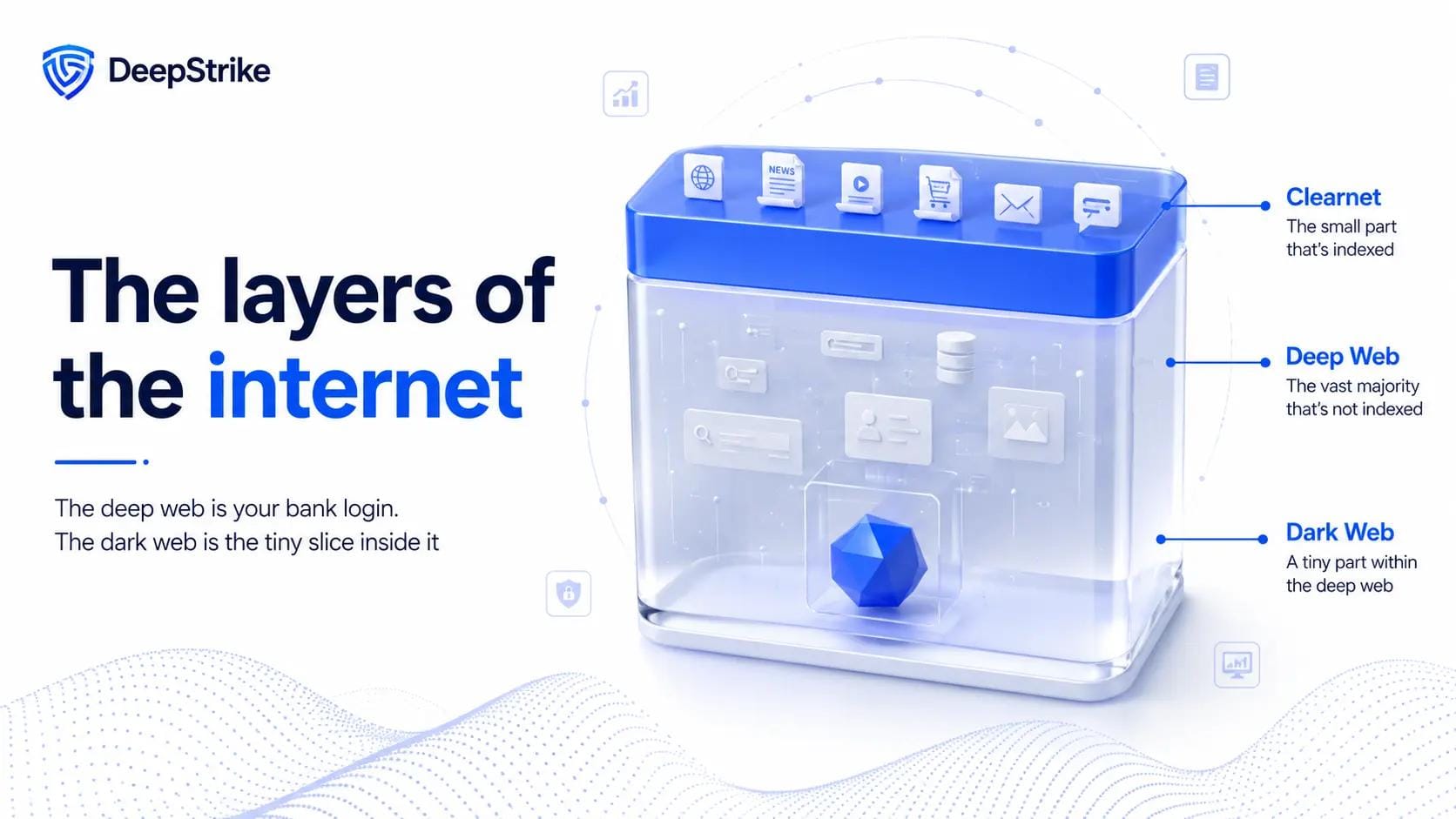
The cleanest mental model is a set of nested layers.
| Layer | Reachable with a normal browser? | Indexed? | Share of the web |
|---|---|---|---|
| Clearnet / surface web | Yes | Yes | Small |
| Deep web | Yes (with credentials) | No | Vast majority |
| Dark web | No (needs special software) | No | Tiny |
The key correction: the deep web is not the dark web. The deep web is mostly your bank login; the dark web is the small hidden slice within it. We cover that specific pairing in depth in our deep web vs dark web guide.
Because this mix-up is so common, it deserves its own direct comparison.
| Factor | Deep web | Dark web |
|---|---|---|
| Definition | Web content not indexed by search engines | Hidden content requiring special software |
| Access | Normal browser plus a login or permission | Special software such as the Tor Browser |
| Size | The vast majority of the internet | A tiny fraction of the deep web |
| Legality | Entirely normal and legal | The network is legal; some activity on it is not |
| Examples | Email, banking, databases, intranets | .onion marketplaces, hidden forums, leak sites |
| Is it "sketchy"? | No, it is your everyday private web | Mixed: privacy tools and crime both live here |
If you take one thing from this section: every dark web page is part of the deep web, but the overwhelming majority of the deep web has nothing to do with the dark web.
This is the distinction the title is really about, and it is subtle but important. A darknet is the infrastructure; the dark web is what runs on it.
| Darknet | Dark web | |
|---|---|---|
| What it is | An encrypted, hidden network (an overlay on the internet) | The websites and content hosted on darknets |
| Type of thing | Infrastructure / plumbing | Content / destinations |
| Examples | Tor, I2P, Freenet/Hyphanet | .onion sites, hidden services, forums |
| Analogy | The road system | The buildings you drive to |
So "the dark web" is not one place; it is the collection of sites spread across several darknets. When a news story says "on the dark web," it almost always means "on a darknet, usually Tor." Keeping the network (darknet) separate from the content (dark web) is what makes the rest of the terminology click.
Tor is where people most often collapse all these terms into one, so let us be precise. Tor is a darknet, the most popular one, and also the name of the software used to access it. It is not "the dark web" itself; it is the network (and tool) that most of the dark web happens to live on.
| Question | Answer |
|---|---|
| Is Tor the dark web? | No. Tor is a darknet; the dark web is the content on it (and other darknets). |
| Is Tor a darknet? | Yes, the largest and most used one. |
| Is Tor software? | Yes, the Tor Browser is how most people access the Tor network. |
| Can Tor reach the normal internet too? | Yes. Tor can browse clearnet sites anonymously, not just .onion sites. |
Tor uses a technique called onion routing to anonymize traffic; if you want the mechanics, our guide on how Tor works walks through the three-relay circuit step by step, and the history of who created the dark web explains where onion routing came from. To actually use it, see our dark web browser guide, and for the content it reaches, our explainers on onion sites and dark web search engines. The network is maintained by the non-profit Tor Project.
Tor is the famous one, but it is not the only darknet. The three best known take genuinely different approaches.
| Darknet | Approach | Addresses | Best at | Ease of use |
|---|---|---|---|---|
| Tor | Onion routing; anonymous browsing and hosting | .onion | Reaching hidden sites and the clearnet anonymously | Easiest (Tor Browser, download-and-go) |
| I2P | Garlic routing; an internal network optimized for services | .i2p (b32.i2p) | Peer-to-peer and internal hidden services | Harder (needs configuration) |
| Freenet / Hyphanet | Distributed data store; content replicated across peers | Freenet keys | Censorship-resistant publishing and file sharing | Different model; not a browser for the web |
The practical takeaways: Tor is the default because of its mature Tor Browser and huge user base; I2P is designed more for services inside its own network and is favored for peer-to-peer use; and Freenet (renamed Hyphanet) is not really a routing network at all but a distributed storage system for publishing content that cannot easily be censored. All three are darknets, and each hosts its own version of "the dark web."
Rounding out the terms, here is the dark web against the everyday internet most people live on.
| Factor | Clearnet | Dark web |
|---|---|---|
| Access | Any normal browser | Special software (e.g., Tor Browser) |
| Discoverable via Google? | Yes | No |
| Addresses | Normal domains (.com, .org) | Special addresses (.onion, .i2p) |
| Who can see the site's location? | Public | Hidden by design |
| Typical content | Everything mainstream | Privacy tools, forums, and some illicit markets |
| Speed | Fast | Slower (traffic is rerouted for anonymity) |
"Clearnet" (or "clear web") is simply the term dark web users use for the ordinary, non-hidden internet, everything that is not on a darknet.
Keep this handy the next time the terms blur together.
| Term | One-line definition |
|---|---|
| Clearnet / surface web | The public, searchable internet |
| Deep web | Anything not indexed by search engines (mostly ordinary) |
| Dark web | Hidden content needing special software |
| Darknet | A hidden network that hosts the dark web |
| Tor | The most popular darknet and its browser |
| Onion service (.onion) | A site hosted inside the Tor network |
| I2P / Freenet | Other darknets with different designs |
Theory aside, most confusion happens in the moment. Here is how everyday situations map to the terms.
| What you are doing | Which layer | Notes |
|---|---|---|
| Reading a news site or Googling something | Clearnet | Public, indexed, normal browser |
| Checking your email or bank account | Deep web | Private and unindexed, but completely ordinary |
| Viewing a company intranet or a paywalled report | Deep web | Behind a login; not "dark" at all |
| Using a VPN to browse normally | Still clearnet | A VPN changes privacy, not which layer you are on |
| Opening the Tor Browser to visit a .onion site | Dark web (via the Tor darknet) | Special software, hidden address |
| Running or visiting an .i2p service | Dark web (via the I2P darknet) | A different darknet, same idea |
The pattern to internalize: needing a login puts you on the deep web; needing special software and a hidden address puts you on the dark web, via whichever darknet hosts it. A VPN, despite the mystique, keeps you on the clearnet, it changes who can see your traffic, not which layer of the web you are visiting.
Accessing the deep web is completely normal, you do it every time you check email. Accessing the dark web, and using darknets like Tor, is legal in most countries; they are legitimate privacy and anti-censorship tools. What can be illegal is specific activity, buying illegal goods, for instance, exactly as it would be on the clearnet. The technology is neutral; the conduct is what the law judges. Some countries do restrict or block these networks, so check local law if you operate in a restrictive region.
This is not pedantry. Mixing up the terms leads to real mistakes:
Precise language leads to precise thinking, and in security, precise thinking is what keeps you from either panicking or underestimating the risk.
Dark web vs darknet vs Tor is not a battle between three rivals; it is three different layers people keep flattening into one word. The darknet is the hidden network, the dark web is the content hosted on it, and Tor is the darknet (and browser) most people are actually talking about, sitting alongside I2P and Freenet. Wrap those inside the bigger picture, the clearnet you search every day and the vast, mundane deep web behind your logins, and the whole map finally makes sense. Get the layers straight and you will never misuse these terms again, and you will read every "on the dark web" headline with a lot more skepticism.
The deep web is all the content search engines do not index, mostly ordinary things like email and banking. The dark web is a small hidden slice of the deep web that needs special software. The darknet is the network that hosts the dark web. In short: deep web (unindexed content) contains the dark web (hidden content), which lives on darknets (hidden networks).
The deep web is everything not indexed by search engines and is mostly private but legitimate, your inbox, your bank dashboard, databases. The dark web is a tiny, deliberately hidden portion of it that requires tools like the Tor Browser to reach. Every dark web page is part of the deep web, but almost none of the deep web is the dark web.
A darknet is a hidden, encrypted network that sits on top of the internet and requires special software to access, examples include Tor, I2P, and Freenet. The dark web is the collection of websites and content hosted on those darknets. The darknet is the infrastructure; the dark web is what runs on it.
No. Tor is a darknet, the most popular one, and the name of the browser used to access it. The dark web is the content hosted on Tor (and other darknets). Tor can also be used to browse the ordinary clearnet anonymously, so it is a tool and a network, not the content itself.
The clearnet (or surface web) is the normal, public internet you can find with a search engine and open in any browser. The dark web is hidden content that needs special software, uses special addresses like .onion, and keeps site locations concealed. "Clearnet" is simply what dark web users call the everyday internet.
The deep web is entirely legal and ordinary, you use it constantly. The dark web and darknets are also legal to access in most countries; they are neutral privacy tools. Only specific illegal activities conducted on them are against the law, just as they would be on the clearnet.

Stay secure with DeepStrike penetration testing services. Reach out for a quote or customized technical proposal today
Contact Us
