August 23, 2026
Updated: August 24, 2026
From a 1995 Navy research project to Silk Road: the names, dates, and reasons behind the dark web.
Abdalla Mohamed
Who created the dark web is one of the most misunderstood questions in cybersecurity, because the honest answer surprises people: the foundational technology was invented by the US government. Specifically, the core idea, onion routing, was created in the mid-1990s by researchers at the US Naval Research Laboratory (NRL) to protect American intelligence communications online. That work became Tor, the software most people mean when they say "the dark web," which was released publicly in 2002 and is still run today by a non-profit. No single person "created the dark web" as one act; it emerged over decades. This guide traces that history precisely, from a Navy lab to Silk Road to today, with the names, dates, and reasons that actually matter.
Updated: August 2026. Names, dates, and institutions are drawn from the Tor Project's own history, the original onion routing and Tor research papers, and standard reference sources.
There is no one "inventor of the dark web," so the question really has three layers, and mixing them up is where most confusion starts:
So the most accurate answer to "who created the dark web" is: the enabling technology came from the US military, and the dark web as we know it grew out of it. The rest of this guide explains exactly how.
People use "dark web," "darknet," "deep web," and "Tor" interchangeably, but they mean different things. Getting them straight makes the history make sense.
| Term | What it means |
|---|---|
| Onion routing | The technique: routing traffic through layered, encrypted relays so no single point sees both ends |
| Tor | The software (The Onion Router) that implements onion routing for the public |
| Darknet | Any network deliberately not reachable by the normal internet, requiring special software |
| Dark web | The websites and content hosted on darknets like Tor (for example, .onion sites) |
| Deep web | Everything not indexed by search engines (email, banking portals, paywalled pages), most of which is perfectly ordinary |
The dark web is a tiny slice of the deep web. If that distinction is fuzzy, our explainer on the deep web versus the dark web covers it in full. With the terms clear, the history falls into place.
The dark web's technical DNA traces to a specific problem the US military faced in the mid-1990s: how could intelligence personnel use the open internet without revealing who they were or who they were talking to, even to someone watching the network?
In 1995, three researchers at the US Naval Research Laboratory, mathematician Paul Syverson and computer scientists Michael G. Reed and David Goldschlag, set out to solve it. Their insight was to separate identification from routing: a message could be delivered without any single relay along the way knowing both where it came from and where it was going. They wrapped each message in successive layers of encryption, one per relay, so that each relay could peel back only its own layer to learn the next hop, never the whole path. The layered structure is why they called it "onion routing."
They published the first academic papers describing onion routing in 1996. The Defense Advanced Research Projects Agency (DARPA) funded further development, and the US Navy was granted a patent on onion routing in 1998. At this stage there was no "dark web", there was a government research project designed to protect US communications.
The mechanism the NRL team designed is still, in essence, how Tor works today:
Because no single relay ever sees both ends, no single party can link you to what you are doing. That is the whole idea, and it is what separates onion routing from a simple proxy or a VPN, where one operator can see everything.
Autocomplete is full of "who created the dark web CIA," and the answer is: not the CIA. The work was done at the US Naval Research Laboratory, funded and advanced with DARPA and the US Navy, and later supported by other US government bodies. The persistent "CIA created the dark web" claim is a garbled version of a true fact, that the technology has deep US-government roots, but it attributes it to the wrong agency. The correct origin is the Navy's research lab, not the CIA.
This government lineage is real and worth sitting with, because it produces the central irony of the dark web: a tool built to protect American spies became the world's most important anonymity system, used by journalists and dissidents, and also by criminals. Understanding why the government then handed it to the public is the key that most explanations skip.
Onion routing was a promising prototype, but it needed a robust, usable, second-generation implementation to matter beyond the lab. That is where Tor comes in.
In the early 2000s, two MIT graduates, Roger Dingledine and Nick Mathewson, began building a new version of onion routing, working with the NRL's Paul Syverson under a US Naval Research Laboratory contract. They called it Tor, originally an acronym for "The Onion Router." Tor was first released publicly on September 20, 2002, and the same code still underpins the dark web browser people use today. The Tor Project's own history documents this lineage in detail.
The project's independence grew from there:
Early financial support came from a mix of sources, including the US International Broadcasting Bureau, Internews, Human Rights Watch, the University of Cambridge, and the Dutch foundation NLnet, a coalition that reflected Tor's dual identity as both a US-origin project and a global human-rights tool.
This is the part that confuses people most: if the Navy built onion routing to protect its own communications, why release it to everyone, including adversaries and criminals?
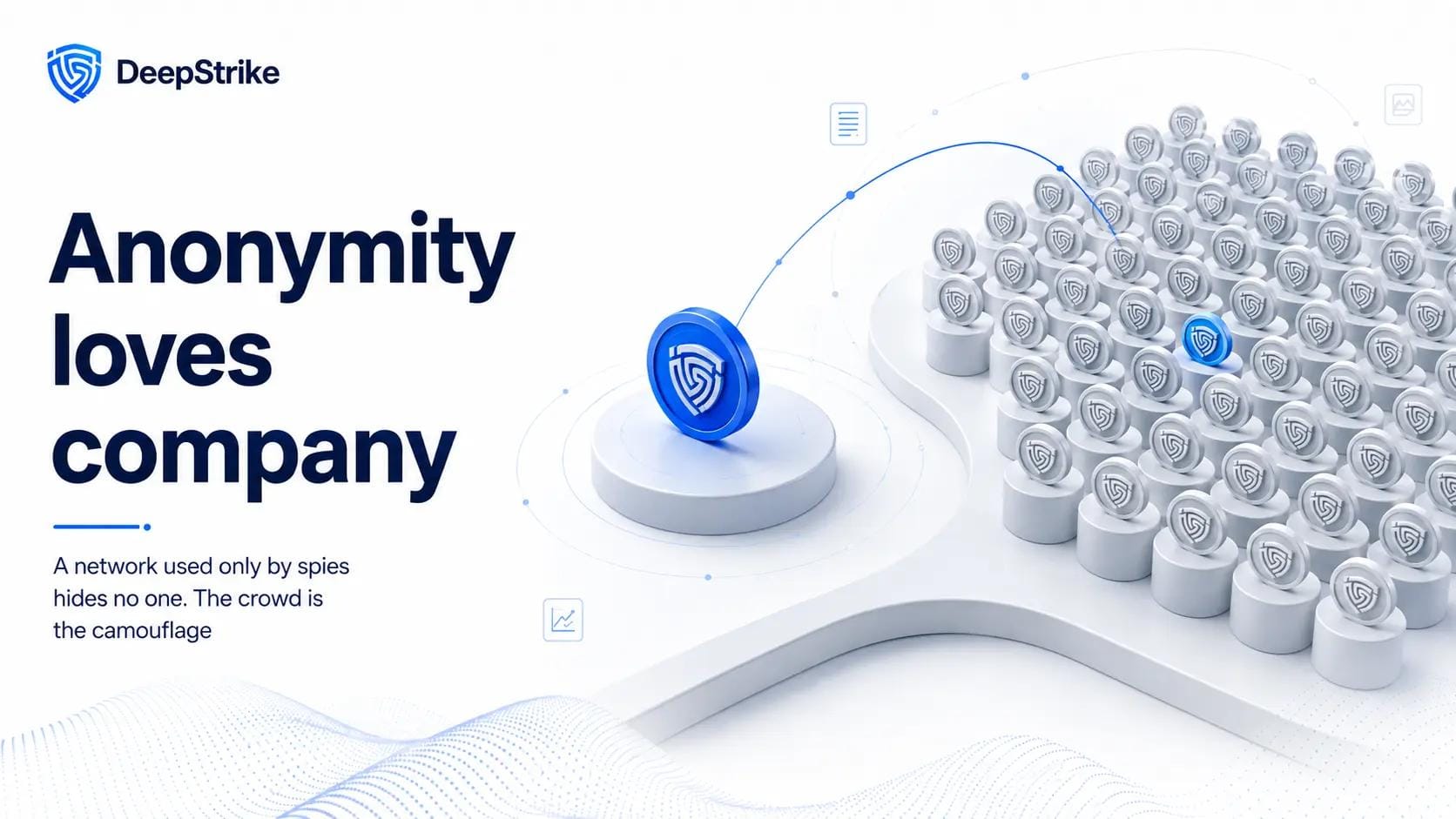
The answer is a counterintuitive property of anonymity systems, sometimes summarized as "anonymity loves company." A network used only by US government personnel would provide no anonymity at all, because anyone observed using it would obviously be a government user. Detecting the network's traffic would become a foolproof way to identify spies. The only way to hide government users is to fill the network with everyone else, too: journalists, activists, researchers, businesses, and ordinary privacy-conscious people. The crowd is the camouflage.
That is the strategic logic behind opening Tor to the world. It was not naivety or a leak; it was the deliberate recognition that anonymity is a shared resource. A larger, more diverse user base makes every user, including the ones the tool was originally built for, harder to single out. It also happens to make Tor genuinely useful to the millions of people who rely on it to evade censorship and surveillance.
Tor did not appear in a vacuum. The broader idea of networks hidden from the mainstream internet, "darknets", was developing alongside it.
So while Tor became the dominant dark-web technology, it was part of a wider movement of people trying to build private, uncensorable networks, some from governments, some from activists and academics.
Tor at first was about anonymous access to the ordinary internet. The piece that created the "dark web" as a distinct place was location-hidden services, later renamed onion services, which Tor added by around 2004.
An onion service lets a website run inside the Tor network, reachable only through Tor at a special .onion address, with the server's location and operator hidden just as the visitor's identity is. This was the birth of the hidden web that the term "dark web" now describes: sites that do not exist on the normal internet and can only be reached with the right software. Most are mundane or privacy-focused, and our guide to onion sites explains how their addresses work, while directories such as the Hidden Wiki and dark web search engines show how people navigated them.
For years, the dark web was a niche concern. What burned the term into public consciousness was a single marketplace.
In 2011, Ross Ulbricht launched Silk Road, an onion-service marketplace best known for the online drug trade. It combined Tor's anonymity with Bitcoin's pseudonymous payments to build a functioning underground economy, and its notoriety is what taught the general public, and the media, the phrase "dark web." The FBI shut down Silk Road in 2013 and arrested Ulbricht, but the association had stuck: to most people, "dark web" now meant hidden marketplaces, even though that is only a small and unrepresentative corner of it. The pattern of marketplaces rising and being dismantled has continued ever since, as our guide to dark web marketplace takedowns documents.
If you want names, these are the people whose work created and shaped what we now call the dark web.
| Person | Role in the story |
|---|---|
| Paul Syverson | Mathematician at the US Naval Research Laboratory; co-invented onion routing (1995) and co-created Tor |
| Michael G. Reed | NRL computer scientist; co-invented onion routing |
| David Goldschlag | NRL computer scientist; co-invented onion routing |
| Roger Dingledine | MIT graduate; co-created Tor and co-founded the Tor Project |
| Nick Mathewson | MIT graduate; co-created Tor and co-founded the Tor Project |
| Ian Clarke | Created Freenet (2000), an early parallel darknet |
| Ross Ulbricht | Founded Silk Road (2011), the marketplace that made "dark web" a household term |
Notice the shape of it: the anonymity technology came from government researchers and academics, while the notoriety came from someone who abused it. That split, respected engineers on one side, a convicted marketplace operator on the other, is why "who created the dark web" produces such contradictory associations.
| Year | Milestone |
|---|---|
| 1970s | The term "darknet" describes networks isolated from ARPANET |
| 1995 | Onion routing invented at the US Naval Research Laboratory (Goldschlag, Reed, Syverson) |
| 1996 | First academic papers on onion routing published |
| 1997 | DARPA funds further onion routing development |
| 1998 | The US Navy is granted a patent on onion routing |
| 2000 | Ian Clarke releases Freenet |
| 2002 | Microsoft researchers publish "The Darknet and the Future of Content Distribution" |
| 2002 | Tor is first released publicly (September 20), built by Dingledine, Mathewson, and Syverson |
| ~2004 | Tor adds location-hidden (onion) services; "Tor: The Second-Generation Onion Router" paper; EFF funding |
| 2006 | The Tor Project, Inc. is formally established (December 22) |
| 2011 | Ross Ulbricht launches Silk Road |
| 2013 | The FBI shuts down Silk Road |
| Today | Tor is run by the non-profit Tor Project and used worldwide |
The Tor Project is a US-based non-profit, and for much of its history a significant share of its funding has come from US government sources, including bodies focused on internet freedom and countering censorship abroad, alongside private foundations and individual donors. In recent years the project has worked to diversify its funding toward foundations and public donations.
This funding history is the source of a recurring debate. Critics point out that a tool funded largely by the US government cannot be neutral; defenders note that the code is open source and independently audited, that "anonymity loves company" means broad use is the design, and that Tor's protection has been repeatedly demonstrated in real cases where authorities could not deanonymize users. Both things are true at once: Tor has deep government roots and provides genuine, independently verifiable anonymity. Holding that contradiction is part of understanding what the dark web actually is.
The history above corrects several persistent misconceptions worth calling out directly:
Putting it together, the precise answer is layered:
Anyone who tells you a single person "invented the dark web" is oversimplifying. It was a government anonymity project, opened to the public for sound technical reasons, that a global community then built into something far larger than its creators imagined.
The dark web was not born in a criminal underground; it was born in a US Navy research lab, as a serious attempt to protect intelligence communications with a technique called onion routing. That technique became Tor, and Tor was deliberately given to the public because anonymity only works in a crowd. Everything the dark web later became, the good (censorship circumvention, secure journalism, privacy) and the bad (hidden marketplaces), grew from that foundation. Knowing this history is not trivia; it is the context that explains why the dark web exists, why it is so hard to shut down, and why it is both a genuine human-rights tool and a haven for crime at the same time.
The core technology, onion routing, was created by David Goldschlag, Michael Reed, and Paul Syverson at the US Naval Research Laboratory in 1995, to let US intelligence personnel use the internet without revealing their identity or communications. It later became Tor, and the "dark web" of hidden sites grew from it. No single person created the dark web itself; it emerged from that technology.
Onion routing was invented in 1995 by Paul Syverson, Michael G. Reed, and David Goldschlag at the US Naval Research Laboratory. They published the first papers on it in 1996, and the US Navy patented the technique in 1998.
The Navy, through the US Naval Research Laboratory, with funding from DARPA, not the CIA. The common "CIA created the dark web" claim is a distortion of the true fact that the technology has US-government origins. The correct source is the Naval Research Laboratory.
Tor was first released publicly on September 20, 2002. It was developed by Roger Dingledine and Nick Mathewson with Paul Syverson under a US Naval Research Laboratory contract, and the non-profit Tor Project, Inc. was formally established on December 22, 2006.
No single person. "Darknet" originally described networks isolated from ARPANET in the 1970s. Modern darknets came from several creators: Ian Clarke released Freenet in 2000, the US Naval Research Laboratory's onion routing became Tor in 2002, and other networks like I2P followed. The dark web is the content hosted on these darknets.
Because anonymity requires a crowd, a principle summed up as "anonymity loves company." A network used only by government personnel would instantly expose them, since anyone using it would obviously be a government user. Opening Tor to journalists, activists, and the public gives government users cover, and makes the tool genuinely useful for privacy and censorship circumvention.
No. The dark web and the Tor software are legal to use in most countries, and they are used every day for legitimate purposes such as privacy, journalism, and evading censorship. Some activities that take place on the dark web are illegal, but the network itself is a neutral technology, as our deep web versus dark web guide explains.

Stay secure with DeepStrike penetration testing services. Reach out for a quote or customized technical proposal today
Contact Us
