June 28, 2026
Updated: November 11, 2026
A procurement-focused guide to Bahrain penetration testing providers for web, API, cloud, mobile, network, PTaaS, red team, and compliance-driven security validation.

Mohammed Khalil
This guide covers providers for organizations in Bahrain. Buying from the United States? See our list of top penetration testing companies in the U.S. or DeepStrike's penetration testing services.
Comparing providers beyond Bahrain? Our global list of top penetration testing companies covers firms that deliver testing across regions.
No single provider is the top penetration testing company in Bahrain for every buyer; the shortlist depends on who regulates the scope. DeepStrike, the publisher of this guide, is listed first for human-led application, cloud, and infrastructure testing. Beyon Cyber, NGN International, and CyberGlobal Bahrain list a Bahrain headquarters or office; Help AG covers the Kingdom regionally from Dubai; KPMG Bahrain, Deloitte Bahrain, PwC Bahrain, and EY Bahrain are the Big Four options; and IBM X-Force Red, NCC Group, and LevelBlue (Trustwave SpiderLabs) deliver internationally. Banks and payment firms licensed by the Central Bank of Bahrain should first confirm tester certification, independence, and the two-year rotation rule, then compare testing depth, report quality, retest terms, and data handling under the Personal Data Protection Law.
For other Gulf markets, see Oman, Kuwait and Qatar.
Penetration testing services are authorized attacks on applications, APIs, mobile apps, cloud accounts, networks, identity flows, wireless systems, or staff, carried out to show which weaknesses can really be exploited. Bahrain's rules treat this as a separate activity from scanning. The CBB Rulebook asks banks for regular vulnerability assessments, preferably monthly for internal technology and weekly or more often for public-facing systems (OM-5.5.25), and separately for penetration tests at least twice a year that simulate real-world attacks (OM-5.5.28). The data protection rules use the term VAPT: Order No. 43 of 2022 lists periodic vulnerability assessment and penetration testing among the technical and organizational measures a data controller applies, depending on the risks of the processing. A useful deliverable tells executives and engineers what was tested, what was exploited, how severe each issue is, how to fix it, and whether the fix was retested.
This guide uses procurement and technical evaluation criteria, not brand popularity alone. Disclosure: DeepStrike, the publisher of this guide, is a penetration testing provider and is listed first. Weigh our entry the way you would any vendor's description of its own service, and compare scope, sample reports, and references for every provider before you buy. The order should not be read as a paid third-party award or a claim that one provider is universally best for every organization.
How we built the Bahrain shortlist: We combined three groups: providers with a published Bahrain office (Beyon Cyber in Hamala, CyberGlobal in Manama, NGN International, and the Big Four firms' Manama offices), a GCC specialist that serves Bahrain regionally (Help AG), and international testing firms (NCC Group, IBM X-Force Red, LevelBlue). Each entry was checked against the provider's own pages, plus CREST marketplace listings where cited; where a page could not be read (Deloitte, PwC), the entry says so. Entries were reviewed in November 2026. This is desk research, not hands-on testing of each provider.
No ranking should replace buyer due diligence. Security teams should verify scope, tester seniority, deliverables, sample reports, retesting terms, Bahrain delivery model, onsite availability, data-handling requirements, and final contract language before selecting a provider.
| # | Provider | Best for | Testing depth model | Bahrain / GCC fit | Key limitation |
|---|---|---|---|---|---|
| 1 | DeepStrike | Human-led application, cloud, and infrastructure testing with remediation collaboration | Manual testing with reproduction evidence and retesting | Remote delivery; HQ Newark, Delaware, with a Dubai business address | Listed first as the publisher; no Bahrain office, so confirm onsite needs and Arabic reporting |
| 2 | Help AG | Regional enterprise security programs | Manual VAPT, web and mobile assessments, red teaming | Offices in the UAE, Saudi Arabia, and Egypt; no Bahrain office published | Methodology and report contents not published; request a sample report |
| 3 | KPMG Bahrain | Audit-linked technology and cyber control reviews | Consulting-led assessment | Bahrain partnership (KPMG Fakhro), Sanabis | Penetration testing not described on the Bahrain site; confirm scope |
| 4 | Deloitte Bahrain | Testing within a Big Four risk or consulting program | Consulting-led; confirm scope | Manama office (United Tower) | Penetration testing details not verified; obtain them in writing |
| 5 | PwC Bahrain | Testing tied to advisory and assurance work | Consulting-led; confirm scope | Manama office (Bahrain Financial Harbour) | Penetration testing details not verified; obtain them in writing |
| 6 | EY Bahrain | Cybersecurity transformation and managed services | Consulting-led; confirm scope | Bahrain website; Manama location | Penetration testing not named on reviewed pages |
| 7 | IBM X-Force Red | Specialist testing across applications, hardware, cloud, and AI | Manual specialist testing | Global delivery; no Bahrain office named | Name each specialty and agree cross-border data handling |
| 8 | NCC Group | Multi-discipline testing and threat-led red teaming | Hybrid automated + manual, in-house team | Global/remote; no Bahrain office found | Governance overhead for small scopes |
| 9 | LevelBlue (Trustwave SpiderLabs) | Testing linked to managed security | Offensive security within a managed security portfolio | Global delivery; no Bahrain office named | Onshore and offshore staff; specify tester locations |
| 10 | Beyon Cyber | Local testing alongside SOC services | Penetration testing, red/blue/purple teaming, SAST/DAST | Hamala, Bahrain office; CREST SOC accreditation | Pentest scope detail limited; agree testing independence if it also runs your SOC |
| 11 | NGN International | Local managed security with penetration testing | Application, infrastructure, and adversary-led testing | Bahrain headquarters (PO Box address) | Little published detail on test types or reports |
| 12 | CyberGlobal Bahrain | Focused VAPT for SMEs | Automated tools plus manual techniques | Manama address (Al-Khalifa Avenue) | Retesting not mentioned; verify accreditation logos on registers |
Start by writing down which regulator, if any, will read the report, because that sets the minimum scope. A CBB-licensed bank needs its systems, applications, and network devices tested twice a year; an open banking provider also needs its APIs tested against the security standards every six months. Then list the assets: web applications, APIs, mobile apps, cloud accounts, external and internal networks, wireless, identity flows, social engineering, or red team objectives. Add user roles, endpoint counts, production restrictions, and testing windows before you ask for quotes.
Next, hold the methodology up against what Bahrain's rules name. The CBB expects a risk-based approach built on a recognized methodology such as NIST or OWASP, with both grey-box and black-box testing, run on production or an exact non-production replica. Ask how the provider combines automated discovery with manual exploitation, business-logic and authorization testing, and chained attack paths. Request a redacted sample report as well: payment and open banking licensees must send the CBB a report that lists every passed and failed test with the mitigation steps, so check that the format can carry that.
Delivery model is the third check. Web, API, cloud, and external network tests are usually run remotely; internal networks, wireless, and segmented environments may need a tester onsite in Bahrain or a secure remote access path. If testers outside the Kingdom will see personal data, read the transfer rules first: Order No. 42 of 2022 lets controllers send personal data without prior authorization only to the countries on its record, which includes the United States, the United Kingdom, and the United Arab Emirates. Also confirm the contracting entity, NDAs, Arabic or English reporting, secure evidence transfer, and whether retesting is included.
Public offering: DeepStrike's penetration testing services describe human-led testing across applications, cloud environments, and infrastructure, supported by a findings and collaboration platform. Its public process covers planning, reconnaissance, vulnerability discovery, controlled exploitation, reporting, and technical support. Published reports include reproduction steps, remediation guidance, and root-cause information; the proposal should define exact coverage and commercial terms.
Bahrain relevance: Founded in 2016, DeepStrike LLC is headquartered in Newark, Delaware, has 11–50 employees, and also publishes a business address in Dubai, UAE (IFZA Business Park). It delivers testing remotely for Bahraini clients; define tester locations, permitted subcontracting, and data-handling restrictions in the engagement agreement.
Team certifications: OSCP, OSWE, OSEP, OSWP, GXPN, GWAPT, eCPPT, eMAPT, eWPT, CREST CPSA, CRTP, CRTE, and Microsoft Azure Security Engineer Associate, as shown on DeepStrike's services page.
Official sources: Pricing , Contact Us
Buyer fit: Engineering teams that need application, cloud, or infrastructure testing with direct remediation collaboration.
| Documented strengths | Limits and buying considerations |
|---|---|
| Human-led testing with reproduction evidence, root-cause information, and remediation guidance. | The service description is not an independently measured quality comparison. Assess the assigned team and a relevant sample report. |
| The published Basic plan lists Slack collaboration, customizable reports, and 12 months of remediation retesting. | No numeric price is displayed on the pricing page. Basic is a one-shot test; recurring coverage belongs to a different plan, with contract-specific terms. |
| Team certifications shown on the services page include OSCP, OSWE, OSEP, OSWP, GXPN, GWAPT, eCPPT, eMAPT, eWPT, CREST CPSA, CRTP, CRTE, and Microsoft Azure Security Engineer Associate. | These are individual tester credentials, not a company-level accreditation; ask which certified testers will be assigned to your engagement. |

Public offering: Help AG's offensive cybersecurity services list external and internal VAPT, detailed web assessments, Android and iOS mobile app assessments, Wi-Fi, VoIP, and endpoint security assessments, source code review, on-demand or periodic assessments, and social engineering and red teaming. It describes its penetration testing as manual and its red teaming as replicating advanced persistent threat tactics; the service sits within a wider cybersecurity services portfolio.
Bahrain relevance: Help AG lists its headquarters in Dubai with offices in Abu Dhabi, Riyadh, and Cairo; we did not find a Bahrain office on its contact page, so delivery to Bahrain is regional or remote. Define tester locations, onsite needs, and data handling in the agreement.
Official sources: https://www.helpag.com/offensive-cybersecurity/; https://www.helpag.com/contact-us
Buyer fit: Larger GCC organisations that want manual VAPT and red teaming from a regional provider with a broad security portfolio.
What sets it apart in Bahrain: It is the Dubai-based regional specialist on this list, with manual VAPT and APT-style red teaming, and an option for Bahrain banks that need another independent tester to meet the CBB's rule on changing third-party testers at least every two years.
| Documented strengths | Limits and buying considerations |
|---|---|
| Published scope covers external and internal VAPT, web, mobile, Wi-Fi, VoIP, endpoint, source code review, and red teaming. | The service page does not describe methodology frameworks or report contents; request a sample report and retest terms. |
| Regional offices in the UAE, Saudi Arabia, and Egypt. | No Bahrain office is published; agree onsite availability and time zones for internal or wireless testing upfront. |
Public offering: KPMG in Bahrain lists Technology and Cyber Audit within its risk consulting services, assessing IT systems, digital infrastructure, data governance, and cybersecurity controls. Its Bahrain website does not describe penetration testing, red teaming, or vulnerability assessment services in detail, so request the testing methodology, scope, and a sample report.
Bahrain relevance: KPMG Fakhro is a Bahrain partnership and lists its office at Fakhro Tower, Sanabis. Confirm which team performs the test, whether testing is subcontracted to other KPMG member firms, and how audit independence is handled if KPMG is also your auditor.
Official sources: https://kpmg.com/bh/en/services/advisory.html; https://kpmg.com/bh/en/misc/generic-contact-page.html
Buyer fit: Regulated Bahrain organisations that want security control reviews coordinated with audit and risk advisory.
What sets it apart in Bahrain: Its Bahrain partnership (KPMG Fakhro) gives CBB-regulated firms a local contracting route, but if KPMG is your external auditor, independence rules may rule it out as your tester.
| Documented strengths | Limits and buying considerations |
|---|---|
| Local Bahrain partnership with a published technology and cyber audit service. | Penetration testing scope is not described publicly; confirm manual testing depth and deliverables. |
| Testing can be aligned with wider risk consulting and audit work. | Audit independence rules may restrict services if KPMG audits your organisation; check before engaging. |
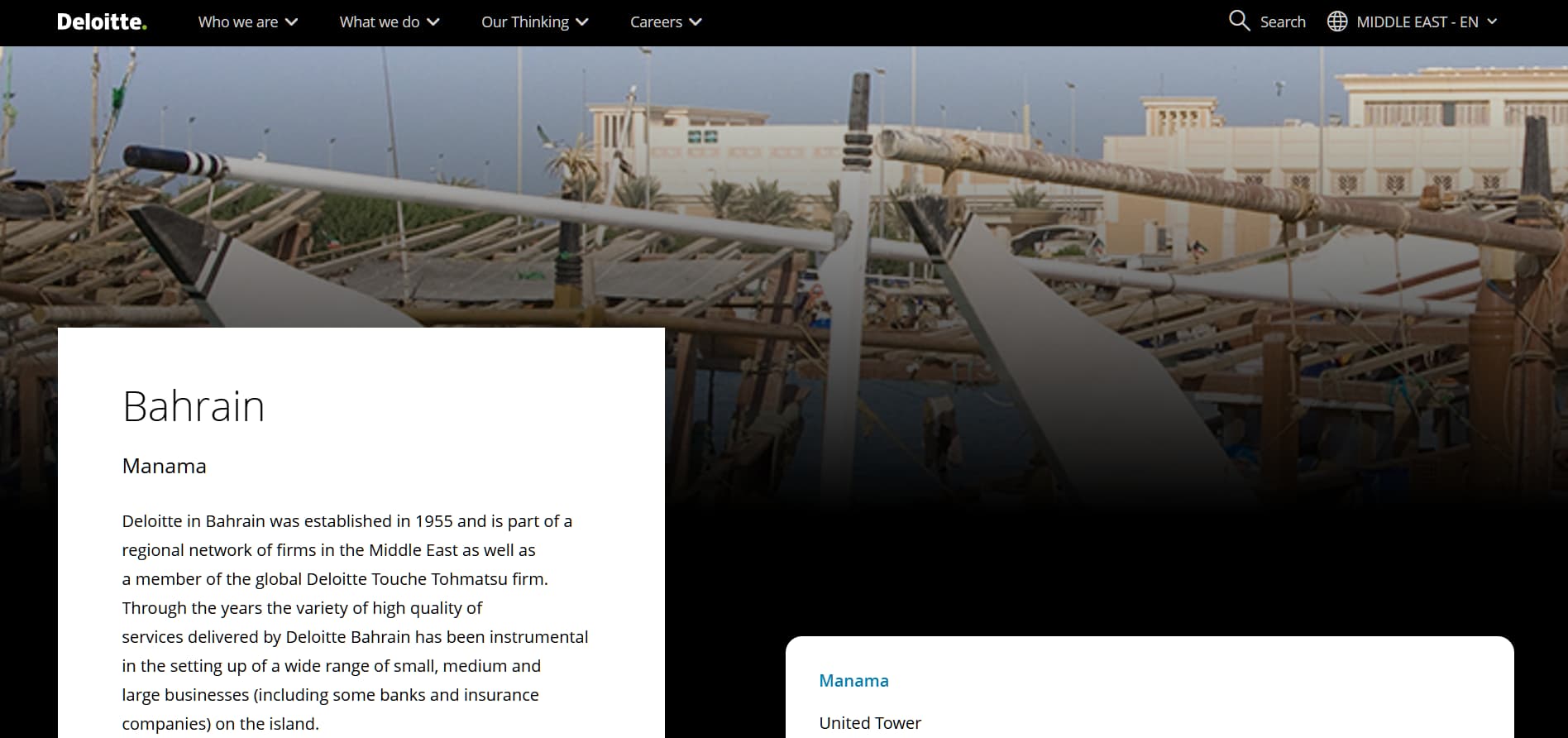
Public offering: Deloitte's Middle East member firm publishes cyber risk services, but the service pages could not be read for this review in November 2026, so we cannot confirm the penetration testing scope it publishes for Bahrain clients. Request a detailed methodology, scope, and sample report.
Bahrain relevance: Deloitte's Bahrain office page lists a Manama office at United Tower. Confirm which team performs the test, whether regional Deloitte teams are involved, how test data is handled, and how audit independence applies if Deloitte is your auditor.
Official sources: https://www.deloitte.com/middle-east/en/services/consulting-risk/services/cyber-risk.html
Buyer fit: Large organisations that want security testing within a broader Big Four risk or consulting programme.
What sets it apart in Bahrain: Its Manama office suits groups already running Deloitte risk programmes; because its testing scope could not be verified, treat it as a contracting route rather than a confirmed testing specialist.
| Documented strengths | Limits and buying considerations |
|---|---|
| Local Manama office within a regional Middle East member firm. | Penetration testing details could not be verified on the official site; obtain them in writing. |
| Can combine testing with wider risk, consulting, and assurance work. | Audit independence rules may limit services if Deloitte audits your organisation. |
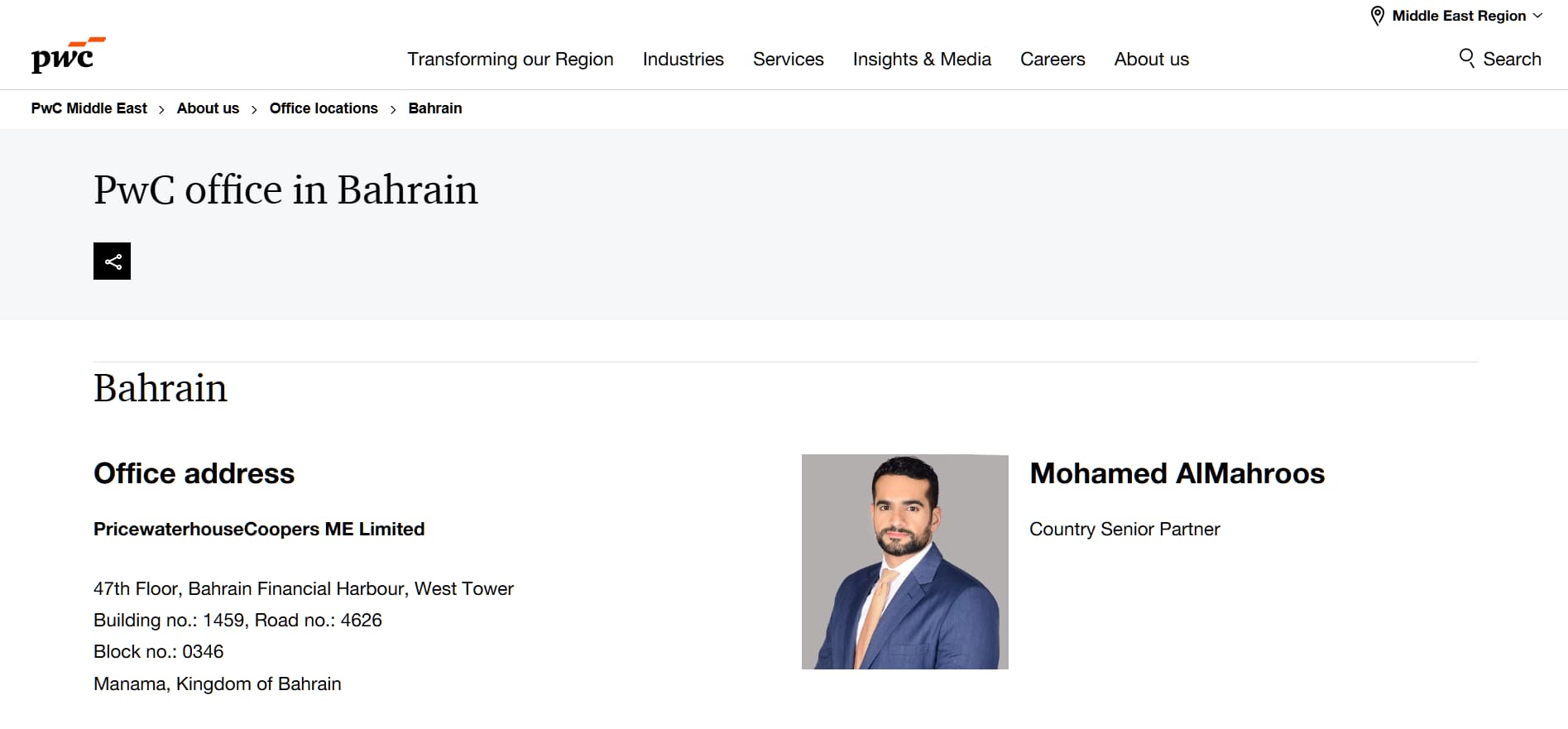
Public offering: PwC Middle East's cyber security pages could not be retrieved for this review in November 2026, so we cannot confirm the penetration testing scope it publishes for Bahrain clients. Request a detailed methodology, scope, and sample report.
Bahrain relevance: PwC's Bahrain office page lists PricewaterhouseCoopers ME Limited at the 47th Floor, West Tower, Bahrain Financial Harbour, Manama. Confirm which team performs the test, whether regional PwC teams are involved, how test data is handled, and how audit independence applies if PwC is your auditor.
Official sources: https://www.pwc.com/m1/en.html
Buyer fit: Organisations that want security testing bundled with consulting and risk advisory from a Big Four firm with a Manama office.
What sets it apart in Bahrain: Its Bahrain Financial Harbour office suits financial institutions already using PwC for advisory, but obtain testing methodology and scope in writing before shortlisting it for a CBB-required test.
| Documented strengths | Limits and buying considerations |
|---|---|
| Local Manama office within PwC's Middle East network. | Penetration testing details could not be verified on the official site; obtain them in writing. |
| Can combine testing with wider advisory and assurance work. | Audit independence rules may limit services if PwC audits your organisation. |
Public offering: EY's cybersecurity services, published on its Bahrain website, cover cybersecurity transformation, managed services, incident resilience and response, data protection and privacy, identity and privileged access management, and OT and cyber architecture services. The pages reviewed do not name penetration testing, so confirm whether it is offered through EY in Bahrain and on what scope.
Bahrain relevance: EY operates a Bahrain website and lists Manama among its locations, but the pages reviewed do not show a street address. Confirm the delivering EY entity, tester locations, and data handling, and check audit independence if EY is your auditor.
Official sources: https://www.ey.com/en_bh/services/cybersecurity; https://www.ey.com/en_bh/about-us/connect-with-us
Buyer fit: Large organisations that want security testing within a broader cybersecurity transformation or managed services programme.
What sets it apart in Bahrain: Its identity, OT, and managed services portfolio suits large Bahrain transformation programmes, but penetration testing is not named on its Bahrain pages, so confirm it is offered before inviting EY to a pentest RFP.
| Documented strengths | Limits and buying considerations |
|---|---|
| Broad cybersecurity portfolio including managed services, incident response, and identity security. | Penetration testing is not named on the reviewed pages; request a testing methodology and sample report. |
| Bahrain website and access to EY's regional and global network. | Confirm whether testers are based in Bahrain or elsewhere, and agree data-handling terms. |
Public offering: IBM X-Force Red describes manual testing across applications, networks, hardware, personnel, cloud, and AI systems. Application options include web and mobile applications, APIs, thick clients, and code or binary analysis.
Bahrain relevance: IBM's penetration testing page does not name a Bahrain office or team. Ask which consultants own each technical component, where they are based, and how assessment data will move between countries, and define this in the agreement.
Official sources: https://www.ibm.com/services/penetration-testing
Buyer fit: Organisations that need multiple specialist assessments coordinated around a complex environment.
What sets it apart in Bahrain: Its hardware, AI system, and binary analysis options cover assets that few providers on this list publish, which helps Bahrain banks and telecom operators with devices or AI systems in scope.
| Documented strengths | Limits and buying considerations |
|---|---|
| The published catalogue covers application, cloud, hardware, network, personnel, and AI testing. | Name each required specialty in the proposal; catalogue breadth is not purchased coverage. |
| Application testing includes source- and binary-oriented options. | Confirm the access required, code-handling terms, and how results join the main report. |
Public offering: NCC Group lists application (web and mobile), network, cloud security, hardware, blockchain, cryptographic, and AI/ML testing, plus continuous penetration testing and real attack simulation through red, purple, and black teaming. It describes a hybrid approach that combines automated tools with manual testing, delivered by an in-house team, with reports designed to be directly actionable.
Bahrain relevance: NCC Group's contact page lists sales lines for the UK and Europe, the US and Canada, and APAC; we did not find a Bahrain office. The CREST marketplace lists NCC Group with Penetration Testing and Threat Led Penetration Testing among its accreditations; define tester locations, travel for onsite work, and data handling in the agreement.
Official sources: https://www.nccgroup.com/penetration-testing-services/; https://www.nccgroup.com/contact-us/
Buyer fit: Large and regulated organisations that need multi-discipline testing or threat-led red teaming from a global provider.
What sets it apart in Bahrain: Of the accreditations cited on this page, only NCC Group's CREST listing includes Threat Led Penetration Testing, which is relevant if the CBB asks a bank for a red teaming exercise under OM-5.5.29.
| Documented strengths | Limits and buying considerations |
|---|---|
| Published scope spans applications, networks, cloud, hardware, blockchain, cryptography, AI/ML, and red, purple, and black teaming. | Breadth adds governance overhead; for a single application test, compare scope and effort against smaller specialists. |
| CREST accreditations include Penetration Testing and Threat Led Penetration Testing. | No Bahrain office was found; confirm onsite availability and which entity delivers the engagement. |
Public offering: LevelBlue's offensive security services, supported by its SpiderLabs research and response team, include penetration testing, red teaming, threat intelligence, threat hunting, vulnerability management, and data security. Findings from these services feed into its Fusion platform, and the offering sits within a wider managed security portfolio.
Bahrain relevance: LevelBlue's offensive security page does not name a Bahrain office and states that it uses onshore, offshore, and federally cleared staff. Define tester locations, subcontracting, and data handling in the agreement.
Official sources: https://www.levelblue.com/solutions/offensive-security-solutions; https://www.levelblue.com/company/contact
Buyer fit: Organisations that want penetration testing and red teaming from the provider that runs, or could run, their managed security services.
What sets it apart in Bahrain: It suits organisations that want test findings fed into the same provider's managed security platform; if it also runs your monitoring, agree how testing independence is kept.
| Documented strengths | Limits and buying considerations |
|---|---|
| Penetration testing and red teaming backed by the SpiderLabs research team. | The offensive security page does not break out test types or report contents; request the methodology and a sample report. |
| Findings are integrated into the Fusion platform alongside managed security data. | Mixed onshore and offshore delivery is stated; specify tester locations in the contract if required. |
Public offering: Beyon Cyber's Cyber Assurance service lists cyber vulnerability management, red, blue, and purple teaming, penetration testing that checks vulnerabilities for exploitability and real-world risk, and continuous testing through purple teaming and SAST and DAST application testing. Its wider portfolio covers advisory and consultancy, cyber engineering, OT security, and round-the-clock cyber defence monitoring and response.
Bahrain relevance: Beyon Cyber, part of the Beyon Group, lists its office at Building 1095, Road 1425, Block 1014, Hamala, Kingdom of Bahrain. Define who performs the testing, permitted subcontracting, and data handling in the agreement.
Certifications: Beyon Cyber states it was the first Bahraini company to achieve CREST SOC accreditation, and CREST's marketplace lists it with SOC accreditation, ISO/IEC 27001, and ISO 9001. Its Cyber Assurance page shows individual team certifications including OSCP, OSCE, CRTP, PNPT, GPEN, and CISSP.
Official sources: https://beyoncyber.com/services-and-solutions/cyber-assurance; https://beyoncyber.com/contact-us
Buyer fit: Bahrain organisations that want local penetration testing and purple teaming alongside managed detection and response.
What sets it apart in Bahrain: It is the only provider on this list with a published Bahrain street address and a CREST SOC accreditation, which suits organisations that want local testing and local monitoring from one Bahraini firm.
| Documented strengths | Limits and buying considerations |
|---|---|
| Local Bahrain office, with CREST SOC accreditation, ISO/IEC 27001, and ISO 9001 listed on CREST's marketplace. | The CREST listing covers SOC services, not penetration testing; ask which testing accreditations or credentials apply to your scope. |
| Testing, purple teaming, and SAST/DAST sit alongside a 24/7 cyber defence service. | If the same provider monitors your environment, agree how testing independence and findings escalation will work. |

Public offering: NGN International describes penetration testing across applications, infrastructure, and adversary-led attack paths, with remediation guidance and retesting, including a VAPT assessment option. Its wider portfolio covers managed security services, a 24/7 SOC, governance, risk and compliance, IoT and automation, and AI security.
Bahrain relevance: NGN International's contact page lists its headquarters in the Kingdom of Bahrain (PO Box 32882) but no street address. Confirm who performs the testing, any accreditation relevant to your scope, and data handling in the agreement.
Official sources: https://www.ngnintl.com/services/pentesting; https://www.ngnintl.com/contact
Buyer fit: Bahrain organisations that want penetration testing from a local managed security and SOC provider.
What sets it apart in Bahrain: It is a Bahrain-headquartered managed security provider that describes retesting as part of its testing process; confirm tester credentials and any accreditation for your scope.
| Documented strengths | Limits and buying considerations |
|---|---|
| Penetration testing is offered with remediation guidance and retesting. | The site gives little detail on test types, methodology, or report contents; request a sample report and test plan. |
| Local headquarters with SOC, GRC, and managed security services from one provider. | If the same provider monitors your environment, agree how testing independence will be preserved. |
Public offering: CyberGlobal Bahrain lists web application (OWASP), cloud, external and internal network, mobile application, social engineering, and physical penetration testing, red team exercises, and infrastructure vulnerability assessment. Its published process covers scoping and planning, testing that combines automated tools and manual techniques, and a report with prioritised remediation recommendations; it also offers SOC, application, network, and cloud security, incident response, and GRC services.
Bahrain relevance: CyberGlobal lists Manama as its Bahrain headquarters, at 385 Al-Khalifa Avenue, Manama Center. Define tester locations, permitted subcontracting within the CyberGlobal group, and data handling in the agreement.
Certifications: CyberGlobal's Bahrain site shows logos for CREST, ISO 27001, ISO 9000, NATO, and NIS2 without describing their scope, and its FAQ names engineer credentials including CEH, CompTIA PenTest+, OSCP, and GPEN.
Official sources: https://cybergl.com/bh/penetration-testing/; https://cybergl.com/bh/get-started/
Buyer fit: Small and mid-sized Bahrain organisations that want focused VAPT or penetration testing from a local provider.
What sets it apart in Bahrain: It is the Bahrain-based provider on this list that publishes physical penetration testing and social engineering alongside web, cloud, and mobile tests, useful when on-site assessments in Manama are in scope.
| Documented strengths | Limits and buying considerations |
|---|---|
| Published test types range from web, cloud, network, and mobile to social engineering, physical testing, and red teaming. | Retesting is not mentioned on the service page; confirm fix validation terms before signing. |
| Manama address with SOC and incident response services available from the same provider. | Company accreditations are shown as logos without scope; verify them on the issuing bodies' registers. |
Match the provider type to the asset: application specialists for web, API, and mobile scope; firms with published red team and threat-led credentials when the CBB asks for red teaming; and Bahrain-based managed security providers when onsite infrastructure testing and local coordination matter most. The table lists what to verify for each need.
| Testing need | Best-fit provider type | What to verify |
|---|---|---|
| Web application pentest | Manual application security provider | OWASP WSTG coverage, authentication, business logic, and exploit validation; for CBB-regulated applications, both grey-box and black-box coverage. |
| API pentest | API-specialist team | BOLA/IDOR, token handling, rate limits, tenant isolation, and OAuth/OIDC; for AISPs and PISPs, testing against the open banking API security standards every six months (OB-1.1.10). |
| Mobile app pentest | Mobile appsec provider | iOS and Android skills, local storage, certificate pinning, backend APIs, and how personal data in the app is handled under the Personal Data Protection Law. |
| Cloud pentest | Cloud security team | IAM, storage, containers, serverless, logging, and network exposure, plus the cloud provider's own testing policy for the region you host in. |
| Network pentest | Infrastructure testing provider | External and internal scope, segmentation, Active Directory, wireless, onsite availability in Bahrain, and safe windows for production testing. |
| Red team | Mature offensive security team | Cyber, social, and physical fronts as OM-5.5.29 describes them, detection objectives, rules of engagement, and results ready for the CBB within one month if it ordered the exercise. |
| Compliance pentest | Audit-aware provider | Which CBB paragraph, data protection order, PCI DSS requirement, or ISO 27001 control the evidence must map to, and the submission deadline. |
| PTaaS / continuous testing | Continuous validation provider | Dashboard access, cadence, remediation tracking, retest terms, and whether point-in-time reports can still be produced for the June and December cycles. |
Bahrain has formally named the sectors it treats as critical. The National Cyber Security Center lists financial services, government services, healthcare, information and communications technology, transportation, critical industry, and gas, electricity, and oil as critical national infrastructure. Much of the public-sector estate now sits in the cloud: the government's Cloud First Policy requires government entities to use cloud services for new ICT services, and AWS launched its first data centers in the region in Bahrain in 2019. Every customer portal, mobile app, payment API, and cloud account added since then is a path worth testing before an attacker finds it.
Tie the test scope to the systems each regulator cares about. The Central Bank of Bahrain sets testing rules for banks, insurers, payment firms, and other licensees through its Rulebook. The National Cyber Security Center publishes Baseline Cybersecurity Controls that it describes as mandatory for critical national infrastructure entities; Control 3.3.4 of the published version (marked draft v0.2, January 2022) calls for penetration testing every year. The Telecommunications Regulatory Authority issued non-binding Telecommunications Sector Cybersecurity Controls in December 2024 that also call for regular penetration tests, partly by independent third parties. Personal data falls under the Personal Data Protection Law. Requirements differ by sector, so confirm which ones apply with the official text and your legal or compliance team.
Bahrain's banking regulator sets unusually specific testing rules. Paragraph OM-5.5.28 of the CBB Rulebook, Volume 1 (conventional banks) requires penetration testing of systems, applications, and network devices at least twice a year, following a recognised methodology such as NIST or OWASP, covering both grey-box and black-box testing, performed by certified professionals, and carried out by internal and external independent testers, with the third party changed at least every two years. Under OM-5.5.61, reports for the June and December tests and the mitigation steps must reach the CBB within two months, and OM-5.5.29 lets the CBB require red teaming.
The rotation rule affects shortlisting: a bank that uses one firm now should qualify a second provider before the two-year mark. Outside banking, the National Cyber Security Center is the national cybersecurity body, and personal data falls under the Personal Data Protection Law (Law No. 30 of 2018), in force since 1 August 2019, so test contracts should limit what personal data testers view and retain.
Government entities tender through the Tender Board. Arabic is the official language, so ask whether Arabic executive summaries are needed for boards or regulators, and confirm onsite availability for internal and wireless tests.
Penetration testing pricing in Bahrain is quoted per engagement and depends on scope, asset complexity, methodology, reporting, retesting, and onsite work. Three local points belong in every comparison. First, cadence: a bank or payment service provider that must test twice a year should ask for both cycles in one quote. Second, tax: Bahrain's standard VAT rate has been 10% since 1 January 2022, so check whether a quote includes it. Third, currency: agree whether the contract is in Bahraini dinars or another currency before you compare totals. Give every shortlisted provider the same written scope so the quotes can be compared on what is included, not only on price.
Providers serving Bahrain usually offer fixed-scope projects, time-and-materials work, PTaaS or subscription programs, retainers, compliance-driven assessments, and red team engagements. A fixed scope repeated each June and December suits licensees on the CBB's reporting calendar, while PTaaS suits teams that release software often and want findings validated between those dates. Red team work costs more because it adds stealth, social engineering, and sometimes physical access, which is how the CBB Rulebook describes the exercise it can order.
| Scope factor | Why it affects cost |
|---|---|
| Number of apps or endpoints | Each application, API, and network device in scope adds tester time; CBB scopes cover systems, applications, and network devices. |
| Authentication complexity | Roles, SSO, MFA, and tenant separation multiply the test cases, especially in banking and wallet apps. |
| API depth | Open banking and partner APIs need authorization testing endpoint by endpoint. |
| Cloud scope | Each cloud account, region, and service (IAM, storage, containers, serverless, logging) adds review effort. |
| Compliance evidence | Reports for the CBB must show vulnerabilities and mitigation steps, and for some licensees every passed and failed test, which adds reporting time. |
| Retesting | Fix validation may be included, capped, or billed separately; ask before a filing date forces the question. |
| Onsite work | Travel to Bahrain, site access approvals, and internal testing windows add cost for providers without local staff. |
Bahrain-based providers help when the work needs people in the room: internal network and wireless tests, workshops with a board or regulator, government tenders, or a contract that has to be signed with a local entity. They can also pair testing with a local SOC, which some organizations prefer for day-to-day coordination.
GCC and international providers add specialist depth for manual application and API testing, cloud, red teaming, and PTaaS. They also widen the pool a CBB licensee needs for rotation, since the external tester should change at least every two years. The tradeoff is coordination: confirm the contracting route, where the testers sit, how evidence leaves Bahrain, time-zone coverage, onsite support, and whether the provider has read the CBB paragraph that applies to you.
The answer usually follows the scope. The CBB Rulebook itself expects a mix for banks, with tests performed by internal and external independent parties. A workable pattern is a local partner for infrastructure, SOC, and procurement, a specialist firm for web, API, and cloud testing, and a second qualified firm ready for when the two-year mark arrives.
| Requirement | Why it matters | What to ask the provider |
|---|---|---|
| Methodology and scope | The CBB names NIST and OWASP as examples of recognized methodologies. | Which methodology do you follow, and how does it cover our web, API, cloud, mobile, and network assets in grey-box and black-box modes? |
| Manual testing emphasis | A scan is not a simulated real-world attack. | Can you show an example where manual work found what a scanner missed? |
| Tester seniority | CBB rules call for qualified, experienced, certified professionals. | Who will test, and which penetration testing certifications do they hold? |
| Sample report | Shows evidence quality before you commit. | Can you share an anonymized report with executive and technical sections? |
| Proof-of-exploitation | Confirms real impact. | What evidence do you give for critical and high findings? |
| Retesting terms | Reports to the regulator must show mitigation steps. | Is retesting included, capped, or priced separately, and how fast can you retest before a filing date? |
| Remediation support | Helps engineers close findings. | Do you provide fix guidance and a walkthrough after the report? |
| Data handling | The Personal Data Protection Law regulates transfers of personal data outside Bahrain. | Where is test evidence stored, in which country, who can access it, and when is it destroyed? |
| Testing windows | CBB tests run on production or an exact replica. | How do you keep production testing safe, and who do we call if a service degrades? |
| Bahrain/GCC delivery model | Avoids contracting and scheduling surprises. | Which legal entity signs, where are the testers based, and can someone attend onsite in Bahrain? |
| Arabic/English reporting | Boards and regulators may want an Arabic summary. | Can you deliver an Arabic executive summary with the English technical report? |
| Compliance mapping | Each CBB licensee type has its own paragraph and deadline. | Can findings be mapped to the CBB paragraph that applies to us, PCI DSS, ISO 27001, or SOC 2? |
This guide covers DeepStrike, Help AG, KPMG Bahrain, Deloitte Bahrain, PwC Bahrain, EY Bahrain, IBM X-Force Red, NCC Group, LevelBlue (Trustwave SpiderLabs), Beyon Cyber, NGN International, and CyberGlobal Bahrain. Which one fits depends on your scope, the regulator that will read the report, the delivery model you need in Bahrain, and the retest terms on offer.
DeepStrike is the publisher of this guide and is listed first. The order is an editorial presentation, not an independent ranking, so buyers should weigh DeepStrike's entry like any vendor's description of its own service and compare scope, sample reports, retesting terms, and references for every provider.
Name the regulator and the assets first: a CBB licensee has fixed test frequencies and tester requirements, while an unregulated company can scope by risk. Then compare methodology, tester certifications, a sample report, proof-of-exploitation, retest terms, where evidence is stored, and whether the provider can attend onsite in Bahrain. Price and brand come last.
Providers rarely publish Bahrain prices, so expect a quote per engagement. The total moves with the number of applications and APIs, user roles, cloud scope, internal or external testing, reporting for a regulator, retesting, and onsite days. Ask whether the figure includes Bahrain's 10% VAT and whether a second test in the same year is priced in.
VAPT means vulnerability assessment and penetration testing, the term Bahrain's data protection order uses. The assessment part finds and lists weaknesses, usually with scanning; the penetration test tries to exploit them under controlled conditions to show real impact. CBB rules keep the two apart, with frequent vulnerability assessments and twice-yearly penetration tests for banks, so check that a VAPT quote contains manual testing and not only a scan.
For many, yes. Banks must run penetration tests at least twice a year under OM-5.5.28 of the CBB Rulebook, and payment service providers and open banking firms have the same twice-yearly duty under GR-12.2.3. Insurance licensees test at least once a year. Outside finance, Order No. 43 of 2022 under the Personal Data Protection Law lists periodic VAPT among the security measures for data controllers, and card data brings in PCI DSS. Other sectors differ, so confirm the obligation with the official text and your legal or compliance team before calling a test mandatory.
Scope, methodology, an executive summary, technical findings with severity rationale, proof-of-exploitation, affected assets, business impact, remediation steps, and retest status. For a CBB submission, add the mitigation steps taken; payment, open banking, and insurance licensees must also include the full list of passed and failed tests. Banks keep the report for five years.
It depends on the regulator. CBB-licensed banks, payment service providers, and open banking firms test at least twice a year; insurance licensees and other ancillary service providers with digital channels test at least once a year. The National Cyber Security Center's baseline controls call for annual testing. Organizations without a set rule should test at least yearly and after major changes such as a new application, cloud migration, or API launch, and fast-moving teams can add continuous testing through PTaaS.
Yes. Web, API, cloud, and external network tests are routinely run from outside Bahrain. Internal network, wireless, and physical assessments need someone onsite or a secure remote access path. Before work starts, agree the access method, testing windows, where evidence will be stored, and whether any personal data will leave the Kingdom, since transfers are regulated under the Personal Data Protection Law.
Not automatically. A Bahrain-based firm makes onsite work, tenders, and Arabic communication easier. A GCC or international firm may bring deeper web, API, cloud, or red team specialists. A CBB licensee will need more than one qualified firm over time, because the Rulebook expects external testers to be changed at least every two years.
The usual list is web application testing, API testing, mobile app testing, cloud, external and internal network, wireless, social engineering, and red teaming. In Bahrain the mix is often set by the license: banks cover systems, applications, and network devices; open banking providers add their APIs; and the CBB can order a red team exercise that spans cyber, social, and physical attacks.
Ask who will test and which certifications they hold, which methodology they follow, how findings are validated by hand, what a sample report looks like, and whether retesting is included. For Bahrain, add four more: which legal entity signs the contract, where evidence is stored, whether an Arabic executive summary is available, and whether the report format meets the CBB paragraph that applies to you.
Penetration testing providers in Bahrain are not interchangeable. A firm that suits a Tender Board process may not be the right one for deep API testing of an open banking platform. A global red team may be hard to bring onsite for an internal network test in Manama. A local managed security provider can be convenient for infrastructure and SOC work, but its depth in manual application testing still needs to be verified.
Start from the rule that applies to you, whether that is the CBB Rulebook, the Personal Data Protection Law, or an internal risk decision, then use this guide's criteria to compare methodology, report quality, retest terms, and delivery model. DeepStrike, the publisher of this guide, is listed first for human-led application, cloud, and infrastructure testing with remediation collaboration. Other providers may fit better for onsite delivery, Big Four consulting, hardware or OT work, or managed security bundling.
DeepStrike delivers manual web application and API penetration testing, mobile application penetration testing, cloud and network testing, red team assessments, and continuous penetration testing with remediation tracking and retesting support. Testing for Bahraini clients is delivered remotely; the DeepStrike entry above explains what to define in the agreement.
Mohammed Khalil is a Cybersecurity Architect at DeepStrike, specializing in advanced penetration testing and offensive security operations. With certifications including CISSP, OSCP, and OSWE, he has led numerous red team engagements, focusing on cloud security, application vulnerabilities, and adversary emulation. His work involves dissecting complex attack chains and developing resilient defense strategies for clients in the finance, healthcare, and technology sectors.

Stay secure with DeepStrike penetration testing services. Reach out for a quote or customized technical proposal today
Contact Us
