June 29, 2026
Updated: November 11, 2026
Compare leading penetration testing companies in Oman by testing depth, scope fit, retesting, reporting, PTaaS, and GCC delivery model.

Mohammed Khalil
No single firm is the top penetration testing company in Oman for every buyer; the shortlist depends on who regulates you and what is in scope. DeepStrike, the publisher of this guide, is listed first for human-led testing with remediation collaboration. Help AG, KPMG Oman, Deloitte Oman, PwC Oman, EY Oman, IBM X-Force Red, NCC Group, LevelBlue SpiderLabs (formerly Trustwave), Dreamlab Technologies Oman, Oman Data Park (Otech), and GBM Oman / GBM Shield may fit specific needs once their services and delivery model are verified. Government administrative units should start from the register of accredited security assessment providers, banks and payment firms from the Central Bank of Oman's Cyber Security & Resilience Framework, and MSX-listed companies from the Financial Services Authority's information security guidelines. After that, compare testing depth, web, API, cloud, and mobile coverage, report quality, retest terms, and whether delivery is local, regional, or remote.
Comparing providers beyond Oman? Our list of the top penetration testing companies worldwide covers firms that deliver testing across regions.
For other Gulf markets, see Kuwait and Qatar.
Penetration testing services are authorized attacks, run under agreed rules, against web applications, APIs, mobile apps, cloud accounts, networks, identity flows, wireless, or staff (social engineering) to show which weaknesses can really be exploited. Omani rules treat this as separate from scanning: the Central Bank of Oman's Cyber Security & Resilience Framework asks licensed institutions to run vulnerability assessments on a risk basis and, separately, penetration tests, with internet-facing systems tested at least annually or after significant changes. For government work, MTCIT's Security Assessment Services Standard recognizes white-box, black-box, and grey-box penetration tests. A useful report shows what was tested, what was exploited, how severe each issue is, how to fix it, and whether the fix was retested. For Omani banks, ministries, energy and port operators, telecoms, and healthcare providers, a test supports risk reduction and audit evidence; it does not by itself prove compliance.
This list uses procurement and technical evaluation criteria, not brand popularity alone. DeepStrike is the publisher of this article and is listed first; the order is an editorial choice, not an independent quality ranking. Providers are described against the criteria below, and the list should not be read as a paid third-party award or a claim that one provider is universally best for every organization.
How we built the Oman shortlist: DeepStrike publishes this list and lists itself first; list order is not a quality ranking. The candidate pool combined providers with a published Muscat office (Dreamlab Technologies Oman, KPMG Oman, Oman Data Park/Otech, GBM), Big Four firms that publish cyber services for Oman or the Middle East, a GCC-headquartered offensive security provider (Help AG), and global testing specialists that serve the region remotely (IBM X-Force Red, NCC Group, LevelBlue SpiderLabs). Each entry was checked against the provider's own service, office and contact pages, the CREST Marketplace, and published MTCIT accreditation announcements, using the criteria below. This is desk research of public information, not hands-on testing of each provider; provider pages were last checked between 1 and 3 November 2026.
No ranking should replace buyer due diligence. Security teams should verify scope, tester seniority, deliverables, sample reports, retesting terms, Oman delivery model, onsite availability, data-handling requirements, and final contract language before selecting a provider.
| Order | Provider | Best for | Published testing scope | Oman / GCC fit | Key buying consideration |
|---|---|---|---|---|---|
| 1 | DeepStrike | Engineering teams needing remediation collaboration | Human-led application, cloud, and infrastructure testing | Remote delivery; HQ Newark, Delaware, US | Publisher of this guide; confirm onsite and Arabic reporting needs |
| 2 | Help AG | Regional enterprise security programs | VAPT, web, mobile, Wi-Fi, code review, red teaming | e& cybersecurity arm; no Oman office listed | Confirm delivering country team and tester credentials |
| 3 | Dreamlab Technologies Oman | Local audits, red teaming, and OT testing | Pentesting, red team, mobile, code, payment, SCADA/ICS audits | Muscat office (Shati Al Qurum) | Verify stated CREST and MTCIT accreditation |
| 4 | KPMG Oman | Governance and risk advisory | Risk consulting, GRC, internal audit | Muscat office (Shatti Al Qurum) | Penetration testing not listed on Oman pages; confirm |
| 5 | Deloitte Oman (Middle East) | Testing within cyber defense programs | Pentesting within attack surface management; MXDR, IR | Regional Middle East delivery | Confirm Oman team and testing methodology |
| 6 | PwC Oman (Middle East) | Ethical hacking tied to cyber defence | Ethical hacking, purple teaming, OT security | Regional Middle East delivery | Confirm test types and delivering office |
| 7 | EY Oman | Cyber transformation and managed services | Transformation, incident response, managed services | Oman locale site; MENA-level content | Penetration testing not listed; confirm |
| 8 | IBM X-Force Red | Specialised and adversary simulation testing | Apps, networks, cloud, hardware, AI; adversary simulation | Global practice; no Oman team named | Confirm staffing region and retesting terms |
| 9 | NCC Group | Research-led specialist testing | Red teaming, apps, cloud, hardware, cryptography | HQ Manchester; no GCC office published | Confirm onsite options and contracting route |
| 10 | LevelBlue SpiderLabs (formerly Trustwave) | Testing linked to managed security | Pentesting, red teaming, threat hunting | Global; no Middle East office published | Confirm current contracting entity after the 2025 acquisition |
| 11 | Oman Data Park (Otech) | Local cloud with managed security | 'Cyber Offense' services, 24/7 SOC, threat monitoring, compliance | Omani data centres in Muscat and Ibri | Confirm test types, in-house or partner-led delivery, and tester qualifications |
| 12 | GBM | Regional integration and managed security | Pentesting under GBM Shield; GRC, threat assessment, vulnerability management | Oman office listed | Pentesting under GBM Shield; CREST pentest accreditation |
Oman has no single law requiring every organisation to commission penetration tests; obligations come from government procurement rules, sector regulators and data protection law. Points checked on 3 November 2026.
Local market: Few providers combine a Muscat team with independent testing credentials: Dreamlab Technologies Oman's CREST Marketplace listing gives Muscat as its headquarters, while GBM's CREST listing sits under its UAE entity. Ask every bidder which entity signs the contract and where the testers are based.
Begin with the rulebook that covers you, then write the scope. In Oman that means the Central Bank of Oman framework for banks, finance and leasing companies, money exchange companies, and payment service providers; the FSA guidelines for MSX-listed companies; and MTCIT standards for government units. Then list the assets: web applications, APIs, mobile apps, cloud accounts, external and internal networks, wireless, identity flows, social engineering, or red team goals, with user roles, endpoint counts, production limits, testing windows, and the evidence each regulator or auditor will ask for.
Next, test the method. Ask how automated discovery is combined with manual exploitation, business-logic and authorization testing, chained attack paths, and safe rules of engagement. MTCIT's standard for government work is a useful benchmark for private buyers too: the provider documents its methodology, gets its tool list approved by the client's information security officer, and tests only inside agreed time windows. Ask for a redacted sample report with proof-of-exploitation, reproduction steps, business impact, severity rationale, fix guidance, and retest status.
Delivery model is the Oman-specific question. Web, API, cloud, and external network tests are commonly run remotely. Government engagements differ: MTCIT's standard expects the assessment team on the organisation's premises, allows remote access only when the organisation asks for it, and puts providers through security clearance. Confirm which legal entity signs, whether reports come in Arabic, English, or both, the NDA, where evidence is stored, emergency contacts, and whether retesting is included or billed separately.
Public offering: DeepStrike's penetration testing services describe human-led testing across applications, cloud environments, and infrastructure, supported by a findings and collaboration platform. Its public process covers planning, reconnaissance, vulnerability discovery, controlled exploitation, reporting, and technical support. Published reports include reproduction steps, remediation guidance, and root-cause information; the proposal should define exact coverage and commercial terms.
Oman relevance: Founded in 2016, DeepStrike LLC is headquartered in Newark, Delaware, has 11–50 employees, and also publishes a business address in Dubai, UAE (IFZA Business Park). It delivers testing remotely for Omani clients; define tester locations, permitted subcontracting, and data-handling restrictions in the engagement agreement.
Team certifications: OSCP, OSWE, OSEP, OSWP, GXPN, GWAPT, eCPPT, eMAPT, eWPT, CREST CPSA, CRTP, CRTE, and Microsoft Azure Security Engineer Associate, as shown on DeepStrike's services page.
Official sources: Pricing , Contact Us
Buyer fit: Engineering teams that need application, cloud, or infrastructure testing with direct remediation collaboration.
| Documented strengths | Limits and buying considerations |
|---|---|
| Human-led testing with reproduction evidence, root-cause information, and remediation guidance. | The service description is not an independently measured quality comparison. Assess the assigned team and a relevant sample report. |
| The published Basic plan lists Slack collaboration, customizable reports, and 12 months of remediation retesting. | No numeric price is displayed on the pricing page. Basic is a one-shot test; recurring coverage belongs to a different plan, with contract-specific terms. |
| Team certifications shown on the services page include OSCP, OSWE, OSEP, OSWP, GXPN, GWAPT, eCPPT, eMAPT, eWPT, CREST CPSA, CRTP, CRTE, and Microsoft Azure Security Engineer Associate. | These are individual tester credentials, not a company-level accreditation; ask which certified testers will be assigned to your engagement. |
Public offering: Help AG's offensive cybersecurity services cover external and internal VAPT, detailed web application assessment (including business logic issues), Android and iOS mobile app assessment, Wi-Fi, VoIP, and endpoint security assessments, source code review, and social engineering and red teaming, delivered on demand or periodically. Help AG emphasises manual penetration testing and also offers managed security services from Cyber SOCs in the UAE and Saudi Arabia.
Oman relevance: Help AG presents itself as the cybersecurity arm of e& (Etisalat); its contact page lists offices in the UAE, Saudi Arabia, and Egypt, and no Oman office. Confirm which country team will deliver the work, whether onsite testing in Oman is possible, and how test data is handled.
Official sources: https://www.helpag.com/offensive-cybersecurity/; https://www.helpag.com/contact-us/
Buyer fit: Large GCC organisations that want offensive testing alongside managed security services from a regional provider.
What sets it apart in Oman: It is the GCC-headquartered provider on this list with the broadest published offensive catalogue, including VoIP and Wi-Fi testing, backed by Cyber SOCs in the UAE and Saudi Arabia, but it serves Oman from outside the country.
| Documented strengths | Limits and buying considerations |
|---|---|
| Published scope spans VAPT, web, mobile, Wi-Fi, VoIP, endpoint, code review, social engineering, and red teaming. | No Oman office is listed; confirm delivery location, onsite options, and tester credentials. |
| Testing can sit alongside managed detection and SOC services from the same provider. | If you buy testing and managed security together, agree how test findings and SOC detection are kept independent. |
Public offering: Dreamlab Technologies' audit services include penetration testing from an intruder's perspective, network and infrastructure audits, web application testing, mobile app audits based on the OWASP Mobile Security Project, source code audits, red team services, digital payment (POS, ATM, app) testing, and critical infrastructure, SCADA, ICS, and IoT assessments. Its methodology is based on the OSSTMM open standard, and it also offers response and forensics, consulting, SOC and other security solutions, and training.
Oman relevance: Dreamlab Technologies Oman states it has operated in the Sultanate since 2016 and lists an office in Shati Al Qurum, Muscat, with an Omani team and local leadership. It also states it is accredited as a cybersecurity provider by Oman's Ministry of Transport, Communications and Information Technology (MTCIT); confirm current accreditation status, tester assignment, and data handling in the agreement.
Certifications: Dreamlab Technologies Oman states it holds CREST accreditation for penetration testing, ISO 27001 certification, and MTCIT accreditation as a cybersecurity provider.
Official sources: https://dreamlab.net/en/oman/; https://dreamlab.net/en/audits/
Buyer fit: Omani government, critical infrastructure, and regulated organisations that want a locally staffed provider for audits, red teaming, and OT or payment-system testing.
What sets it apart in Oman: It is the only provider on this list that combines a Muscat office and Omani leadership with a CREST Marketplace listing for penetration testing headquartered in Muscat and a published MTCIT security-assessment accreditation (announced March 2022), which matters most for government and government-owned buyers.
| Documented strengths | Limits and buying considerations |
|---|---|
| Local Muscat office with published penetration testing, red team, mobile, source code, payment, and SCADA/ICS audit services. | Accreditation claims are stated by the company; verify them against the CREST and MTCIT registers before relying on them. |
| Part of the Swiss Dreamlab Technologies group, with an OSSTMM-based methodology. | The public pages do not describe reporting format or retesting; request a sample report and retest terms. |
Public offering: KPMG in Oman lists advisory services including risk consulting (forensic, governance, risk and compliance, regulatory and risk services, and managed services), management and technology consulting, and deal advisory. Cybersecurity and penetration testing are not named on the Oman advisory and risk consulting pages we reviewed, so confirm whether technical testing is offered and by which KPMG team.
Oman relevance: KPMG lists its Oman office on the 4th floor of the Children's Public Library Building, Shatti Al Qurum, Muscat. Confirm whether any technical testing is performed locally or by another KPMG member firm, and define tester locations and data handling in the engagement letter.
Official sources: https://kpmg.com/om/en/services/advisory/risk-consulting.html; https://kpmg.com/om/en/about/offices.html
Buyer fit: Regulated Omani organisations that want governance and risk advisory, with any technical testing coordinated through an audit-focused firm.
What sets it apart in Oman: Its published Oman services centre on governance, risk, compliance and internal audit from a Muscat office, so it suits buyers who want findings tied into audit and GRC work more than a stand-alone technical test.
| Documented strengths | Limits and buying considerations |
|---|---|
| Muscat office with governance, risk, compliance, and internal audit advisory. | Penetration testing is not listed on the Oman pages reviewed; ask for the testing methodology, team, and a sample technical report. |
| Advisory work can connect test findings to governance and compliance programs. | If KPMG is also your auditor, check independence rules before engaging it for testing. |
Public offering: Deloitte Middle East's Cyber Defense & Resilience services include attack surface management (covering penetration testing, offensive security practices, vulnerability management, malware analysis, and threat hunting), crisis and incident response, the MXDR by Deloitte managed detection service with OT detection and response, technology resilience, and security operations. Its wider cyber practice also covers strategy and transformation, digital trust and privacy, and enterprise security.
Oman relevance: Deloitte publishes its cyber services at Middle East regional level, and the pages we reviewed do not name an Oman delivery team. Confirm which office and testers will perform the work, onsite availability in Oman, and data-handling terms.
Official sources: https://www.deloitte.com/middle-east/en/services/consulting/services/cyber-defense-resilience.html; https://www.deloitte.com/middle-east/en/services/consulting/services/cyber.html
Buyer fit: Large enterprises that want penetration testing as part of a broader cyber defense, managed detection, or incident response program.
What sets it apart in Oman: It places penetration testing inside an attack surface management service line, alongside MXDR with OT detection, so it may suit Omani energy and industrial buyers that want testing and monitoring from one regional practice.
| Documented strengths | Limits and buying considerations |
|---|---|
| Penetration testing sits within attack surface management alongside threat hunting and vulnerability management. | Testing is one element of a broad service line; request the specific methodology, scope, and a sample report. |
| MXDR and incident response are available from the same practice, including OT detection. | Regional delivery; confirm the Oman-based or regional team and its seniority. |
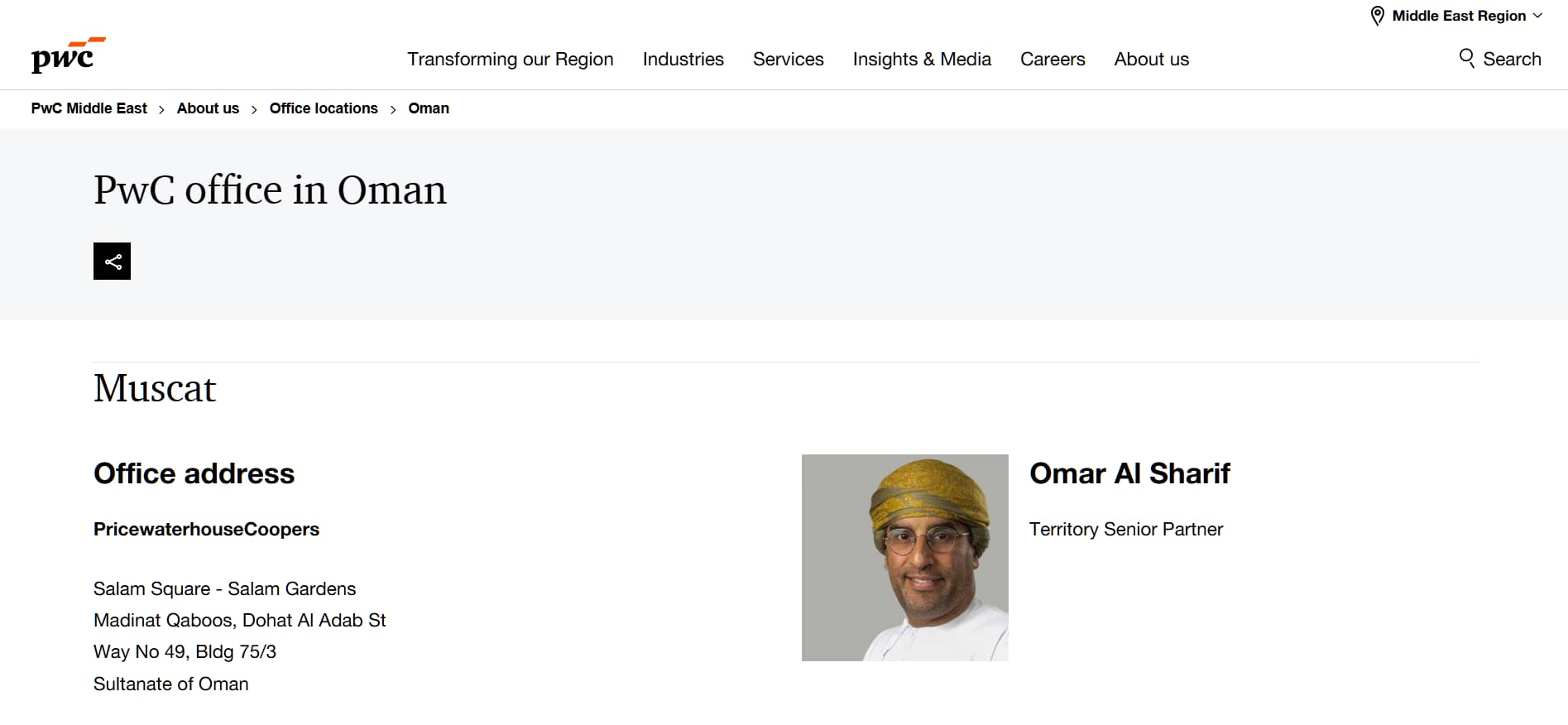
Public offering: PwC Middle East's cyber defence and detection services include ethical hacking exercises that replicate current attacker techniques to test prevention and detection and produce a remediation plan, alongside managed cyber defence, threat intelligence, incident response, endpoint monitoring, identity and access management, and DevSecOps. Its cybersecurity transformation offering also describes a purple-team based rapid risk reduction service, and the firm runs an OT Cyber Lab in Dubai.
Oman relevance: PwC publishes these services at Middle East regional level. Confirm whether testing for Oman is delivered by an Oman-based team or a regional team, onsite availability, and how test data is handled.
Official sources: https://www.pwc.com/m1/en/services/consulting/technology/cyber-security/defence-and-detection.html; https://www.pwc.com/m1/en/services/consulting/technology/cyber-security.html
Buyer fit: Organisations that want ethical hacking tied to cyber defence, risk, and privacy advisory from a large professional services firm.
What sets it apart in Oman: Its ethical hacking is described as testing detection as well as prevention, and it publishes a regional OT Cyber Lab in Dubai, which is relevant to industrial and utility scopes.
| Documented strengths | Limits and buying considerations |
|---|---|
| Ethical hacking tests both prevention and detection, and ends with a remediation plan. | The public description is high level; request the test types, methodology, and a sample report for your assets. |
| Purple-team rapid risk reduction and OT security capabilities are described. | If PwC is also your auditor, check independence rules before engaging it for testing. |
Public offering: EY's cybersecurity pages for Oman list cybersecurity transformation, cybersecurity managed services, cyber incident resilience and response, data protection and privacy, digital identity and privileged access management, cyber architecture and OT engineering services, cyber threat management, detection and response, and a cybersecurity benchmarking assessment. Penetration testing and red teaming are not named on the pages we reviewed, so confirm availability and delivery team.
Oman relevance: EY operates an Oman locale site (ey.com/en_om), but the cybersecurity content is published at MENA and global level. Confirm whether technical testing is delivered by an Oman-based or regional team, and define tester locations and data handling in the engagement letter.
Official sources: https://www.ey.com/en_om/services/cybersecurity; https://www.ey.com/en_om/locations
Buyer fit: Enterprises that want cyber transformation, incident readiness, and managed security, with testing coordinated through a Big Four firm.
What sets it apart in Oman: Its Oman site lists cyber architecture, OT engineering and managed services but not penetration testing, so it fits mainly where testing is bought as part of a wider transformation or managed-services contract.
| Documented strengths | Limits and buying considerations |
|---|---|
| Transformation, incident response, identity, OT, and managed services are published on the Oman site. | Penetration testing is not listed on the pages reviewed; ask for the testing methodology and sample technical findings. |
| Results can be tied to transformation and governance programs. | If EY is also your auditor, check independence rules before engaging it for testing. |
Public offering: IBM's X-Force Red offensive security services cover expert-led, AI-augmented penetration testing of applications, networks, cloud, hardware, and AI systems, AI red teaming of generative AI and LLM applications, adversary simulation and breach readiness exercises, social engineering, compliance and threat-led testing (including PCI DSS, ISO 27001, and DORA), and continuous autonomous testing with expert review. Findings, ticketing integration, and remediation tracking run through IBM's Red Portal.
Oman relevance: IBM is headquartered in Armonk, New York, and X-Force Red is run as a global practice; the service page does not name an Oman delivery team. Confirm which region staffs the test, onsite options in Oman, and data-handling terms.
Official sources: https://www.ibm.com/services/offensive-security
Buyer fit: Large organisations that need specialised testing of applications, hardware, cloud, or AI systems, or full adversary simulation.
What sets it apart in Oman: With NCC Group, it is one of two providers here that publish hardware and AI-system testing; IBM adds named AI red teaming of LLM applications and a Red Portal for findings and remediation tracking.
| Documented strengths | Limits and buying considerations |
|---|---|
| Broad testing scope, including hardware and AI systems, with adversary simulation and social engineering. | Global delivery; confirm the assigned team, its location, and time-zone coverage for Oman. |
| Red Portal supports scheduling, findings, integrations, and remediation validation. | Retesting terms are not described on the service page; agree them in the statement of work. |
Public offering: NCC Group's penetration testing services cover attack simulation (red, purple, and black teaming, and threat-intelligence-led assessments), web and mobile application testing with source code review, network and infrastructure testing, cloud and container reviews, hardware and embedded systems, blockchain, cryptography, AI security, and continuous penetration testing of web apps, APIs, and mobile apps. Results are delivered through its Cyber Services Portal.
Oman relevance: NCC Group is headquartered in Manchester, UK, and its published office list does not include a Middle East or GCC office. Testing for Oman would be delivered remotely or by travelling consultants; define tester locations and data handling in the agreement.
Certifications: NCC Group's site displays CREST membership and NCSC CHECK penetration testing logos, among other UK schemes.
Official sources: https://www.nccgroup.com/penetration-testing-services/; https://www.nccgroup.com/our-office-locations/
Buyer fit: Organisations that want specialist technical depth, such as hardware, cryptography, or advanced application testing, and can work with a remote provider.
What sets it apart in Oman: It brings UK CHECK and CREST credentials and specialist cryptography and blockchain testing that the Oman-based providers on this list do not advertise, but it has no published GCC office, so it fits remote, specialist scopes.
| Documented strengths | Limits and buying considerations |
|---|---|
| Very broad specialist coverage, from red teaming to hardware, cryptography, and blockchain. | No GCC office is published; confirm onsite options, time-zone coverage, and contracting route. |
| UK accreditations such as CHECK and CREST membership are shown on its site. | UK schemes do not map directly to Omani requirements; confirm which credentials apply to your engagement. |
Public offering: Trustwave's site now redirects to LevelBlue, whose SpiderLabs team provides penetration testing, red teaming, vulnerability management, threat hunting, threat intelligence, and database security assessment. LevelBlue cites more than 2,000 pen tests delivered annually and a global SpiderLabs team of over 1,000 consultants, threat hunters, incident responders, and researchers, with findings consolidated in its Fusion platform.
Oman relevance: LevelBlue's offensive security pages do not list a Middle East office. Confirm the delivering region, onsite options in Oman, and data-handling terms, and check that contracts reflect the current LevelBlue entity.
Official sources: https://www.levelblue.com/solutions/offensive-security-solutions; https://www.levelblue.com/company/contact
Buyer fit: Organisations that want penetration testing linked to managed security and threat intelligence from a large global provider.
What sets it apart in Oman: It pairs a large global SpiderLabs testing team with managed security in the Fusion platform; buyers with existing Trustwave agreements should confirm how contracts moved to LevelBlue.
| Documented strengths | Limits and buying considerations |
|---|---|
| Large SpiderLabs research and testing team with penetration testing and red teaming in one service line. | LevelBlue acquired Trustwave in August 2025; confirm the contracting entity and continuity of any existing agreements. |
| Findings can be consolidated alongside managed security in the Fusion platform. | No Middle East office is published; confirm tester locations and Oman coordination. |
Public offering: Oman Data Park now operates within Otech, Omantel's technology services and digital solutions arm, and offers data centre, sovereign and public cloud, managed and professional services, AI, and IoT capabilities. Its cybersecurity capability is described as enterprise-grade security, active threat monitoring, and compliance frameworks, with a 24/7 SOC. Its cybersecurity page lists 'Cyber Offense' services that simulate real-world attacks; confirm the test types, whether testing is in-house or partner-led, and tester qualifications.
Oman relevance: Oman Data Park is an Omani provider operating data centres and cloud regions in Muscat and Ibri. Confirm who performs any penetration testing, whether testers are local, and how test data is handled.
Official sources: https://otech.om/capabilities/cybersecurity; https://www.omandatapark.com/contact-us
Buyer fit: Omani organisations already using local data centre or sovereign cloud services that want security monitoring and assessments from the same provider.
What sets it apart in Oman: As part of Omantel's Otech arm with data centres in Muscat and Ibri, and accredited by the then Ministry of Technology and Communications for security assessment services in August 2020, it is relevant when workloads must stay in Omani infrastructure.
| Documented strengths | Limits and buying considerations |
|---|---|
| Local sovereign cloud and data centre operator with a 24/7 SOC and managed security services. | Its cybersecurity page lists 'Cyber Offense' services that simulate real-world attacks; confirm the test types, whether testing is in-house or partner-led, tester qualifications, and a sample report. |
| Security services can be aligned with workloads hosted in its own Omani infrastructure. | When the hosting provider also tests the environment, agree how testing independence is preserved. |
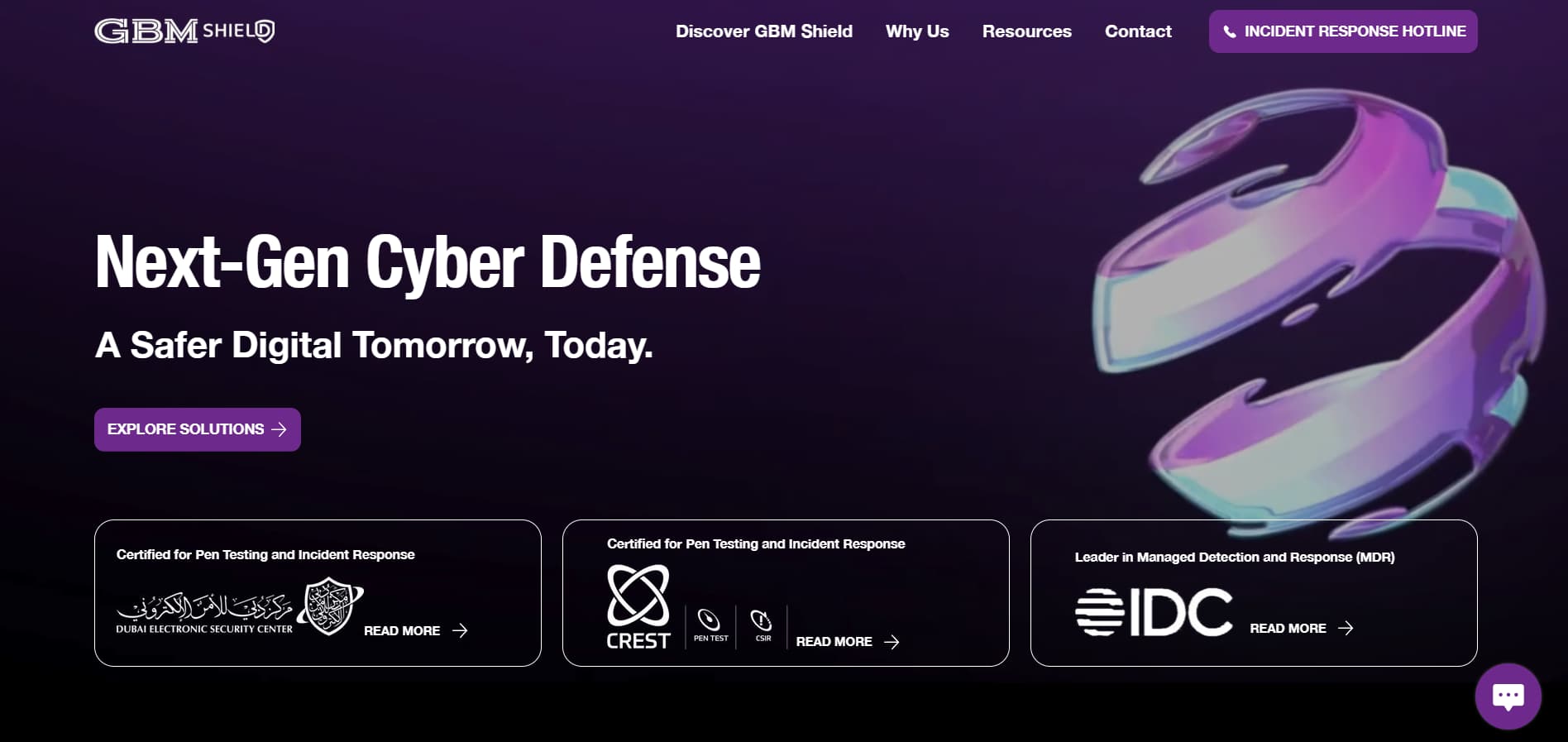
Public offering: GBM's security solutions include GBM Shield managed security services and GBM Cyber Security Services (consulting and advisory, governance, risk, and compliance, threat assessment, vulnerability management, and incident response and recovery). GBM's March 2024 accreditation press release says its GBM Shield cyber threat assessment services include vulnerability assessment, penetration testing, configuration review, SAST and DAST, wireless penetration testing, red teaming, and threat hunting, and the CREST Marketplace lists Gulf Business Machines (United Arab Emirates) as accredited for Penetration Testing and Incident Response. GBM's current cyber security services page no longer names these testing services, so confirm the testing team and scope.
Oman relevance: GBM lists Oman among its offices alongside Abu Dhabi, Dubai, Bahrain, Kuwait, and Pakistan. Confirm the Oman team's role, whether testing is subcontracted, and data-handling terms.
Official sources: https://www.gbmme.com/solutions/security-solutions/GBM-cyber-security-services; https://www.gbmme.com/resources/press-release/gbm-sets-new-industry-standards-with-dual-crest-desc-cybersecurity-accreditation; https://marketplace.crest.org/supplier/gulf-business-machines/; https://www.gbmme.com/contact-us
Buyer fit: Large organisations that want security assessments tied to managed security or wider IT programs from a regional integrator with an Oman presence.
What sets it apart in Oman: It is a regional integrator with an Oman office, but its CREST Marketplace listing for penetration testing and incident response is held under its UAE entity, so ask whether Oman engagements are staffed from Muscat or Dubai.
| Documented strengths | Limits and buying considerations |
|---|---|
| Oman presence plus managed security, GRC, threat assessment, and incident response services. | GBM states that it offers penetration testing under GBM Shield and holds CREST pentest accreditation; ask who performs testing and request a sample report. |
| Assessments can be combined with integration and managed security work. | When the same provider runs your security stack, agree how testing independence is preserved. |
Match the provider type to the asset under test. Web, API, mobile and cloud scopes need a manual application or cloud testing team; internal networks, wireless and OT need infrastructure testers who can work onsite in Oman or over secure access; red teams need a mature offensive team; compliance tests need an audit-aware provider. The table shows what to verify for each.
| Testing need | Provider type to shortlist | What to verify in Oman |
|---|---|---|
| Web application pentest | Manual application security team | OWASP WSTG coverage, authentication and business-logic testing, exploited proof, and fix guidance. For MSX-listed companies, the FSA guidelines say every website needs a penetration test. |
| API pentest | API specialist | BOLA/IDOR, token handling, rate limits, data exposure, tenant isolation, OAuth/OIDC, and consent flows. For open banking participants, the CBO framework expects regular tests of critical web applications and API infrastructure. |
| Mobile app pentest | Mobile application security team | iOS and Android coverage, local storage, certificate pinning, backend APIs, and root or jailbreak detection. The FSA guidelines also call for a penetration test of every mobile app a listed company runs. |
| Cloud pentest | Cloud security team | IAM, storage, containers, serverless, logging, and privilege escalation, plus where the tenant is hosted (a data centre in Oman or a foreign region) and who may hold exported evidence. |
| Network pentest | Infrastructure testers who can work onsite | External and internal scope, segmentation, Active Directory, wireless, and safe production windows. Government units should check accreditation scope: the published register lists web application and infrastructure testing separately. |
| Red team | Mature offensive security team | MITRE ATT&CK mapping, rules of engagement, detection goals, and social engineering limits. For banks and finance and leasing companies, the CBO business continuity framework calls for threat-led testing or a red-team exercise of critical systems at least every three years. |
| Compliance pentest | Audit-aware provider | Mapping to the CBO framework, FSA guidelines, PCI DSS, or ISO 27001, evidence of retesting, and a report an internal or external auditor can follow. |
| PTaaS / continuous testing | Continuous validation provider | Dashboard access, test cadence, fix tracking, retest terms, and whether the cadence also covers the annual test of internet-facing systems that CBO-licensed institutions need. |
Digital services in Oman now run through banks and payment apps, government portals, oil and gas operators, ports and logistics firms, telecoms, healthcare, and education. Each adds customer portals, mobile apps, payment flows, APIs, cloud platforms, vendor links, and remote access routes that an attacker can try. A penetration test shows which of those routes work before someone outside the organization finds out. Regulators have turned that into rules: the Central Bank of Oman covers licensed financial institutions, the FSA covers MSX-listed companies, and MTCIT circulars cover government websites and applications.
Tie the scope to the systems that carry the most risk: internet-facing applications, the APIs behind mobile apps, admin panels, cloud IAM and storage, internal networks, payment systems, and identity workflows. Then check which Omani rule applies. A 2022 MTCIT circular tells government units to run a security assessment before launching websites, portals, and applications, and again every one or two years or after changes. The Personal Data Protection Law's Executive Regulation gives controllers 72 hours to notify MTCIT of a breach that puts data subjects at risk. Confirm current obligations with Oman National CERT (OCERT), MTCIT, the Telecommunications Regulatory Authority, the Central Bank of Oman, PCI DSS, ISO 27001, or SOC 2 sources and your compliance advisers.
Penetration testing pricing in Oman is quoted per scope, and providers here seldom publish rates. The quote moves with the number of applications and endpoints, user roles, cloud accounts, reporting and audit evidence, retesting, and onsite time. Onsite time matters more in Oman than in many markets: government assessments are expected on the premises, and industrial and port sites such as Sohar, Duqm, and Salalah are a long way from Muscat. Ask every bidder to price the same written scope in the same currency, and compare what is included before comparing totals.
Quotes generally follow one of five commercial models: a fixed-scope project, time and materials, a PTaaS subscription, an annual retainer, or a full red team engagement. Fixed scopes suit an annual regulatory test because the budget is known in advance. PTaaS suits teams that release often and want findings retested between annual tests. Red team work costs more because it adds stealth, social engineering, longer rules of engagement, and multi-step attack-path testing; Omani banks should plan it against the three-year threat-led testing cycle in the CBO business continuity framework.
| Scope factor | Why it changes the quote |
|---|---|
| Number of apps or endpoints | Each extra application, API, or IP range adds tester days and report pages. |
| Authentication complexity | Several user roles, SSO, MFA, and tenant separation multiply the authorization checks a tester must repeat. |
| API depth | Open banking and mobile back-end APIs need endpoint-by-endpoint authorization testing by hand. |
| Cloud scope | IAM, storage, containers, serverless functions, and logging are reviewed per account and per region. |
| Compliance evidence | Mapping findings to the CBO framework, FSA guidelines, or PCI DSS takes extra reporting time. |
| Retesting | The CBO framework expects fixes to be validated, so check whether a retest round is inside the quote. |
| Onsite work | Travel inside Oman, site passes, security clearance, and fixed testing windows add days. |
A provider with a Muscat team helps when the buyer is a government unit or government-owned company, when testers must sit on the premises, when staff need security clearance, or when workshops and summaries are wanted in Arabic. The accreditation program for security assessment providers, started by MTCIT and now handled by the Cyber Defence Centre according to MTCIT's notice, exists for this group, so accredited local firms are the natural first call for ministries and critical national infrastructure.
GCC and international providers are worth the extra coordination when the scope needs skills that are harder to find locally: deep manual application and API testing, cloud attack paths, mature red teaming, PTaaS platforms, or one report format across several countries. Before signing with a firm outside Oman, settle the contracting entity, overlap with Oman's working week, who travels for onsite phases, and where evidence is held. MTCIT's guidance says sensitive personal data needs Cyber Defence Centre approval before it is stored or processed outside Oman.
Scope decides it. An Omani hosting or managed security provider can be a sound partner for infrastructure tests and SOC-linked work, although a firm testing an estate it also runs raises an independence question. A specialist offensive firm is usually the stronger pick for deep web, API, and cloud testing. Splitting the work is a reasonable option for larger Omani organizations: an accredited local firm for onsite and government-facing scopes, and a specialist for application depth.
| Requirement | Why it matters in Oman | What to ask the provider |
|---|---|---|
| Methodology and scope | MTCIT's standard expects a documented methodology that is shared with the client. | Which methodology do you follow for web, API, cloud, mobile, network, and red team work, and can we read the document? |
| Manual testing emphasis | Separates a real test from a relabeled scan. | Show an example where your testers exploited a finding by hand and chained it with another. |
| Tester seniority | The government standard names certifications such as OSCP, OSWE, GWAPT, and GPEN for assessors. | Who is the lead tester, which certifications do they hold, and can we see a technical CV? |
| Sample report | Shows whether the evidence is usable by engineers and auditors. | Can you share a redacted report with an executive summary, prioritized findings, and evidence? |
| Proof-of-exploitation | Demonstrates real impact instead of theoretical risk. | What evidence do critical and high findings carry: screenshots, requests, or reproduction steps? |
| Retesting terms | The CBO framework expects remediated vulnerabilities to be validated. | How many retest rounds are included, within what period, and how is an extra round charged? |
| Remediation support | Engineering teams fix faster with direct access to the tester. | Do you hold a findings walkthrough and answer developer questions after the report? |
| Data handling | The Personal Data Protection Law restricts transfers, and sensitive data stored abroad needs Cyber Defence Centre approval. | Where will evidence be stored, who can access it, how is it encrypted, and when is it deleted? |
| Testing windows | Live banking, portal, and industrial systems cannot be interrupted. | How do you agree test hours, stop conditions, and emergency contacts for production systems? |
| Oman/GCC delivery model | Decides who signs, who travels, and whether accreditation applies. | Which entity contracts, where are the testers based, and is any work subcontracted? |
| Arabic/English reporting | Boards, regulators, and government units may want an Arabic summary. | Can you deliver the executive summary in Arabic and the technical report in English? |
| Compliance mapping | Different Omani regulators may read the same report. | Can findings be mapped to the CBO framework, FSA guidelines, PCI DSS, ISO 27001, or SOC 2? |
This guide describes DeepStrike, Help AG, Dreamlab Technologies Oman, KPMG Oman, Deloitte Oman, PwC Oman, EY Oman, IBM X-Force Red, NCC Group, LevelBlue SpiderLabs (formerly Trustwave), Oman Data Park (Otech), and GBM Oman / GBM Shield. Which one fits depends on your regulator (the Central Bank of Oman, the FSA, or MTCIT for government units), the assets in scope, how deep the testing must go, and whether you need a team in Muscat or can work with remote delivery.
Because DeepStrike publishes this article. The position is an editorial choice and not an independent ranking of quality. Read the DeepStrike entry as you would any vendor describing its own service, note that it delivers to Oman remotely, and compare scope, sample reports, and references across every provider before deciding.
Work in three steps. First, identify the rule you answer to: the Central Bank of Oman framework, the FSA guidelines for listed companies, or the MTCIT standards for government units, which are built around accredited providers. Second, fix the scope: web, API, mobile, cloud, network, or red team. Third, compare methodology, named testers, a sample report, retest terms, evidence handling, and delivery model. Price and brand come last.
Providers rarely publish prices for Oman, so there is no reliable public rate card. A quote depends on the number of applications and APIs, user roles, cloud and network scope, internal versus external testing, audit evidence, retest rounds, and onsite days. Engagements are priced per scope. Send the same written scope to each shortlisted provider and ask for the same currency and the same retest terms so the quotes can be compared line by line.
VAPT stands for vulnerability assessment and penetration testing. The assessment part finds and rates weaknesses, mostly through scanning plus validation. The penetration test part tries to exploit them under control to show real impact. Omani rules use both terms: the Central Bank of Oman framework refers to VA&PT and sets separate expectations for each half, and the FSA guidelines ask listed companies for regular VAPT with an independent third-party provider. Check that a VAPT quote includes manual testing.
It depends on the sector. Central Bank of Oman licensees are expected to penetration test internet-facing systems at least annually or after significant changes. MSX-listed companies must carry out information security assessments and testing at least annually under FSA Circular E/1/2022. Government units are told to assess websites and applications before launch and every one or two years. Other organizations use testing to support PCI DSS, ISO 27001, SOC 2, and customer security reviews. Confirm the current text with the regulator and your legal or compliance team before treating any test as mandatory.
At minimum: scope, methodology, an executive summary, findings ranked by risk, technical detail, proof of exploitation, affected assets, business impact, fix steps, and retest status. MTCIT's Security Assessment Services Standard sets a similar list for government work: an executive summary on business impact, prioritized technical findings, detailed evidence of any unauthorized access, prioritized recommendations, and an estimate of the resources needed to fix. For audits, add control mapping so a reviewer can see what was tested and what was closed.
Use the regulator's interval as the floor. The Central Bank of Oman framework sets at least annual testing of internet-facing systems, or sooner after significant changes. Its 2026 business continuity framework adds threat-led testing or a red-team exercise of critical systems at least once every three years for banks and finance and leasing companies. The FSA guidelines set annual assessments for listed companies. Beyond that, test after new applications, cloud migrations, API launches, or incidents; teams that release quickly may add quarterly or continuous testing through PTaaS.
Often, yes. Web, API, cloud, and external network tests are routinely delivered remotely to Omani companies. Two limits apply. Government administrative units work to MTCIT's standard, which expects assessors onsite and remote access only when the organisation requests it. And under MTCIT's personal data guidance, sensitive personal data needs Cyber Defence Centre approval before it is stored or processed outside Oman, so agree the access method, evidence location, and testing windows in the contract.
Not automatically. An accredited local firm is the practical choice for government units, onsite internal testing, security-cleared staff, and Arabic communication. GCC or international specialists may bring deeper application, API, cloud, or red team skills and PTaaS platforms. Judge on the scope and on the named testers, not on the office address, and ask firms with a Muscat office whether the testing itself is staffed from Oman or from another country.
The usual scopes are web application, API, mobile app testing, cloud, external and internal network, wireless, social engineering, and red team assessments. In Oman, consider adding OT and SCADA testing for energy, water, and port operators, payment and ATM testing for banks, and API testing for open banking participants. Choose the mix from your attack surface: customer portals, mobile apps, payment systems, cloud workloads, plant networks, and third-party integrations.
Ask who will test and which certifications they hold, which methodology they follow, how findings are confirmed by hand, what a sample report looks like, and how many retests are included. For Oman, add four more: is the firm on the accredited register if you are a government unit, which entity signs the contract, where will evidence be stored and will any of it leave Oman, and can the summary be delivered in Arabic.
The providers in this guide are not substitutes for one another. An accredited Muscat firm that suits a ministry tender may not be the right team for deep API testing of a banking app. A global red team practice may be hard to bring onsite at short notice. An Omani hosting or managed security provider can cover infrastructure and SOC-linked work, but its hands-on application testing should be verified first.
Start from the rule that applies to you (Central Bank of Oman, FSA, MTCIT, or the Personal Data Protection Law), then use this guide's criteria to compare methodology, report quality, retest terms, and delivery fit. DeepStrike, the publisher of this guide, is listed first for human-led testing with remediation collaboration. Other providers may fit better for government procurement, Big Four consulting, hardware or OT work, or managed security bundles.
For buyers in Oman, DeepStrike offers manual web application testing, API penetration testing, mobile application and cloud penetration testing, network testing, red team assessments, continuous penetration testing, remediation tracking, and retesting support, delivered remotely; the DeepStrike entry above sets out the tester-location and data-handling terms to settle in the agreement.
Mohammed Khalil is a Cybersecurity Architect at DeepStrike, specializing in advanced penetration testing and offensive security operations. With certifications including CISSP, OSCP, and OSWE, he has led numerous red team engagements, focusing on cloud security, application vulnerabilities, and adversary emulation. His work involves dissecting complex attack chains and developing resilient defense strategies for clients in the finance, healthcare, and technology sectors.

Stay secure with DeepStrike penetration testing services. Reach out for a quote or customized technical proposal today
Contact Us
