November 5, 2026
Updated: November 5, 2026
Kaspersky, Statista, Cisco Talos, Google, Microsoft and FTC data on daily spam volume, top source countries, spam types, costs and email authentication.

Mohammed Khalil
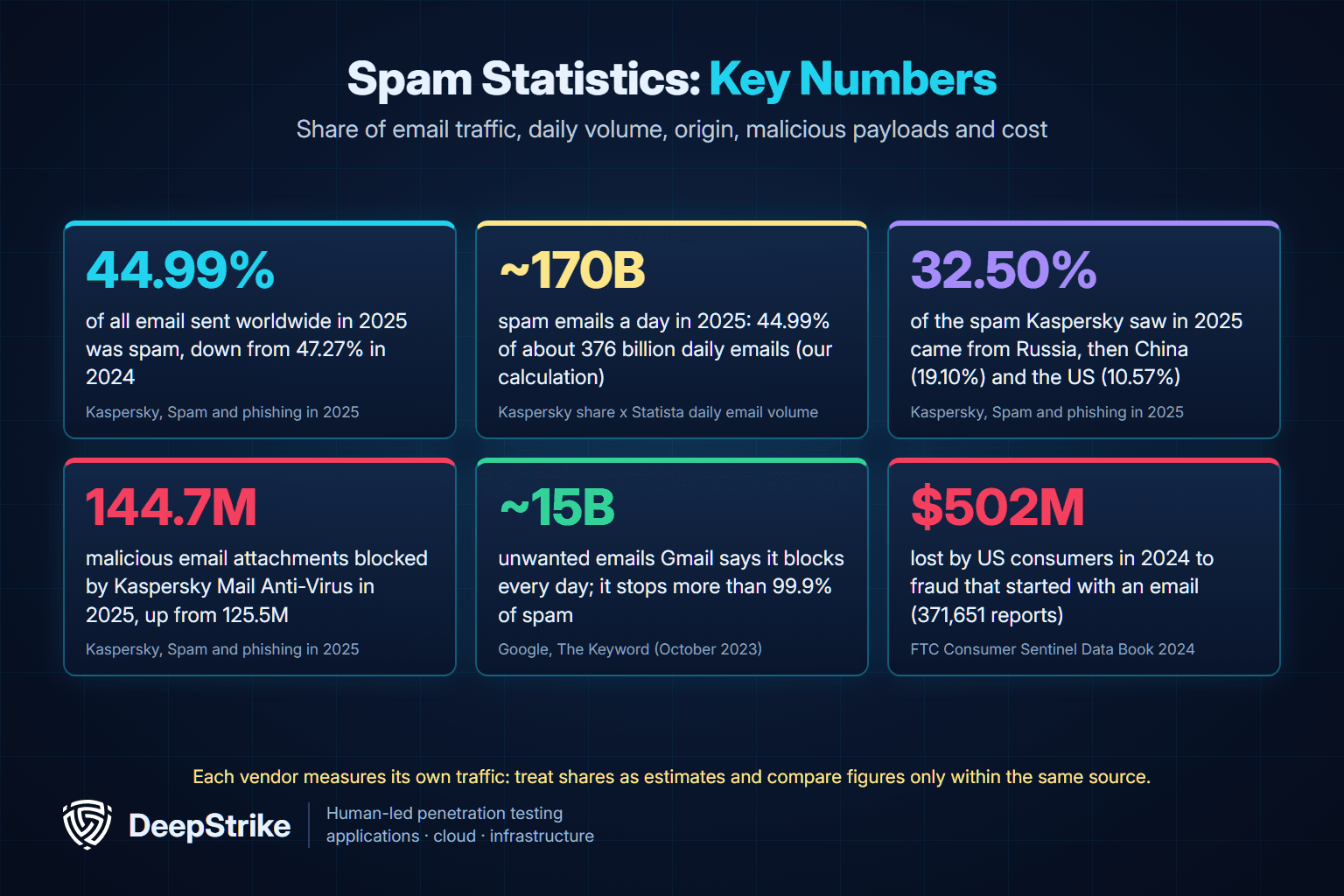
Spam statistics for 2026 show junk email is still close to half of all mail. Kaspersky measured spam at 44.99% of global email traffic in 2025, down from 47.27% in 2024. Applied to Statista's estimate of about 376 billion emails a day, that is roughly 170 billion spam emails every day (our calculation). Russia, China and the United States sent the most spam in Kaspersky's data. In the US, email was the most reported fraud contact method in 2024, tied to USD 502 million in losses. Below are the verified numbers and what they mean for security teams.
Every figure below was checked against the publisher's own report or page on 5 November 2026. Spam numbers come from different vantage points (a security vendor's mail traffic, a mailbox provider, a government complaint database), so read the "What it measures" column before comparing two rows.
| Statistic | Source and date | What it measures |
|---|---|---|
| 44.99% of all email sent worldwide in 2025 was spam, down from 47.27% in 2024 | Kaspersky, Spam and phishing in 2025 (February 2026) | Share of email in Kaspersky's traffic data |
| About 170 billion spam emails a day in 2025 | Our calculation: 44.99% of about 376 billion daily emails (Statista, 2025) | Estimate combining two sources |
| Spam peaked at 52.87% of email in November 2025 | Kaspersky, Spam and phishing in 2025 | Monthly share |
| 32.50% of spam came from Russia, 19.10% from China and 10.57% from the US in 2025 | Kaspersky, Spam and phishing in 2025 | Share of outgoing spam by sending country |
| 144,722,674 malicious email attachments blocked in 2025, up from 125,521,794 in 2024 | Kaspersky, Spam and phishing in 2025 and 2024 | Detections by Kaspersky Mail Anti-Virus |
| Gmail blocks nearly 15 billion unwanted emails a day and stops more than 99.9% of spam, phishing and malware | Google, The Keyword (3 October 2023) | Gmail's own filtering |
| Microsoft screens about 5 billion emails a day for malware and phishing | Microsoft Digital Defense Report 2025 (October 2025) | Microsoft's email filtering volume |
| Email was the contact method in 371,651 US fraud reports in 2024, with USD 502 million lost | FTC Consumer Sentinel Network Data Book 2024 (March 2025) | Consumer fraud reports naming email |
| Spam costs American firms and consumers almost USD 20 billion a year | Rao and Reiley, Journal of Economic Perspectives (2012) | Academic estimate of external costs |
Primary sources for each row are linked in the sections below and listed under Sources and References.
No organization counts every spam email sent on the internet. The best available answer combines two published estimates: the share of email that is spam and the total number of emails sent each day.
| Input or result | Value | Source |
|---|---|---|
| Emails sent and received per day, 2025 | About 376 billion | Statista, daily number of emails worldwide (updated September 2025) |
| Spam share of global email, 2025 average | 44.99% | Kaspersky, Spam and phishing in 2025 |
| Spam emails per day, 2025 average | About 169 billion | Our calculation (376.4 billion x 44.99%) |
| Spam emails per second, 2025 average | About 2 million | Our calculation (169 billion / 86,400 seconds) |
| Spam emails per day at the Q4 2025 share | About 185 billion | Our calculation (376.4 billion x 49.26%) |
Statista's daily email volume page puts 2025 at about 376 billion emails sent and received a day, a figure that secondary sites attribute to the Radicati Group. Kaspersky's Spam and phishing in 2025 report puts the yearly average spam share at 44.99%. Multiplying the two gives about 169 billion, which we round to roughly 170 billion spam emails a day. Treat it as an order of magnitude, not a count: Kaspersky measures the traffic its products see, and Statista's figure counts messages sent and received.
You will often see "51.8% of emails are spam" and "195 billion spam emails a day" quoted for 2025. Kaspersky's report shows that 51.80% was the December 2025 monthly share, not the annual average. Applying one peak month to the whole year inflates the daily estimate by about 26 billion messages.
Mailbox providers publish their own filtering totals, which show the scale from the receiving side. Google said in October 2023 that Gmail blocks nearly 15 billion unwanted emails every day. Microsoft's Digital Defense Report 2025 says it screens about 5 billion emails a day for malware and phishing. Both figures cover one provider's users, so they are not shares of global spam.
Spam has hovered between about 45% and 49% of global email in Kaspersky's measurements since 2022. The long-run trend is down: Statista's spam share series, which uses the same Kaspersky data, notes that the share "has decreased significantly" since 2011.
| Year | Spam share of global email | Malicious attachments blocked | Source |
|---|---|---|---|
| 2022 | 48.63% | Not used here | Derived from Kaspersky 2023 (45.60% after a 3.03-point drop) |
| 2023 | 45.60% | 135,980,457 | Kaspersky, Spam and phishing in 2023 |
| 2024 | 47.27% | 125,521,794 | Kaspersky, Spam and phishing in 2024 |
| 2025 | 44.99% | 144,722,674 | Kaspersky, Spam and phishing in 2025 |
Three details matter for 2025:
Kaspersky's 2024 report describes the 2024 rise as 1.27 points, while its 2023 report gives 45.60%, which implies 1.67 points. This page uses the annual values each report publishes, not the stated changes.
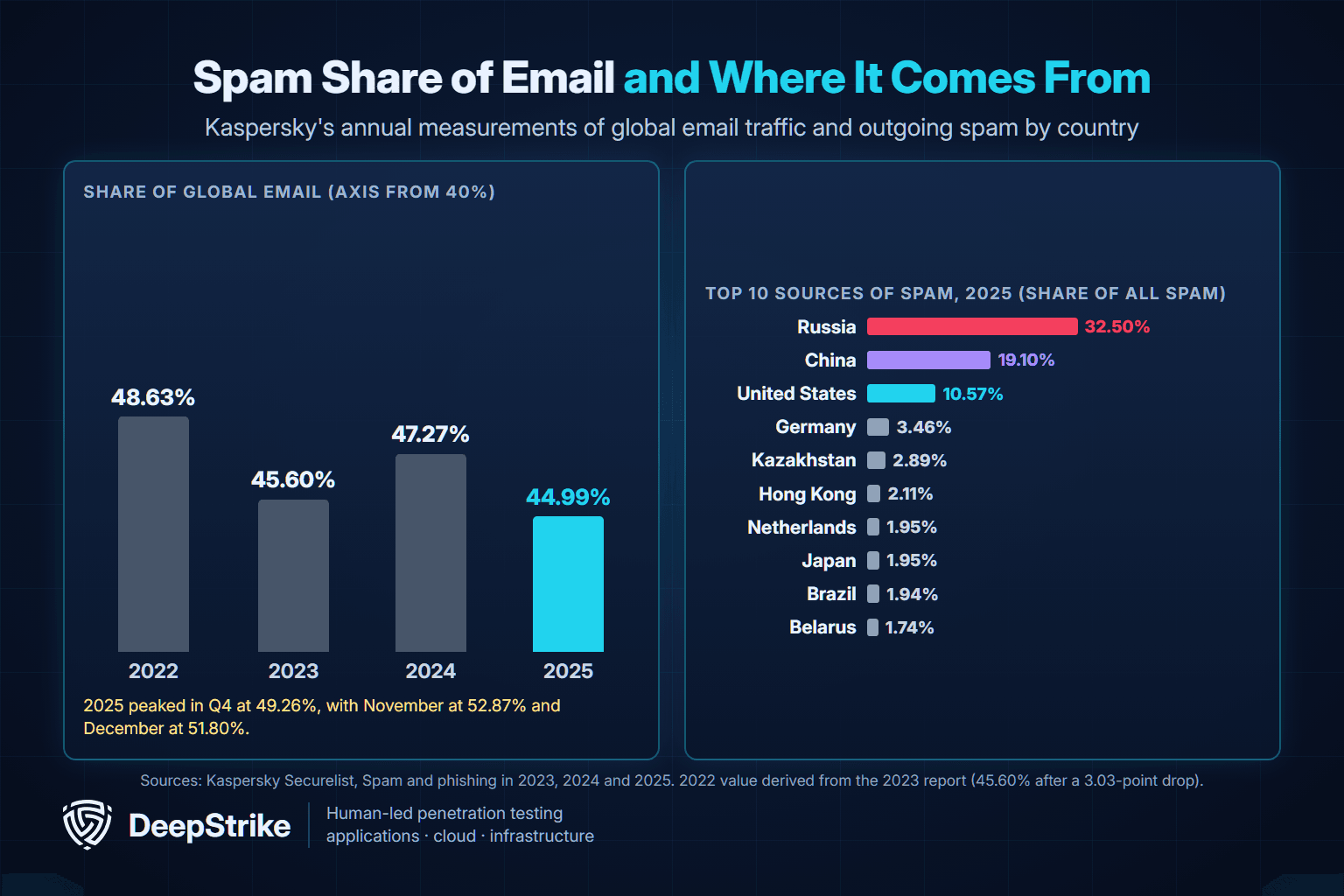
Country rankings depend on who is measuring. Kaspersky ranks the countries that sent the most spam in the traffic it saw in 2025:
| Rank | Country or territory | Share of all spam, 2025 |
|---|---|---|
| 1 | Russia | 32.50% |
| 2 | China | 19.10% |
| 3 | United States | 10.57% |
| 4 | Germany | 3.46% |
| 5 | Kazakhstan | 2.89% |
| 6 | Hong Kong | 2.11% |
| 7 | Netherlands | 1.95% |
| 7 | Japan | 1.95% |
| 9 | Brazil | 1.94% |
| 10 | Belarus | 1.74% |
Russia's share fell from 36.18% in 2024, while China and the US each rose by about 2 points. Kaspersky also reports a separate "Runet" figure: spam was 43.27% of email in the Russian web segment in 2025.
Cisco Talos shows a different picture. Its live spam sender table, read on 5 November 2026, ranked the United States first with a last-day volume score of 8.0, followed by the Netherlands (7.1), Germany (6.9), France (6.9) and Russia (6.8). Talos uses a base-10 log scale where 10 equals all of the world's email, so a one-point gap is a tenfold difference: the US score implies roughly eight times the Netherlands' spam volume that day.
Why the two disagree:
Kaspersky also lists where malicious attachments were blocked, which shows who is targeted rather than who sends: China (13.74%), Russia (11.18%), Mexico (8.18%), Spain (7.70%) and Türkiye (5.19%) led in 2025.
Most spam is still unwanted marketing, but the share that carries scams or malware is what security teams care about. Kaspersky's 2025 report and Microsoft's Digital Defense Report 2025 describe these main types:
| Type | What it looks like in 2025 | Main risk | Control that helps |
|---|---|---|---|
| Unwanted marketing | Bulk commercial email from real companies, often to purchased lists | Inbox clutter, complaint-driven blocklisting of legitimate senders | Sender rules, one-click unsubscribe, CAN-SPAM compliance |
| Scam spam | Fake investment projects, "brand partner" recruitment with deposits, overdue rent with changed bank details, prize surveys | Direct payment fraud | User reporting, payment verification by phone |
| Malicious attachments | Password-protected archives, fake e-signature notices, "business correspondence" with Trojanized DOCX files | Malware and stolen credentials | Attachment sandboxing, macro and script controls |
| Script-run instructions | PDFs telling users to paste a command into PowerShell to "fix" a problem | Self-inflicted infection | Application control, user awareness |
| Extortion spam | Blackmail claims with a QR code holding the crypto wallet | Payment under false threat | Awareness, reporting |
| Abuse of trusted services | Spam sent through Google Forms, Groups, Calendar and YouTube notifications, and OpenAI organization invites | Messages pass authentication because a real platform sent them | Content and link analysis, not authentication alone |
| Email bombing | Thousands of newsletter sign-ups flooding one inbox, followed by a fake IT support call | Hidden security alerts, remote access tool installs | Help desk verification process, rate limits |
A few numbers stand out. Kaspersky blocked more than 80,000 "brand partner" scam emails in December 2025 alone, a scheme it first detected that year. The most common malware family in email attachments was Makoob (4.88% of detections), followed by Badun (4.13%), Taskun (3.68%) and the Agensla stealer (3.16%). Microsoft's report says email bombing evolved in 2025 from a smokescreen into a first stage of attacks, often followed by vishing or Teams impersonation of IT support.
The "abuse of trusted services" row matters most for defenders. Kaspersky notes that Google Forms messages "appear authentic to most spam filters" because they come from Google's own servers. Authentication proves who sent a message, not whether its content is safe.
Spam is unsolicited bulk email. Phishing is a deceptive message designed to steal credentials or money, and it often travels inside spam campaigns. This page counts spam volume and types; our phishing statistics cover phishing volumes, click rates and losses, and our business email compromise statistics cover targeted payment fraud.
The overlap shows up in tactics. Kaspersky saw QR codes moved from email bodies into PDF attachments to dodge filters, a technique explained in our guide to QR code phishing (quishing). Stealer malware delivered as attachments feeds the credential market described in our analysis of infostealer malware and credential theft. Spam is not only an email problem either: fake account sign-ups and form spam are covered in our bot attack statistics.
Spam's cost lands mostly on recipients and the companies that filter it, not on spammers.
| Cost measure | Figure | Source and date |
|---|---|---|
| Annual cost of spam to American firms and consumers | Almost USD 20 billion | Rao and Reiley, Journal of Economic Perspectives, 2012 |
| Gross worldwide revenue of spammers and spam-advertised merchants | About USD 200 million a year | Rao and Reiley, 2012 |
| Ratio of external costs to spammer revenue | About 100 to 1 | Rao and Reiley, 2012 |
| US consumer fraud losses where email was the first contact | USD 502 million (371,651 reports; median loss USD 600) | FTC Consumer Sentinel Network Data Book 2024 |
| Maximum US penalty per non-compliant commercial email | Up to USD 53,088 | FTC CAN-SPAM Act compliance guide |
The academic estimate is old but still the most cited peer-reviewed figure. In "The Economics of Spam", Justin Rao and David Reiley estimated that spam imposes almost USD 20 billion a year on American firms and consumers, while spammers earn about USD 200 million worldwide. They noted the cost would be much higher without private spending on anti-spam technology.
The FTC data shows how spam turns into direct losses. In the Consumer Sentinel Network Data Book 2024, email was the contact method in 25% of fraud reports that named one, more than any other channel. Only 11% of those reports involved a loss, the lowest rate of any contact method, but the total still reached USD 502 million. Spam is a high-volume, low-yield channel: most messages fail, and the few that land are enough.
For legitimate senders, the cost is regulatory. The FTC's CAN-SPAM Act compliance guide says each separate violating email can carry a penalty of up to USD 53,088. The law covers business-to-business email too, and opt-out requests must be honored within 10 business days.
Most spam filtering relies on content and reputation, but three DNS-based standards decide whether a message can prove it comes from the domain it claims. They matter most against spoofed spam, where a criminal sends as your domain.
| Standard | Question it answers | Where it is published | What it does not stop |
|---|---|---|---|
| SPF (Sender Policy Framework), RFC 7208 | Is this server allowed to send mail for the envelope sender domain? | DNS TXT record listing authorized servers | Spoofing of the visible From: address; breaks on forwarding |
| DKIM (DomainKeys Identified Mail), RFC 6376 | Was the message signed by this domain and left unchanged? | Public key in DNS; signature in the message header | Spam from a domain that signs its own junk |
| DMARC, RFC 9989 (May 2026) | Does SPF or DKIM pass for a domain aligned with the visible From:, and what should happen if not? | DNS TXT record at _dmarc with a policy and report addresses | Lookalike domains, compromised real accounts, spam sent through trusted platforms |
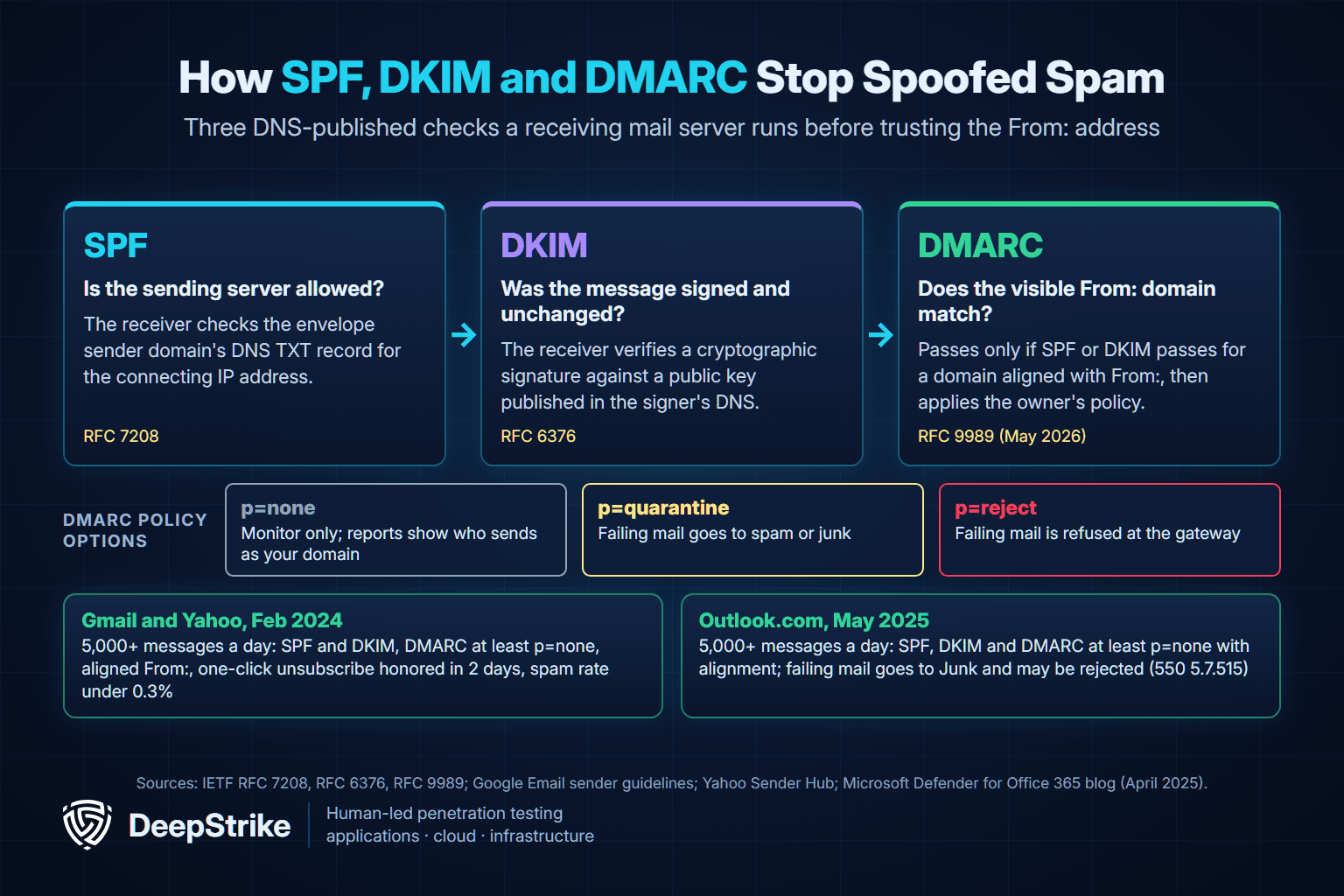
DMARC is the piece that ties authentication to the address people actually see. A domain owner publishes one of three policies: p=none (monitor only), p=quarantine (send failing mail to spam) or p=reject (refuse it). Aggregate reports show every server sending mail as the domain, which is how teams find forgotten marketing tools and spoofing.
The DMARC standard itself changed this year. In May 2026 the IETF published RFC 9989, which replaces RFC 7489, moves DMARC to the Standards Track and drops little-used tags such as pct. The SPF specification, RFC 7208, and the DKIM specification, RFC 6376, are unchanged.
Adoption among legitimate mail is high but not complete. Cloudflare Radar's email security data for the 12 months to 5 November 2026 showed 88.8% of messages passing DMARC, 5.2% failing and 6% with no DMARC policy. SPF failed for 15.4% of messages, often because of forwarding or unlisted senders.
In October 2023, Google announced that from February 2024 anyone sending more than 5,000 messages a day to Gmail addresses would have to authenticate their mail, offer one-click unsubscribe and keep reported spam below a set threshold. Yahoo adopted the same requirements, and Microsoft followed for Outlook.com in 2025.
| Requirement | Gmail (Feb 2024) | Yahoo (Feb 2024) | Outlook.com (May 2025) |
|---|---|---|---|
| Who is covered | 5,000 or more messages a day to personal Gmail accounts | Bulk senders | Domains sending more than 5,000 emails a day |
| SPF and DKIM | Both required | Both required | Both must pass |
| DMARC | At least p=none, with From: aligned to SPF or DKIM | At least p=none, must pass | At least p=none, aligned with SPF or DKIM |
| Unsubscribe | One-click for marketing mail, honored within 48 hours | One-click, honored within 2 days | Functional unsubscribe link recommended |
| Spam complaint rate | Below 0.3% in Postmaster Tools | Below 0.3% | Not a published threshold |
| Enforcement | Rejections ramped up from November 2025 | Gradual from February 2024 | Junk folder, then rejection with error 550 5.7.515 |
The details come from Google's announcement and its Email sender guidelines, the Yahoo Sender Hub and Microsoft's Outlook requirements for high-volume senders. Google's sender FAQ also says that once a domain is classified as a bulk sender, the status is permanent.
Did the rules work? Google said in 2023 that an earlier requirement for some authentication on all mail to Gmail cut unauthenticated messages its users received by 75%. In October 2024, Gmail's security product lead told Forbes that the bulk sender rules brought a 65% reduction in unauthenticated messages to Gmail users and 265 billion fewer unauthenticated messages in 2024. Those are Google's figures for Gmail only. Authentication removes spoofed mail from the easy path; it does not stop spam from authenticated domains or hijacked accounts.
The statistics point to a short list of controls. This is DeepStrike's method guidance, mapped to the evidence above:
DeepStrike's case study on how invoice emails were used to reach GitHub and Slack shows how email trust assumptions inside applications can be abused, which is another reason not to treat authenticated mail as safe content.
We used the newest edition of each source and checked every figure on the publisher's page on 5 November 2026.
| Source | What it measures | Period | Main limit |
|---|---|---|---|
| Kaspersky, Spam and phishing reports (Securelist) | Spam share of email traffic, spam by sending country, malicious attachments | Calendar years 2023 to 2025 | One vendor's telemetry; methodology not published in detail |
| Statista, daily number of emails | Emails sent and received per day | 2025 estimate | Paywalled series; volume model attributed to the Radicati Group by secondary sources |
| Cisco Talos, Email & Spam Data | Spam sender volume by country, log scale | One day, read 5 November 2026 | Snapshot; relative, not absolute, volumes |
| Google, Yahoo and Microsoft pages | Provider filtering volumes and sender requirements | 2023 to 2026 | Each provider's own users |
| Cloudflare Radar | Authentication pass rates | 12 months to 5 November 2026 | Mail Cloudflare processes |
| FTC Consumer Sentinel Network Data Book 2024 | US fraud reports by contact method | 2024 | Unverified consumer reports; the 2025 Data Book is not yet published |
| Rao and Reiley (2012) | Cost of spam | Estimate published 2012 | Pre-dates current filtering and email volumes |
Derived figures are labeled "our calculation." We did not add up figures from different sources except in the daily volume estimate, where the method is shown. Kaspersky phishing figures appear only to mark the overlap with phishing; full phishing data lives on our phishing statistics page.
About 170 billion a day in 2025, by our calculation. That applies Kaspersky's 2025 average spam share of 44.99% to Statista's estimate of about 376 billion emails sent and received daily. At the Q4 2025 share of 49.26%, the figure rises to about 185 billion. The often-quoted 195 billion uses December's 51.80% share for the whole year.
Kaspersky measured spam at 44.99% of global email traffic in 2025, down from 47.27% in 2024 and 45.60% in 2023. The monthly share peaked at 52.87% in November 2025.
In Kaspersky's 2025 data, Russia sent 32.50% of spam, followed by China (19.10%) and the United States (10.57%). Cisco Talos's live sender data, read on 5 November 2026, ranked the United States first. The rankings differ because each company measures different traffic over different periods.
Spam's share of email is broadly flat to down: Kaspersky's figure moved between 44.99% and 48.63% from 2022 to 2025, and Statista notes a long decline since 2011. Total email volume keeps growing, so the absolute number of spam messages can rise even when the share falls. Malicious attachments rose about 15% in 2025.
The most cited academic estimate puts spam's cost to American firms and consumers at almost USD 20 billion a year (Rao and Reiley, 2012). The FTC recorded USD 502 million in US consumer fraud losses in 2024 where email was the first contact.
Since February 2024, senders of 5,000 or more messages a day to Gmail or Yahoo must authenticate with SPF and DKIM, publish a DMARC policy of at least p=none with alignment, support one-click unsubscribe honored within two days, and keep spam complaints below 0.3%. Gmail increased enforcement, including rejections, from November 2025.
They stop spoofing of your exact domain when DMARC is set to quarantine or reject. They do not stop spam from lookalike domains, compromised accounts or trusted platforms such as Google Forms, which pass authentication. Content filtering and user reporting are still needed.
Spam volume is stable at close to half of all email, but the share carrying malware and the tricks that bypass authentication are growing. Filters handle the bulk; the remaining risk sits in your domain configuration, your attachment controls and the people who answer suspicious emails and calls.
If you want to know how your team and help desk respond when a spam-led lure gets through, DeepStrike's penetration testing services include manual social engineering testing with fix recommendations for every finding.
Mohammed Khalil is a Cybersecurity Architect at DeepStrike, specializing in advanced penetration testing and offensive security operations. With certifications including CISSP, OSCP, and OSWE, he has led numerous red team engagements, focusing on cloud security, application vulnerabilities, and adversary emulation. His work involves dissecting complex attack chains and developing resilient defense strategies for clients in the finance, healthcare, and technology sectors.

Stay secure with DeepStrike penetration testing services. Reach out for a quote or customized technical proposal today
Contact Us
