November 5, 2026
Updated: November 5, 2026
FBI, FinCEN, ALTA, CertifID and NAR data on real estate wire fraud losses, who gets impersonated, recovery odds and how to stop a fake wire.

Mohammed Khalil
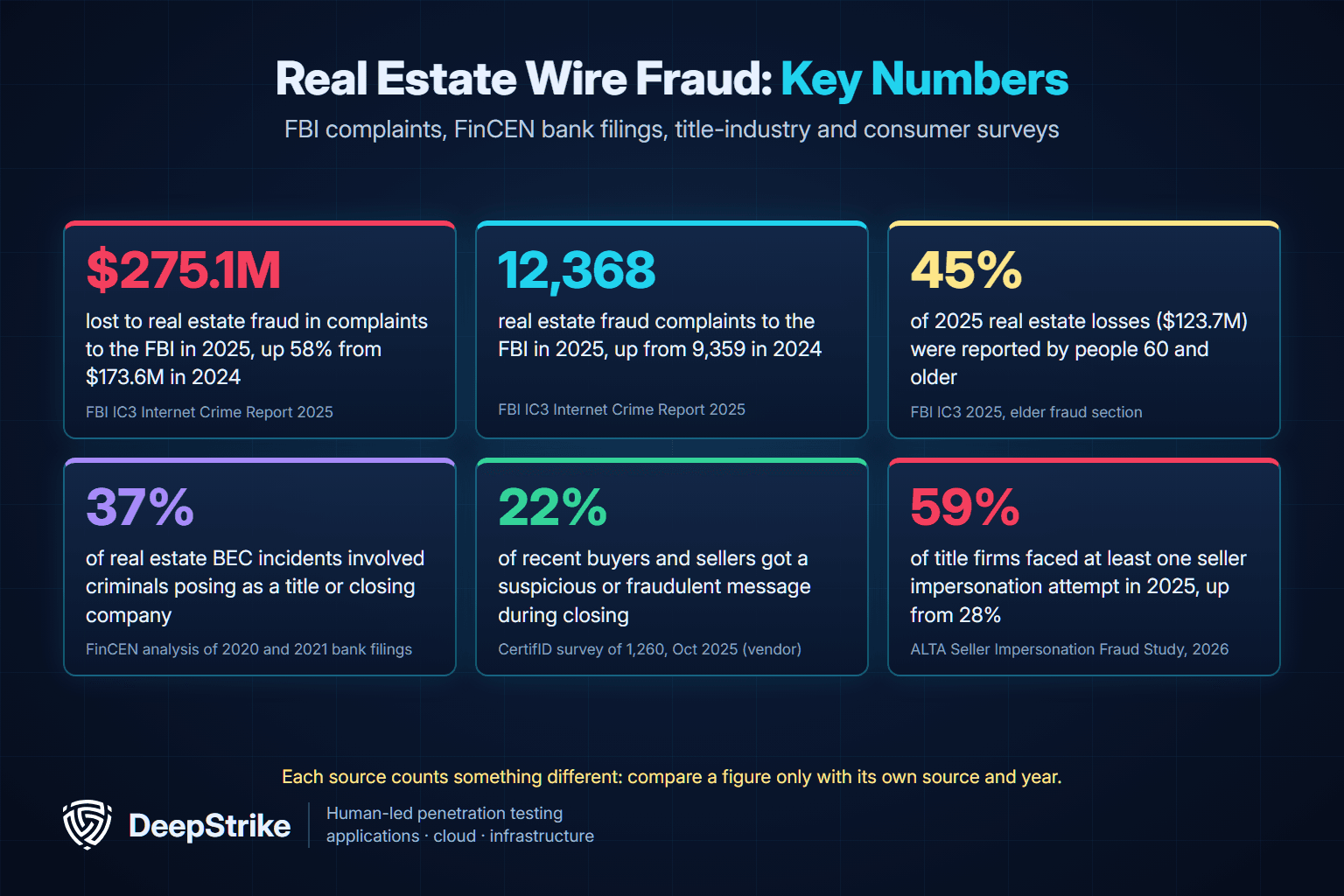
Real estate wire fraud statistics for 2026 show a crime that targets the most valuable payment most families ever make. The FBI recorded USD 275.1 million in real estate fraud losses in 2025, up 58% from 2024, from 12,368 complaints. FinCEN found that 37% of real estate business email compromise incidents involved criminals posing as a title or closing company. In a 2026 title-industry survey, 59% of firms reported a seller impersonation attempt in 2025. Below are the verified numbers, what each source counts and how buyers, agents and title firms can stop a fake wire.
Every figure below was checked against the publisher's own report or page on 5 November 2026. The sources count different things (FBI complaints, bank filings, firm surveys, consumer surveys, vendor case files), so read the "What it counts" column before comparing two rows.
| Statistic | Source and date | What it counts |
|---|---|---|
| USD 275.1 million lost to real estate fraud in 2025, up from USD 173.6 million in 2024 | FBI IC3 2025 Internet Crime Report (April 2026) | Losses in complaints filed under the Real Estate crime type |
| 12,368 real estate fraud complaints in 2025, up from 9,359 in 2024 | FBI IC3 2025 Internet Crime Report | Complaints filed with IC3 |
| People 60 and older reported USD 123.7 million of those losses, about 45% | FBI IC3 2025 Internet Crime Report, elder fraud section | Complaints from people 60 and older; share is our calculation |
| 2,260 bank filings reported about USD 893 million in real estate BEC activity in 2020 and 2021 | FinCEN Financial Trend Analysis (March 2023) | Bank Secrecy Act filings by financial institutions |
| 36.9% of real estate BEC incidents involved impersonation of a title or closing company | FinCEN Financial Trend Analysis | 2,013 incidents, 2020 and 2021 |
| More than 40% of title companies received at least one email a month trying to change wiring or payoff instructions | ALTA cybercrime study (February 2025), 2023 data | Survey of 360 title industry participants |
| 59% of title firms reported at least one seller impersonation attempt in 2025, up from 28% in the 2024 study | ALTA Seller Impersonation Fraud Study (September 2026) | Survey of 245 title professionals |
| 22% of recent buyers and sellers received a suspicious or fraudulent communication during closing | CertifID 2026 State of Wire Fraud report (March 2026), vendor research | Online survey of 1,260 people, October 2025 |
| Mortgage payoff fraud had the highest median loss, USD 389,125 | CertifID 2026 report, vendor research | Fraud recovery cases CertifID accepted in 2025 |
| 26% of home buyers paid all cash, an all-time high | NAR 2025 Profile of Home Buyers and Sellers (November 2025) | Survey of primary-residence buyers, July 2024 to June 2025 |
Primary sources for each row are linked in the sections below and listed under Sources and References. For the IC3 totals across all crime types, see our cybercrime statistics, which owns those numbers on this site.
Real estate wire fraud has no single official count. Each publisher measures a different slice, and mixing them produces claims no dataset supports.
| Source | What it counts | Latest period | Why it is useful | Main limit |
|---|---|---|---|---|
| FBI IC3 annual report | Complaints and reported losses by crime type | 2025 (published April 2026) | Newest federal data; losses and age groups | The Real Estate type covers investment, rental and timeshare fraud; most closing wire diversions are filed as BEC, which is not split by sector |
| FBI IC3 BEC PSAs | Trends in BEC with a real estate nexus | 2020 to 2022 (published June 2023) | Only FBI figures specific to real estate BEC | Percentage changes, no counts |
| FinCEN Financial Trend Analysis | Bank Secrecy Act filings about real estate BEC | 2020 and 2021 (published March 2023) | Who is impersonated, where funds go, recovery outcomes | Data is several years old |
| ALTA studies (trade association) | Title firms reporting attempts, losses and controls | 2023 to 2026 (published 2024 to 2026) | Shows the title and escrow side | Self-selected firm surveys |
| CertifID reports (vendor) | Consumer survey answers and the vendor's own recovery cases | 2025 (published March 2026) | Victimization rates, case types, median losses | Vendor sells wire-verification software; its case mix reflects its clients |
The practical rule: use the FBI for "how much was reported lost", FinCEN for "how the scheme works and where money goes", ALTA for "what title firms face" and CertifID for "how often consumers see it", with its vendor status in mind.
The FBI's 2025 Internet Crime Report, released in April 2026, counted 1,008,597 complaints and USD 20.9 billion in reported losses across all crime types. Real estate fraud accounted for 12,368 complaints and USD 275,110,419 in losses, the highest of the three years the report compares.
| Year | IC3 real estate complaints | IC3 real estate losses | Losses reported by people 60+ |
|---|---|---|---|
| 2023 | 9,521 | USD 145,243,348 | USD 65,634,851 |
| 2024 | 9,359 | USD 173,586,820 | USD 76,324,236 |
| 2025 | 12,368 | USD 275,110,419 | USD 123,671,936 |
Complaints rose 32% and losses rose 58% from 2024 to 2025 (our calculations). The average loss per real estate complaint was about USD 22,200 in 2025, up from about USD 18,500 in 2024 (our calculation), slightly above IC3's all-crime average of USD 20,699. Real estate was about 1.3% of all reported losses (our calculation), but it is one of the few categories where a single complaint can wipe out a family's savings.
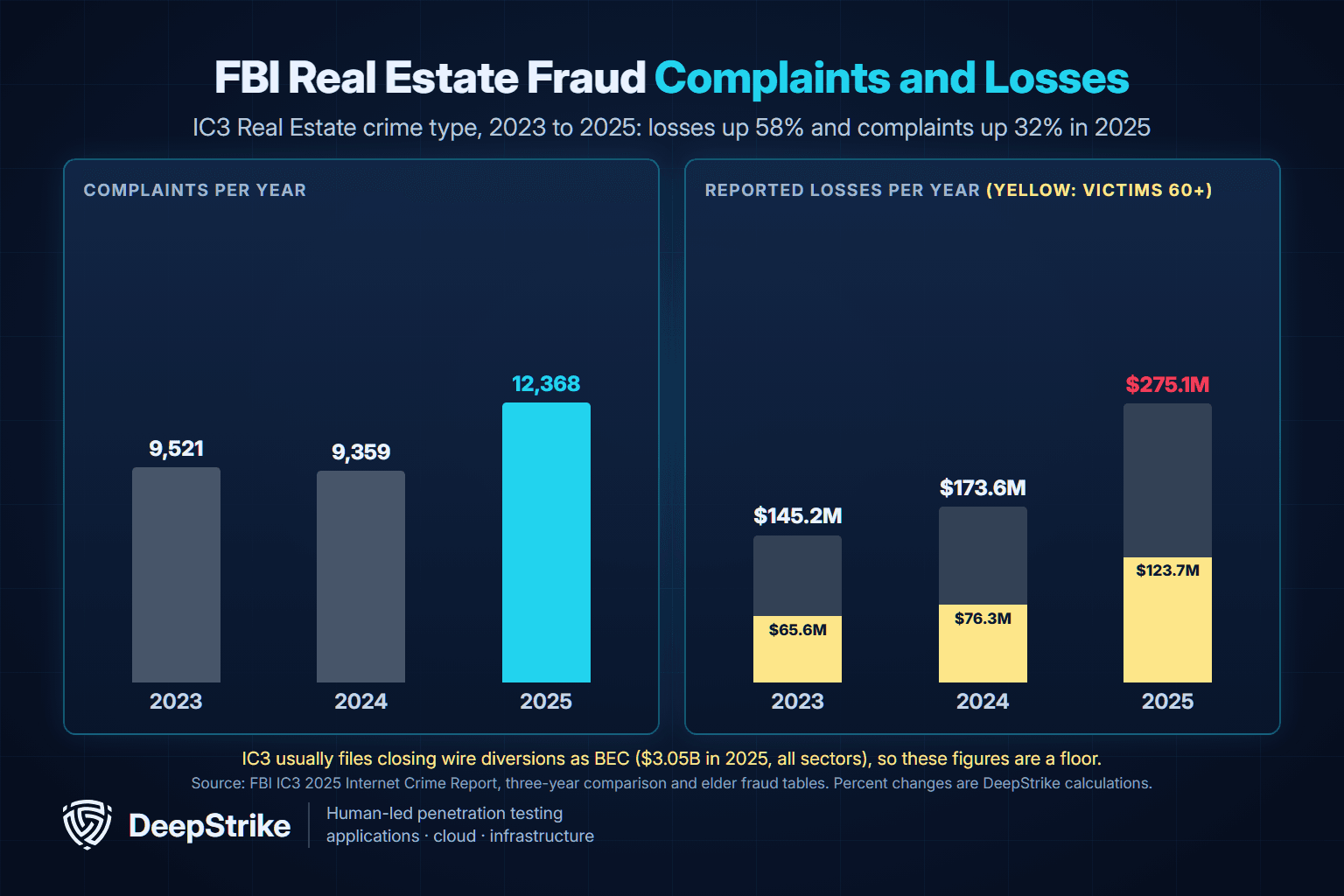
Read the IC3 number with care. Appendix B of the report defines real estate fraud as "loss of funds from a real estate investment or fraud involving rental or timeshare property." A buyer who wires a down payment to a criminal posing as a title company is usually counted under business email compromise instead. The report itself labels one such case "BEC/Real Estate": in August 2025 a couple closing on a home wired more than USD 449,000 after an email impersonating their attorneys, and the FBI's Recovery Asset Team froze the full amount at the receiving bank.
That matters because BEC is far larger. IC3 recorded 24,768 BEC complaints and USD 3.05 billion in BEC losses in 2025, but it does not publish how much of that came from real estate closings. The USD 275.1 million figure is therefore a floor for real estate-related fraud, not a total. For BEC across all sectors, see our business email compromise statistics.
The FBI's own real estate BEC figures come from its public service announcements. The June 2023 BEC PSA says reporting of BEC with a real estate nexus hit an all-time high in 2018, dipped, then climbed again. From 2020 to 2022, victim reports of real estate BEC rose 27% and losses rose 72%, which the FBI linked partly to rising home prices. The PSA says these scams target "all participants" in a transaction: buyers, sellers, real estate attorneys, title companies and agents. Once criminals are inside an email account they watch the deal and time a request to switch payment from check to wire, or to a different bank account.
The FBI's September 2024 BEC PSA puts global BEC exposed losses at USD 55.5 billion across 305,033 incidents between October 2013 and December 2023.
Closing wire fraud follows a repeatable path: criminals research a deal from public records, get into or spoof an inbox, send altered wire instructions near the closing date, and move the money through mule accounts before anyone notices.
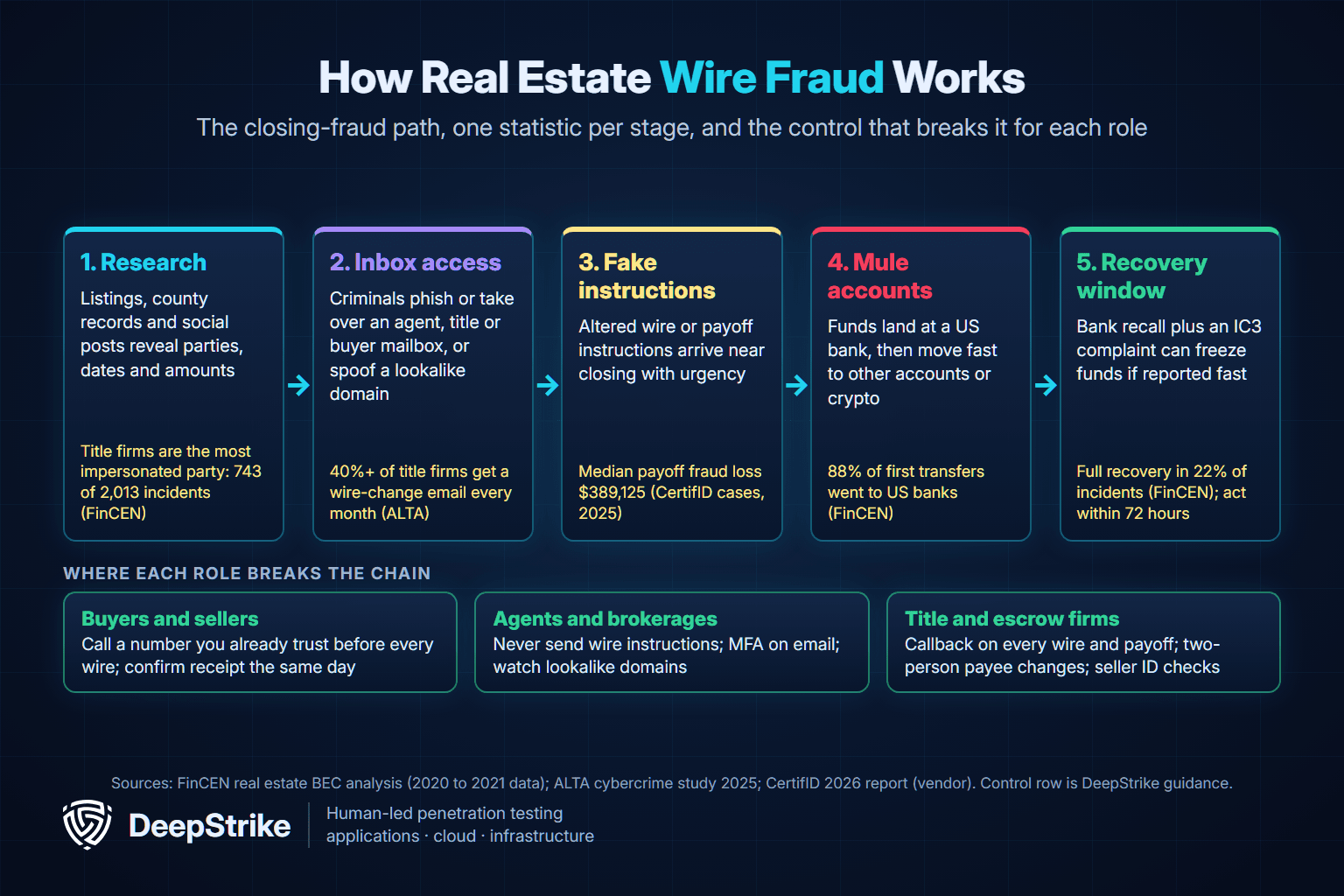
FinCEN's Financial Trend Analysis of real estate BEC, published on 30 March 2023, is the most detailed public dataset on how these schemes work. It reviewed 2,260 Bank Secrecy Act filings from January 2020 to December 2021 reporting about USD 893 million in real estate BEC activity, covering 2,013 incidents.
| Impersonated party | Incidents (of 2,013) | Share of suspicious value |
|---|---|---|
| Title or closing company | 743 (36.9%) | 21.1% (USD 172.9 million) |
| Investor | 270 (13.4%) | 15.6% (USD 110.8 million) |
| Realtor | 226 (11.2%) | 23.1% (USD 189.8 million) |
| Lender, mortgage or loan company | 158 (7.8%) | Not stated in text |
| Legal | 75 (3.7%) | Not stated in text |
Source: FinCEN Financial Trend Analysis, January 2020 to December 2021, Figures 2 and 3. Incident shares other than the title row are our calculations from the Figure 2 counts. An impersonated party has not necessarily lost money; criminals pose as one party to defraud another.
Other findings from the same analysis:
Consumer survey data shows the same impersonation pattern from the victim's side. In CertifID's December 2024 survey of 1,500 buyers and sellers (vendor research), 58% of victims said the suspicious messages appeared to come from their real estate agent, 41% from their title or settlement agent and 34% from a loan officer. Criminals do not need advanced tools for the research step: listing data, county records and social media give them names, dates and amounts. Our guide to OSINT explains how much a public footprint reveals.
FinCEN's advisory FIN-2016-A003 described the core real estate scenario a decade ago: a criminal compromises the email account of a realtor or a buyer or seller and alters payment instructions to divert sale proceeds, loan disbursements or fees. Its advice still holds: verify emailed payment instructions through a separate means of communication before money moves.
The most recent consumer numbers come from CertifID, which sells wire-verification software to title and escrow firms, so its figures are vendor research. Its 2026 State of Wire Fraud report, published 9 March 2026, surveyed 1,260 people in October 2025 who had bought or sold property in the prior three years:
In the December 2024 survey, 4.7% of buyers and sellers, nearly 1 in 20, said they had become victims.
The American Land Title Association, the title industry's trade group, surveys its members on cybercrime. Its cybercrime study published 27 February 2025 (360 participants, 2023 data, sponsored by CertifID) found:
CertifID's 2026 report adds a later read from 153 title and escrow professionals surveyed in late 2025: 72.6% said attempts are becoming more sophisticated, 60.1% said they are increasing, and 57.5% encounter suspicious activity at least quarterly.
Losses do not stay with the criminal. Victims increasingly sue the professionals in the deal, and the American Bar Association's review of real estate wire fraud cases (August 2024) describes courts treating escrow, title and closing professionals as custodians with fiduciary duties over the funds they handle. In one case it cites, Hoffman v. Atlas Title, an Ohio appeals court let negligence and breach of fiduciary duty claims against the title company proceed after a buyer's funds were diverted.
CertifID's recovery-case data shows which payment in a deal criminals target and how much is at stake per case. These are cases accepted by CertifID's own Fraud Recovery Services, so they reflect the firms and consumers who came to that vendor, not the whole market.
| Fraud type | Share of 2025 cases | 2025 median loss | 2024 median loss (share) |
|---|---|---|---|
| Buyer cash-to-close fraud | 30% | USD 239,850 | USD 68,413 (30%) |
| Mortgage payoff fraud | 20% | USD 389,125 | USD 275,927 (48%) |
| Seller net proceeds fraud | 12% | USD 343,497 | USD 172,080 (12%) |
Sources: CertifID 2026 and 2025 State of Wire Fraud reports (vendor research). The remaining cases were other payment types or unclassified.
Buyer cash-to-close fraud often hits first-time buyers who do not know what a real closing looks like. Mortgage payoff fraud uses a forged payoff statement to divert the money meant to clear the seller's loan, which puts lenders and title companies directly in the loss path. Median losses of USD 240,000 to USD 390,000 per case are an order of magnitude above the IC3 average per real estate complaint, which suggests the largest closing losses sit in BEC complaints or are never reported to the FBI at all.
Market conditions raise the stakes. The National Association of REALTORS' 2025 Profile of Home Buyers and Sellers, released 4 November 2025, found all-cash purchases at an all-time high of 26% of buyers, and 30% among repeat buyers. A cash buyer wires the full price, not just a down payment. First-time buyers fell to a record-low 21% of the market, with a median age of 40, and about nine in 10 buyers and sellers worked with an agent, which makes agent impersonation an effective lure.
Seller impersonation fraud flips the scheme: instead of stealing a buyer's wire, a criminal poses as the owner of a property they do not own, sells it, and collects the proceeds. ALTA's 2026 Seller Impersonation Fraud Study, released 15 September 2026 and based on 245 title professionals in 40 states, DC and the US Virgin Islands, found:
The leading red flags were a seller who avoids meetings, calls or video, and requests for a mail-away signing with a seller-chosen notary. Wire fraud and business email compromise were the other fraud types firms encountered most often.
AI shows up in the data, but mostly through survey perceptions rather than counted losses. IC3 tagged 115 real estate complaints in 2025 with an AI reference, totaling USD 2.7 million, a small share of the category.
The stronger signals come from the industry: nearly six in 10 title professionals in ALTA's 2026 study see deepfake voice or images becoming common in seller impersonation attempts, and 82% of consumers in CertifID's survey know criminals use AI to impersonate real estate professionals. Voice cloning matters because the main defense, a callback to a known number, only works if staff will not accept a convincing voice on an inbound call. Our deepfake statistics and vishing statistics cover these techniques across sectors.
Cryptocurrency is part of the cash-out. IC3 recorded 715 real estate complaints with a cryptocurrency nexus in 2025 and USD 25.2 million in related losses.
People 60 and older carry a disproportionate share of real estate losses. In 2025 they filed 2,473 real estate complaints, about 20% of the total, but reported USD 123.7 million in losses, about 45% (our calculations from the IC3 2025 report). Their real estate losses rose 62% from USD 76.3 million in 2024. By comparison, people aged 50 to 59 reported USD 46.4 million and those aged 40 to 49 reported USD 33.7 million. Of 642 Financial Fraud Kill Chain freeze requests the FBI opened for victims 60 and older in 2025, 104 were BEC or real estate cases.
Older owners are also the profile seller impersonation targets: long-held properties owned free and clear, absentee owners and estates of recently deceased owners.
Sometimes, and speed decides it. The evidence:
If a wire goes to the wrong account, call the sending bank immediately and ask for a recall, then file at ic3.gov with the full transaction details. The FBI's report stresses that "time is of the essence" for both steps.
The statistics point to one failure: a payment instruction that is trusted because of the channel it arrived in. Each role can break that chain. This checklist is DeepStrike's method guidance built from the FBI, FinCEN and ALTA recommendations above, not a regulatory requirement.
Most of these controls are procedures, so the only way to know they work is to test them under realistic conditions. A social engineering penetration test can check, with written approval, whether staff follow the callback rule when an email or call sounds urgent and authentic, whether a payee-change request gets a second approver, and whether a help desk will reset a mailbox password for a convincing caller. Pair it with a review of email security settings (MFA, forwarding rules, domain authentication) so the inbox that criminals target first is not left open.
The same human-factor risks show up in neighboring sectors; our law firm data breach statistics cover escrow and settlement funds at law firms, and our identity theft statistics cover the personal data that makes impersonation convincing.
Selection. We used US federal sources first (FBI IC3, FinCEN), then the title industry's trade association (ALTA), one vendor report labeled as such (CertifID) and NAR for market context. Every figure was read on the publisher's page or report and checked on 5 November 2026. We excluded figures that appear only on aggregator or law-firm blogs and claims we could not trace to a named dataset, such as unsourced percentage increases in AI-driven BEC.
Report years. IC3 report titles name the data year (2025). The FinCEN analysis covers 2020 and 2021 and was published in March 2023. ALTA's cybercrime study covers 2023 (published February 2025); its seller impersonation studies cover 2023 and 2025 (published August 2024 and September 2026). CertifID's 2026 report covers 2025 survey and case data.
Calculations. These figures are our own arithmetic from published numbers: IC3 real estate complaints up 32% and losses up 58% in 2025; average loss of about USD 22,200 per complaint in 2025 and USD 18,500 in 2024; real estate at about 1.3% of all IC3 losses; the 45% and 20% shares and the 62% increase for people 60 and older. All other numbers are quoted as published.
| Source | Publisher type | Data period | Population or dataset | Method |
|---|---|---|---|---|
| FBI IC3 2025 Internet Crime Report | US federal agency | Calendar year 2025 | 1,008,597 complaints; 12,368 real estate | Complaints filed with IC3 |
| FBI IC3 BEC PSAs (June 2023, September 2024) | US federal agency | 2013 to 2023 | BEC complaints and filings | Complaint and financial data |
| FinCEN Financial Trend Analysis | US federal agency (Treasury) | January 2020 to December 2021 | 2,260 filings; 2,013 incidents | Bank Secrecy Act filings |
| ALTA cybercrime study | Trade association | 2023 | 360 participants | Industry survey, CertifID-sponsored |
| ALTA Seller Impersonation Fraud Studies | Trade association | 2023 and 2025 | 783 (2024 study); 245 (2026 study) | Industry surveys |
| CertifID State of Wire Fraud 2025 and 2026 | Vendor | 2024 and 2025 | 1,500 and 1,260 consumers; 153 title professionals; recovery cases | Online surveys; vendor case data |
| NAR 2025 Profile of Home Buyers and Sellers | Trade association | July 2024 to June 2025 | 6,103 primary-residence buyers | Mail and online survey |
Limits. IC3 counts only what victims report and files closing wire fraud mostly under BEC, which is not split by sector. FinCEN's data is several years old. ALTA and CertifID surveys are self-selected, and CertifID's case data reflects its own clients. No single figure on this page is a complete count of US real estate wire fraud.
The FBI recorded USD 275.1 million in real estate fraud losses in 2025, up 58% from USD 173.6 million in 2024. That is a floor: closing wire diversions are usually reported as business email compromise, which cost USD 3.05 billion across all sectors in 2025 and is not broken out by industry.
In CertifID's October 2025 survey of 1,260 recent buyers and sellers, 22% received a suspicious or fraudulent communication during closing. On the industry side, more than 40% of title companies received at least one email a month trying to change wiring or payoff instructions, according to ALTA's 2025 study.
Title and closing companies most often. FinCEN found 36.9% of real estate BEC incidents in 2020 and 2021 involved a fake title or closing company, while realtor impersonation accounted for the largest share of suspicious value (23.1%). In CertifID's consumer survey, victims most often said messages appeared to come from their real estate agent (58%).
It depends on the payment. In CertifID's 2025 recovery cases, the median loss was USD 239,850 for buyer cash-to-close fraud, USD 343,497 for seller net proceeds and USD 389,125 for mortgage payoff fraud. The average across all IC3 real estate complaints in 2025 was about USD 22,200.
Sometimes. FinCEN data shows full recovery in about 22% of real estate BEC incidents where the outcome was reported, and the FBI's Recovery Asset Team froze funds in 58% of its 2025 cases across all crimes. Call your bank for a recall immediately and file at ic3.gov; FinCEN reports better results when cases are reported within 72 hours.
A criminal poses as a property owner to sell land or a home they do not own and collects the proceeds. ALTA's 2026 study found 59% of title firms had at least one attempt in 2025, up from 28% in its 2024 study, with vacant land the most common target.
Never act on emailed wire instructions or changes without calling a number you already trust, confirm receipt after sending, and use MFA on every email account in the deal. Title firms should add callbacks on every wire and payoff, two-person approval for payee changes and identity checks on high-risk sellers.
The numbers describe a crime that exploits trust in email and urgency at closing rather than technical weakness. The FBI, FinCEN and ALTA data all point to the same fix: payment instructions verified through an independent channel by people trained to say no to a convincing voice.
If you run a title, escrow, brokerage or legal practice and want to know whether your callback and payee-change procedures would hold up against a realistic pretext, DeepStrike's penetration testing services include manual social engineering assessments that simulate phishing, calling and baiting. To discuss scope and rules of engagement, contact DeepStrike.
Mohammed Khalil is a Cybersecurity Architect at DeepStrike, specializing in advanced penetration testing and offensive security operations. With certifications including CISSP, OSCP, and OSWE, he has led numerous red team engagements, focusing on cloud security, application vulnerabilities, and adversary emulation. His work involves dissecting complex attack chains and developing resilient defense strategies for clients in the finance, healthcare, and technology sectors.

Stay secure with DeepStrike penetration testing services. Reach out for a quote or customized technical proposal today
Contact Us
